

Sales Prospecting Research: A 2026 Framework
It's Monday morning. You've got 50 accounts to work this week, and your manager wants personalized outreach for every single one. At 20 minutes per prospect, that's roughly 17 hours gone before you send a single email. Meanwhile, 69% of cold email senders say performance declined year over year. The reps who still win aren't doing more sales prospecting research - they're doing smarter research.
Why Prospect Research Is Non-Negotiable
96% of buyers research companies and products before engaging with a sales rep. They've read your case studies, scanned your pricing page, and compared you to competitors - all before you hit send. If your outreach doesn't show you've done the same homework, you're dead on arrival.
The cost of skipping research isn't just low reply rates. It's bounced emails torching your domain reputation, wasted sequences aimed at the wrong persona, and reps spending 20-40% of their time on manual data work instead of selling. The vast majority of teams send segment templates and wonder why conversion keeps dropping. When you research prospects properly, every touchpoint carries more weight.
What You Actually Need
Three things fix 80% of prospect research problems:
- A framework so you know exactly what to look for (C.O.M.P. for accounts, P.A.P. for contacts - covered below).
- A time-box so you don't over-research. Seven to ten minutes is the ceiling for cold outbound.
- A tool with verified data so your research doesn't go stale before you hit send.
How Long to Spend Per Prospect
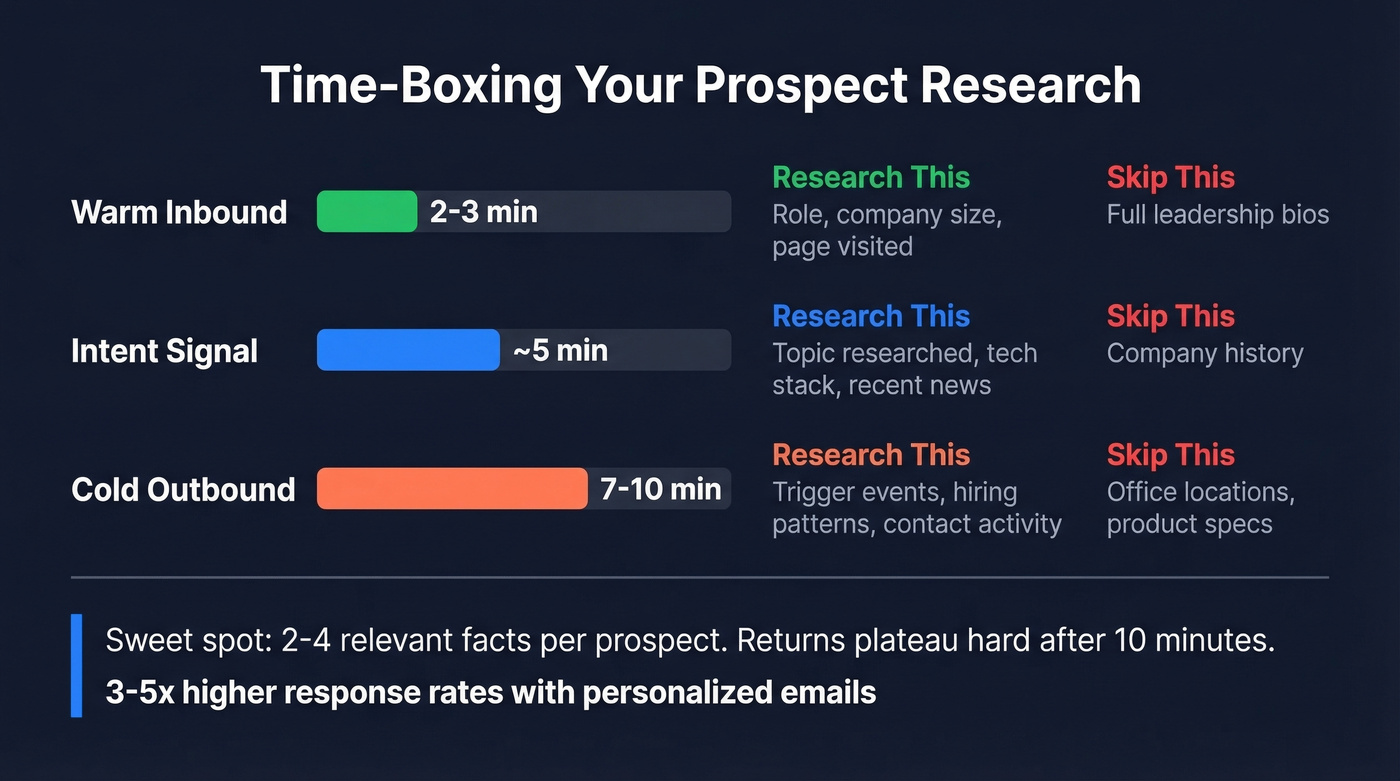
Not every prospect deserves the same depth. The biggest mistake we see is teams treating warm inbound leads and cold outbound targets identically - spending 20+ minutes on every name in the CRM. That's how you miss activity targets and end up with stale intel.
| Prospect Type | Time Budget | Research This | Skip This |
|---|---|---|---|
| Warm inbound | 2-3 min | Role, company size, page visited | Full leadership bios |
| Intent signal | ~5 min | Topic researched, tech stack, recent news | Company history |
| Cold outbound | 7-10 min | Trigger events, hiring patterns, contact activity | Office locations, product specs |
Personalized emails get 3-5x higher response rates than generic blasts. But returns plateau hard after 10 minutes of digging. You need two to four relevant facts per prospect, not a 500-word dossier.
The C.O.M.P. Framework for Accounts
C.O.M.P. gives you a repeatable structure for account-level research so you're not randomly clicking around company websites hoping something useful jumps out.
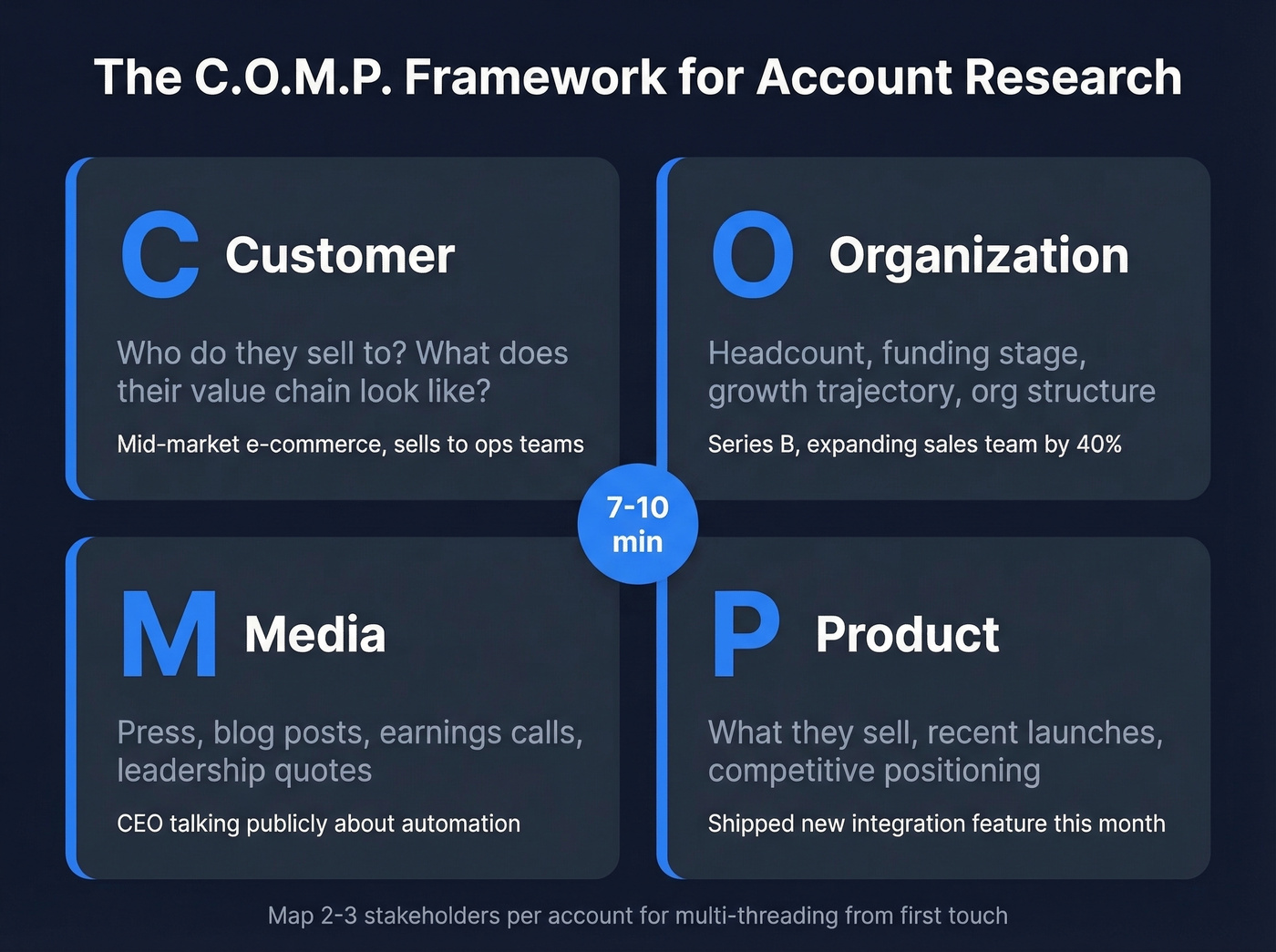
- Customer - Who do they sell to? What does their value chain look like?
- Organization - Headcount, funding stage, growth trajectory, org structure.
- Media - Recent press, blog posts, earnings calls, leadership quotes.
- Product - What they sell, recent launches, competitive positioning.
| Element | Example |
|---|---|
| Customer | Mid-market e-commerce; sells to ops teams |
| Organization | Recently raised a Series B; expanding the sales team |
| Media | Leadership talking publicly about automation and efficiency |
| Product | Shipped a new integration or workflow feature this month |
Buying committees now average 6-10 stakeholders per deal. Don't research one contact and call it done - map two to three people per account so you're multi-threading from the first touch. Capturing relationship data at this stage makes expanding the conversation far easier later.

The C.O.M.P. framework works best when your account data is already verified. Prospeo's 300M+ profiles with 30+ filters - including buyer intent, headcount growth, and technographics - let you map 6-10 stakeholders per account in minutes, not hours. Data refreshes every 7 days, so your research never goes stale before you hit send.
Cut your per-prospect research from 20 minutes to under 10.
Competitor Analysis for Prospecting
Here's the thing: before you write a single outreach email, you need to understand how your prospect's competitive landscape shapes their priorities. Competitor analysis isn't about trashing rivals. It's about knowing which pain points the market is amplifying so your message lands with urgency.
Fold this into the "Product" layer of C.O.M.P. Scan your prospect's top two competitors for recent launches, pricing changes, or market-share shifts. If a competitor just raised a round or launched a feature your prospect lacks, that's a trigger event worth referencing in outreach. Studying the prospect's rivals - not your own - gives you angles that generic templates never surface. (If you want a deeper system, build lightweight competitive intelligence into your weekly workflow.)
The P.A.P. Framework for Contacts
Once you've got account context, P.A.P. helps you find the personal hooks that make outreach feel human instead of templated.
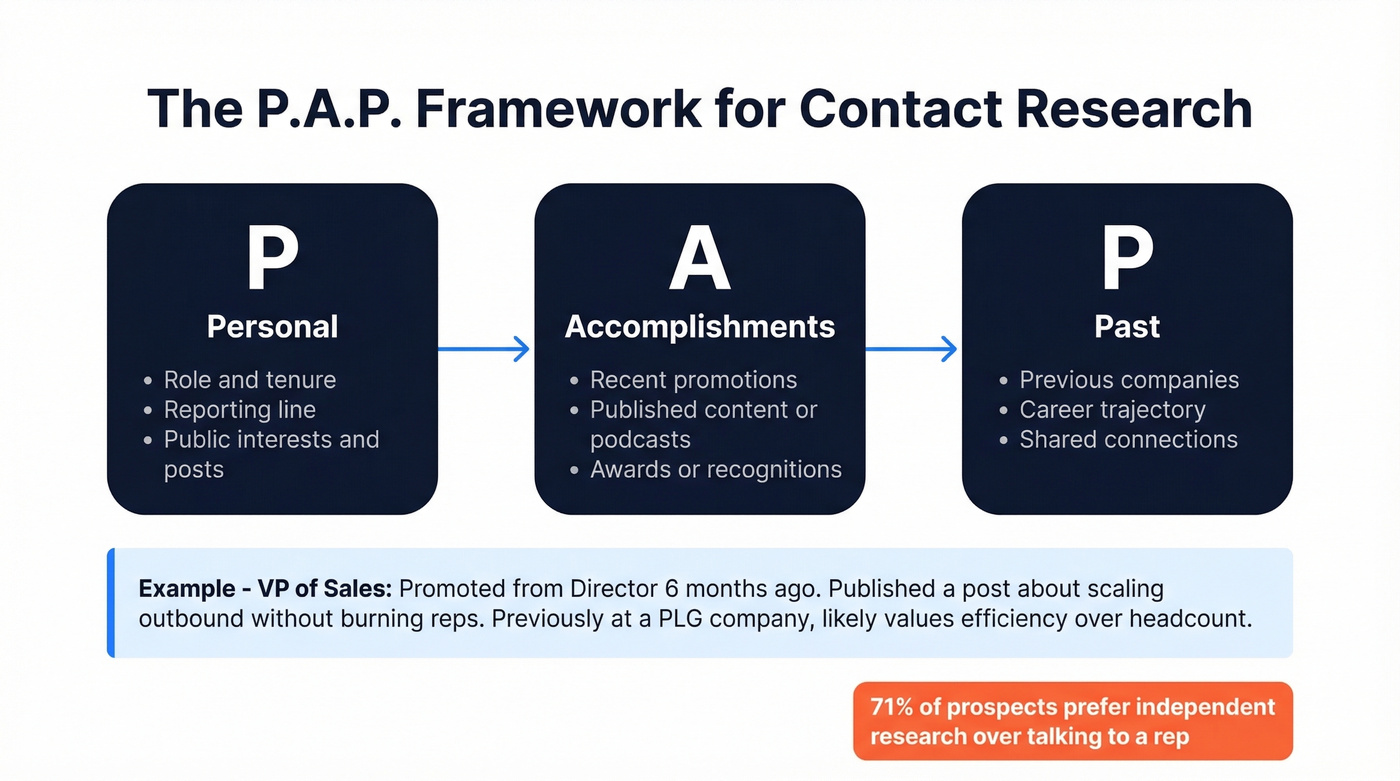
- Personal - Role, tenure, reporting line, public interests.
- Accomplishments - Promotions, awards, published content, podcast appearances.
- Past - Previous companies, career trajectory, shared connections.
For a VP of Sales persona, that might look like: Promoted from Director six months ago. Published a post about scaling outbound without burning reps. Previously at a PLG company - likely values efficiency over headcount.
71% of prospects prefer independent research over talking to a rep. Your research should surface what they've already been reading about so your outreach meets them where they are, not where you wish they were.
Using Intent Data to Prioritize
Buyers stay anonymous for roughly 75% of their research journey. By the time someone fills out a form, they've already shortlisted vendors. Intent data catches them earlier - when they're reading comparison articles, downloading guides, or searching for solutions in your category.
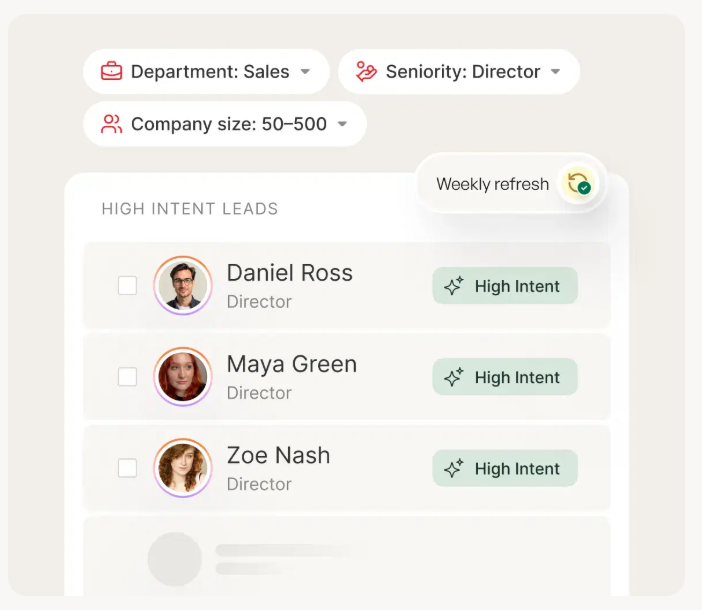
The mechanics are straightforward: a provider tracks content consumption across thousands of sites, classifies it by topic, scores it against a company's baseline behavior, and delivers signals to your CRM. 65% of marketing teams report that intent signals improved their pipeline forecasting accuracy. Instead of guessing which accounts to prioritize this week, intent data tells you. For BDR teams especially, layering intent signals on top of firmographic filters, technographics, and hiring trends turns a sprawling TAM into a focused hit list you can actually work in a week.
Tools That Speed Up Research
Let's be honest: the tool you pick matters far less than the data quality it delivers. A fast list with 30% bounced emails will damage your domain reputation faster than a slow list with verified contacts. We've tested all six of the tools below on the same prospect lists, and accuracy variance is enormous.
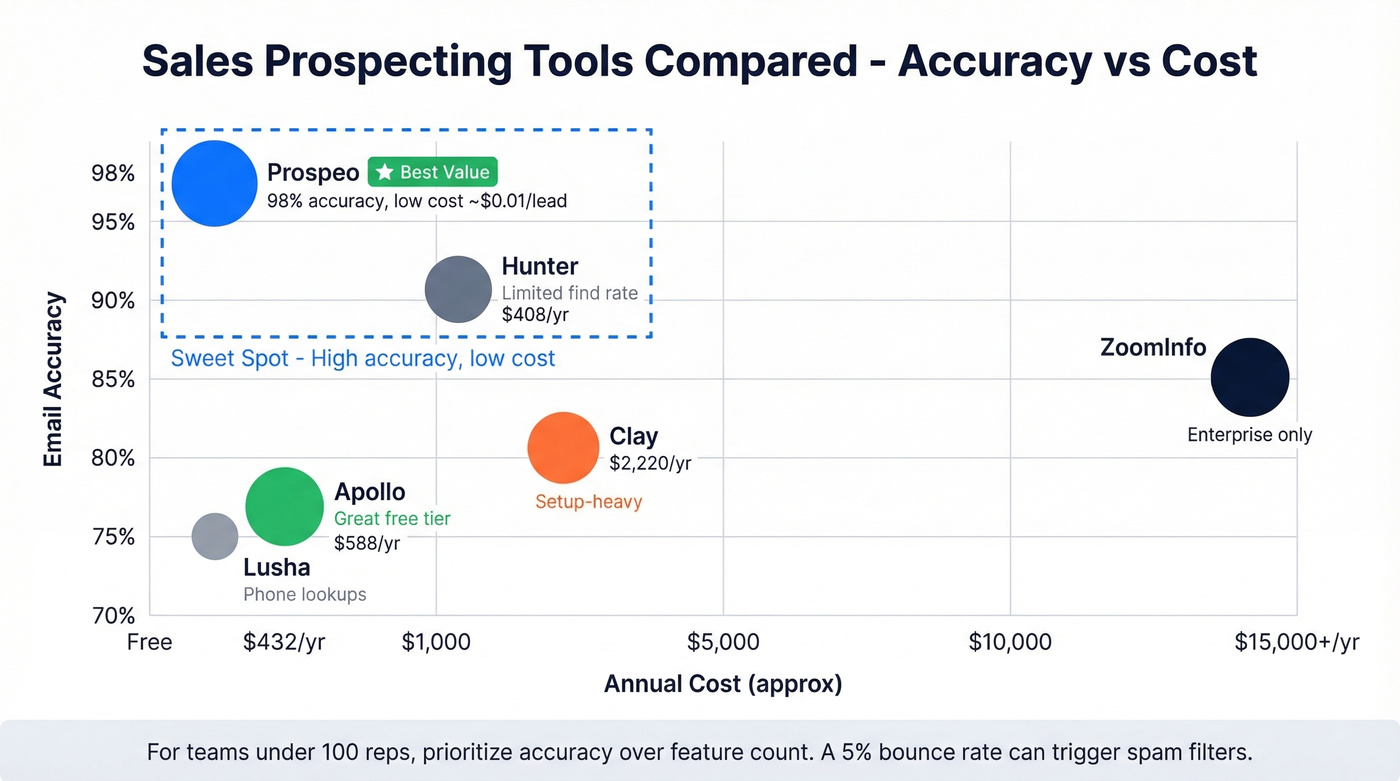
| Tool | Best For | Email Accuracy | Starting Price |
|---|---|---|---|
| Prospeo | Best overall for outbound teams | 98% | Free / ~$0.01/lead |
| Apollo | Fastest list building + sequences | 70-80% | Free / $49/mo |
| ZoomInfo | Enterprise orgs (500+ employees) | 85-91% | ~$14,995/yr |
| Clay | Hyper-specific enrichment workflows | 75-85% | $185/mo |
| Lusha | Quick phone lookups | 70-82% | Free / $36/mo |
| Hunter | Lightweight email finding | 90%+ (limited find rate) | Free / $34/mo |
For most outbound teams under 100 reps, Prospeo is the strongest starting point. Its database covers 300M+ professional profiles with 143M+ verified emails and 125M+ verified mobile numbers, all refreshed every seven days. At roughly $0.01 per lead, a 10,000-contact list costs about $100 - versus ~$14,995+/year for ZoomInfo's entry tier. There's a free tier to test it, no sales call required.

Apollo is the default starting point on Reddit for a reason - the free tier is generous and sequences are built in. The tradeoff is accuracy: expect 70-80%, which means verifying before you send. The consensus on r/sales is basically "Apollo for the list, something else for the verification." (If you're evaluating options, compare more sales prospecting databases before you commit.)
ZoomInfo is enterprise-grade in both capability and cost. Mid-market contracts run $25-40K/year. If you're a 500-person org that needs intent, chat, and workflow automation in one platform, it makes sense. For everyone else, you're paying for modules you'll never activate. Skip this if your team is under 50 reps.
Clay chains enrichment steps like LEGO pieces to build lists no single database can produce. Starting at $185/mo, it's powerful but setup-heavy - nobody on our team would recommend it unless you genuinely enjoy configuring workflows. (If you're doing this at scale, data enrichment services can be a better fit.)
Lusha is reliable for quick phone numbers in North America and Western Europe, hit-or-miss elsewhere. Hunter finds emails at 90%+ accuracy but has a limited find rate and no phone data. Both are supplements, not primary research tools. If you're building a stack, start with free lead generation tools and add paid data only where it moves pipeline.
Intent data without accurate contact data is a wasted signal. Prospeo layers Bombora intent across 15,000 topics on top of 143M+ verified emails at 98% accuracy - so you prioritize in-market buyers and actually reach them. At ~$0.01 per email, your research budget stretches 90x further than ZoomInfo.
Turn intent signals into booked meetings with contacts that don't bounce.
Turning Research Into Outreach
All this research is worthless if it doesn't show up in your first line. You don't need a paragraph of flattery - you need one sentence that proves you did the work. (For more examples, keep a swipe file of emails that get responses.)
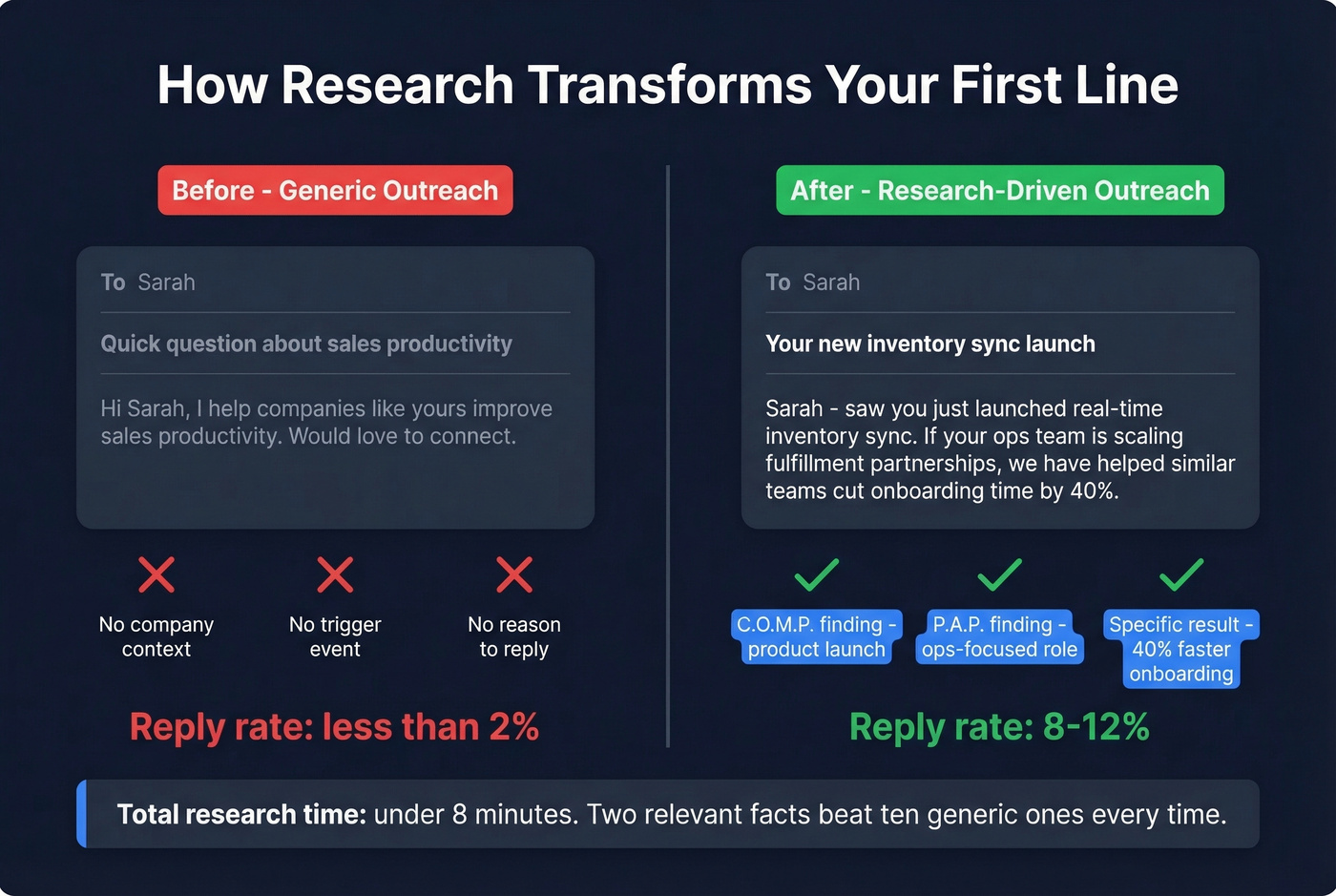
Before (generic): "Hi Sarah, I help companies like yours improve sales productivity. Would love to connect."
After (research-driven): "Sarah - saw you just launched real-time inventory sync. If your ops team is scaling fulfillment partnerships, we've helped similar teams cut onboarding time by 40%."
In our experience, two relevant facts woven into a natural opening beat ten generic ones every time. The C.O.M.P. finding (product launch) plus the P.A.P. finding (ops-focused role) gave us everything we needed in under eight minutes. That's the whole point of structured sales prospecting research: you spend less time digging and more time writing messages that actually get replies.
FAQ
What's the difference between prospect research and lead qualification?
Prospect research gathers information before outreach - company context, contact details, trigger events. Lead qualification (BANT, MEDDIC) happens during conversations to assess fit and buying readiness. They're separate pipeline steps that feed each other sequentially.
How do I verify prospect data before sending?
Run your list through an email verification tool before launching any sequence. Even a 5% bounce rate can trigger spam filters and damage domain reputation. Prospeo's 5-step verification catches spam traps, honeypots, and catch-all domains automatically at 98% accuracy, but whatever tool you use, don't skip this step.
Should I research every prospect the same way?
No. Warm inbound leads need two to three minutes. Cold outbound prospects deserve seven to ten minutes max. Diminishing returns hit fast after that. Match your depth to the opportunity size and signal strength - that's the core principle behind effective sales prospecting research.