

20+ Sales Quota Examples You Can Copy (With Formulas That Work)
A RevOps lead we know ran a quota-setting exercise last quarter using the classic formula: total revenue target divided by headcount. Three months later, 80% of the team was underwater and the top performer was interviewing elsewhere. The math was clean. The quotas were garbage.
That RevOps lead isn't alone. 91% of organizations have fewer than 80% of their reps hitting quota - per a QuotaPath survey of 450+ RevOps, Finance, and Sales leaders. The root causes split almost evenly: 35% misaligned activities, 31% unrealistic quotas, 32% lack of motivation. A third of quota misses are the quota's fault, a third are the rep's fault, and a third are the system's fault. The sales quota examples below address all three - with real numbers, formulas, and templates you can steal.
Quick Navigation
- Need plug-and-play quota numbers? Jump to the examples by role and by type tables.
- Need to check whether your quota is realistic? Jump to the pipeline coverage math.
- New hires keep missing quota? Jump to the ramp schedule template.
What Is a Sales Quota?
A sales quota is an individual, time-bound performance target tied directly to compensation. That last part matters - it's what separates a quota from a goal or a target. If missing it doesn't affect someone's paycheck, it's not a quota. It's a suggestion.
Goals, targets, and quotas get used interchangeably. They shouldn't be.
| Goal | Target | Quota | |
|---|---|---|---|
| Scope | Broad, strategic | Milestone-level | Individual rep |
| Timeframe | Annual / long-term | Quarterly / monthly | Monthly / quarterly |
| Tied to comp? | Rarely | Sometimes | Always |
| Example | Grow revenue 40% YoY | $4M in Q2 ARR | Rep closes $250K/quarter |
Goals set direction, targets measure progress, quotas drive behavior. When you're designing quotas, you're designing incentives - and incentives are the most powerful lever in your sales org.
6 Types of Sales Quotas
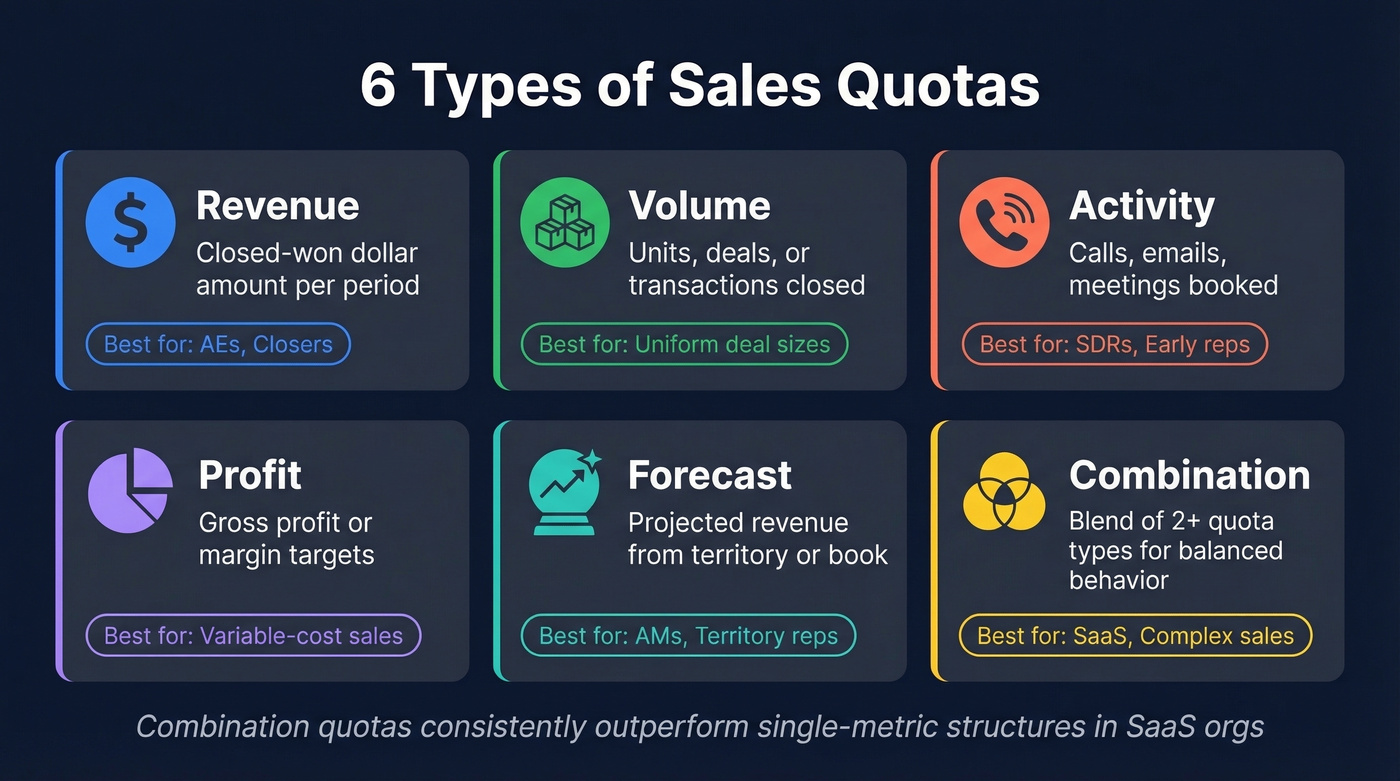
Not all quotas measure the same thing, and picking the wrong type for your sales motion is one of the fastest ways to get misaligned behavior. Here are the six types - and which ones actually matter for your team.
Revenue Quotas
The most common type. Rep owes a dollar amount in closed-won revenue per period. A mid-market AE carries $200K/quarter in new ARR, an enterprise AE owes $750K/quarter in new business, and an SMB AE targets $50K/month in closed revenue.
Revenue quotas are clean and easy to track. The downside: they incentivize discounting unless you pair them with margin guardrails.
Volume Quotas
Picture an insurance agency where every policy pays roughly the same commission. Volume quotas - measured in units, deals, or transactions - make perfect sense there. A SaaS AE owes 15 new logos per quarter, an insurance agent owes 40 policies per month, a retail rep owes 200 units per week.
They fall apart the moment deal sizes diverge. A rep can hit quota by closing 15 tiny deals while ignoring the enterprise opportunity worth 10x more. If your deal sizes vary by more than 3x, volume quotas will steer reps toward the wrong deals.
Activity Quotas
These measure inputs - calls made, emails sent, meetings booked - rather than outcomes.
| Role | Activity Quota | Period |
|---|---|---|
| SDR | 50 outbound calls + 30 personalized emails | Daily |
| BDR | 15 qualified meetings | Monthly |
| AE (prospecting) | 20 discovery calls | Monthly |
Here's the thing about activity quotas: volume is meaningless without data quality. If a third of your rep's emails bounce and half their phone numbers are disconnected, they'll hit their activity numbers while generating zero pipeline. We've seen teams fix this overnight by switching to verified contact data - when every dial and every send actually reaches a human, the same activity volume produces dramatically different results.

When to Use Profit Quotas
Use them when your reps control pricing, your margins vary by product line, or discounting has become a crutch. A manufacturing rep carrying $150K/quarter in gross profit or a solutions seller with a 35% minimum margin floor will think twice before slashing price to close.
Skip them if your pricing is fixed or your finance team can't deliver margin data to the CRM in real time. Profit quotas without transparent margin visibility just confuse reps.
Forecast Quotas
Based on projected revenue from a rep's territory or book of business. An AM might owe $500K in forecasted expansion revenue per quarter; a territory rep needs to hit 95% of committed forecast. These work best when your CRM data and forecasting methodology are mature. If reps are sandbagging or inflating pipeline, forecast quotas create perverse incentives.
Combination Quotas
The gold standard for SaaS. Blend two or more quota types to drive balanced behavior:
- AE: $800K new ARR + 110% NRR on existing book
- SDR: 20 qualified meetings/month + 70% show rate
- AM: $200K expansion + 95% gross retention
Let's be honest: if you're running a SaaS sales org, combination quotas are the only structure that truly aligns rep behavior with how subscription businesses grow. Pure revenue quotas incentivize new logos at the expense of retention, and that's a death spiral. In our experience, combination quotas consistently outperform single-metric structures across every SaaS org we've worked with.
| Quota Type | Best For | Watch Out For |
|---|---|---|
| Revenue | AEs, closers | Discounting risk |
| Volume | Uniform deal sizes | Ignores deal quality |
| Activity | SDRs, early reps | Vanity metrics |
| Profit | Variable-cost sales | Complex to track |
| Forecast | AMs, territory reps | Requires CRM maturity |
| Combination | SaaS, complex sales | Harder to comp design |
Sales Quota Examples by Role
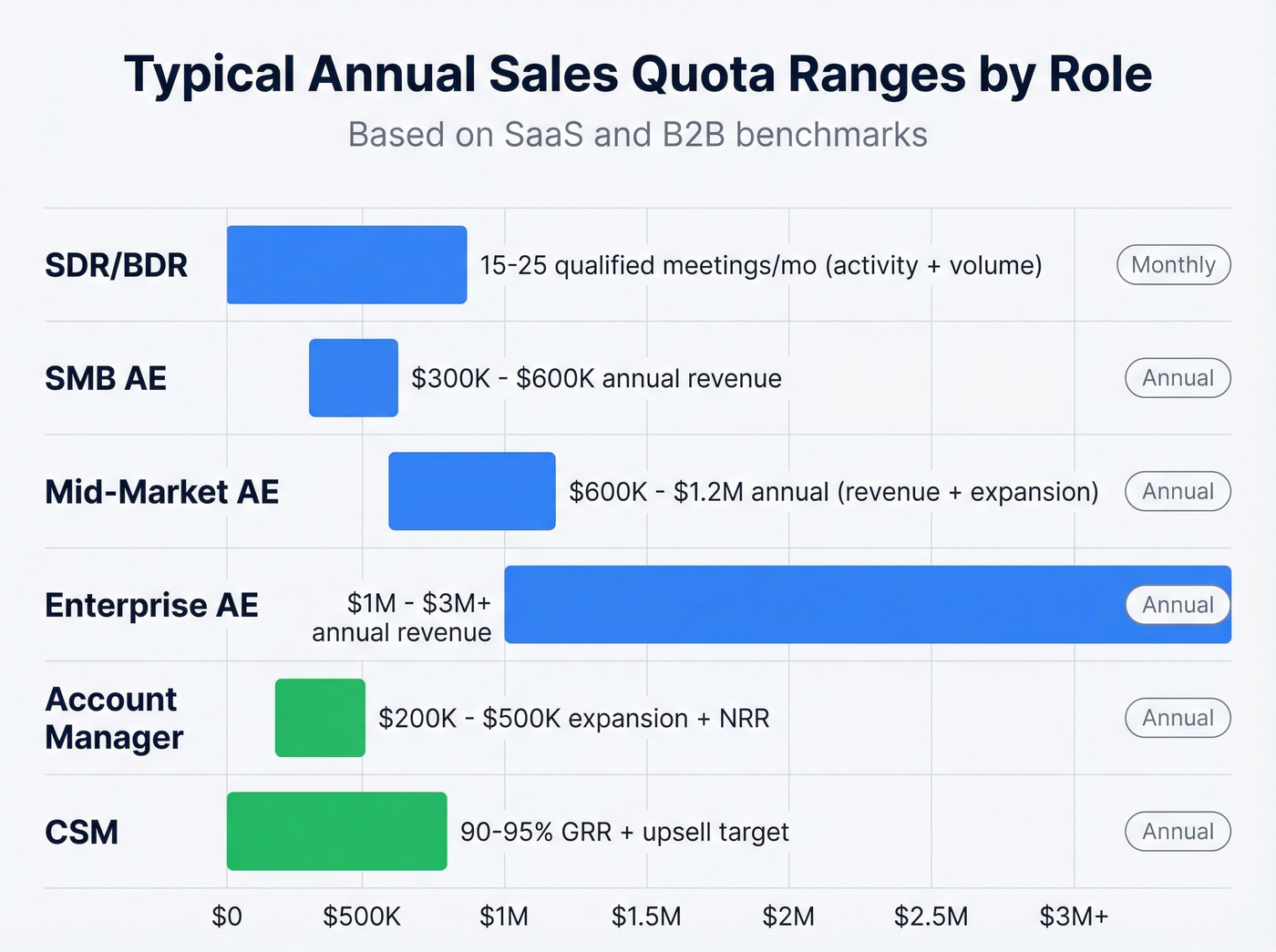
Quota ranges vary wildly by segment, industry, and sales cycle. These are the ranges we see most often across SaaS and B2B companies:
| Role | Quota Type | Typical Range | Period |
|---|---|---|---|
| SDR/BDR | Activity + volume | 15-25 qualified meetings/mo | Monthly |
| SMB AE | Revenue | $300K-$600K | Annual |
| Mid-Market AE | Revenue + expansion | $600K-$1.2M | Annual |
| Enterprise AE | Revenue | $1M-$3M+ | Annual |
| Account Manager | Expansion + NRR | $200K-$500K expansion | Annual |
| CSM | Retention + upsell | 90-95% GRR + upsell | Annual |
For SDRs, the meeting quota is the headline number, but smart orgs add a quality layer - qualified opportunities that convert to pipeline, not just calendar invites. A 20-meeting quota with a 60% qualification rate is more valuable than a 30-meeting quota where half are junk.
On the AE side, that $1M annual number you see on r/sales is real - it's a common mid-market to enterprise SaaS figure. But context matters enormously. A $1M quota with a 90-day sales cycle and 25% win rate requires very different pipeline math than a $1M quota with a 30-day cycle and 40% win rate.
Enterprise AEs at companies selling six-figure deals can carry $2-3M+ quotas, but they're typically closing 3-8 deals per year. The number is high; the volume is low.

Activity quotas fail when contact data is bad. If 30% of emails bounce and half of dials hit dead numbers, your reps burn hours hitting activity targets that produce zero pipeline. Prospeo delivers 98% email accuracy and 125M+ verified mobiles with a 30% pickup rate - so every call and every send actually reaches a buyer.
Same activity volume, dramatically different pipeline. Start with data that connects.
Quota Templates by Business Model
Matching quota types to your revenue engine is half the battle. Here's how it breaks down.
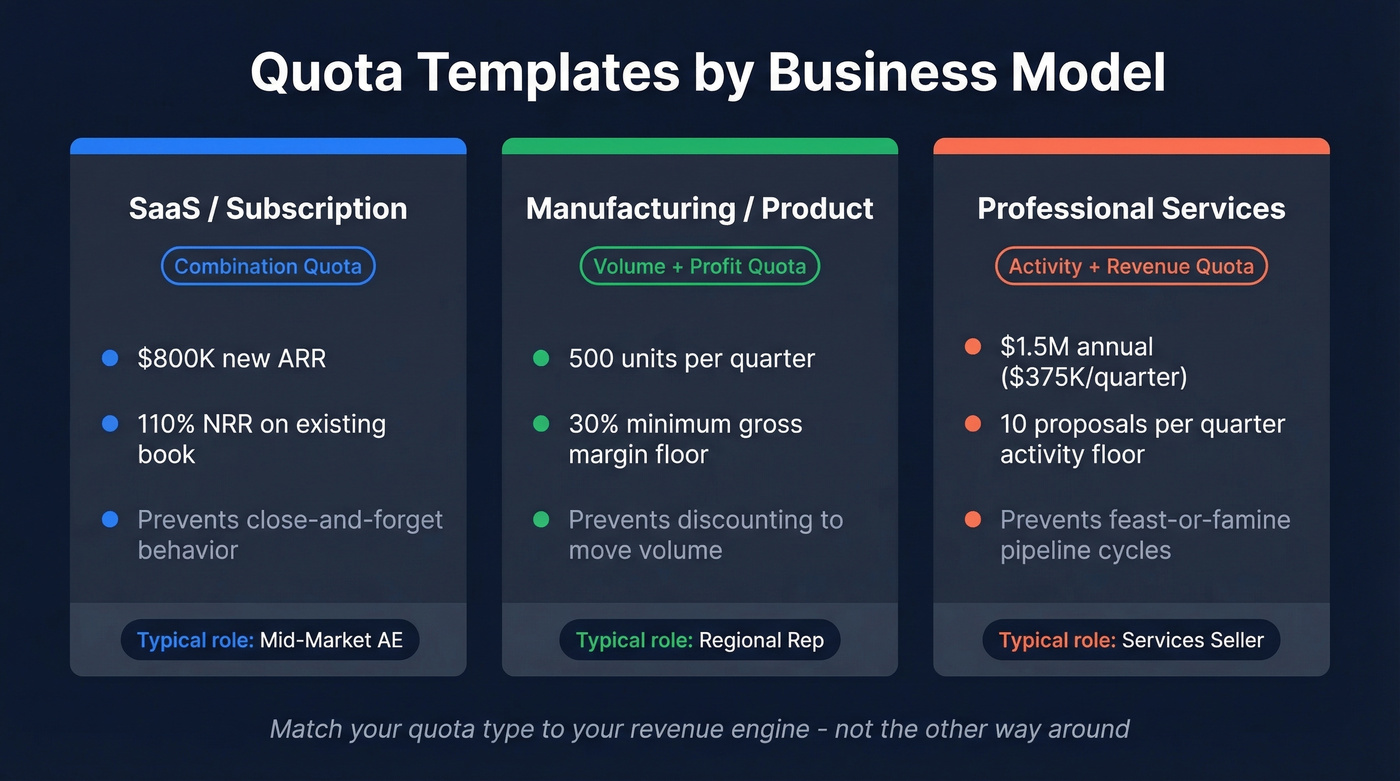
SaaS / Subscription. SaaS quotas should reflect subscription economics - combination quotas blending new ARR with expansion and retention. A typical mid-market SaaS AE carries $800K in new ARR plus a 110% NRR target on their existing book. The NRR component prevents the "close and forget" behavior that kills SaaS companies.
Manufacturing / Product. Volume quotas paired with profit quotas to protect margin. A regional rep owes 500 units/quarter at a minimum 30% gross margin. Without the margin floor, reps discount to move volume and your CFO loses sleep.
Professional Services. Activity quotas as leading indicators combined with project revenue targets. A services seller carries $1.5M annually - say $375K per quarter - with a 10-proposal-per-quarter activity floor to keep pipeline from drying up while reps deliver current projects. Services orgs that skip the activity floor inevitably hit feast-or-famine cycles because nobody prospects while they're busy delivering.
Ramp Quotas for New Hires
Full quota on day one is lazy management and a recipe for turnover. Rain Group's research shows it takes 9 months for a new rep to be fully productive and 15 months to become a top performer. The Bridge Group reports that 41% of companies see average ramp times of 5+ months.
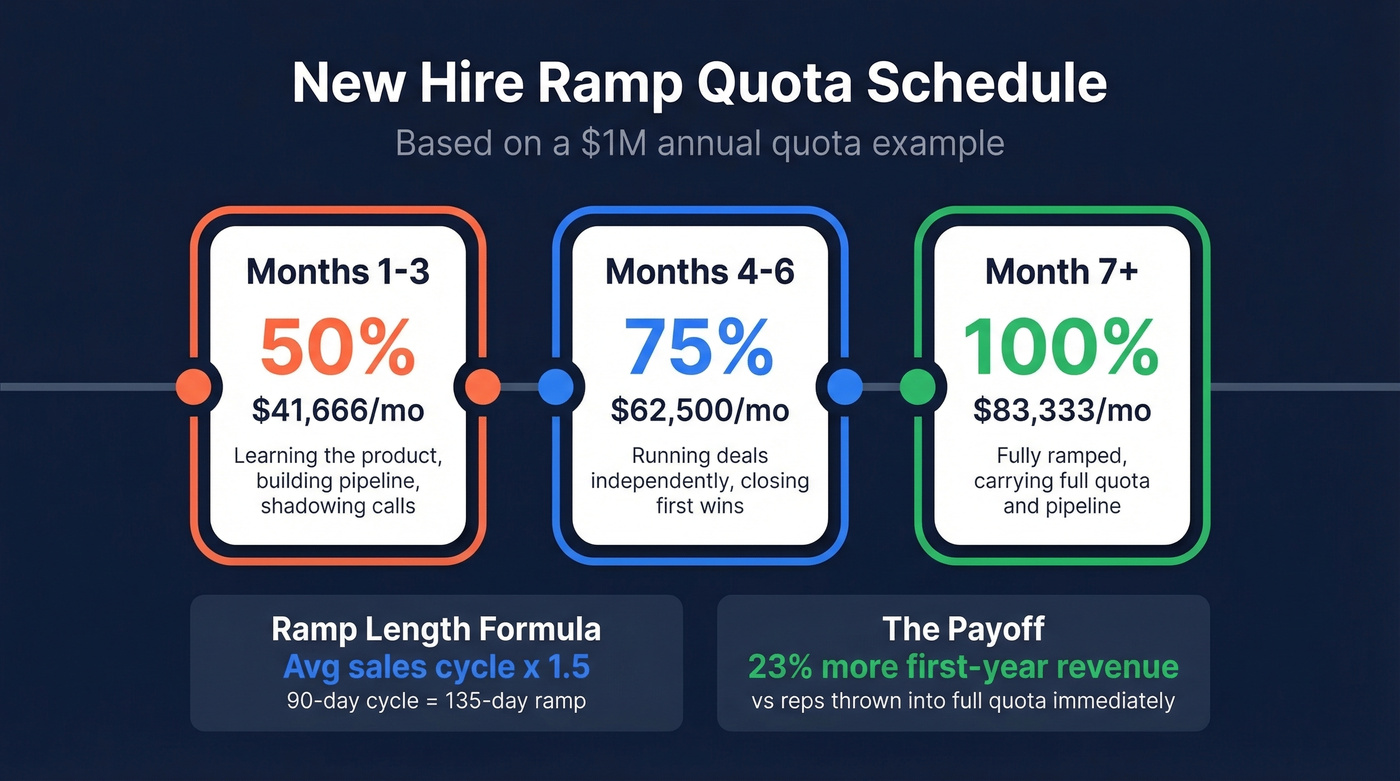
The standard ramp schedule that works for most teams:
| Period | % of Full Quota | $1M Annual Example |
|---|---|---|
| Months 1-3 | 50% | $41,666/mo |
| Months 4-6 | 75% | $62,500/mo |
| Month 7+ | 100% | $83,333/mo |
How long should ramp last? Average sales cycle length x 1.5. If your sales cycle is 90 days, plan for a ~135-day (4.5-month) ramp. This accounts for the learning curve on top of the natural deal cycle.
For compensation during ramp, most companies offer a draw structure - 80% guaranteed incentive pay in month one, 50% in month two, then taper to standard commission. This keeps new hires from starving while they build pipeline.
The payoff is real. Reps on structured ramp schedules generate roughly 23% more first-year revenue compared to reps thrown into full quota immediately. We've seen teams cut ramp time nearly in half by pairing structured schedules with clean prospect data - GreyScout reduced rep ramp from 8-10 weeks to 4 weeks after switching to Prospeo, because new reps spent their first weeks actually selling instead of scrubbing spreadsheets.
How to Calculate a Realistic Quota
Most quota-setting is backwards. Teams start with a revenue target, divide by headcount, and call it a day. That's how you get the 91% miss rate.
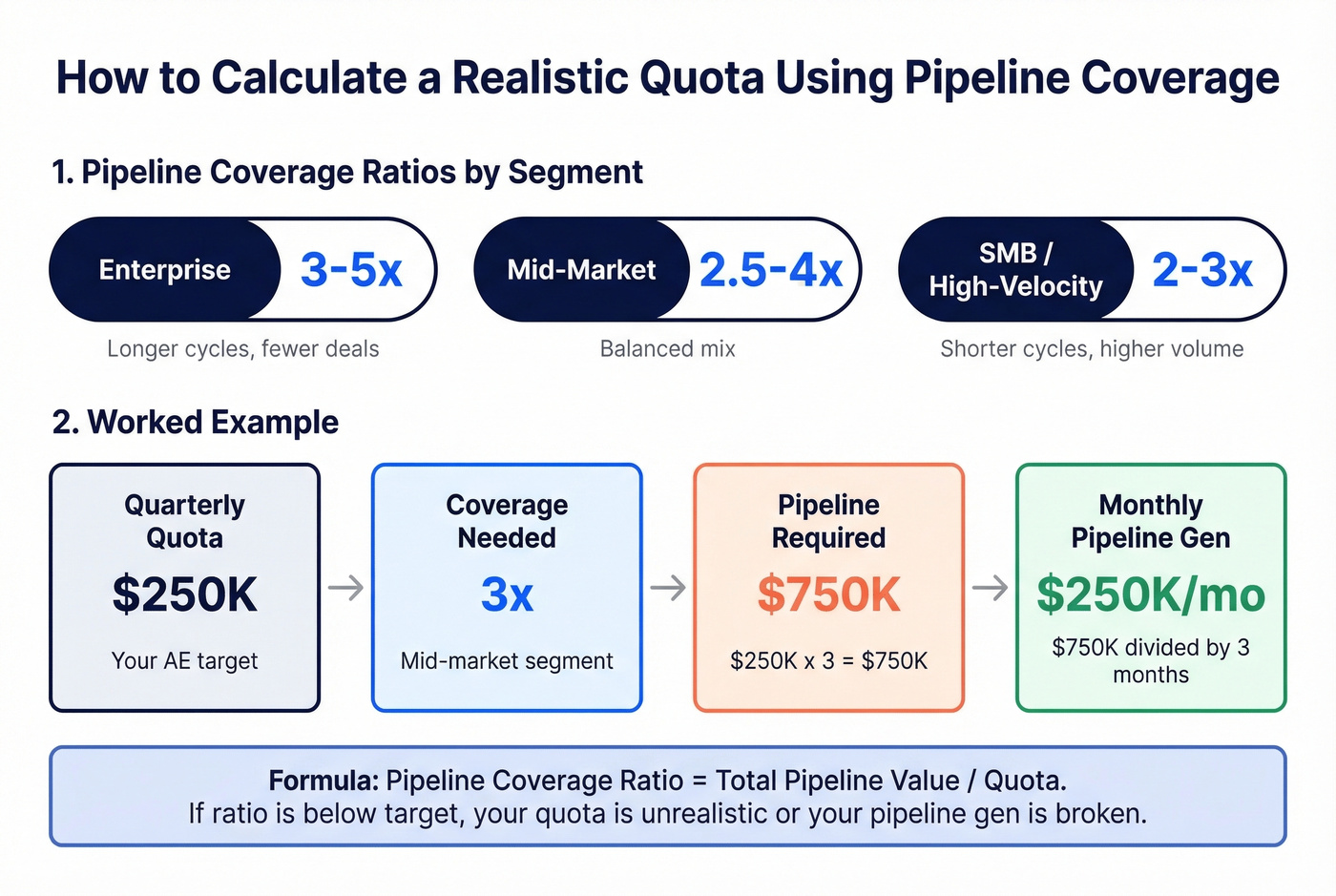
The baseline formula is simple: total expected revenue / number of reps = average quota. If you need $1M/month from 20 reps, each rep owes $50K. This is a starting point, not a strategy.
The pipeline coverage method is where it gets real. The formula: pipeline coverage ratio = total pipeline value / quota. Outreach's benchmarks by segment:
- Enterprise: 3-5x coverage needed
- Mid-market: 2.5-4x coverage
- SMB / high-velocity: 2-3x coverage
Here's a worked example. Your AE has a $250K quarterly quota and a 25% win rate. They need $250K / 0.25 = $1M in pipeline to hit quota. That's 4x coverage. If they can't generate $1M in qualified pipeline with their current territory, tools, and support, the quota is fiction - no amount of motivational Slack messages will fix it.
One critical distinction: unweighted pipeline treats every opportunity at face value, while weighted pipeline multiplies each deal by its probability of closing based on stage, historical data, or AI scoring. Weighted coverage is more accurate but requires mature CRM hygiene. If your pipeline data is messy, use unweighted with a higher coverage multiple.
Start with territory potential - total addressable pipeline in a rep's territory - and work backward to a quota that's achievable with reasonable effort. Dividing a board-level revenue target by headcount is how you get quotas that look good in a spreadsheet and terrible in a comp plan.
Why Most Teams Miss Quota
Back to those QuotaPath root causes: 35% misaligned activities, 31% unrealistic quotas, 32% lack of motivation.
Unrealistic quotas come from top-down math that ignores territory potential, ramp time, and pipeline capacity. The fix is the coverage math above - if your team can't generate 3x pipeline against quota, lower the number or increase the resources. For a deeper look at the numbers that typically support healthy coverage, see sales pipeline benchmarks.
Misaligned activities are subtler. Reps hit their call and email numbers but pipeline stays flat. One underrated fix: verify your prospect data. If a third of your reps' emails bounce, their activity numbers look fine but nothing converts. Prospeo's 7-day data refresh cycle keeps contact data current so reps aren't burning effort on dead leads - GreyScout saw their bounce rate drop from 38% to under 4% after switching, and pipeline jumped 140%. If you want to diagnose the issue quickly, start with your email bounce rate and your email deliverability.
Lack of motivation often stems from comp plan complexity. Reps take 3-6 months to fully understand their comp plans. If a rep can't calculate their commission on a napkin, the plan is too complicated. Involve your reps in the quota-setting process - even just a calibration conversation - and you'll see both buy-in and attainment improve. This is also where sales performance management and clear sales operations metrics make quota conversations less emotional and more measurable.
Look, the consensus on r/sales is pretty clear on this: segment-specific quotas - different numbers for SMB vs. mid-market vs. enterprise, adjusted for territory and tenure - take more work to design but improve attainment across the board. Annual quotas let reps coast through Q1 and panic in Q4. Quarterly quotas create shorter feedback loops, force mid-year course corrections, and give managers real data to adjust territories before it's too late. If your average deal cycle is under 90 days, there's no reason to set annual quotas. If you're rebuilding the system around shorter cycles, a simple 30-60-90 day plan helps managers align expectations with ramp and pipeline reality.
Whether your AEs carry $600K or $3M, quota attainment depends on pipeline coverage - and pipeline depends on reaching real decision-makers. Prospeo's 300M+ profiles with 30+ filters (buyer intent, headcount growth, technographics) let reps build targeted lists that convert, not just fill a CRM. At $0.01/email, the math works at every quota tier.
Build the pipeline your quota demands. Verified contacts, not guesswork.
FAQ
What's a realistic quota for a new sales rep?
Start at 50% of full quota for months one through three, step to 75% for months four through six, then 100% from month seven onward. Use the formula: ramp length = average sales cycle x 1.5. Structured ramp schedules produce roughly 23% more first-year revenue than full quota on day one.
How do you know if a quota is too high?
Run the pipeline coverage math. If your team can't generate 3x pipeline against the quota with current territory, tools, and support, the number is unrealistic. When 91% of organizations have fewer than 80% of reps hitting quota, the problem usually isn't the reps - it's the target.
How does data quality affect quota attainment?
Activity quotas are wasted on bad data. If 30%+ of emails bounce, reps burn effort without generating pipeline. Verified contact data with weekly refresh cycles eliminates this silent quota killer. Teams like GreyScout saw pipeline jump 140% after switching to clean data because every outbound touch actually reached a prospect instead of hitting a dead inbox.
What quota type works best for SaaS companies?
Combination quotas blending new ARR with expansion and net revenue retention outperform single-metric structures in subscription businesses. A typical mid-market SaaS AE carries $800K in new ARR plus a 110% NRR target - this prevents the "close and forget" behavior that erodes recurring revenue over time.