

Sales Skills Assessment: What to Measure, Which Tools to Use, and How to Avoid Expensive Mistakes
Your best candidate crushed the interview. Confident, articulate, nailed every behavioral question. Six months later, they can't close a door. The estimated cost to replace that salesperson? $130,933. Factor in lost deals, pipeline drag, and team morale, and a bad sales hire runs 3-5x total compensation.
Interviews reward confidence, not competence. One HR leader on r/humanresources put it perfectly: candidates interview well but struggle in-role, and there's no structured way to screen for resilience, motivation, or rejection handling before it's too late. A sales skills assessment fixes that gap - if you pick the right one.
What You Need (Quick Version)
- Free starting point: HubSpot's sales scorecard + SalesDNA (MTD) - structured interviewing plus a free skills benchmark.
- Dedicated sales-drive test: DriveTest - $160-$320/test, anti-faking design, about 20 minutes, EEOC compliant.
- Full assessment platform: TestGorilla - free tier available, Core from $142/mo (annual), 350+ tests.
What a Sales Skills Assessment Actually Measures
A well-designed evaluation measures whether someone can sell - across planning, buyer engagement, deal management, and conversion. Highspot defines sales competencies as measurable standards for selling behaviors that are learned and tracked over time, not innate personality traits.
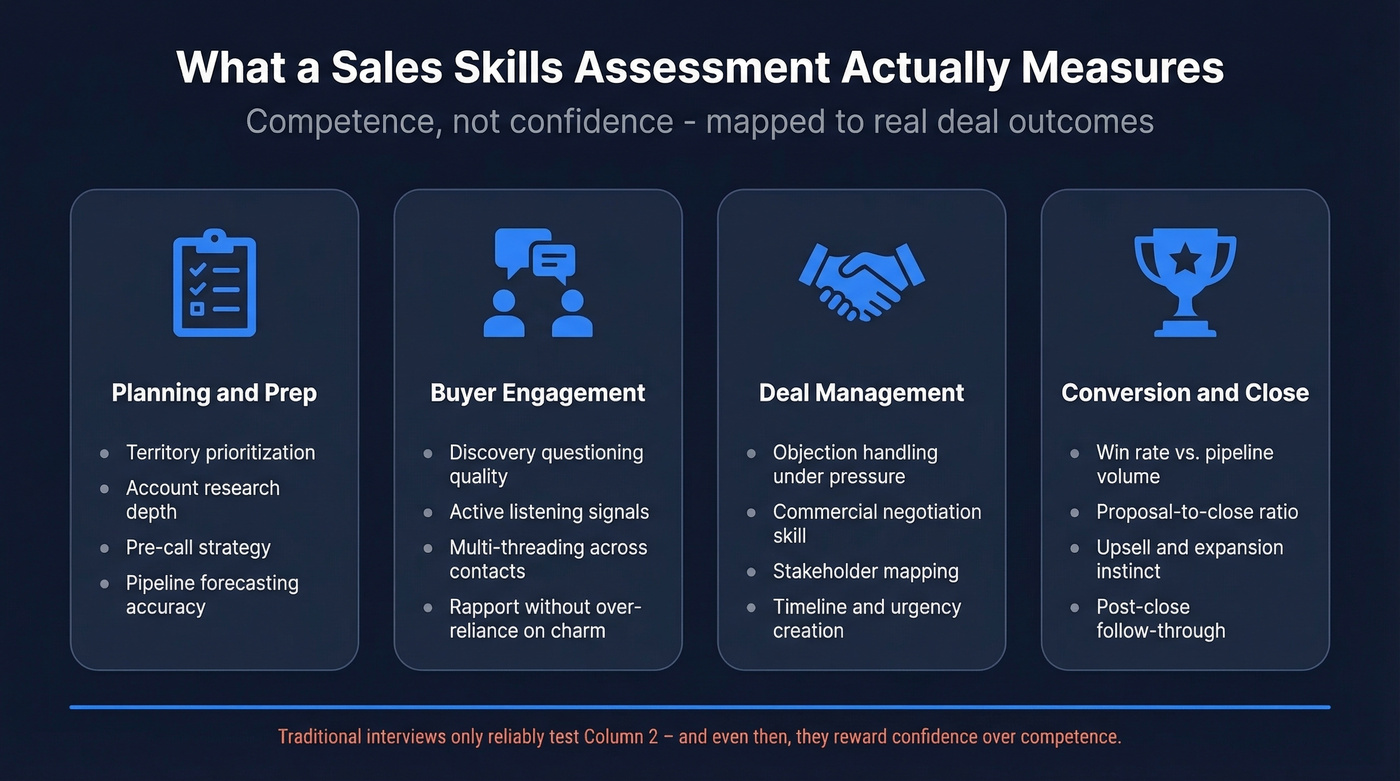
Here's the thing: Corporate Visions' research found that traditional approaches often measure confidence rather than competence. That explains why charismatic interviewers flame out on the phones. Their "Great 8" framework, built from buyer feedback across 150,000+ B2B deals, ties competencies directly to win/loss outcomes. These signals don't surface in a 30-minute conversation. They surface in structured scenarios designed to expose them.
Types of Sales Ability Assessments
Personality tests are the most common and the least useful. Objective Management Group's research is blunt: personality assessments aren't reliably predictive of job performance. They measure emotional behavior, not selling ability.
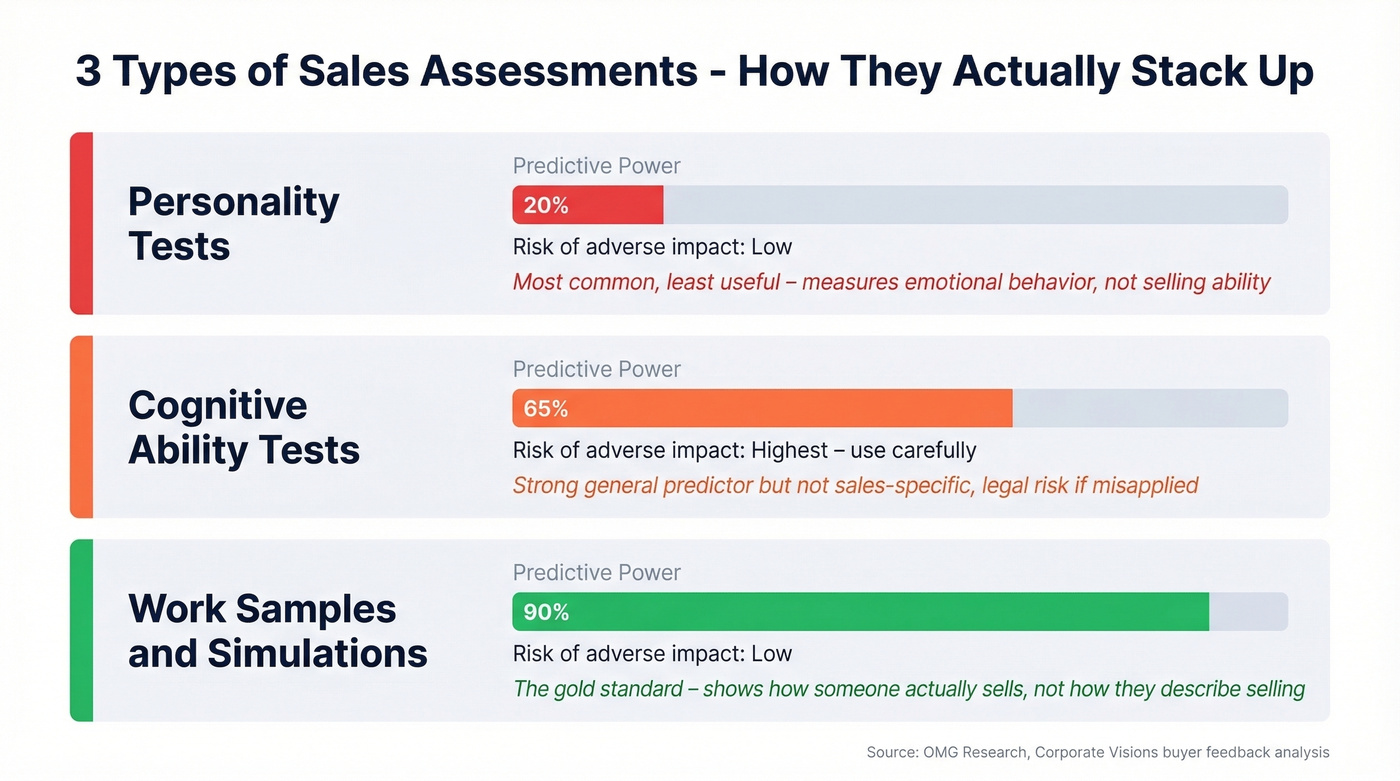
Cognitive ability tests predict job performance well but aren't sales-specific and carry the highest risk of adverse impact. Use them carefully.
Work samples and simulations are the gold standard. Role plays, mock discovery calls, and deal-review exercises show you how someone actually sells - not how they describe selling. Most companies default to personality tests because they're easy to administer. Easy isn't the same as effective.
Best Assessment Tools (Real Pricing)
| Tool | Price | Time | Best For |
|---|---|---|---|
| TestGorilla | Free; paid from $142/mo (annual); Plus from $400/mo | Varies | Full-platform assessment |
| DriveTest | $160-$320/test | ~20 min | Sales-specific drive |
| HubSpot Scorecard | Free | N/A | Structured interviews |
| SalesDNA (MTD) | Free | Varies | Quick skills snapshot |
| SalesGenomix | $249/candidate | Varies | Role-fit mapping |
| Caliper | ~$5K-$15K+/yr | ~60 min | Enterprise hiring |
| OMG | ~$2,500/yr + per-assessment fees | Varies | Predictive scoring |
| ProProfs | From $19.99/mo | Custom | DIY quiz assessments |
TestGorilla
The broadest platform here, and the one we'd recommend if you hire across multiple roles - not just sales. The free tier gets you AI resume scoring and 5 essential skills tests. Core ($142/mo annual) unlocks 350+ tests and analytics. Plus (from $400/mo) adds AI video interviews and ATS integrations. It carries a 4.1/5 from 265 reviews on Software Advice. Skip this if you only hire salespeople - you'll pay for capabilities you don't need.
DriveTest (SalesDrive)
DriveTest measures one thing: sales drive - Need for Achievement, Competitiveness, and Optimism. The 42-question forced-choice format takes about 20 minutes and includes a consistency scale to catch faking. Candidates scoring Green on Drive are reportedly twice as likely to become sales leaders. At $160-$320 per test, save it for final-round candidates. We've seen teams blow their assessment budget by running DriveTest on every applicant - don't do that.
HubSpot Sales Scorecard
Free, downloadable, and surprisingly useful. It gives you a structured rubric for every interview stage, forcing the consistency that most sales hiring lacks. Not a replacement for a real assessment, but a solid foundation.
SalesDNA (MTD)
Free tool assessing 64 key sales skills. Best for reps with a year or two of experience. No customization, but the price is right. It also works well as a sales self-assessment, letting reps benchmark their own strengths before a manager review.
Caliper Profile
Enterprise-grade, covering 280 behaviors, 56 competencies, 21 traits, and abstract reasoning. Expect around $5K-$15K+/year. Best for final-round screening when you're down to fewer than 10 candidates and the stakes justify the cost.
SalesGenomix
$249 per candidate, self-service. Maps candidates against 14 sales role models - useful when hiring across different motions like inside vs. field vs. channel.

Hiring the right reps is half the battle. The other half is giving them data that converts. Prospeo delivers 98% verified emails and 125M+ direct dials - so your top-scored candidates actually reach decision-makers from day one.
Stop losing deals to bad data after investing thousands in the right hire.
How to Identify Skill Gaps in Your Team
Assessments aren't just for hiring. Run a sales ability assessment across your current reps and you'll almost certainly find gaps they don't recognize themselves. In 2026, the areas where reps most frequently underperform are discovery questioning, multi-threading, and commercial negotiation - the skills that separate quota-carriers from quota-missers.
Once you've mapped weaknesses across the team, build targeted enablement programs instead of generic training that wastes everyone's time. The reps who need objection-handling practice get it; the reps who struggle with pipeline management get that instead. Let's be honest - most "sales training" is a week-long offsite that everyone forgets by Tuesday. Assessment-driven coaching is the antidote.
Mistakes That Kill Your Assessment
Assessing too early and too long. The top complaint on r/sales is hour-long assessments before speaking to anyone. If your assessment takes 30+ minutes before a candidate has talked to a human, you're filtering out your best people. Top performers have options - they won't jump through hoops for a company that hasn't invested any time in them yet.
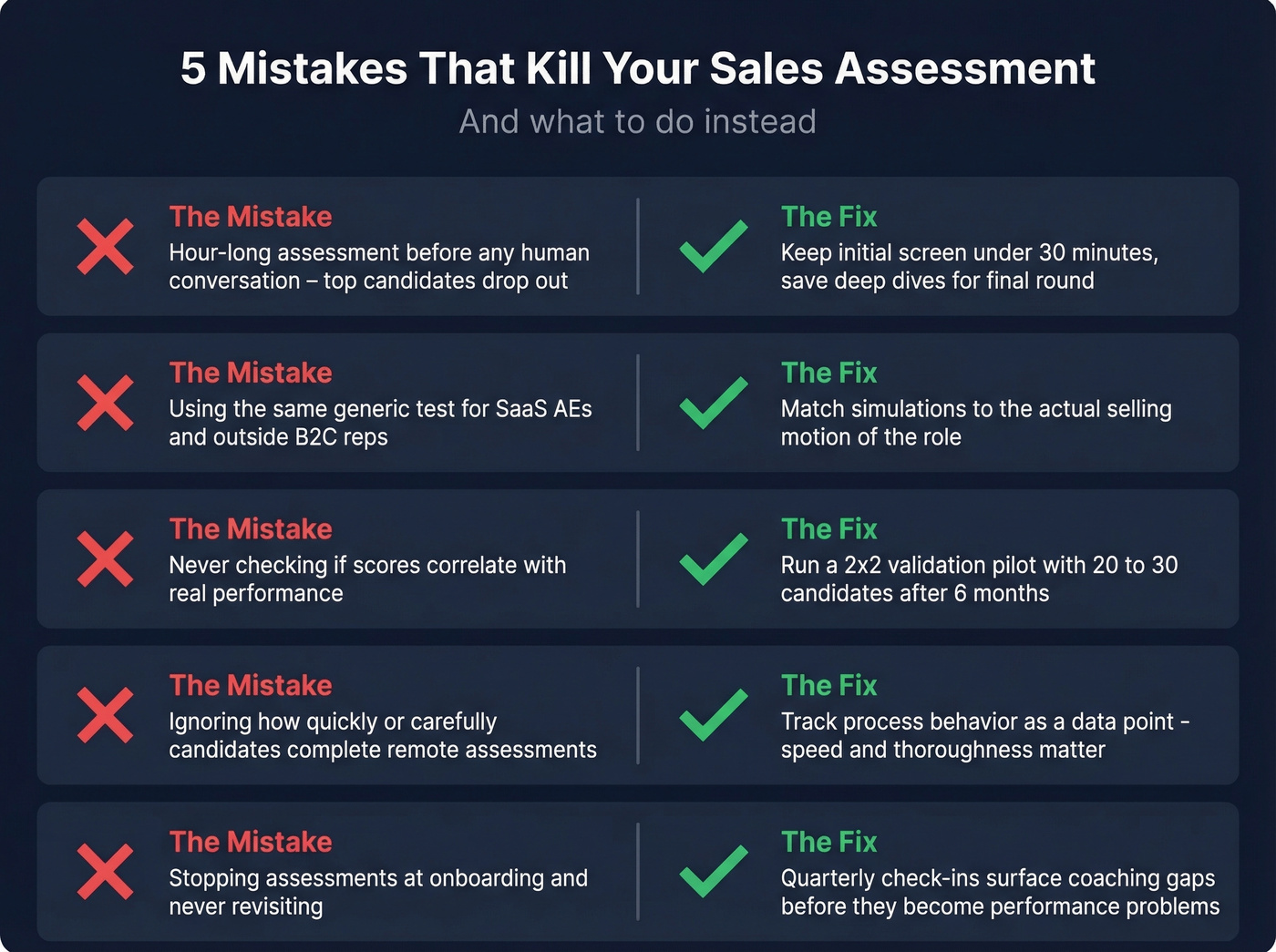
Using generic tests for specialized roles. A SaaS AE and an outside B2C rep need completely different simulations. One-size-fits-all assessments produce one-size-fits-none results.
No validation. Most companies never check whether their assessment predicts performance. They just assume it works. We've talked to teams running the same assessment for three years without a single correlation study. That's not a process - it's a ritual.
Ignoring process behavior. How quickly a candidate completes a remote assessment is itself a signal. Treat it as one.
Overlooking gaps post-hire. Assessments shouldn't stop at onboarding. Quarterly check-ins surface coaching opportunities before they become performance problems.
How to Validate Your Assessment
Score 20-30 candidates with your assessment, hire a mix of high and low scorers, then compare scores to 6-month performance using a 2x2 grid: high score/high performance, high score/low performance, low score/high performance, low score/low performance. Above 60% accuracy, you've got a tool worth scaling. Below that, you're paying for noise.
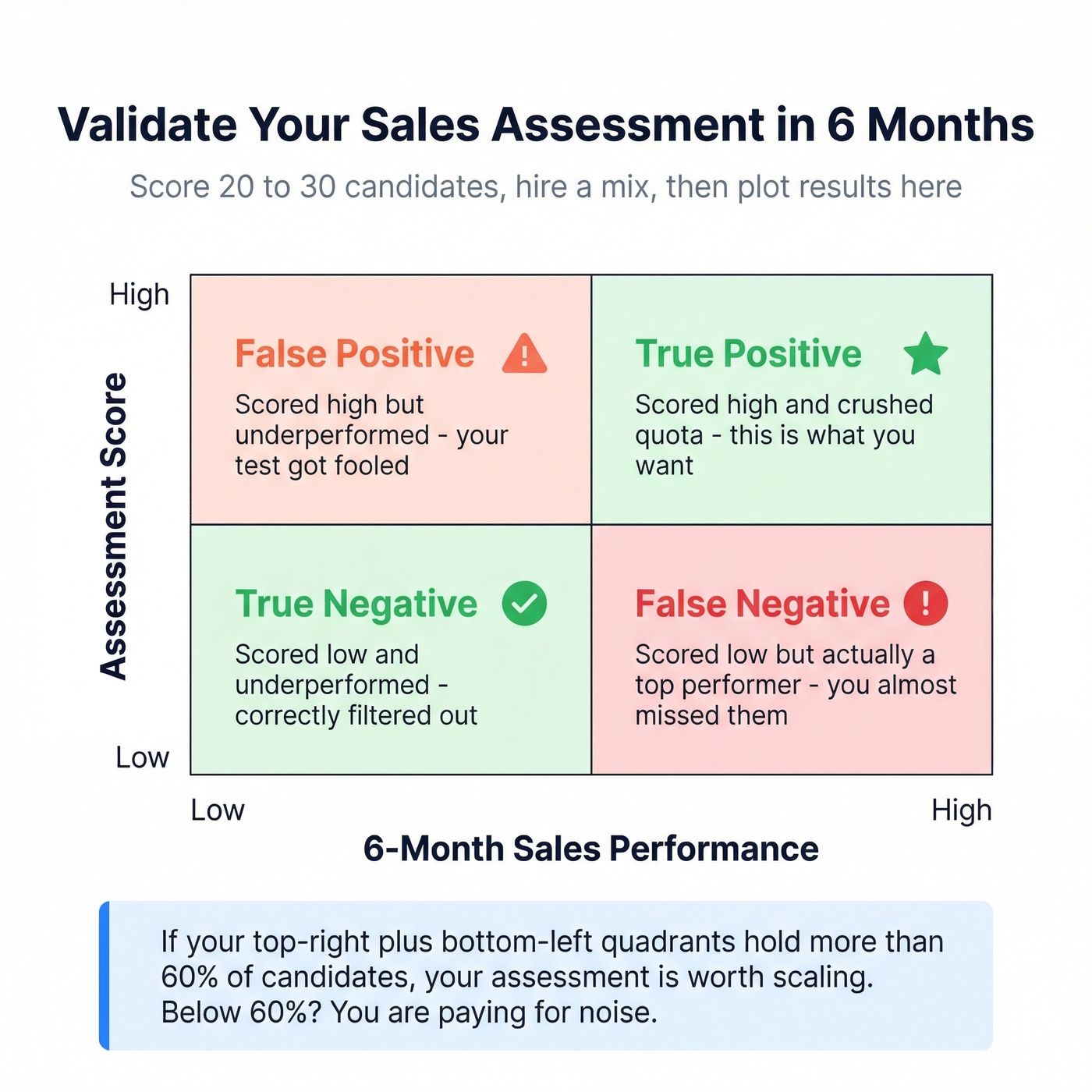
In our experience, teams run assessments for years without doing this basic check. Don't be one of them. The whole point of a structured assessment is that it's measurable - so measure it.
Fix Your Pipeline First
Even the best sales skills assessment can't fix bad sourcing. If your recruiting outreach bounces because contact data is stale, you're assessing whoever happens to reply - not the strongest candidates. Prospeo's 98% email accuracy and 7-day data refresh cycle mean your outreach hits real people in real roles, so you're evaluating a strong pool from the start. One customer, Meritt, saw bounce rates drop from 35% to under 4% after switching.
If you're rebuilding top-of-funnel, start with sales prospecting techniques and a clean lead generation workflow so your assessment process actually has qualified candidates to evaluate.
You're mapping skill gaps and building targeted coaching. But even your sharpest reps can't close deals they never start. Prospeo's 300M+ profiles with 30+ filters - including buyer intent and job changes - put qualified prospects in front of reps who are ready to sell.
Pair assessed talent with data that actually connects - at $0.01 per email.
FAQ
Do sales skills assessments predict performance?
Yes, when validated against real outcomes. Work samples and structured simulations predict better than personality tests alone. Run a 2x2 pilot with 20-30 candidates and compare scores to 6-month results - accuracy above 60% is promising and improves with scale.
How long should the assessment take?
Under 30 minutes for initial screening. Longer assessments before any human interaction cause top candidates to drop out. Save deep-dive tools like Caliper's 60-minute profile for final-round candidates who've already met the team.
What's the cheapest way to start evaluating sales candidates?
HubSpot's free scorecard and SalesDNA (free, 64 skills) cost nothing. TestGorilla's free tier adds AI resume scoring and 5 skills tests. That combination covers structured interviews, skills measurement, and cognitive screening without spending a dollar.
Can a sales self-assessment replace a formal evaluation?
Not entirely, but it's a valuable complement. Having reps rate themselves before a manager review surfaces blind spots and creates a more productive coaching conversation. Pair self-assessments with objective data from tools like SalesDNA or OMG for the most accurate picture.