

How to Build a Sales Team That Actually Hits Quota in 2026
84% of sales reps missed quota last year. Not because they lacked hustle - because their sales team lacked structure. The comp plans were vague, the onboarding was "shadow someone for a week," and the CRM was full of dead emails.
This is the operator's playbook with real numbers: what to pay, how to structure, when to hire, and what tools actually move the needle.
The Short Version
Choose your structure model (Island, Assembly Line, or Pod). Pay market rate - there's an OTE table below so you stop guessing. Onboard to first qualified meeting in 9 days, not 9 weeks. Equip reps with four tools max: CRM, engagement platform, data/enrichment, and scheduling. The data quality layer is the one most orgs skip, and it's the reason reps spend 28% of their week actually selling while 72% goes to everything else.
What Is a Sales Team?
A sales team is the group responsible for turning pipeline into revenue - prospecting, qualifying, closing, and expanding accounts. But the real question isn't the definition. It's how you build one that doesn't hemorrhage money while missing targets.
Per Korn Ferry, organizations with a clear picture of what "excellent" looks like for sales roles achieve +25% quota attainment, +17% win rates, and +8% revenue attainment. The structure you choose is the difference between a team that scales and one that stalls.
Roles and Responsibilities
Most guides tell you to "hire great people." That's useless without knowing which roles to hire, in what order, and what each person actually owns.
SDR / BDR
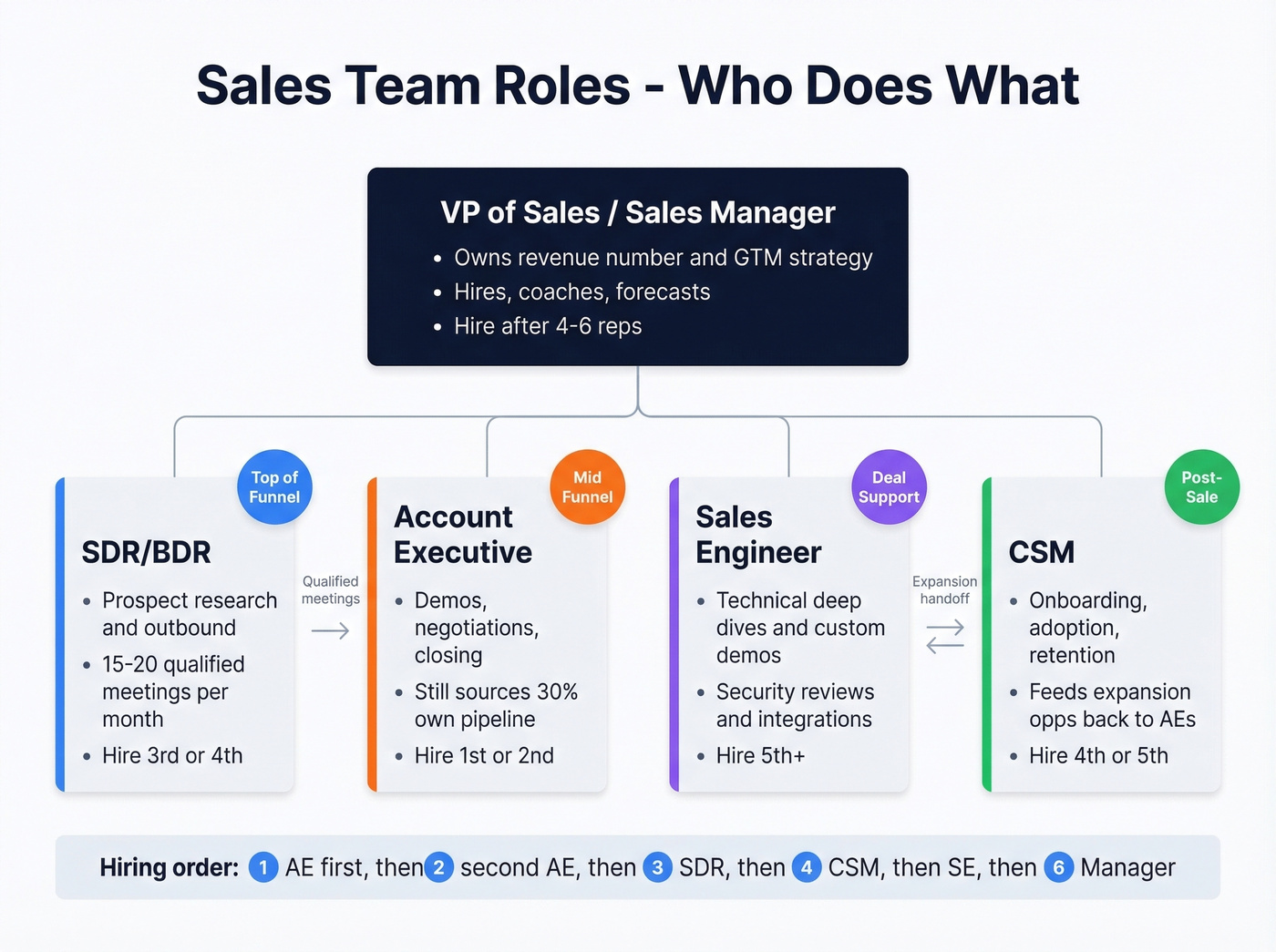
Sales Development Reps own the top of funnel. Their job is prospect research, outbound outreach across cold calls, emails, and social touches, lead qualification, and meeting setting. They live in the CRM, keeping data clean and nurturing leads that aren't ready yet. A strong SDR books 15-20 qualified meetings per month and hands warm opportunities to AEs with context - not just a calendar invite.
Account Executive
AEs convert qualified pipeline into closed revenue. That means running demos, managing deal cycles, negotiating contracts, and building relationships with buying committees. The role splits by segment: an SMB AE running 30-day cycles looks nothing like an enterprise AE navigating 12-month procurement processes with 20+ stakeholders.
In early-stage companies, AEs often do their own prospecting. Even with SDR support, the best AEs still source roughly 30% of their own pipeline.
Sales Engineer
Sales Engineers handle the technical side of complex deals - product deep dives, custom demos, integration questions, security reviews. They support AEs on deals where the buyer needs proof that the product actually works in their environment. Base runs $110k-$140k, and good SEs are worth every dollar because they directly impact win rates on technical evaluations.
Customer Success Manager
CSMs own the post-sale relationship: onboarding, adoption, retention, and expansion. Their variable comp typically ties to renewal rates and net revenue retention, not new logos. The common split is 80/20 or 70/30 base-to-variable. In a well-run org, CSMs feed expansion opportunities back to AEs and flag churn risk before it hits the P&L.
Sales Manager & VP of Sales
Sales Managers hire, coach, set goals, track KPIs, and forecast. They're player-coaches in smaller orgs and full-time managers in larger ones. The VP of Sales owns the entire revenue number, GTM strategy, cross-functional alignment with marketing and product, and team scaling decisions. In early-stage companies, the founder is the VP of Sales whether they want to be or not.
In startups under 10 people, these roles collapse. Your first AE is also your SDR. Your founder is also your sales manager. That's fine - just know when to split them. The moment a single person can't do both jobs well is the moment you need the next hire.
| Role | Primary Responsibility | Typical Hire Order |
|---|---|---|
| SDR/BDR | Top-of-funnel pipeline generation | 3rd-4th |
| AE | Closing qualified opportunities | 1st-2nd |
| Sales Engineer | Technical deal support | 5th+ |
| CSM | Retention and expansion | 4th-5th |
| Sales Manager | Coaching, forecasting, hiring | 6th+ (after 4-6 reps) |
Compensation: OTE by Role
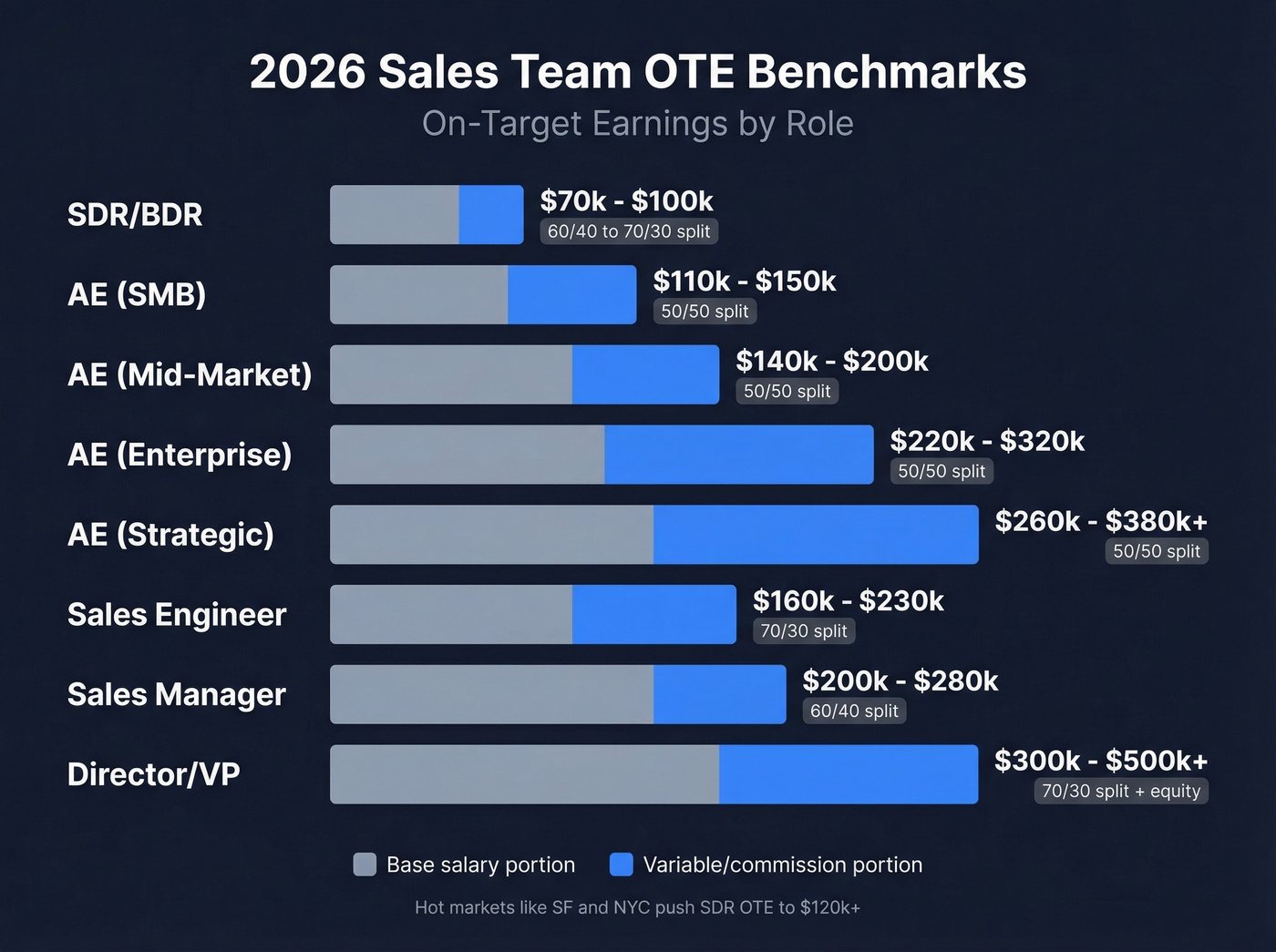
Most comp advice boils down to "pay competitively" without telling you what competitive actually means. Here are the actual numbers for 2026.
| Role | Base Range | OTE Range | Typical Split |
|---|---|---|---|
| SDR/BDR | $45k-$65k | $70k-$100k | 60/40 to 70/30 |
| AE (SMB) | $60k-$80k | $110k-$150k | 50/50 |
| AE (Mid-Market) | $75k-$95k | $140k-$200k | 50/50 |
| AE (Enterprise) | $110k-$140k | $220k-$320k | 50/50 |
| AE (Strategic) | $130k-$160k | $260k-$380k+ | 50/50 |
| Sales Engineer | $110k-$140k | $160k-$230k | 70/30 |
| Sales Manager | Varies | $200k-$280k | 60/40 |
| Director/VP | Varies | $300k-$500k+ | 70/30 (+ equity) |
SDR OTE can push to $120k in hot SaaS hubs like SF or NYC. Enterprise AEs with accelerators blow past the top of these ranges on a strong year. For AEs, the 50/50 split is standard - it keeps reps hungry. For SDRs, a 60/40 or 70/30 split provides enough base stability that they're not panicking about rent while learning the motion.
For VP of Sales compensation, stage matters more than title. Series A/B companies typically offer $250k-$400k OTE with meaningful equity on a 4-year vest with a 1-year cliff, while later-stage companies push north of $500k OTE but with less equity upside. The split shifts too: 50/50 at a startup where the VP is still closing deals, 70/30 at an enterprise org where they're managing managers. Uncapped commissions with accelerators and decelerators are the standard for leadership comp. If you're capping your VP's upside, you're capping your revenue.
Three Structures That Work
Island Model (Full-Cycle)
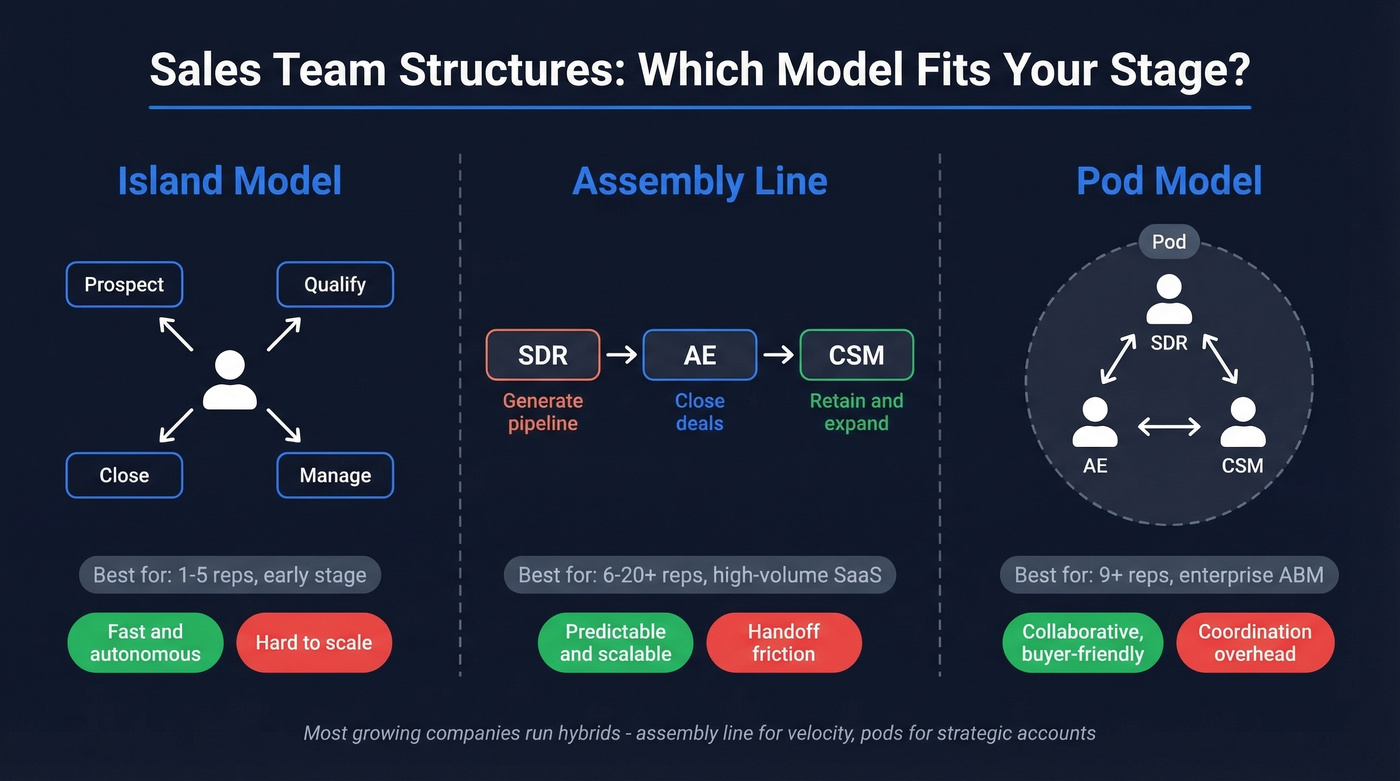
One rep owns everything: prospecting, qualifying, closing, and account management. This works when you're early-stage, when deals are relationship-driven, and when you need speed over process. The upside is autonomy and simplicity. The downside? Nearly impossible to forecast, hard to scale, and you lose all institutional knowledge when a rep leaves.
Assembly Line (Specialized)
SDRs generate pipeline, AEs close, CSMs handle retention and expansion. This is the Predictable Revenue model that SaaS companies have run for 15 years. It creates clear career ladders, predictable pipeline metrics, and specialization that improves performance at each stage. The risk is handoff friction - leads get lost between SDR and AE, context gets dropped, and the buyer experience suffers if transitions aren't tight.
Pod Model (Cross-Functional)
Small cross-functional units - typically an SDR, AE, and CSM - aligned to a segment, vertical, or region. Pods emphasize collaboration and customer experience. They work well for complex accounts and account-based selling motions where the buying committee needs a coordinated team, not a relay race. Korn Ferry notes that a single $1M deal can involve 20-40 internal stakeholders, and that kind of complexity demands a pod. The tradeoff is coordination overhead and the need for enough deal volume per pod to justify the structure.
How to Choose
| Model | Best For | Team Size | Pros | Cons |
|---|---|---|---|---|
| Island | Early stage, simple sales | 1-5 reps | Fast, autonomous | Hard to scale/forecast |
| Assembly Line | High-volume SaaS | 6-20+ reps | Predictable, scalable | Handoff friction |
| Pod | Complex/enterprise ABM | 9+ (3 per pod) | Collaborative, buyer-friendly | Coordination overhead |
Most growing companies end up running hybrids - assembly line for the velocity motion, pods for strategic accounts. That's not indecision; it's pragmatism. If your team is distributed, your structure needs to work asynchronously, which means tight handoff documentation and shared dashboards, not just a Slack channel. Korn Ferry's data backs this up: orgs that nail role clarity see +17% win rates and 17% lower voluntary turnover. The structure you pick matters less than the clarity you bring to it.

You just read that reps spend 72% of their time NOT selling. The biggest culprit? Dead emails and wrong numbers in the CRM. Prospeo's 98% email accuracy and 125M+ verified mobiles mean your SDRs book meetings instead of bouncing messages. At $0.01 per email, equipping your entire sales team costs less than one missed deal.
Stop building a sales team on top of bad data.
Building Step by Step
There's a progression that works, and it's not "hire 5 SDRs on day one." This mirrors what founder-operators often recommend - and what we've seen work repeatedly at early-stage companies.
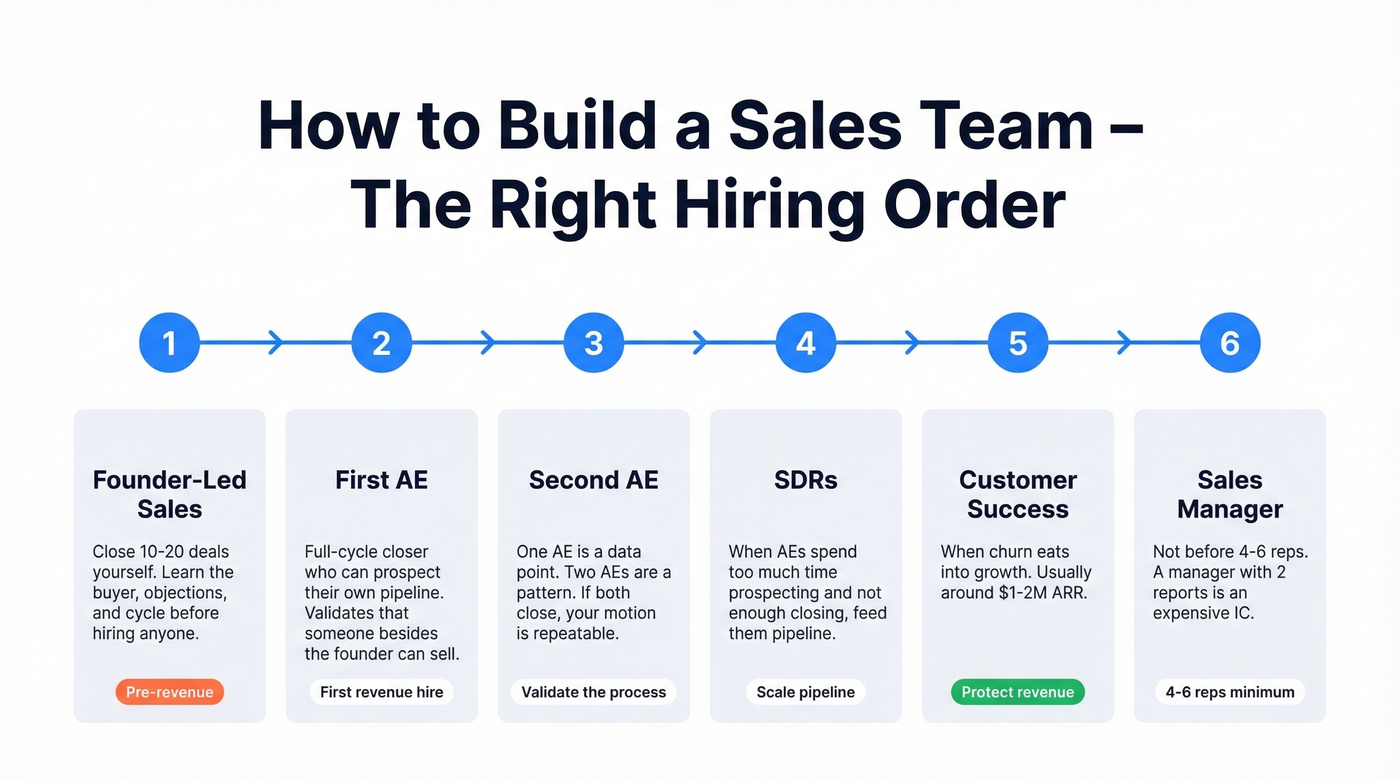
Step 1: Founder-led sales. Before you hire anyone, close 10-20 deals yourself. You need to understand the buyer, the objections, the sales cycle, and the messaging before you can teach someone else. Skip this and you'll hire reps into a vacuum.
Step 2: Hire your first AE. This person should be a full-cycle closer who can prospect their own pipeline. Don't hire an SDR first - you don't have enough pipeline knowledge to manage one yet. Your first AE validates that someone other than the founder can sell this product.
Step 3: Add a second AE. One AE is a data point. Two AEs are a pattern. If both can close, your sales motion is repeatable. If only one can, the problem is your process, not your people.
Step 4: Hire SDRs. Once your AEs are spending too much time prospecting and not enough time closing, bring in SDRs to feed them. Even then, AEs should still do roughly 30% of their own outbound - it keeps them sharp and ensures they don't become order-takers.
Step 5: Add Customer Success. When churn starts eating into growth, it's time for a dedicated CSM. This usually happens around $1-2M ARR when the founder can no longer personally manage every account relationship.
Step 6: Hire a Sales Manager. Not before you have 4-6 reps. A manager with two direct reports is an expensive individual contributor. after 4-6 reps is also when you can start thinking about formalizing sales leadership systems instead of winging it. 45% of sales leaders expect team expansion in 2026 - just make sure you're expanding into a structure, not into chaos.
Onboarding and Ramp Benchmarks
Ramp time is the silent killer of revenue economics. The average SaaS rep takes 5.7 months to fully ramp - up from 4.3 months in 2020, a 32% increase. Enterprise reps take 9-12 months. SDRs are faster at roughly 3.2 months, but that's still a full quarter of sub-quota performance.
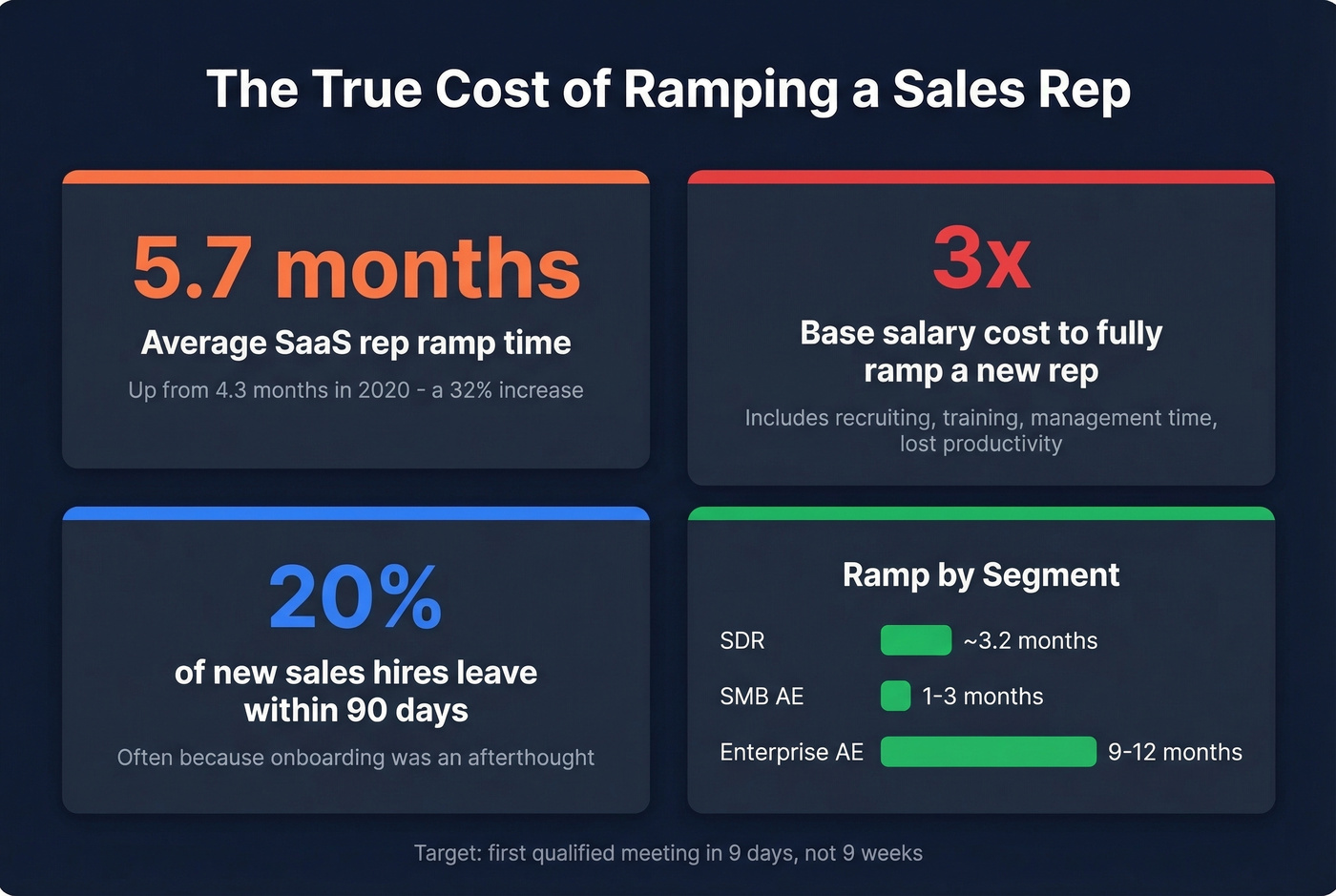
The cost isn't just the salary. Factor in recruiting, training, management time, and lost productivity, and ramping a new rep costs roughly 3x their base salary. And 20% of new sales hires leave within the first 90 days, often because onboarding was an afterthought.
| Segment | Average Ramp Time |
|---|---|
| SDR | ~3.2 months |
| SMB AE | 1-3 months |
| Mid-Market AE | 4-6 months |
| Enterprise AE | 9-12 months |
The best programs don't measure ramp in months - they measure it in milestones. Per Highspot's research, top-performing onboarding programs hit these targets: first qualified meeting within 9 days of completing training, 96% certification completion within 21 days, and first closed-won deal within 32 days versus a 45-day baseline.
Those are aggressive targets, but they force you to build an onboarding program that actually works instead of a "shadow someone for two weeks" approach. Equip new reps with verified prospect data from day one so they spend week one selling, not cleaning a stale CRM.
One stat that should change your follow-up cadence: the first follow-up email boosts reply rates by 49%. The second adds just 3%. The third actually decreases response rates by 30%. Build that decay curve into your onboarding playbook so new reps aren't wasting sequences on diminishing returns (and borrow a few sales follow-up templates so they’re not writing from scratch).
KPIs That Actually Matter
Activity metrics without outcome metrics are vanity metrics. A rep making 80 dials a day who books zero meetings isn't productive - they're busy.
| KPI | Benchmark | Why It Matters |
|---|---|---|
| Opportunity Conversion | 20-30% (B2B SaaS) | Pipeline quality signal |
| Win Rate | 15-25% | Sales effectiveness |
| Sales Cycle Length | SMB: 1-6 mo, Enterprise: 6-18 mo | Forecasting accuracy |
| Quota Attainment | Top teams: 60-70%+ | Team health indicator |
| Pipeline Coverage | 3-4x quota | Risk buffer |
| ARR Growth | Stage-dependent | The metric that matters most |
HubSpot's survey of 1,000+ sales pros found that 42% of leaders say ARR is their most important metric, followed by profit margin at 30%, conversion rate at 29%, and win rate at 28%. Sales cycle length came in at 22% - surprising, because cycle length is one of the best leading indicators of deal health.
The real insight is layering these. A team with a 25% win rate and a 90-day cycle is in a fundamentally different position than one with a 25% win rate and a 270-day cycle. Same win rate, completely different economics.
Management Mistakes That Kill Performance
Only 52% of CEOs believe in their own growth plans. That uncertainty cascades down to every manager and rep in the org. Here are the five mistakes that do the most damage.
1. Hiring for experience over coachability. The rep with 10 years of experience and a Rolodex sounds great in the interview. But if they can't adapt to your product, your market, and your motion, they'll underperform a hungry rep with two years of experience who actually listens to coaching. We've seen this pattern destroy first-year organizations at startups more than any other single mistake.
2. Tracking activity without outcomes. A rep cold calling 80 times a day to look busy while booking zero meetings is a management failure, not a rep failure. If you're measuring dials instead of meetings booked, you're incentivizing performance theater (use a short list of sales activities that map to pipeline outcomes).
3. Delaying firings. Everyone knows within 60 days whether a hire is going to work. Most managers wait 6-9 months to act on that knowledge. Every month you delay costs you the rep's salary plus the opportunity cost of the pipeline they're not building.
4. Ignoring burnout. 55% of the U.S. workforce experiences burnout, and burnt-out employees are roughly 3x more likely to leave within the year. Highly engaged teams see 21% greater profitability - so the ROI of not burning people out is measurable. Sales is already a high-pressure role. Piling on unrealistic quotas and mandatory 60-hour weeks doesn't build a team; it builds a revolving door.
5. Micromanaging instead of coaching. There's a difference between inspecting pipeline and dictating every email. Leaders who nail GTM strategy are 2x more likely to meet or exceed revenue expectations, with 74% achieving or surpassing goals. That comes from setting clear direction and removing obstacles, not from hovering over Salesforce dashboards.
The ritual that fixes most of these: Run a weekly "deal autopsy" where the team dissects one lost deal without blame. What did the buyer say? Where did the deal stall? What would you change? This builds institutional learning faster than any training program and creates the psychological safety that prevents burnout. The best sales managers we know block 30 minutes every Friday for this - non-negotiable.
Here's the thing: the standalone "sales department" is an outdated concept. The best organizations in 2026 run revenue teams - sales, marketing, CS, and RevOps sharing data, goals, and accountability. If your sellers operate in a silo, you're already behind. And if your average deal size is under $15k, you probably don't need a 15-person org. You need a tight pod of 3-4 people with great tools and clean data.
The 2026 Tech Stack
You don't need 12 tools. You need four. If your reps spend 72% of their week on admin, the problem isn't motivation - it's your tech stack.
AI: Cut the Hype, Keep the Automation
81% of sales organizations now use AI in some form, with 41% fully implemented. The efficiency gains are real - 10-15% across the board - but they come from automating admin work, not replacing reps. AI writes first-draft emails, summarizes call recordings, scores leads, and auto-logs CRM activity. It doesn't build relationships or navigate a six-person buying committee. Use AI to give your reps their time back. Don't use it as an excuse to cut headcount and wonder why pipeline dried up.
CRM
HubSpot's free tier is genuinely good for small teams. Pipedrive starts at $14/seat/month and is a strong option for SMB teams that need pipeline visibility without Salesforce complexity (here are more examples of a CRM if you’re comparing categories). Salesforce has entry plans around $25/user/month, though total costs rise significantly once you add the features, add-ons, and workflows a real org depends on.
Engagement
Outreach and Salesloft are the two serious options for mid-market and up, typically around $100-150/user/month. For smaller teams, Instantly or Smartlead handle cold email sequences at a fraction of the cost ($30-100/month). Skip Outreach if you're under 10 reps - you'll pay enterprise prices for features you won't use for two years (if you’re building the stack, start with a shortlist of SDR tools).
Data & Enrichment
This is where most teams either overspend or underspend. Bad data is the silent tax on every revenue org - your CRM is worthless if the contacts inside it bounce or go to voicemail.
Prospeo covers 300M+ professional profiles with 143M+ verified emails and 125M+ verified mobile numbers. The 98% email accuracy rate means your sequences actually land, and the 7-day data refresh cycle keeps your CRM current instead of rotting with stale contacts. Mobile numbers hit a 30% pickup rate, which makes cold calling dramatically more efficient. At roughly $0.01 per lead with a free tier of 75 emails/month, there's no reason to start with bad data. GreyScout cut rep ramp time from 8-10 weeks to 4 weeks after switching, and their bounce rate dropped from 38% to under 4% (if you’re evaluating vendors, compare data enrichment services side by side).

Scheduling
Calendly's free tier works. If you want a one-time purchase, TidyCal runs $29 lifetime. Don't overthink this category.
| Category | Recommended Tool | Starting Price | Notes |
|---|---|---|---|
| CRM | HubSpot / Pipedrive | Free / $14/seat/mo | HubSpot free tier is strong for small teams |
| Data & Enrichment | Prospeo | Free (75 emails/mo) | 98% accuracy, 7-day refresh |
| Engagement | Outreach / Salesloft | ~$100-150/user/mo | Instantly for budget teams |
| Scheduling | Calendly / TidyCal | Free / $29 lifetime | Don't overspend here |
GreyScout cut rep ramp time from 8-10 weeks to 4 and doubled their sales team - with bounce rates under 4%. Snyk's 50 AEs drove 200+ new opportunities per month. The difference wasn't comp plans or org charts. It was giving reps data refreshed every 7 days, not every 6 weeks.
Give your reps the data layer that actually moves quota attainment.
FAQ
How many salespeople do I need?
Pre-revenue to $500k ARR: founder + 1 AE. $500k-$2M ARR: 2-3 AEs + 1-2 SDRs. $2M-$5M ARR: 4-6 AEs, 2-4 SDRs, 1 manager, 1-2 CSMs. Scale from there based on quota capacity and pipeline coverage ratios, not gut feel.
What's the ideal SDR-to-AE ratio?
The most common ratio is 2:1 for high-volume motions and 3:1 for outbound-heavy mid-market teams. Enterprise motions often flip to 1:1 because deal cycles are longer and SDRs need deeper research per account. Start at 2:1 and adjust based on meeting-to-opportunity conversion.
What's the biggest hiring mistake?
Prioritizing experience over coachability. A rep who crushed quota at a company with inbound leads and brand recognition will flounder at a startup where they need to build pipeline from scratch. Look for adaptability, curiosity, and resilience over a polished resume.
How do I keep CRM data accurate?
Use a data platform with built-in verification and frequent refresh cycles. The industry average refresh is every 6 weeks - Prospeo refreshes every 7 days and verifies emails before delivery. Bulk enrichment handles CRM hygiene at scale, and the free tier lets you test quality before committing budget.
How long does it take to build a full team?
Founder-led sales typically runs 6-12 months. First AE hire to validated playbook takes another 3-6 months. Building a full group of 5-8 people with SDRs, AEs, and a manager usually takes 12-18 months from the first hire. Rushing this timeline is one of the most expensive mistakes a startup can make.