

How to Set Sales Team Goals Reps Actually Hit
A RevOps leader on r/sales shared a story that should make every sales manager uncomfortable. Their company grew headcount from 22 to 45 reps but added zero new accounts. Everyone's book got cut in half. Six out of eighteen reps hit quota. The math was never going to work, and leadership set the goals anyway.
That's not an outlier. RepVue's Q3 2025 Cloud Sales Index - covering 249 companies and 49,000+ quota-carrying professionals - puts average quota attainment at 43.2%. Ebsta's data is worse: 69% of reps fell short, and just 17% of reps generate 81% of total revenue. The problem isn't lazy reps. It's broken goal-setting.
If you only read one section, read "How to Cascade Revenue Goals." Most teams set goals top-down from investor expectations. The teams that actually hit quota start with funnel math, set 3 goals max, and track leading indicators weekly.
Why Most Sales Goals Fail
The conventional wisdom is that targets fail because reps don't work hard enough. That's almost never the real issue.
Goals fail because they're set backwards - starting from a board deck number and dividing by headcount, with zero regard for territory capacity, funnel math, or market reality. Data from 900+ Sales Agility Assessments paints a damning picture: 65% of organizations don't align rep quotas to overall company goals, 74% provide no initial or ongoing training, and 75% don't know their competition well enough to differentiate. These aren't edge cases. They're the majority.
Here's the thing: most teams don't have a goal problem. They have a goal quantity problem. Fifteen KPIs on a dashboard isn't a strategy. It's noise. The teams we've seen consistently hit number share one trait - they pick three achievable targets that matter and ignore everything else. HBR's guidance on goal-setting makes the same point: people perform better when they can see how their work connects to larger objectives, and when goals create a feedback loop with real-time input.
Stop setting 15 goals. Set 3.
The 2026 Sales Environment
Before you set a single target, understand what your reps are actually dealing with this year:
- 60% of rep time goes to non-selling tasks - admin, CRM updates, internal meetings
- 80% of buyer interactions now happen digitally, shifting where and how reps engage prospects
- The average B2B deal involves 13 decision-makers
- 73% of B2B buyers actively avoid sellers who send irrelevant outreach
- 88% of reps with AI agents say the technology increases their odds of hitting targets
These numbers reshape what "realistic" means. If your reps lose most of their week to non-selling work and deals require more stakeholders than ever, your activity targets and pipeline coverage ratios need to reflect that - not last year's assumptions.
What Stakeholders Actually Want
One reason sales team goals misfire: the CEO, CRO, and frontline manager all mean different things when they say "hit our number."
| Stakeholder | Primary Goal Lens | What They Measure |
|---|---|---|
| CEO / Board | Revenue growth vs. plan | ARR, net retention, CAC payback |
| CRO / VP Sales | Forecast accuracy + attainment | Pipeline coverage, rep productivity |
| Sales Manager | Rep development + quota | Win rate, ramp time, coaching hours |
| RevOps | Process efficiency | Cycle length, conversion rates, data quality |
If your cascading process doesn't account for these different lenses, you'll set targets that satisfy the board but confuse the people who actually have to execute them.
SMART Goals, OKRs, and the Hybrid
George T. Doran coined SMART goals in 1981. They've been the default framework ever since - Specific, Measurable, Achievable, Relevant, Time-bound. OKRs came from Intel and got popularized by Google. Both work. Neither is complete on its own.
| Attribute | SMART | OKR |
|---|---|---|
| Best for | Individual execution | Team alignment |
| Scope | Tactical, task-level | Strategic, org-wide |
| Ambition | Achievable targets | Stretch goals (70% = success) |
| Transparency | Manager ↔ rep | Shared across teams |
| Sales use case | "Close $150K this quarter" | "Win enterprise segment" |
The right move for most sales orgs is a hybrid. Use OKRs at the team and org level to set strategic direction - "Expand into mid-market" with key results around deal count, ACV, and win rate. Then translate those into SMART goals for individual reps: "Book 12 qualified demos with companies in the 200-500 employee range by March 31."
One addition worth stealing: use goal ranges instead of single numbers. A floor/target/stretch structure (e.g., $120K / $150K / $180K) tied to comp tiers gives reps a realistic minimum while preserving upside motivation. Single-number quotas create a binary pass/fail that kills motivation across the board.
SMART is a formatting framework, not a strategy. OKRs give you the strategy. Use both.
How to Cascade Revenue Goals
This is the section that separates functional goal-setting from wishful thinking. Most teams take a revenue target, divide by headcount, and call it a quota. That's not cascading - that's arithmetic. Real cascading means decomposing revenue into the levers each team actually controls.
The Tability framework lays out the formula cleanly for SaaS:
MRR(month) = MRR(previous month) x Retention Rate + Visits x Signup Rate x Trial Conversion Rate x ARPA
Say your annual targets call for $1.2M in new ARR - that's $100K in new MRR per month. Working backwards:
- At an average ARPA of $5K/month, you need 20 new customers per month
- At a 6% opportunity-to-close rate, you need ~333 qualified opportunities
- At a 15% MQL-to-SQL conversion, you need ~2,220 MQLs
- At a 40% lead-to-MQL rate, that's ~5,550 raw leads per month
Now you've got something actionable. Each lever maps to a team:
| Revenue Lever | Owning Team | Example OKR |
|---|---|---|
| Raw lead volume | Marketing | Grow inbound leads to 5,550/mo |
| MQL→SQL conversion | SDR/BDR | Improve qualification rate to 15% |
| Opp→Close rate | AEs | Raise win rate to 6% via multi-threading |
| ARPA | AEs + Product | Increase avg deal size to $5K |
| Retention rate | CS/Product | Reduce monthly churn to 3% |
When you cascade this way, every team sees exactly which number they own and how it connects to revenue. No one's guessing.

Your funnel math only works if reps can actually reach the 13 decision-makers in every deal. Prospeo gives your team 300M+ profiles with 98% email accuracy and 125M+ verified mobiles - so pipeline coverage targets translate into real conversations, not bounced emails.
Stop setting goals your data can't support. Start with contacts that connect.
Funnel Benchmarks Worth Knowing
You can't set realistic sales team goals without knowing what "good" looks like. These are the stage-by-stage B2B conversion benchmarks that should anchor your targets:
| Stage | Benchmark Range | Notes |
|---|---|---|
| Lead → MQL | 35-45% | Depends heavily on lead source |
| MQL → SQL | ~15% | Largest drop-off in most funnels |
| SQL → Opportunity | 25-30% | Qualification quality matters here |
| Opp → Closed-Won | 6-9% | Enterprise skews lower, SMB higher |
| Overall Lead → Customer | 1.5-2.5% | Median B2B conversion: 2.9% |
Industry context matters: B2B SaaS conversion ranges from 1.1% to 7.0% depending on ACV and sales motion, while legal services can hit 7.4% and B2B e-commerce sits around 1.8%. Don't benchmark your enterprise SaaS team against an SMB transactional model.
Pipeline coverage of 3-4x is the standard benchmark, but it varies wildly by ACV. RepVue's data shows that for $200K+ ACV deals, 48.3% of reps hit quota - actually higher than the overall 43.2% average. Bigger deals have longer cycles but more predictable close rates.
If your funnel numbers are significantly below these ranges, setting aggressive revenue targets is just setting your team up to fail. Fix the funnel first, then raise the targets.
25+ Goal Examples by Role and Metric
These aren't 25 goals to implement simultaneously. They're a menu. Pick the three that matter most for your team right now. Revisit next quarter.
Let's be honest: if your average contract value sits below $15K, you probably don't need 15 KPIs and a RevOps team of four. You need three goals, a clean CRM, and reps who actually prospect.
Revenue and Quota
- Increase monthly new ARR from $80K to $120K by Q2 end, tied to new market segment entry
- Grow average deal size from $35K to $45K ACV by multi-threading all deals over $20K
- Hit 95% forecast accuracy over a 90-day rolling window, up from a 78% baseline
- Achieve 55% quota attainment across the team, up from 43%
Pipeline and Deals
- Maintain 4x pipeline coverage against a $300K quarterly target - $1.2M in qualified pipeline at all times
- Shorten average sales cycle from 45 to 30 days by pre-qualifying technical requirements before demo
- Ensure 75% of deals above $50K have 3+ stakeholders mapped before proposal stage
- Reduce demo no-show rate from 18% to under 10% through same-day confirmation sequences
Activity and Outreach
- Send 200 verified emails per week per SDR, targeting 45%+ open rate and 8%+ reply rate
- Book 15 qualified meetings per month per BDR, up from 10, with "qualified" defined by BANT
- Achieve 25%+ connect rate on outbound calls using verified mobile numbers only
The word "verified" in that first goal is doing all the heavy lifting. 200 emails to unverified addresses isn't an outreach goal - it's a domain reputation risk. Snyk's team learned this the hard way: bounce rates sat at 35-40% until they fixed the data layer with Prospeo, dropping bounces under 5% and growing AE-sourced pipeline 180%. Activity goals without data quality are vanity metrics.
Conversion and Efficiency
- Raise win rate from 22% to 28% by Q3 through mandatory discovery call frameworks
- Improve SQL-to-opportunity conversion from 25% to 35% by tightening ICP scoring
- Reduce cost per acquisition by 20% while maintaining deal volume
Retention and Expansion
Retention goals are where compounding math gets exciting - and where long-term targets separate high-growth orgs from stagnant ones. Bain's research shows a 5% retention increase drives 25-95% profit growth, yet most sales orgs treat retention as a CS problem and ignore it in goal-setting entirely. Three goals worth considering: increase net revenue retention from 95% to 110% through structured expansion plays at renewal, reduce logo churn from 8% to 5% annually, and generate 30% of quarterly pipeline from existing customer referrals and expansions.
Enablement and Training
- Complete competitive battle card certification for all AEs within 60 days of hire - three-quarters of teams can't differentiate against competitors
- Invest $5K+ per rep in training annually. The current average of $2K per rep is organizational malpractice when Accenture's research shows corporate training delivers 353% ROI.
- Reduce new rep ramp time from 90 to 60 days through structured onboarding with shadowing milestones (use a 30-60-90 day plan)
Role-Specific
- SDR: Generate 40 qualified opportunities per quarter with 60%+ AE acceptance rate
- AE: Close $200K in new ARR per quarter while maintaining 25%+ win rate
- CSM: Achieve 115% net revenue retention on managed book through upsell and cross-sell
- Sales Manager: Get 60%+ of direct reports to quota through weekly pipeline coaching and monthly skill assessments
- VP Sales: Reduce revenue concentration - no single rep should account for more than 15% of team revenue. When 17% of reps generate 81% of revenue and 30% of teams rely on one rep for half their number, that's a business risk, not a performance win.
Five Goal-Setting Mistakes That Kill Performance
1. Setting goals from the board deck, not the territory. That Reddit story? Headcount doubled, accounts stayed flat, and leadership expected the same per-rep output. 65% of organizations don't align quotas to company goals - and even fewer align them to territory capacity.
2. Punishing top performers with higher targets. When your best AE crushes quota and gets rewarded with a 40% target increase and a smaller book, you're training them to sandbag or leave. Comp plans should reward consistency, not create a treadmill.
3. Tracking lagging indicators only. Revenue is a lagging indicator. By the time you see it's off, it's too late. Track leading indicators weekly - meetings booked, pipeline created, multi-threading coverage - and you'll catch problems in week 2 instead of month 3.
4. Using last year's numbers as the only baseline. Markets shift. Buying committees grew to 13 people. Sales cycles are longer. Last year's conversion rates don't apply. Benchmark against current funnel metrics, not historical nostalgia.
5. Underinvesting in training. The average company spends less than $2K per rep on training. Meanwhile, OMG's data shows top producers generate 10x more revenue than bottom producers. The gap is closeable - but not without investment.
How to Track Progress
A goal without a tracking system is a wish. We've tested dozens of approaches, and this structure - adapted from Smartsheet's goal tracking templates - is the one that sticks:
Goal Tracking Template
| Column | Purpose | Example |
|---|---|---|
| Goal | What you're achieving | Raise win rate to 28% |
| Metric | How you measure it | Closed-won / total opps |
| Baseline | Where you are today | 22% |
| Target | Where you need to be | 28% |
| Current | Where you are now | 24.5% |
| Owner | Who's accountable | Sarah Chen, AE Lead |
| Due Date | Deadline | 2026-09-30 |
That's it. No 15-tab spreadsheet. No dashboard with 40 widgets.
Review Cadence
- Weekly: Leading indicators - activity volume, meetings booked, pipeline created (use clear sales activities examples)
- Monthly: Conversion metrics - win rate, cycle length, SQL rate
- Quarterly: Revenue targets - ARR, attainment, forecast accuracy (see Sales Forecast vs Sales Goal)
This rhythm catches problems early without creating meeting fatigue. One prerequisite most teams skip: data hygiene. Your goal dashboard is only as accurate as your CRM data. If a big chunk of contacts have stale emails or wrong titles, your pipeline numbers are fiction. Prospeo's CRM enrichment returns 50+ data points per contact with a 92% API match rate - making goal dashboards reflect reality instead of six-month-old records.
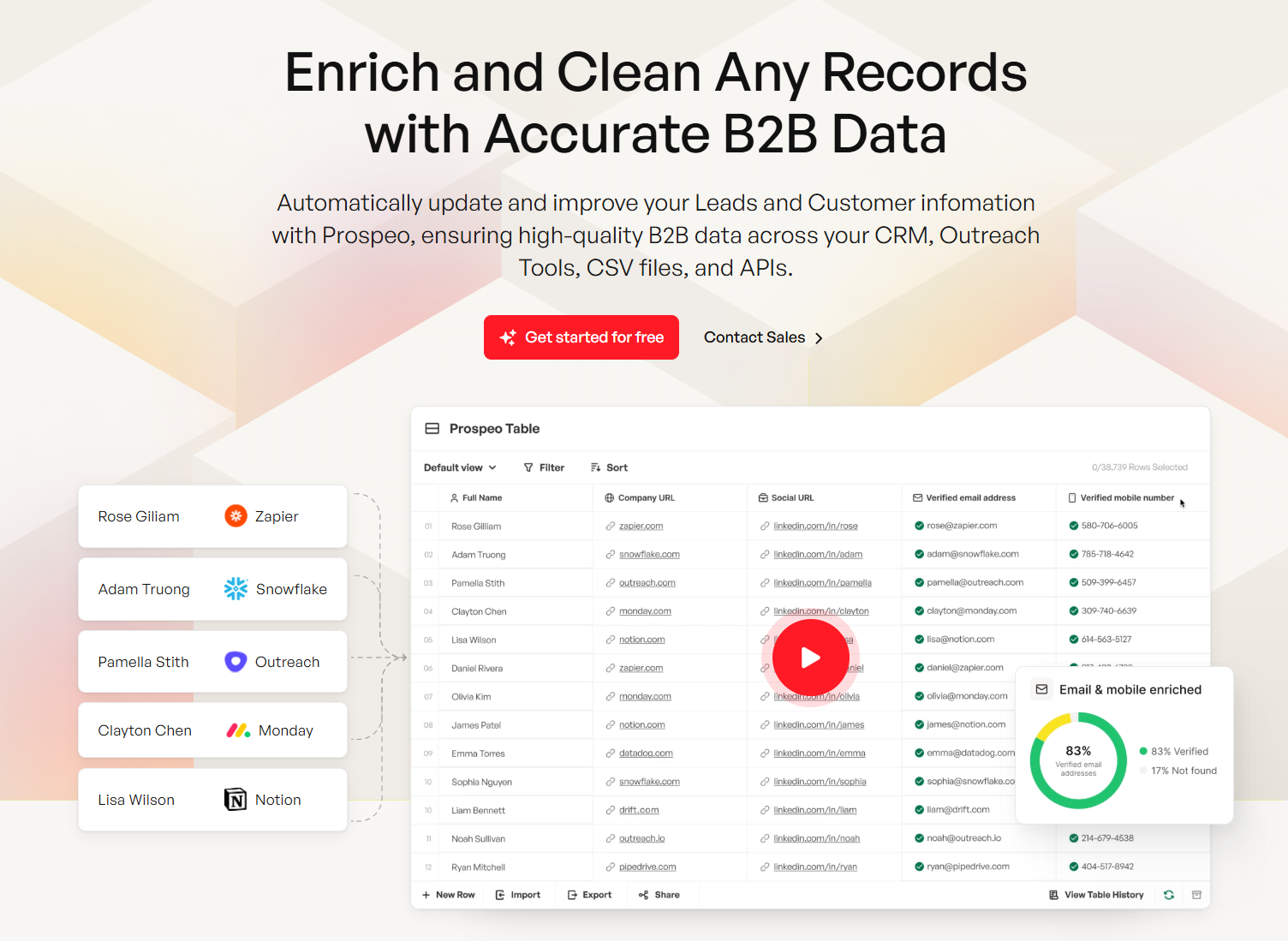
60% of rep time lost to non-selling tasks means every lead matters more. Prospeo's 7-day data refresh and 92% enrichment match rate keep your CRM current - so reps spend time closing, not chasing outdated contacts that tank your conversion benchmarks.
Hit quota with data refreshed weekly, not goals set on stale numbers.
FAQ
What's a realistic quota attainment rate?
RepVue's Q3 2025 index across 249 companies and 49,000+ reps shows 43.2% average attainment. Forrester puts it around 47%. Well-aligned teams - with proper territories, training, and realistic targets - aim for 60-70% of reps hitting quota. Below 40% means the goals are broken, not the reps.
How often should sales team goals be reviewed?
Weekly for leading indicators like activity volume and pipeline created. Monthly for conversion metrics like win rate and cycle length. Quarterly for revenue targets. HBR emphasizes real-time feedback as a performance driver - waiting for quarterly reviews to course-correct means you've already lost the quarter.
How do you set outreach goals when contact data is unreliable?
Fix the data first. Setting a "200 emails per week" target on unverified lists accelerates domain damage. Verify your contacts before you set activity goals - the order matters. Bounce rates above 5% aren't just a deliverability problem; they're a signal that every downstream metric in your funnel is inflated.
What's the difference between monthly, quarterly, and annual sales goals?
Annual goals set strategic direction - total ARR, market expansion, headcount productivity. Monthly goals break that into trackable increments tied to conversion metrics and pipeline generation. Quarterly goals align with comp plan periods and give enough runway to course-correct. The best teams cascade all three so hitting weekly and monthly targets mathematically adds up to the annual number.