

Why Your Sales Team Keeps Leaving - And How to Fix It
Most sales team retention advice focuses on pizza parties and recognition programs. That's not why your reps are leaving.
Average annual B2B sales rep turnover sits at 13.9%, and SDR churn runs 30-35% annually. If half your revenue engine is cycling through new hires at any given time, you don't have a talent problem - you have a systems problem. Retaining sales reps starts with diagnosing root causes, not applying surface-level fixes.
The Retention Crisis in Numbers
Best-practice orgs hold turnover near 8%. Anything above 20% is a five-alarm fire. When you factor in open headcount, expected attrition, new-hire productivity drag, and growth hiring, sales capacity at risk can hit 50-60% - a number that should terrify any CRO staring at a board deck. European tech commercial teams aren't faring better, with Ravio's latest data showing 18.4% attrition. And 50% of U.S. companies are bracing for turnover in 2026.
BDR retention is especially fragile. Frontline development reps face the steepest churn because they sit at the intersection of high-volume activity targets and the longest promotion timelines.
What Sales Turnover Actually Costs
The average cost of replacing an employee now runs $45,236, up from $36,723 the prior year. For sales roles, it's worse.
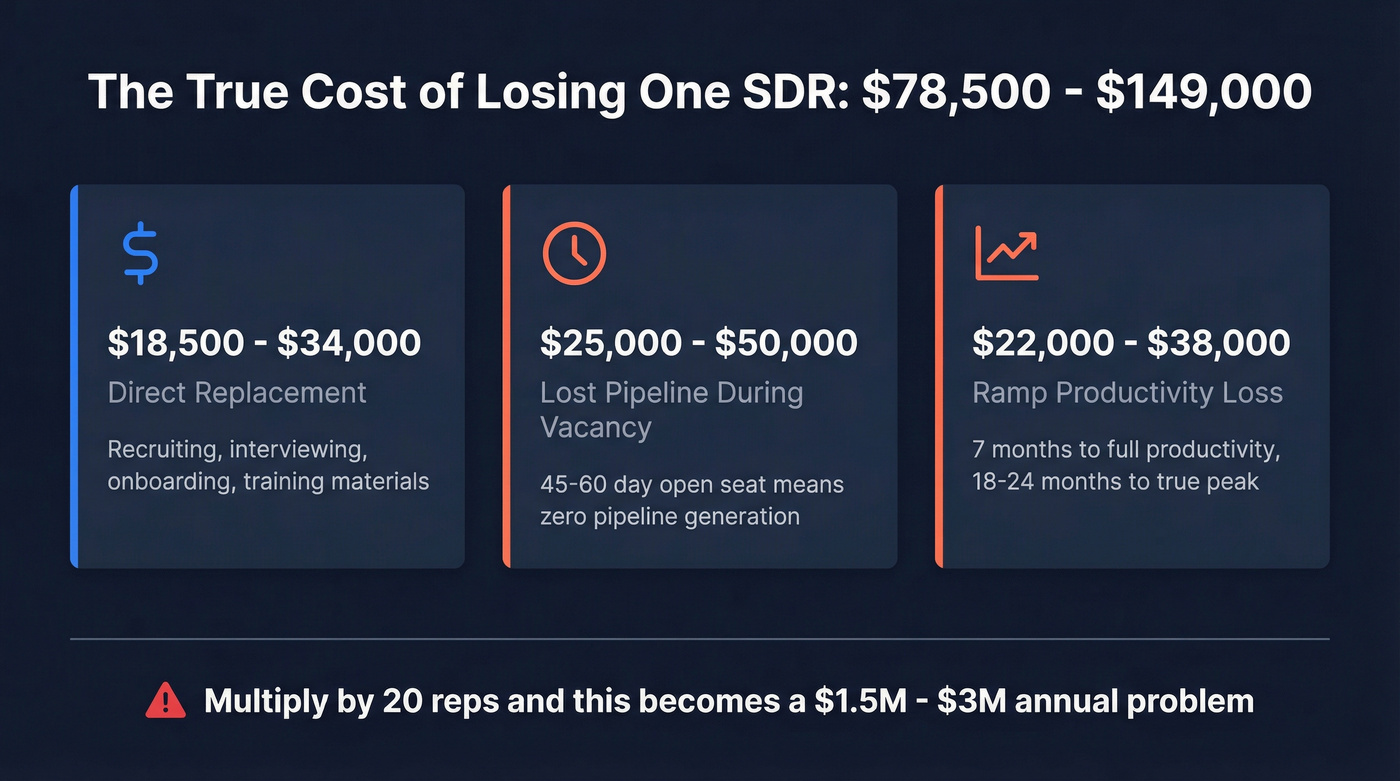
A single SDR departure costs $78,500-$149,000 across three buckets: direct replacement ($18,500-$34,000), lost pipeline during the 45-60 day vacancy ($25,000-$50,000), and ramp productivity loss ($22,000-$38,000). New reps take roughly 7 months to hit full productivity - and Baylor's Keller Center puts the true ramp window at 18-24 months. Multiply those numbers across a team of 20 and you'll see why organizations serious about reducing turnover treat retention as a P&L line item, not an HR initiative.

Bad data is a silent retention killer. When reps waste hours on bounced emails and dead numbers, they miss quota - and then they leave. Prospeo's 98% verified emails and 7-day refresh cycle cut Snyk's bounce rate from 35% to under 5% and boosted AE-sourced pipeline 180%.
Stop losing reps to a problem your data provider created.
Why Sales Reps Actually Leave
Territory and Quota Inequity
When 70% of B2B sales reps miss quota, the problem isn't effort - it's territory design. Alexander Group's diagnostics reveal bimodal attainment: about 20% of reps crush 150%+ while just under half sit below 50%. Tenured reps get grandfathered into the best accounts; new hires get greenfield territories and bigger numbers.
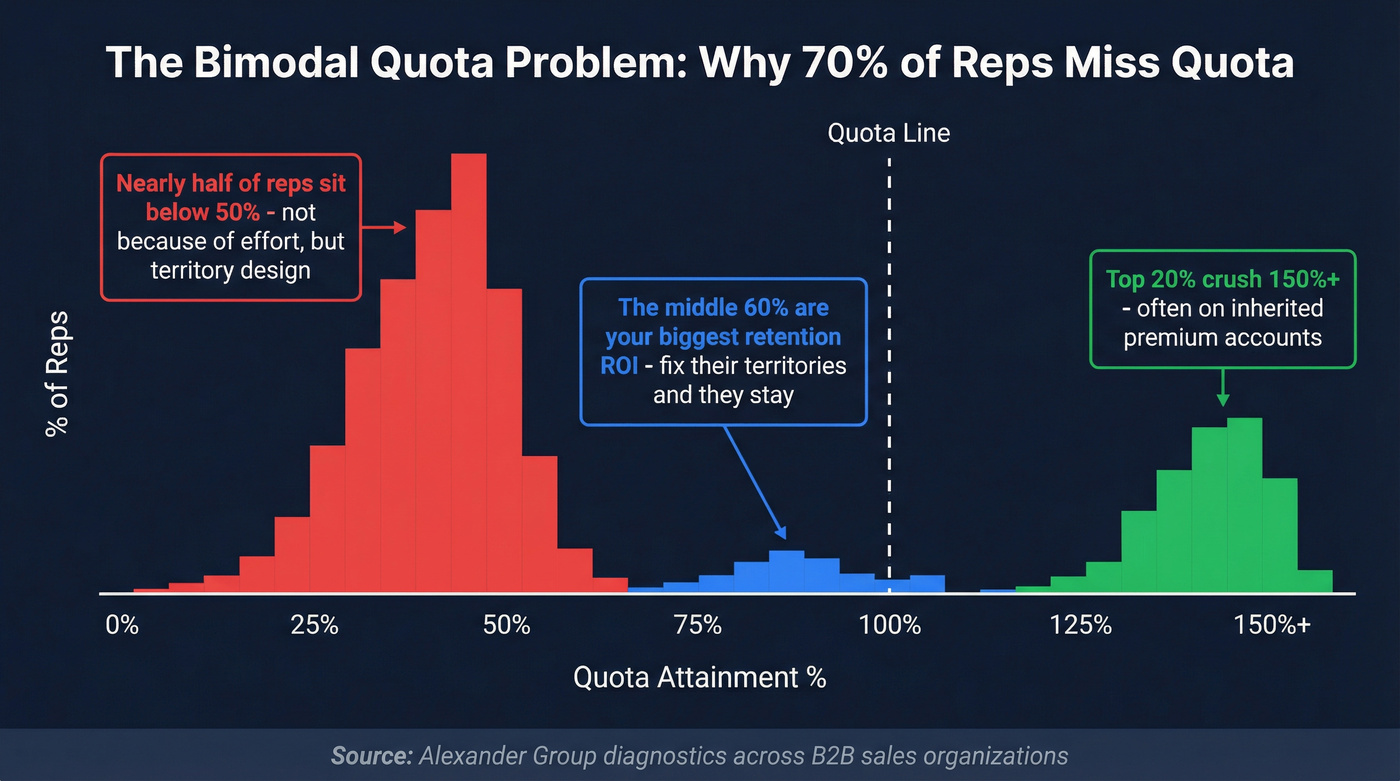
The sentiment on r/sales is blunt - success feels like "luck" based on territory assignment, not skill. The biggest retention ROI comes from the middle 60%, the reps who could hit quota with better territory design but churn when the system is stacked against them.
Comp Plan Manipulation
One rep on r/sales described their comp plan changes: commission rate cut in half, accelerators removed, earnings shifted to a "bonus" dependent on team quota that felt "highly unlikely." Leadership spun it as a positive. That's not a comp plan. It's a trust violation.
And it's not an outlier - 39% of revenue leaders admit their comp plans don't align with business goals.
Admin Overload
Reps spend roughly 30% of their time actually selling and 70% on non-selling tasks. In the "Great Sales Reset" thread on Reddit, one poster pegged their admin time at 72%. When reps can't hit activity targets because they're drowning in CRM updates and internal meetings, quota attainment becomes structurally impossible.
This is a silent killer. Reps don't quit because they hate selling. They quit because they're barely allowed to sell.
Strategies That Actually Reduce Turnover
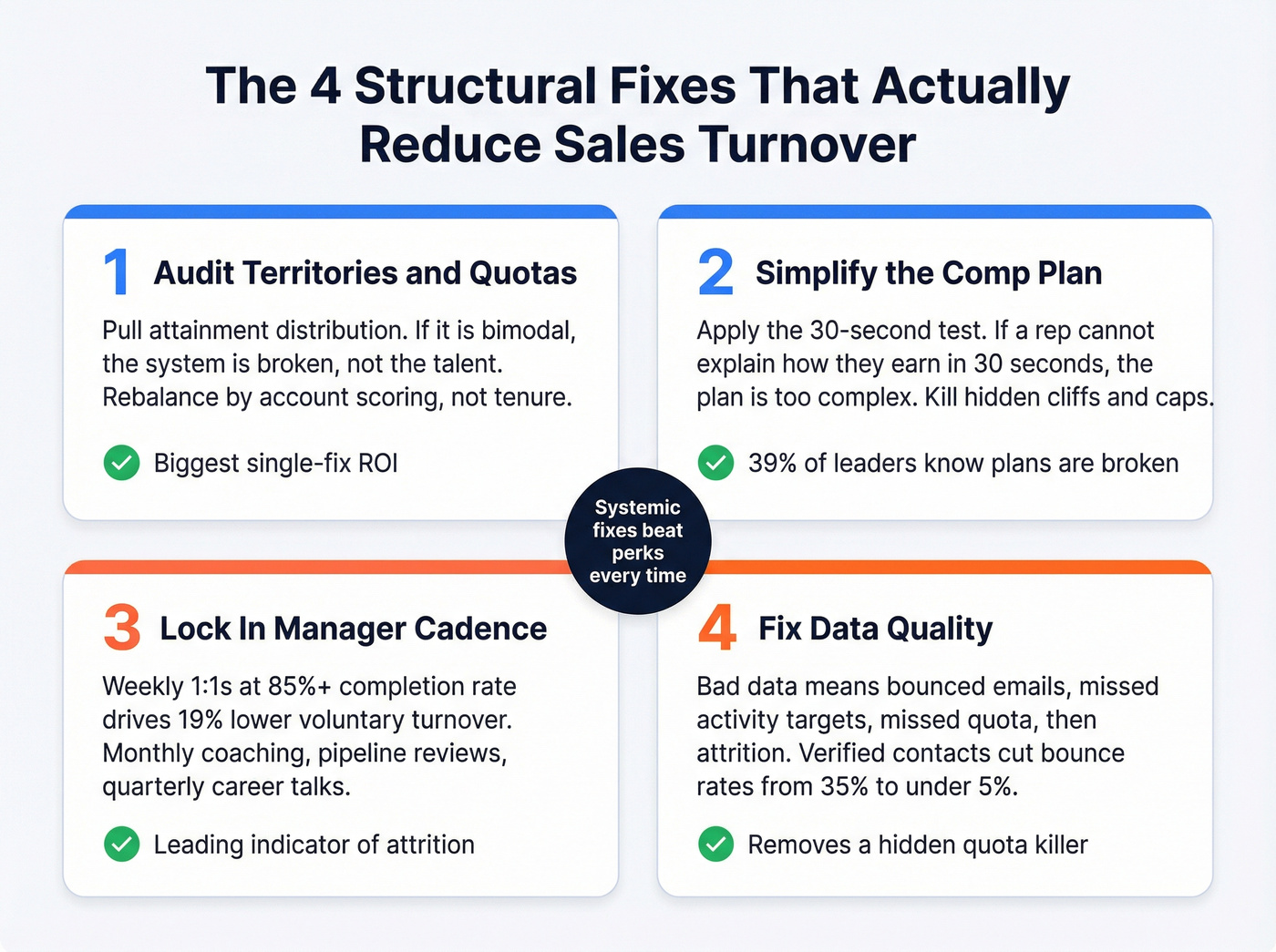
If we had to pick three fixes, they'd be: audit territories and quotas, simplify comp until reps can explain it in 30 seconds, and give managers a non-negotiable 1:1 cadence. Let's break each one down.
Audit Territories and Quotas
Pull your quota attainment distribution and look at the shape. Bimodal? The system is broken, not the talent. Rebalance territory potential using account scoring, not tenure. Stop giving new hires the hardest territories with the biggest numbers - that's a churn machine. In our experience, this single fix does more for retaining SDRs than any engagement survey ever will.
If you want a repeatable way to score and prioritize accounts, start with an Ideal Customer Profile and build from there.
Simplify the Comp Plan
QuotaPath's 30-second test is the right benchmark: if a rep can't explain how they earn in 30 seconds, the plan is too complex. Eliminate hidden cliffs and caps. Make accelerators transparent. If 39% of revenue leaders know their plans are broken, the bar is underground.
Lock In a Manager Cadence
Worklytics analyzed 3.4 billion collaboration events and found that teams with managers maintaining 85% weekly 1:1 completion see 19% lower voluntary turnover. That's not a soft metric - it's a leading indicator.
Pair that with Factor8's framework: monthly 1:1s, call coaching twice a month, pipeline reviews twice a month, and quarterly career conversations. Most managers default to reactive firefighting. A structured cadence forces proactive coaching, and coaching is what keeps reps from updating their resumes.
If you're trying to operationalize this, treat it like sales leadership infrastructure, not a manager preference.
Fix Data Quality to Fix Quota Attainment
Here's the thing: the 30/70 time split is a structural quota killer, and bad prospect data makes it worse. Bounced emails mean missed activity targets, which mean missed quota, which mean attrition. We've seen this pattern play out dozens of times.
If bounced emails are a recurring issue, use email bounce rate benchmarks to diagnose what’s normal vs. systemic.
Snyk saw it firsthand - bounce rates running 35-40% dropped under 5% after switching to Prospeo's 98%-accurate verified emails on a 7-day refresh cycle. AE-sourced pipeline jumped 180%. When reps trust their data, they hit their numbers. When they hit their numbers, they stay.
If you're evaluating vendors, compare data enrichment services and your verification workflow end-to-end.

Compress the SDR Career Path
If your SDR-to-AE promotion path takes longer than 18 months, you're training reps for your competitors. SDR tenure averages 14-18 months, and 72% of SDRs say career progression impacts their likelihood of staying long-term. Typical SDR ramp to full quota is 3-6 months, which means many SDRs leave before they're fully productive - you're losing people right when they start generating real value.
Compress the path or lose the people. For teams serious about retaining entry-level sales talent, career velocity matters more than base salary bumps.
A structured onboarding plan helps here - use a 30-60-90 day plan for sales reps to set expectations and milestones.
Spot Attrition Before It Happens
Don't wait for the resignation email. Track these leading indicators:
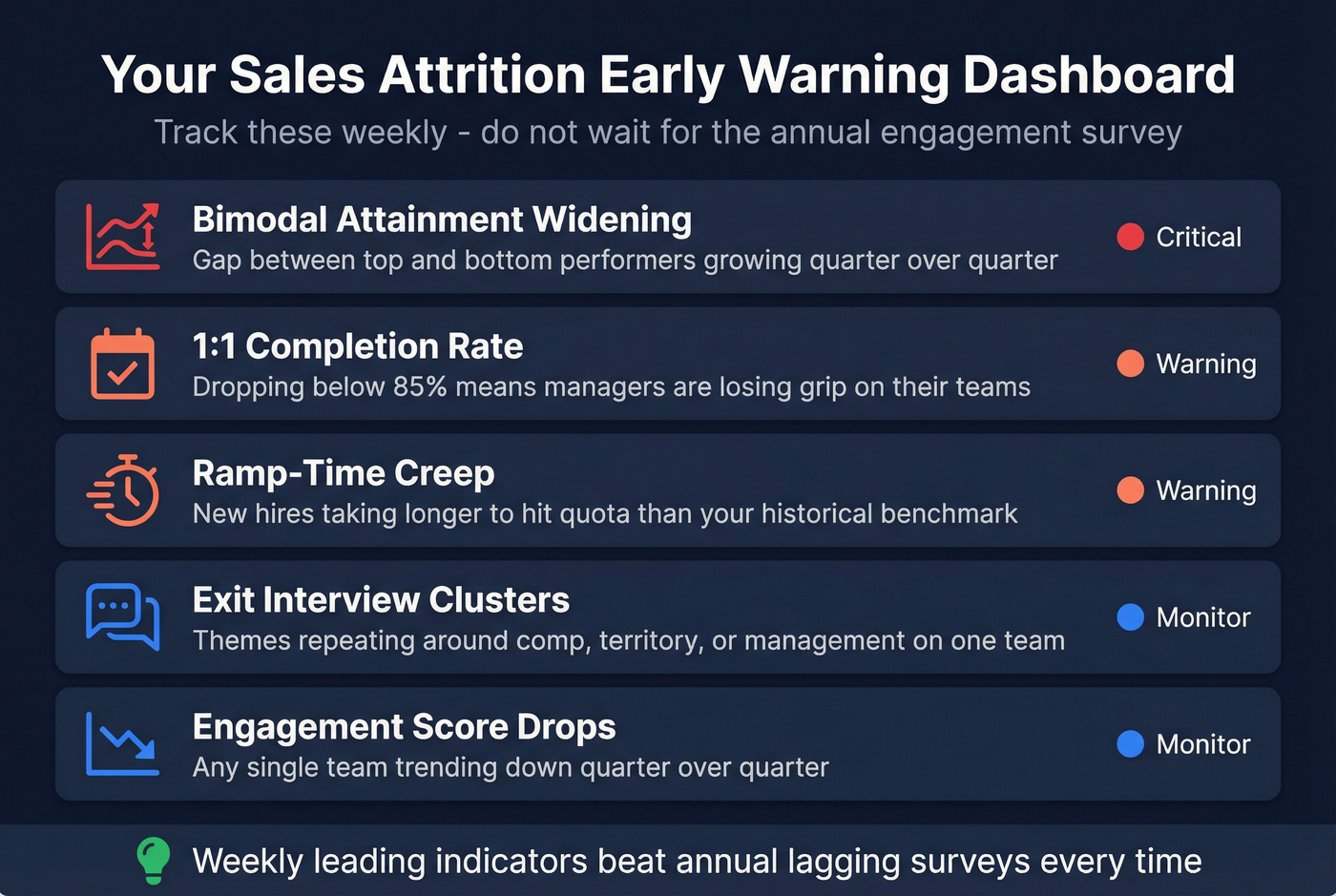
- Bimodal attainment widening quarter over quarter - territory or quota design is degrading
- 1:1 completion rate dropping below 85% - managers are losing grip
- Ramp-time creep - if new hires take longer to hit quota than your benchmark, onboarding needs work
- Exit interview clusters around comp, territory, or management themes
- Engagement score drops trending down quarter over quarter on any single team
Skip the annual engagement survey. By the time those results come back, your best reps are already interviewing. Weekly leading indicators beat annual lagging ones every time.
To make this measurable, align retention signals with sales operations metrics and review them like pipeline.
Your reps spend 70% of their time not selling. Every bounced email, every wrong number, every manual data cleanup compounds that problem. Prospeo gives your team 300M+ verified contacts at $0.01/email - so they spend time closing, not cleaning.
Give your team data worth staying for.
FAQ
What's a good sales turnover rate?
Average B2B sales turnover is 13.9%. Best-practice organizations hold it near 8%. Anything above 20% signals a structural problem - territory design, quota fairness, and comp complexity are the usual culprits worth auditing first.
How much does it cost to replace a sales rep?
The average employee replacement costs $45,236. For SDRs specifically, the fully loaded cost ranges from $78,500 to $149,000 per departure when you include vacancy pipeline loss and ramp productivity drag.
What drives the most improvement in sales team retention?
Territory equity, comp plan transparency, manager coaching cadence, and data quality. Fix those four and you address the structural causes behind most voluntary attrition. Systemic changes that remove the reasons reps leave outperform perks and bonuses every time.
How does better prospecting data reduce sales turnover?
Reps who hit quota stay longer - and bad data is a hidden quota killer. Tools like Prospeo cut bounce rates from 35-40% to under 5% with 98%-accurate verified emails refreshed every 7 days, directly improving activity metrics and attainment.