

How to Build a Sales Team Training Program That Doesn't Fail
Your VP of Sales just told you the team needs training because they missed quota last year. You've got $50K and 90 days to build a sales team training program that "fixes execution" without turning the org upside down.
Here's the uncomfortable part: only 18% of buyers believe salespeople are well-prepared for meetings. And 85-90% of sales training has no lasting impact after 120 days. It's not because reps are lazy - it's because most companies buy a workshop and call it a program.
U.S. training spend reached $102.8B in 2025, the most recent year on record. The money's there. The system usually isn't.
What You Need (Quick Version)
If you're building from scratch, you need three things:
- A methodology that fits your deal type - enterprise qualification isn't the same as SMB velocity.
- A reinforcement system, not a one-time event.
- Clean prospect data so reps can apply what they learned immediately instead of spending week one hunting for email addresses (see sales prospecting techniques that work with verified lists).
What a Training Program Actually Is
A training program for your sales team isn't "training." It's a system that changes behavior inside your workflow.
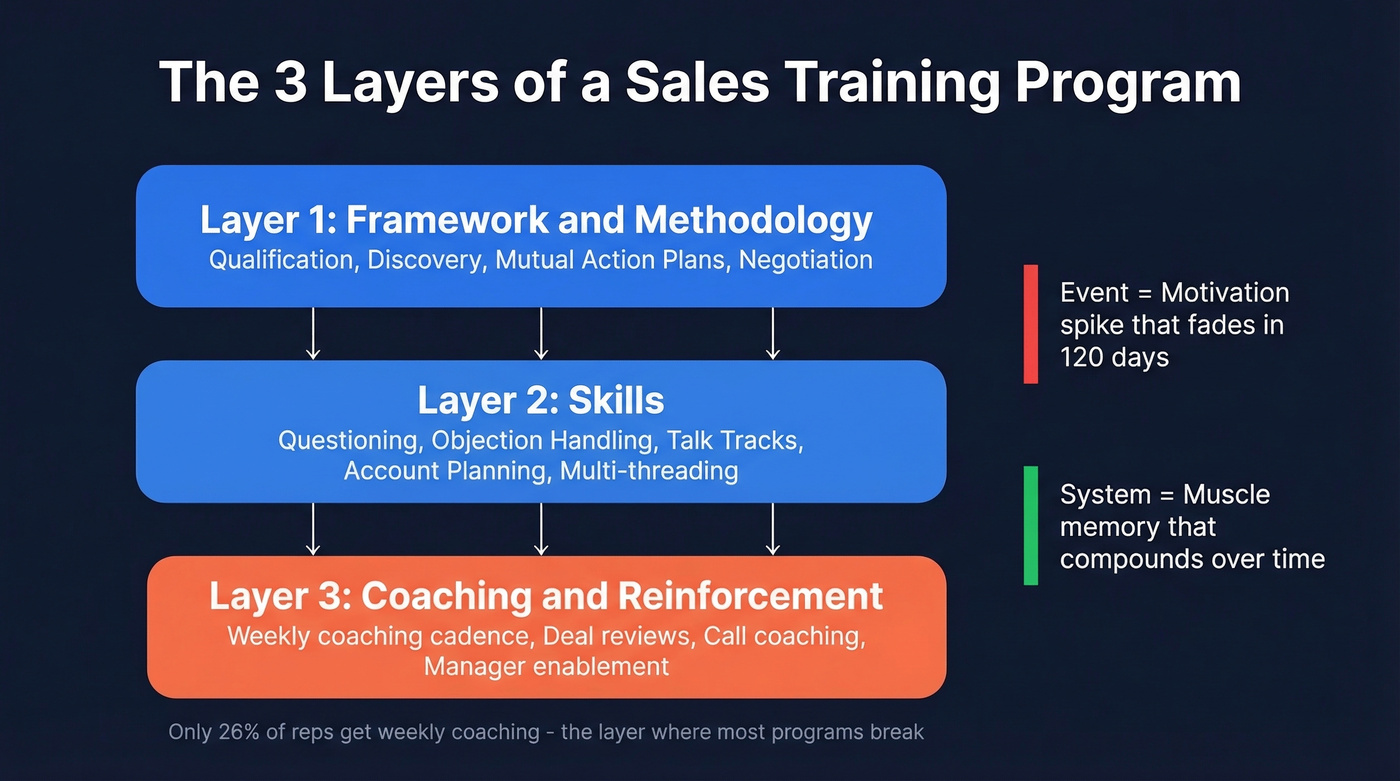
Think of it as three layers. First, framework and methodology - how your team runs deals through qualification, discovery, mutual action plans, and negotiation. Second, skills - the micro-behaviors reps execute like questioning, objection handling, talk tracks, account planning, and multi-threading. Third, coaching and reinforcement - the operating cadence that makes the first two stick.
Most teams do layers 1 and 2 as an event - kickoff, workshop, certification - then wonder why nothing changes. Training as an event creates motivation. Training as a system creates muscle memory.
Coaching is the choke point. Only 26% of reps receive weekly coaching, even though weekly coaching is linked to 25% higher quota attainment and 30% more deals won. That's why "great content" still dies on Monday.
Why Most Sales Training Fails
Programs fail in three predictable ways.
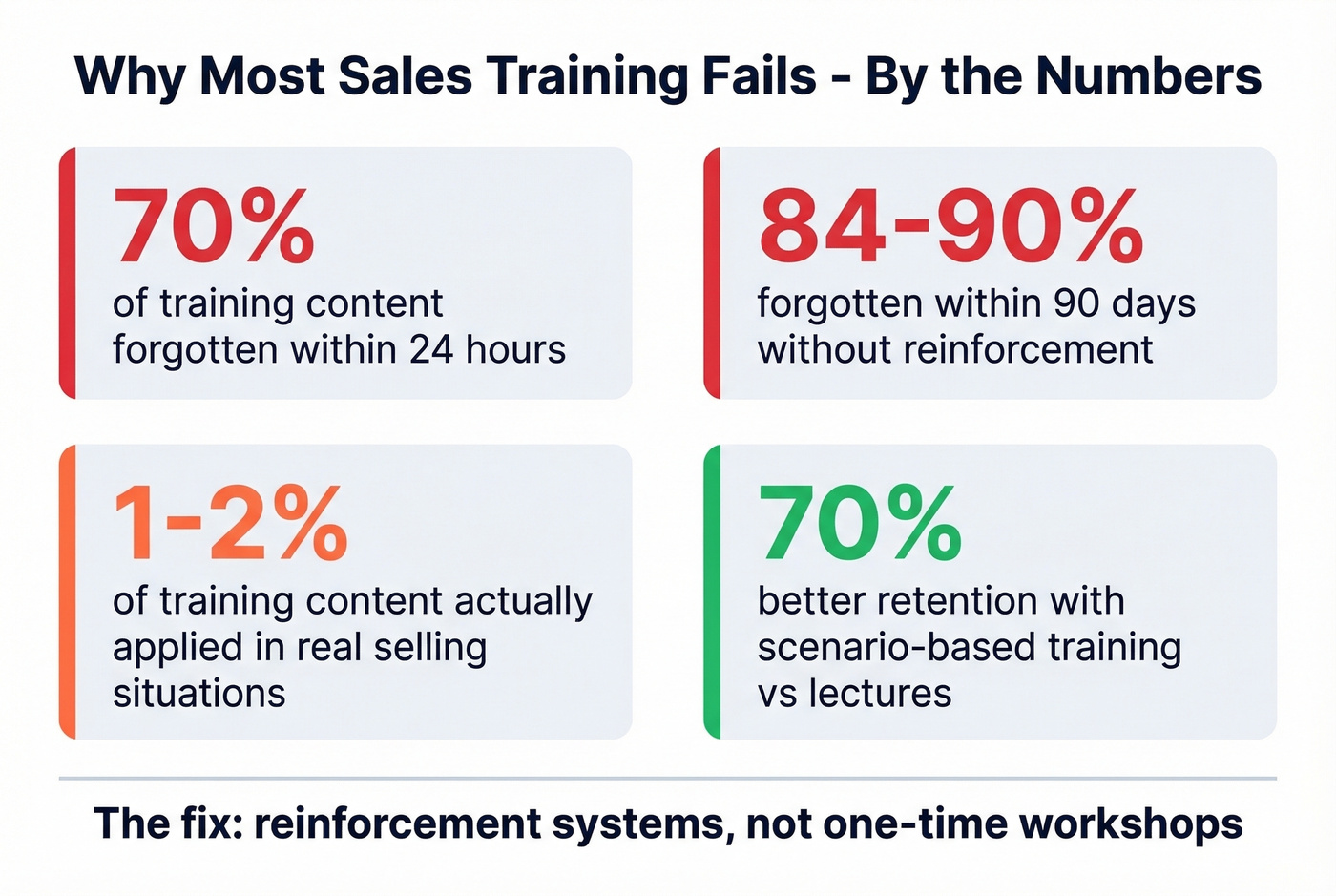
It's treated like a one-and-done. Reps get a two-day workshop, a PDF playbook, and a pat on the back. Then they go back to the same pipeline, the same sequences, and the same manager habits. The forgetting curve is brutal: teams forget 70% within 24 hours and 84-90% within 90 days. If you don't build reinforcement into the calendar, you're paying for a motivational spike.
There's no reinforcement mechanism. A common benchmark is that only 1-2% of training content gets applied in real situations. Scenario-based training improves retention up to 70% versus lecture-based formats. If your program is mostly slides, it's mostly theater.
Nobody measures a baseline. If you can't answer "what's broken?" with data, you'll build generic training that produces generic results. The baseline doesn't need to be fancy - discovery-to-next-step conversion, stage velocity, win rate by segment, and talk-to-listen ratio on calls will tell you most of what you need.
We've watched teams spend months debating "which methodology is best" while ignoring the fact that half their opps have no next meeting booked. Fix the operating system first (and map it to your sales process optimization work).
How to Build Your Program in 6 Steps
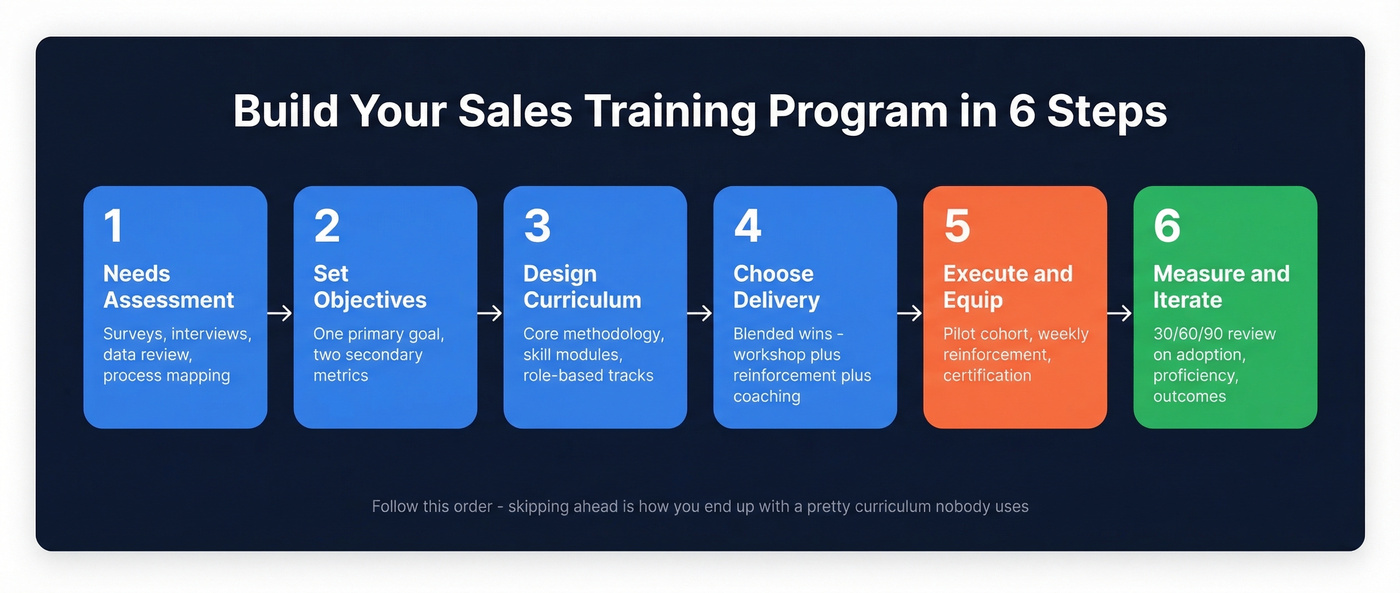
This is the build sequence that holds up in real orgs - whether you're a 6-rep startup or a 60-rep scale-up. A solid training plan follows these stages in order, because skipping ahead is how you end up with a pretty curriculum nobody uses.
Step 1: Run a Needs Assessment
Start with evidence, not opinions. A thorough sales training needs assessment finds the one or two bottlenecks that create the biggest revenue drag - not the skill gap leadership assumes exists.
Use a mix of rep surveys covering confidence by skill and where deals stall, stakeholder interviews across Sales, CS, Marketing, and RevOps to find where handoffs break, performance data review covering stage conversion and win/loss notes, and process mapping to see where your defined process diverges from reality.
We've done bake-offs where the "problem" was framed as objection handling, but the data showed discovery was weak - reps weren't uncovering impact, so pricing pressure was inevitable. Documenting training needs with data rather than gut feel is what separates programs that move metrics from programs that produce binder shelfware.
Step 2: Set Measurable Objectives
Training goals like "improve discovery" don't survive budget scrutiny. Tie the program to business outcomes and pick leading indicators you can coach weekly.
Examples that work: increase average deal size by 20%, which usually means improving discovery, value articulation, and packaging. Or reduce sales cycle by 10%, which usually means tightening qualification, next-step discipline, and mutual plans. Pick one primary objective and two secondary metrics. More than that and you'll drown in dashboards (use a simple pipeline health view to keep it coachable).
Step 3: Design the Curriculum
Build the curriculum like a product roadmap: small releases, tight feedback loops, and ruthless prioritization.
A practical structure includes a core methodology module covering how you run deals end-to-end, skill modules for discovery, qualification, objection handling, and negotiation, role-based tracks for SDRs versus AEs versus AMs, and a dedicated manager track for coaching and deal reviews.
For new hires specifically, structured onboarding reduces ramp time by up to 34% and retains 50% more new hires. Build a distinct 30/60/90-day onboarding track within the program rather than throwing new reps into the same curriculum as tenured sellers (you can model it on a 30/60/90-day plan).
Step 4: Choose Delivery Methods
Delivery is a lever, not the program. Pick the format that matches your constraints and your team's maturity.
Classroom / live workshop is best for alignment and energy but weak for retention unless reinforced. Online / self-paced is scalable and cheap, but completion doesn't equal behavior change. Blended is the default winner - workshop plus weekly reinforcement plus manager coaching. AI simulation is the best way to get reps practice without burning pipeline.
Let's be honest: blended plus practice beats "content" every time. Content is abundant. Behavior change is scarce.
Step 5: Execute and Equip Reps
Execution is where programs die - not because the training is bad, but because the environment doesn't support the new behavior.
Your rollout needs a pilot cohort of 5-10 reps before full rollout, weekly manager-led reinforcement sessions of 15-30 minutes at a consistent day and time, deal review templates that force the new methodology, call coaching tied to one skill per week, and a simple pass/fail certification tied to real scenarios. Each reinforcement meeting should focus on a single skill or scenario - trying to cover three topics in 30 minutes guarantees none of them stick.
Step 6: Measure and Iterate
If it doesn't show up in the CRM and deal reviews, it doesn't exist.
Measure in three layers. Adoption: are reps using the language and steps in deals? Proficiency: are they getting better in role-plays and call reviews? Outcomes: did your target metrics move on cycle time, win rate, and deal size?
Run a 30/60/90-day review. Keep what's working. Cut what isn't. Training is a system, not a launch.

You just invested months building a training program. Don't let reps waste week one hunting for contact data. Prospeo gives your team 300M+ verified profiles with 98% email accuracy so they can apply new skills on real prospects the same day training ends.
Training without clean data is just expensive theater. Fix that.
Which Methodology Fits Your Team?
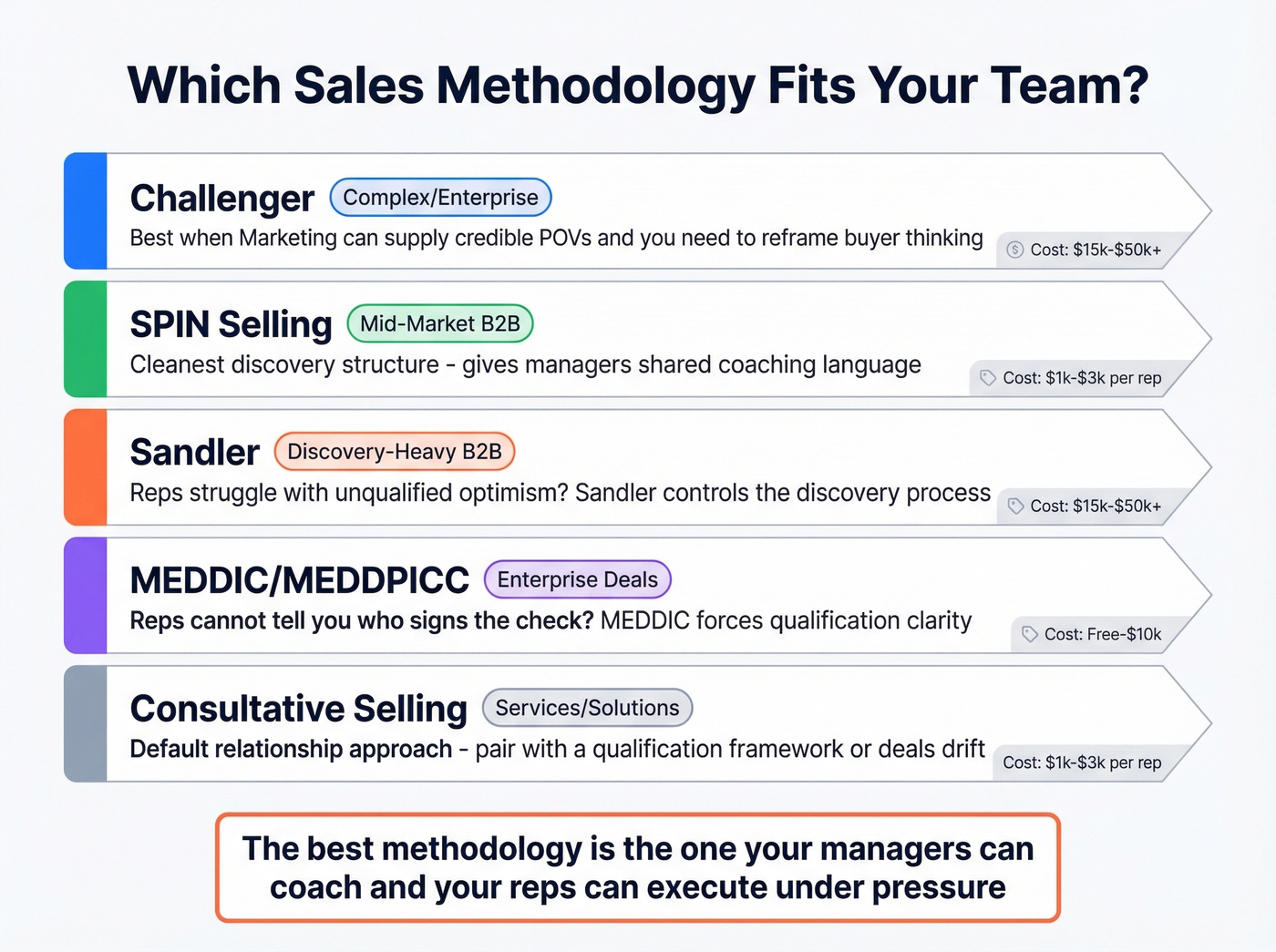
Methodologies are tools. The "best" one is the one your managers can coach and your reps can execute under pressure.
| Methodology | Best For | Research Basis | Ideal Deal Type | Typical Cost |
|---|---|---|---|---|
| Challenger | Commercial insight selling | 6,000+ reps studied | Complex/enterprise | $15k-$50k+ |
| SPIN Selling | Structured discovery | 35,000 calls / 12 yrs | Mid-market B2B | $1k-$3k/rep |
| Sandler | Discovery + control | System-based | Discovery-heavy B2B | $15k-$50k+ |
| MEDDIC/MEDDPICC | Qualification rigor | Field-proven | Enterprise deals | Free-$10k |
| Consultative Selling | Relationship/value | Broad | Services/solutions | $1k-$3k/rep |
Skip Challenger Unless Marketing Can Back You Up
Challenger works when you sell something that requires reframing the buyer's thinking. It's built on research with 6,000+ reps, and Xerox drove $65M in contract value and a 17% sales increase after implementation. But here's where it breaks: teams try to "teach" without real customer insight. If Marketing can't supply credible POVs, reps end up sounding like they're reading hot takes off a slide. Without the insight engine, Challenger is just assertiveness training.
SPIN Selling
SPIN is still one of the cleanest discovery structures ever published, based on 35,000 calls across 20+ countries over 12 years. For mid-market teams, SPIN's biggest value is consistency - it gives managers a shared language to coach. The tradeoff is speed. If you're running high-velocity inbound where calls are 12 minutes long, SPIN can feel heavy unless you simplify it.
Sandler vs. MEDDIC
Sandler and MEDDIC solve adjacent problems, and teams often confuse them. Sandler controls the discovery process - it's for teams that struggle with "unqualified optimism," the opp that feels good but never closes. MEDDIC controls the qualification process - it forces clarity on metrics, economic buyer, and decision process.
If your problem is "reps don't ask hard questions early enough," pick Sandler. If your problem is "reps can't tell you who signs the check," pick MEDDIC.
Here's the thing: MEDDIC fails when it becomes a checkbox exercise. If reps fill fields after the fact, you're just documenting losses. And Sandler fades fast if leadership treats it like a rep-only training instead of running Sandler-style deal reviews themselves. The consensus on r/sales is pretty consistent on this - methodology without manager buy-in is dead on arrival.
Consultative Selling
Consultative selling is the "default" approach most teams think they're doing. It's fine for relationship-driven sales and services, but it needs structure or it turns into friendly conversations with no next step. If you pick consultative, pair it with a qualification framework so deals don't drift (and keep reps consistent with discovery questions managers can coach).
What Sales Training Costs in 2026
Training budgets get weird because teams compare a $300 course to a $30k engagement like they're the same thing. They're not.
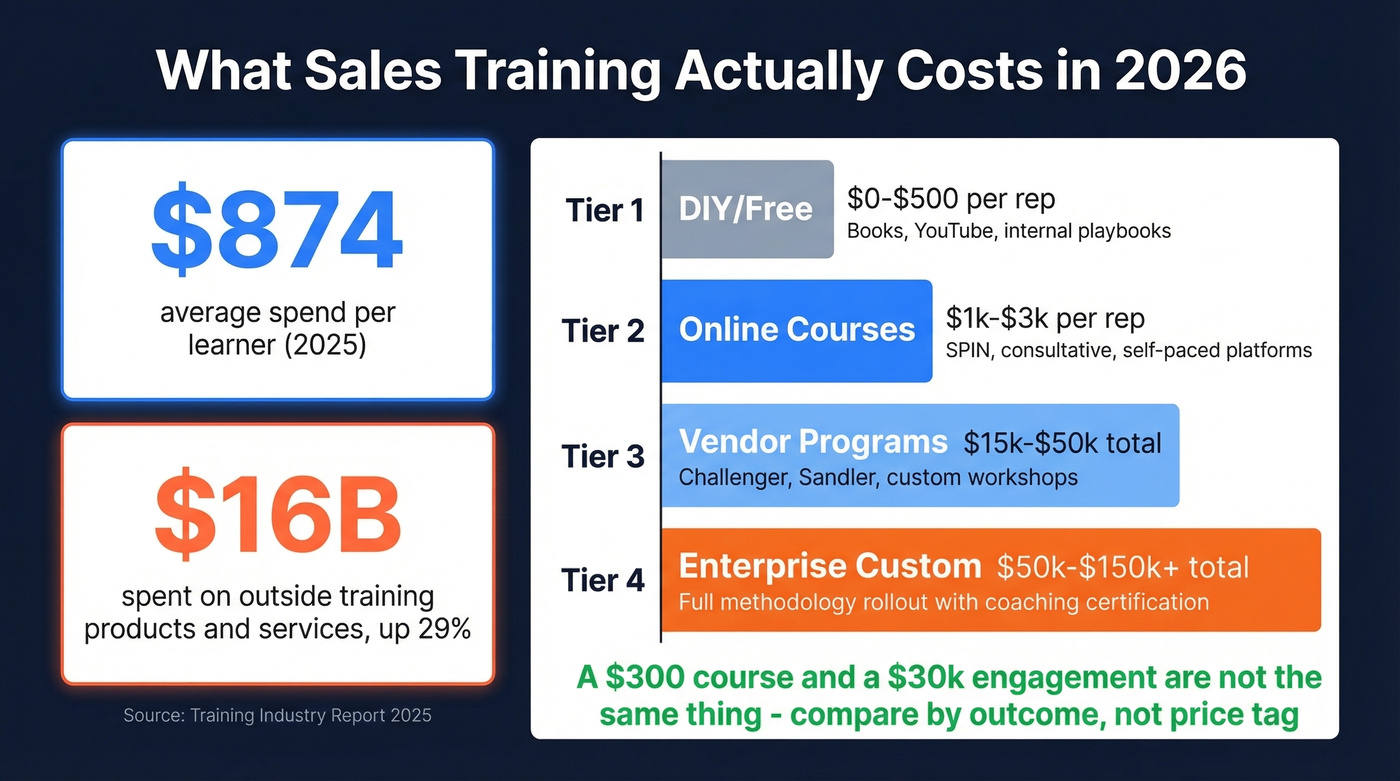
A clean benchmark: companies spent $874 per learner in 2025 on average across all training. Outside products and services spend jumped 29% to $16B that same year, which tells you companies are increasingly buying vendor programs rather than building in-house.
| Format | Price Range | Best For | Example Providers |
|---|---|---|---|
| Online course | $50-$500 | Basics, refreshers | LMS vendors |
| Workshop (per rep) | $1k-$3k | Skill sprints | Sandler, Richardson |
| Custom corporate | $15k-$50k+ | Full programs | RAIN Group, Dale Carnegie |
| Certification | Free-$200 | Credibility | Trailhead, Salesforce |
| AI role-play | $1k-$5k/rep/yr | Practice at scale | Second Nature, Hyperbound |
For credibility anchors: Trailhead is free, and the $200 Salesforce Sales Representative Certification exam is a real, published number. On the high end, custom corporate programs typically land in the $15k-$50k+ range depending on team size and duration. Dale Carnegie's published program range is $1,000-$1,800 depending on location.
A practical budget for a 20-person team lands around $25,000-$60,000/year: $15k-$30k for a vendor-led program or workshops, $5k-$15k for reinforcement tooling including enablement and AI practice, and $5k-$15k for manager enablement and call coaching ops.
Skip any vendor that won't publish even a ballpark price. They're using the same opaque approach they're training your reps not to use.
How to Evaluate a Provider
Evaluate providers on reinforcement and implementation risk, not on how good the slide deck looks.
The Sales Collective has the cleanest scorecard we've used, because it forces you to weight what actually drives adoption. Here's the weighted model from their effective sales training scorecard:
| Category | Weight | What to Look For |
|---|---|---|
| Fit | 15% | ICP + deal motion match |
| Methodology | 15% | Clear, coachable system |
| Manager enablement | 20% | Manager training + tools |
| Reinforcement | 20% | Weekly cadence + assets |
| Measurement | 20% | CRM + deal review metrics |
| Impl. risk | 10% | Time, effort, change mgmt |
The rule we use in every evaluation: if it doesn't show up in CRM and deal reviews, it doesn't exist. Great training that isn't inspected becomes optional.
Five green flags: they can explain their reinforcement system in 60 seconds without hand-waving. They train managers first or at least in parallel, not as an afterthought. They'll run a pilot and define success metrics before scaling. They map training content to your actual stages, exit criteria, and call types. And they provide assets that live inside the workflow - deal review templates, call scorecards, certification rubrics (borrow from proven sales training tips to keep reinforcement lightweight).
AI and Sales Training in 2026
AI practice has moved from experimental to expected.
Gartner projected that 60% of large enterprises would adopt AI-based simulation tools by 2026 - and we're there now. If your team isn't using AI role-play, you're already in the minority among enterprise orgs.
The outcomes justify the shift. PwC found simulation learners were 275% more confident and finished 4x faster than classroom learners. Deloitte ties immersive learning to up to 60% time-to-competency reduction. McKinsey links genAI in customer-facing roles to 15-20% productivity improvements.
Budgets are following: 51% of business leaders rank L&D as a top tech spending priority.
Tools worth evaluating for AI role-play: Second Nature and Hyperbound. If your program doesn't include AI practice by 2027, you're behind the curve - and behind your competitors.
The Training Multiplier Nobody Budgets For
Your newest AE aced the role-plays, passed certification, and hit the phones Monday. By Wednesday, she's winging it because her prospect list is full of dead contacts.
That's the training multiplier nobody budgets for: data quality. If reps can't reach the right people, they can't practice the new talk track, they can't run clean discovery, and managers can't coach real calls. GreyScout saw rep ramp time drop from 8-10 weeks to 4 weeks after fixing the data layer and deliverability issues - bounce rates went from 38% to under 4%, and pipeline jumped 140% (this is where data enrichment services can make the training stick).
If you want the simplest starting point, use Prospeo's email finder to build verified lists for the exact accounts and roles your training scenarios target. Reps get 98% accurate emails and direct dials on day one, so the skills you just trained actually get executed against real buyers.
The article says 85-90% of training fails within 120 days. One reason? Reps can't practice on real pipeline because they're stuck finding emails. Prospeo's 30+ search filters, intent data, and $0.01/email pricing let newly trained reps fill pipeline fast - so coaching sticks.
Cut rep ramp time by giving them prospects, not busywork.
FAQ
How long does it take to build a sales team training program?
Plan 4-8 weeks for needs assessment, curriculum design, and pilot delivery. Reinforcement and iteration are continuous - training is a system, not a project with an end date. Building your rollout plan week by week gives you natural checkpoints to adjust before scaling to the full org.
What's the average ROI of sales training?
Industry benchmarks put ROI around $4.53 returned per $1 invested when programs include structured reinforcement. Without reinforcement, 85-90% of sales training has no lasting impact after 120 days. Measure ROI through stage conversion, cycle time, and win rate shifts - not satisfaction surveys.
Should I build internally or hire a vendor?
Teams under 20 reps with a strong sales leader can build internally using a proven methodology plus a strict coaching cadence. Larger teams or orgs without dedicated enablement benefit from a vendor's reinforcement infrastructure and manager training resources.
How do I get leadership buy-in for training budget?
Lead with the $874/learner benchmark and tie spend to a specific revenue gap - for example, "we close 18% of qualified opps vs. our 25% target." Propose a 90-day pilot with clear KPIs and a go/no-go decision point. Executives don't fund "training." They fund measurable bets.
What tools complement a training program?
A complete stack includes a methodology, an enablement platform like Highspot or Seismic, AI practice tools like Second Nature or Hyperbound, call coaching through Gong, and verified prospect data so reps can apply skills immediately on real accounts instead of stale lists.