

Sales Tips That Actually Work - for Reps and Managers
Most sales tips articles are written by marketers who haven't carried a quota since 2019. You can tell because the advice sounds great on a slide deck and falls apart on a Monday morning. Every tip here is paired - one for reps, one for managers - because that's what useful sales advice actually looks like: both sides of the same problem, not generic platitudes aimed at nobody in particular.
An SDR manager we know pulled a report last quarter and found one rep had sent 847 emails in a single week. Impressive hustle, right? Except 38% bounced. That's 322 messages that never reached a human, and the rep's "activity metrics" looked great on paper. The manager's dashboard was lying to both of them.
That's the kind of problem these paired tips solve.
If You Only Do Three Things
Pick one from your column and do it this week.
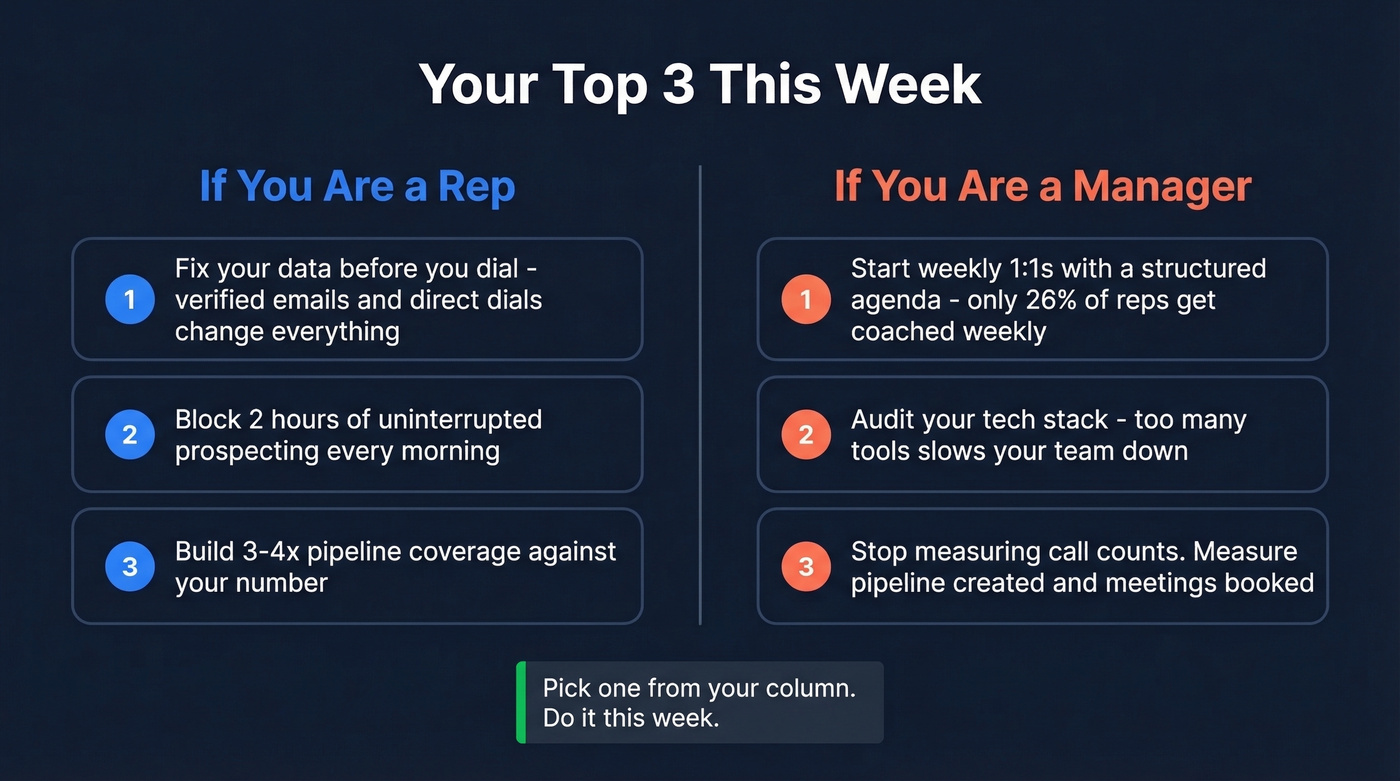
| If You're a Rep | If You're a Manager |
|---|---|
| Fix your data before you dial - verified emails and direct dials change everything | Start weekly 1:1s with a structured agenda (only 26% of reps say they get one-on-one coaching weekly) |
| Block 2 hours of uninterrupted prospecting every morning | Audit your tech stack - too many tools slows your team down |
| Build 3-4x pipeline coverage against your number | Stop measuring call counts. Measure pipeline created and meetings booked |
That pipeline coverage number isn't arbitrary. If your quota is $500K, you need $1.5-2M in qualified pipeline at all times. Anything less and you're one slipped deal away from a bad quarter.
Prospecting and Pipeline
Reps: Better Data Beats Better Scripts
Engaging a potential B2B buyer takes more than a dozen touches on average. A lot of reps stop after a few. That's not a motivation problem - it's a math problem. If your contact data is bad, those touches never land, and you burn out chasing ghosts.
The fastest way to improve your prospecting isn't a new subject line. It's making sure your emails actually arrive. Snyk had 50 AEs each spending 4-6 hours per week prospecting with a 35-40% bounce rate. After cleaning up their data layer with verified contacts through Prospeo, bounces dropped under 5%, AE-sourced pipeline jumped 180%, and they were generating 200+ new opportunities per month. The emails didn't get better. The data did.

Managers: Audit Inputs, Not Outputs
If your team's bounce rate is above 5%, you don't have a performance problem - you have a data problem. Before you coach reps on messaging, check whether their messages are even arriving.
Pull your team's last 1,000 outbound emails and check the bounce rate. If it's north of 10%, your activity dashboards are inflated and your reps are demoralized by phantom "low response rates" that are actually deliverability failures. Fix the data layer first. Everything downstream gets easier.
Build the expectation of 3-4x pipeline coverage into your operating rhythm. Review this number weekly, not quarterly. If coverage drops below 3x, that's your early warning system - not the missed-quota email from finance six weeks later.
Coaching and Feedback
Reps: Don't Wait to Be Coached
Only 26% of reps get weekly 1:1 coaching. If your manager isn't offering it, ask for it. Come with specific questions, not vague requests for "feedback." Record your own calls, listen back, and bring the timestamp where you lost the deal. That's self-coaching, and it's the fastest way to improve regardless of your manager's skill level.
Build a personal skill rotation: objection handling on Monday, discovery questions on Tuesday, closing techniques on Wednesday. Fifteen minutes a day compounds faster than a quarterly training session.
Managers: Structure Your 1:1s
Gartner's research shows that effective coaching increases rep performance by 8%. The keyword is "effective." A 30-minute 1:1 where you review pipeline in a spreadsheet isn't coaching - it's a status update.
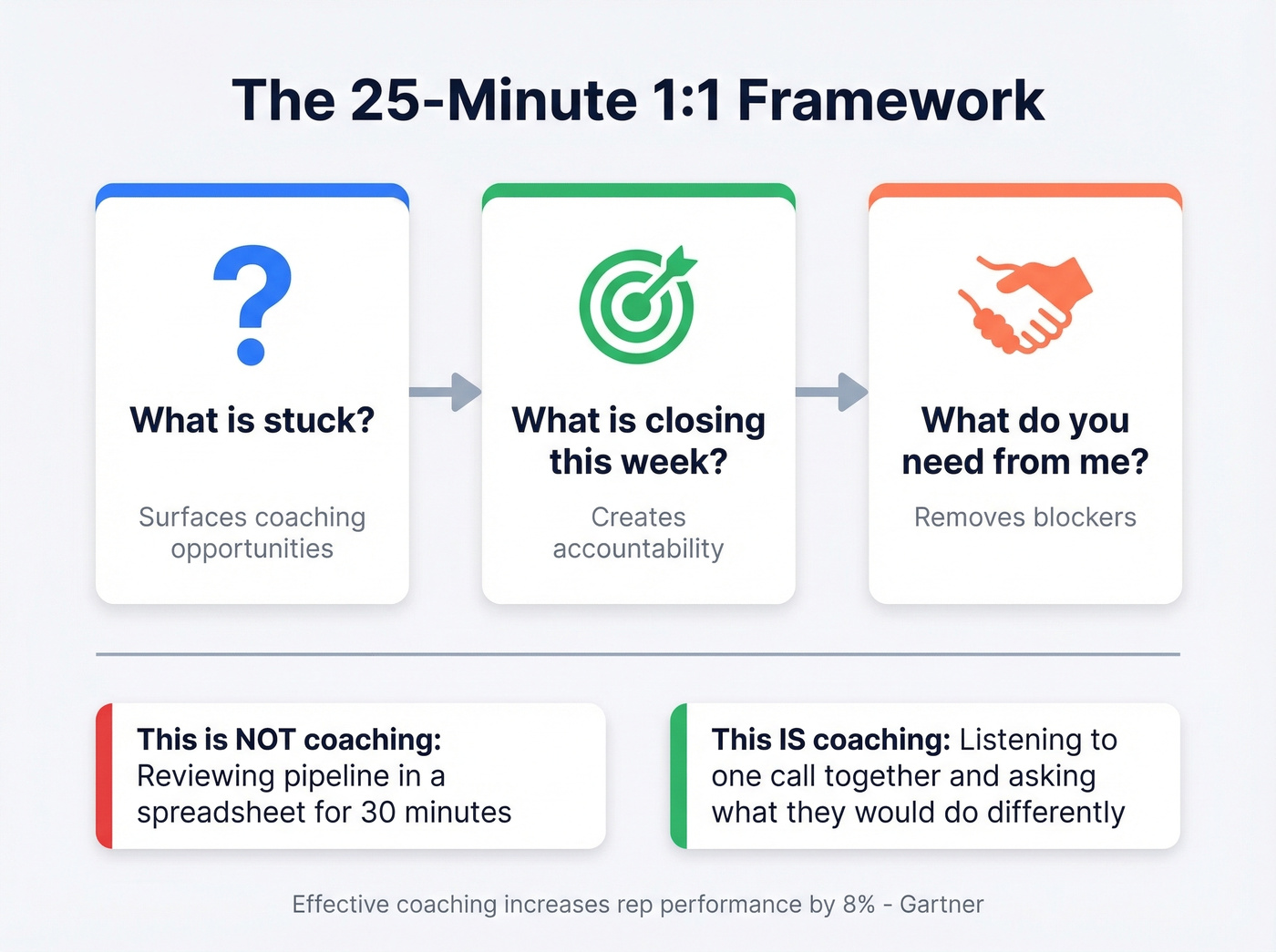
Use three questions every week: What's stuck? What's closing this week? What do you need from me? The first question surfaces coaching opportunities. The second creates accountability. The third removes blockers. If you can't answer all three in 25 minutes, you're going too deep on one deal and missing the pattern across the team.
Call reviews are the highest-leverage coaching tool most managers ignore. Pick one call per rep per week. Listen together. Don't critique - ask the rep what they'd do differently. They'll coach themselves better than you can.
Time and Productivity
Reps: Guard Your Morning
Sales reps spend roughly 40% of their time searching for or creating content. That's a massive chunk of the week not selling. The fix is brutally simple: time-block your calendar.
Two hours of uninterrupted prospecting every morning, before Slack and email eat your focus. Batch admin tasks into a 45-minute afternoon block. Prep for tomorrow's calls in the last 30 minutes of your day. This isn't productivity theater - it's the difference between 20 meaningful touches a day and 8.
Managers: Protect Selling Time
37% of employees say they use too many tools, and every tool comes with a login, a dashboard, and a meeting about the dashboard. If your team is constantly toggling between platforms, you're the problem, not them.
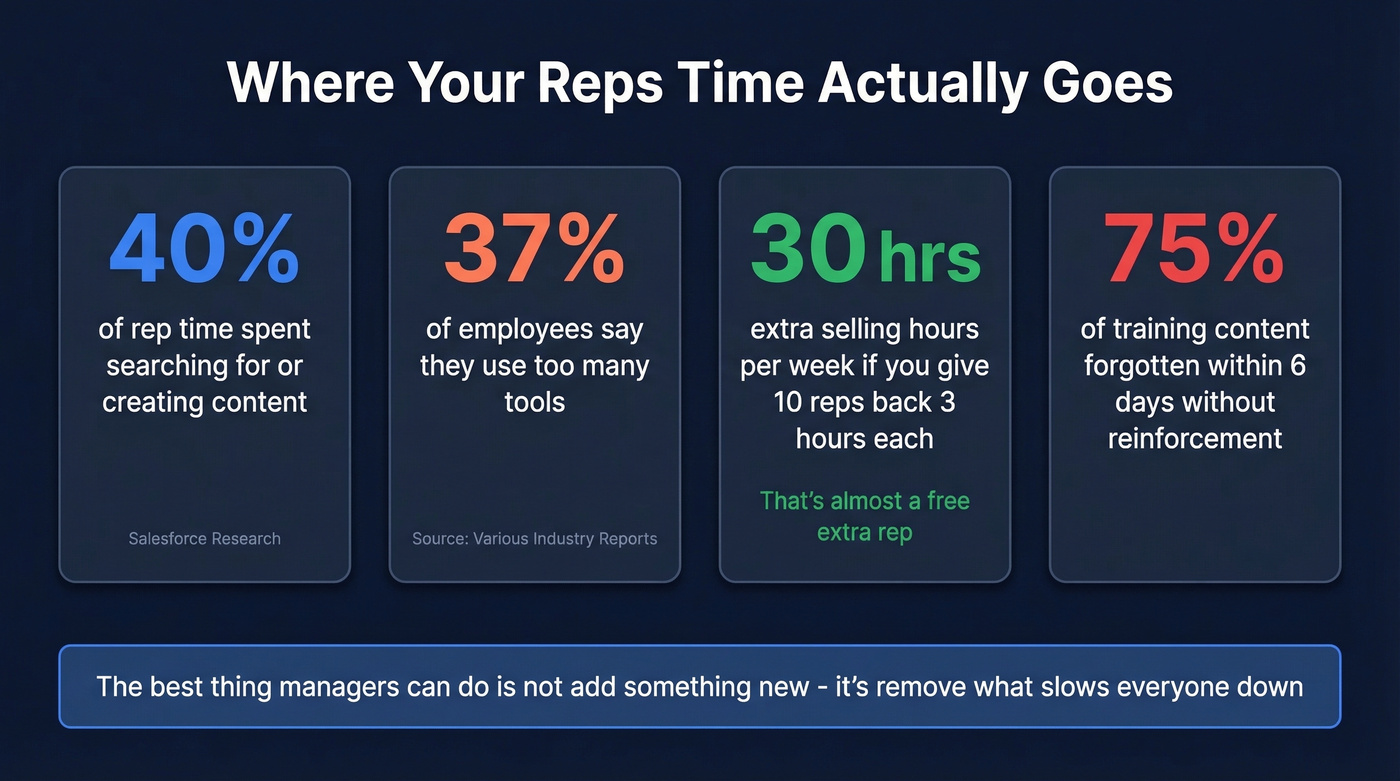
Audit ruthlessly. Kill the tools nobody opens. Cancel the "pipeline review" meeting that duplicates what's already in the CRM. If you give a 10-rep team back 3 hours per rep per week, you just created 30 additional selling hours - almost a full extra rep, for free. The best advice for sales managers often isn't about adding something new. It's about removing what's slowing everyone down.

This article keeps coming back to the same root cause: bad data inflates dashboards, burns out reps, and makes managers coach the wrong problems. Prospeo's 98% email accuracy and 7-day data refresh eliminate the phantom metrics. Snyk dropped bounces from 35% to under 5% and saw AE-sourced pipeline jump 180%.
Stop coaching around bad data. Start with contacts that actually connect.
Training That Sticks
Reps: Microlearn, Don't Binge
People forget roughly 75% of what they learn after six days if it isn't applied or reviewed. That week-long sales kickoff? Most of it evaporated by the following Friday. And 35% of people working in sales blame low-quality training for their lack of engagement - a stat most companies ignore because it's uncomfortable.
The antidote is microlearning. Fifteen minutes a day on one specific skill. Watch one call recording. Read one framework. Practice one objection response out loud. Small, daily reps beat annual training events every time.
Managers: Build Spaced Repetition
If you teach something once and expect it to stick, you're ignoring how memory works. Build a reinforcement cadence: teach on Day 1, reinforce at 48 hours, quiz at 7 days, role-play at 14 days. It's not complicated - it's a calendar reminder and 10 minutes of your time.
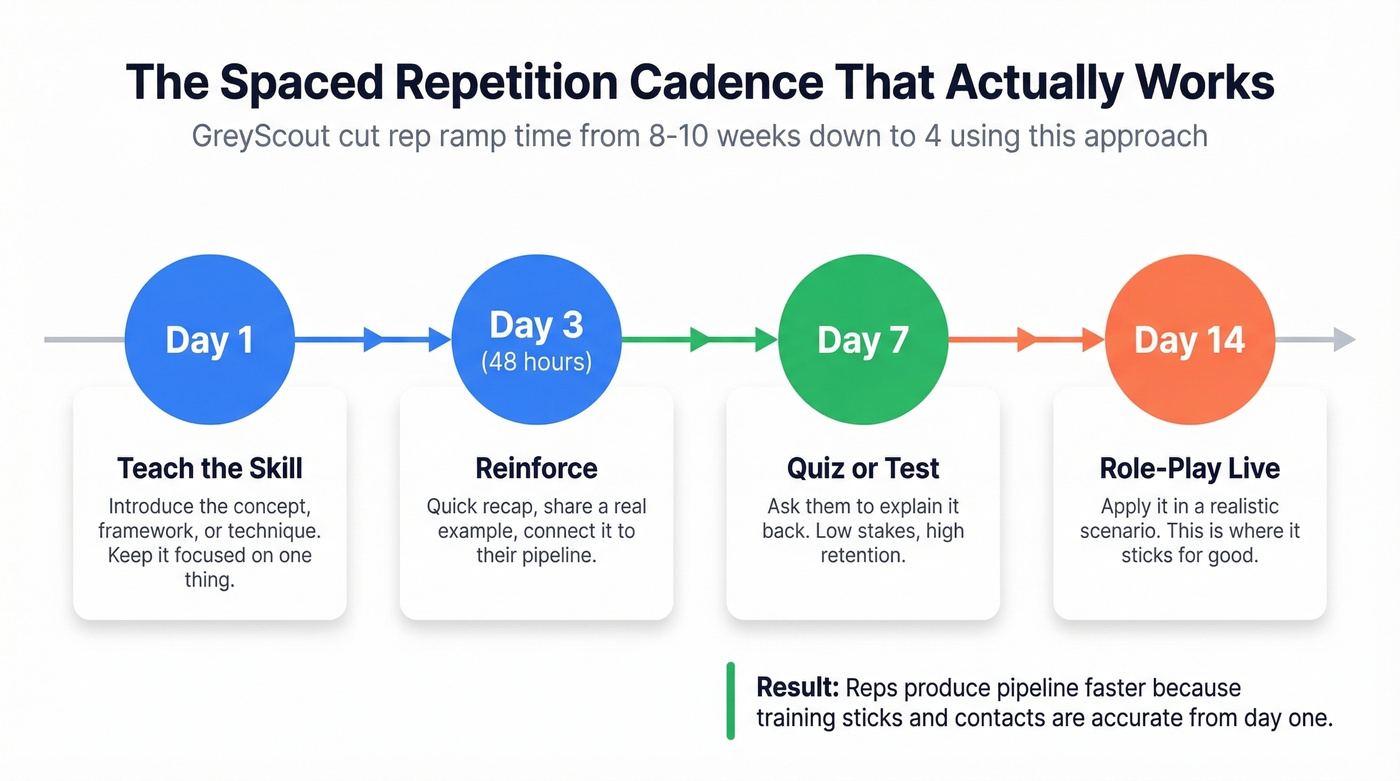
GreyScout built a spaced repetition cadence alongside verified prospecting data and cut rep ramp time from 8-10 weeks down to 4. New reps weren't just learning faster - they were producing pipeline faster because the training stuck and the contacts they worked were accurate from day one.
Goals, Metrics, and Accountability
Reps: Build Your Own Dashboard
Don't wait for your manager to tell you how you're doing. Track five numbers daily: pipeline created this week, meetings booked from outbound, win rate on deals you sourced, average deal size, and cycle length. These five numbers tell you everything. Call counts tell you nothing.
Managers: Activity Metrics Are a Crutch
Here's the thing: measuring call counts and email volume is what lazy managers do when they don't want to have hard conversations about pipeline quality. A rep making 80 calls a day with a 2% connect rate isn't outperforming the rep making 30 calls with an 8% connect rate. They're just busier.
A recurring theme on r/sales is that new managers default to micromanaging activity metrics because they don't know what else to measure. It's the management equivalent of a security blanket - comforting but useless.
Measure outcomes instead. Pipeline created, meetings booked from outbound, win rate, average deal size, and sales cycle length. Share the dashboard with the whole team. Transparency creates accountability faster than any performance improvement plan.
Culture, Motivation, and Retention
Reps: Find a Mentor, Manage Energy
70% of sellers struggle with mental health. Sales is a rejection machine, and pretending otherwise doesn't help. Find a mentor inside or outside your company - nine out of 10 workers with mentors report being happier at work, and happier reps sell more. That's not soft advice. It's a performance strategy.
Manage your energy, not just your time. If you're emotionally drained after a tough call, take 10 minutes before the next one. A bad mindset on a good prospect is worse than no call at all.
Managers: Address Negativity, Celebrate Wins
Negativity on a sales floor spreads like a virus. One consistently negative voice in a team meeting poisons the room for everyone. Address it privately, immediately, and directly.
On the flip side, celebrate wins publicly. Ring the bell. Post in Slack. Call out the specific behavior, not just the result - "Sarah booked that meeting because she researched the prospect's tech stack and led with a relevant pain point" teaches the whole team more than any formal training deck. And check in on wellbeing, not just pipeline. Ask "how are you doing?" and actually listen.
The Only 4 Tools You Need
Let's be honest: most sales teams would close more deals with fewer tools, not more. Every extra login is a tax on selling time. We've seen teams running 8-10 tools where 4 would do the job better. Here's what you actually need, and they need to talk to each other.
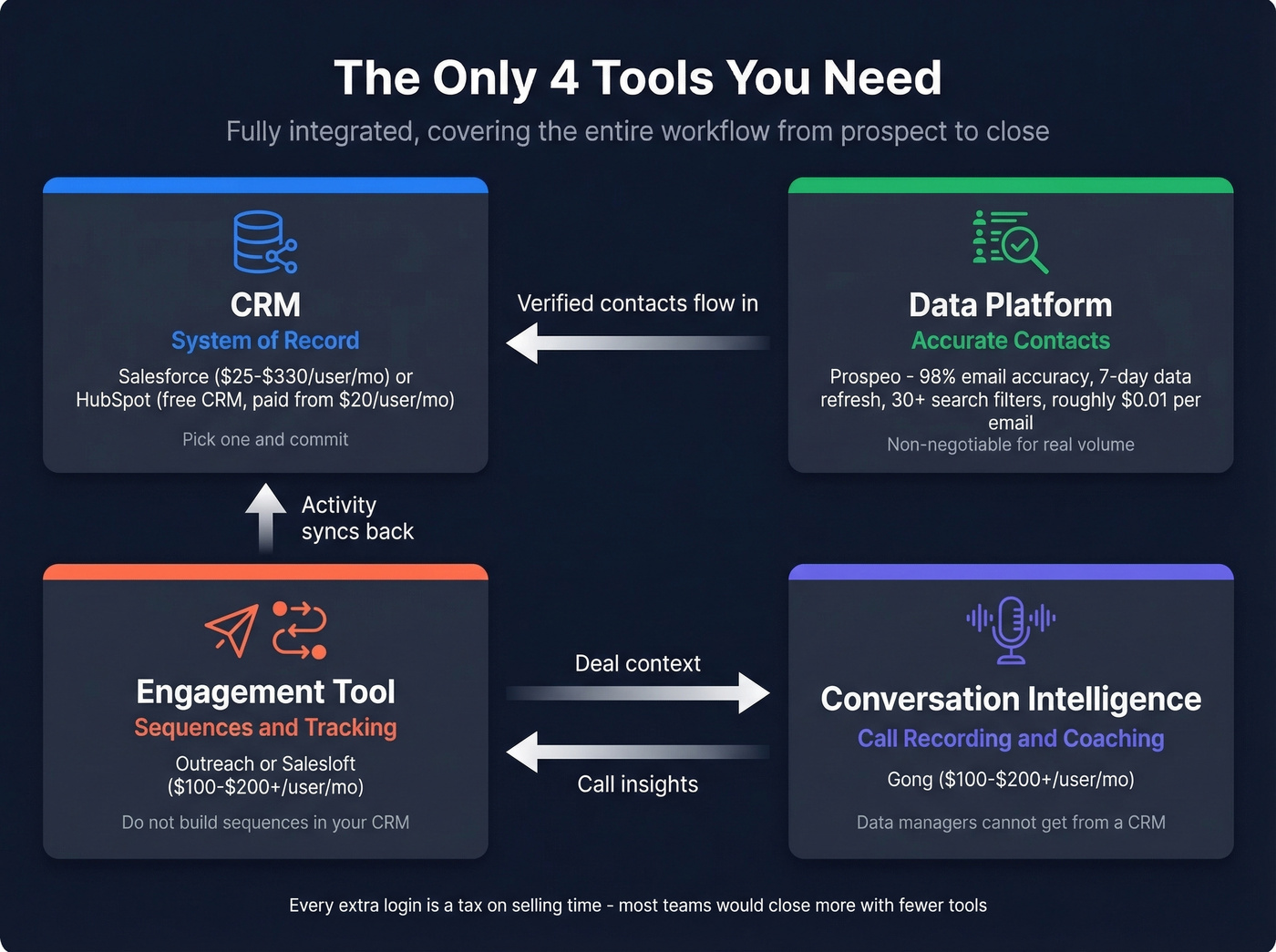
CRM - Salesforce runs around $25-$330/user/mo depending on edition, or HubSpot with a free CRM and paid Sales Hub tiers starting around $20-$25/user/mo. This is your system of record. Pick one and commit. If you're evaluating options, start with these examples of a CRM.
Data platform - Prospeo gives you 98% email accuracy, a 7-day data refresh cycle, and 30+ search filters including buyer intent and technographics. Free tier available, roughly $0.01 per email. Skip this category if your team does fewer than 100 outbound emails per month - but if you're doing real volume, accurate data is non-negotiable. If you're comparing vendors, see data enrichment services and best B2B company data.
Engagement tool - Outreach or Salesloft, typically ~$100-$200+/user/mo. This runs your sequences and tracks engagement. Don't build sequences in your CRM - use a purpose-built tool. For the workflow side, review sequence management.
Conversation intelligence - Gong, usually ~$100-$200+/user/mo. Records calls, surfaces coaching moments, and gives managers data they can't get from a CRM report. Pair this with a consistent sales performance management cadence.
Four tools, fully integrated, covering the entire workflow from prospect identification to closed-won analysis. Everything else is optional until you've maxed out these four. If you want more ways to fill the top of funnel, use these sales prospecting techniques and free lead generation tools.
You just read that protecting selling time is the highest-leverage move a manager can make. Prospeo's Chrome extension - used by 40,000+ sales pros - finds verified emails and direct dials in one click, no platform-hopping. At $0.01 per email, giving your team back 3+ hours a week costs less than a team lunch.
Give every rep on your team an extra 3 hours of selling time this week.
FAQ
What's the fastest way to improve sales performance this quarter?
Fix your prospecting data and start weekly 1:1 coaching simultaneously. Verified contact data eliminates wasted outreach, and structured coaching lifts rep performance by 8%. Expect pipeline impact within 4-6 weeks if you commit to both.
How much pipeline should a rep carry to hit quota?
The standard benchmark is 3-4x your quota number. If your target is $500K, maintain $1.5-2M in qualified pipeline at all times. Review coverage weekly, not quarterly - by the time you notice a gap at quarter-end, it's too late to recover.
What KPIs should sales managers actually track?
Focus on pipeline created, meetings booked from outbound, win rate, average deal size, and sales cycle length. Activity metrics like call counts and emails sent are noise without outcome context. A rep booking 15 meetings from 200 emails outperforms the rep booking 5 from 800 every time.
How do I reduce email bounce rates for my outbound team?
Switch to a data provider with real-time verification - bounce rates above 5% signal stale or unverified contacts. Audit your current list monthly and re-verify before every campaign. Teams that make this switch typically see bounce rates drop from 30-40% to under 5% within the first month.