


Scrapingdog Review 2026: Pricing, Benchmarks, Pros & Cons
Three sites list three different Scrapingdog pricing tiers. One says $20/month, another says $40, and a competitor comparison page throws out $29 as the "better deal." Most of that info is wrong or outdated. Here's what's actually correct about Scrapingdog's pricing, what real users think, and whether the tool is worth it at any price.
30-Second Verdict
Scrapingdog is a budget scraping API that can be excellent on certain supported targets and return zero results on others. Its 34% overall success rate looks awful until you dig into the numbers: six targets score a flat zero, dragging down strong performance everywhere else. For the sites it supports, it's fast and cheap. For everything else, it's useless.
What Is Scrapingdog?
Scrapingdog is a web scraping API that handles proxy rotation, JavaScript rendering, and CAPTCHA bypass so you don't have to. It competes with ScraperAPI and ScrapingBee on price while offering dedicated APIs for Google Search, Amazon, and Twitter.
If you're evaluating scraping as a growth channel, it helps to understand the bigger picture of web scraping lead generation and when it actually makes sense.
Pricing Breakdown
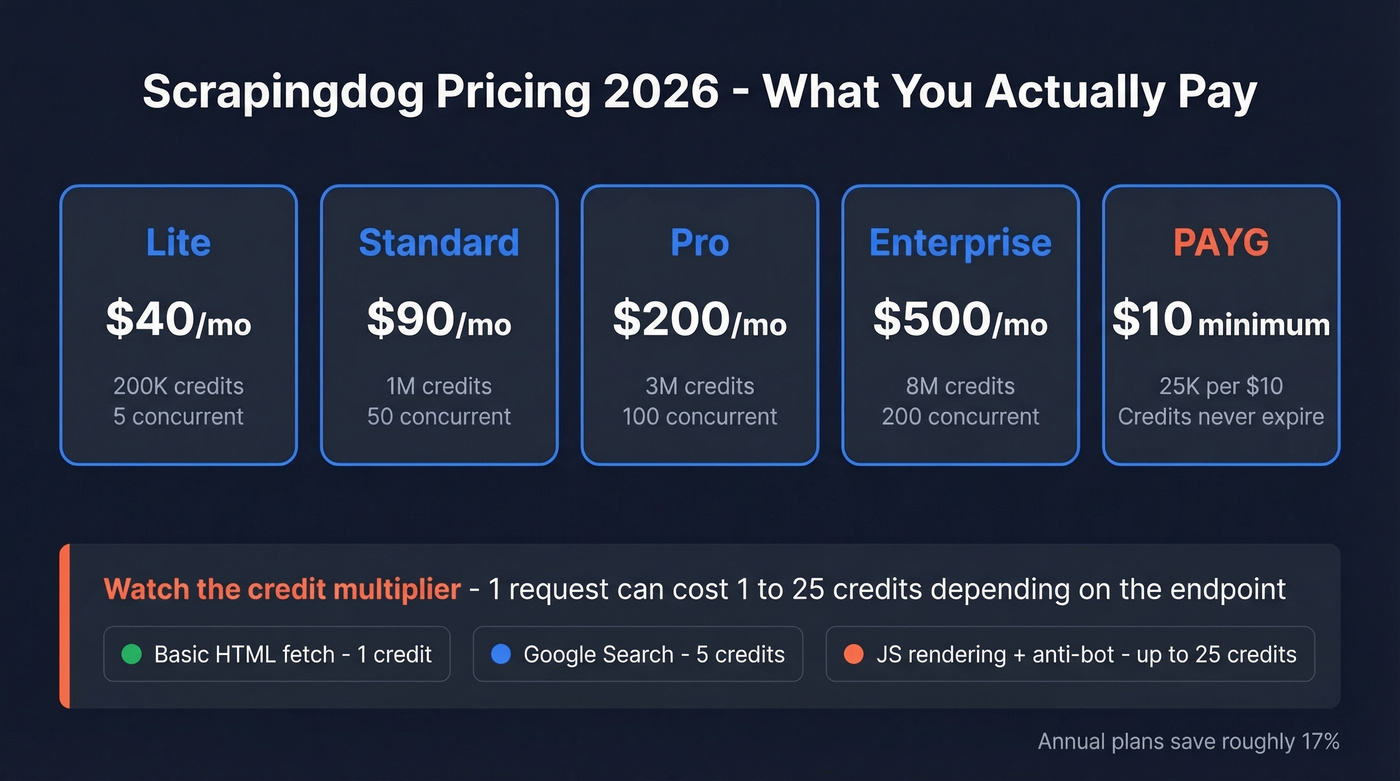
If you've seen "$20/month" on CompareCamp, that's outdated. The $29 figure floating around? That's Scrape.do's starter plan, not Scrapingdog. Here are the actual prices:
| Plan | Monthly | Credits | Concurrency |
|---|---|---|---|
| Lite | $40 | 200,000 | 5 |
| Standard | $90 | 1,000,000 | 50 |
| Pro | $200 | 3,000,000 | 100 |
| Enterprise | $500 | 8,000,000 | 200 |
| PAYG | $10 min | 25K per $10 | Lower |
Annual plans save roughly 17%.
Scrapingdog also introduced a pay-as-you-go model in late 2025. PAYG credits don't expire, but subscriptions are about 50% more economical and come with higher concurrency.
Here's what trips people up: each API request can cost between 1 and 25 credits depending on the endpoint and the anti-bot work needed. Scrapingdog's own test table shows Google requests costing 5 credits, while basic HTML fetches cost just 1. That 200,000-credit Lite plan could mean 200,000 simple requests or 8,000 premium ones. We've run the credit math on several use cases, and the variance is significant enough that you should model your specific workload before committing to a tier.
If you're trying to compare credit systems across tools, you can sanity-check the math against other providers’ breakdowns like Datagma pricing.
Performance Benchmarks
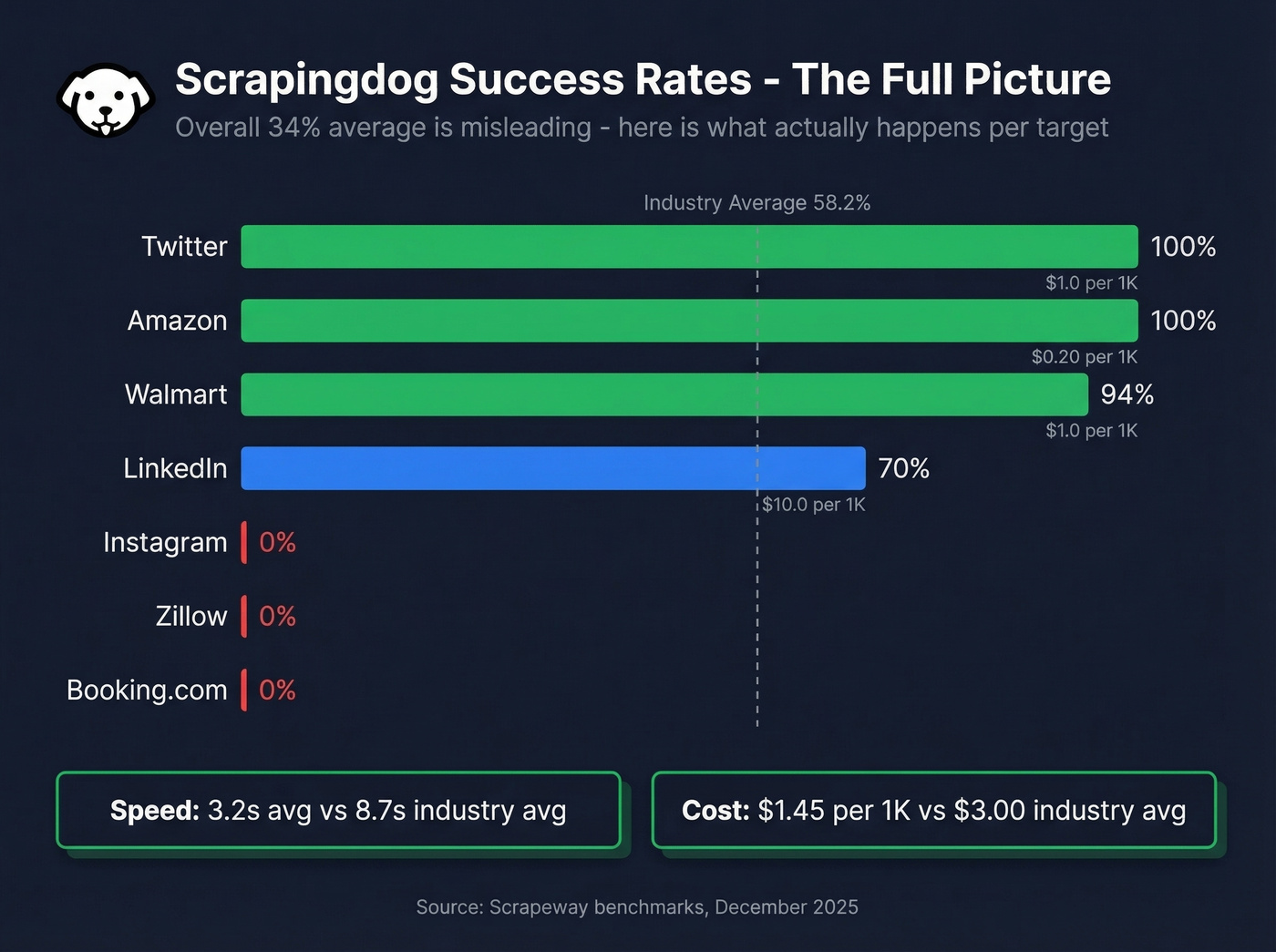
Scrapeway's benchmarks paint a nuanced picture. The headline number - 34% overall success rate against a 58.2% industry average - is misleading without context.
| Target | Success Rate | Speed | Cost/1K |
|---|---|---|---|
| 100% | 1.0s | $1.0 | |
| Amazon | 100% | 2.9s | $0.2 |
| Walmart | 94% | 4.4s | $1.0 |
| 70% | 0.2s | $10.0 | |
| 0% | - | - | |
| Zillow | 0% | - | - |
| Booking.com | 0% | - | - |
Six targets - Instagram, Zillow, Booking.com, Indeed, Realtor, StockX - score a flat zero, destroying the average. On supported targets, Amazon at 100% success with $0.20 per thousand requests is genuinely impressive.
Let's be honest: no scraping API hits 100% across all targets. A December 2025 benchmark from WebDataGuru tested 12 providers across 15 heavily protected sites and confirmed as much. Scrapingdog's issue isn't that it's bad at scraping. It's that its gaps are wider than most competitors if you need broad coverage.
Speed is where Scrapingdog quietly wins: 3.2 seconds average versus the 8.7-second industry average. Cost efficiency runs $1.45 per 1,000 scrapes against a $3.00 industry average.
If your end goal is pipeline (not just pages), it’s worth mapping scraping output to lead generation metrics so you can tell whether “success rate” is actually moving revenue.

Scraping APIs charge 1-25 credits per request with no guarantee of finding contact data. Prospeo gives you 143M+ verified emails and 125M+ mobile numbers directly - 98% accuracy, 7-day refresh, $0.01 per email. No proxies, no CAPTCHAs, no zero-percent success rates.
Skip the scraping stack. Search verified B2B contacts in seconds.
Pros & Cons
Pros:
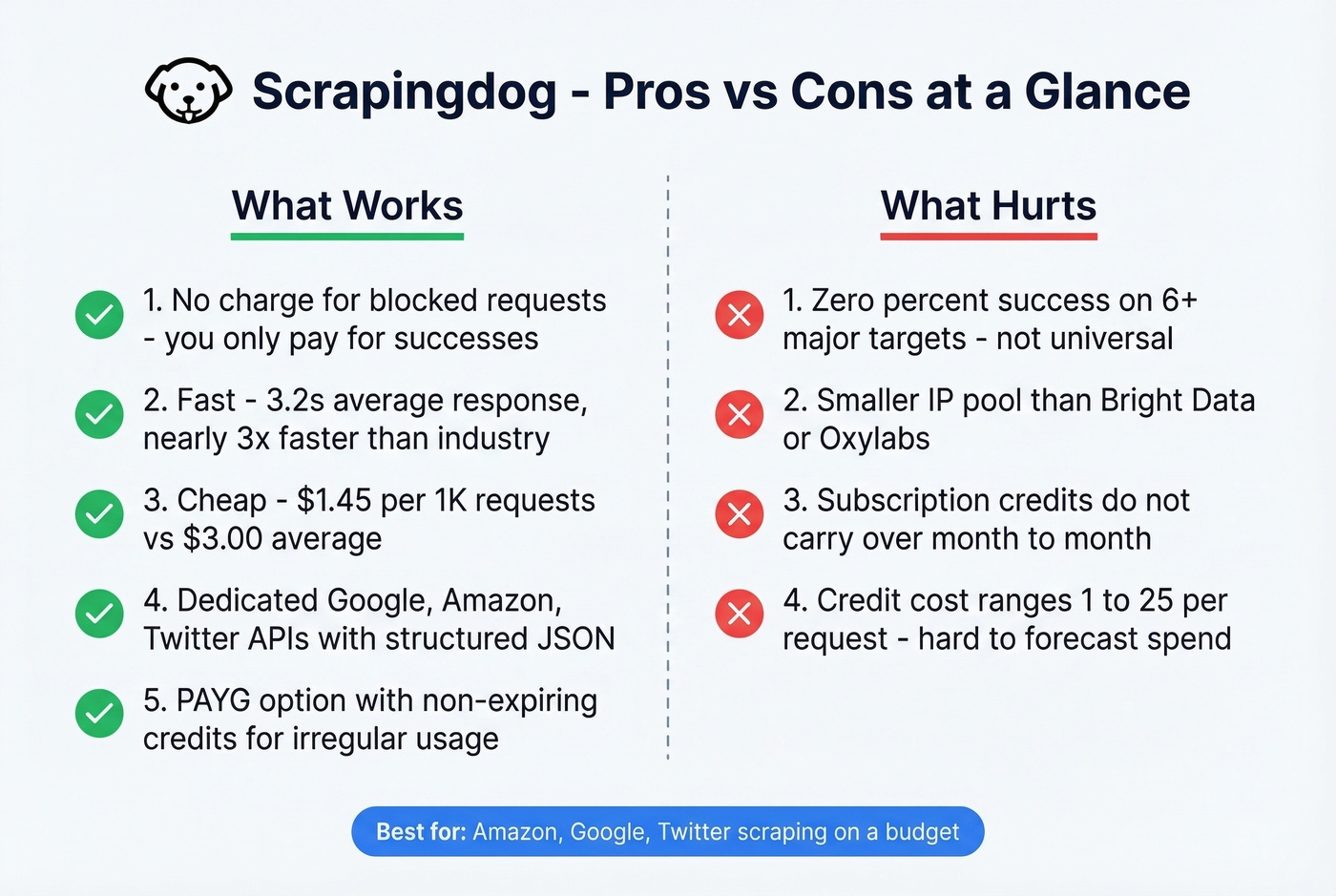
- No charge for blocked requests - you only pay for successful scrapes
- Fast response times (3.2s vs 8.7s industry average)
- Cheap per-request cost ($1.45/1K vs $3.00 average)
- Dedicated APIs for Google, Amazon, Twitter with structured JSON output
- PAYG option with non-expiring credits for irregular usage
Cons:
- Zero percent success on 6+ major targets - not a universal scraping solution
- Smaller IP pool than premium providers like Bright Data or Oxylabs
- Subscription credits don't carry over month-to-month
- Credit consumption range (1-25 per request) makes cost forecasting tricky
What Users Say
Trustpilot shows 4.7/5 from 580 reviews. G2 shows 3.0/5 from just 5 reviews. The gap comes down to sample size - and G2 also flags that the profile hasn't been active for over a year.
Users consistently praise fast support response times and reliable Google Maps/Places scraping at production scale. Scrapingdog replies to 66% of negative reviews within 24 hours, which is better than most tools in this space.
The negatives are harder to dismiss. Multiple Trustpilot reviews flag billing and cancellation friction - one user reported there's no cancel button in Stripe, forcing you to contact support. Another December 2025 review describes a refund dispute where support responded with "are you threatening us?" We've seen this pattern before with smaller API providers: great when things work, frustrating when they don't. On Reddit, Scrapingdog barely comes up in r/webscraping threads, which tracks with it being a smaller name than ScraperAPI or Bright Data.
If you’re using scraped data for outbound, make sure you’re not skipping basics like email deliverability and email bounce rate management.
When to Use Scrapingdog
Use it if you're scraping Amazon, Google, or Twitter at scale on a budget, you need PAYG flexibility, or response speed matters more than target breadth.
Skip it if you need broad target coverage (Instagram, Zillow, Booking.com are dead ends), you need an enterprise-grade IP pool, or you're scraping for B2B contact data specifically.
Here's the thing: if you're building scraping infrastructure to find business emails and phone numbers, you're solving the wrong problem. Prospeo gives you 143M+ verified emails and 125M+ mobile numbers through a direct search with 30+ filters - no proxies, no CAPTCHAs, no credits burned on failed requests. Email accuracy runs 98%, data refreshes every 7 days, and the free tier lets you test without commitment.
If you do need contact data enrichment on top of what you already have, compare options in data enrichment services.
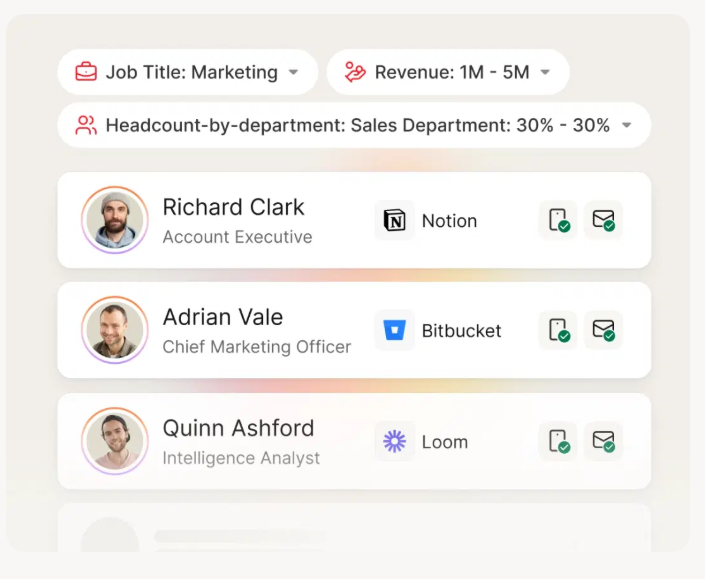
If you're evaluating Scrapingdog to build B2B lead lists, you're overengineering it. Prospeo's 30+ search filters - intent data, technographics, job changes, funding - let you find decision-makers without writing a single API call. 15,000+ companies already made the switch.
Get the contacts directly. Zero credits burned on failed requests.
Alternatives Worth Considering
ScraperAPI is the safe default. 5,000 free credits to start, plans from ~$49/month, and broader target support than Scrapingdog - though success rates drop on heavily protected content.
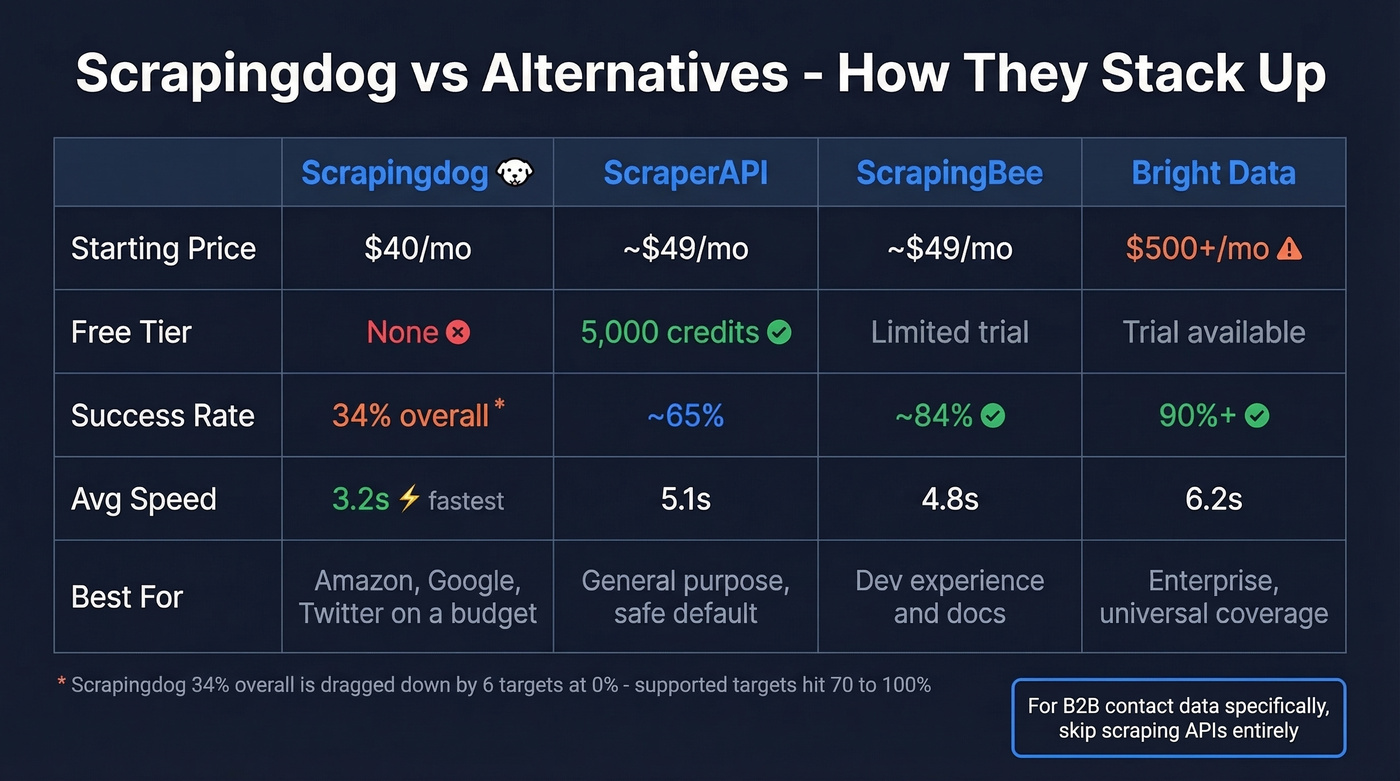
For teams that care more about developer experience than raw cost, look at ScrapingBee. It starts at ~$49/month for 100,000 credits with stronger documentation and faster onboarding. Independent benchmarks put its success rate around 84% at standard load.
If you’re comparing that category specifically, see our breakdown of ScrapingBee alternatives.
Then there's the premium tier. Bright Data starts at $500+/month with a massive IP pool and near-universal target coverage. Overkill for most projects, but if you need it, nothing else comes close.
Our take: if your average scraping project runs under $200/month, Scrapingdog or ScraperAPI will handle it fine. For B2B contact data specifically, don't scrape at all - a dedicated data platform will save you weeks of proxy headaches and deliver better results.
If you’re building lists for outbound, you’ll usually get more leverage from sales prospecting techniques than from adding more scraping endpoints.
FAQ
Is Scrapingdog good for large-scale scraping?
Yes, for supported targets like Amazon, Google, and Twitter, Scrapingdog handles high-volume workloads reliably at 100% success rates and 3.2-second average response times. Its Pro plan offers 3M credits with 100 concurrent threads. Avoid it if your project requires broad target coverage - six major sites return zero results.
How much does Scrapingdog actually cost per request?
Effective cost ranges from $0.20 to $10.00 per 1,000 requests depending on the endpoint. Simple HTML fetches cost 1 credit each, while Google or JavaScript-rendered requests consume 5-25 credits. Model your specific workload against the credit tiers before choosing a plan.
What's a good alternative to Scrapingdog for B2B data?
Skip scraping APIs entirely for contact data. Prospeo provides 143M+ verified emails at 98% accuracy and 125M+ mobile numbers with a 30% pickup rate - all searchable through 30+ filters. At roughly $0.01 per email, it's cheaper and more reliable than burning scraping credits on professional profiles.
Does Scrapingdog charge for failed requests?
No. Scrapingdog only bills credits on successful responses, which is a genuine advantage over competitors that charge regardless of outcome. This makes cost forecasting easier on supported targets, though it doesn't help when a target has a 0% success rate - you simply get no data at all.