

SDR Automation: Why Most Setups Fail (And the Stack That Works)
Right now, an AI SDR tool is sending a "personalized" cold email to a company's biggest existing customer. That's not a hypothetical - one 11x user reported exactly this, along with hundreds of CRM duplicates and nonsensical messaging. Meanwhile, 50-70% of teams abandon their SDR automation setup within three months.
That's not a product maturity problem. It's a setup problem.
What You Need (Quick Version)
- Most AI SDR failures trace back to bad data, not bad AI. Fix the data layer first.
- A ~$200-$500/mo stack of verified data plus a sequencer outperforms a $5,000/mo AI SDR running on unverified contacts.
- Budget 40-60 hours of data prep and 30 days of daily monitoring before scaling anything.
What Sales Development Automation Actually Means
SDR automation covers any technology that handles repetitive sales development work - email sequencing, social touches, call scheduling, lead qualification, and follow-up cadences. When it's done right, it eliminates the manual busywork that eats 60-70% of a rep's day while keeping strategic decisions in human hands.
Two models dominate. Full-replacement AI SDRs like 11x and Artisan run $40k-$60k/year and promise autonomous prospecting, writing, and sending. Augmentation tools - sequencers, enrichment platforms, deliverability infrastructure - run $50-$200/mo each and keep a human in the loop. The distinction matters because the failure modes are completely different.
Why Most AI SDR Setups Fail
Here's the thing: the AI layer isn't usually the problem. The infrastructure underneath is.

Bad data destroys domain reputation
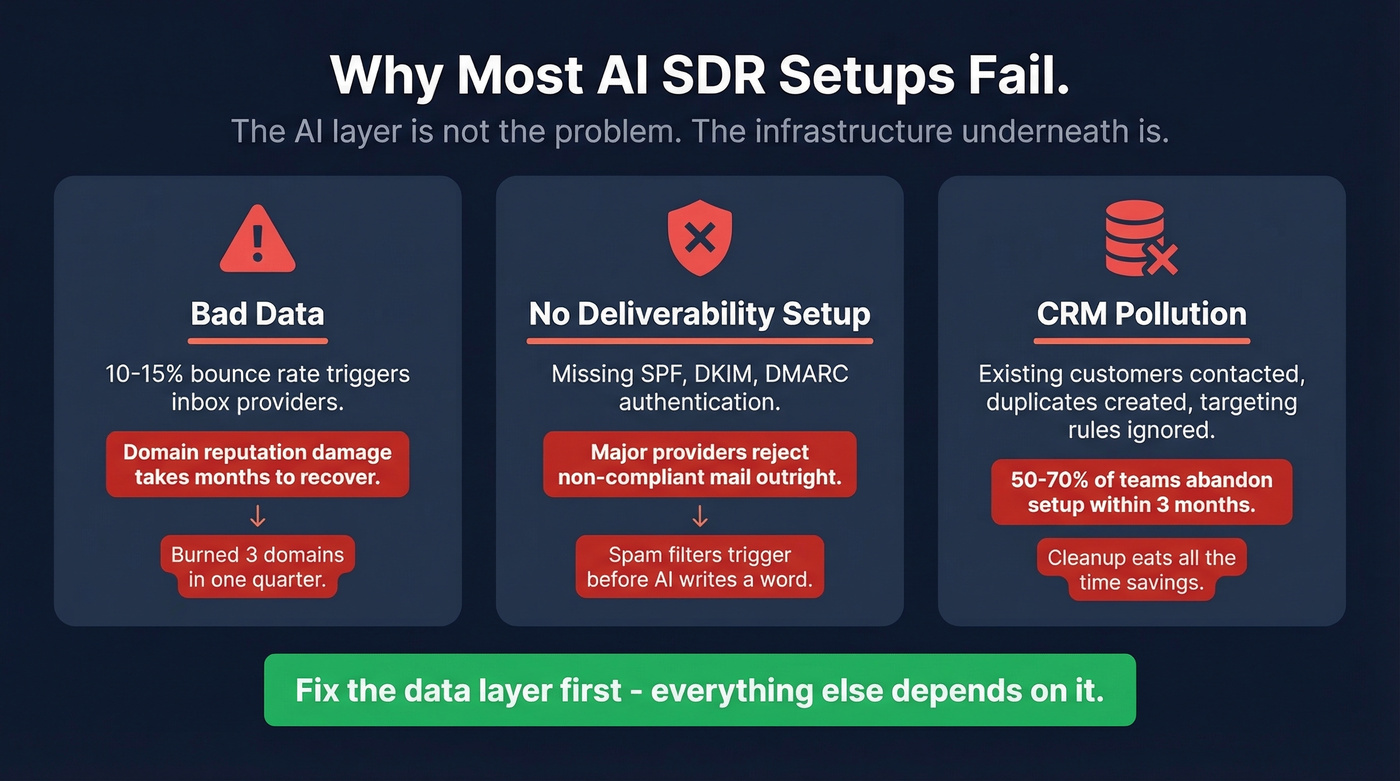
If your contact list bounces at 10-15%, inbox providers notice fast. Domain reputation damage takes months to recover, and one bad list can tank deliverability for your entire org. We've seen teams burn through three domains in a quarter because they skipped verification on a single purchased list.
No deliverability infrastructure
SPF, DKIM, and DMARC authentication aren't optional anymore. Major providers reject non-compliant mail outright.
Without proper warm-up, domain rotation, and volume throttling, you're triggering spam filters before your AI writes a single word. The safe cap is roughly 200 emails per mailbox per day, and complaint rates need to stay under 0.3%. Miss either threshold and you're digging yourself out of a hole that takes weeks to fix.
CRM pollution and generic AI copy
That 11x user review is worth reading in full: irrelevant companies added to the pipeline, existing customers contacted, targeting rules ignored, hundreds of duplicates created. The cleanup work alone ate whatever time the tool saved.
The broader pattern across Reddit threads and review sites is consistent - generic AI-sounding messages, embarrassing factual errors, and zero cultural nuance are the top reasons teams churn off these tools within 90 days.
In our experience, the data layer is the failure point in most broken SDR stacks. Letting AI drive decisions without daily review creates a false sense of control. Leads silently drop from flows, fallback logic breaks, and by the time you notice, you've burned through your best accounts with garbage messaging.

Bad data is the #1 reason SDR automation fails. Prospeo's 5-step verification delivers 98% email accuracy and a 7-day refresh cycle - so your sequences never run on stale contacts. Meritt tripled pipeline to $300K/week and cut bounce rates from 35% to under 4%.
Stop burning domains. Start with data that actually connects.
The 4-Layer Stack That Works
Think of automated sales development as four layers. Skip one and the whole thing collapses.
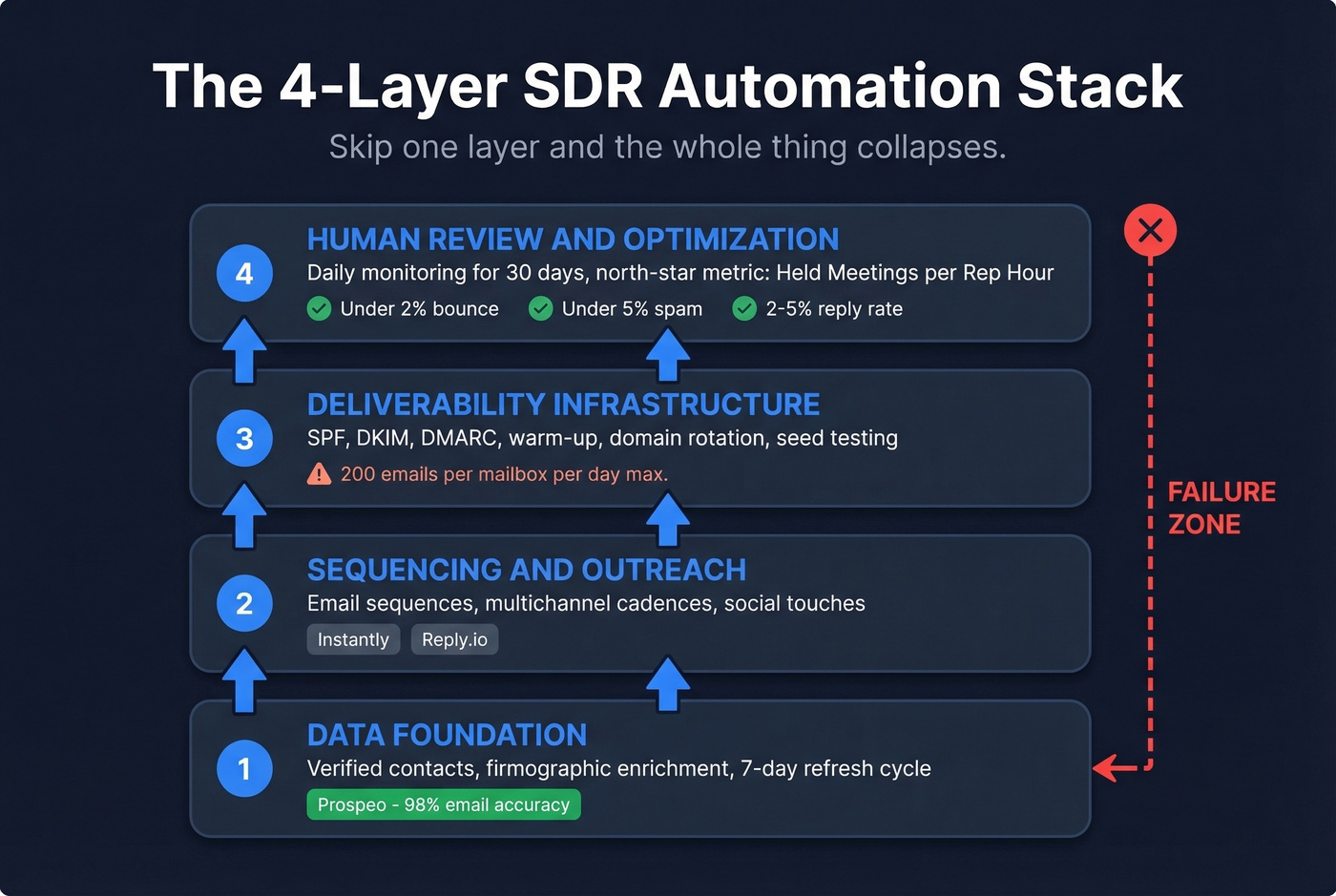
Layer 1: Data foundation. Everything starts here. You need verified contacts, firmographic and technographic enrichment, and a refresh cycle that doesn't let data go stale. Prospeo handles this with 300M+ profiles at 98% email accuracy, 125M+ verified mobile numbers, and a 7-day refresh cycle while the industry average sits at six weeks. It integrates natively with Instantly, Clay, and HubSpot. Meritt cut their bounce rate from 35% to under 4% and tripled pipeline to $300K/week after switching to Prospeo as their data layer.

Layer 2: Sequencing and outreach. Tools like Instantly, Reply.io, or Apollo's sequencing features. Multichannel is ideal, but email is where most teams start and where deliverability matters most.
Layer 3: Deliverability infrastructure. Authentication - SPF, DKIM, DMARC - plus warm-up, domain rotation, and seed testing. Not glamorous, but it's the difference between 90%+ inbox placement and landing in spam.
Layer 4: Human review and optimization. Monitor daily for the first 30 days. Your north-star metric is Held Meetings per Rep Hour. Target benchmarks: under 2% bounce, under 5% spam placement, 2-5% positive reply rate, 10-25% connect-to-meeting rate.
Demandbase reported 2x opportunity creation when tool adoption went from ~50% to 95-100% - but that required daily leadership involvement, not just flipping a switch.
Tools Worth Evaluating in 2026
Let's be honest: if your average deal size is under $15k, you almost certainly don't need a full AI SDR. A $49/user/mo Apollo plan with verified emails will outperform a $5,000/mo AI SDR running on stale data every single time.
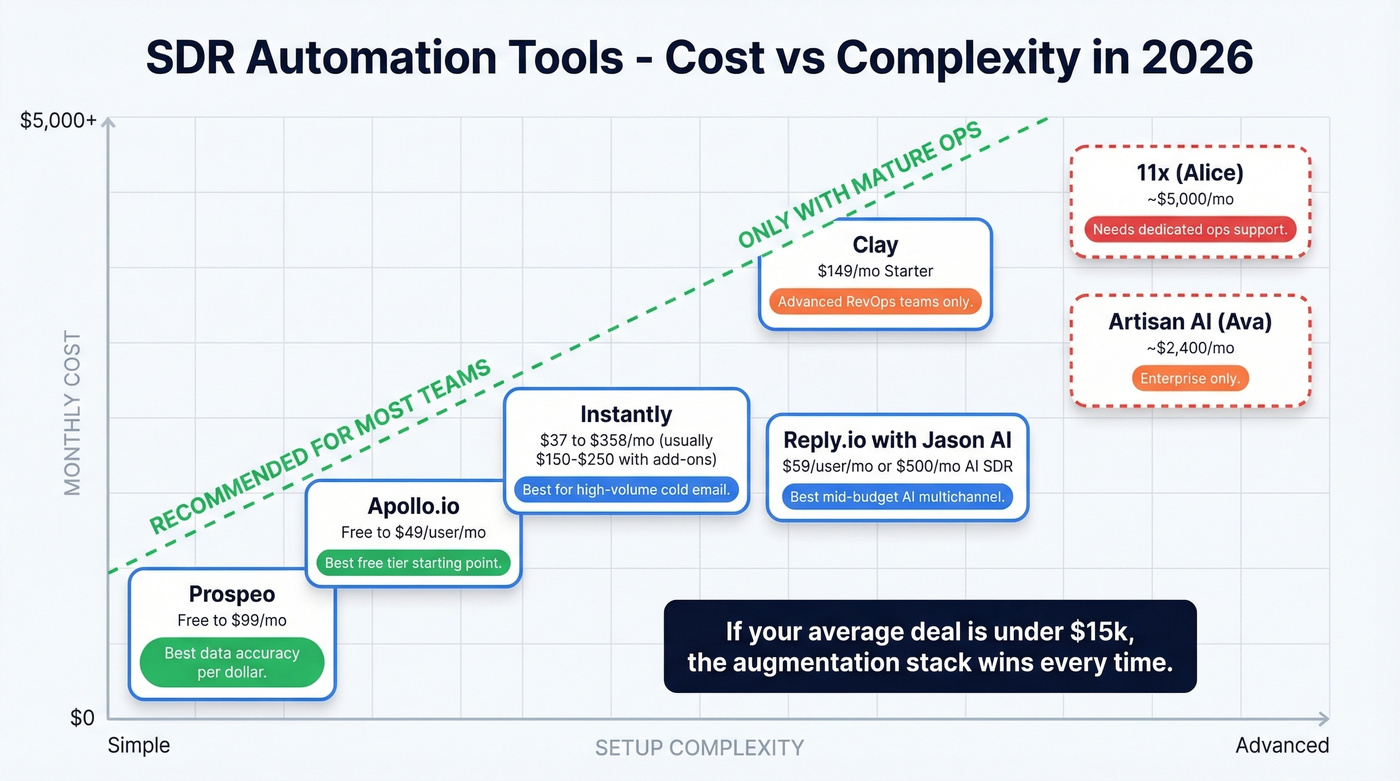
| Tool | Category | Starting Price | Best For |
|---|---|---|---|
| Prospeo | Data + Verification | Free (75 emails/mo) | Best data accuracy per dollar |
| Apollo.io | Database + Sequencing | Free, then $49/user/mo | Best free-tier starting point |
| Reply.io (Jason AI) | AI Sequencing | $59/user/mo; $500/mo AI SDR | Best mid-budget AI multichannel |
| Instantly | Cold Email Scale | $37-$358/mo | Best for 5K+ emails/month |
| Clay | Enrichment | $149/mo (Starter) | Advanced enrichment workflows |
| 11x (Alice) | Full AI SDR | ~$5,000/mo | Only with dedicated ops support |
| Artisan AI (Ava) | Full AI SDR | ~$2,400/mo | Enterprise with $30k+/yr budget |
Apollo.io
The default starting point for most teams. The free tier is generous, the database is massive, and combining data plus sequencing in one tool reduces your vendor count. The tradeoff: we've seen bounce rates climb when teams skip a verification step before sequencing. At $49/user/mo for Basic, it's hard to beat on value. Skip it if you need strong EMEA mobile coverage - that's where it falls short.
Instantly
Real costs usually land $150-$250/mo after add-ons. Domain rotation, warm-up, and deliverability monitoring are baked in, making it the best pure-play cold email tool on the market. It doesn't do data though, so pair it with a verification layer or you're just sending faster to bad addresses.
Reply.io and Jason AI
Contact-based pricing here - $500/mo gets 1,000 active contacts with unlimited users, which is smart for larger teams splitting territories. The AI SDR tier is meaningfully cheaper than 11x or Artisan, making it the middle ground between full automation and manual sequencing. This tiered approach lets you test AI capabilities without committing to a $40k annual contract.
Clay
For advanced RevOps teams only. $149/mo for Starter. Powerful waterfall enrichment logic that can pull from multiple data sources and apply conditional rules, but the learning curve is steep and it's not where beginners should start.
11x (Alice)
Runs ~$5,000/mo and promises full SDR replacement. The consensus on r/sales is mixed at best - reports of CRM pollution, ignored targeting rules, and nonsensical messaging keep surfacing. Only consider this if you have mature ops support and dedicated cleanup resources. For everyone else, the augmentation stack wins.
A $200/mo stack with verified data outperforms a $5,000/mo AI SDR on bad contacts. Prospeo gives you 300M+ profiles, 125M+ verified mobiles, and native integrations with Instantly, Clay, and HubSpot - starting at $0.01 per email. No contracts.
Get enterprise-grade SDR data at 90% less than ZoomInfo.
Implementation Guardrails
These aren't suggestions. They're the difference between a stack that compounds and one that implodes.
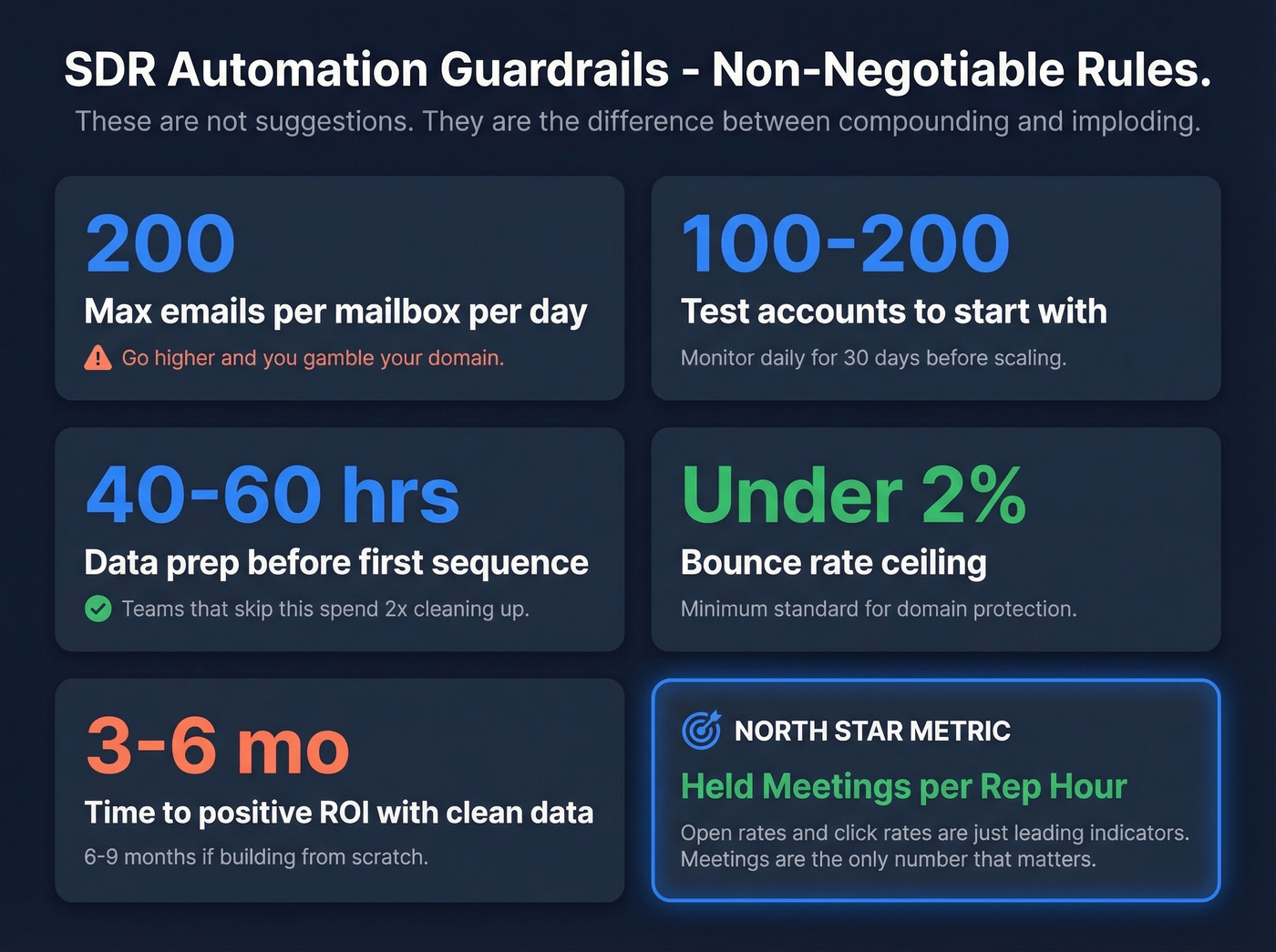
- Cap sending at 200 emails per mailbox per day. Go higher and you're gambling with your domain.
- Start with 100-200 test accounts. Monitor daily for the first 30 days before touching the volume dial.
- Budget 40-60 hours of data prep before launching a single sequence. Yes, really. Teams that skip this spend twice as long cleaning up the mess.
- North-star metric: Held Meetings per Rep Hour. Open rates, click rates, reply rates - they're all leading indicators. Meetings are the only number that matters.
- Expect 3-6 months to positive ROI with clean data, 6-9 months if you're building from scratch.
- Verify every list before it hits a sequencer. A 2% bounce rate ceiling isn't aspirational - it's the minimum standard for protecting your sending reputation.
FAQ
What's the difference between an AI SDR and SDR automation?
An AI SDR is a full-replacement tool that autonomously prospects, writes, and sends - typically $2,000-$5,000+/mo. SDR automation is a layered stack of specialized tools covering data, sequencing, and deliverability with human oversight, usually $100-$500/mo total. Most teams get better results from the stack approach because each layer can be optimized independently, and when something breaks, you know exactly where to look.
How much does a sales development automation stack cost?
Augmentation stacks run $100-$500/mo. Full-replacement AI SDRs cost $2,400-$5,000+/mo with annual contracts. The biggest hidden cost is data prep: budget 40-60 hours before launch, or you'll spend that time cleaning up CRM damage after.
Why do AI SDR tools fail within three months?
Bad data causes bounces, which damages domain reputation. Missing deliverability infrastructure means emails never reach the inbox. Without human review, AI tools contact wrong accounts, create duplicates, and send embarrassing messages. The AI isn't the failure point - the data and infrastructure underneath are.
What's the best free tool to start automating SDR workflows?
Apollo.io offers the most generous free tier for combined data and sequencing. For data accuracy specifically, Prospeo's free plan includes 75 email credits with 98% verification - better for teams that need clean contacts before loading any sequencer. Start with verified data, then layer in automation tools as volume grows.