

The SDR Funnel: Stages, Benchmarks, and the Math to Fix It
Your VP just asked how many SDRs you need next quarter. You open the CRM, pull a report, and realize you can't actually answer the question. Your team booked 120 meetings last quarter. Maybe 40 got accepted by AEs. Of those, 26 actually happened. Pipeline created? Around $195K - against a $500K target.
You don't have a headcount problem. You have an SDR funnel math problem.
The five funnel stages with CRM-ready definitions are in the table below. The one formula that matters - Meetings x Acceptance Rate x Show Rate x Avg Deal Size - tells you pipeline-per-SDR. And the single biggest lever most teams ignore is data quality at the top of the funnel.
What Is a Sales Development Funnel?
A sales development funnel is the sequence of stages a prospect moves through from first touch to closed deal. The SDR owns the top half - Lead through SQL. The AE owns SQL through Close.
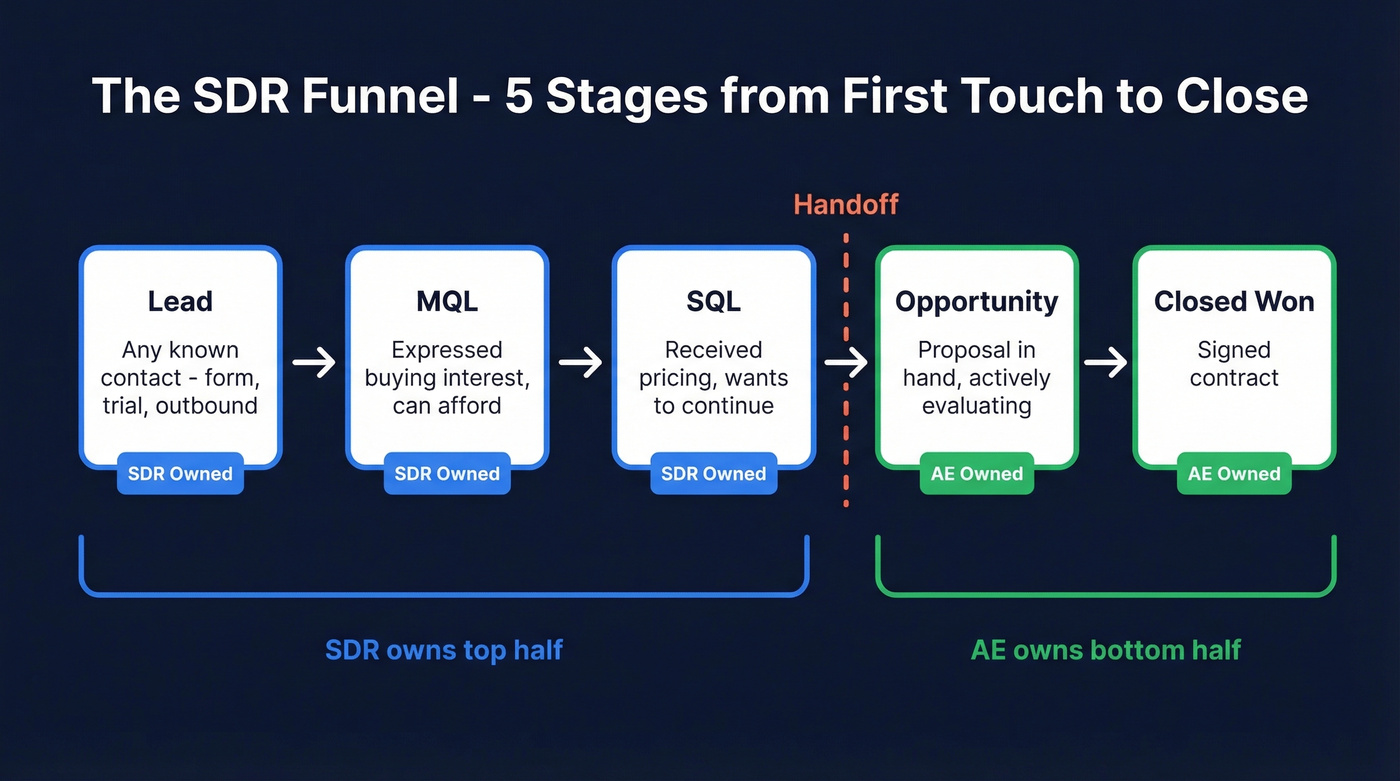
| Stage | Definition | Owner |
|---|---|---|
| Lead | Any known contact (form, trial, outbound) | SDR |
| MQL | Expressed buying interest, can afford | SDR |
| SQL | Received pricing, wants to continue | SDR -> AE |
| Opportunity | Proposal in hand, actively evaluating | AE |
| Closed Won | Signed contract | AE |
Some teams add a SAL (Sales Accepted Lead) between MQL and SQL. It's useful if your AE acceptance rate is a problem - otherwise, skip it.
Here's the thing most RevOps teams miss: SDR data spans four CRM objects - Contact, Account, Task, and Opportunity. AE data lives mostly in one. That asymmetry is why reporting on the sales development funnel breaks so much more often than reporting on the close cycle.
Conversion Benchmarks That Matter
Stage-by-Stage Rates
These are the numbers your VP actually wants. Two columns, because SMB and enterprise funnels behave very differently.
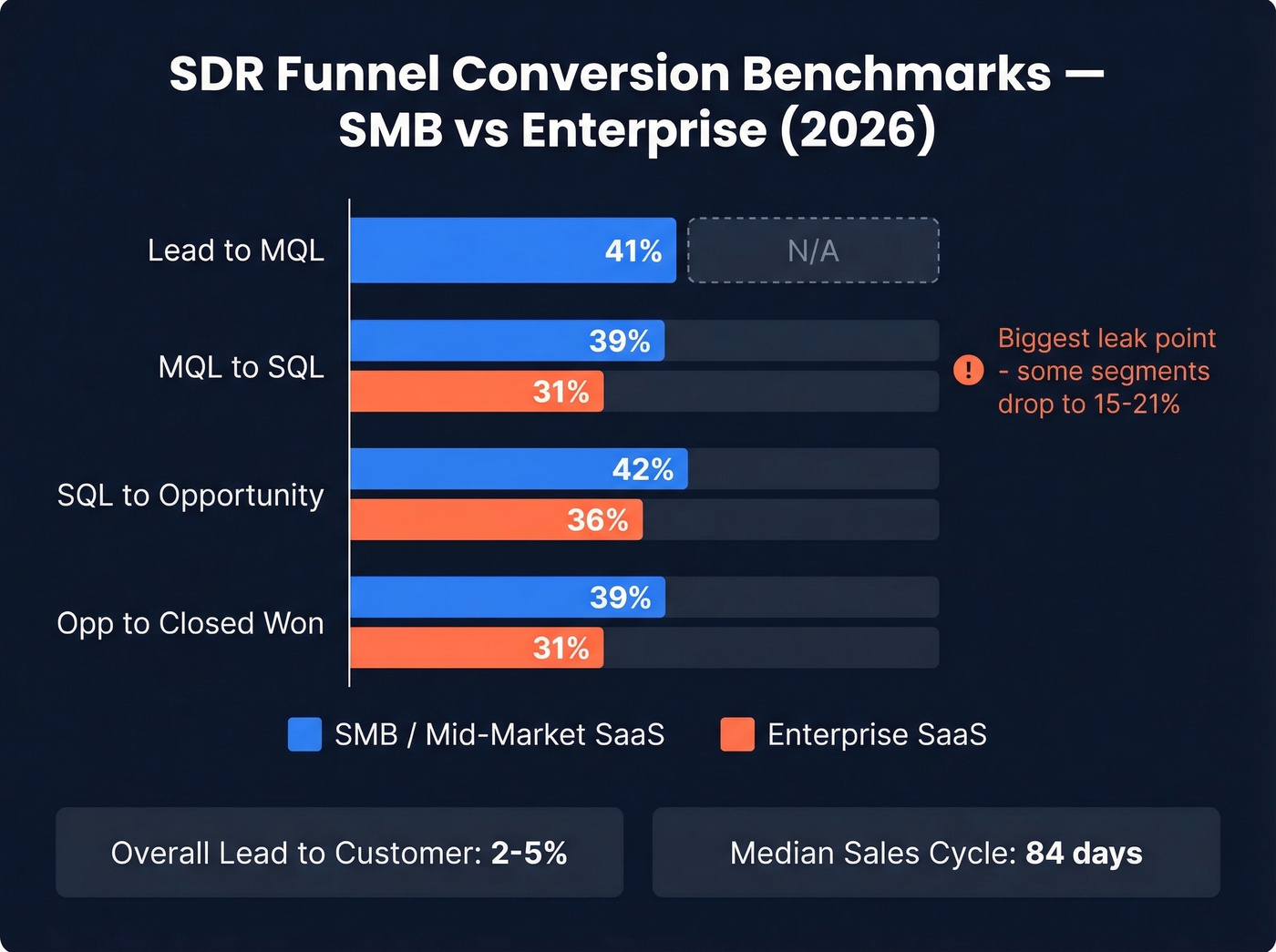
| Stage Transition | SMB / Mid-Market SaaS | Enterprise SaaS |
|---|---|---|
| Lead -> MQL | 41% | - |
| MQL -> SQL | 39% | 31% |
| SQL -> Opportunity | 42% | 36% |
| Opp -> Closed Won | 39% | 31% |
These benchmarks come from Digital Bloom's 2026 pipeline compilation. For context, the overall lead-to-customer conversion rate across B2B SaaS lands between 2-5%, and the median sales cycle runs 84 days.
The MQL-to-SQL bottleneck is where most funnels leak - some segments see this drop to 15-21%. In our experience, that's where RevOps teams should start diagnosing. The channel you source leads from matters enormously, too: SEO-sourced leads convert MQL-to-SQL at 51%, while PPC leads convert at just 26%. Events drive a 40% Opp-to-Close rate. If you're not segmenting funnel metrics by channel, you're flying blind.
Activity Benchmarks
An Optif.ai study across 939 companies gives us the clearest picture available. Median meetings per month: 8-10. Top quartile: 12-15. Elite performers hit 18+.
Daily activity for top-quartile reps runs 70-80 calls, 45-55 cold emails, and 25-35 social touches. Multi-touch sequences convert at 4-7%, and multichannel outreach yields 287% higher engagement than single-channel. It now takes 18+ dials to connect with a single prospect. Single-channel outreach isn't just suboptimal - it's mathematically insufficient.
The Pipeline-per-Rep Formula
Here's the formula that should be on every RevOps dashboard:
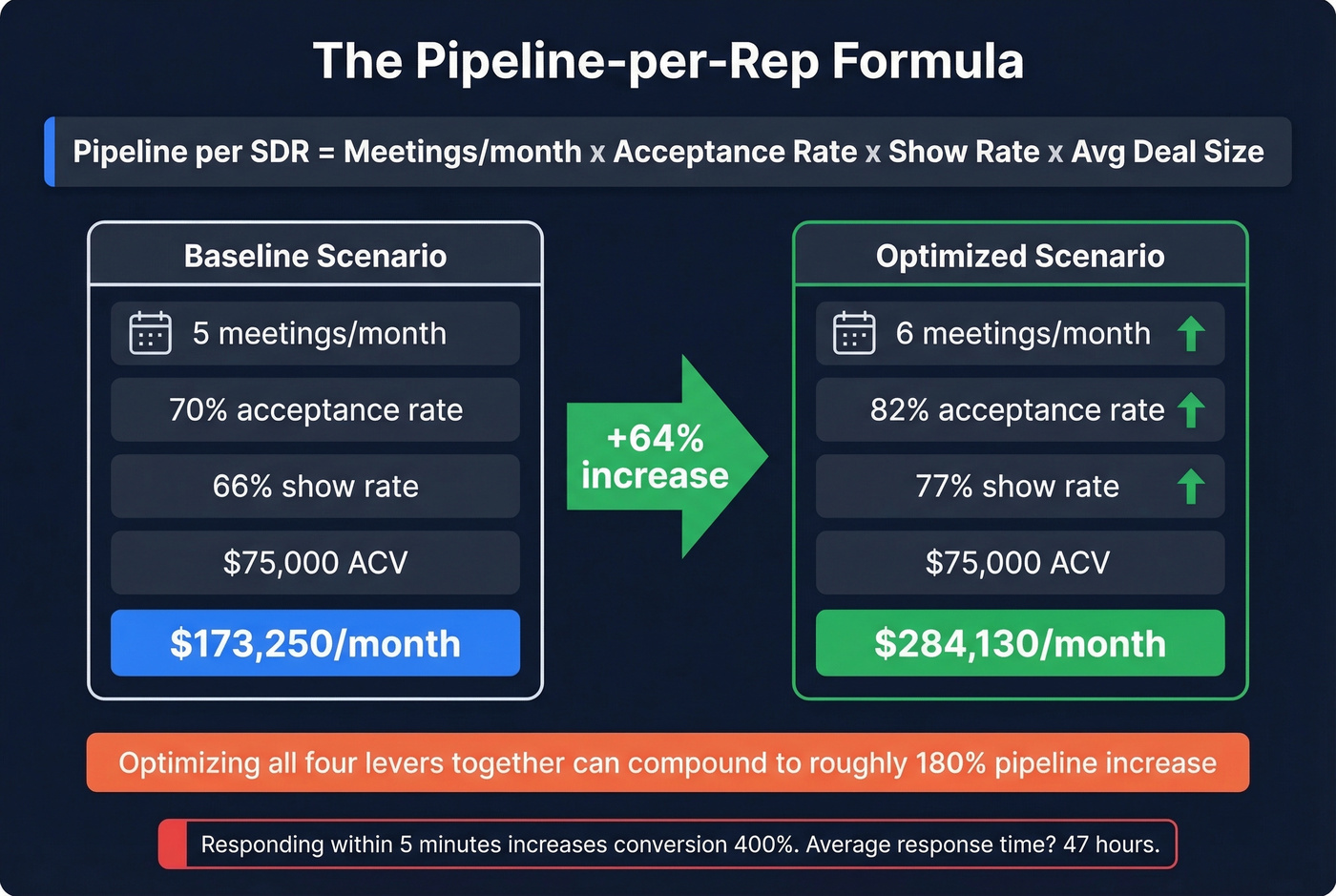
Pipeline per SDR = Meetings/month x Sales acceptance rate x Show rate x Avg deal size
Worked example: 5 meetings x 70% acceptance x 66% show rate x $75,000 ACV = $173,250/month in pipeline per SDR.
Now watch the compounding effect. Bump each lever - 6 meetings instead of 5, 82% acceptance, 77% show rate, same deal size - and pipeline jumps to $284,130/month. That's a 64% increase from a single rep. SOMAmetrics shows how optimizing all four levers together can compound to a roughly 180% pipeline increase.
Also worth tracking: Pipeline velocity = (Opportunities x Deal Value x Win Rate) / Cycle Length. And one stat that should haunt every SDR manager: responding to inbound leads within 5 minutes increases conversion by 400%. The average response time? 47 hours.
Let's be honest: most teams that "need more SDRs" actually need better math. If your pipeline-per-rep is below $150K/month, adding headcount just scales the inefficiency. Fix the levers first.

Your pipeline-per-rep formula has a hidden variable: data quality. Every bounced email zeroes out a sequence, burns domain reputation, and kills the meeting that feeds your entire funnel. Prospeo's 98% email accuracy and 7-day refresh cycle mean your SDRs spend rep-hours on real prospects - not dead inboxes. At $0.01 per verified email, fixing your top-of-funnel costs less than one wasted SDR hour.
Stop scaling bad data. Start scaling pipeline.
Where SDR Funnels Break
Top of Funnel - Bad Data
This is where most funnels silently die. Not from bad messaging or weak sequences - from bad data. Bounced emails, wrong phone numbers, wasted sequences on dead inboxes.
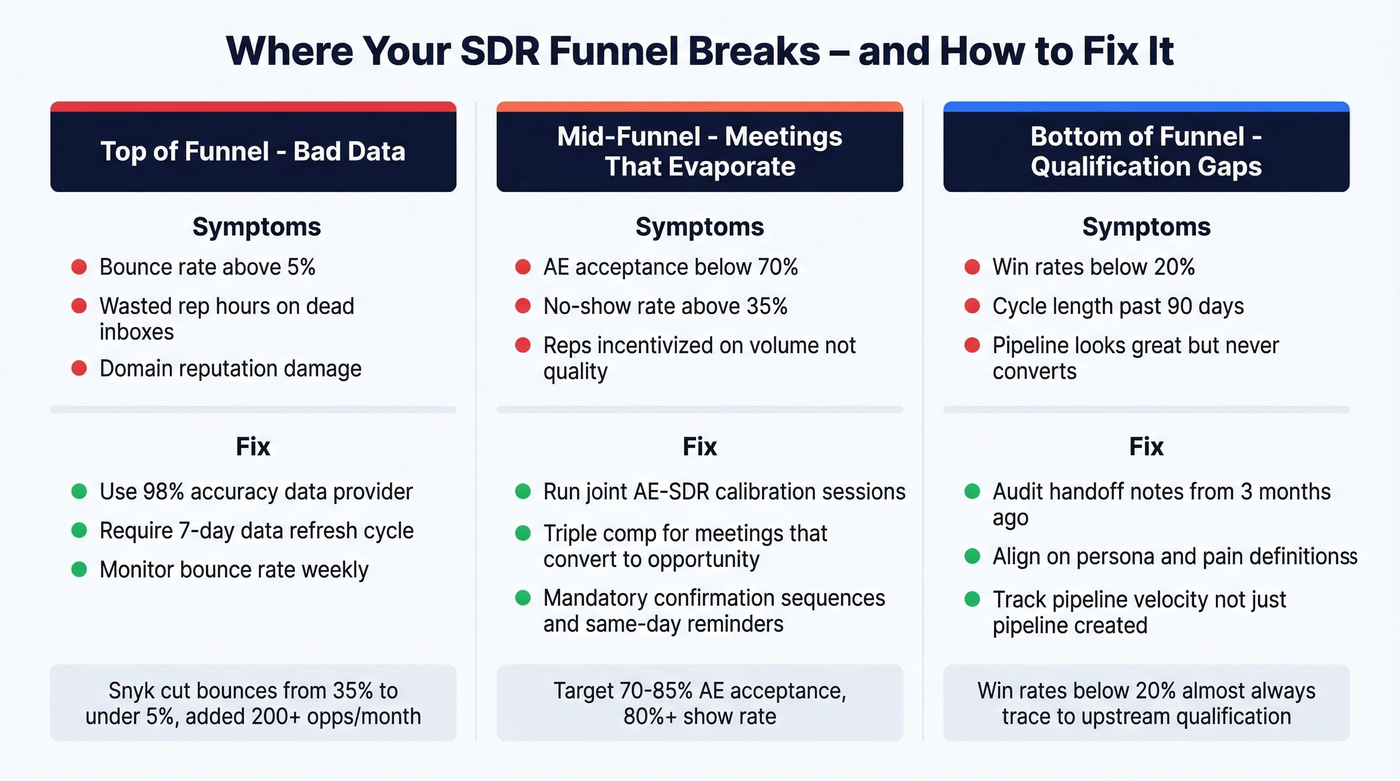
Treat a bounce rate above 5% as a red flag. Every bounced email is a rep-hour burned, a domain reputation hit, and a meeting that never had a chance. Snyk's SDR team was running 35-40% bounce rates before they overhauled their data source. After switching to Prospeo, bounces dropped under 5% and AE-sourced pipeline jumped 180%, generating 200+ new opportunities per month. That kind of improvement comes from 98% email accuracy and a 7-day data refresh cycle - versus the 6-week industry average most providers operate on.
We've seen teams double pipeline just by fixing their bounce rate. GreyScout dropped from 38% to under 4%, pipeline climbed 140%, and rep ramp time got cut from 8-10 weeks to just 4.
Mid-Funnel - Meetings That Evaporate
Booking 15 meetings means nothing if 6 no-show and 4 get rejected by AEs.
Target 70-85% AE acceptance on qualified meetings. Below that, your SDRs and AEs aren't aligned on what "qualified" means. Run a joint calibration session - have AEs review the last 20 rejected meetings and explain exactly why. You'll find the gap in 30 minutes.
Here's something most SDR leaders get wrong: they incentivize meeting volume instead of downstream outcomes. Consider tripling comp payouts for meetings that convert to SAL or opportunity. When reps get paid for pipeline, not activity, qualification improves overnight. The consensus on r/sales backs this up - threads about SDR comp consistently argue that meeting-only quotas produce garbage pipeline.
No-shows are a separate problem. Confirmation sequences, calendar holds, and same-day reminders should be non-negotiable. An 80% show rate is achievable. Below 65%, something structural is wrong.
Bottom of Funnel - Qualification Gaps
Win rates below 20% almost always trace back to upstream qualification problems - wrong persona, overstated pain during handoff, or inflated deal sizes. The pipeline number looks great on the dashboard but never converts.
If your average cycle stretches past 90 days, start auditing the handoff notes from three months ago. That's where the rot started.
Snyk cut bounce rates from 35% to under 5% and added 200+ opportunities per month. GreyScout dropped from 38% to under 4% and saw pipeline climb 140%. The difference wasn't more SDRs - it was 98% accurate contact data refreshed every 7 days. Prospeo's free tier gives you 75 verified emails and 100 Chrome extension credits monthly to prove the math yourself.
Test the data quality impact on your funnel - free, no contracts.
How to Standardize Your Funnel
In HubSpot, use custom properties and workflows for lead status transitions. Build activity-based reports for calls and emails. Restrict SDRs to "Owned only" records and use field-level permissions to keep things clean.
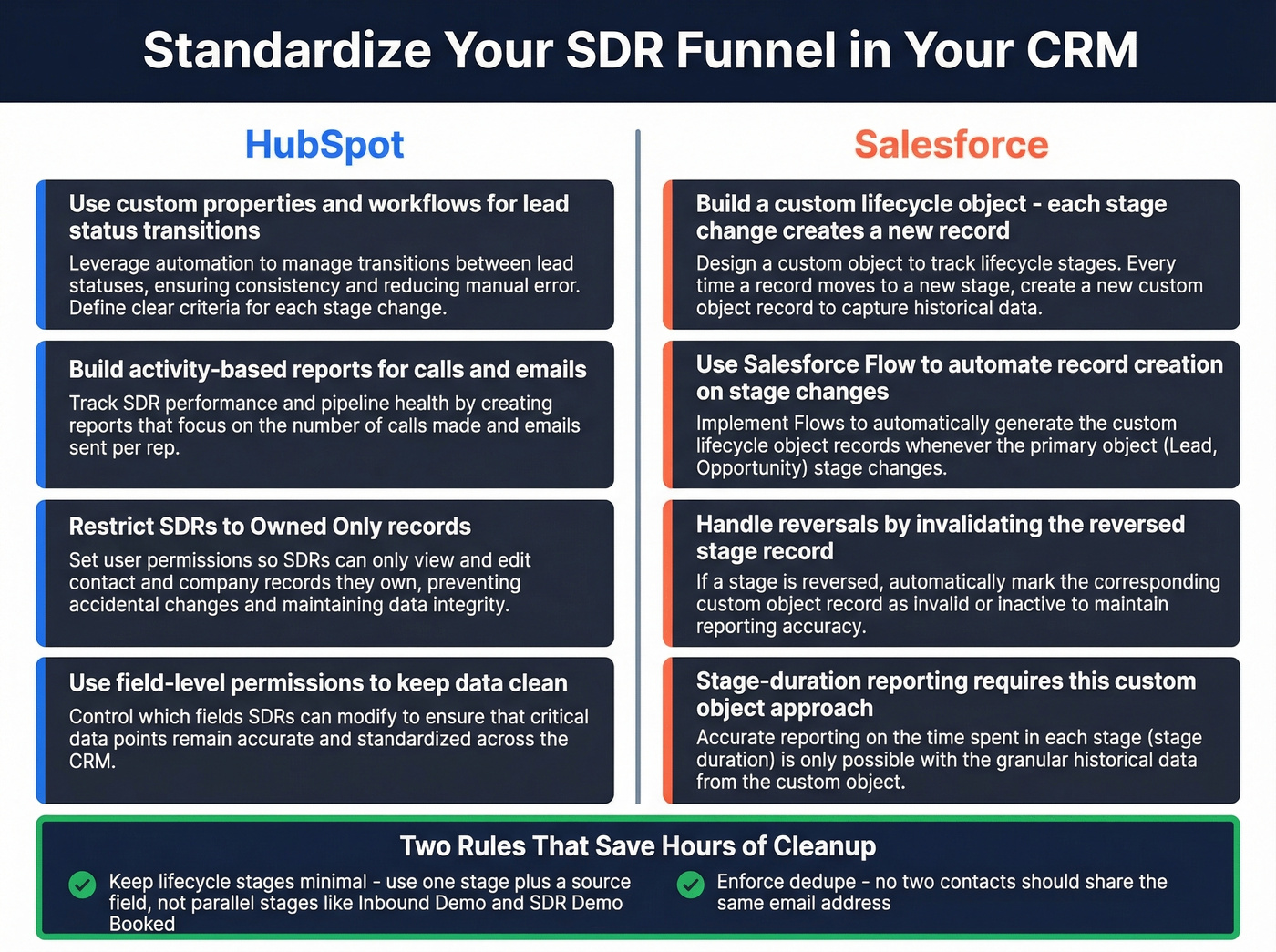
In Salesforce, build a custom lifecycle object where each stage change creates a new record - it's the only way to get reliable stage-duration reporting. Use Salesforce Flow to automate record creation on stage changes. Handle reversals by invalidating the reversed stage record.
Two rules that save hours of cleanup: keep lifecycle stages minimal - don't create parallel stages like "Inbound Demo" and "SDR Demo Booked" when you can use one stage and a source field - and enforce dedupe so no two contacts share the same email address. The goal is to standardize funnel definitions across your entire revenue team so that every rep, manager, and analyst measures the same thing.
AI and the SDR Funnel in 2026
AI agents can handle up to 80% of traditional SDR tasks - prospecting, research, scheduling, CRM hygiene. SDRs currently spend roughly 30% of their time on data entry and research, and that's the first thing AI reclaims.
But automation amplifies good data, not bad data. If your contact database is stale, AI just sends bad sequences faster. Layering intent signals on top of clean, weekly-refreshed contact data is how AI-era SDR teams prioritize who to call first, not just how to call them. Skip this approach if your CRM hygiene is a mess - fix the foundation before you automate on top of it.
If you're rebuilding your stack for this, start with your SDR tools and your sales engagement platform before you add more automation.
FAQ
What's a good meeting-to-opportunity rate?
Strong teams convert SQL to Opportunity at 50-59%. Many B2B SaaS funnels sit closer to 35-42%. If you're below 30%, audit AE acceptance criteria and whether meetings are genuinely qualified before booking.
How long does it take to ramp an SDR?
Expect 3-4 months to full productivity. Month 1: 20-30% of quota. Month 2: 50-60%. Month 3: 75-85%. Clean contact data and solid sequences cut ramp significantly - GreyScout halved theirs from 8-10 weeks to 4 by fixing data quality upstream.
How many meetings should an SDR book monthly?
Median across 939 companies: 8-10 qualified meetings. Top quartile: 12-15. Elite: 18+. Multi-touch, multichannel sequences convert at 4-7%, roughly 2-3x single-channel rates.
What's the cheapest way to fix top-of-funnel data?
Start with a free tier from a verified data provider and measure the bounce rate difference against your current source. Paid plans from quality providers run about $0.01 per lead, which is 90% cheaper than enterprise platforms like ZoomInfo.
The SDR funnel isn't complicated. It's four multipliers and a data quality problem. Fix the math, fix the data, and the headcount question answers itself.