

The SDR Process That Actually Works: Cadences, Benchmarks, and Daily Rhythm
A 10-rep SDR team burning through $2,000-$5,000 per rep per month in tools - and half of them can't explain what happens after a prospect says "sure, let's talk." That's not a people problem. It's a process problem, and it's fixable.
What You Need (Quick Version)
A multichannel cadence, a qualification framework matched to your deal size, and verified data underneath it all. If your bounce rate is above 2%, fix your data before touching anything else. The rest of this piece gives you exact templates to build a repeatable sales development workflow from scratch.
What the SDR Process Actually Is
This system moves accounts from cold to qualified held meeting. Not "pipeline generation" in the abstract - a concrete sequence of inputs like ICP criteria, trigger events, and verified contacts; a system of cadences, deliverability guardrails, and parallel dialing; and outputs measured in held meetings that convert to SQLs and revenue.
The north-star metric that punishes busywork: held meetings per rep hour.
Six in ten B2B SaaS companies run in-house SDR teams. If yours doesn't have a documented process, your reps are improvising. Improvisation doesn't scale.
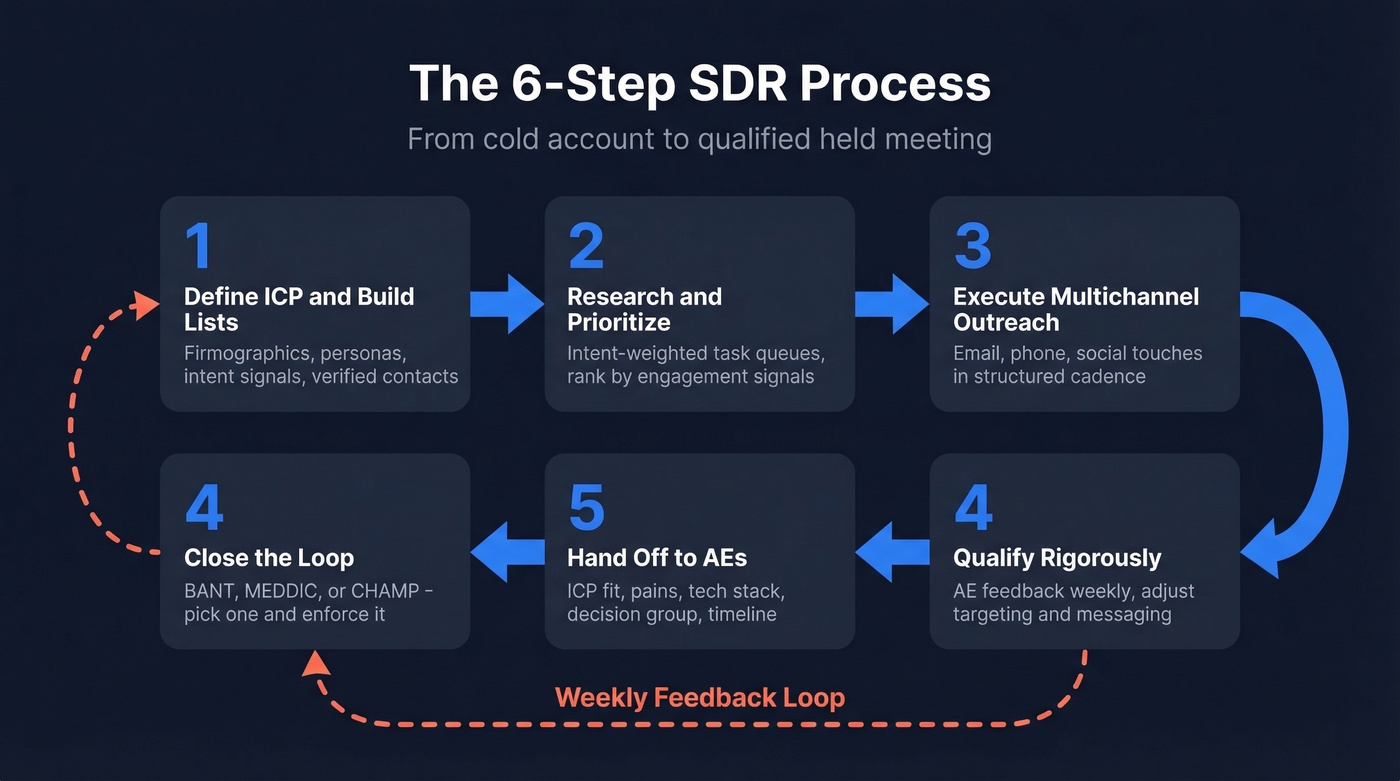
The 6-Step Sales Development Workflow
1. Define Your ICP and Build Lists
Everything starts with targeting. Get this wrong and every downstream metric suffers.
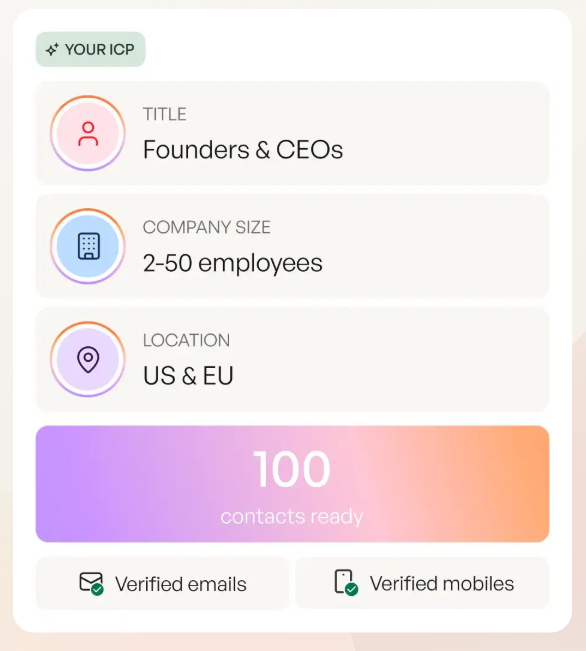
Define firmographics: industry, headcount, revenue. Map buyer personas by title and department. Layer in intent signals - hiring patterns, tech stack changes, funding rounds. Then build lists from verified sources. A 35% bounce rate will wreck your domain reputation in a week.
2. Research and Prioritize
Don't treat every lead equally. Use intent-weighted task queues - repeat email opens, website visits, competitor usage signals - to rank your daily work. A prospect who visited your pricing page twice this week gets a call before someone sitting cold in your CRM for 60 days.
This prioritization step separates a disciplined workflow from random activity.
3. Execute Multichannel Outreach
Email alone doesn't cut it. Nearly half of B2B buyers still prefer phone contact. Layer email, phone, and social touches across a structured cadence. We'll cover the exact template below.
4. Qualify Rigorously
Apply a consistent framework - BANT, MEDDIC, or CHAMP - to every conversation. The goal isn't a nice chat. It's determining whether this prospect has budget, authority, a real pain, and a timeline.
5. Hand Off to AEs
A sloppy handoff wastes the meeting you worked weeks to book. Your AE calendar invite should include ICP fit and triggers, pains identified, current tech stack, the decision group, timeline, and the prospect's stated success criteria. Skip any of those and the AE walks in blind.
6. Close the Loop
Here's where most processes die. AEs need to report back on meeting quality, and SDR managers need to adjust targeting, messaging, and cadence design based on what's actually converting. In our experience, the teams that run this feedback loop weekly outperform those who do it quarterly by a wide margin. Without it, you're optimizing in the dark.
Daily Workflow That Hits 15+ Meetings
Let's be honest: most SDR underperformance isn't about skill or messaging. It's about how reps spend their hours. Here's the time-blocked schedule we've seen work across teams that consistently hit 15+ meetings per month.
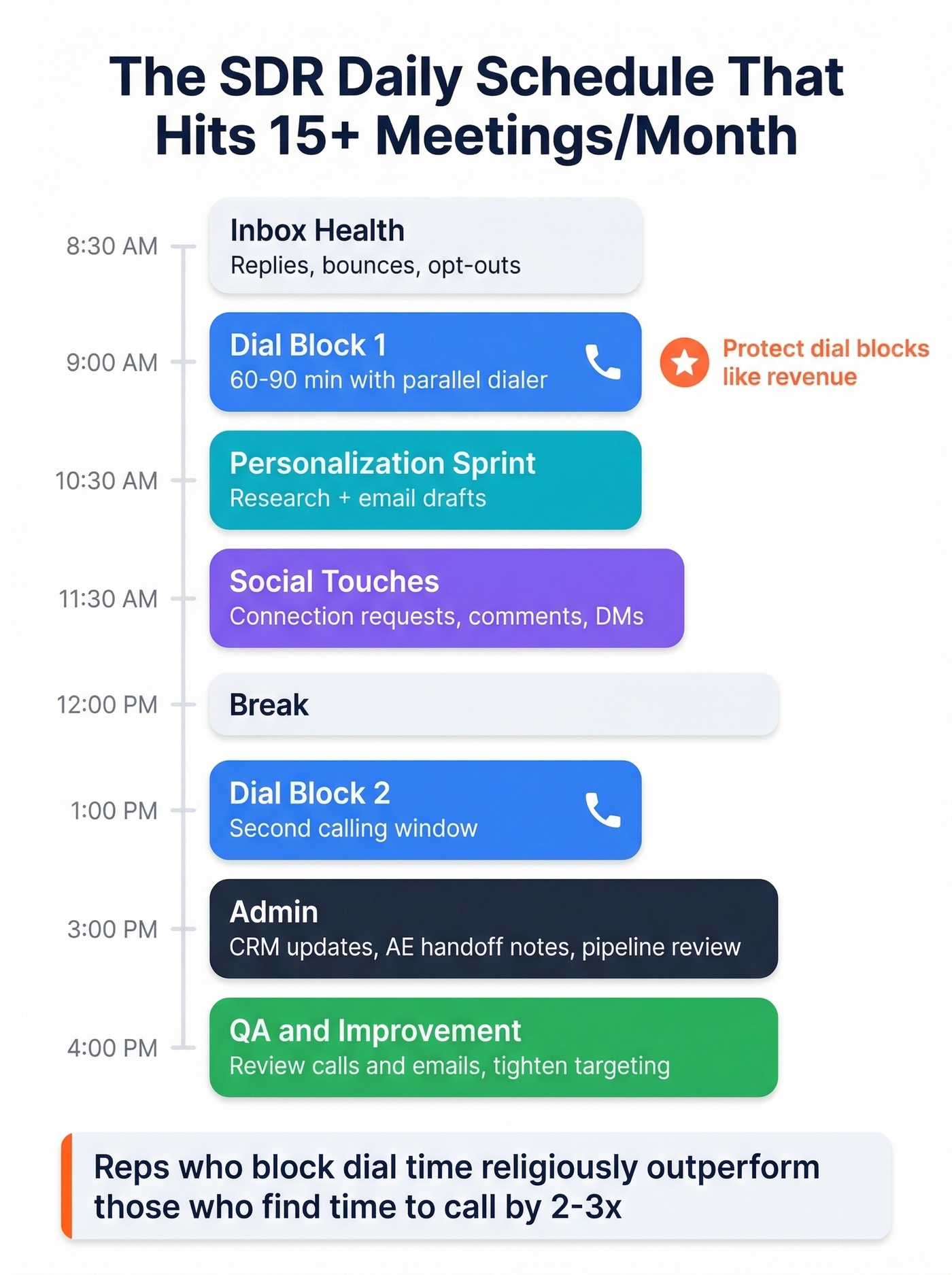
| Time | Block |
|---|---|
| 08:30 | Inbox health - replies, bounces, opt-outs |
| 09:00 | Dial block #1 (60-90 min, parallel dialer) |
| 10:30 | Personalization sprint - research + email drafts |
| 11:30 | Social touches - connection requests, comments, DMs |
| 12:00 | Break |
| 13:00 | Dial block #2 |
| 15:00 | Admin - CRM updates, AE handoff notes, pipeline review |
| 16:00 | QA - review calls/emails, tighten targeting + messaging |
The reps who block dial time religiously outperform the ones who "find time to call" by 2-3x. Protect the dial blocks like they're revenue - because they are.
SDR Cadence Template
A 12-step multichannel cadence running 28-32 days. Adjust timing based on your market and buyer persona.
| Day | Channel | Action |
|---|---|---|
| 1 | Personalized intro email | |
| 2 | Social | Profile view + follow |
| 3 | Phone | Parallel dial burst #1 |
| 5 | Follow-up #1 (new angle) | |
| 7 | Social | Connection request |
| 9 | Phone | Dial burst #2 |
| 12 | Case study or insight | |
| 15 | Social | Comment or DM |
| 18 | Phone | Dial burst #3 |
| 22 | Breakup email | |
| 26 | Social | Share or mention |
| 30 | Phone | Final dial burst |
If this feels like too much, start with the 3-7-3 model: 3 value props, 7 touches, 3 channels over roughly 3 weeks. Simpler, still multichannel, and a good starting point for teams without a sequence management tool yet.
Cognism's practitioners recommend 17-21 days with 8-12 touchpoints as a baseline. One regional note worth flagging: EMEA and APAC buyers generally respond to fewer touches. Triple-tapping on Day 1 works in the US but reads as aggressive in DACH markets.

You just read that a 35% bounce rate wrecks your domain in a week. Prospeo's 5-step email verification delivers 98% accuracy - teams using it cut bounce rates from 35% to under 4% and tripled pipeline. At $0.01 per email, fixing your data costs less than one bad send.
Stop building cadences on broken data. Start with emails that actually land.
Qualification Frameworks Compared
| Framework | Best For | Weakness |
|---|---|---|
| BANT (Budget, Authority, Need, Timeline) | SMB, sub-30-day cycles | Misses stakeholder complexity |
| MEDDIC (Metrics, Econ Buyer, Decision Criteria, Pain, Champion) | Enterprise, high-ACV | Can slow deals if applied too rigidly |
| CHAMP (Challenges, Authority, Money, Prioritization) | Mid-market consultative | Too loose without discipline |
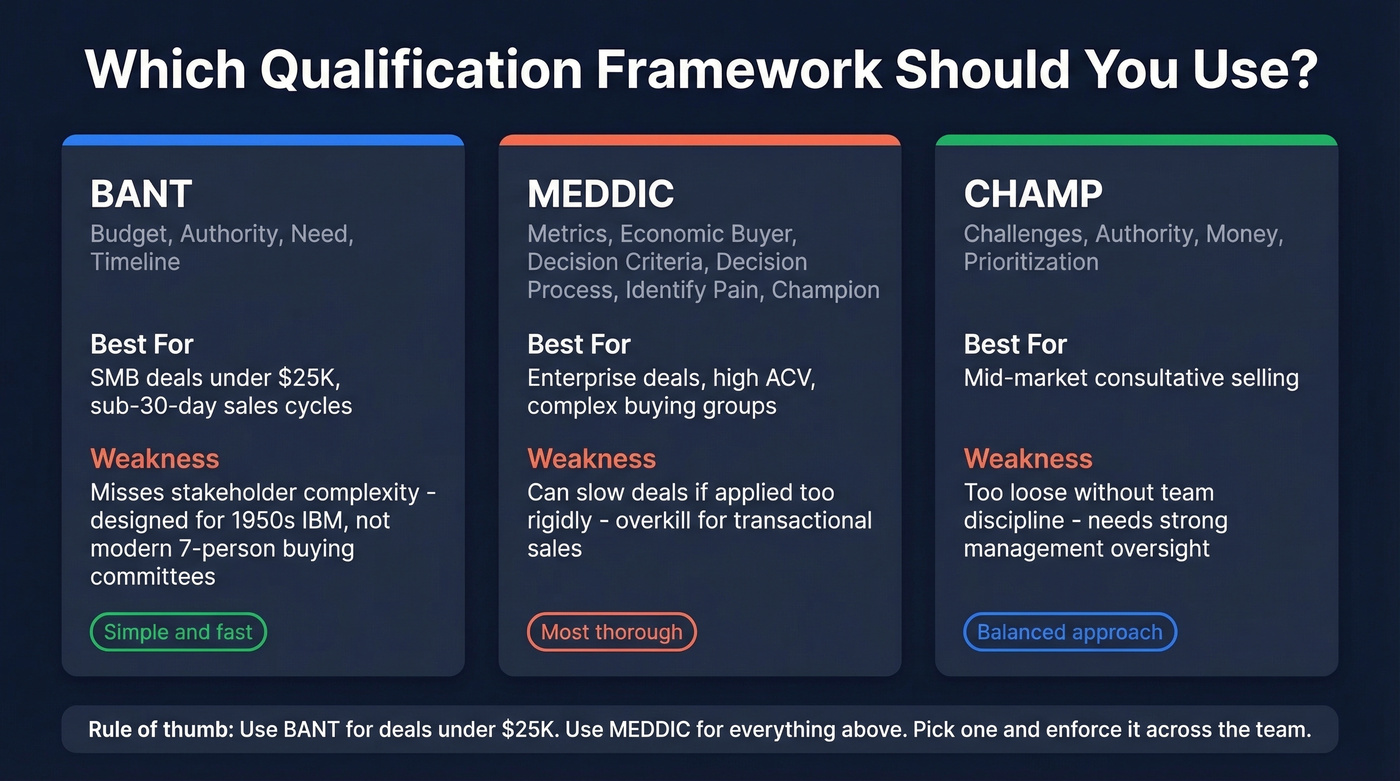
BANT was developed at IBM in the 1950s. It still works for transactional deals, but modern B2B buying involves an average of seven stakeholders - BANT wasn't designed for that. Our rule of thumb: use BANT for deals under $25K, MEDDIC for everything above. Pick one and enforce it across the team. Letting reps freestyle qualification is how you end up with AEs sitting in meetings that were never real opportunities.
SDR Benchmarks for 2026
| Metric | Benchmark |
|---|---|
| Cold email reply rate | 5.8% avg |
| Cold call success rate | 2.3% avg |
| Meetings booked/month | ~15 (outbound) |
| Meeting show rate | ~80% |
| Meeting-to-opportunity | ~50% |
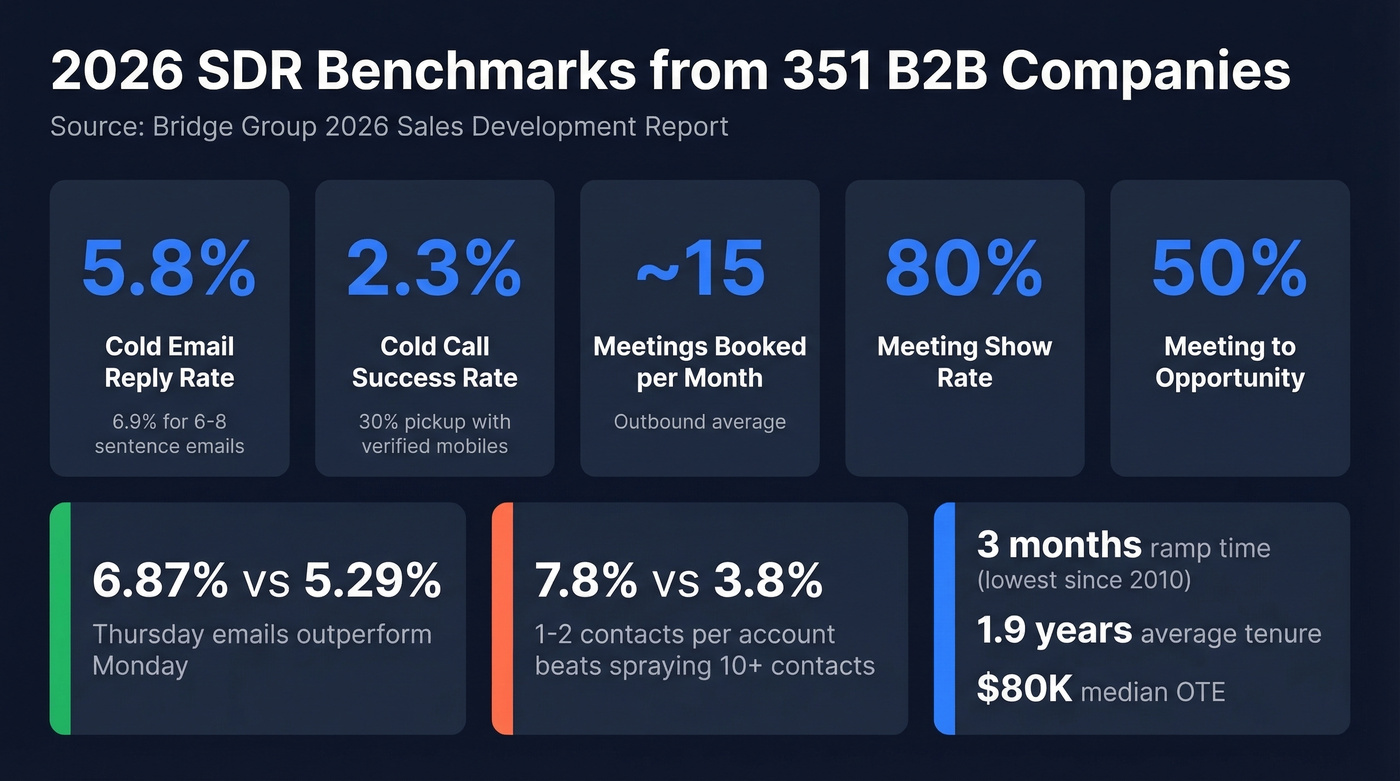
Emails in the 6-8 sentence range pull a 6.9% reply rate. Thursday emails outperform Monday at 6.87% vs 5.29%. And here's one most teams get backwards - touching 1-2 contacts per company yields a 7.8% reply rate vs 3.8% when you spray 10+ contacts at the same account. More contacts doesn't mean more replies. It means more spam complaints.
From the Bridge Group's 2026 report across 351 B2B companies: average SDR ramp time is 3 months (the lowest since 2010), average tenure is 1.9 years, and median OTE sits at $80K.
SDR Tech Stack
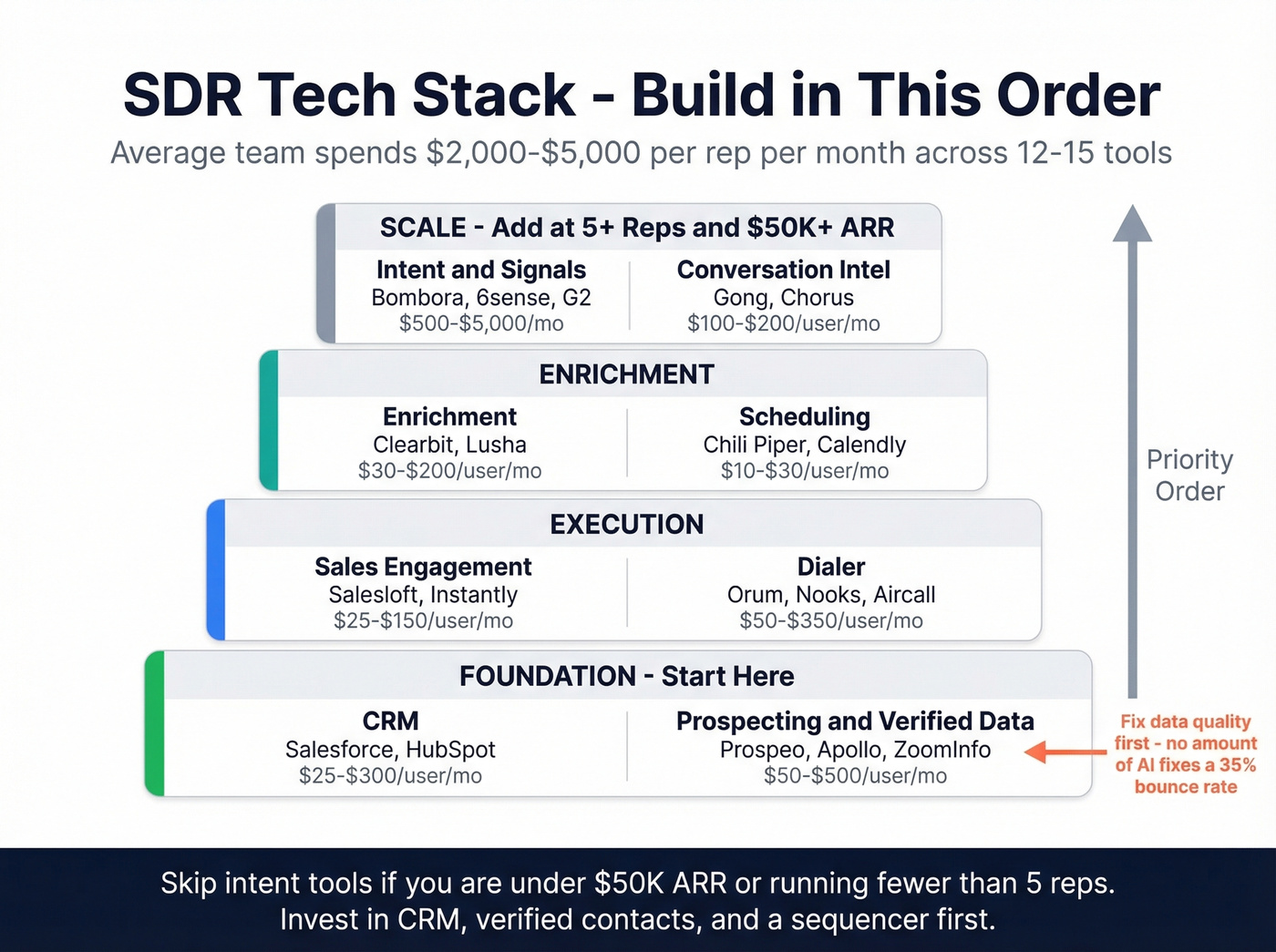
The average SDR team uses 12-15 tools at $2,000-$5,000 per rep per month. Most of those tools exist because the first tool's data was bad. That's a frustrating cycle we've watched teams repeat over and over.
| Category | Examples | Cost Range |
|---|---|---|
| CRM | Salesforce, HubSpot | $25-$300/user/mo |
| Prospecting & Data | Prospeo, Apollo, ZoomInfo | $50-$500/user/mo |
| Sales Engagement | Salesloft, Instantly | $25-$150/user/mo |
| Dialer | Orum, Nooks, Aircall | $50-$350/user/mo |
| Enrichment | Clearbit, Lusha | $30-$200/user/mo |
| Scheduling | Chili Piper, Calendly | $10-$30/user/mo |
| Intent/Signals | Bombora, 6sense, G2 | $500-$5,000/mo |
| Conversation Intel | Gong, Chorus | $100-$200/user/mo |
The prospecting row is where teams waste the most money. ZoomInfo runs $15-50K/year for most teams. Prospeo covers 300M+ profiles with 143M+ verified emails and 125M+ verified mobile numbers at roughly $0.01 per email - a fraction of that cost. The 7-day data refresh cycle means you're not calling people on six-week-old data. One customer, Meritt, cut bounce rates from 35% to under 4% and tripled pipeline just by switching data providers. No amount of AI personalization fixes a 35% bounce rate. Start with clean data.
Skip the intent data tools if you're under $50K ARR or running fewer than 5 reps. The signal-to-noise ratio isn't worth the spend at that stage. Invest in a solid CRM, verified contacts, and a sequencer first.

Nearly half of B2B buyers prefer phone contact, but your parallel dialer is useless without real numbers. Prospeo gives SDRs access to 125M+ verified mobile numbers with a 30% pickup rate - that's 3x the industry average. Layer intent data from 15,000 Bombora topics to prioritize who to call first.
Hit 15+ meetings a month with direct dials that actually connect.
Harsh Truths From the Trenches
The consensus on r/techsales is blunt, and worth hearing.
There's no golden pitch. Success is product, territory, and timing. Your messaging matters, but it's maybe 20% of the equation. A mediocre pitch with great territory beats a perfect pitch with a dead market every time.
Spray-and-pray is dead in mature markets. You need a real reason to call - competitor usage, a trigger event, an actual insight. "Just checking in" isn't a reason.
SDR purgatory is real. The "SDR to AE in 12-18 months" promise isn't guaranteed. Ask about promotion paths, timelines, and historical data before accepting the role. If the company can't answer, that's your answer.
Building a Strategy That Scales
The six steps above give you a working foundation. Turning it into something durable means layering in three things: documented workflows that any new hire can follow without shadowing a tenured rep for two weeks, feedback loops between AEs and SDR managers that run weekly rather than quarterly, and a tech stack where data quality is the first investment rather than the last.
Some teams adopt an assembly line model - splitting list building, outreach, and qualification across specialized roles. This works at scale with 20+ reps but adds coordination overhead that smaller teams can't afford. For teams under ten reps, keep each person full-cycle and invest in better tooling instead.
If you're tightening the system end-to-end, it helps to map this SDR motion into your broader sales process optimization and track funnel metrics so you can see where meetings turn into revenue (or don't).
SDR Process FAQ
What's the ideal SDR-to-AE ratio?
Bridge Group data across 351 companies shows 1 SDR supporting 2.4 AEs on average - steady since 2018. The commonly cited 2:1 or 3:1 ratio is outdated. Align SDRs to AE territories; 82% of top-performing teams do.
How long does it take to ramp a new SDR?
The current average is 3 months - the lowest since 2010. Give new reps a daily schedule, a cadence template, and a qualification framework from Day 1. Start with verified data so they're not debugging bounces during their first week.
What tools does an SDR need on Day 1?
Four essentials: a CRM like HubSpot or Salesforce, a verified data source, a sequencing tool like Instantly or Salesloft, and a dialer. Everything else is optimization. Total cost for a lean stack: $250-$800/SDR/month.
How do I know if my workflow is broken?
Look at three signals: bounce rates above 5%, meeting no-show rates above 25%, and AEs rejecting more than 20% of handed-off meetings. If any of those are true, work backwards through the six steps to find where the process is leaking.