

The SDR Role: What You'll Earn, What You'll Do, and Where It Leads in 2026
You're three months into the SDR gig. The CRM is a mess, your call list bounced 19% last week, and the AE you're feeding meetings to just got promoted - again. Meanwhile, you're staring at a quota that only 57.3% of SDRs actually hit. The SDR role is the most misunderstood job in B2B sales: simultaneously the fastest path into tech and the one most likely to burn you out before you get anywhere.
Here's what the role actually looks like in 2026 - real numbers, not platitudes.
The Quick Version
Pay: Median OTE is $85k ($60k base + variable). Top performers clear $127k+.
Daily grind: Expect 80-100 activities per day - a mix of calls, emails, and social touches. It's a volume game with a skill ceiling.
Time to promotion: 12-18 months to AE for most reps. High performers make it in 10-12. You'll need 90%+ quota for two consecutive quarters to build a promotion case.
AI threat level: Real but nuanced. 36% of B2B companies decreased SDR headcount last year. The role isn't disappearing - it's shifting from pure volume to AI-assisted qualification and strategic outreach.
What Is a Sales Development Representative?
A Sales Development Representative is the front line of B2B sales. SDRs don't close deals. They prospect, qualify inbound and outbound leads, and book meetings for Account Executives. Think of the SDR as the bridge between marketing (which generates interest) and the closing team (which turns interest into revenue).
The typical org structure puts SDRs inside the sales department - about 60% of sales development groups report to Sales leadership, per the Bridge Group's 2025 report covering 351 B2B companies. The average SDR:AE ratio sits at 1:2.4, meaning one SDR feeds roughly two and a half closers. That ratio has held steady since 2018, which tells you something: even as tools get better, the human pipeline-generation function hasn't been automated away yet.
Most SDRs work at B2B SaaS companies with median deal sizes around $50k. The position exists because AEs are too expensive to spend their time cold-calling - it's a straightforward division of labor that lets closers focus on closing.
SDR vs BDR vs ADR
Most companies use these titles interchangeably. The theoretical distinctions matter less than what the actual job description says.
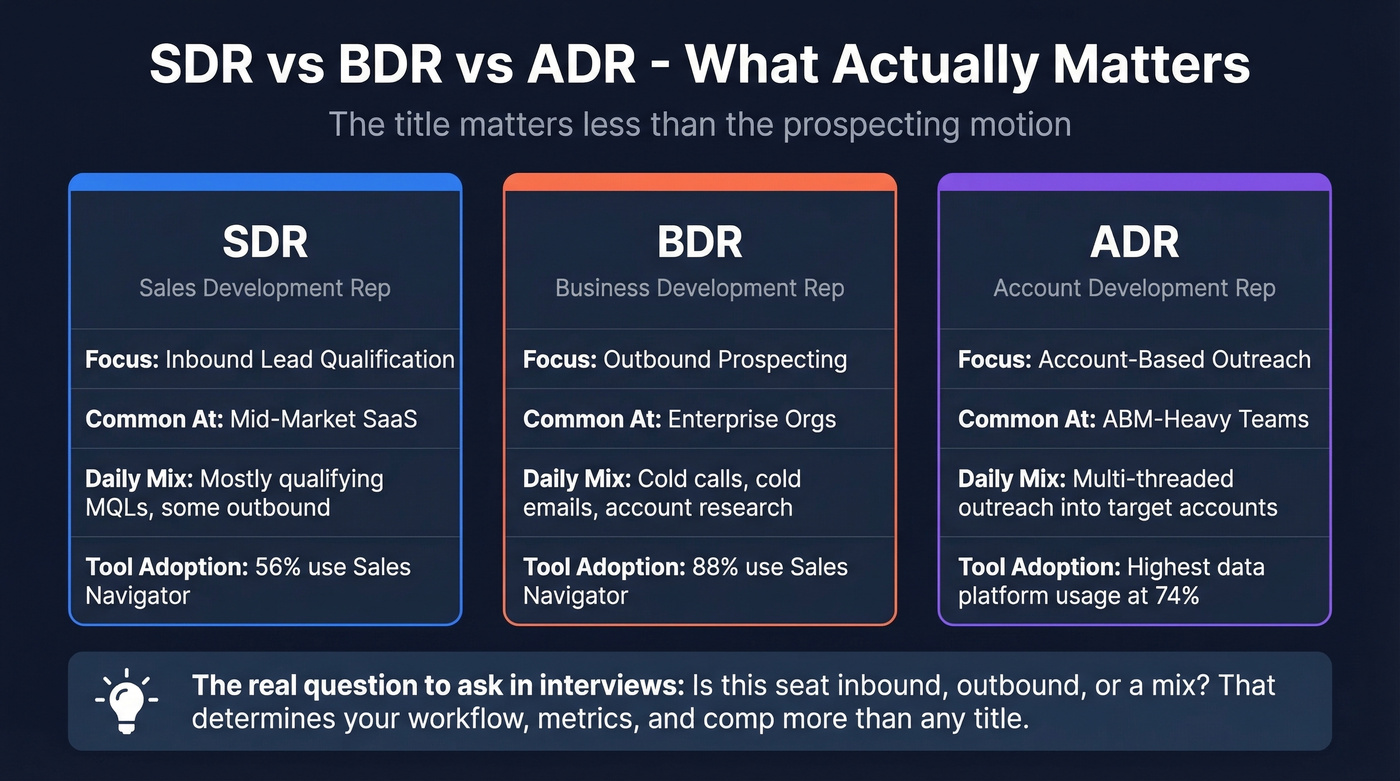
| Title | Typical Focus | Common At |
|---|---|---|
| SDR | Inbound lead qualification | Mid-market SaaS |
| BDR | Outbound prospecting | Enterprise orgs |
| ADR | Account-based outreach | ABM-heavy teams |
The "SDR = inbound, BDR = outbound" split is the textbook answer, but plenty of companies hire "SDRs" who do nothing but cold outbound. And some "BDRs" spend their entire day qualifying inbound MQLs.
What actually matters is whether the position is inbound-focused, outbound-focused, or a mix. That determines your daily workflow, your metrics, and your comp structure far more than the three letters on your business card. The 351-company study confirms this: tool adoption varies dramatically by motion. For example, 88% of "allbound" SDR teams pay for LinkedIn Sales Navigator versus just 56% of inbound-only teams. Contact data platforms follow a similar pattern - 74% adoption for outbound teams versus 56% for inbound.
The motion defines the job, not the title. When evaluating opportunities, always look past the title and dig into the actual prospecting motion.
What Does the Day Actually Look Like?
The honest answer: a lot of repetitive work punctuated by brief moments of genuine human connection.
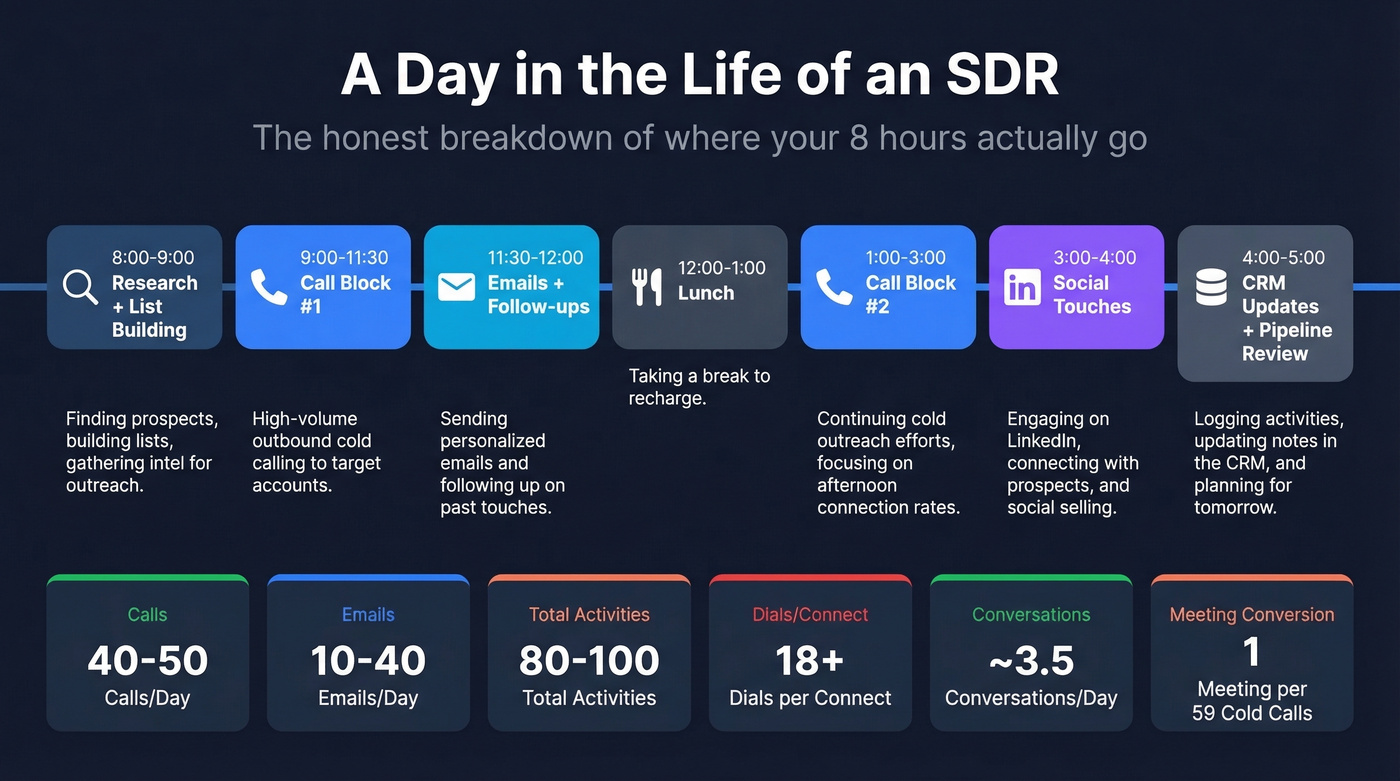
| Time Block | Activity | Duration |
|---|---|---|
| 8:00-9:00 | Research + list building | 1 hr |
| 9:00-11:30 | Call block #1 | 2.5 hrs |
| 11:30-12:00 | Email sequences + follow-ups | 30 min |
| 12:00-1:00 | Lunch | 1 hr |
| 1:00-3:00 | Call block #2 | 2 hrs |
| 3:00-4:00 | Social touches + personalization | 1 hr |
| 4:00-5:00 | CRM updates + pipeline review | 1 hr |
The morning research block is where data quality makes or breaks your day. SDRs who start with verified contacts spend their call blocks actually talking to people. SDRs who start with stale data spend half their time leaving voicemails at wrong numbers and watching emails bounce.
That's not an exaggeration. One team cut bounce rates from 35% to under 4% after switching to verified contacts on a weekly refresh cycle - and their connect rate tripled to 20-25%.
Here are the benchmark numbers that define "good":
- 40-50 calls per day (outbound)
- 10-40 emails per day, depending on personalization level
- 80-100 total activities across all channels
- 18+ dials to get one live conversation
- Roughly 3.5-4.4 conversations per day
- Roughly 1 meeting booked per 59 cold calls
That last number is the one that surprises people. Fifty-nine calls for one meeting. It's a grind, and pretending otherwise does nobody any favors. The SDRs who thrive aren't the ones who love cold calling - they're the ones who've built systems to make the grind efficient.
Salary & Compensation in 2026
Let's talk money. The RepVue dataset via TheQuota gives us the clearest picture across thousands of self-reported data points:
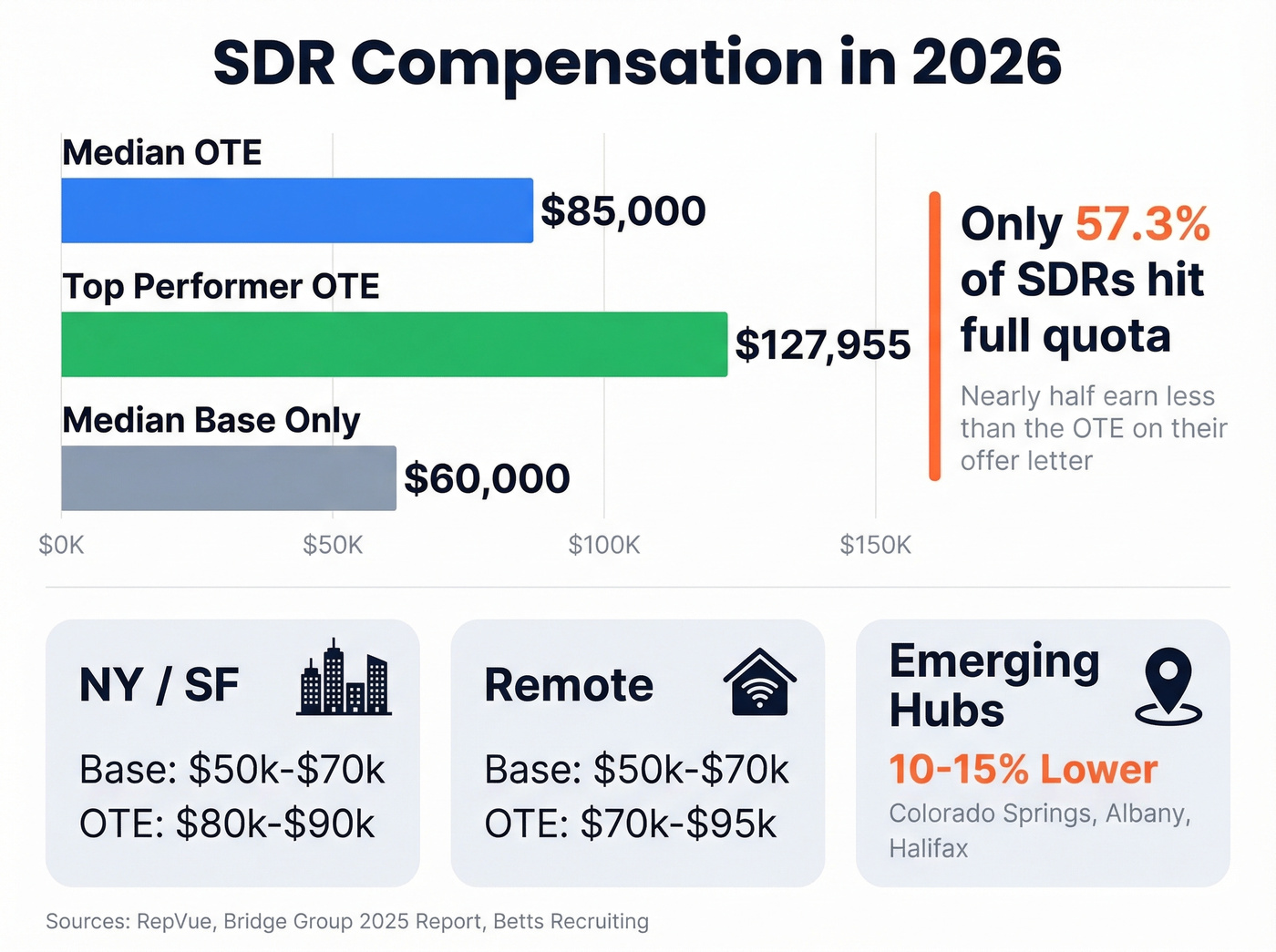
| Metric | Amount |
|---|---|
| Median base salary | $60,000 |
| Median OTE | $85,000 |
| Top performer OTE | $127,955 |
| Quota attainment | 57.3% |
| Variable as % of base | 20-60% |
The Bridge Group's 351-company study lands close, pegging median OTE at $80k. The $5k gap between the two sources is noise; directionally, you're looking at $80-85k OTE as the realistic midpoint.
Geography still matters, though less than it did pre-remote. Betts Recruiting's comp data breaks it down:
| Location | Entry Base | Entry OTE | 6-Month Base |
|---|---|---|---|
| NY / SF | $50k-$70k | $80k-$90k | $60k-$80k |
| Remote | $50k-$70k | $70k-$95k | $60k-$75k |
| Emerging hubs | 10-15% lower | 10-15% lower | Varies |
SDR salaries increased 5-10% from 2024, and emerging talent hubs like Colorado Springs, Albany, and Halifax are closing the gap with traditional tech cities. The variable component swings wildly - some companies offer 20% of base as variable, others go up to 60%. Ask about this in the interview. A $60k base with 60% variable means your OTE is $96k, but your floor is $60k if you miss quota. A $65k base with 25% variable means $81k OTE but a much safer floor.
Only 57.3% of SDRs hit full quota. That means nearly half the people in this role earn less than the OTE number on their offer letter. Factor that into your decision.
Metrics & KPIs That Matter
Every SDR manager lives and dies by a handful of numbers. These are the benchmarks that matter:
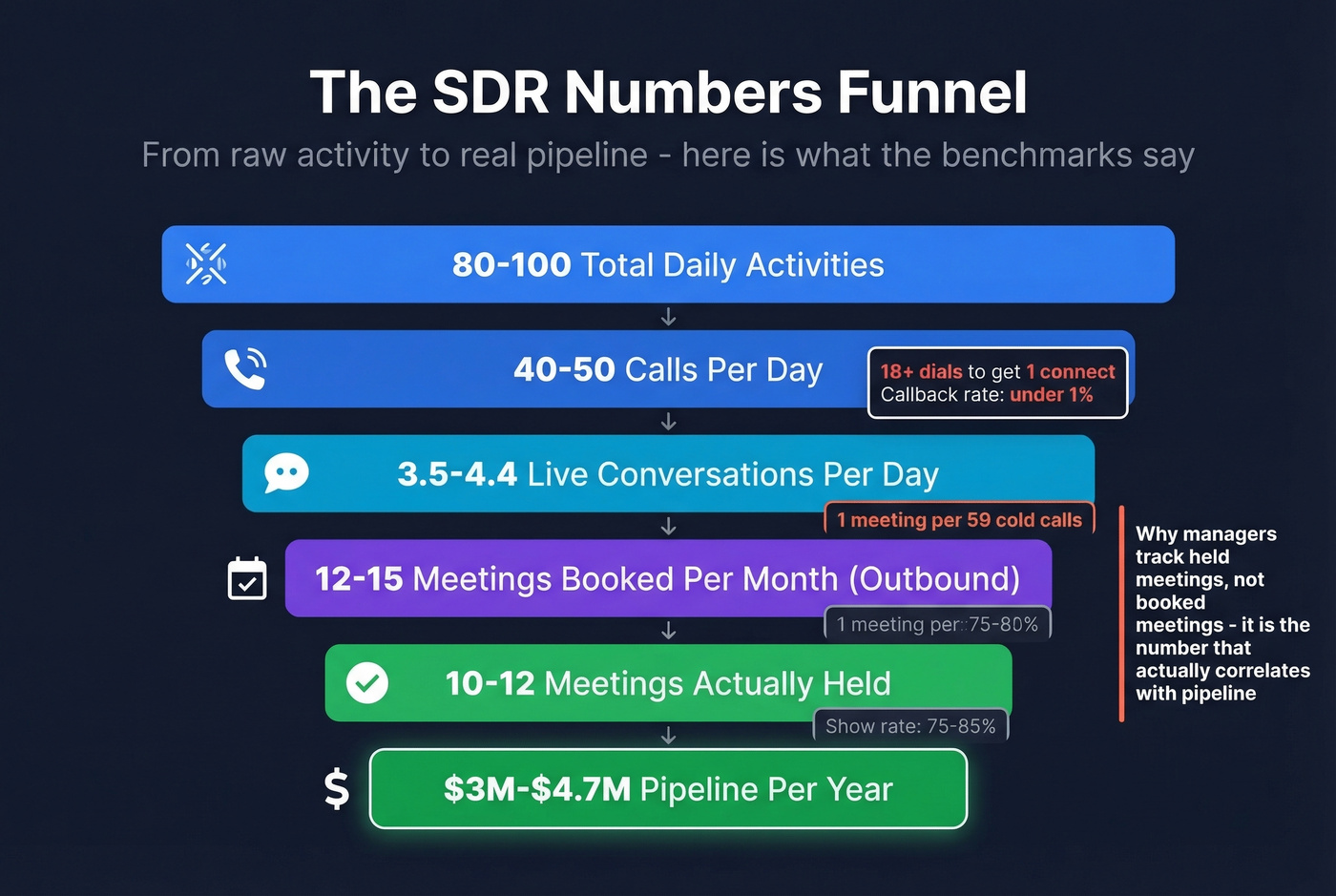
| Metric | Benchmark |
|---|---|
| Calls per day | 40-50 |
| Emails per day | 10-40 |
| Total activities/day | 80-100 |
| Dials to connect | 18+ |
| Callback rate | <1% |
| Conversations/day | ~3.5-4.4 |
| Meetings booked (outbound) | 12-15/month |
| Meetings booked (inbound) | 20-25/month |
| Show rate | 75-85% |
| Held meetings (from 12 booked) | 10-12 |
| Median pipeline generated | $3M-$4.7M/year |
| Avg cadence attempts | 10.6 |
A few things jump out. The callback rate is under 1%. Voicemails are dead as a conversion mechanism - they exist to build name recognition, not to generate callbacks. The gap between outbound meetings (12-15/month) and inbound (20-25/month) is significant too. If you're evaluating positions, an inbound-heavy seat will feel very different from a pure outbound one.
The show rate deserves attention. Even at 75-85%, you're losing 2-3 meetings per month to no-shows. That's why experienced managers track "held meetings" rather than "meetings booked" - it's the number that actually correlates with pipeline.
The median SDR generates $3M-$4.7M in pipeline annually, depending on deal size and market. That's the number that justifies the role's existence to finance teams. When someone asks "why do we pay SDRs $85k?" the answer is "$3M+ in pipeline at a fraction of the cost of an AE doing their own prospecting."

That morning research block determines your entire day. Prospeo gives SDRs 300M+ profiles with 98% email accuracy and 125M+ verified mobile numbers - refreshed every 7 days, not every 6 weeks. One team tripled their connect rate to 20-25% after switching.
Stop burning dial time on wrong numbers and bounced emails.
Duties That Get You Promoted
The SDRs who get promoted fastest aren't necessarily the ones who make the most calls. They're the ones who combine activity volume with genuine skill development.
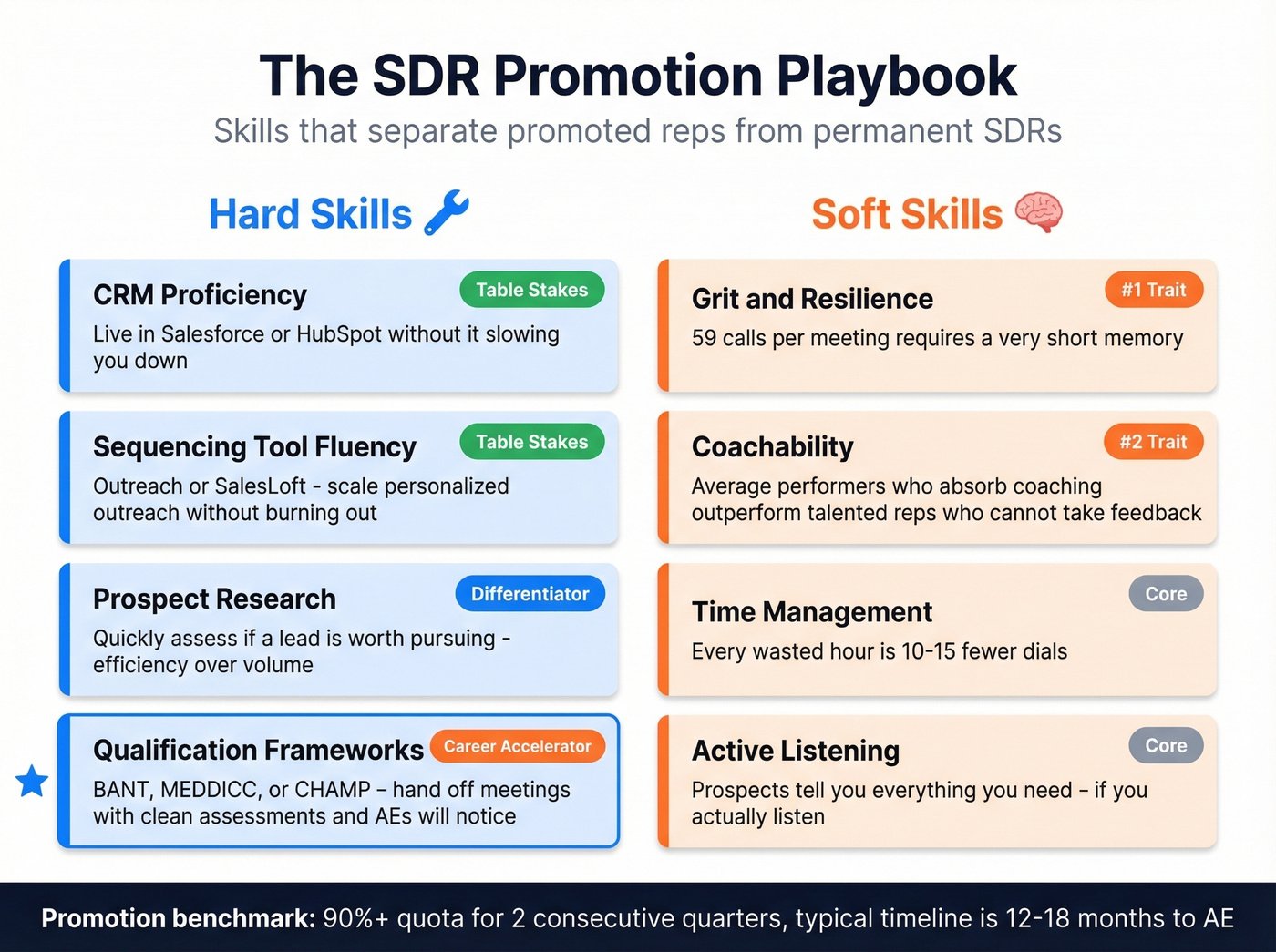
On the hard skills side, CRM proficiency is table stakes - you need to live in Salesforce or HubSpot without it slowing you down. Sequencing tool fluency with platforms like Outreach or SalesLoft matters because it's how you scale personalized outreach without burning out. Prospect research - knowing how to quickly assess whether a lead is worth pursuing - separates efficient reps from busy ones.
Here's the real differentiator most SDRs skip: qualification frameworks. Learning BANT (Budget, Authority, Need, Timeline), MEDDICC, or CHAMP gives you a structured way to assess opportunities that AEs immediately recognize. When an SDR hands off a meeting with a clean MEDDICC assessment attached, the AE notices. Managers notice. It signals you're thinking like a closer, not just a meeting-setter.
On the soft skills side, grit and resilience top every list for obvious reasons - 59 calls per meeting requires a short memory. Coachability is the second most important trait. We've seen SDRs with raw talent plateau because they couldn't take feedback, while average performers who absorbed coaching consistently outperformed them within two quarters. Time management and active listening round out the core four.
What a Strong Job Description Looks Like
If you're evaluating offers, use this as a benchmark - if the company's JD is missing half of these elements, that's a signal they haven't thought through the role:
Title: Sales Development Representative (Outbound) OTE: $85k ($60k base + $25k variable) Quota: 15 qualified meetings/month Promotion path: AE eligibility after 2 consecutive quarters at 90%+ attainment Tools provided: Salesforce, Outreach, Gong, verified data platform Ramp: 3-month structured onboarding with dedicated SDR manager
If the posting doesn't mention promotion criteria, quota expectations, or the tools you'll use, ask about all three in the first interview.
SDR Career Path in 2026
This is a launchpad, not a destination.
| Path | Timeline | Typical Comp |
|---|---|---|
| SDR → AE | 12-18 months | $120k-$180k OTE |
| SDR → CSM | 15-20 months | $80k-$110k total |
| SDR → RevOps | 18-24 months | $90k-$130k |
| SDR → SDR Manager | 18-24 months | $100k-$140k |
| SDR → Sales Engineering | 24+ months | $120k-$160k |
The AE path is the most common and the most lucrative. High performers make the jump in 10-12 months. The standard promotion criteria at most companies: hit 90%+ quota for two consecutive quarters. That's the threshold - not "be a nice person" or "show initiative," though those help. It's quota attainment, documented and consistent.
Here's the uncomfortable trend, though. Internal promotion rates for SDRs dropped from 34% in 2020 to 16% in 2024. Companies are hiring experienced AEs externally rather than promoting from within. Median tenure sits at 1.9 years with annual turnover of 34-40%. Average ramp time has dropped to 3.0 months - the lowest since 2010 - which means companies expect you productive fast.
The r/sales subreddit is full of SDRs debating whether the grind is worth the promotion timeline. The honest answer depends entirely on the company. A startup with a clear SDR-to-AE pipeline and a track record of internal promotions is a different universe from a company that treats SDRs as disposable pipeline machines.
The alternative paths deserve more attention than they get. RevOps ($90k-$130k) is quietly becoming one of the best career moves for analytically-minded reps. Customer Success ($80k-$110k) suits those who enjoy relationship-building more than hunting. And SDR Manager is the path for people who want to build and coach teams rather than carry a personal quota.
I'll say it plainly: if the company you're considering sells deals under $15k, the position is probably a dead end. Low-ACV companies automate pipeline generation faster, promote SDRs slower, and pay less variable comp. Target companies selling $30k-$100k deals - that's where SDRs generate enough pipeline value to justify real investment in the role and its promotion path.
The SDR Tech Stack
The average SDR team uses 12-15 tools daily, and the total stack cost runs $2,000-$5,000 per SDR per month. That's not a typo.
| Category | Tools | Price Range |
|---|---|---|
| CRM | Salesforce, HubSpot | $25-$300/user/mo |
| Prospecting & Data | Prospeo, Apollo, ZoomInfo | Free-$500/user/mo |
| Sales Engagement | Outreach, SalesLoft | $75-$150/user/mo |
| Dialer | Orum, Nooks | $200-$350/user/mo |
| Enrichment | Clearbit, Clay | $30-$200/user/mo |
| Scheduling | Calendly, Chili Piper | $10-$30/user/mo |
| Intent/Signals | Bombora, 6sense | $500-$5,000/mo |
| Conversation Intel | Gong, Chorus | $100-$200/user/mo |

The prospecting and contact data layer is where most SDRs feel the pain first. Bad data cascades through everything - bounced emails tank your domain reputation, wrong numbers waste call blocks, and stale contacts mean you're pitching people who left the company six months ago. In our experience, the data layer is where most teams underinvest and where the ROI on upgrading is highest.
Prospeo covers 300M+ professional profiles with 98% email accuracy and a 7-day refresh cycle, compared to the six-week industry average. For SDRs, that translates to fewer bounces, more live conversations, and less time wasted on dead leads. The free tier gives you 75 emails plus 100 Chrome extension credits per month - enough to start building lists before you even land the job.

Apollo (free-$79/user/mo) is the budget-friendly alternative with a solid database, though email accuracy runs lower. ZoomInfo ($15k+/year, with most teams spending $20-50k) is the enterprise standard but overkill for individual SDRs or small teams. Cognism ($15k-$40k/year) wins for EMEA-focused prospecting.
The dialer category has gotten expensive. Orum ($250-$350/user/mo) and Nooks ($200+/user/mo) offer parallel dialing, but at those prices, they need to deliver measurable meeting increases to justify the spend. Skip them if your team books fewer than 10 outbound meetings per rep per month - the math won't work.
If you're comparing platforms, start with a ranked list of SDR tools and then narrow by your motion (inbound vs outbound).
59 cold calls per meeting is brutal math. Cut it down by starting with direct dials that actually pick up. Prospeo's verified mobiles hit a 30% pickup rate - nearly 3x the industry average. At $0.01 per email, even entry-level SDR budgets can afford enterprise-grade data.
Book more meetings from fewer dials - the math is simple.
How AI Is Changing Sales Development
Let's address the elephant in the room. An Emergence Capital survey of 560+ B2B software companies found that 36% decreased SDR/BDR headcount in the past year. Only 19% grew their teams.
The performance data is hard to ignore. SaaStr's internal comparison between human and AI SDRs showed stark gaps:
| Metric | Human SDR | AI SDR |
|---|---|---|
| Answered technical questions immediately | 15% | 87% |
| Time to technical qualification | 8.3 days | 2.1 days |
| Technical buyer satisfaction | 6.2/10 | 8.4/10 |
| Calls requiring technical follow-up | 73% | 22% |
The economics tell a similar story. A fully loaded SDR costs $98k-$173k per year when you factor in salary, benefits, tools, overhead, and ramp time. AI SDR platforms run $6k-$24k per year. That's a 5-10x cost difference.
But here's what the "AI is replacing SDRs" narrative misses: AI SDRs require daily QA and training. They aren't set-and-forget. They excel at pattern-matching and speed but struggle with the nuanced, relationship-driven conversations that move enterprise deals forward. We've seen teams that pair AI qualification with human follow-up outperform both pure-human and pure-AI approaches - the combination is stronger than either alone.
The practitioner consensus from SaaSiest's survey of 27 SDR leaders is more nuanced. The role is shifting from pure volume to intelligence, multi-threading, and strategic outreach. Activity counts matter less. Commercial insight, competitive knowledge, and the ability to orchestrate multiple stakeholders matter more.
Salesforce's own SDR program now trains reps to work alongside AI agents rather than compete with them. That's the direction: AI handles the repetitive qualification layer, and human SDRs focus on conversations that require judgment, creativity, and empathy.
Is the SDR Role Worth It in 2026?
Take this role if:
- You want the fastest path into tech sales without a specific degree
- $85k OTE with a clear promotion timeline appeals to you
- You're willing to grind for 12-18 months as an investment in your career
- You want transferable skills - prospecting, qualification, CRM fluency - that work across industries
Skip this role if:
- You can't handle rejection at scale (59 calls per meeting, remember)
- The company you're considering has no documented promotion path
- You need income stability - 57.3% quota attainment means variable comp is genuinely variable
- You aren't prepared for 34-40% annual turnover rates
The verdict: the SDR role is worth it as a 12-18 month launchpad, but only if you pick the right company. Three criteria matter more than anything else when evaluating offers. First, promotion velocity - ask how many SDRs got promoted to AE in the last 12 months and what the average timeline was. Second, OTE structure - understand the base/variable split and what realistic attainment looks like, not just the top-line number. Third, tech stack quality - a team running a solid data platform, a modern sequencing tool, and conversation intelligence will make you more productive and more promotable than a team handing you a spreadsheet and a phone.
How to Get Hired
Getting hired is more about demonstrating coachability and hustle than having a perfect resume. Five things actually move the needle:
- Tailor your resume to metrics, not responsibilities. "Exceeded monthly targets by 15%" beats "Responsible for outbound prospecting." Even non-sales metrics work - "Managed 200+ customer interactions weekly" from a retail job shows volume tolerance.
- Practice cold calling before the interview. Most interviews include a mock cold call. Record yourself, listen back, iterate. The bar isn't perfection - it's composure and structure.
- Learn a CRM on your own. HubSpot's free tier is enough. Being able to say "I've already built a pipeline view in HubSpot" separates you from 90% of applicants.
- Research the company's ICP. Know who they sell to, what problems they solve, and who their competitors are. Then reference it in the interview. (If you need a starting point, use an Ideal Customer Profile template.)
- Ask about promotion criteria and ramp timeline. This signals you're thinking long-term and evaluating them as much as they're evaluating you. If they can't answer clearly, that's a red flag.
FAQ
What does an SDR do every day?
An outbound SDR typically completes 80-100 activities per day: 40-50 calls, 10-40 personalized emails, and social touches across professional networks. The goal is booking 12-15 qualified meetings per month for Account Executives, which requires roughly 59 cold calls per meeting booked.
How much do SDRs earn in 2026?
Median base salary is $60k with median OTE of $85k. Top performers earn $127k+. Only 57.3% of SDRs hit full quota, so actual take-home often falls below the OTE number on your offer letter.
How long does it take to go from SDR to AE?
Typically 12-18 months, with high performers making it in 10-12 months. Most companies require 90%+ quota attainment for two consecutive quarters as the minimum promotion threshold. Internal promotion rates have dropped to 16%, so verify the company's track record before accepting.
What tools do SDRs need?
A CRM (Salesforce or HubSpot), a verified data platform for contact sourcing, a sales engagement platform like Outreach or SalesLoft, and a dialer. The full stack typically includes 12-15 tools costing $2,000-$5,000 per SDR per month.
Are AI SDRs replacing human SDRs?
Not entirely, but 36% of B2B companies decreased SDR headcount last year. AI excels at speed and pattern-matching but struggles with nuanced enterprise conversations. The winning model pairs AI qualification with human follow-up - SDRs who develop multi-threading skills and commercial insight will remain valuable.