

SDR Tracking: The Only 4 Metrics Your Sales Team Needs
The average SDR logs 104 activities per day. Only 18% produce a meaningful conversation. That's about 85 activities going nowhere - every single day - because most teams track the wrong things.
Here's the thing: effective SDR tracking starts with knowing which numbers actually move pipeline, and which ones just make your dashboard look busy.
(Quick note: "SDR" also means software-defined radio. If you're tracking aircraft transponders on 1090 MHz, wrong article. This one's about sales development reps.)
What you need: Track four things - daily activities, contact-to-connect rate, meetings booked, and pipeline created. Use your CRM, add an engagement platform for sequences, and verify your contact data so the numbers actually mean something. Everything below is the how.
What SDR Tracking Actually Means
SDR tracking is the combination of activity logging, pipeline attribution, and coaching signals that tells you whether reps are productive - not just busy. It connects raw effort like calls, emails, and social touches to revenue outcomes like qualified pipeline and closed deals.
A single SaaS SDR produces roughly $3M in pipeline per year, and SDRs drive 30-45% of new revenue at most B2B companies. That's a serious investment. Tracking the right metrics is how you protect it.
The 4 SDR Metrics That Matter
Most SDR dashboards drown in vanity numbers. We've found that a four-bucket framework - activity, efficiency, quality, outcomes - covers everything a manager needs without creating noise.
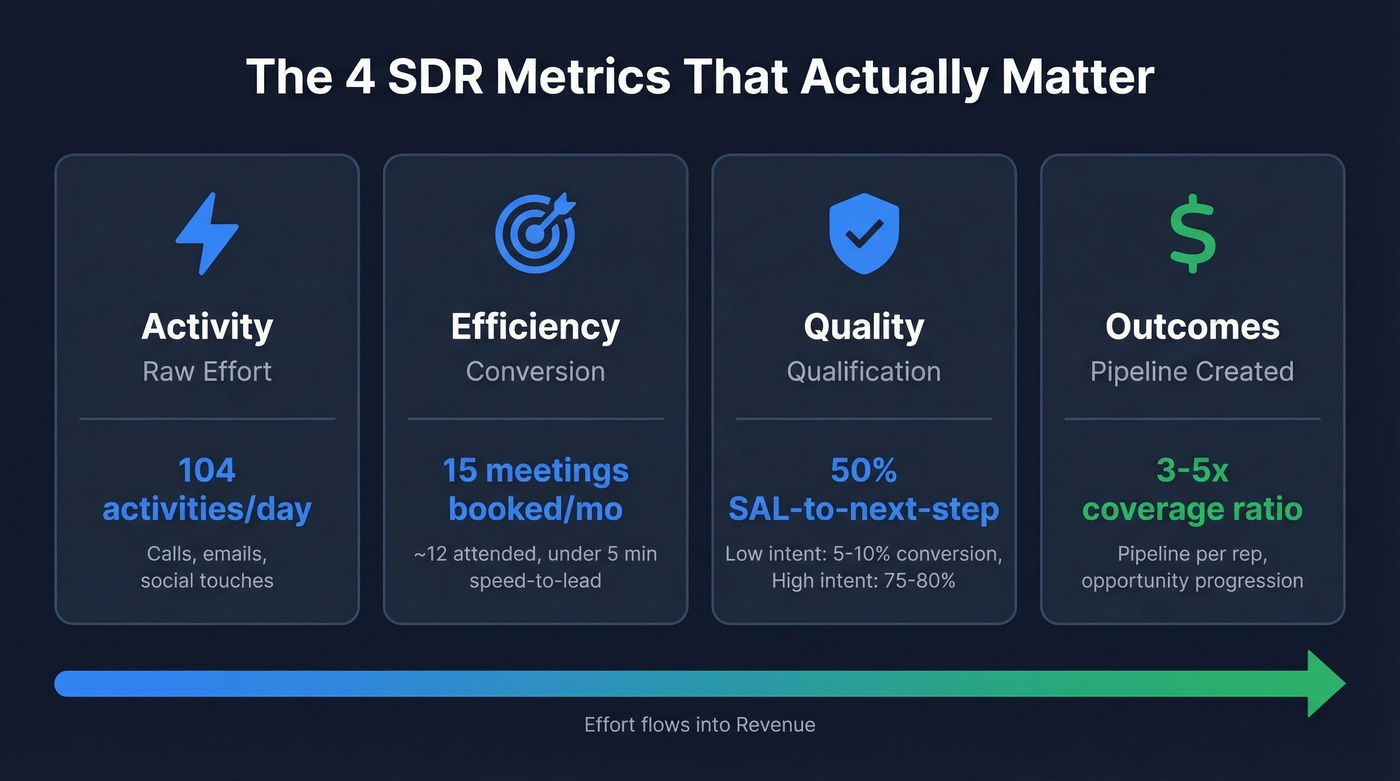
Activity (Raw Effort)
Calls made, emails sent, social touches logged. The Bridge Group benchmark is 104 activities per day, but raw volume alone is a terrible performance indicator. Track it to spot reps who aren't putting in the work - then immediately look at the next bucket.
- Benchmark: 104 activities/day
- Watch for: High activity + low connect rate = data problem, not effort problem
Efficiency (Conversion)
Contact-to-connect rate, email reply rate, and conversation-to-meeting conversion tell you whether effort is translating into pipeline motion. Outbound SDRs should benchmark against 15 meetings per month, with roughly 20% drop-out bringing attended meetings to around 12.
- Benchmark: 15 meetings booked/month, ~12 attended
- Speed-to-lead for inbound: Route in under 5 minutes
Quality (Qualification)
Not all meetings are equal. Low-intent leads convert at 5-10% from lead to meeting; high-intent leads convert at 75-80%. If your team isn't distinguishing between the two, you're blending signals that should be separate.
- Benchmark: 50% SAL-to-next-step conversion
- Hot take: If your average deal size is under $15k, skip lead scoring entirely and just measure meetings-to-pipeline. The scoring overhead isn't worth it.
Outcomes (Pipeline Created)
The number that pays the bills. Pipeline created per rep, coverage ratio of 3-5x quota per quarter, and opportunity progression. If a rep books 15 meetings but creates $0 in qualified pipeline, the meetings aren't the problem. Qualification is.

Every bounced email and dead dial inflates your activity count and tanks your conversion metrics. Prospeo's 98% email accuracy and 125M+ verified mobiles on a 7-day refresh cycle mean your SDRs spend less time chasing ghosts and more time creating pipeline.
Stop tracking vanity metrics caused by bad data.
Your SDR Dashboard in Practice
A good dashboard answers four questions at a glance: Are reps reaching enough people? Are conversations converting to meetings? How do reps compare across the team? And is effort actually hitting pipeline?
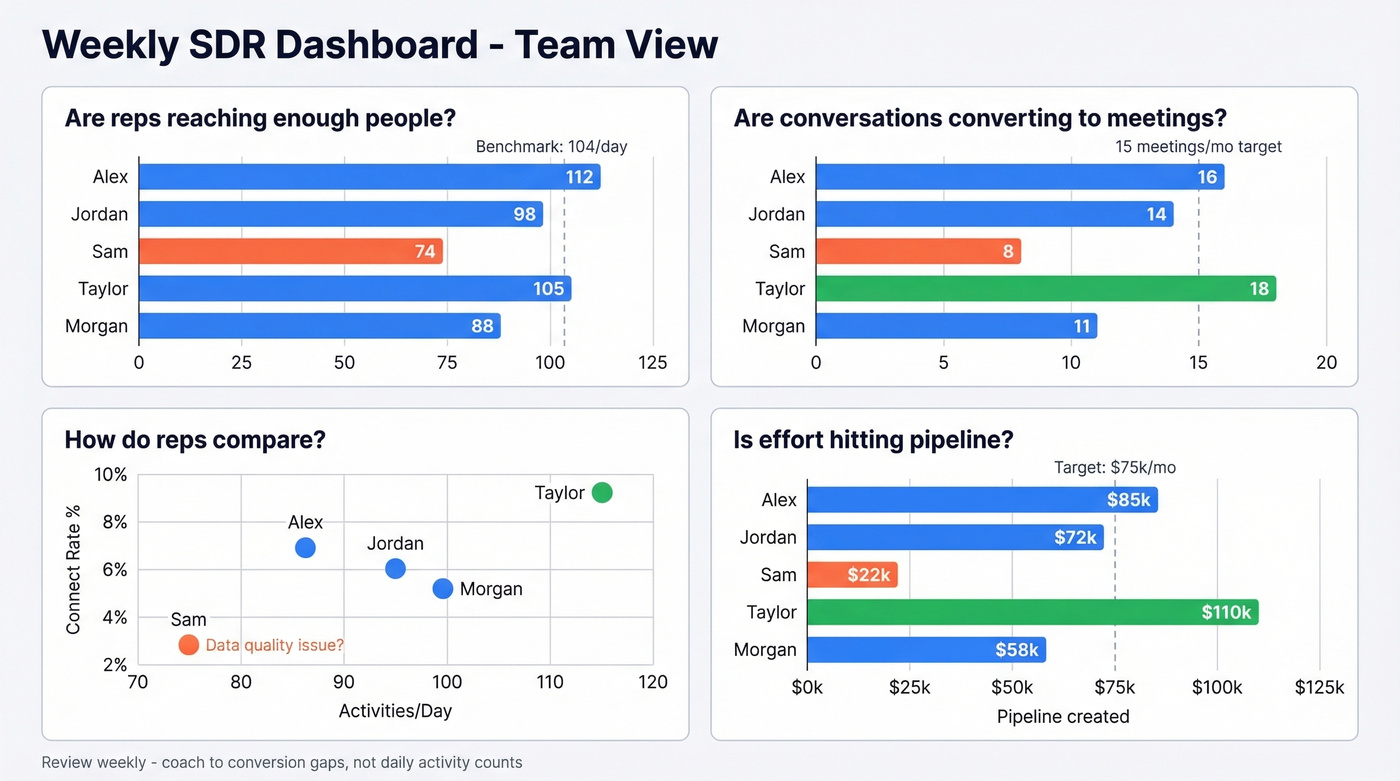
Use dashboards for coaching, not surveillance. The number-one complaint on r/sales about performance tracking is being forced to fill out daily spreadsheets counting calls, emails, and touches. That's busywork, not management. We review weekly, flag patterns, and coach to conversion gaps - not daily activity counts.
If you want a broader stack view beyond dashboards, start with a curated list of SDR tools and build from there.
Best Tools for SDR Tracking
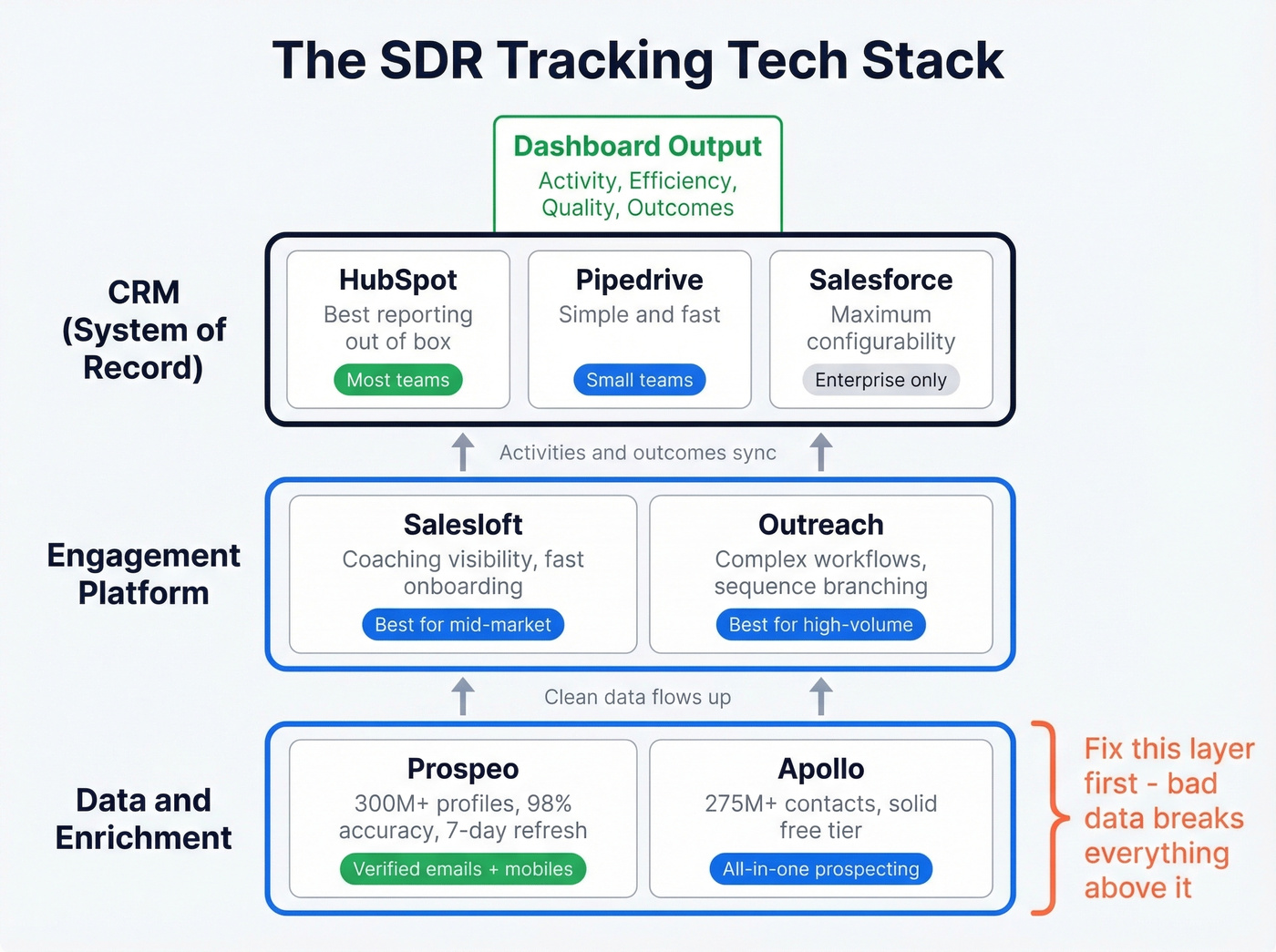
SDR tracking stacks fall into three categories.
CRMs
Your system of record. HubSpot Sales Hub works for most teams and has the cleanest out-of-the-box reporting for SDR managers. Pipedrive is a great option for small teams that want simplicity over configurability. Salesforce is the enterprise default but demands more admin overhead than either - skip it if you don't have a dedicated admin or RevOps person.
If you're still evaluating options, it helps to compare a few examples of a CRM before you commit.
Engagement Platforms
These run your sequences. Outreach is built for high-volume SDR teams in Salesforce-centric orgs with complex workflows and granular sequence branching. Salesloft wins on coaching visibility and faster onboarding, and in our experience gets teams productive in about half the time. For most mid-market teams, Salesloft is the better starting point.
If you're rolling this out for the first time, follow a structured plan for implementing a sales engagement platform so tracking stays consistent.
Data and Enrichment
This is where your tracking metrics either mean something or don't. Prospeo covers email verification and verified mobiles across 300M+ profiles at 98% accuracy, with a 7-day data refresh cycle that keeps contact records current. Apollo offers all-in-one prospecting with 275M+ contacts and a solid free tier - good for teams just getting started with outbound.
To go deeper on vendors and use cases, see our roundup of data enrichment services.
AI SDRs
The new category. Budget 40-60 hours of data cleanup before launch and expect 3-6 months to positive ROI. Most vendors won't tell you that upfront.
| Category | Tool | Best For | Starting Price |
|---|---|---|---|
| CRM | HubSpot Sales Hub | Most teams | $20/user/mo |
| CRM | Pipedrive | Small teams | $14/user/mo |
| CRM | Salesforce | Enterprise | $25/user/mo |
| CRM | Close | High-velocity | $35/user/mo |
| Engagement | Salesloft | Coaching visibility | ~$100/user/mo |
| Engagement | Outreach | High-volume sequences | ~$100/user/mo |
| Data | Prospeo | Email accuracy + verified mobiles | Free; ~$0.01/email |
| Data | Apollo | All-in-one prospecting | Free; $49/user/mo |
| Cold Email | Instantly | Sending at scale | $30/mo |
| AI SDR | Various | Automated outbound | $500-$2,000/mo |
The Data Problem Nobody Talks About
Let's reframe that 104-activities-per-day stat. If only 18% produce a meaningful conversation, the first question shouldn't be "are reps working hard enough?" It should be "are reps dialing real numbers and emailing valid addresses?"
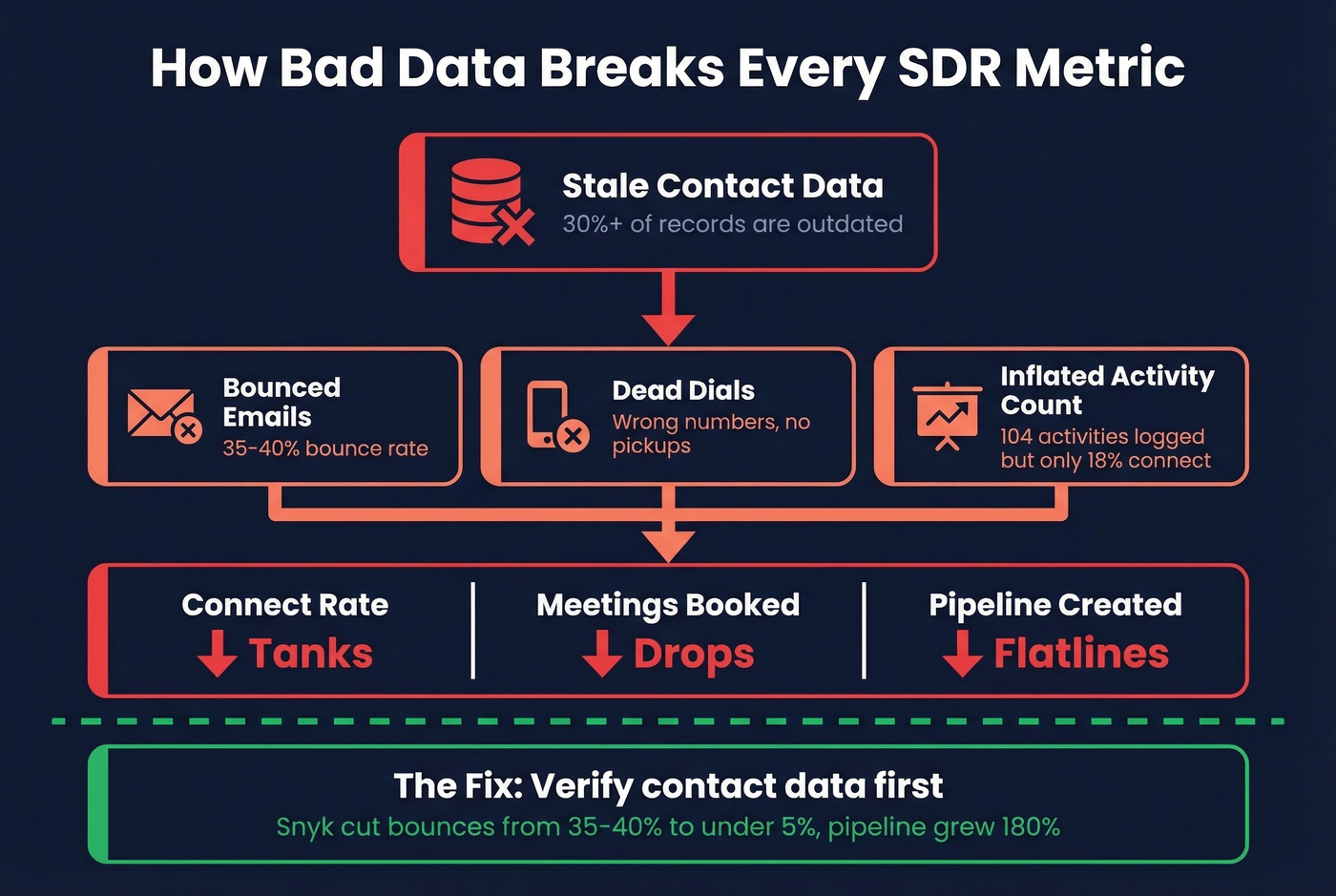
Contact-to-connect rate is the most underrated metric in any SDR tracking setup. When it's consistently low across the team, you don't have a rep problem - you have a data problem. Every bounced email and dead phone number inflates your activity count while deflating every conversion metric downstream. We've seen teams blame reps for months before someone finally audits the contact list and finds 30%+ of records are stale.
If bounces are part of the issue, start by tracking and fixing your email bounce rate and tightening your email deliverability fundamentals.
Snyk's AE team ran into exactly this. Fifty AEs were prospecting 4-6 hours per week with bounce rates hitting 35-40%. After switching to verified contact data, bounces dropped under 5%, AE-sourced pipeline jumped 180%, and the team generated 200+ new opportunities per month. The reps didn't change. The data did.
Snyk's 50 AEs cut bounce rates from 35-40% to under 5% and grew AE-sourced pipeline 180% after switching to verified contact data. Your SDR tracking dashboard can't fix a data problem - but 300M+ verified profiles refreshed every 7 days can.
Fix the data layer and every SDR metric improves downstream.
FAQ
How many dials per day should an SDR make?
The Bridge Group benchmark is 104 activities/day, but connect rate matters more than volume. A rep making 60 calls at 25% connect rate outperforms one making 120 into bad numbers.
Should I track inbound and outbound SDRs differently?
Always. Outbound benchmarks against meetings booked - 15/month and pipeline created. Inbound benchmarks against speed-to-lead and lead-to-meeting conversion, which ranges from 5% to 80% depending on intent level.
Which metrics should I review first?
Start with contact-to-connect rate and meetings booked. They reveal whether your data is clean and whether reps are converting conversations into pipeline. Activity counts only matter once those two numbers are healthy.
Why are my SDR activity numbers high but pipeline is flat?
Almost always a data quality problem. If contact-to-connect rate is consistently low, your reps are dialing dead numbers and emailing invalid addresses. Verify your data before blaming rep performance - high bounce rates tank every downstream metric.