

Search Intelligence Platforms: What They Are, What They Cost, and How to Pick One
Your CMO just pinged you about ChatGPT. Specifically, why your biggest competitor shows up when prospects ask for vendor recommendations - and you don't. A search intelligence platform would answer that question, but the term means five different things depending on who's selling.
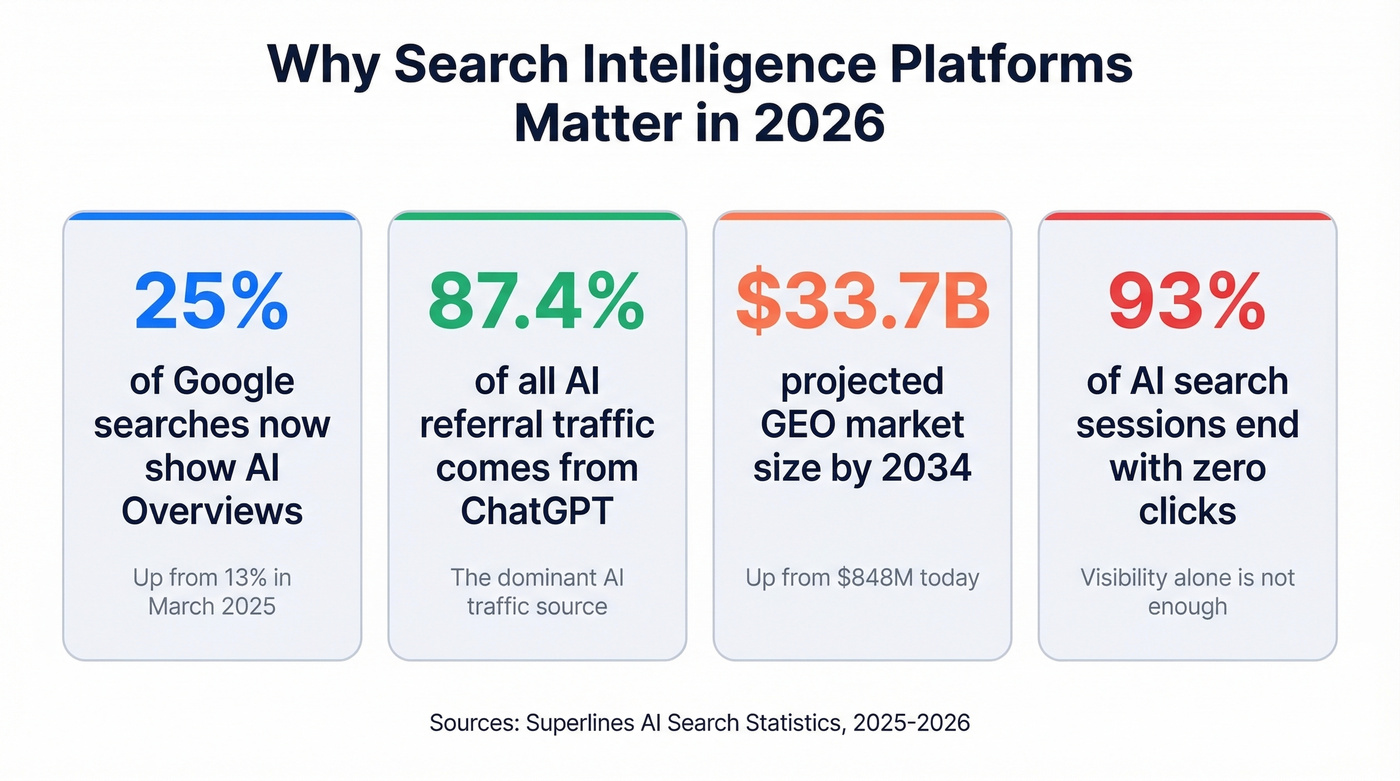
Google AI Overviews now appear in 25% of searches, up from 13% in March 2025. ChatGPT drives 87.4% of all AI referral traffic. The GEO market is projected to balloon from $848M to $33.7B by 2034. You can't ignore this for another quarter.
Let's sort out the tooling.
The Short Version
If you don't want the full breakdown:
- All-in-one SEO + AI visibility: Semrush One (from $199/mo). Organic rankings and AI citation tracking in one subscription.
- Budget AI visibility tracker: Otterly.AI (from $25/mo). Lightweight, focused - tells you where you show up in ChatGPT and Perplexity.
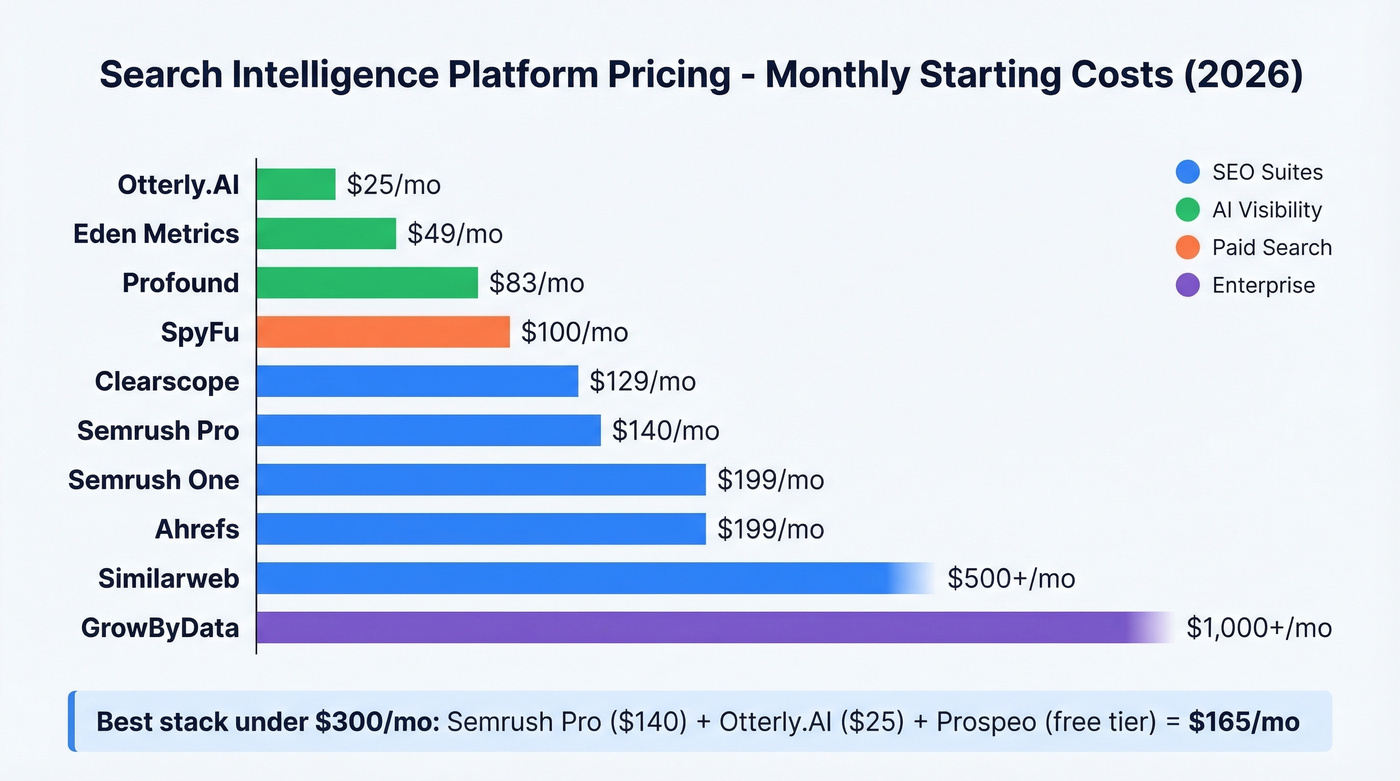
- Best stack for under $300/mo: Semrush Pro ($140) + Otterly.AI ($25) + Prospeo (free tier) - monitoring, AI visibility, and verified contact data to reach decision-makers once you spot opportunities.
Here's the thing: most teams overspend on a single platform when a lean stack covers more ground. If your average deal size is under $25k, you almost certainly don't need an enterprise-grade suite. A $200/mo stack will outperform a $2,000/mo platform that nobody on your team fully uses.
What Is a Search Intelligence Platform?
Nobody agrees on what this term means. G2 defines paid search intelligence as software for tracking competitor ad copy, landing pages, destination URLs, and other paid-search competitive intel. TrustRadius groups a much wider mix under "Search Marketing Intelligence" - SEO suites, SERP monitoring tools, paid search tools, and newer AI visibility trackers all lumped together.
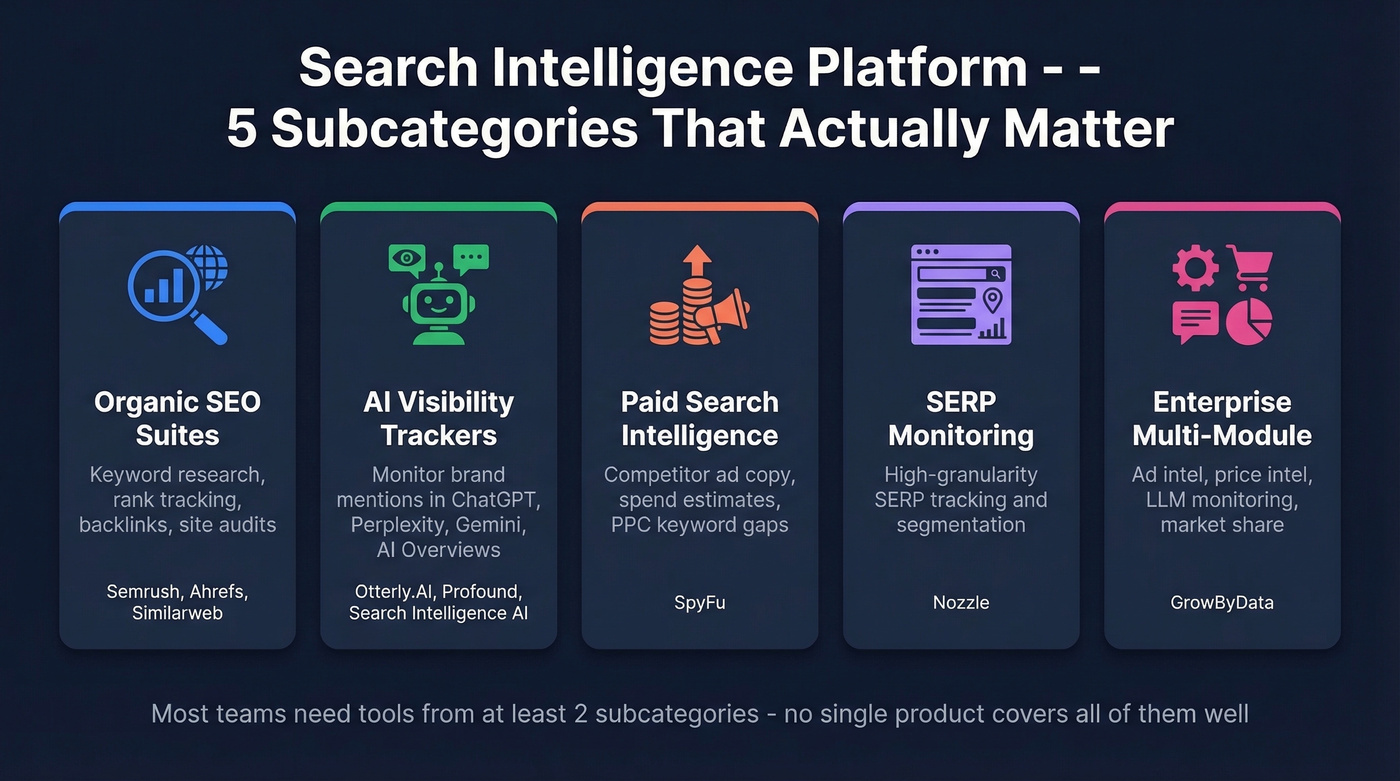
The subcategories that actually matter:
- Organic SEO suites - keyword research, rank tracking, backlink analysis, site audits. Semrush, Ahrefs, Similarweb.
- AI visibility trackers - monitor whether ChatGPT, Perplexity, Gemini, and Google AI Overviews mention or cite your brand. Otterly.AI, Profound, Search Intelligence AI.
- Paid search intelligence - competitor ad copy, spend estimates, PPC keyword gaps. SpyFu.
- SERP monitoring platforms - high-granularity SERP tracking and segmentation. Nozzle.
- Enterprise multi-module platforms - combine several of the above with ad intelligence, price intelligence, and LLM monitoring. GrowByData.
A sixth meaning - internal site search optimization (think Algolia) - is a completely different product category and not covered here. Most teams need tools from at least two of these subcategories. No single product covers all of them well.
Best Platforms by Category
Organic SEO Suites
Semrush is the default, and for good reason. It carries 3,310 G2 reviews at 4.5 stars - more than any competitor in the category. The SEO Toolkit runs $140/mo (Pro), $250/mo (Guru), or $500/mo (Business).
The real story in 2026 is Semrush One, announced in October 2025, which bundles the SEO Toolkit with an AI Visibility Toolkit for tracking brand mentions across LLMs. Semrush One starts at $199/mo (Starter), with Pro+ at $299/mo and Advanced at $549/mo. The AI Visibility Toolkit alone costs $99/mo and tracks one domain across 25 daily prompts. For teams already living in Semrush, this is the path of least resistance - you're adding a tab, not a tool. The pricing tiers scale with projects, keywords tracked, and crawl limits. Common G2 complaints center on price and learning curve. This is a deep platform, not a quick-start tool.
Similarweb takes a different angle. Where Semrush is SEO-first, Similarweb is traffic-intelligence-first - it excels at competitive benchmarking, market share analysis, and understanding where competitors get their traffic. The AI-era additions are strong: an AI Traffic feature showing visits from ChatGPT, Perplexity, and Gemini, plus a Brand Visibility module that functions as rank tracking for generative AI platforms. It carries 1,147 G2 reviews at 4.4 stars. Pricing isn't public - typically $500-$1,500/mo for a meaningful plan. Use this if you care more about competitive traffic analysis than keyword-level SEO. Skip it if you need a hands-on SEO workflow tool.
Ahrefs added an AI visibility add-on starting at $199/mo. It's solid for backlink analysis and keyword research, but the AI monitoring features feel bolted on rather than native. Worth watching, not worth switching for.
AI Visibility Trackers
This is the fastest-moving subcategory. A year ago, most of these tools didn't exist.
We've talked to dozens of marketing teams about this, and the honest answer in 2026 is that no single tool handles both traditional SEO and AI visibility perfectly. That's why stacks beat suites for most teams.
Otterly.AI is the budget pick at $25/mo on annual billing. It tracks your brand's presence across major AI engines and gives you a simple dashboard showing where you appear and where you don't. For teams that just need directional visibility data without enterprise complexity, nothing else touches it at this price point.
Search Intelligence AI positions itself as a platform unifying traditional SEO rankings with AI search visibility. Pricing runs £199/mo, £499/mo, or £2,400/mo depending on scale. The dual-tracking angle is genuinely useful - you see the tradeoffs between your Google rankings and your AI citation performance in one view.
Profound starts at $82.50/mo on annual billing and is built for teams that want stronger visibility and citation insights than a lightweight tracker, without buying a full SEO suite.
Eden Metrics (around $49-$299/mo) offers a guided SEO data experience with dedicated support time baked into each plan. If you want a tool that comes with a human who'll walk you through the data, this is the play. Early-stage but differentiated.
SearchIntel takes a completely different approach - it's an advisory/managed-service model rather than self-serve software. If you'd rather hand the analysis to specialists than learn another dashboard, they're worth a conversation. Expect around $500-$2,000/mo for managed engagements.
Peec AI (from €89/mo) and ZipTie (from $58.65/mo annual) round out the category. Both are early-stage and worth monitoring.
One caveat across all AI visibility tools: LLM outputs aren't consistent. The same prompt can produce different citations on different days. Every tool in this space gives you directional data, not pixel-perfect rankings. That's fine - directional is what you need for strategic decisions.
Paid Search Intelligence
This subcategory is mature and less disrupted by AI than the others. SpyFu (TrustRadius 7/10, 131 reviews) remains the go-to for PPC competitor analysis - ad copy history, keyword overlap, estimated spend. Starts under $100/mo. Does one thing well.
SERP Monitoring
Nozzle (TrustRadius 10/10, 17 reviews) offers SERP monitoring at a granular level, built for teams that want deep segmentation and reporting around rankings and SERP composition.
Enterprise Multi-Module Platforms
GrowByData spans two major pillars: LLM Intelligence (brand visibility and sentiment across ChatGPT, Perplexity, Google AI Overviews) and Search Intelligence (market share across Google and Bing). They also cover ad intelligence and price intelligence, making this a true enterprise play.
The tradeoff? Typically $1,000-$10,000+/mo depending on scope and modules. A free trial is available, and reviews flag a steep learning curve and an interface that takes time to navigate. This is for teams with dedicated analysts, not lean marketing squads.
Clearscope ($129/mo) is adjacent to this category - it optimizes content for search engines rather than tracking AI visibility, but pairs well with the monitoring tools above for teams investing heavily in content-led SEO.

A search intelligence stack shows you where opportunities are. Prospeo shows you who to contact. Layer 300M+ verified profiles with 30+ filters - buyer intent, technographics, job changes - to turn competitive insights into booked meetings.
Visibility without contact data is just window shopping. Start free.
Pricing Comparison
| Tool | Category | Starting Price | Free Trial | Best For |
|---|---|---|---|---|
| Semrush One | SEO + AI Visibility | $199/mo | 7-day | All-in-one teams |
| Semrush Pro | SEO Suite | $140/mo | 7-day | SEO-focused teams |
| Similarweb | Traffic Intelligence | ~$500+/mo | Limited free | Competitive analysis |
| Otterly.AI | AI Visibility | $25/mo | Yes | Budget AI tracking |
| Profound | AI Visibility | $82.50/mo | Yes | Citation insights |
| Search Intelligence AI | SEO + AI Visibility | £199/mo | Yes | Dual-tracking |
| Eden Metrics | SEO + AI Visibility | ~$49-$299/mo | Yes | Guided experience |
| SearchIntel | Managed Advisory | ~$500-$2K/mo | Consultation | Hands-off teams |
| SpyFu | Paid Search Intel | <$100/mo | Limited free | PPC competitor analysis |
| GrowByData | Enterprise Multi | ~$1K-$10K+/mo | Yes | Enterprise analytics |
| Ahrefs | SEO + AI Add-on | $199/mo | No | Backlink-first teams |
| Clearscope | Content Optimization | $129/mo | No | Content teams |
| Nozzle | SERP Monitoring | Contact sales | Yes | Granular SERP data |
Turning Search Intelligence Into Action
Intelligence without action is just a dashboard. We've seen teams spend months perfecting their AI visibility monitoring setup and then do absolutely nothing with the data.
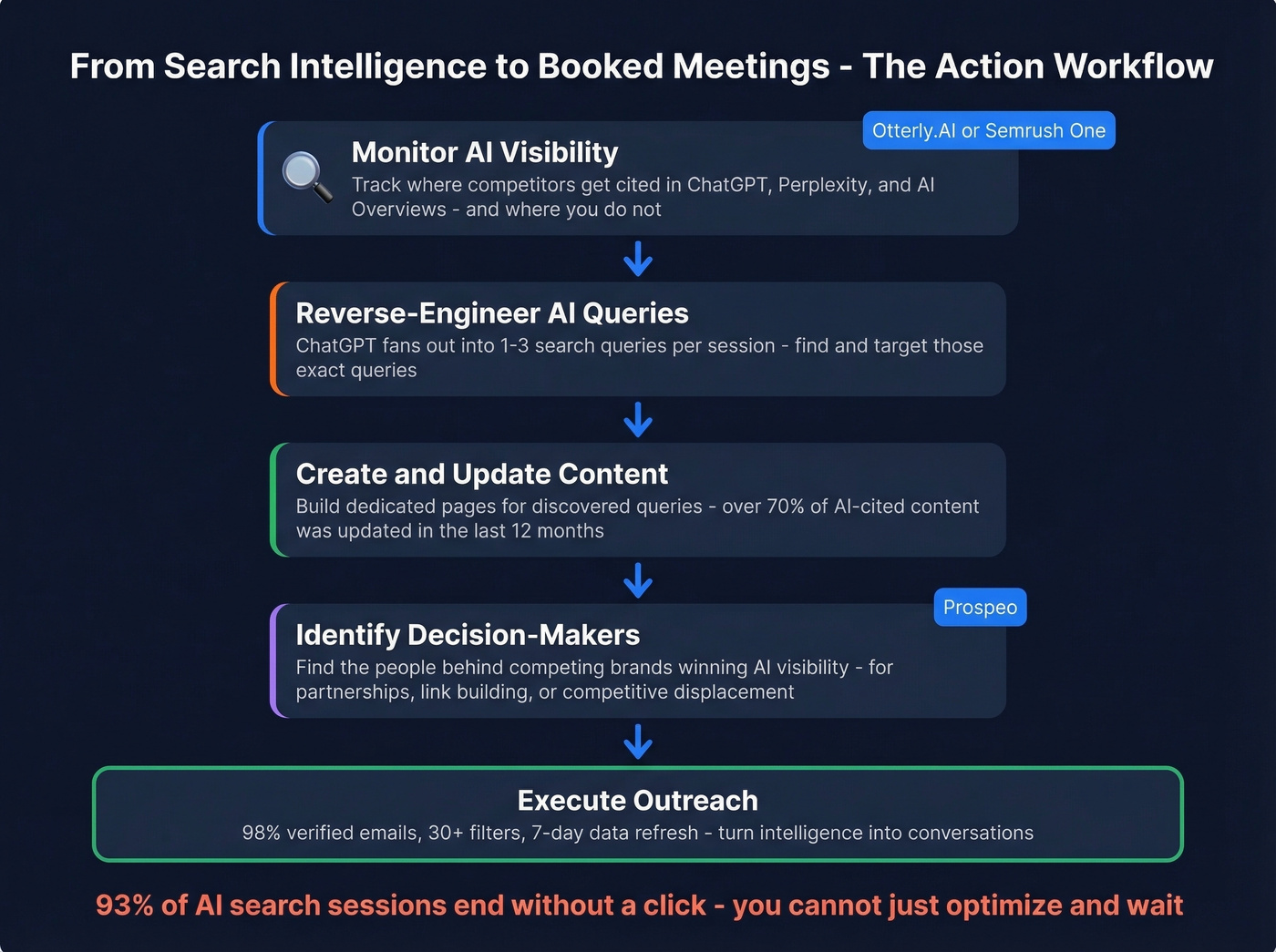
Consider this: 93% of AI search sessions end without a click. You can't just optimize and wait for traffic. You need to be proactive - identify which competitors are getting cited where you aren't, then go after those gaps.
Inspect ChatGPT's web search behavior. When it triggers a search, it fans out into 1-3 queries you can reverse-engineer. Build dedicated pages targeting those discovered queries, interlink them, and build links to them. Over 70% of AI-cited content was updated within the last 12 months, so freshness isn't optional - it's a ranking factor for LLMs. Audit your top pages quarterly at minimum.
Then close the execution gap. When you spot companies winning AI visibility in your space, reach the decision-makers at those companies for partnership pitches, link-building outreach, or competitive displacement campaigns. That's where a tool like Prospeo fits into the stack - 98% email accuracy and a 7-day data refresh cycle mean you're reaching real people with current contact info, not bouncing off stale records. The free tier gives you 75 verified emails per month, enough to test the workflow before committing a dollar. If you're building lists at scale, pair this with a repeatable lead generation workflow and tighter firmographic and technographic data filters.
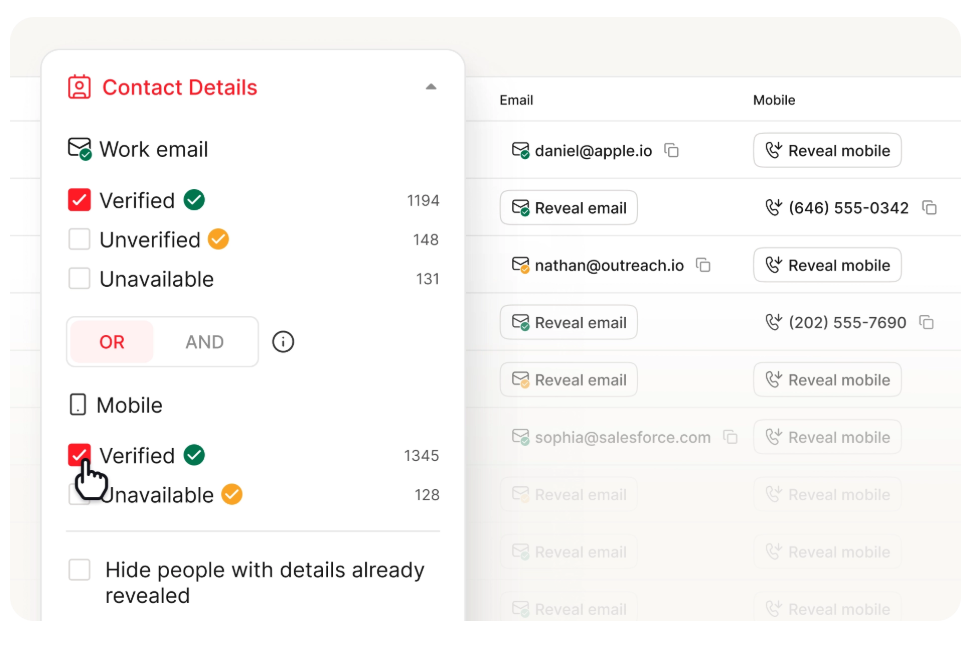
The best stack under $300/mo includes search intelligence and verified contact data. Prospeo's free tier gives you 75 emails at 98% accuracy - enough to act on every opportunity your AI visibility tracker surfaces.
Stop monitoring competitors. Start reaching their prospects at $0.01 per email.
How to Choose the Right Tool
Don't start with features. Start with the question: do you need a suite or a stack?
A suite like Semrush One gives you organic SEO and AI visibility in one login, one bill, one learning curve. A stack - say, Semrush Pro + Otterly.AI - costs less and lets you swap components as the market evolves. We lean toward stacks for teams under 20 people and suites for larger orgs where vendor consolidation matters more than flexibility.
Engine coverage is table stakes. Any search intelligence platform worth considering tracks ChatGPT, Perplexity, Gemini, Claude, and Google AI Overviews. The real differentiator is whether it distinguishes between being named and being linked - those are very different outcomes for your traffic. Beyond that, evaluate whether the tool tells you what to fix or just what's broken, and whether pricing is transparent. If you can't find the price on the website, budget 3x what you'd expect.
This category is moving so fast that any tool you pick today will look different in six months. Buy flexibility, not lock-in. If you're planning to operationalize insights with outbound, align your stack with proven sales prospecting techniques and a clean sequence management process.
FAQ
What is a search intelligence platform?
Software that tracks your brand's visibility across search engines and AI systems like ChatGPT, Perplexity, and Gemini. In 2026, the category spans organic SEO suites, AI visibility trackers, paid search tools, SERP monitors, and enterprise multi-module platforms.
How much do these platforms cost?
Budget trackers start at $25/mo (Otterly.AI). Full SEO suites run $140-$500/mo. Enterprise platforms start at $1,000+/mo. A complete stack covering SEO, AI visibility, and outreach execution runs under $300/mo when you pair Semrush Pro with Otterly.AI and a free-tier contact data tool.
What's the difference between SEO tools and AI visibility tools?
SEO tools track Google and Bing rankings for specific keywords. AI visibility tools track whether ChatGPT, Perplexity, and Gemini mention or cite your brand in generated responses. Different surfaces, different optimization tactics - most teams need both in 2026.
Can one tool handle both SEO and AI visibility?
Semrush One ($199/mo) is the closest all-in-one option, combining organic rank tracking with LLM citation monitoring. Similarweb and Search Intelligence AI also offer dual tracking. That said, dedicated AI visibility tools like Otterly.AI often provide deeper citation-level insights at a fraction of the cost.
What's GEO vs AEO?
AEO (Answer Engine Optimization) targets being selected as a direct answer in AI Overviews and voice assistants. GEO (Generative Engine Optimization) targets being cited in long-form AI responses from ChatGPT, Gemini, and Perplexity. Different surfaces, significant tactical overlap.