

How to Sell to Educational Institutions (and Actually Close Deals)
You closed a great pilot at one school. The principal loves your product. But now you need district-level approval, and you have no idea who to contact - or even which office handles purchasing. Welcome to selling to educational institutions, where a single enthusiastic champion doesn't mean a thing until procurement, the superintendent, and possibly the school board all sign off.
The US has roughly 140,000 K-12 schools, and postsecondary institutions spend about $702B per year in overall institutional spending. The opportunity is massive. The process to capture it is unlike anything you've seen in SaaS.
The Quick Version
- Expect long cycles. 37% of K-12 deals take 6-11 months. Another 22% take 12-17 months. Only 7% close in under three months.
- Map every stakeholder. Teachers, principals, IT directors, curriculum leads, procurement officers, and board members all touch the decision.
- Tie your pitch to a funding source. If you can't name the budget line, you're asking the district to create one. They won't.
- Start with a small pilot. Prove impact in one building before pushing district-wide.
- Verify your contacts before outreach. Bounced emails to .edu domains damage your sender reputation fast.
Why Education Sales Differ from SaaS
Here's the thing: selling to educational institutions is closer to government sales than anything in the SaaS playbook. The buyer isn't one person - it's a committee. The budget isn't flexible - it's allocated months in advance against specific funding categories. And the timeline isn't "let's get this done this quarter" - it's "let's evaluate this year and maybe buy next fiscal."
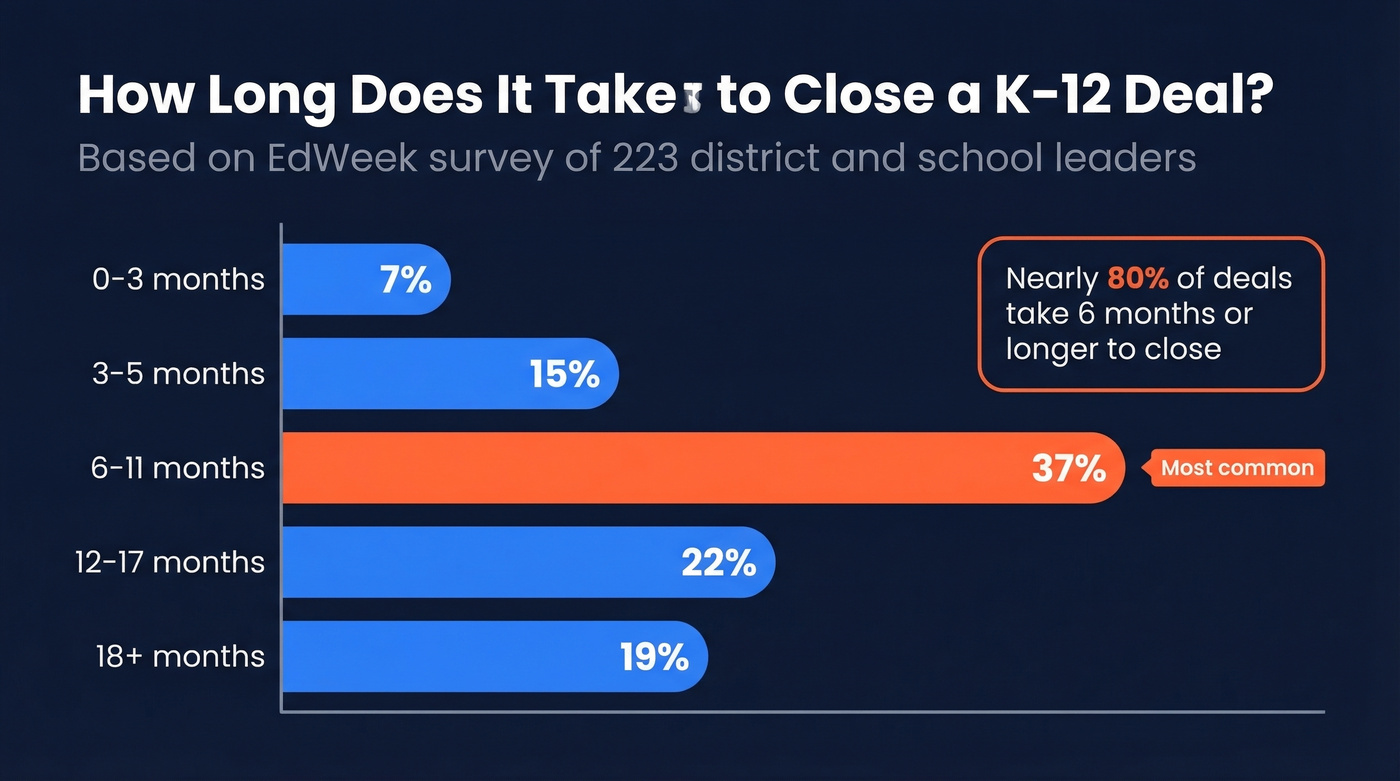
An EdWeek Research Center survey of 223 district and school leaders puts hard numbers on this. The largest group (37%) reported 6-11 months from need identification to signed contract. Another 22% said 12-17 months. And 19% reported 18 months or longer.
For teacher-facing tools that require a pilot, add another year on top. Students are the end users, and they don't get a vote - that asymmetry means districts scrutinize vendor claims more carefully than a typical enterprise buyer would. A recurring question on r/edtech and r/sales is whether cold outreach even works in this space. It does, but only after you've mapped the stakeholder chain and can speak to the right person about the right funding source.
The 2026 Funding Reality
The ESSER cliff is the single biggest factor shaping education sales right now. The $190B in federal stimulus funding - equivalent to 30-40% of a typical district's discretionary spending - ran out by January 2025. Districts are now operating without that cushion, and the squeeze is real.
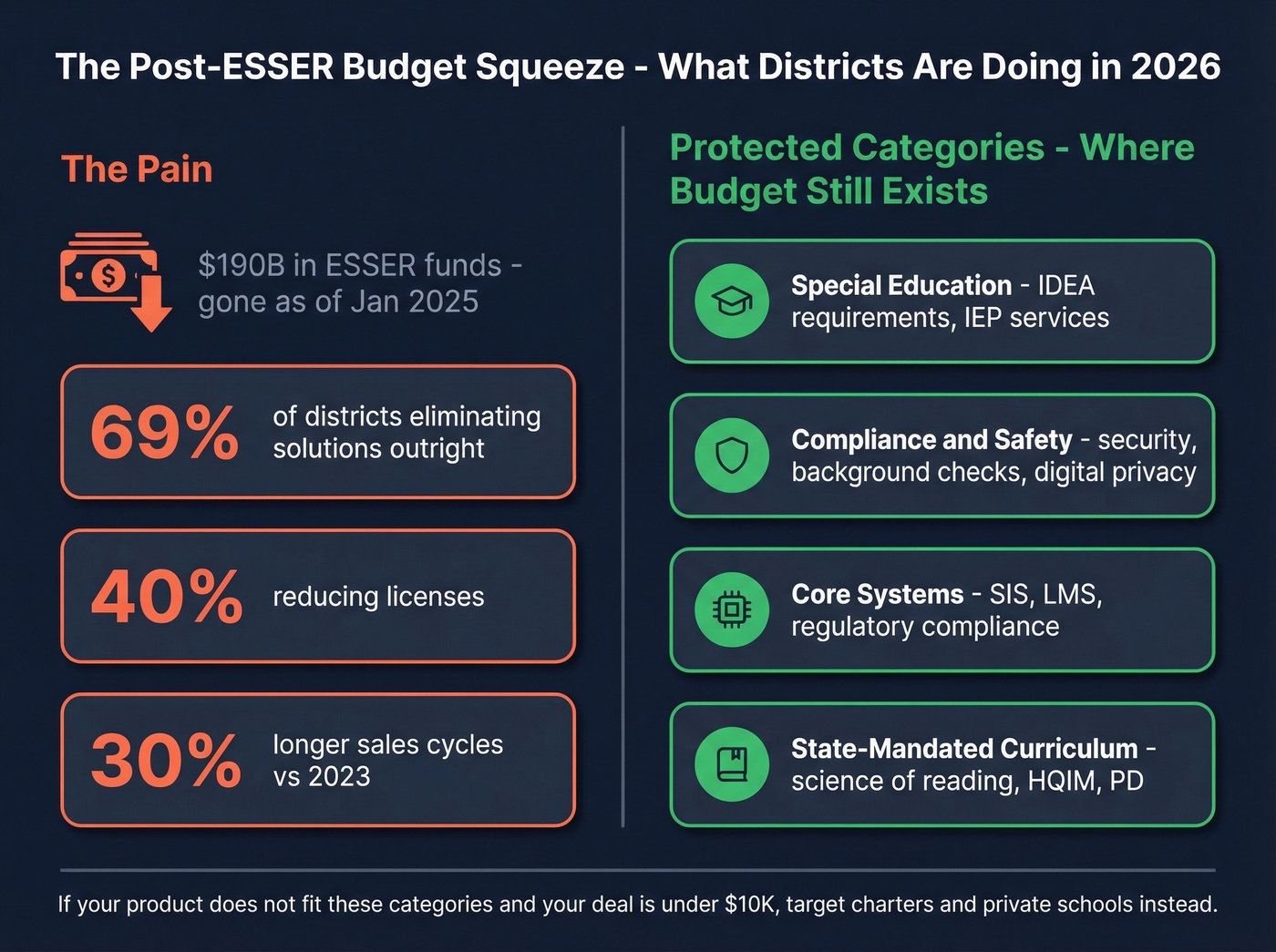
A Tyton Partners survey of 60+ K-12 executives found that 69% of districts are eliminating solutions outright, 40% are reducing licenses, and sales cycles are running 30% longer than 2023. On the vendor side, 45% attributed revenue shortfalls directly to ESSER-driven budget pressure.
Categories that remain protected:
- Special education - IDEA requirements make IEP-related services non-negotiable
- Compliance and safety - security, background checks, digital privacy
- Core systems - SIS, LMS, regulatory compliance software
- State-mandated curriculum - science of reading, HQIM, professional development
Look, if your product doesn't fit one of these categories and your deal size sits below $10K, you're probably better off selling to charter networks and private schools than fighting through district procurement in a post-ESSER budget environment. Districts are favoring solutions that reduce headcount costs or generate revenue - Medicaid reimbursement platforms are a standout category right now.
How Procurement Works
K-12 Procurement
K-12 school district purchasing follows an 8-step flow: need identification, budgeting and funding allocation (Title I, IDEA, Perkins), research and vendor selection, RFP or purchase decision, committee evaluation, contract negotiation, implementation, and renewal. Board approval is often required for purchases around $25K+, though thresholds vary by state and district.
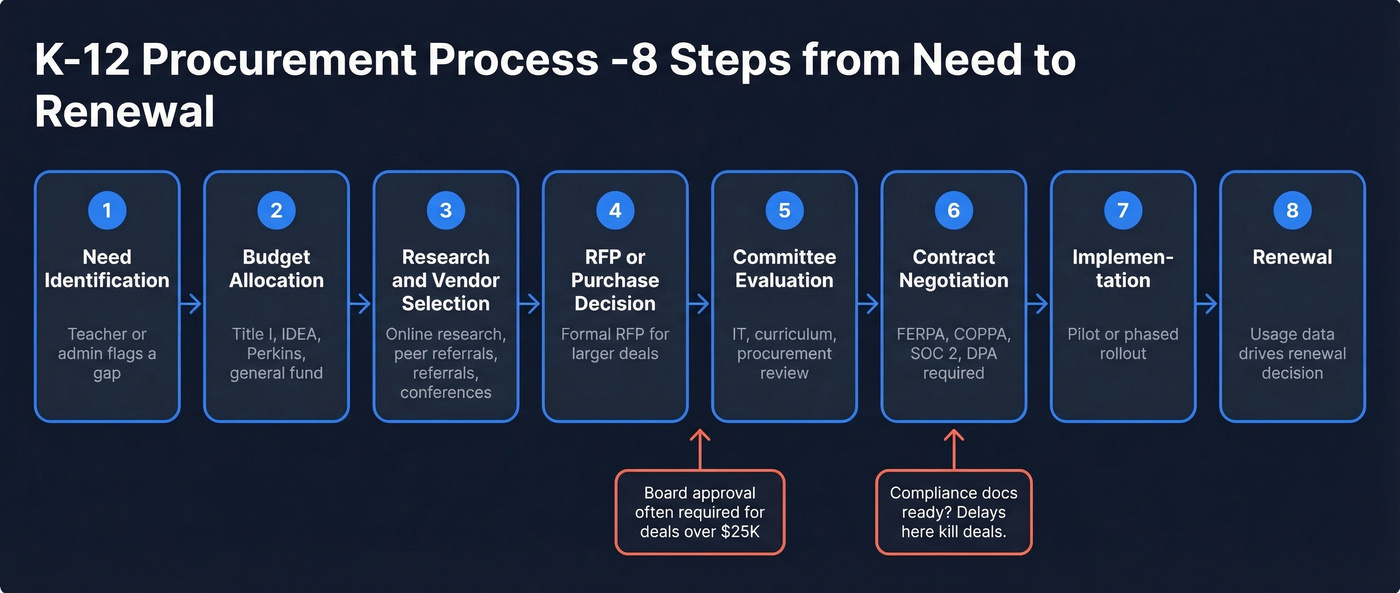
Have your FERPA/COPPA compliance documentation, a SOC 2 report, and a template Data Processing Agreement ready before contract negotiations begin. Districts will ask. Delays here kill momentum faster than anything else we've seen in the education buyer journey.
One trend worth watching: AI procurement is shifting toward consortium models. California's Education Technology Joint Powers Authority, serving 2.6M+ students, now pre-vets vendors so districts can buy from an approved pool without running a full procurement cycle. Getting on these lists early is becoming a serious competitive advantage.
Higher-Ed Procurement
Higher-ed institutions spend roughly $6.6B annually on technology, but the buying process varies wildly by institution size. 67% of small institutions (under 1,000 users) have annual IT budgets below $500K, while 60% of large institutions (25,000+ users) exceed $5M. And 52% of institutions have fewer than 25 IT staff - meaning your onboarding process needs to be lightweight or it won't survive implementation.
| Role | Top Priority | What They Need to Hear |
|---|---|---|
| Provost/CAO | Mission, student success | Long-term academic impact |
| CIO/IT Director | Integration, security | No infrastructure disruption |
| Procurement | Cost, ROI | Budget sustainability |
| Dean/Faculty | Ease of use, time savings | Classroom-level impact |
Of institutions with set planning windows, 41% evaluate in Q2-Q3 for the next fiscal year. You can't show up in September and expect a decision by December.

Education sales cycles run 6-17 months. You can't afford to waste that time on bounced emails to .edu domains. Prospeo's 98% email accuracy and 5-step verification - including catch-all handling - means your outreach to superintendents, IT directors, and procurement officers actually lands.
Stop burning budget season on bad contact data.
When to Start Outreach
For K-12: Begin in January-March. This aligns with the March-April budget discussion window and gives you time to build relationships before June budget finalization. In our experience, the January-March window is non-negotiable - miss it and you're waiting a full year.
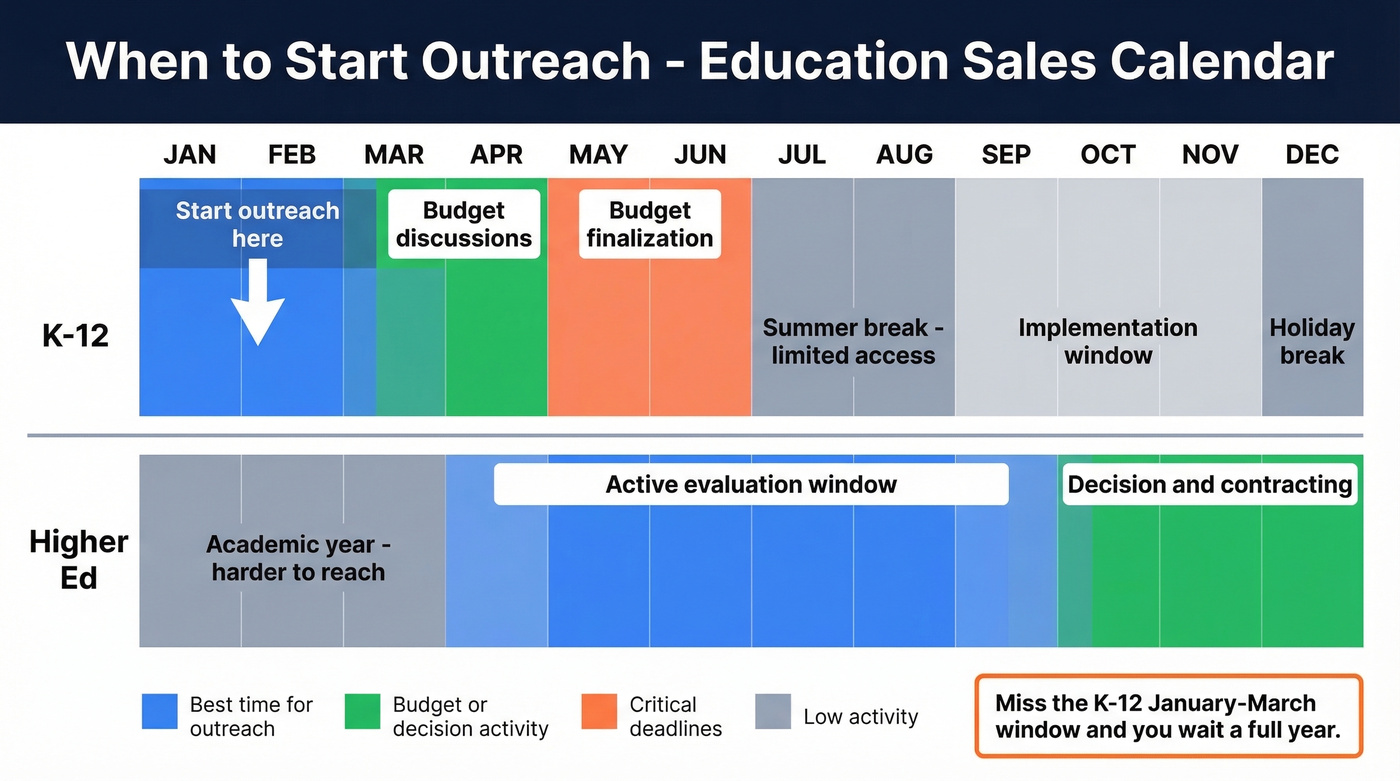
For higher ed: Target Q2-Q3 (April-September) when the largest share of institutions are actively evaluating.
For AI/edtech vendors: Don't just respond to individual RFPs. Get on consortium and JPA approved vendor lists. The co-op model is expanding beyond California, and being pre-vetted means districts can buy without a full procurement cycle. Skip this step if you're only targeting private schools or charters - they typically don't use consortium purchasing.
How to Find Decision-Makers
Every education sales guide tells you to "reach the right person." None of them tell you how to actually find that person's verified email in a district with 50 schools and no org chart on their website.
This is where most edtech sales teams burn weeks. They send emails to generic info@ addresses. They call the front office and get routed to voicemail. They guess at email formats and watch their bounce rates climb. We've talked to teams who burned their primary sending domain within two months of launching education outreach because they were working off scraped, unverified lists.
Prospeo lets you filter by job title, department, and institution size across 300M+ professional profiles - so you can build a targeted list of every curriculum director at districts with 5,000+ students in Texas in about ten minutes. Emails are 98% accurate and verified in real time, which matters because bounced emails to .edu domains will tank your sender reputation. The free tier gives you 75 emails per month, enough to test whether your outreach messaging resonates before scaling up.

Mapping the stakeholder chain from principal to school board is the hard part. Finding their verified emails and direct dials shouldn't be. Prospeo gives you 30+ filters to pinpoint education decision-makers by job title, department, and institution size - with 125M+ verified mobile numbers when email isn't enough.
Reach every stakeholder in the district buying committee.
Mistakes That Kill Education Deals
Pitching features without understanding governance. As Michael Fung, a higher-ed leader, put it: "Institutions aren't buying features - they're buying alignment. If you don't understand their governance or process, you're just noise." We've seen vendors with great products stall for months because they couldn't answer basic questions about ecosystem fit.
If you want a simple way to operationalize this, treat each district like an account and run a lightweight account-based selling motion: map stakeholders, align messaging, and sequence outreach by role.
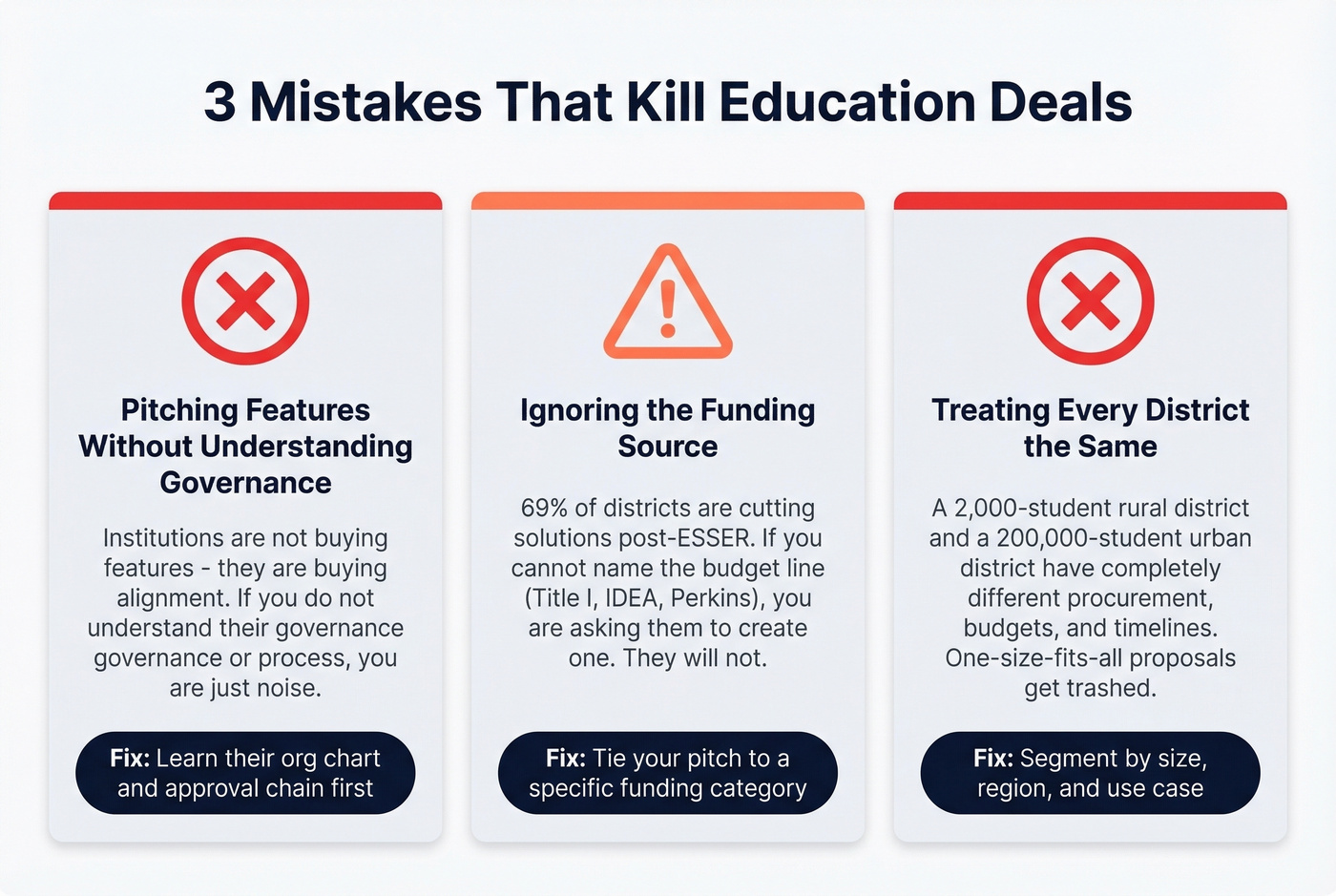
Ignoring the funding source. If you can't tie your solution to a specific budget line - Title I, IDEA, Perkins - you're asking the district to create a new line item. In a post-ESSER environment where 69% of districts are actively cutting solutions, that's a non-starter.
Treating every district the same. A 2,000-student rural district in Montana and a 200,000-student urban district in Houston have completely different procurement processes, budget structures, and decision timelines. Your pitch deck, pricing model, and implementation plan should reflect that. One-size-fits-all proposals get filed in the trash.
Building a Repeatable Sales Engine
Don't hire sales reps until you have a repeatable playbook. Founder-led sales comes first - founders sell vision better than anyone, and education buyers respond to conviction.
Your first 5-10 customers should be in the same segment: same district type, same region, same use case. Education is a highly referenceable market - a cluster of five logos in one state carries more weight than twenty scattered across the country. Superintendents talk to each other constantly. One strong reference in a network can unlock an entire region, and we've watched a single case study in a mid-size Texas district open doors across the whole state.
Charge a nominal fee for pilots - even $500 signals commitment and filters out tire-kickers. Free pilots attract evaluators who were never going to buy.
Once you have early wins, systematize your sales prospecting techniques and build a consistent sales follow-up cadence so deals don't die between budget meetings.
FAQ
How long does it take to close a deal with a school district?
Most K-12 deals take 6-17 months from need identification to signed contract. Only 7% close in under three months. If your deal requires board approval or a pilot period, plan for 12-18 months minimum.
What funding sources can schools use to buy edtech?
Common sources include Title I, IDEA, Title III, Perkins, and E-Rate. Post-ESSER, districts are prioritizing compliance-driven categories like special education and science of reading. Always ask prospects which budget line your solution fits before pitching.
How do I find verified contacts at a school district?
Map the stakeholder chain first - curriculum director, IT director, procurement officer, superintendent. Then use a B2B data platform like Prospeo to pull verified emails and direct dials by job title and institution size, instead of guessing at generic info@ addresses that nobody monitors. Accurate contact data is the difference between a campaign that books meetings and one that burns your domain.