

Served Addressable Market: Definition, Calculation, and Examples
You're building your pitch deck and an investor asks: "Why is this in your SAM if you can't sell in that region yet?" You stumble. The number you put on the slide suddenly feels indefensible. That moment kills fundraising conversations - and it's avoidable.
Understanding your served addressable market is the fix.
What You Need (Quick Version)
SAM - your served addressable market - is the slice of your total market you can actually reach and sell to today. Three things to remember:
- It's defined by constraints: geography, product fit, channels.
- It's not what you've already captured - that's market share.
- Investors care more about a defensible SAM than a massive TAM.
Here's the stat that should motivate you: 42% of startups fail because there's no market need for what they built. Getting your SAM right isn't academic. It's survival.
What Does SAM Actually Mean?
Steve Blank and Bob Dorf popularized the framework in The Startup Owner's Manual (2012), defining SAM as the market opportunity within a firm's existing core competencies and past performance. Let's clear up the terminology: "serviceable addressable market" and "serviceable available market" are both shortened to SAM, and you'll also see "served available market" used as a synonym. They all mean the same thing.
The practical test is simple. Scalepath frames it well: "If this customer came to you organically, could you actually sell to them?" If yes, they're in your SAM. If not today but maybe after you expand into a new region or build a new feature, they belong in your TAM - not your SAM.
TAM vs SAM vs SOM vs Market Share
| Term | What It Means | Question It Answers |
|---|---|---|
| TAM | Total market demand | How big is the universe? |
| SAM | Market you can reach today | Where can we compete now? |
| SOM | Share you'll capture (3-5 yr) | What will we actually win? |
| Market Share | Revenue already captured | What do we have today? |
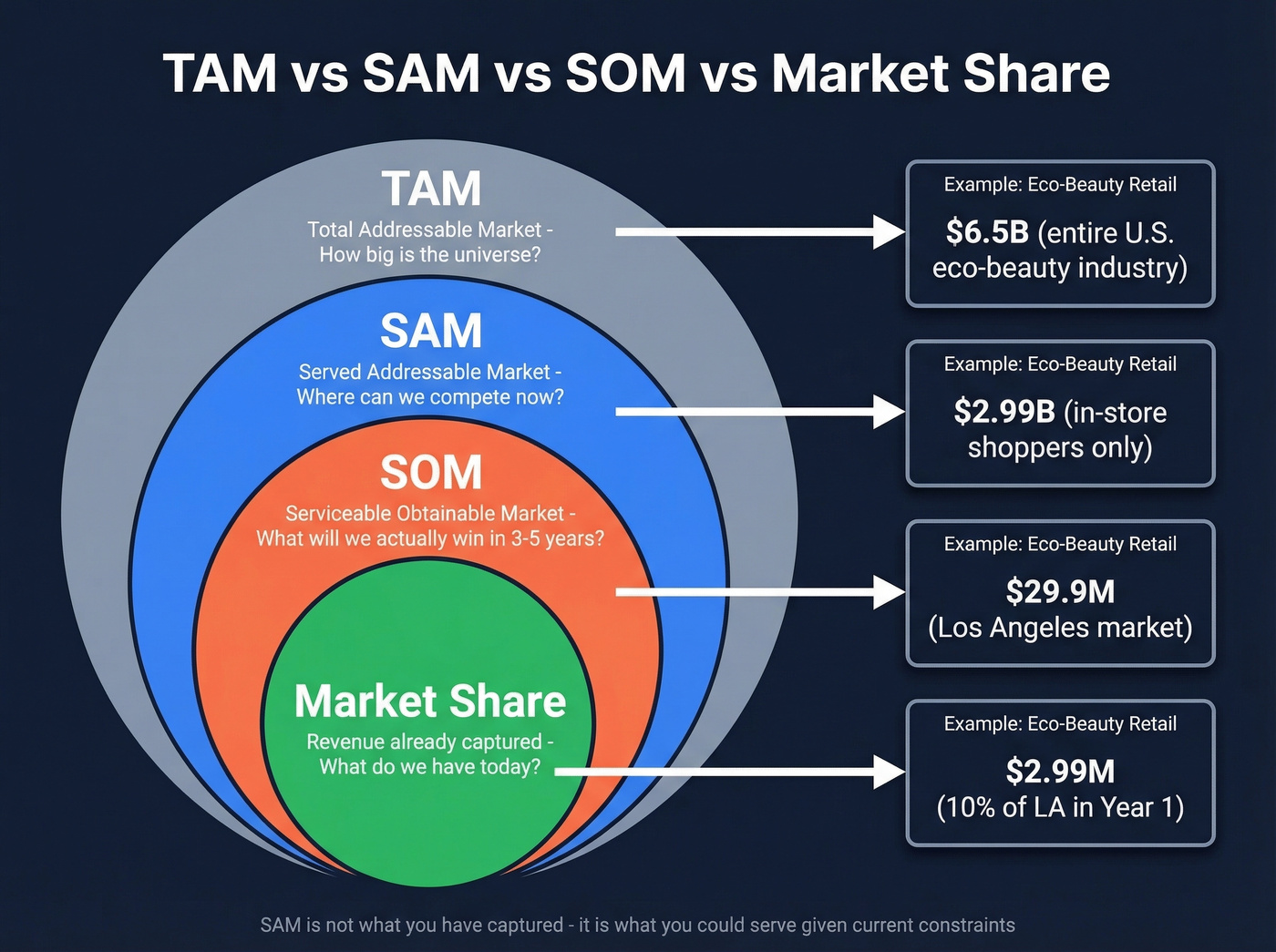
The critical distinction: "served" doesn't mean "already captured." SAM is the addressable opportunity you could serve given your current constraints - not what you've already won.
One more concept worth knowing: Hunter introduces the idea of a Prioritized Obtainable Market (POM) - the subset of SOM you're most likely to win at scale. Think of it as "build deep in a narrow segment first." It's a useful lens for GTM planning even if it doesn't show up on most pitch decks.

Your SAM means nothing if you can't reach the buyers inside it. Prospeo's 300M+ profiles with 30+ filters - including headcount, revenue, technographics, and buyer intent - let you turn a market-sizing slide into a live prospecting list. 98% email accuracy means your outreach actually lands.
Stop sizing your market. Start reaching it.
How to Calculate Your SAM
Two approaches dominate: top-down (start with the total market, apply filters) and bottom-up (count actual customers, multiply by price). Use both. If the two numbers diverge wildly, that's a signal to investigate your assumptions - not pick the bigger number.
Top-Down: Eco-Beauty Retail
This example comes from Salesforce's TAM/SAM/SOM breakdown. Start with the U.S. eco-friendly beauty industry at $6.5B (your TAM). You only sell through physical stores, and 46% of consumers prefer buying beauty products in person. That gives you a SAM of $6.5B x 46% = $2.99B.
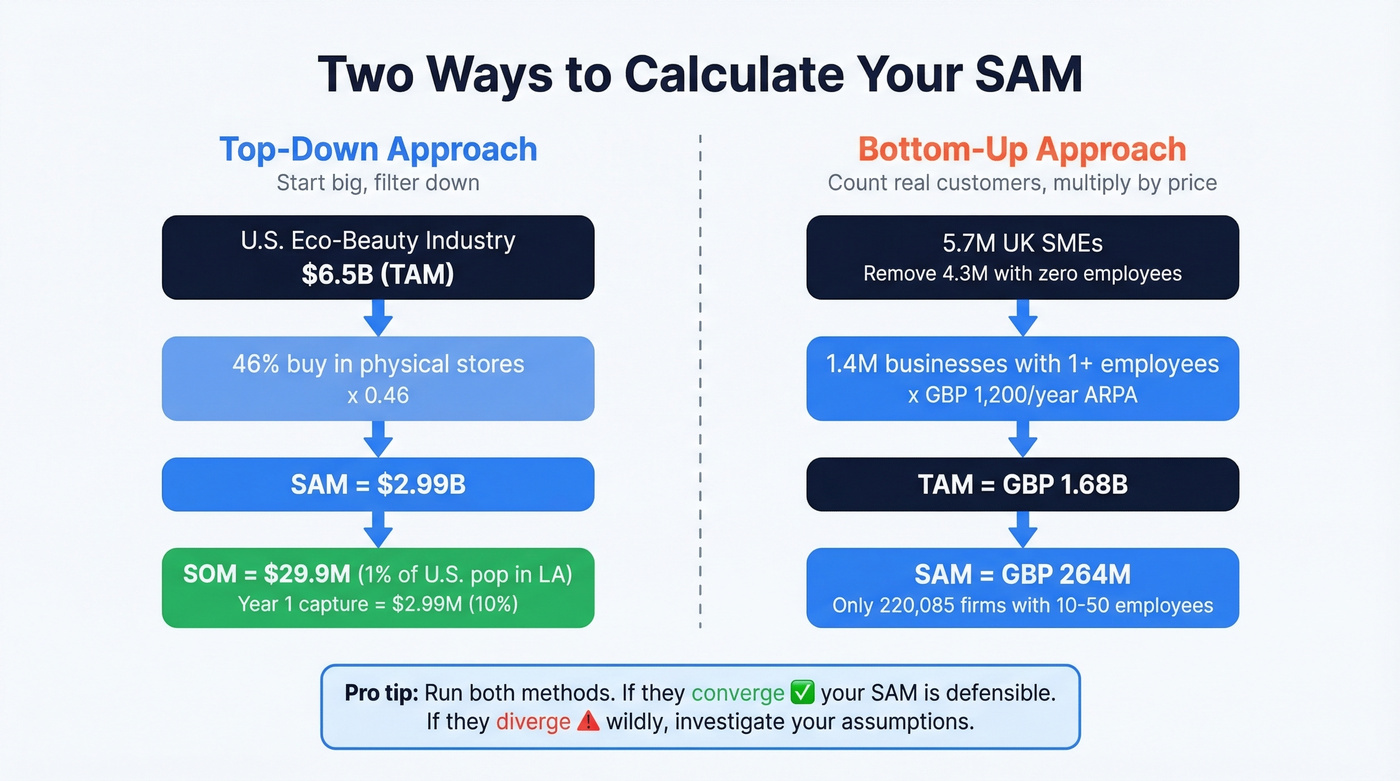
Now narrow to SOM. You're launching in Los Angeles, roughly 1% of the U.S. population, so $2.99B x 1% = $29.9M. Estimate you'll capture 10% of that local market in year one: $29.9M x 10% = $2.99M. Every step has a clear constraint and a clear number. That's what "show your work" looks like.
Bottom-Up: UK Payroll Software
This one's from Wise's market sizing guide. The UK has 5.7M SMEs. Remove 4.3M with zero employees - they don't need payroll software. That leaves 1.4M businesses with at least one employee. Multiply by your average revenue per account (GBP 1,200/year) and your TAM is roughly GBP 1.68B.
But your product only fits companies with 10-50 employees. That segment contains 220,085 businesses. Multiply by GBP 1,200/year, and your SAM is roughly GBP 264M - about 16% of TAM. Notice how the bottom-up approach forces you to name a specific customer profile and count real companies. That's why investors trust it more.
A practical rule of thumb: SAM often lands around 10-40% of TAM depending on geographic and channel constraints. Early-stage SOM typically falls between 1-10% of SAM. These aren't rules - they're sanity checks. If your SOM is 50% of your SAM, expect investors to push hard on why you can win that much that fast.
Mistakes That Kill Your SAM
Five ways to lose credibility with investors:
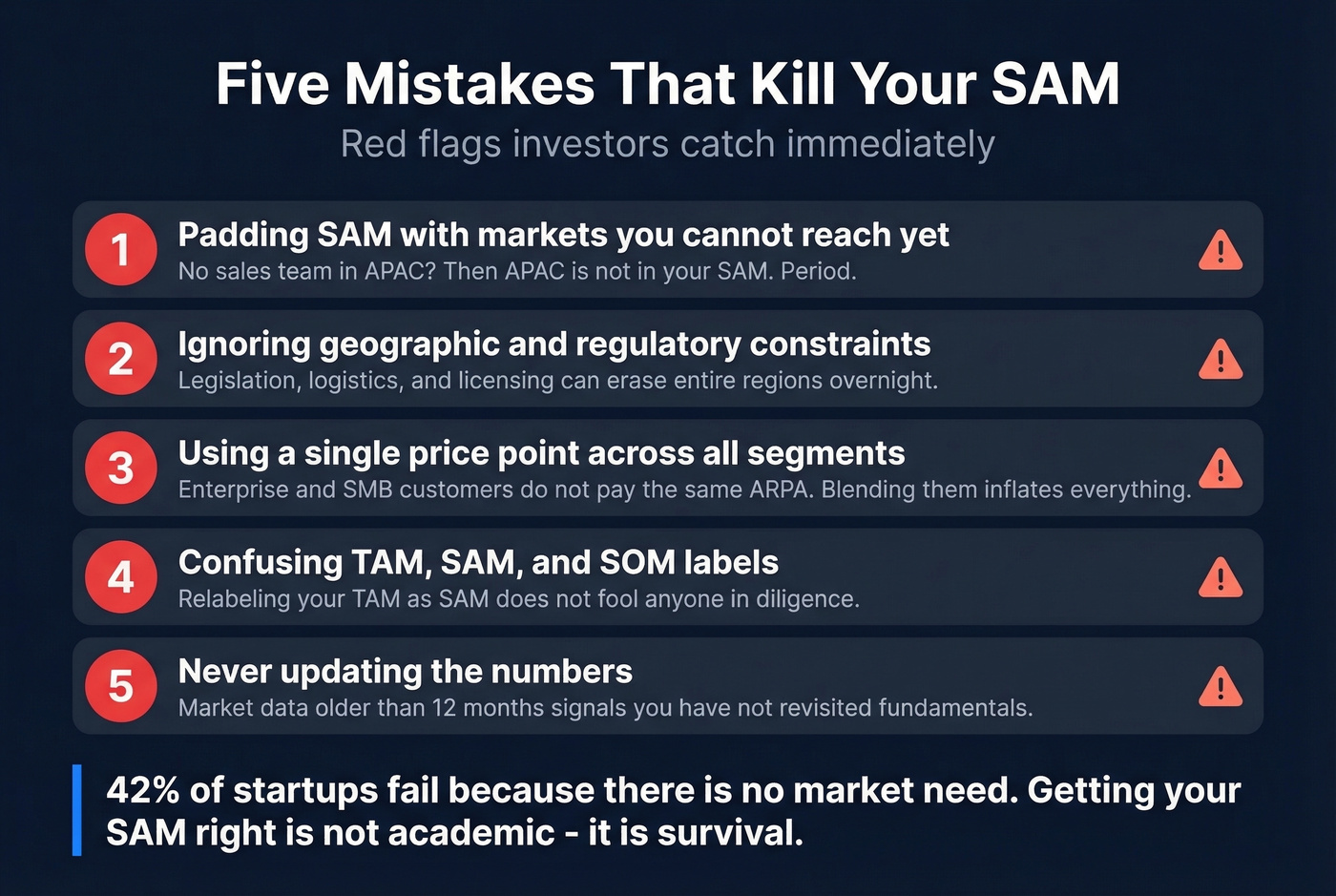
- Padding SAM with adjacent markets you can't reach yet. If you don't have a sales team in APAC, APAC isn't in your SAM. Period.
- Ignoring geographic and regulatory constraints. Legislation, logistics, and licensing can make entire regions unreachable. MarketingProfs flags this as one of the most common errors.
- Using a single price point across segments. Enterprise and SMB customers don't pay the same ARPA. Blending them inflates your numbers.
- Confusing TAM, SAM, and SOM. We've seen decks where the "SAM" slide is actually showing TAM with a different label. Investors notice.
- Never updating the numbers. Markets shift. If you haven't revisited your sizing in over a year, it's probably wrong.
Here's the thing: the consensus on r/startups is brutal. TAM is "stitched together from random assumptions" and "padded with adjacent markets." The cure isn't abandoning market sizing - it's showing your constraints and assumptions so clearly that an investor can challenge any single one and you'll have an answer ready.
How Investors Evaluate Your SAM
Investors don't care if your TAM is $50B. They care whether your serviceable addressable market is defensible and aligned with your GTM plan. GoingVC frames it well - SAM is where they test "can you win here today?" It needs to match your product capabilities, your pricing, and your current traction.
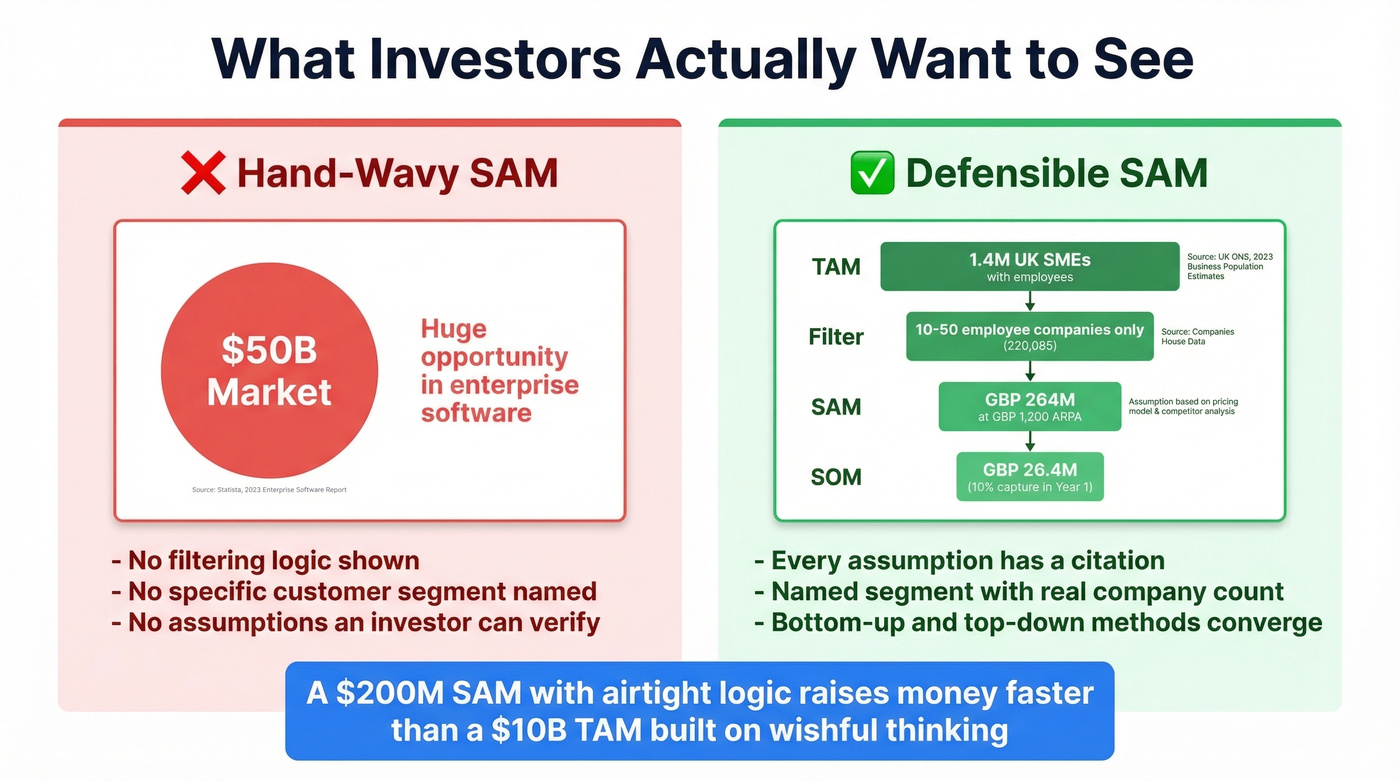
A small, defensible SAM beats a huge, hand-wavy TAM every time - especially in diligence. A defensible SAM slide names the segment, the constraint, and the math. A hand-wavy one says "$50B market" with a Statista logo and no filtering logic. In our experience, the decks that survive diligence are the ones where every assumption has a citation an investor can verify in five minutes.
Bottom-up calculations carry more weight than top-down alone because they force you to name specific customer segments, count them, and attach real pricing. If you can show both approaches converging on a similar number, you've essentially passed the test.
Let's be honest: most early-stage founders spend too much time inflating their TAM and not enough time proving their SAM is real. A $200M SAM with airtight logic will raise money faster than a $10B TAM built on Statista reports and wishful thinking.
From SAM to Reachable Buyers
Your SAM is a number on a slide. It means nothing if your SDRs can't find decision-makers or your bounce rate is killing deliverability.
The gap between "theoretical market" and "pipeline" is contact data quality. This is where a platform like Prospeo closes that gap - filter 300M+ professional profiles by 30+ criteria, including intent data across 15,000 topics, to narrow from your SAM definition to a verified, exportable contact list with 98% email accuracy. That's the bridge between a number on a slide and a pipeline your team can actually work.
If you're building outbound from this list, your next bottleneck is usually email deliverability and email bounce rate - not market size.
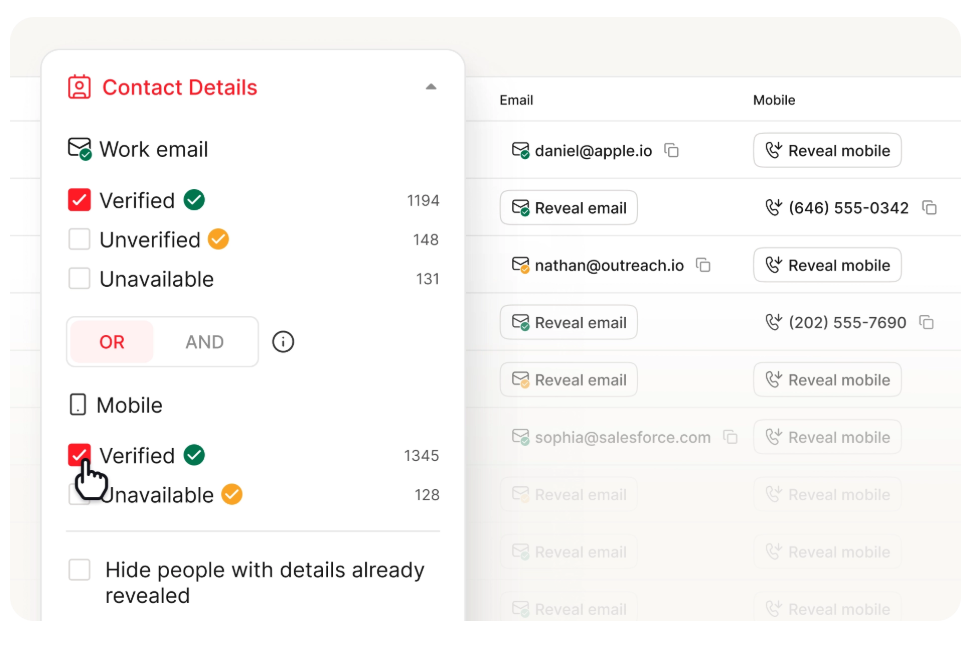
Bottom-up SAM calculations require counting real companies and attaching real contacts. Prospeo lets you filter by company size, geography, industry, and tech stack - then export verified emails at $0.01 each. That's how you go from a defensible SAM number to booked meetings.
Turn your serviceable addressable market into pipeline today.
FAQ
Is "served addressable market" the same as "serviceable addressable market"?
Yes. Both terms refer to SAM, the portion of your total market you can actually reach and sell to given current constraints like geography, product fit, and distribution channels. "Serviceable available market" and "served available market" are also synonyms. All four phrases describe the same metric.
How often should you update your SAM?
At least annually, or whenever you enter a new geography, launch a new product, or change pricing. Companies that raised Series A in 2026 and still show 2024 market data on their deck are signaling they haven't revisited fundamentals. If your GTM plan has shifted, your SAM should reflect that.
What's a realistic SAM-to-TAM ratio?
For most B2B startups, SAM lands between 10-40% of TAM depending on geographic reach and channel constraints. Below 5% usually signals a very niche play; above 50% suggests you haven't filtered aggressively enough. Investors treat ratios outside this range as a red flag worth probing.
What tools help you validate SAM with real data?
Firmographic databases, CRM pipeline data, and B2B data platforms are the standard toolkit. Prospeo's 30+ search filters - including technographics, headcount growth, and buyer intent - let you count actual companies matching your SAM criteria and verify whether decision-makers are reachable, connecting market sizing to real outbound execution.