

How to Set Sales Goals Your Team Can Actually Hit
A RevOps lead posted on r/sales about quota attainment at their company: two reps out of ten hitting their number each quarter. That's 20% attainment. Leadership's response wasn't to recalibrate - it was to offer unpaid swing shifts so reps could "work another four hours at home." When the fix for missed goals is more hours instead of better math, the entire goal-setting process needs a rethink.
Here's the short version: you need three numbers before anything else - pipeline coverage ratio, win rate, and average sales cycle length. Everything else is derived from those. This guide gives you the formulas, benchmarks, and accountability system to make it work.
What Sales Goals Actually Are
Goals, quotas, targets, and KPIs get used interchangeably. They shouldn't be. A goal is a strategic outcome - grow revenue 30%, enter a new segment. A quota is the specific number assigned to an individual rep, derived from that goal. KPIs are the leading indicators that tell you whether you're on track before the quarter ends.
Conflating these causes real damage. When leadership sets a "goal" of $50M in ARR and divides by headcount, they've skipped the entire capacity model. That's arithmetic, not strategy. And bad goals don't just miss - they drive attrition. Replacing a ramped AE creates a multi-month productivity gap, often about seven months to full productivity, plus recruiting costs that nobody budgets for upfront.
Goal-setting should involve the CRO, RevOps, and frontline managers together. When any of those three are absent, the goals end up disconnected from reality.
SMART Framework for Sales Goals
The SMART framework - Specific, Measurable, Achievable, Relevant, Time-bound - is necessary but not sufficient. Without pipeline math behind it, a SMART goal is just a well-formatted wish. Think of SMART as the formatting layer on top of your capacity model, not a replacement for one.
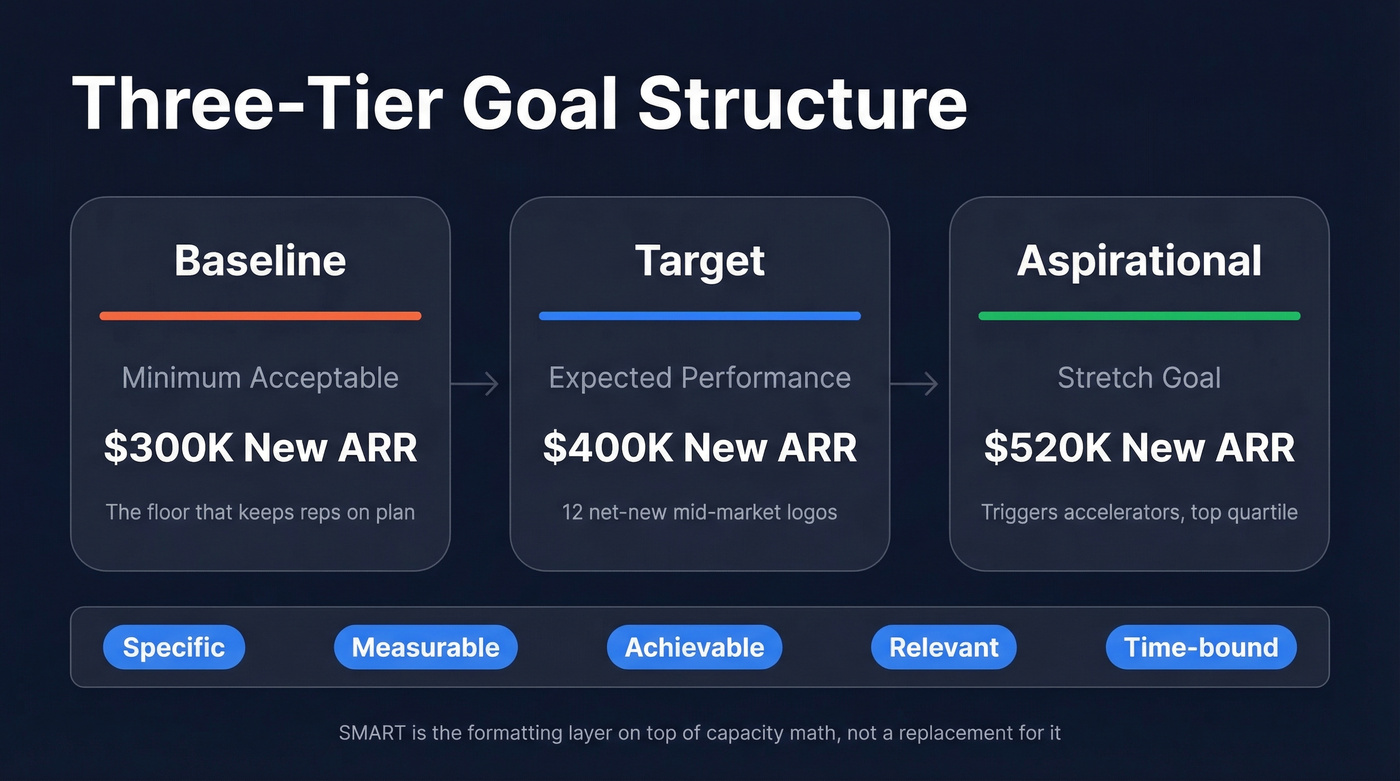
The structure that actually works is a three-tier model:
- Baseline (minimum acceptable): Close $300K in new ARR this quarter - the floor that keeps the rep on plan
- Target (expected performance): Close $400K in new ARR - what the capacity model says a ramped rep should produce
- Aspirational (stretch): Close $520K in new ARR - triggers accelerators, represents top-quartile performance
Each tier passes the SMART test. "Grow revenue" fails. "Close $400K in new ARR by Q2 end through 12 net-new mid-market logos" passes. The three-tier structure gives reps a floor to protect confidence and a ceiling to chase.
Capacity Math Behind Achievable Goals
Here's where most sales orgs go wrong. They set a revenue target, divide by headcount, and call it a quota. That ignores ramp time, turnover, and the fact that workload-based capacity models often assume reps spend only about 29% of their week in true selling time.
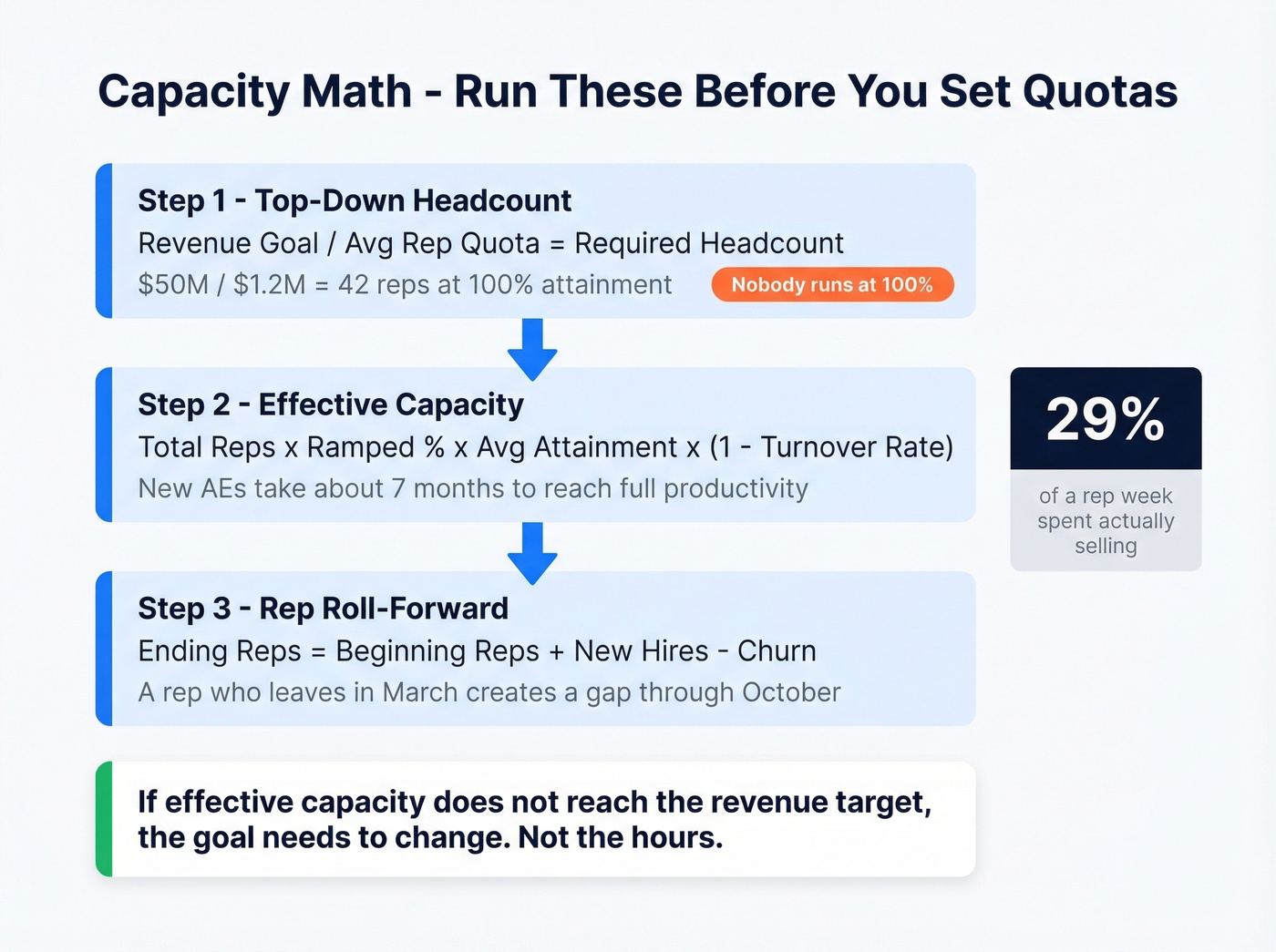
Top-down headcount formula:
Revenue Goal / Average Rep Quota = Required Headcount
$50M target / $1.2M quota = roughly 42 reps at 100% attainment. But nobody runs at 100%. In most SaaS orgs, quota attainment lands somewhere around 40-60% depending on segment, territory quality, and ramp mix.
Effective capacity formula:
Effective Capacity = Total Reps x Ramped % x Avg Quota Attainment x (1 - Turnover Rate)
New AEs typically take seven months to reach full productivity. Five reps hired in January aren't fully contributing until August.
Rep roll-forward formula:
Ending Reps = Beginning Reps + New Hires - Churn
A rep who leaves in March and gets replaced in April creates a long productivity gap because the replacement still has to ramp. We've seen teams skip this step and overshoot quota by 30-40%, then blame the reps when the math was broken from day one.
Run these formulas before you assign targets. If effective capacity doesn't reach the revenue target, the goal needs to change. Not the hours.
One more thing: sellers who partner with AI sales tools are 3.7x more likely to meet quota. Capacity planning needs to account for the tooling your reps actually have access to.
Pipeline Coverage - The Ratio That Predicts Your Number
Pipeline coverage is one of the best predictors of whether you'll hit your number:
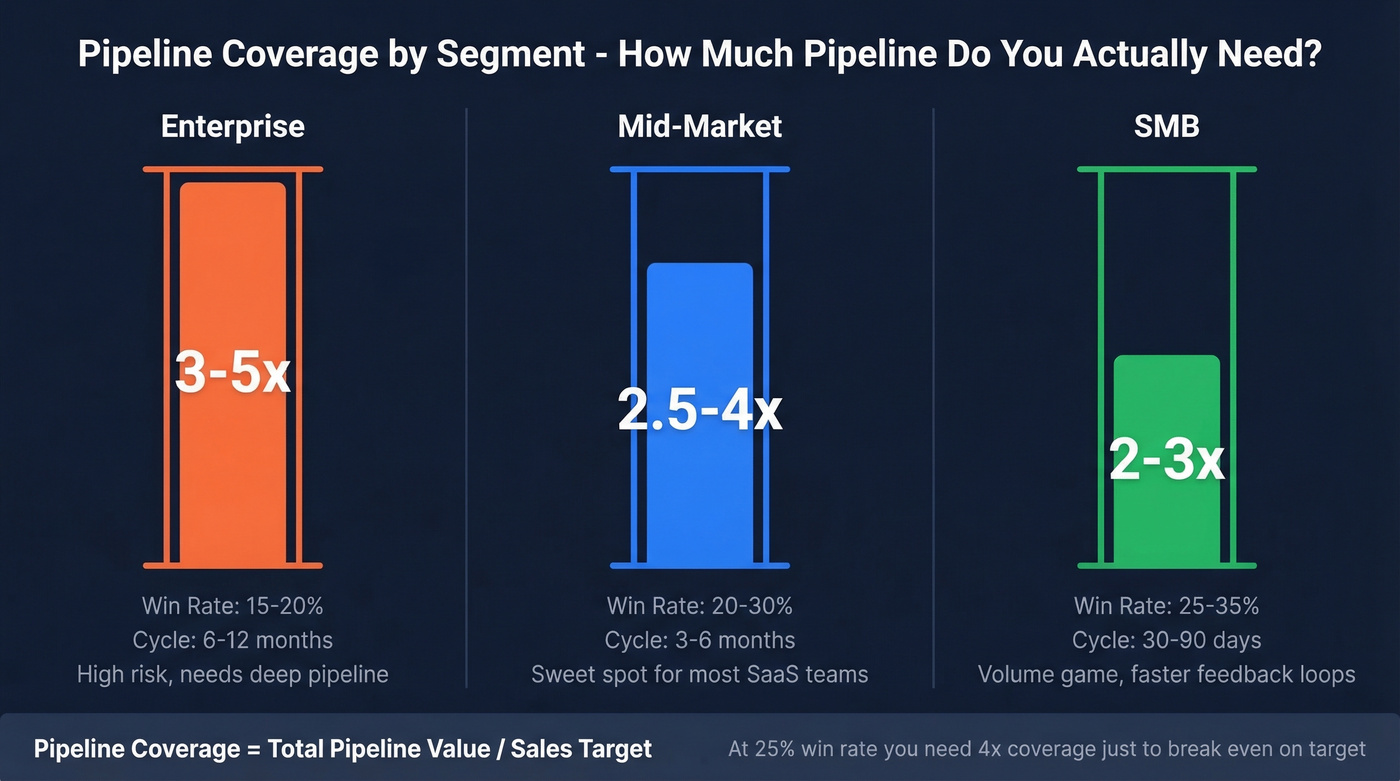
Pipeline Coverage Ratio = Total Pipeline Value / Sales Target
If your target is $100K and your pipeline holds $250K, you're at 2.5x coverage. Whether that's enough depends on your segment.
| Segment | Coverage Needed | Typical Win Rate | Cycle Length |
|---|---|---|---|
| Enterprise | 3-5x | 15-20% | 6-12 months |
| Mid-market | 2.5-4x | 20-30% | 3-6 months |
| SMB / High-velocity | 2-3x | 25-35% | 30-90 days |
If your win rate is 25%, you need 4x coverage just to break even on target. Anything less and you're hoping for a miracle quarter.
Weighted coverage multiplies each opportunity by its probability of closing. More accurate, but only if your stage definitions are honest. Let's be real - most CRMs are full of deals that should've been disqualified two months ago.
Pipeline Velocity - One Formula, Four Levers
Pipeline velocity tells you how much revenue your pipeline generates per day:
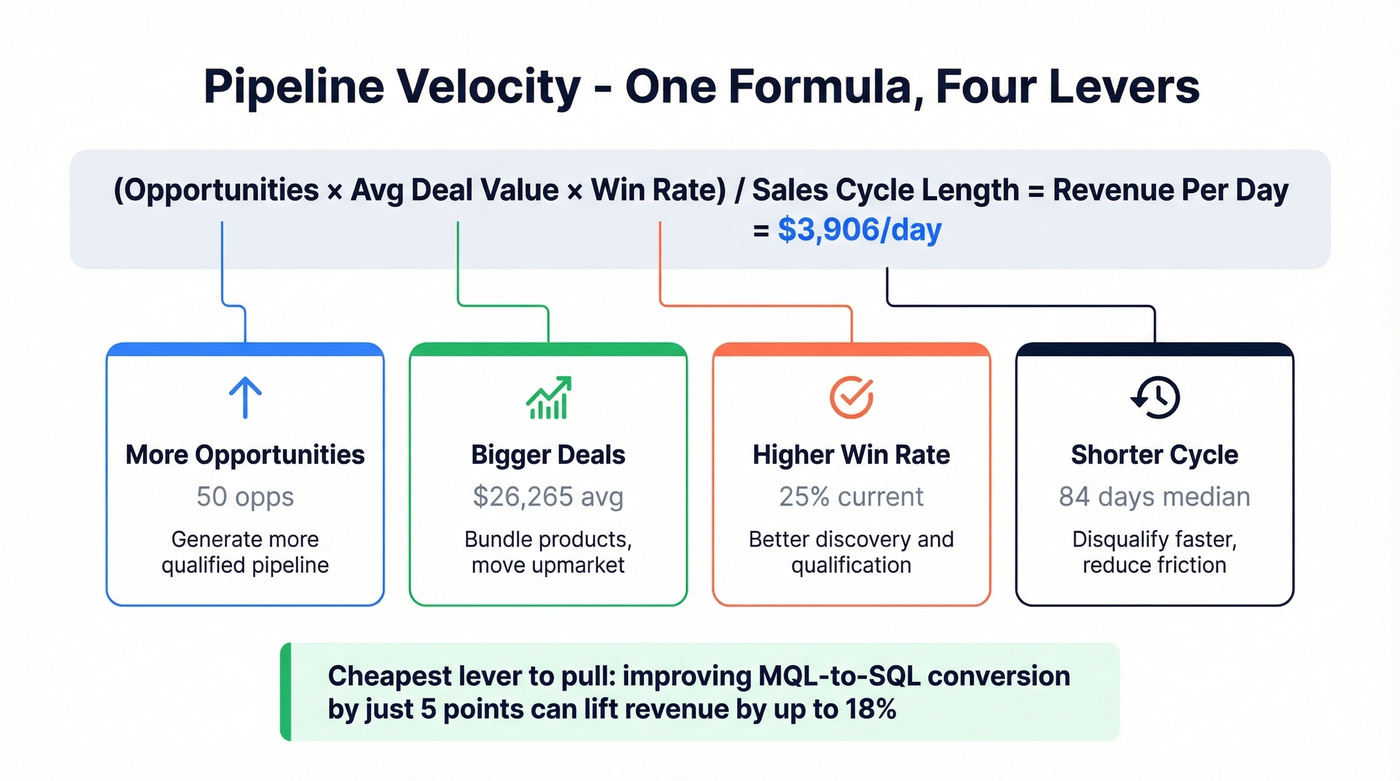
Pipeline Velocity = (Opportunities x Avg Deal Value x Win Rate) / Sales Cycle Length
Plugging in baseline SaaS benchmarks: 50 opportunities x $26,265 average deal x 25% win rate / 84-day cycle = $3,906/day in expected revenue.
Every sales goal should map to one of these four levers. Want more revenue? Generate more opportunities, increase deal size, improve win rate, or shorten the cycle.
The cheapest lever to pull: improving MQL-to-SQL conversion by just 5 points can lift revenue by up to 18%. Better qualification costs less than more top-of-funnel volume every single time.

Pipeline velocity has four levers - but none of them work if reps are emailing dead contacts. Prospeo's 98% email accuracy and 7-day refresh cycle mean every opportunity in your formula maps to a real, reachable buyer. Teams using Prospeo book 35% more meetings than Apollo users.
Stop inflating pipeline with contacts that bounce. Start with verified data.
2026 Funnel Benchmarks Worth Knowing
Activity goals are only useful when grounded in real conversion data. Here are B2B SaaS funnel benchmarks by channel:
| Channel | Visitor-to-Lead | MQL-to-SQL | Opp-to-Close |
|---|---|---|---|
| SEO | 2.1% | 51% | 36% |
| PPC | 0.7% | 26% | 35% |
| 2.2% | 30% | 39% | |
| 1.3% | 46% | 32% | |
| Webinar | 0.9% | 39% | 40% |
The biggest bottleneck across nearly every channel is MQL-to-SQL, sitting at 15-21% in aggregate. That's where deals die - not at the top of funnel.
Use these as starting points and calibrate to your own data after one to two quarters. One thing these benchmarks assume: your contact data is accurate. If your email bounce rate is above 5%, reps waste 20-30% of their activity on dead contacts. Tools like Prospeo, with 98% email accuracy and a 7-day data refresh cycle, ensure activity goals reflect actual reachable prospects rather than ghosts in a stale database.
12 Sales Goal Examples With the Math
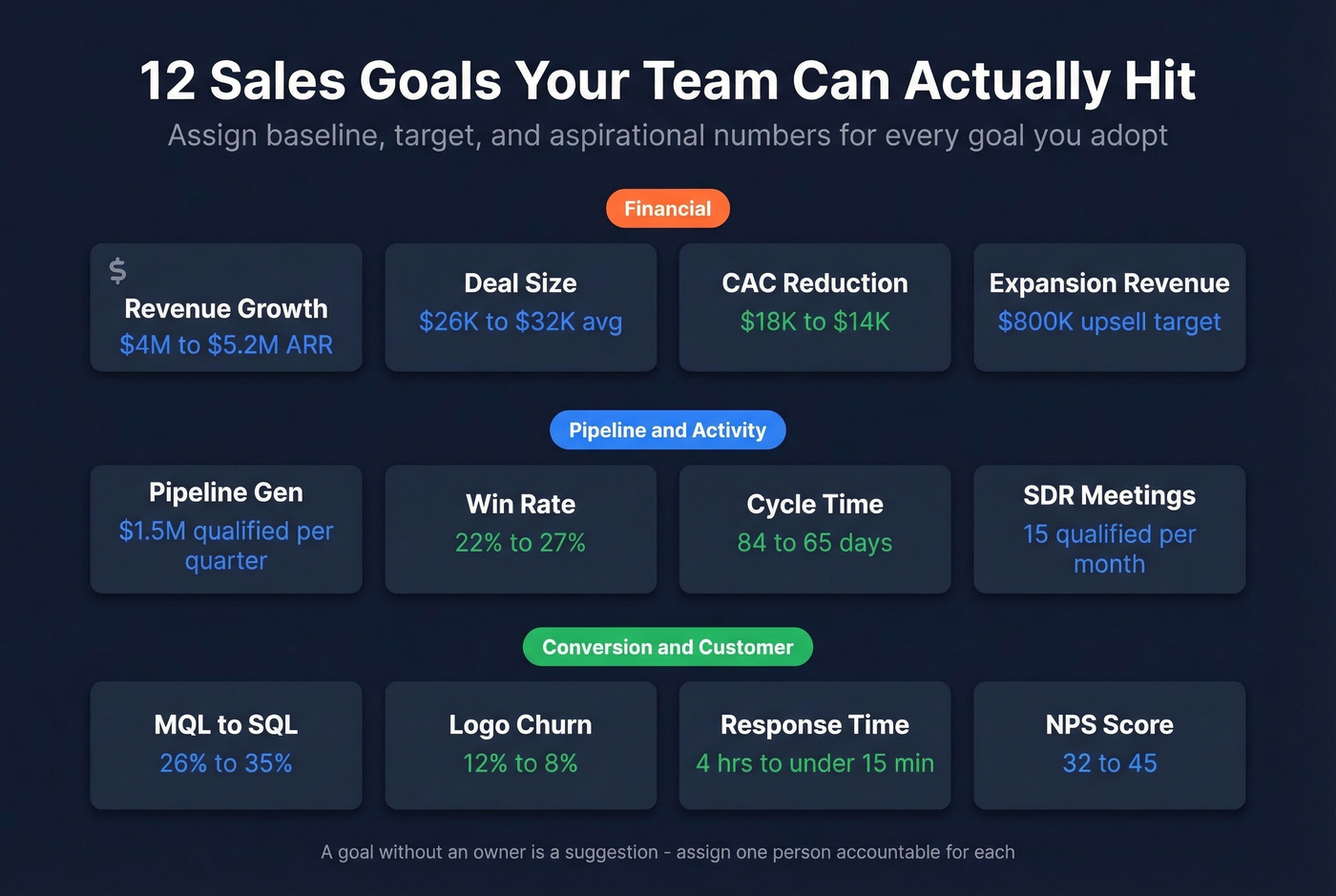
Here are twelve goal types organized by category. Each follows the three-tier structure - assign a baseline, target, and aspirational number for every one you adopt.
Financial Goals
| Goal | SMART Formulation | Key Benchmark |
|---|---|---|
| Revenue growth | Increase new ARR from $4M to $5.2M by Q4 end | Requires 4x pipeline coverage |
| Average deal size | Raise average deal from $26K to $32K via multi-product bundling by Q3 | Top quartile: $35K+ |
| CAC reduction | Lower CAC from $18K to $14K by shifting 20% of pipeline to organic by Q4 | SaaS median: $15K |
| Upsell/cross-sell | Generate $800K in expansion revenue from accounts above 80% tier usage by Q4 | Best-in-class: 30%+ of new ARR |
Pipeline & Activity Goals
Pipeline generation: each AE generates $1.5M in qualified pipeline per quarter, derived from quota multiplied by the required coverage ratio. Win rate improvement: move from 22% to 27% within two quarters by implementing structured discovery - a 5-point improvement at current volume equals roughly 18% revenue lift. Cycle time reduction: cut median sales cycle from 84 to 65 days by disqualifying unqualified opportunities before Stage 3. SDR activity: each SDR books 15 qualified meetings per month, requiring roughly 200 verified contacts to work through.
Conversion & Customer Goals
Conversion rate: improve MQL-to-SQL from 26% to 35% for PPC-sourced leads by Q3 through tighter lead scoring. Customer retention: reduce logo churn from 12% to 8% annually - each retention point at $4M ARR saves $40K. Response time: cut average lead response time from 4 hours to under 15 minutes - speed-to-lead remains one of the highest-leverage inbound metrics. NPS: improve from 32 to 45 within three quarters through structured post-onboarding check-ins.
A goal without an owner is a suggestion. Every one of these needs a single person accountable.
Align Goals With Compensation
If your comp plan doesn't reward the goals you've set, the goals are decorative.
Here's what the market looks like for SaaS sales compensation: SDR OTE runs about $85K with base at 65-75%. AE OTE averages $154K on a 50/50 split. Accelerators matter enormously - top performers earning 1.5-2x their standard commission rate after 120% attainment is the norm. If nobody on your team has ever triggered an accelerator, your comp plan isn't motivating anyone. It's just a cost structure.
Here's our hot take: most companies set quotas high enough that accelerators are theoretically possible but practically unreachable. If fewer than 15% of your reps hit accelerator territory in any given quarter, your quotas are aspirational fiction dressed up as compensation strategy. Set the target where 50-60% of ramped reps can hit it, and let the accelerators reward the top 20% who blow past it.
The Accountability System That Works
Goals without a review cadence are New Year's resolutions. The RAIN Group framework breaks accountability into tiers:
Daily: Review goals every morning. End each day by identifying your Greatest Impact Activity - the one action that moves pipeline most.
Weekly: Friday review of the full week. Set next week's goals before Monday hits and the fires take over. Pair with a goals partner - a peer, mentor, or coach who reviews progress honestly. This single practice catches problems weeks before they surface in the pipeline report.
Monthly and quarterly: Small group review monthly, 3-4 people max. Full priority reset quarterly - are the goals still right? Has the market shifted? Adjust immediately rather than waiting for the next cycle.
A messy weekly review beats a polished quarterly one every time.
Five Mistakes to Avoid
1. Adding 20% to last year's number. The most common approach and the laziest. If last year's number was wrong, adding 20% makes it more wrong.
2. Top-down fantasy quotas. Leadership picks a number that sounds good in a board deck, divides by headcount, and calls it a quota. No ramp adjustment, no attrition modeling, no coverage analysis. Sales goal setting for managers starts with capacity math, not board-level ambition.
3. Ignoring ramp time. Five new reps in Q1 don't produce five quotas in Q2. They produce maybe one combined. Plan for the seven-month ramp or watch your forecast collapse.
4. Lagging-only goals with no leading indicators. Revenue is a lagging indicator. By the time you miss it, the problem happened two months ago. Track pipeline health, activity metrics, and conversion rates weekly. Failing to qualify leads early - talking too much, listening too little - compounds the damage downstream.
5. Bad data silently killing activity metrics. Reps making calls to disconnected numbers and sending emails that bounce. Activity metrics look fine on paper while actual reach is 30% lower than reported. This is the most frustrating one because it's invisible until you audit the data - and by then you've already missed the quarter.
Build Your Sales Goal Tracker
You don't need expensive software. A well-structured spreadsheet works - free templates from Smartsheet and similar platforms give you a starting structure to customize.
For each goal, capture the goal statement in one SMART-formatted sentence, the specific metric you're tracking, your current baseline, the three-tier target, a single owner (not a team), the review cadence, resources needed, anticipated obstacles named upfront, and an action plan with specific dates and responsibilities.
Structure these in a cascading hierarchy: individual goals roll up to team goals, team goals to department, department to the org target. If any level doesn't connect to the one above it, something's broken. This cascading structure also feeds your sales forecasting - when individual goals are grounded in capacity math, the roll-up becomes a reliable forecast rather than a hope.
Skip the fancy dashboards until you've proven you can maintain a simple tracker for two consecutive quarters. If your team can't keep a spreadsheet current, a $50K BI tool won't fix the discipline problem.
Review the tracker weekly. Update it honestly. A tracker that only gets touched during QBRs is just a document.
Your capacity model assumes reps spend their time selling - not chasing bad phone numbers and bounced emails. Prospeo gives your team 300M+ verified profiles, 125M+ direct dials with a 30% pickup rate, and 30+ filters to target exactly the right accounts. At $0.01 per email, fixing your data costs less than one lost deal.
Hit your sales goals by reaching real buyers, not database ghosts.
FAQ
What's the difference between a sales goal and a quota?
A goal is a strategic target like revenue growth or market expansion. A quota is the specific number assigned to an individual rep, derived from the broader goal divided by team capacity. Goals set direction, quotas set individual accountability. You need both, and they should always connect through capacity math.
How often should sales goals be reviewed?
Review activity and leading indicators weekly, pipeline and conversion metrics monthly, and revenue targets quarterly. If market conditions shift mid-cycle - a competitor launches, your product reprices - adjust immediately rather than waiting for the scheduled reset.
What should I do when goals feel unrealistic?
Run the capacity formula: effective reps x ramped percentage x average attainment x (1 - turnover). If the output doesn't reach the target, the goal needs recalibrating. Present the math to leadership. Numbers are harder to argue with than feelings.
How does data quality affect goal attainment?
If 30% of your contact data bounces, your reps' effective activity is 30% lower than reported - every conversion metric downstream is inflated. Cleaning up your data source is the single fastest way to close that gap, so activity targets reflect real reachable prospects rather than stale records.
How do I set goals for a brand-new team?
Start with the industry benchmarks in this article's funnel tables, set conservative 90-day targets, and recalibrate once you have one to two quarters of your own conversion data. Overindexing on activity goals early is fine - you need the data before you can set meaningful outcome goals.