

Signal-Based Marketing: How to Build It and What It Actually Costs
Your SDR gets a Slack alert: a VP of Engineering at a target account just visited your pricing page twice in 24 hours. The SDR fires off a personalized email within the hour. It bounces. The phone number in the CRM? Disconnected six months ago.
The signal was gold. The data underneath it was garbage.
That's the gap nobody talks about in signal-based marketing - and it's where most programs quietly die.
The Short Version
Signal-based marketing means using real-time buyer behavior - not static lists - to decide who to contact and when. Less than 5% of your market is actively buying at any given time, and signals help you find that 5%.
The minimum stack is a signal source, a data quality layer, and a sequencer. You can start for under $500/mo or spend $50K+/yr on enterprise platforms. But the #1 mistake isn't picking the wrong signal platform. It's sending outreach to emails that bounce 20%+ of the time, torching your domain reputation before the program even gets off the ground.
What Is Signal-Based Marketing?
The term lives in two worlds. In ad tech, it's about replacing third-party cookies with first-party behavioral signals for targeting. In B2B go-to-market, it means something more specific: using real-time buying signals to prioritize accounts and personalize outreach.
This guide focuses on the B2B definition.
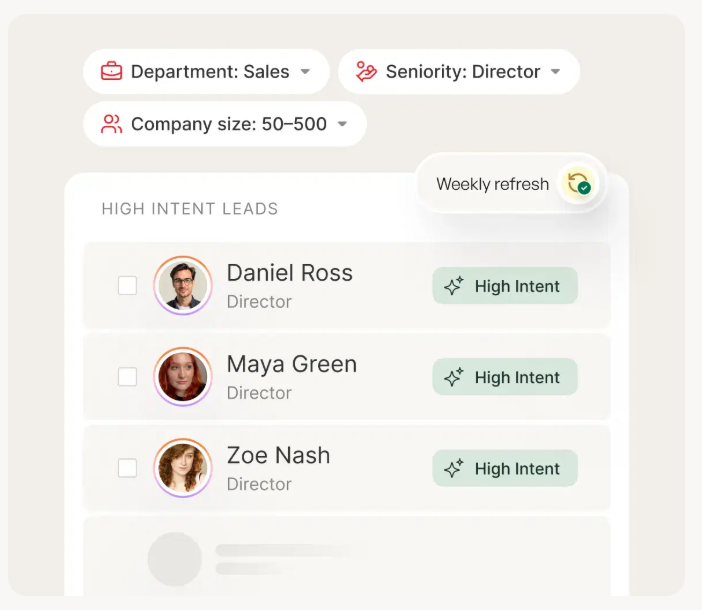
Google's research found that B2B buyers complete roughly 57% of their purchase journey before ever talking to a vendor, averaging 12 online searches before visiting a brand's website. All that activity is invisible to your sales team unless you're tracking signals. Illuminating those digital breadcrumbs - and using them to show up at the right moment with the right message - is what separates modern GTM from spray-and-pray.
The shift is operational, not philosophical. Instead of asking "who fits our ICP?", you're asking "who fits our ICP and is showing buying behavior right now?" That second filter changes everything about how you allocate rep time.
Why Signals Matter in 2026
Three forces are converging to make signal-based approaches the default GTM strategy.
AI adoption in GTM isn't experimental anymore. ICONIQ's State of Go-to-Market report showed that 70% of companies report moderate or full AI adoption in their GTM workflows. Among $100M+ ARR companies, AI-native firms convert free trials and POCs at 56% versus 32% for everyone else. The gap is widening fast.
Privacy regulations have gutted the old targeting playbook. Third-party data is getting noisier. First-party signals - pricing page visits, product usage, content engagement - are becoming the most reliable inputs you've got.
Contact data decays at roughly 2% per month. That's over 20% annually. Every quarter you wait, your database gets worse.
The results back this up: signal-based platforms drive 30-50% improvement in MQL-to-SQL conversion compared to traditional list-based approaches. And the vendor ranked first late in a buyer's selection process wins roughly 80% of the time - which means acting on signals fast isn't just nice-to-have, it's the entire game.
Let's be honest: none of this is conceptually new. It's what good marketers have always done - calling the prospect who just downloaded the case study, following up after the conference booth visit. The difference now is tooling that can do this at scale, across thousands of accounts, in near real-time.
The Signal Taxonomy
Not all signals are created equal. Here's how they break down by origin, decay window, and strength.
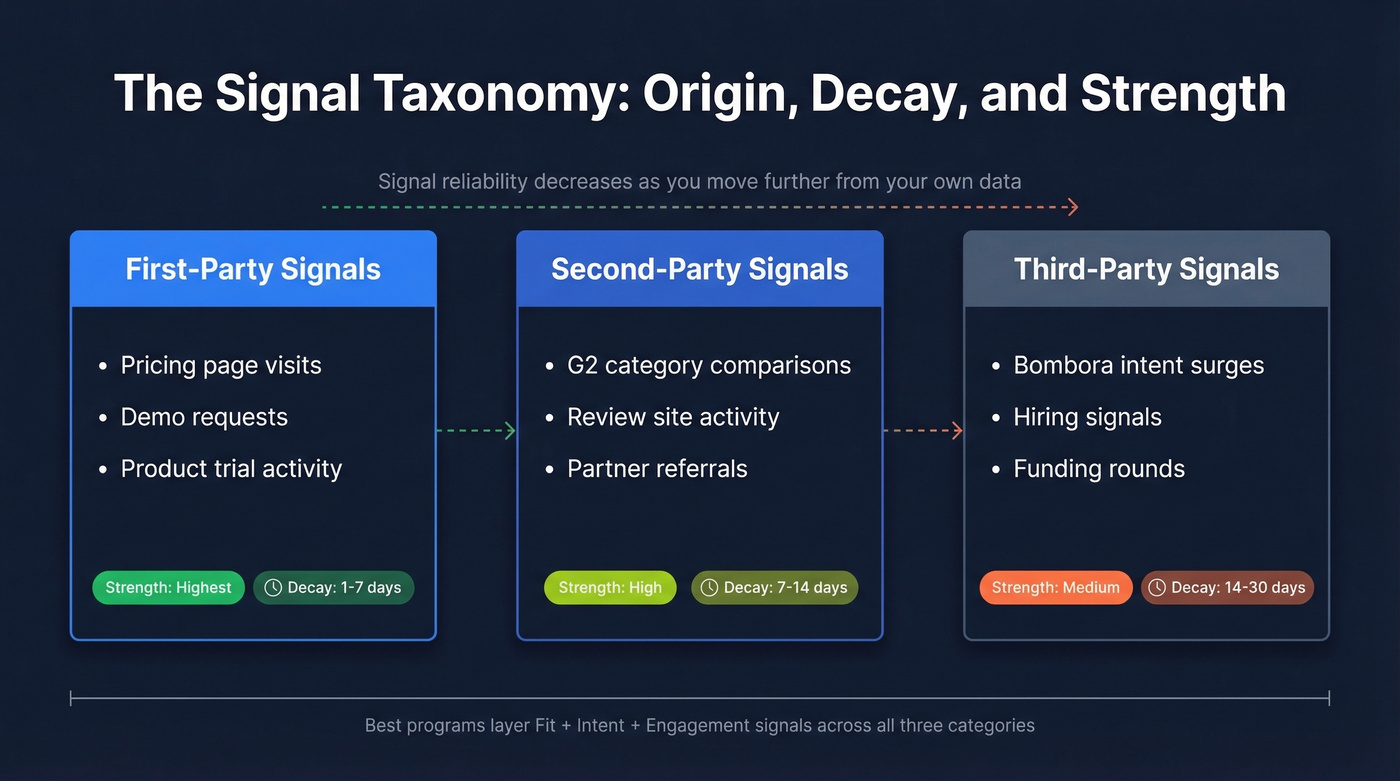
| Category | Examples | Decay Window | Strength |
|---|---|---|---|
| First-party | Pricing page visit, demo request, product trial activity | 1-7 days | Highest |
| Second-party | G2 comparison, review site activity, partner referral | 7-14 days | High |
| Third-party | Bombora intent surge, hiring signals, funding rounds | 14-30 days | Medium |
First-party signals come from your own properties. Someone visits your pricing page three times in a week? That's a strong signal with a short decay window - act within days, not weeks.
Second-party signals come from platforms where buyers research solutions: G2 category comparisons, Capterra reviews, industry community discussions. High-quality, but you don't control the data directly.
Third-party signals are the broadest category. Intent data from providers like Bombora, job postings scraped from career pages, funding announcements, technographic changes. Useful but often the oldest by the time they reach your CRM.
Demandbase offers a complementary lens: Fit, Intent, and Engagement. Fit signals tell you who. Intent signals tell you when. Engagement signals tell you how interested. The best programs layer all three.
One signal deserves special attention: champion job changes. When a former customer or power user moves to a new company, that's a signal with 3x the conversion rate of cold outbound. UserGems built an entire business around this insight.

Signals decay fast - but bad contact data kills them instantly. Prospeo refreshes 300M+ profiles every 7 days (not the 6-week industry average), so when a VP hits your pricing page, the email you send actually lands. 98% accuracy. Under 4% bounce rates. The data layer your signal stack is missing.
Stop wasting intent signals on bounced emails.
Which Signals Convert (And Which Are Noise)
The difference between a program that works and one that creates alert fatigue is mapping signals to specific plays with clear SLAs.
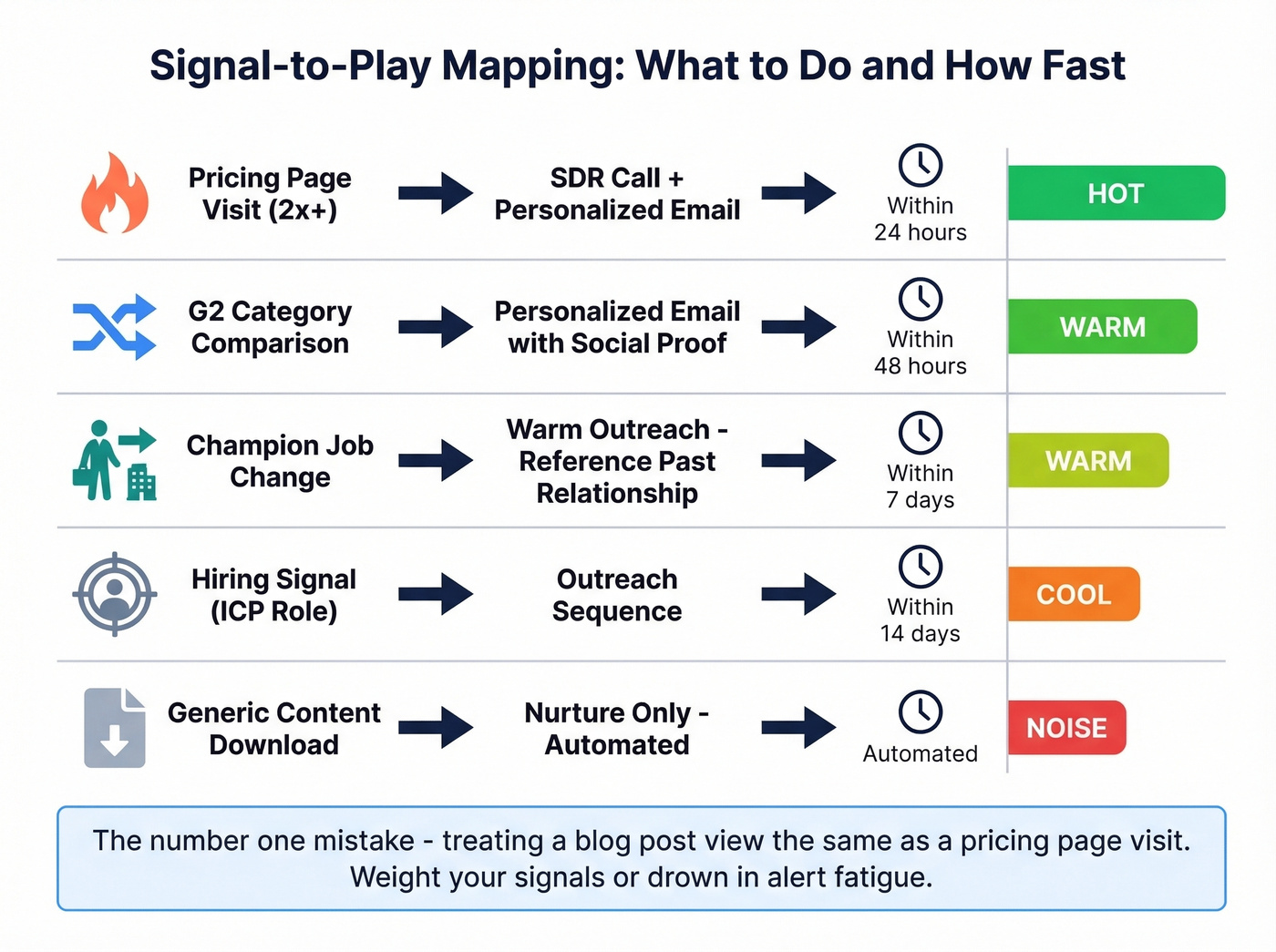
| Signal | Play | SLA | Decay |
|---|---|---|---|
| Pricing page visit (2x+) | SDR call + email | Within 24 hrs | 1-3 days |
| G2 category comparison | Personalized email | Within 48 hrs | 7-14 days |
| Champion job change | Warm outreach | Within 7 days | 14-30 days |
| Hiring signal (ICP role) | Outreach sequence | Within 14 days | 30+ days |
| Generic content download | Nurture only | Automated | 30+ days |
Here's where most teams go wrong: they treat a generic ebook download the same as a pricing page visit. Demandbase's team uses a great example - a student downloading an ebook looks identical to a real buyer in your analytics. Without context, you can't tell them apart.
We've seen this firsthand. Teams that weight all signals equally end up with reps chasing noise instead of pipeline. The fix isn't more signals - it's better signal-to-play mapping with strict SLAs.
If your average deal size is under $15K, you probably don't need a $60K/yr intent platform. A well-configured first-party signal stack with verified contact data will outperform an expensive intent engine sitting on top of a dirty database. Every time.
And every vendor claims their signals are "real-time." Ask what that actually means. For some, it's 24 hours. For others, it's three weeks of aggregated data delivered in a weekly batch. The difference between those two is the difference between a relevant conversation and a cold call.
How to Build a Signal-Based System
Two paths. Pick the one that matches your budget and technical appetite.
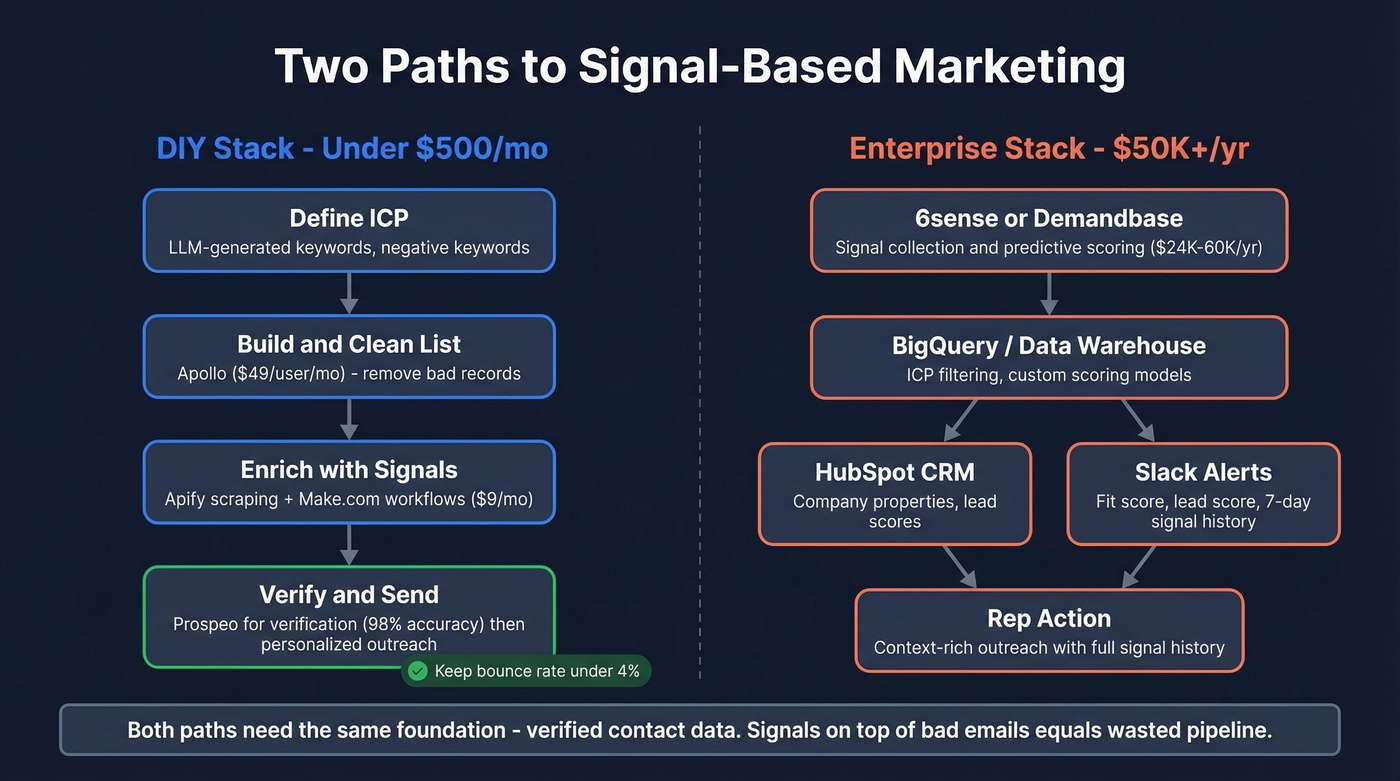
The DIY Stack (Under $500/mo)
No single tool handles the full workflow - monitoring, scoring, enrichment, personalized outreach. That's why teams stitch together 3-4 tools, and why most give up during integration. Here's the workflow that's been making the rounds on r/sales, refined with what we've seen work in practice:
- Define your ICP precisely. Use an LLM to generate search keywords and negative keywords for your prospecting tool. Export the list.
- Build and clean your list. Pull from Apollo ($49/user/mo, free tier available). Remove records missing emails or websites. Cut irrelevant industries.
- Enrich with signals. Use Apify to scrape company news, job postings, funding announcements, and recent projects. Feed these into Make.com workflows that route enriched data to your sequencer.
- Personalize with AI. Use an LLM to generate a "why now / why them / why you" first line and email body based on the signals you've collected.
One practitioner running this exact stack reported landing 6 new B2B clients in a single month with zero ad spend. The key wasn't any single tool - it was the verification step that kept deliverability above 96%.
If you're transitioning from high-volume cold outbound, run both systems in parallel for about 60 days. Compare cost-per-meeting, not email volume. That's how you get leadership buy-in.
The Enterprise Stack ($50K+/yr)
For larger teams, the architecture looks more like what Dreamdata documented: signal collection feeds into BigQuery, where ICP filtering and scoring happen. Qualified signals push back into HubSpot as company properties, which trigger a Slack workflow to a dedicated #outbound-opportunities channel.
The Slack alert includes fit score (filtered to "Good" or "Excellent" only), lead score, time of latest interaction, and a 7-day signal history. Reps see context, not just a name.
At this tier, 6sense or Demandbase typically serves as the signal source layer. They're powerful - predictive buying-stage classification, orchestration, multi-channel activation. But they're wildly overpriced for teams under 100 employees. A 6sense contract runs around $54K-60K/yr. Demandbase starts around $24K/yr. That's real money before you've added CRM seats, sequencing tools, or data enrichment.
Tools and What They Cost
| Tool | Category | Starting Price | Best For |
|---|---|---|---|
| Apollo | List building + signals | $49/user/mo (free tier) | SMB outbound |
| Factors.ai | Anonymous visitor ID | ~$149/mo | Website deanonymization |
| Salesmotion | Signal tracking | $85/mo | Affordable monitoring |
| Common Room | Community/PLG signals | ~$1,000/mo | PLG motions |
| Clay | Data orchestration | ~$700-720/mo | Technical RevOps |
| UserGems | Champion tracking | ~$10K+/yr | Job-change signals |
| LinkedIn Sales Navigator | Social selling | ~$100-160/mo | Relationship selling |
| Demandbase | ABM platform | ~$24K+/yr | Enterprise ABM |
| 6sense | Revenue AI / ABM | $54K-60K+/yr | Predictive intent |
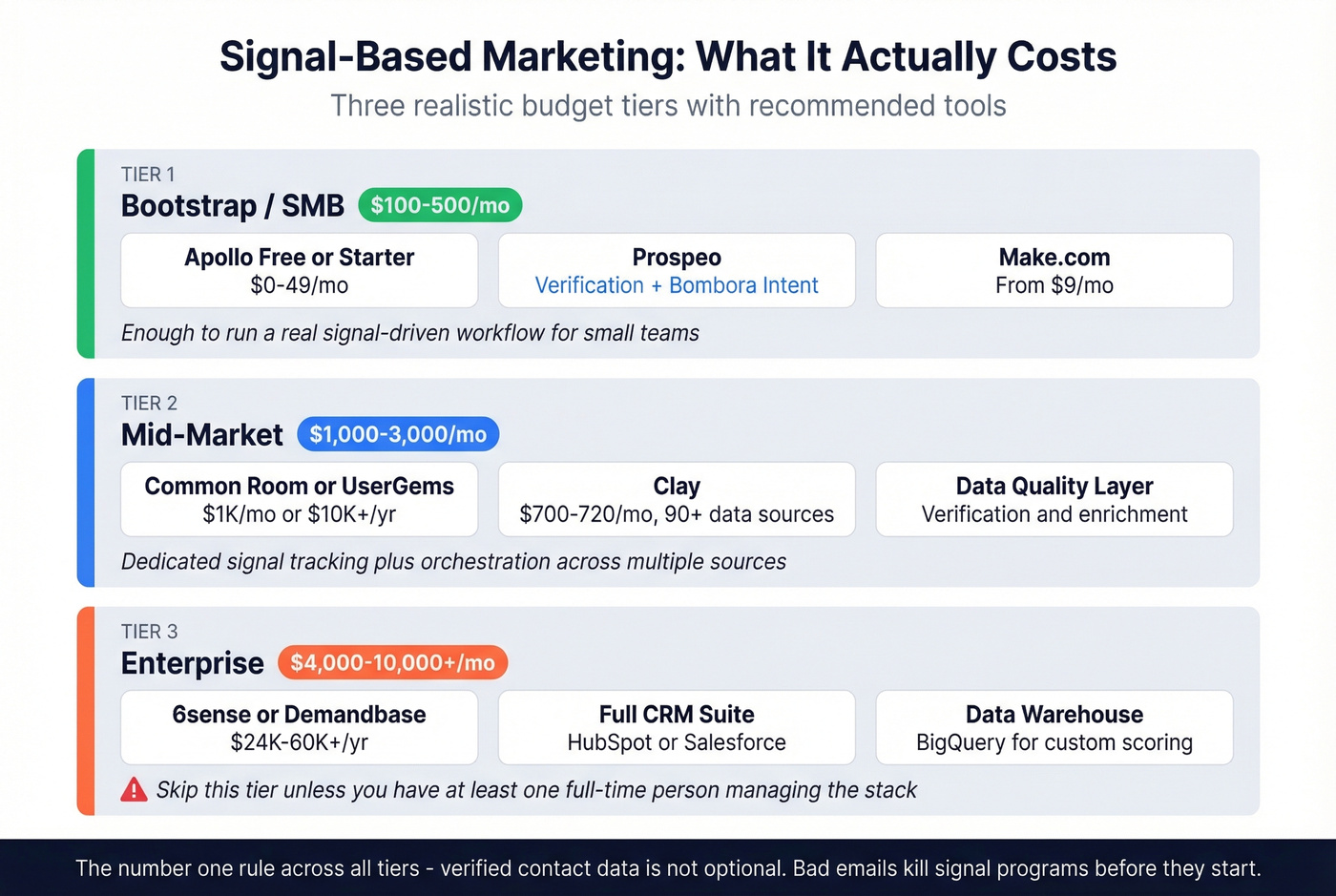
Now let's map these to realistic budgets.
Bootstrap / SMB ($100-500/mo): Apollo's free or starter tier for list building, Prospeo for verification, enrichment, and intent data across 15,000 Bombora topics, Make.com for automation from $9/mo. This is enough to run a real signal-driven workflow.
Mid-market ($1,000-3,000/mo): Add Common Room or UserGems for dedicated signal tracking, Clay for orchestration across its 90+ data sources, and a solid data quality layer underneath.
Enterprise ($4,000-10,000+/mo): 6sense or Demandbase as the signal engine, full CRM suite, data warehouse for custom scoring, and a dedicated RevOps team to keep it all running. Skip this tier if you don't have at least one full-time person managing the stack - these platforms don't run themselves.
Mistakes That Kill Signal Programs
Treating all signals equally. A pricing page visit and a blog post view aren't the same signal. Without weighting, a false positive looks identical to a real buyer. Your reps drown in noise.
Ignoring signal freshness. Third-party intent data can be weeks old by the time it hits your dashboard. Calling someone about a problem they researched three weeks ago isn't timely - it's late.
The "more signals = better" fallacy. Collecting every possible signal creates rep chaos, not rep productivity. Pick 3-5 high-converting signals and nail the response playbook before adding more.

Volume addiction. This one kills programs politically. Your VP of Sales sees outbound meetings "down 30%" because volume dropped from 5,000 emails to 800. What they don't see: reply rates tripled and meetings per dollar are up 3x. About half of teams struggle to make intent data actionable, and organizational resistance to lower volume is a big reason why. Run the parallel test. Show cost-per-meeting, not email count.
Ignoring contact data quality. This is the foundation mistake - and it leads directly to the most overlooked piece of the entire signal-based stack.
Data Quality: The Real Foundation
Look, most guides on signal-based marketing obsess over which signals to track. That's the wrong starting point.
Contact data decays at roughly 2% per month. Over half of teams cite data quality as their top challenge with intent data. You can have the best signal architecture in the world, and it means nothing if your emails bounce and your phone numbers are disconnected.
Meritt, an outbound agency, saw bounce rates drop from 35% to under 4% after switching to Prospeo for their verification layer - their pipeline tripled from $100K to $300K per week. That's not a marginal improvement. That's the difference between a signal-based program that works and one that quietly bleeds money.
The math is straightforward: if your program generates 100 high-intent leads per week but 20% of your emails bounce, you're burning 20 opportunities and damaging your sender reputation in the process. Fix the data layer first. Everything else gets easier after that.
Champion job changes convert at 3x cold outbound - but only if you have verified contact data at their new company. Prospeo tracks job changes across 300M+ profiles with 98% email accuracy and 125M+ verified mobiles, refreshed weekly. Layer it with Bombora intent data across 15,000 topics, all in one platform for ~$0.01/email.
Turn every buying signal into a conversation that actually connects.
FAQ
What's the difference between signal-based marketing and ABM?
ABM targets a static account list based on ICP fit; signal-based marketing dynamically prioritizes accounts showing active buying behavior right now. Think of ABM as "who" and signals as "who + when." Most modern ABM programs layer real-time signals on top of their account lists for better timing.
What's the minimum budget to start?
Under $500/month gets you a functional system. Apollo's free tier handles list building, Prospeo's free plan covers 75 email verifications for initial testing, and Make.com starts at $9/month for automation. No enterprise contracts required.
How long before results show up?
Most teams see measurable lift in reply rates and meeting quality within 30-60 days. Run your old outbound system and the new signal-driven workflow in parallel during the transition - this gives you clean data to prove the lift to leadership.
Is this the same as intent data?
Intent data is one type of signal. Signal-based marketing combines intent data with engagement signals like pricing page visits and demo requests, fit signals like firmographics and technographics, and event signals like job changes and funding rounds. Intent data is an ingredient; the full approach is the recipe.
What free tools work for tracking buying signals?
Prospeo's free tier includes 75 email credits plus intent data across 15,000 Bombora topics - enough to test a basic workflow. Apollo's free plan adds list building. Pair both with Make.com's free tier for automation, and you've got a starter signal stack at zero cost.