

Skrapp vs SphereScout: Which One Fits Your Lead Gen?
Skrapp and SphereScout get compared a lot, and honestly, it drives us a little nuts. They're not direct competitors.
Skrapp is a B2B email finder built around finding a person at a company. SphereScout is a local business directory built around pulling lists of SMBs by location and category. If you're stuck choosing between them, the real question isn't "which tool is better?" It's "what kind of leads are we actually trying to reach?"
Let's break this down in plain terms, with the tradeoffs that matter once you start sending real volume.
30-second verdict
Pick Skrapp if you do B2B outbound to named professionals: SDRs, founders, recruiters, and anyone who needs work emails tied to specific people at specific companies. It has a Chrome extension, bulk enrichment, and an API for workflows.
Pick SphereScout if you sell to local SMBs and you need lots of business listings fast: agencies pitching dentists, roofers, restaurants, gyms, franchises. It's built for city + category list pulls, and the per-contact cost is low.
Skip both if your job is high-volume professional outreach and deliverability isn't optional. Skrapp's accuracy ceiling and SphereScout's "business listing" data type leave a gap right where most serious outbound teams live.
Features and data, side by side
| Skrapp | SphereScout | |
|---|---|---|
| Category | B2B email finder | Local business directory |
| Data type | Professional emails tied to people | Business listings (often generic emails/phones) |
| Sources | Web + company sites + professional profiles | Google Maps + major local directories (Yelp, TripAdvisor, YellowPages) |
| Coverage | Global (B2B) | US + France |
| Integrations | API + CSV/XLSX workflows | CSV/Excel export |
| Reviews | G2: 4.5/5 (324) | Trustpilot: 4.1/5 (5) |
| Free tier | 100 credits/month | 100 free leads |
| Entry price | $30/month (1,000 credits) | $49/month (15,000 contacts) |
| Top tier | $262/month monthly or $349/month billed annually (50,000 credits) | $499/month (500,000 contacts) |
| Best for | B2B email outreach | Local SMB list building |
That review gap matters. Hundreds of reviews doesn't mean a tool's perfect, but it does mean the rough edges are well-known. With SphereScout, you're taking more of a "test it yourself" bet because the public feedback footprint is small.
Skrapp in practice
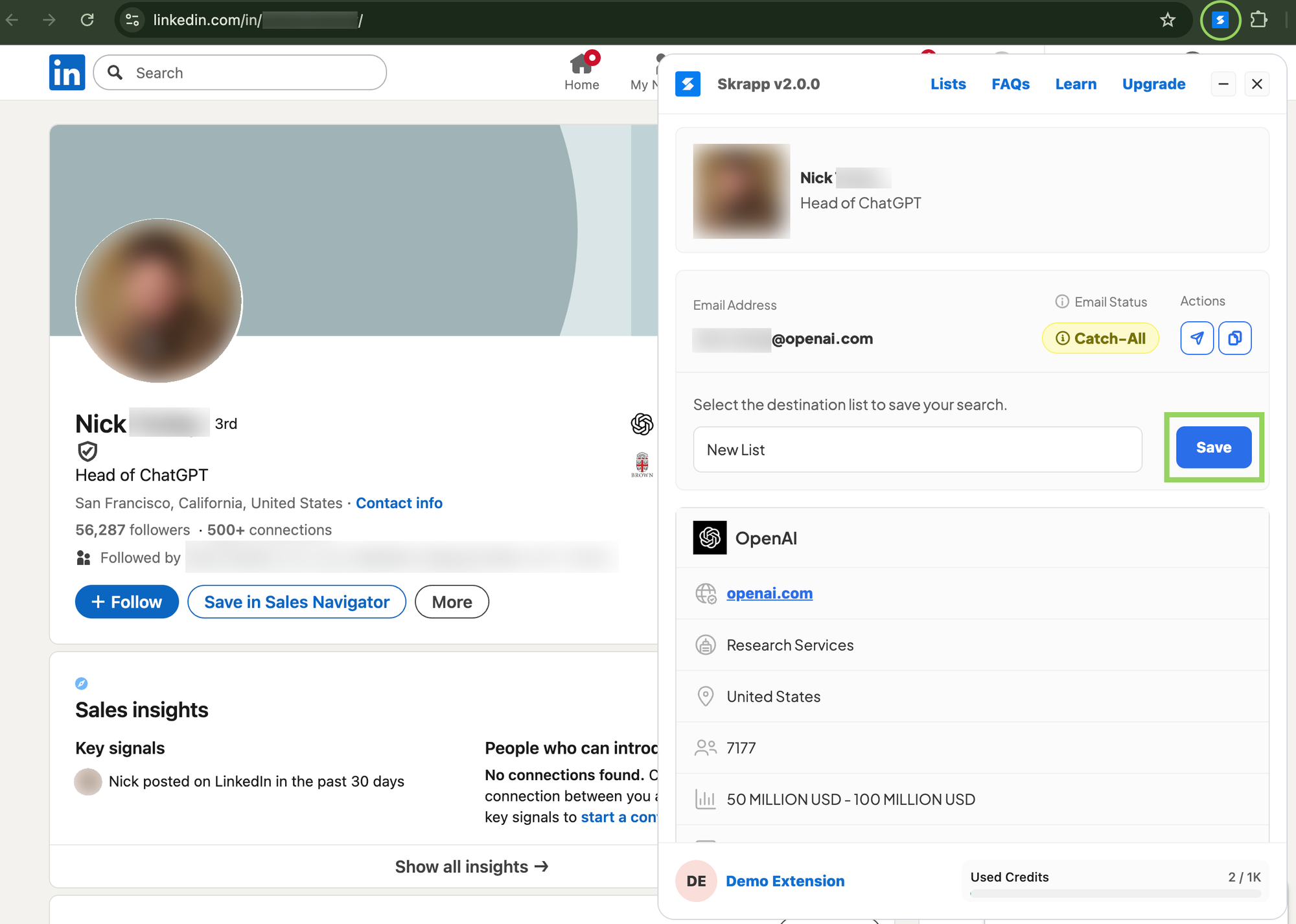
Skrapp's workflow is familiar if you've used any email finder: search by name + company, use the browser extension while you're browsing profiles and company sites, or upload a CSV and enrich in bulk. For a lot of small teams, that's enough.
One policy we like: credits only get deducted for valid or catch-all results. Plenty of tools still charge you for obvious junk, and that gets expensive fast.
Pricing is also easy to understand. The free tier (100 credits/month) is actually useful for a real test, not just a demo. And the Professional plan at $30/month for 1,000 credits is approachable if you're early-stage and just trying to get a sequence off the ground.
Now the part people gloss over: bounce risk.
The most common complaint in Skrapp reviews is accuracy. Not "it missed a few." More like "we sent volume and got burned." If you're sending 50 emails a day, you can sometimes brute-force your way through imperfect data. If you're sending 500 a day across multiple inboxes, a bad week can trash your domain reputation and force a painful warmup reset.
Here's a scenario we've seen play out: a small agency runs Skrapp-enriched lists through a sequencer, sees bounce rates creeping up, then starts adding a separate verification step. That helps, but now you're paying twice (finder + verifier), and you're still stuck with shallow enrichment because the tool's job is "find the email," not "build a full contact record."
If you just need emails and you're disciplined about verification, Skrapp can work. If you're trying to scale without babysitting deliverability, it's a tougher sell. (If you want benchmarks and fixes, see our guide to email bounce rate.)

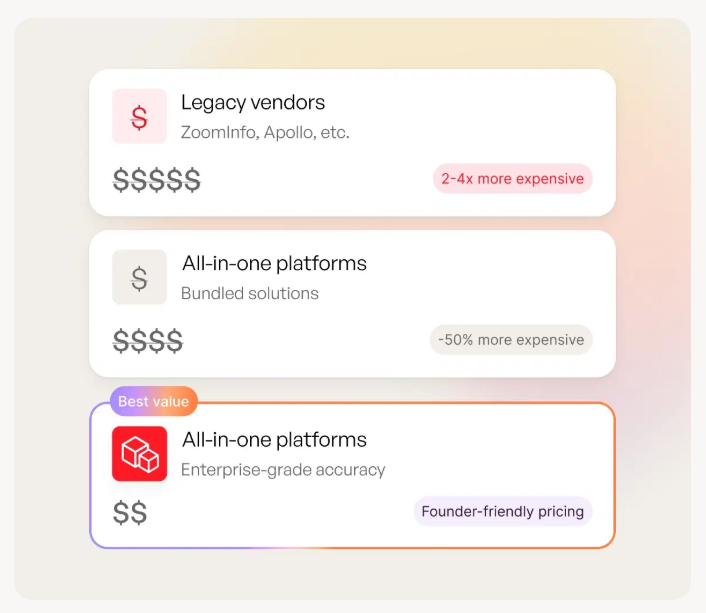
Paying for an email finder and then paying again for a separate verifier is a tax on bad data. Prospeo's proprietary 5-step verification delivers 98% email accuracy out of the box - no extra tools, no babysitting bounce rates. At ~$0.01 per email, you spend less than Skrapp and get richer data than SphereScout ever will.
Stop stacking tools. Get verified emails in one step.
SphereScout in practice
SphereScout is a list-buying tool for local businesses. You filter by industry and location, optionally layer in things like ratings or social presence, see the lead count up front, and export to CSV.
Look, this is the key mental model: you're not buying "verified decision-maker emails." You're buying "business listings." That often means a phone number, address, maybe a website, and sometimes a generic inbox like info@ or contact@. SphereScout itself points out that a meaningful chunk of local listings don't even have a website, which tells you what to expect before you spend a dollar.
The positioning is refreshingly straightforward. The founder has described it on Reddit as a Google Maps list tool for SMB-focused teams that don't want to pay enterprise database prices. That's exactly how it behaves in the real world.
Where it shines is volume. Need 15,000 restaurant contacts in Texas for a local SEO offer? The Starter plan is $49/month for 15,000 contacts, and you can pull that list in minutes. There's also a one-time purchase option (7-day access with unlimited usage rights), which is great if you only run local campaigns occasionally.
Where it gets risky is trust and workflow.
Five Trustpilot reviews isn't enough to feel confident about consistency across niches and cities. There's also no native CRM integration, so you're living in CSV land. And coverage is limited to the US and France, which is fine if that's your market and a non-starter if it isn't.
And just to say it out loud: a restaurant's info@ address isn't the same thing as the GM's email. If your offer needs a real decision-maker conversation, you'll spend time doing follow-up research anyway.

What it actually costs
| Skrapp Professional | SphereScout Starter | SphereScout Scale | |
|---|---|---|---|
| Monthly | $30 | $49 | $499 |
| Credits | 1,000 emails | 15,000 contacts | 500,000 contacts |
| Per 1,000 | $30.00 | $3.27 | $1.00 |
SphereScout looks wildly cheaper per 1,000. But it's not the same unit.
Skrapp's "1,000" is trying to be person-level B2B contact data. SphereScout's "1,000" is business listings, where a good chunk will be phone-first, and many emails will be generic inboxes. If you compare these as if they're interchangeable, you'll make the wrong call and blame the tool instead of the strategy.
Real talk: if your average deal is under $500 and you can close off a quick call with an owner, SphereScout-style lists can be plenty. The moment you're selling something that needs a director/VP-level buyer, generic listings won't get you there, and Skrapp's bounce risk becomes a deliverability problem, not just a data problem.
When we tell teams to skip both
If your actual need is verified B2B emails (and ideally mobiles) for professional outreach at scale, neither Skrapp nor SphereScout is the clean answer.
Skrapp can be fine for lightweight prospecting, but it frustrates teams once they push volume because accuracy isn't consistent enough to protect inbox health. SphereScout isn't trying to solve that problem at all; it's built for local business list building, not person-level prospecting.
If you're in that "we need accuracy, freshness, and we don't want to duct-tape three tools together" camp, tools like Prospeo are a better fit. Prospeo gives you 300M+ professional profiles, 143M+ verified emails, and 125M+ verified mobile numbers, refreshed every 7 days. Email accuracy is 98%, which is the difference between "our sequences land" and "why are we warming up domains again?"
It also helps that it's self-serve and built for workflows: 30+ filters (including buyer intent, technographics, and job changes), a Chrome extension, API access, and native integrations with Salesforce, HubSpot, Instantly, Lemlist, Clay, and Zapier. If you're doing outbound seriously, that stack compatibility matters more than people expect.
For deliverability best practices (the stuff that keeps you out of trouble regardless of tool), these are worth bookmarking:
- Google Postmaster Tools: https://postmaster.google.com/
- RFC 7489 (DMARC): https://www.rfc-editor.org/rfc/rfc7489
- RFC 7208 (SPF): https://www.rfc-editor.org/rfc/rfc7208
Neither Skrapp's shallow enrichment nor SphereScout's generic business listings give you what scaled outbound actually needs: verified decision-maker emails, direct dials, and 50+ data points per contact - refreshed every 7 days. Prospeo covers 300M+ profiles with 125M+ verified mobiles so you reach real buyers, not info@ inboxes.
Real decision-maker data, not business directory leftovers.
FAQ
Is SphereScout legit?
SphereScout is a real product with real users, but the public review footprint is thin: 4.1/5 from five Trustpilot reviews and a single G2 review. Feedback highlights responsive support and relevant leads. Treat it like any list source: run a small test pull, spot-check the data, and only then scale.
Does Skrapp verify emails?
Yes. Skrapp includes verification and only charges for valid or catch-all results. In practice, users still report bounce issues, so if domain reputation matters (it does), add a verification step or use a provider built around higher accuracy.
Can I use Skrapp and SphereScout together?
Yes, and it's a sensible combo for some teams. Use SphereScout to generate a company list by category and city, then use a people-focused tool to find specific decision-makers at those businesses. They feed different parts of the pipeline.
What's the best tool for verified B2B emails at scale?
Prospeo is the strongest option if accuracy and freshness are the priority: 300M+ profiles, 98% email accuracy, 125M+ verified mobiles, and a 7-day refresh cycle. It's also built for real workflows with enrichment, API access, and integrations into major CRMs and outbound tools.