

Slack's Go-to-Market Strategy: What Worked, What Didn't, and What You Should Steal
A RevOps lead we know calls Slack's trajectory "the most expensive lesson in SaaS history about the difference between winning users and winning purchase orders." That's harsh, but it's not wrong. Slack's go-to-market strategy took a failed video game's internal chat tool to a $27.7B Salesforce acquisition - and still couldn't outrun a bundled competitor with worse UX. That tension is the whole story.
The Short Version
The core of Slack's GTM: position against a pain ("email is broken"), not a competitor. Design a freemium tier where the upgrade trigger maps to core value. Let users sell the product internally. It worked until Microsoft bundled Teams into Office 365 and Slack lost the procurement fight. Below is the full arc with numbers, and five lessons you can apply today.
Timing and Positioning
Stewart Butterfield had already built and sold Flickr. He knew how to get press. When Slack launched, the positioning wasn't "better chat app" - it was "email is the enemy." That framing gave journalists a story and gave users a villain.
Internally, the team operated under what Butterfield described as "competitor aware, customer obsessed." They studied every messaging tool on the market but optimized for user delight, and the positioning worked because it named a universal pain without picking a fight with any specific product.
The Preview Release
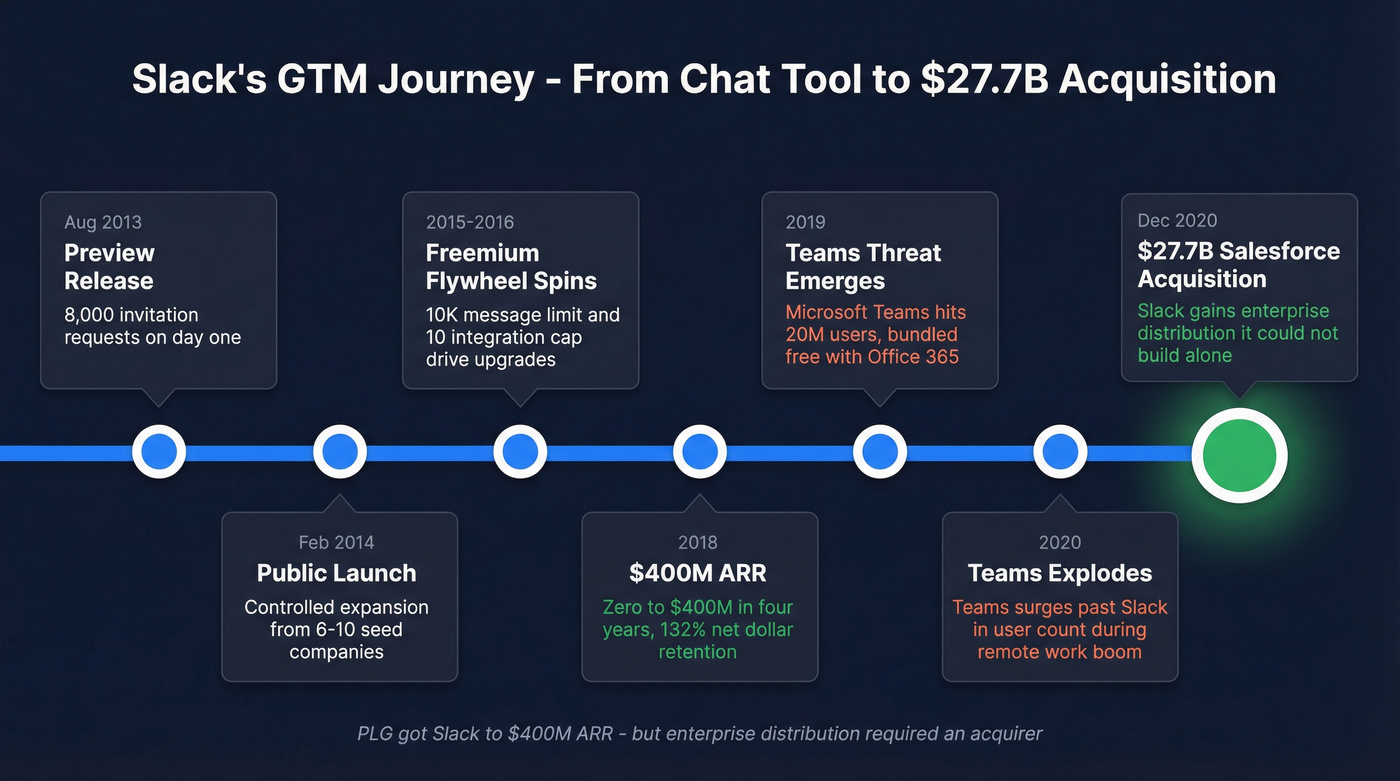
In August 2013, Slack launched what Butterfield called a "preview release" - not a beta. "Beta" signals broken software. "Preview" signals exclusivity. Day one: 8,000 invitation requests.
For more than six months, Slack ran a controlled expansion, starting with 6-10 companies Butterfield recruited through friends. Slack leaned heavily on earned press and the founders' prior media relationships from the Flickr days - coverage most startups spend years chasing. That head start mattered.

Slack's preview release worked because Butterfield had warm connections to seed companies. Most founders don't. Prospeo's database of 300M+ profiles with 30+ filters - including buyer intent, technographics, and headcount growth - lets you build targeted prospect lists for your GTM launch without relying on personal networks.
Find your first 1,000 prospects in minutes, not months.
How the Freemium Engine Drove Adoption
Here's where the GTM gets brilliant.
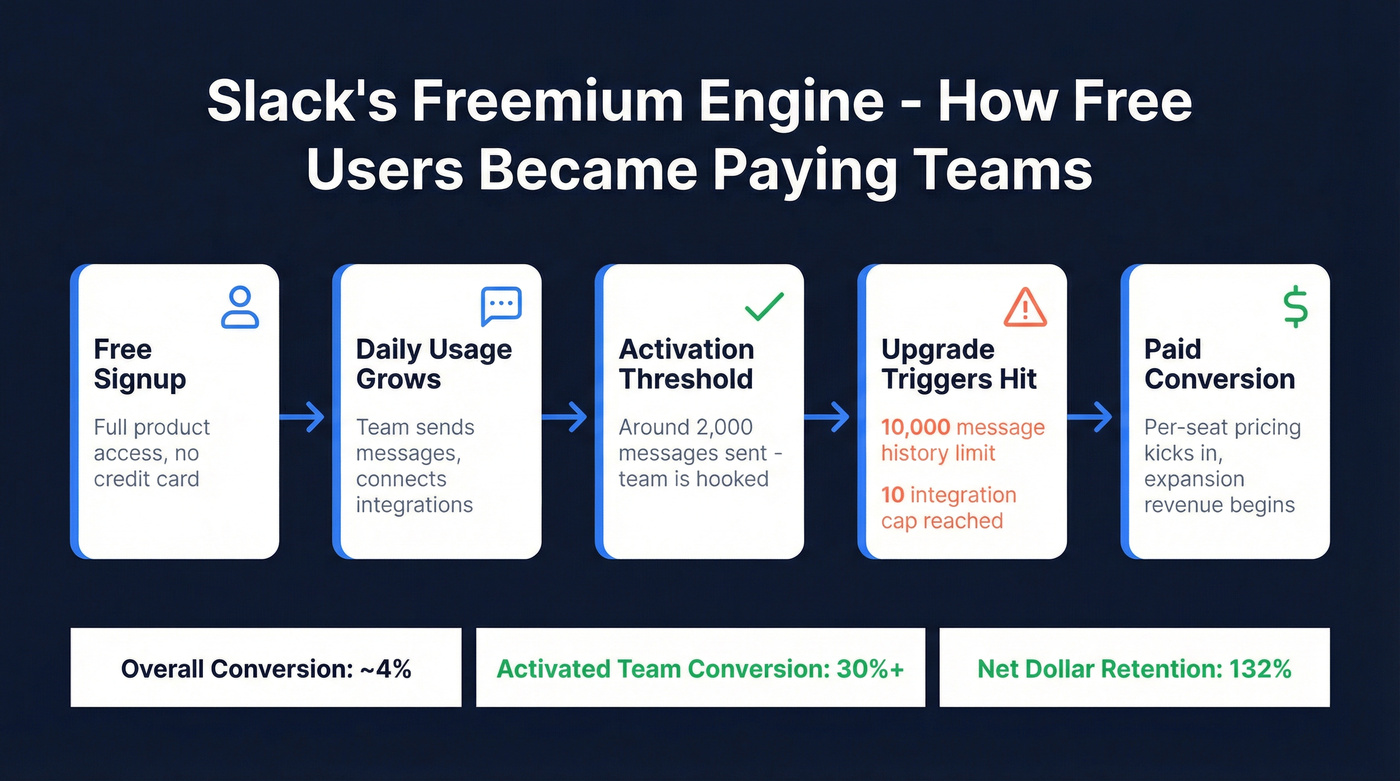
The free tier wasn't a crippled product - it was the full product with a time bomb. The 10,000-message history limit meant most active teams hit the wall within 3-6 months. By then, the team's entire communication history lived in Slack. Paying to keep it searchable was an easy yes. The secondary trigger was a 10-integration cap. Power users who connected Slack to GitHub, Jira, and Google Drive hit this limit fast and became internal champions for the upgrade.
Slack also tracked an activation metric that became legendary in PLG circles: hitting around 2,000 messages sent was a strong signal a team was "really using" the product. Overall freemium-to-paid conversion ran around 4% - well above the ~1-2% many SaaS teams expect from freemium. But among activated teams (the ones that truly adopted Slack into daily work), conversion could climb past 30%. That gap is why "conversion rate" without a funnel definition is meaningless.
Per-seat pricing created automatic expansion revenue. Slack went from $0 to $400M ARR in four years, with net dollar retention hitting 132% by 2020 - existing customers spending 32% more each year as usage expanded across departments.
The Enterprise Gap
Slack didn't lose to a better product. Slack lost to a purchase order.
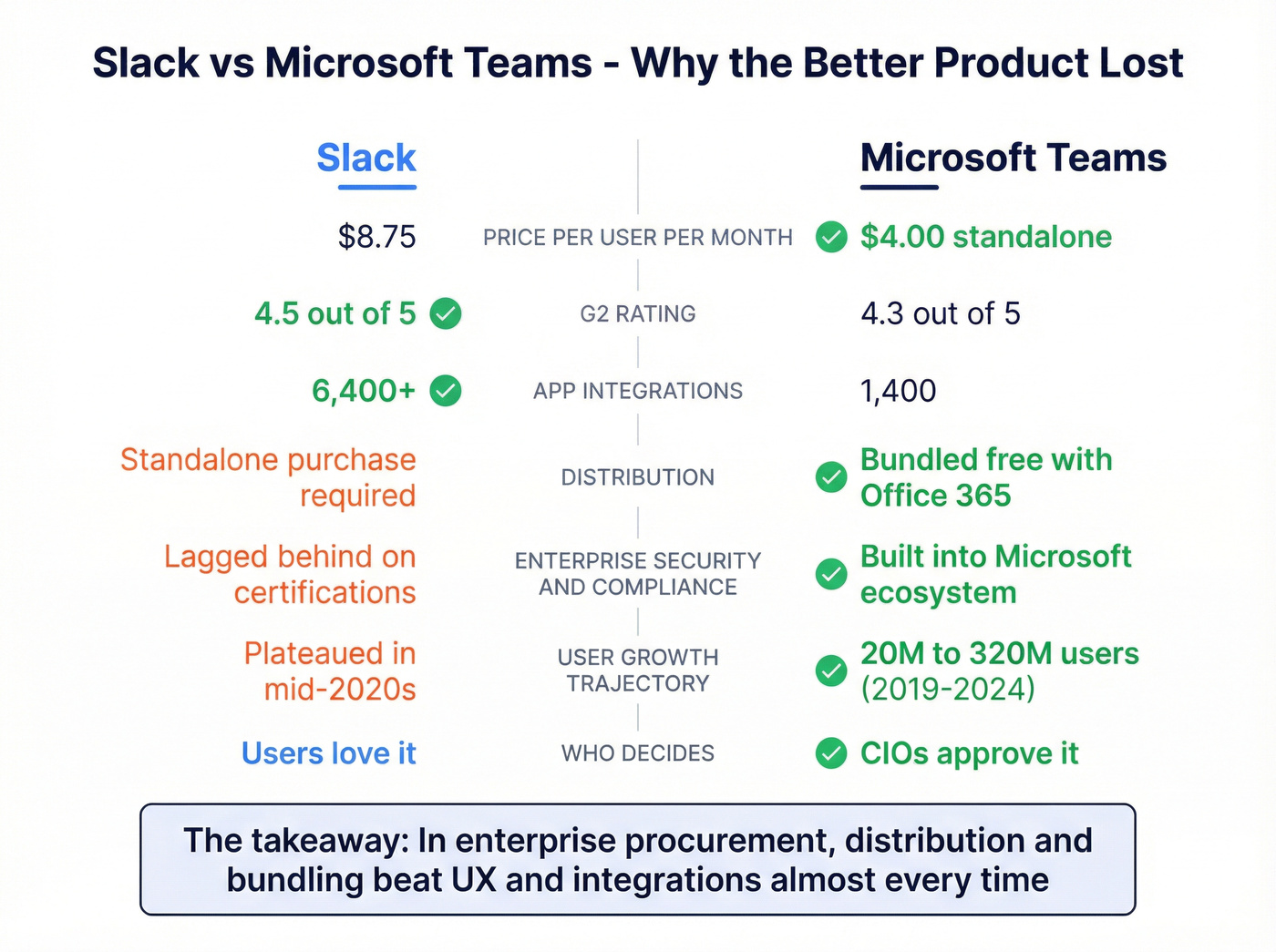
Microsoft bundled Teams into Office 365, making it effectively free for any company already paying for Microsoft's suite. The consensus on r/SaaS is blunt: Slack under-invested in the "boring stuff" - security certifications, compliance controls, admin tooling - that enterprise procurement actually cares about. Teams went from 20M users in 2019 to 320M by 2024. Slack still has tens of millions of monthly users, but the growth trajectory tells the story.
On G2, Slack rates higher than Teams (4.5/5 vs 4.3/5). Users love it. CIOs don't care.
| Slack Pro | Teams / M365 Business Standard | |
|---|---|---|
| Price/user/mo | $8.75 | $4.00 standalone / $12.50 bundled |
| G2 Rating | 4.5/5 | 4.3/5 |
| App Integrations | 6,400+ | 1,400 |
Slack wins on UX, integrations, and satisfaction. Teams wins on price, distribution, and the CIO's path of least resistance. In enterprise procurement, the second list beats the first almost every time.
The $27.7B Endgame
PLG isn't just a growth strategy - it's an acquisition strategy. Salesforce acquired Slack in December 2020 for $27.7B. Salesforce needed a communication layer; Slack gained enterprise distribution it couldn't build alone. We've seen this pattern repeat: teams that nail PLG acquisition but skip enterprise readiness end up selling to someone who has it.
Five GTM Lessons for 2026
In 2026, most B2B SaaS companies run hybrid GTM - PLG for acquisition under $10K ACV, sales-assisted expansion above $25K. The benchmark: $2 in sales and marketing for every $1 of new ARR, with CAC payback under 12 months. Slack proved the first half of that equation; the Salesforce acquisition proved they needed the second.
Here's what to steal:
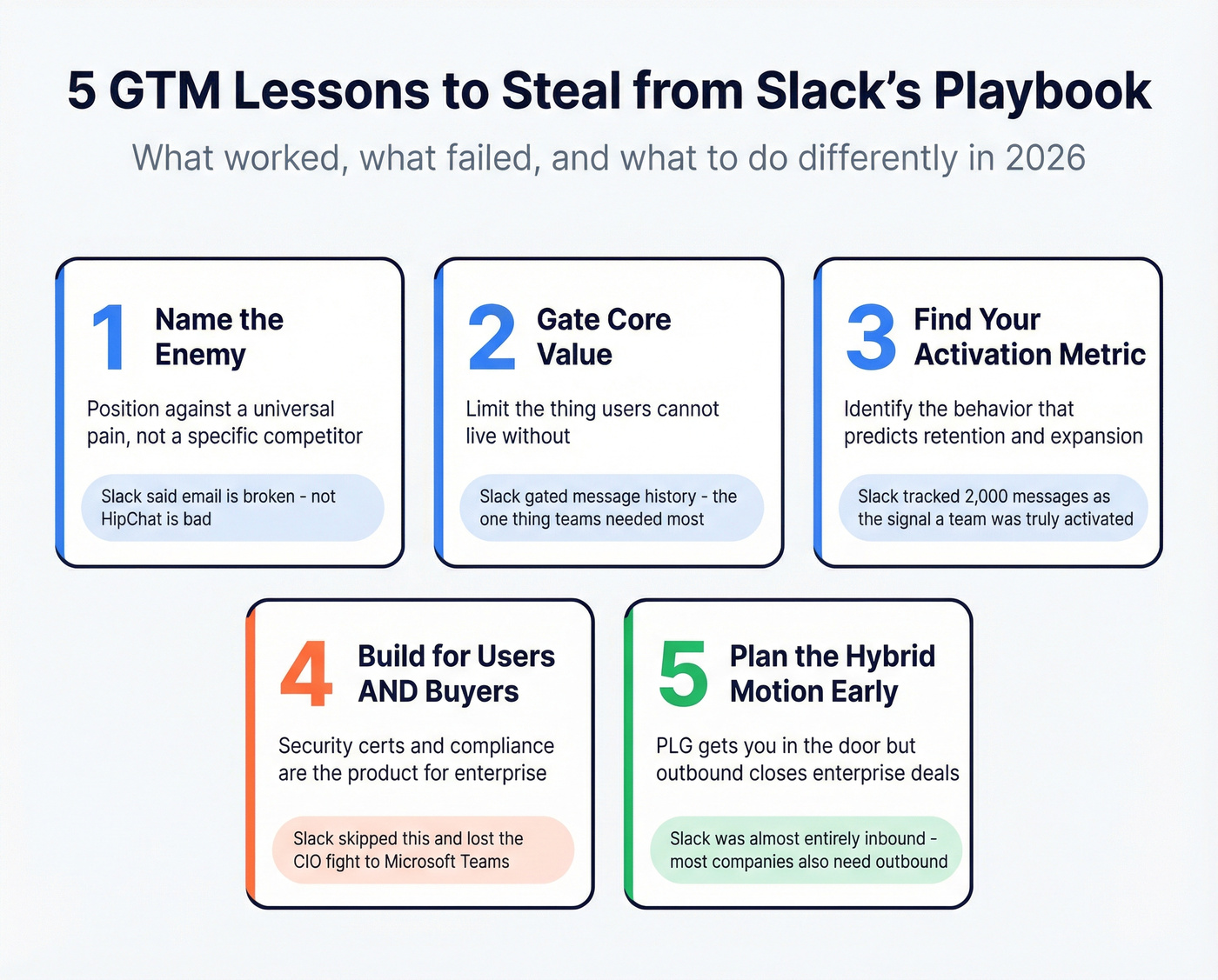
1. Name the enemy. Position against a pain, not a competitor who can pivot or die. "Email is broken" outlasted every specific chat tool Slack could've targeted.
2. Gate core value, not random features. Slack limited message history - the thing users couldn't live without. Too many SaaS companies gate the wrong stuff (seat counts, cosmetic features) and wonder why nobody upgrades.
3. Find your "2,000 messages." Every SaaS product has an activation metric that predicts retention and expansion. Find yours and build onboarding around reaching it. If you don't know what yours is yet, look at the behavior of your best cohort at day 14 and work backward.
4. Build for users, but don't ignore buyers. If you're selling into companies with IT governance, security reviews and compliance certifications aren't optional - they're the product. In our experience, teams that treat procurement readiness as a post-Series B problem are already too late. Skip this if you're purely SMB, but the moment you chase $50K+ deals, this becomes your top priority.
5. PLG gets you in the door - plan the hybrid motion early. Slack's approach was almost entirely inbound and product-led. Most companies also need outbound for upmarket expansion, and outbound lives or dies on data accuracy. Prospeo finds verified emails at 98% accuracy with a free tier - a practical starting point for founders layering outbound onto a PLG foundation.
Let's be honest: if your average deal size is under $10K, you probably don't need a 50-person sales team. You need a product good enough that users drag it into their company, and data accurate enough that your small outbound team doesn't waste cycles on bounced emails.
Lesson #5 hit a nerve for a reason: PLG gets you in the door, but outbound closes the enterprise gap. The gap that cost Slack its independence. When you layer outbound onto your product-led motion, bounced emails kill momentum and domain reputation. Prospeo delivers 98% email accuracy with 7-day data refresh - so your small outbound team connects with real buyers, not dead inboxes.
Don't let bad data turn your hybrid GTM into an expensive bounce log.
FAQ
What was Slack's go-to-market strategy?
A controlled preview release in August 2013, "email is the enemy" positioning, and a freemium model with a 10,000-message history limit as the upgrade trigger. Bottom-up adoption with per-seat expansion revenue took Slack from $0 to $400M ARR in four years.
Why did Salesforce acquire Slack for $27.7B?
Salesforce needed a real-time communication layer to compete with Microsoft's bundled Office 365 + Teams suite. The December 2020 deal gave Slack enterprise distribution it couldn't build alone, while Salesforce got a PLG product with tens of millions of active users.
How do you add outbound to a product-led GTM motion?
Start with accurate contact data and a sequencing tool. Pair a platform like Prospeo (98% email accuracy, 75 free credits/month) with a sequencer like Instantly or Lemlist, and you've got a functional outbound stack for under $200/month - enough to test upmarket expansion without a full sales org.