

Smarketing: Why 92% of Companies Get It Wrong (and How to Fix It)
Your SDR manager pulls up last quarter's numbers. Marketing delivered 2,000 MQLs - target hit, high-fives all around. Sales closed 12 deals. The CEO asks where the other 1,988 went, and nobody has an answer.
This is the smarketing problem in one scene: two teams, two scorecards, zero shared accountability. Then someone digs into the lead data and discovers half the emails bounced. Marketing was feeding sales a list of ghosts.
This isn't a communication problem. It's a structural one. Misalignment between sales and marketing costs companies $1 trillion per year, and only 8% of companies have achieved strong alignment. The other 92% are running two departments with different goals, different data, and different definitions of what a "good lead" even means. Most guides tell you to "communicate better." That's like telling someone with a broken leg to walk better. Let's fix the architecture instead.
Short on Time? Here's the Three-Step Version
- Run the diagnostic. Use the 5-sign checklist below to confirm your alignment is actually broken (it probably is).
- Build the SLA. Skip to the SLA template section and fill it out with both teams in the same room. No template, no alignment.
- Lock in the tech stack. You need three things: a shared CRM, a communication channel, and a data verification layer to enforce the SLA automatically.
Now let's get into the details.
What Is Smarketing?
The term started as a HubSpot buzzword in the early 2000s - a portmanteau of sales and marketing. The idea was simple: align both teams around shared revenue goals instead of letting them operate as separate kingdoms with separate budgets and separate metrics. At its core, sales-marketing alignment means treating revenue as a joint outcome rather than a departmental metric.
The concept has evolved considerably since then. What started as "get sales and marketing to talk to each other" has matured into a rigorous operating discipline. Salesforce emphasizes an Operating Level Agreement (OLA) - a formal internal commitment between teams that establishes accountability, handoff criteria, and shared metrics. RevOps takes it further, extending alignment across sales, marketing, and customer success with unified data and processes. The modern version maps the full revenue model in CRM, from first touch through closed-won to retention, so every team sees the same customer journey.
Here's the distinction worth remembering: smarketing is the philosophy. RevOps is the operating model that makes the philosophy enforceable.
Consider a concrete example from Salesforce's framework: a medical software company targeting hospital managers at 200+ employee hospitals. Marketing identifies the ICP, runs campaigns against that segment, and scores leads based on engagement and fit. When a hospital manager at a 300-bed facility requests a demo, the handoff to sales includes the contact's engagement history, company data, and the specific content they consumed. Sales picks up the conversation where marketing left off - no cold start, no re-qualification. That's alignment working end-to-end.
Why Alignment Matters
The business case isn't subtle. An Influ2 study of 105 companies found that 53% had broken handoffs - meaning sales followed up with fewer than 35% of marketing-engaged prospects. Only 11% were fully aligned on both handoff execution and audience targeting.
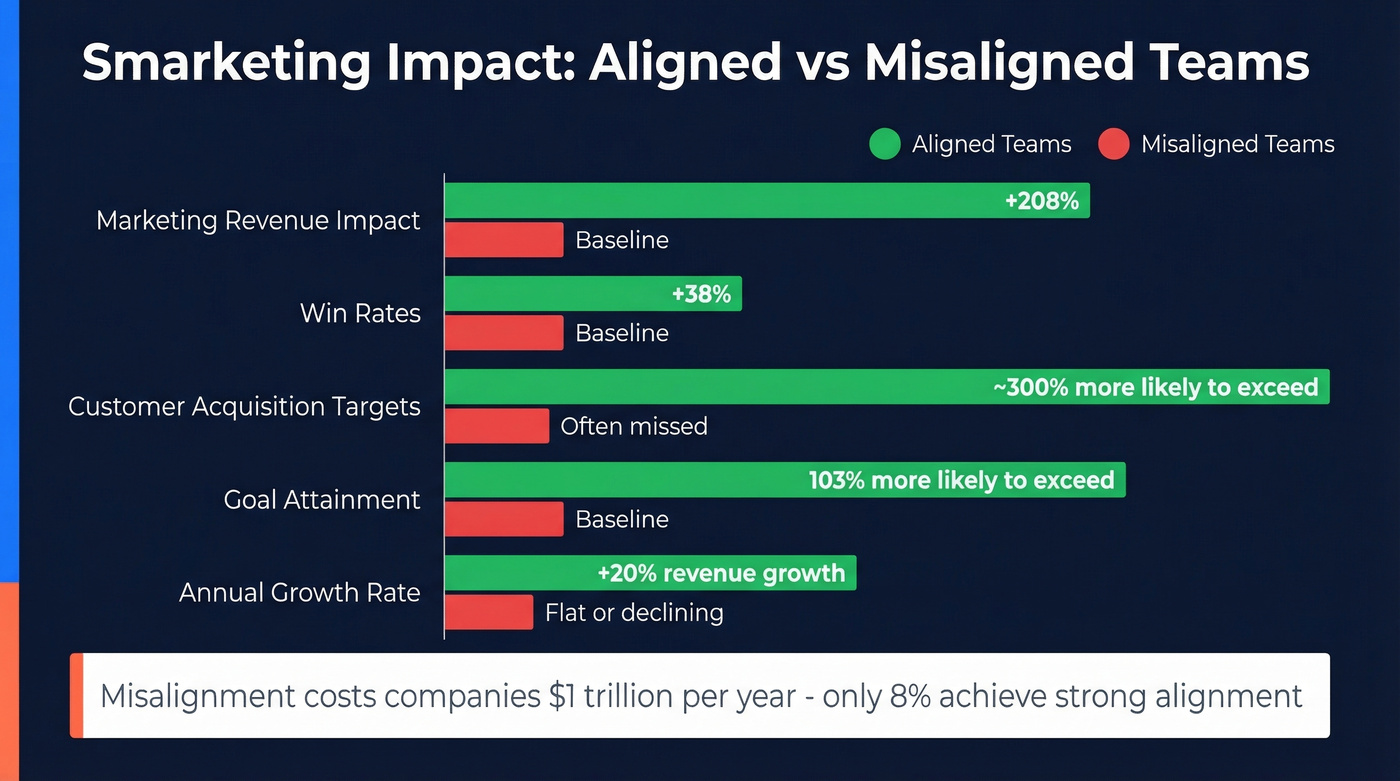
The gap between aligned and misaligned organizations shows up everywhere:
| Metric | Aligned Teams | Misaligned Teams |
|---|---|---|
| Marketing revenue impact | 208% higher | Baseline |
| Win rates | 38% higher | Baseline |
| Customer acquisition targets | ~300% more likely to exceed | Often missed |
| Goal attainment | 103% more likely to exceed | Baseline |
| Annual growth rate | 20% revenue growth | Flat or declining |
The ~300% stat on customer acquisition targets is the one that should get your CFO's attention. These aren't marginal improvements. Aligned companies grow faster, close more, and retain better. Misaligned companies don't just stagnate - they actively lose revenue, with some studies showing a 4% revenue decline that compounds every quarter you ignore it.
Here's our hot take: most companies don't actually have a demand gen problem or a closing problem. They have an alignment problem wearing a demand gen costume. Fix the handoff, and you'll be shocked how much pipeline was already there.
5 Signs Your Alignment Is Broken
Before you build a playbook, you need to diagnose the problem. Here are five symptoms that show up in almost every misaligned organization:
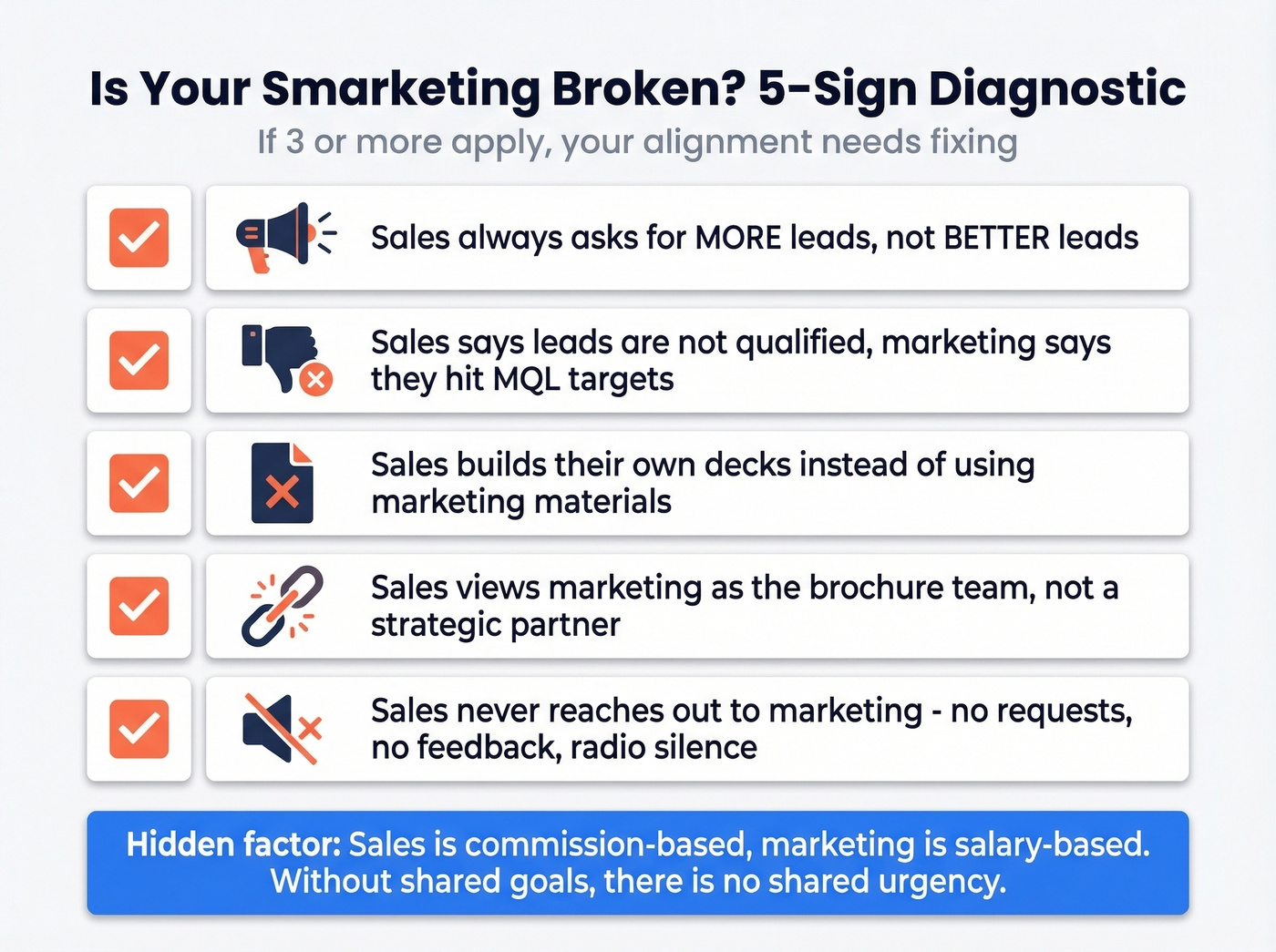
- Sales always asks for more leads. Not better leads - just more. This means they've given up on quality and are trying to brute-force volume.
- Sales says leads aren't qualified. Marketing hit their MQL number. Sales says the leads are garbage. Both teams are technically right, which is the whole problem.
- Sales doesn't use marketing materials. If reps are building their own decks and one-pagers, marketing's content isn't landing. That's a signal, not a personality conflict.
- Sales doesn't value marketing expertise. When sales views marketing as "the people who make brochures," you've lost the strategic partnership entirely.
- Sales never reaches out to marketing. No requests for case studies, no feedback on messaging, no collaboration on accounts. Radio silence.
There's also a structural dynamic most people miss: sales is typically commission-based, marketing is salary-based. Without shared goals, there's no shared urgency.
If three or more of these sound familiar, your alignment is broken. The playbook below is for you.

Bad data is the silent killer of smarketing. Marketing hits their MQL target, sales calls the list, and 35% of emails bounce. Prospeo delivers 98% verified email accuracy on a 7-day refresh cycle - so when marketing hands off leads, sales actually reaches real buyers.
Stop feeding your sales team a list of ghosts.
5 Mistakes That Kill Alignment
Knowing you're misaligned is step one. Understanding why is step two.
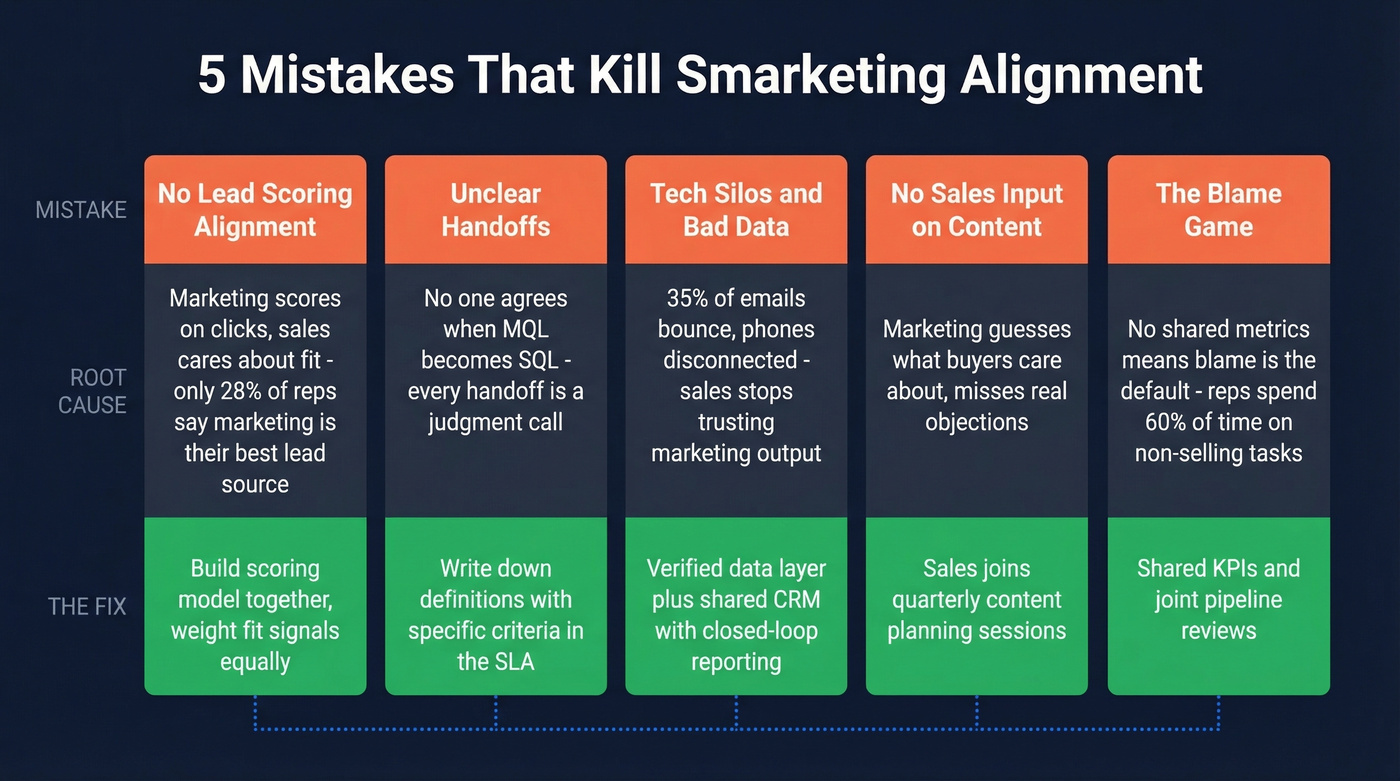
No Lead Scoring Alignment
Marketing builds a scoring model. Sales ignores it because the "hot" leads are cold. The root cause: marketing scores on engagement like downloads and page views, while sales cares about fit - title, company size, budget authority. As the B2B Playbook puts it: "A click is not intent. Downloading a PDF is not intent." When only 28% of salespeople say marketing is their best lead source, the scoring model is the first place to look.
The fix: Build the scoring model together. Weight fit signals like ICP match, company size, and tech stack at least as heavily as engagement signals. Review and recalibrate quarterly.
Unclear Handoffs
Nobody agrees on when a lead becomes an MQL, when an MQL becomes an SQL, or what happens to leads that fall between the cracks. Without codified definitions, every handoff is a judgment call - and judgment calls create blame.
The fix: Write down the definitions. Literally. MQL = meets these criteria. SQL = meets these criteria plus these behaviors. Put it in the SLA.
Tech Silos and Bad Data
Bad contact data silently breaks the handoff. Marketing hands off 500 leads. Sales calls and emails them. 35% of the emails bounce. Phone numbers are disconnected. Sales stops trusting marketing's output - not because the targeting was wrong, but because the data was rotten.
Tech silos compound the problem by preventing closed-loop reporting: when marketing can't see what happened to their leads after handoff, they can't improve targeting or scoring. The fix isn't just better communication. It's verified data and connected systems. When your enrichment layer catches bad data before the handoff, you eliminate a major source of cross-team distrust. And when both teams share a single CRM with closed-loop reporting, the feedback cycle becomes automatic - removing the human error that causes most breakdowns.
No Sales Involvement in Content
Marketing makes assumptions about what buyers care about. Sales holds the actual insights from hundreds of conversations. When marketing creates content in a vacuum, it misses the objections, language, and pain points that close deals. The top ask from sales reps on r/sales? "Listen to more calls that close."
The fix: Sales joins the content planning meeting. Not every meeting - but the quarterly planning session where themes and priorities get set.
The Blame Game
Marketing blames sales for not following up. Sales blames marketing for bad leads. Leadership lets it fester.
This is a culture problem, but it's also a measurement problem. When neither team owns shared metrics, blame is the default. And here's the kicker: sales reps spend 60% of their time on non-selling tasks like manual data entry and lead research. When sales is drowning in admin work, they don't have time to follow up properly - and marketing takes the blame for "bad leads" that were never actually worked.
The fix: Shared KPIs and joint pipeline reviews. When both teams own the same number, finger-pointing becomes problem-solving.
The Alignment Playbook: 8 Steps
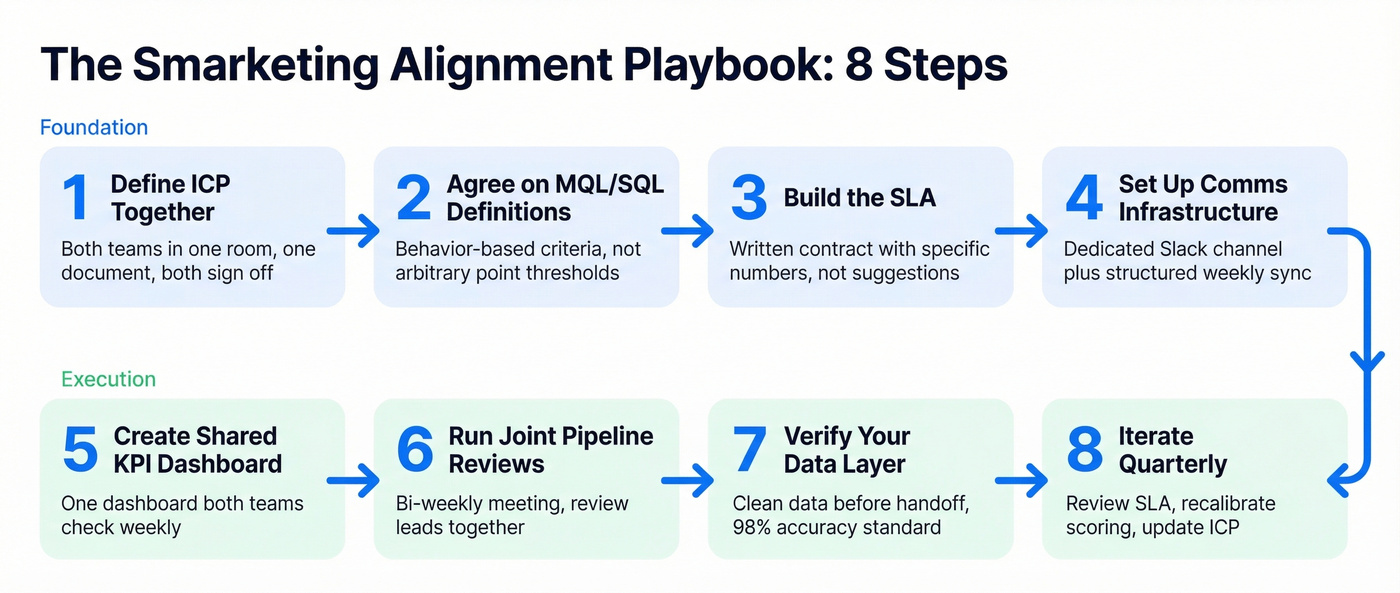
Alignment isn't a one-time project. It's an operating rhythm. These eight steps build the infrastructure that makes your smarketing strategy sustainable.
1. Define ICP Together
Get both teams in a room. Define the firmographic, technographic, and behavioral criteria that make a company a good fit. One document, both teams sign off. As the B2B Playbook warns: "Most organisations don't really have clarity around their ICP... They give lip service to it, but they don't actually execute against it." If sales and marketing can't agree on who they're targeting, nothing else matters.
2. Agree on MQL/SQL Definitions
Write down specific, behavior-based criteria for each stage. "Downloaded a whitepaper" isn't an MQL. "Visited the pricing page twice, matches ICP, and requested a demo" is closer. The shift from point-based scoring to behavior-based handoffs is the modern standard - pricing page visits and mid-funnel engagement signals are more predictive than arbitrary point thresholds.
3. Build the SLA
This is the contract. Skip to the SLA template section below and fill it in. If your SLA isn't written down with specific numbers, you don't have an SLA. You have a suggestion.
4. Set Up Communication Infrastructure
A dedicated Slack channel for sales-marketing communication is non-negotiable. Pair it with a weekly sync meeting - but give it a structured agenda. Without an agenda and psychological safety, these meetings become status updates that nobody values.
Anti-pattern to avoid: Don't create a Slack channel and call it done. We've seen teams launch #smarketing channels that go dead within two weeks because nobody assigned ownership. Appoint a channel owner from each team who's responsible for posting weekly wins, flagging handoff issues, and keeping the conversation alive.
5. Create a Shared KPI Dashboard
Pick a tool - Monday.com, Looker, even a shared Google Sheet - and build a dashboard both teams check weekly. The five KPIs that force alignment: lead-to-opportunity conversion, speed-to-lead, MQL-to-SQL rate, pipeline velocity, and CAC. When both teams stare at the same numbers, accountability becomes automatic.
6. Implement Behavior-Based Handoffs
Stop handing off leads based on point scores. Instead, trigger handoffs based on buying behavior: pricing page visits, demo requests, case study downloads combined with ICP fit. These signals are harder to game and more predictive of actual purchase intent.
Configure your CRM to automate the handoff when criteria are met. AI-powered predictive scoring is the next evolution here - tools like Salesforce Einstein and HubSpot's predictive lead scoring can surface buying signals that manual scoring models miss, especially when trained on your closed-won data.
7. Co-Create Content
Marketing writes the narrative. Sales personalizes it for specific accounts. This isn't optional - it's how you build content that actually moves pipeline.
The easiest starting point is case studies. Marketing interviews the customer, writes the story, and sales tailors the distribution for target accounts in the same industry.
8. Build a Feedback Loop
Every rejected lead gets a reason code. Every disqualified opportunity gets tagged with why. This feedback loop is the mechanism that makes the entire system self-correcting. Without it, marketing keeps sending the same bad leads and sales keeps rejecting them. With it, both teams learn and improve every cycle.
The SLA Template
Most SLA templates are too vague to enforce. "Marketing will deliver qualified leads" means nothing. Here's a template with actual numbers you can customize.
| Marketing Commits | Sales Commits | Success Commits |
|---|---|---|
| Deliver X qualified leads/mo | Respond within 4 hours | Onboard within 48 hours |
| Handoff within 24 hours | 5 follow-ups in 7 days | Track engagement weekly |
| Include: contact, history, score | Convert, recycle, or disqualify | Escalate churn risk |
| Refresh ICP criteria quarterly | Return rejected leads w/ reason | Report churn reasons upstream |
Shared metrics both teams review weekly: % leads accepted by sales, average response time, lead-to-opportunity conversion rate, onboarding time, and renewal rate.
Salesforce emphasizes an Operating Level Agreement as the internal alignment contract, and the distinction matters. An SLA implies one team serves another. An OLA implies mutual accountability. Use whichever term your organization prefers, but the structure is the same: specific numbers, specific timelines, specific consequences.
Fill this template out in a room with both team leads and walk out with signed commitments. You'll have done more for alignment in one hour than most companies do in a year. A few tips for teams just getting started: begin with one shared metric before adding complexity, assign a single owner for the SLA review cadence, and revisit definitions every quarter as your market evolves.
The Tech Stack
We've seen teams overcomplicate this. You need three tools that actually matter: a shared CRM, a communication channel, and a data verification layer. Everything else is optional until you've nailed those three.
| Category | Tool | Price Range | Role in Alignment |
|---|---|---|---|
| CRM | Salesforce, HubSpot | ~$25-$300/user/mo | Single source of truth |
| Marketing Automation | HubSpot, Marketo | ~$800-$5,000+/mo | Scoring + nurture |
| Communication | Slack | Free-~$15/user/mo | Real-time feedback loop |
| Revenue Intelligence | Gong, Clari | ~$20K-$100K+/yr | Deal visibility |
| Intent Data | Bombora (standalone) | $25K-$50K+/yr | In-market buyer signals |

Your CRM is only as good as the data inside it. If you're handing off leads with bouncing emails and disconnected phone numbers, no amount of process improvement will save you. Prospeo maintains 300M+ professional profiles on a 7-day refresh cycle, with 98% email accuracy and 125M+ verified mobile numbers - so marketing can hand off leads that sales actually trusts. It also includes Bombora-powered intent data tracking 15,000 topics, letting both teams prioritize accounts showing buying signals right now without paying standalone Bombora pricing.
The proof point: Snyk's outbound team of 50 AEs saw their bounce rate drop from 35-40% to under 5% after switching their enrichment layer. AE-sourced pipeline went up 180%, generating 200+ new opportunities per month. That's what happens when sales stops fighting bad data and starts selling.
KPIs to Track
These are the metrics that force alignment because both teams own the outcome. Track them weekly, review them in your joint sync, and hold each other accountable.
| KPI | Formula | Benchmark | Owner |
|---|---|---|---|
| Lead-to-Opp Conversion | Opps created / leads received | 13-25% | Both |
| Speed-to-Lead | Time from handoff to first touch | Under 5 minutes (inbound) | Sales |
| MQL-to-SQL Rate | SQLs / MQLs | 30-45% | Both |
| Pipeline Velocity | Opps x deal size x win rate / cycle length | Track trend | Both |
| CAC | Total S+M spend / new customers | Varies by industry | Both |
Companies that track shared KPIs between sales and marketing are 103% more likely to exceed their goals. Not because the metrics are magic - because shared measurement eliminates the blame game.
One more metric worth tracking that doesn't make most lists: sales cycle length. You're not optimizing for an absolute number. You're watching the trend. If cycles are getting longer after you implement alignment processes, something in the handoff or qualification process is broken. Dig into the reason codes from your closed-loop reporting to find the bottleneck.
If you want to tighten execution fast, standardize your sales follow-ups and document your lead status rules so both teams interpret pipeline the same way.
Your SLA is only as strong as the data enforcing it. Prospeo's CRM enrichment returns 50+ data points per contact at a 92% match rate - giving both teams the ICP fit signals, verified emails, and direct dials they need to make handoffs stick.
Align sales and marketing on data they both trust.
FAQ
What is smarketing?
Smarketing is the practice of aligning sales and marketing teams around shared revenue goals, unified data, and mutual accountability. Rather than operating as separate departments with separate scorecards, both teams work from the same definitions, metrics, and customer journey - turning finger-pointing into joint problem-solving.
What's the difference between smarketing and RevOps?
Smarketing aligns sales and marketing around shared revenue goals. RevOps extends that alignment across sales, marketing, and customer success with unified data, processes, and technology. Think of the first as the philosophy and RevOps as the operating system that enforces it.
Who should own the alignment process?
A RevOps leader or CRO is ideal because they sit above both functions. In smaller companies, the VP of Sales and VP of Marketing co-own it with a written SLA and shared dashboard. The worst option - and the most common - is nobody.
How long does it take to see results?
Most teams see improvement in lead acceptance rates and speed-to-lead within 30-60 days of implementing an SLA. Pipeline impact typically shows within one full sales cycle - roughly 60-120 days for most B2B companies.
How does data quality affect alignment?
Bad contact data is the number-one silent killer of sales-marketing alignment. When 35% of emails bounce, sales loses trust in marketing's output regardless of how good the targeting was. Verifying emails and phone numbers before the handoff - using tools like Prospeo at 98% accuracy - ensures both teams work from the same reliable information. That's the foundation everything else is built on.