

How to Build a Software Sales Strategy That Actually Hits the Number
It's day 45 of a deal you forecasted to close this quarter. The champion went quiet, procurement hasn't started, and the CFO just asked for a "business case refresh." Every leader trying to build a software sales strategy that survives 2026 has lived this moment. Sales cycles have lengthened 32% since 2021, the end of ZIRP rewrote the rules, and smaller teams are expected to produce more with less.
As one r/SaaS thread put it, the 2026 playbook looks nothing like 2021: "raise what you need, win niche first, hire behind revenue." Efficiency or extinction - that's the choice now.
Three Levers to Fix First
Before you touch your deck or your tech stack, nail these:
- Account coverage discipline. Dynamic books of 100-300 accounts per rep, refreshed every 30-60 days. Not static territory lists based on zip codes.
- Signal-led outbound. Replace volume plays with intent signals, job changes, and funding triggers. Fewer touches, higher conversion.
- MEDDPICC rigor for any deal over ~$25K ACV. Qualification isn't optional when cycles stretch past 90 days.
Get these right and everything downstream - sequences, demos, pricing conversations - gets easier.
Choose Your Motion by ACV
Your average contract value dictates your go-to-market motion. Running a PLG playbook on $50K enterprise deals is the fastest way to burn cash.
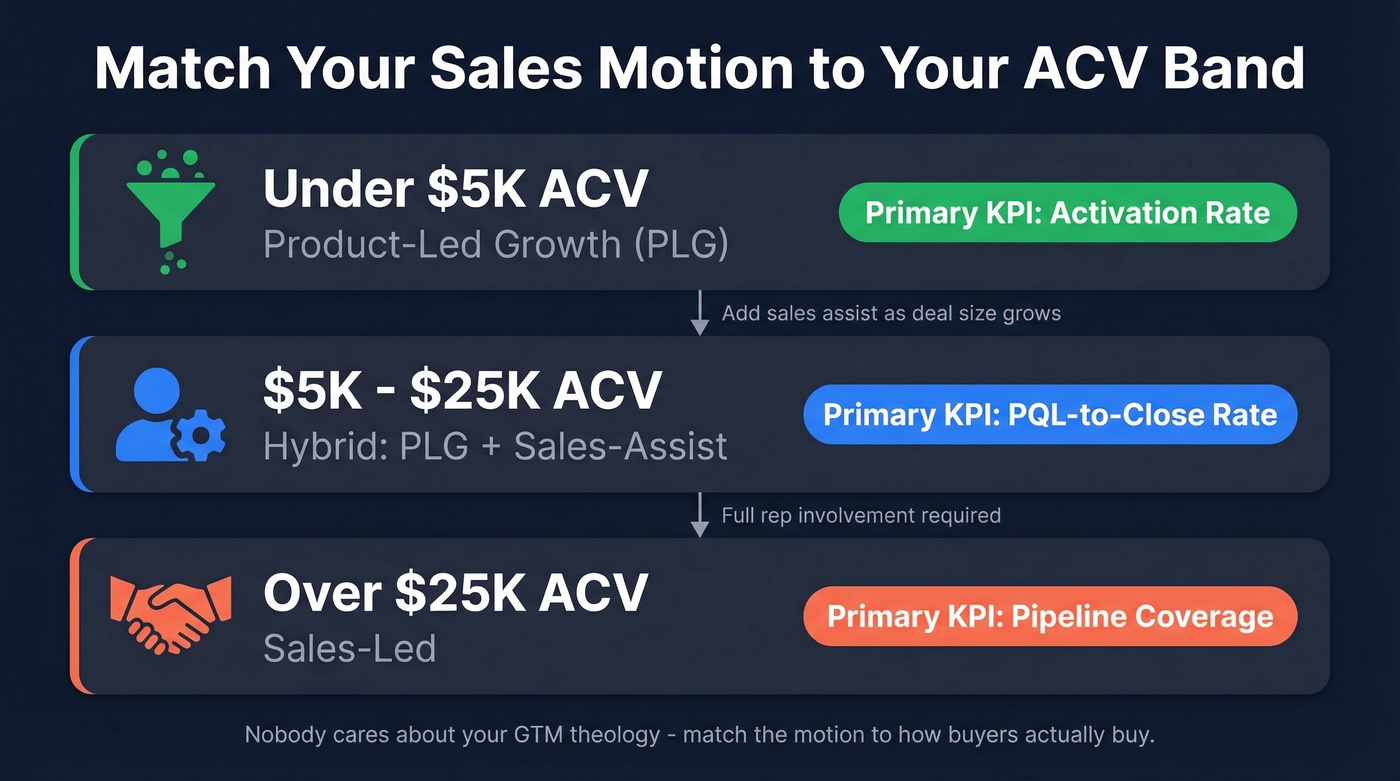
| ACV Band | Motion | Primary KPI |
|---|---|---|
| < $5K | Product-led (PLG) | Activation rate |
| $5K-$25K | Hybrid (PLG + sales-assist) | PQL-to-close rate |
| > $25K | Sales-led | Pipeline coverage |
For PLG motions, keep trials to 7-14 days with full feature access. Slack started PLG and later layered enterprise sales on top. Salesforce went the other direction, adding self-serve trials to a historically sales-led motion. Nobody cares about your GTM theology - match the motion to how buyers at your price point actually buy.
Dynamic Books, Not Zip Codes
The single highest-leverage change most teams can make isn't a new tool or a new sequence. It's shrinking rep books.
Box moved from thousands of accounts per rep to 200-250 high-potential accounts. Their quote says it all: "We used to hand reps zip codes. Now, we hand them opportunity." Another company trimmed books to 300-400 accounts and watched win rates climb from 13% to over 20% in under a year. We've run similar experiments with mid-market teams and the pattern holds every single time - smaller books, higher win rates, no exceptions.
The benchmark is 100-300 active accounts per rep, refreshed every 30-60 days. Static territory assignments rot fast. Build a process to rotate accounts based on engagement signals and fit scores, not geography.
Signal-Led Outbound Over Volume
Here's the thing: somewhere along the way, teams started optimizing for calendar slots instead of customers. Collin Stewart nailed it: "Predictable Revenue was never meant to be about brute-force outreach - it was about focus."
Cold email reply rates sit in the 1-5% range. Cold call connect rates commonly land around 5-15%. More volume won't fix that math.
Signal-led outbound means sequencing prospects who are actively showing buying intent - researching your category, hiring for roles your product supports, or expanding into markets you serve. Meanwhile, 45% of teams now run hybrid AI-SDR models to handle initial research and sequencing, with AI coaching shaving an average of 11 days off sales cycles. Teams that ignore this shift will fall behind fast.
Operationalizing any of this requires contact data that's accurate and fresh. Prospeo's 98% email accuracy on a 7-day refresh cycle means reps aren't wasting sequences on dead addresses. Layer in intent data across 15,000 Bombora topics and 30+ filters for ICP targeting, and you're building lists of people who are actually in-market - not just people who match a title string.
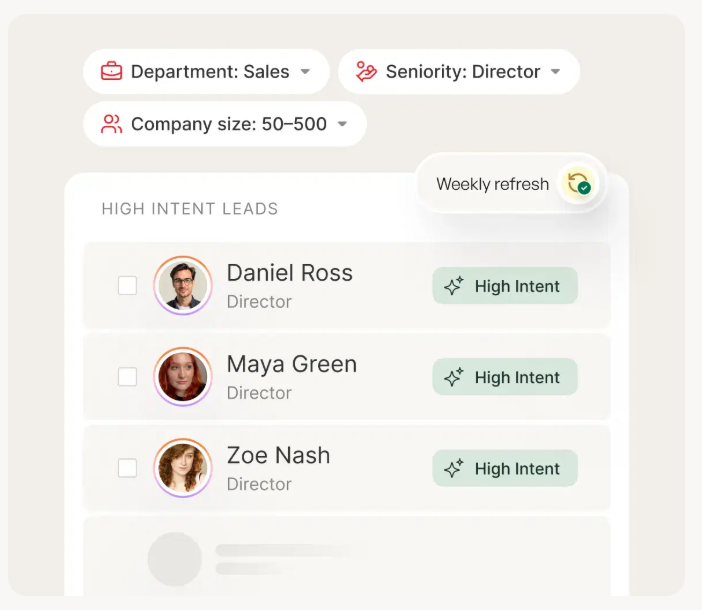

Signal-led outbound dies on bad data. Prospeo delivers 98% email accuracy on a 7-day refresh cycle with intent signals across 15,000 Bombora topics - so your reps sequence buyers who are actually in-market, not contacts who bounced three months ago.
Stop burning sequences on dead addresses. Start hitting quota.
Qualification: MEDDIC vs. MEDDPICC
Teams using formal qualification frameworks report 28% higher win rates than those winging it. Dick Dunkel created MEDDIC at PTC in 1996, and it helped grow that company from roughly $300M to over $1B in revenue.
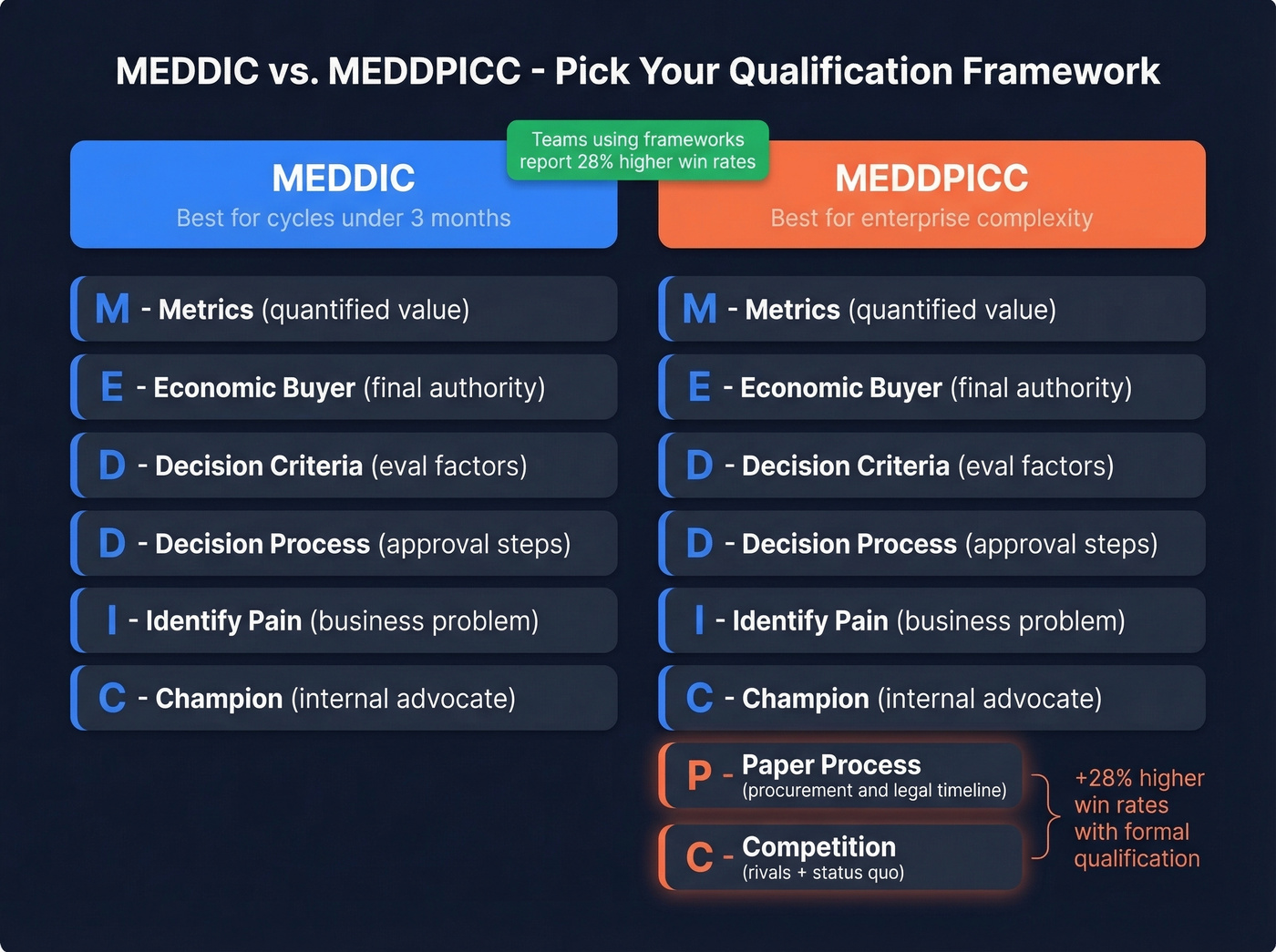
| MEDDIC | MEDDPICC Adds |
|---|---|
| Metrics - quantified value | Paper Process - procurement/legal |
| Economic Buyer - final authority | Competition - rivals + status quo |
| Decision Criteria - eval factors | |
| Decision Process - approval steps | |
| Identify Pain - business problem | |
| Champion - internal advocate |
Use MEDDIC for cycles under three months where procurement is light. Switch to MEDDPICC for enterprise complexity. The "Paper Process" element alone saves deals - we've seen teams lose six-figure opportunities because nobody mapped the procurement timeline until week 10 of a 12-week cycle. That's not a process gap. That's malpractice.
Pipeline Math & Cycle-Time Strategy
Opportunities closed within 50 days carry a 47% win rate. After 50 days, win rates drop to 20% or lower. That's not a gradual decline. It's a cliff.
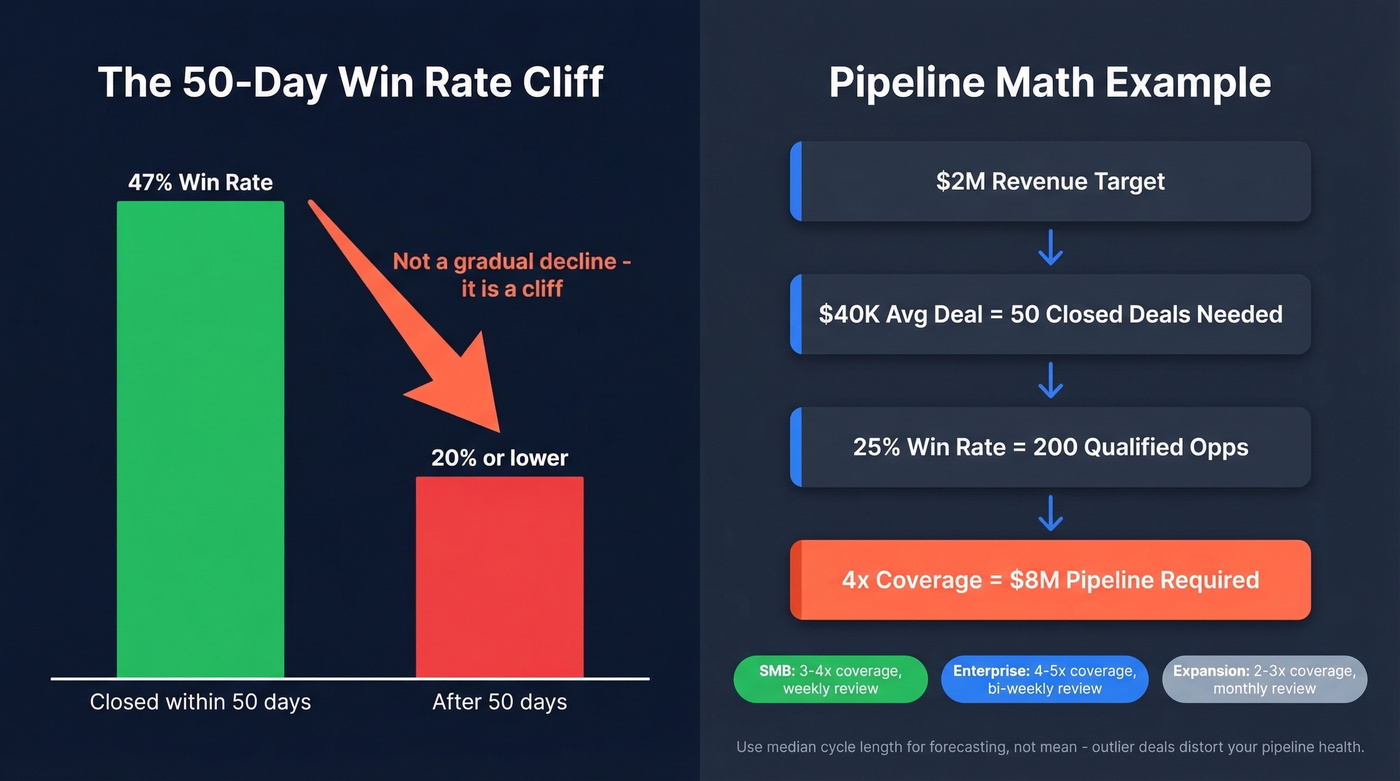
What does that mean in practice? If your target is $2M and your average deal is $40K, you need 50 closed deals. At a 25% win rate, that's 200 qualified opportunities. At 4x coverage, you need $8M in pipeline - and most of it needs to close within 50 days of creation.
| Segment | Coverage Target | Review Cadence |
|---|---|---|
| New Logo SMB | 3-4x | Weekly |
| New Logo Enterprise | 4-5x | Bi-weekly |
| Expansion | 2-3x | Monthly |
72% of B2B software revenue comes from existing customers, which is why expansion pipeline deserves its own coverage target and review cadence - not an afterthought buried in a rep's forecast.
One more thing: use median cycle length for forecasting, not mean. A handful of 9-month enterprise deals will distort your average and make your pipeline look healthier than it is. Front-load discovery, get procurement involved early, and kill deals that stall past your median cycle length.
Comp Plans That Match the Motion
Pay for the wrong things and reps will optimize for the wrong outcomes. The 2026 benchmarks:
- OTE range: $150K-$250K for closing roles
- Pay mix (US): 44:56 base-to-variable; AEs typically 50/50, SDRs 65/35, CSMs 80/20
- Quota-to-OTE ratio: 4:1 to 6:1
- Commission rates: 11-14% of ACV, median around 11.5%
Sample AE plan: $120K OTE, $600K annual quota (5x ratio), 10% base commission, 15% accelerator above quota, 5% decelerator below 50% attainment. Tie your quota period to your cycle length - monthly for SMB, quarterly for mid-market, annual for enterprise.
Common Mistakes by Stage
| Explore (Pre-PMF) | Standardize (Post-PMF) |
|---|---|
| Outsourcing sales too early | Scaling before motion is proven |
| Targeting too broad a market | Ignoring segment conversion data |
| Charging too little | Letting "pilot" count as "customer" |
| Building without customer data | Over-investing in tools before process |
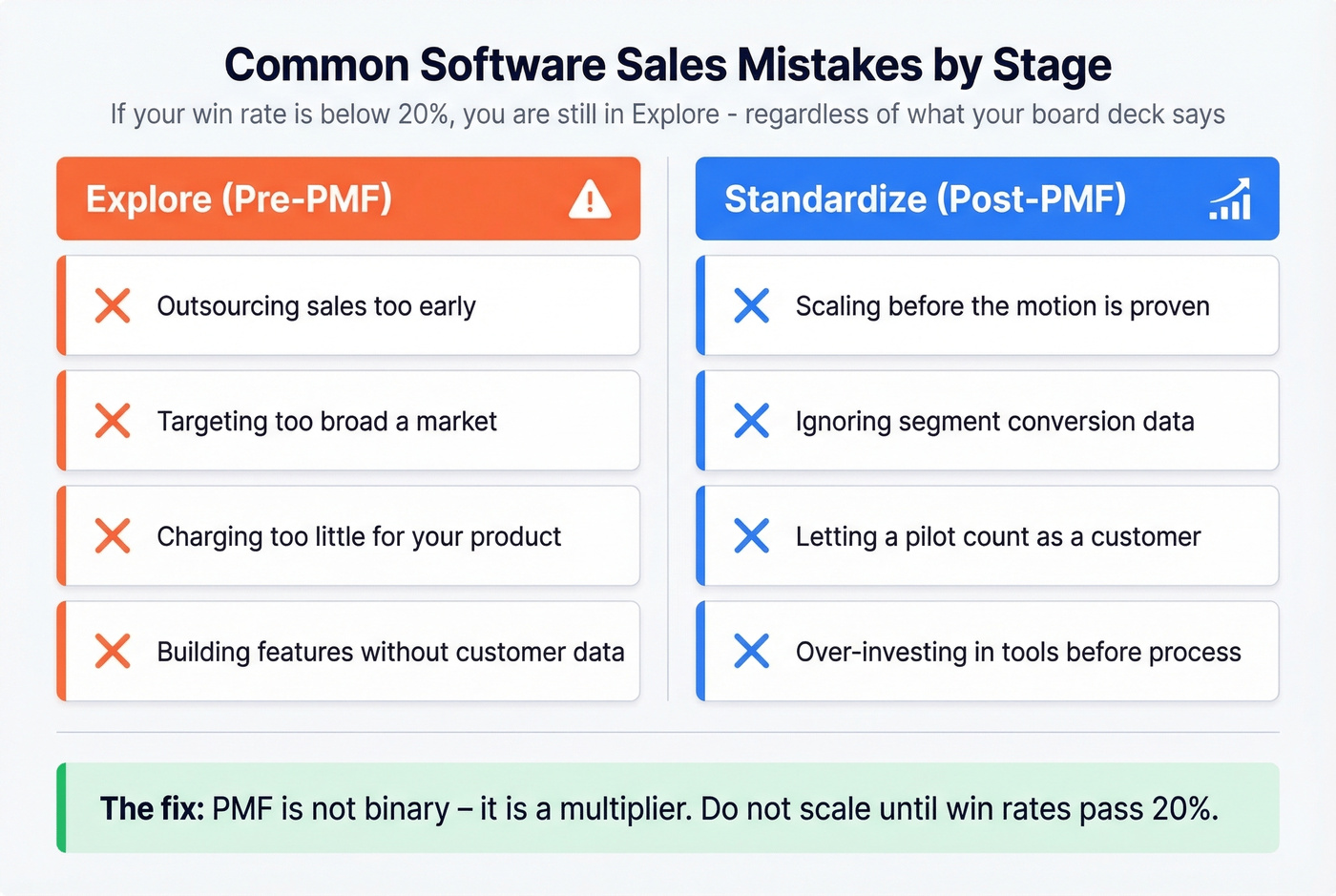
Let's be honest: product-market fit isn't binary - it's a multiplier. Most teams declare PMF too early, then scale a motion that converts at 8% and wonder why CAC is through the roof. If your win rate is below 20%, you're still in the explore phase, regardless of what your board deck says. Skip the scaling playbook until that number moves.
Putting It Together
A winning software sales strategy in 2026 isn't about more reps or more dials. It's about tighter books, sharper signals, disciplined qualification, and pipeline math that actually adds up. Get the fundamentals right before you scale anything.
If you want to go deeper on outbound execution, start with sales prospecting techniques and a tighter ideal customer profile. Then pressure-test your funnel with pipeline health and sales pipeline benchmarks.
Pipeline math only works when your coverage is real. Prospeo's 30+ ICP filters, verified mobiles with 30% pickup rates, and 92% enrichment match rate mean your 4x coverage target is built on contacts reps can actually reach - at $0.01 per email.
Fill your pipeline with verified buyers, not phantom prospects.
FAQ
What's the difference between a sales methodology and a sales process?
A sales methodology is a set of principles guiding how sellers engage buyers - SPIN, MEDDIC, and Challenger are methodologies. A sales process is the sequence of pipeline stages a deal moves through. You need both: the process defines where a deal is, the methodology defines how reps advance it.
How much pipeline coverage do I need for a new product launch?
Start at 5x coverage for new logo targets - your conversion rates are unknown, so you need a buffer. Track weekly by segment and adjust the multiplier down as you accumulate real win-rate data. Expansion pipeline can start at 2-3x since those deals convert more predictably.
How do I keep outbound data accurate enough to protect deliverability?
Use a provider with real-time verification and frequent refresh cycles. Stale data is the fastest way to land in spam - if your provider refreshes on a 6-week cycle, you're sequencing contacts who've already changed roles. A 7-day refresh with 98% email accuracy keeps bounce rates under control and protects sender reputation.