

SourceScrub vs Apollo.io: Different Tools, Different Jobs
You found 50 acquisition targets in SourceScrub, exported the contacts, and half the emails bounced on the first send. So you searched "SourceScrub vs Apollo.io" hoping Apollo's bigger database would fix the problem. Here's the reality: these two tools don't actually compete. Comparing them is like comparing a deal-sourcing microscope to a sales outreach shotgun - if you're evaluating both, you're probably asking the wrong question.
Let's break that down.
30-Second Verdict
- Choose SourceScrub if you're in PE, investment banking, or corp dev and need to discover private companies by source lists, conferences, and ownership type. Note: SourceScrub and Grata are joining forces, so the platform will likely evolve significantly through 2026.
- Choose Apollo if you're in sales or marketing and need contact data plus built-in email sequences at transparent pricing.
If your deal sizes are under $25K and you're not in private equity, you almost certainly don't need SourceScrub. Apollo's free tier plus a verification layer will get you 90% of the way there at a fraction of the cost.
SourceScrub vs Apollo.io at a Glance
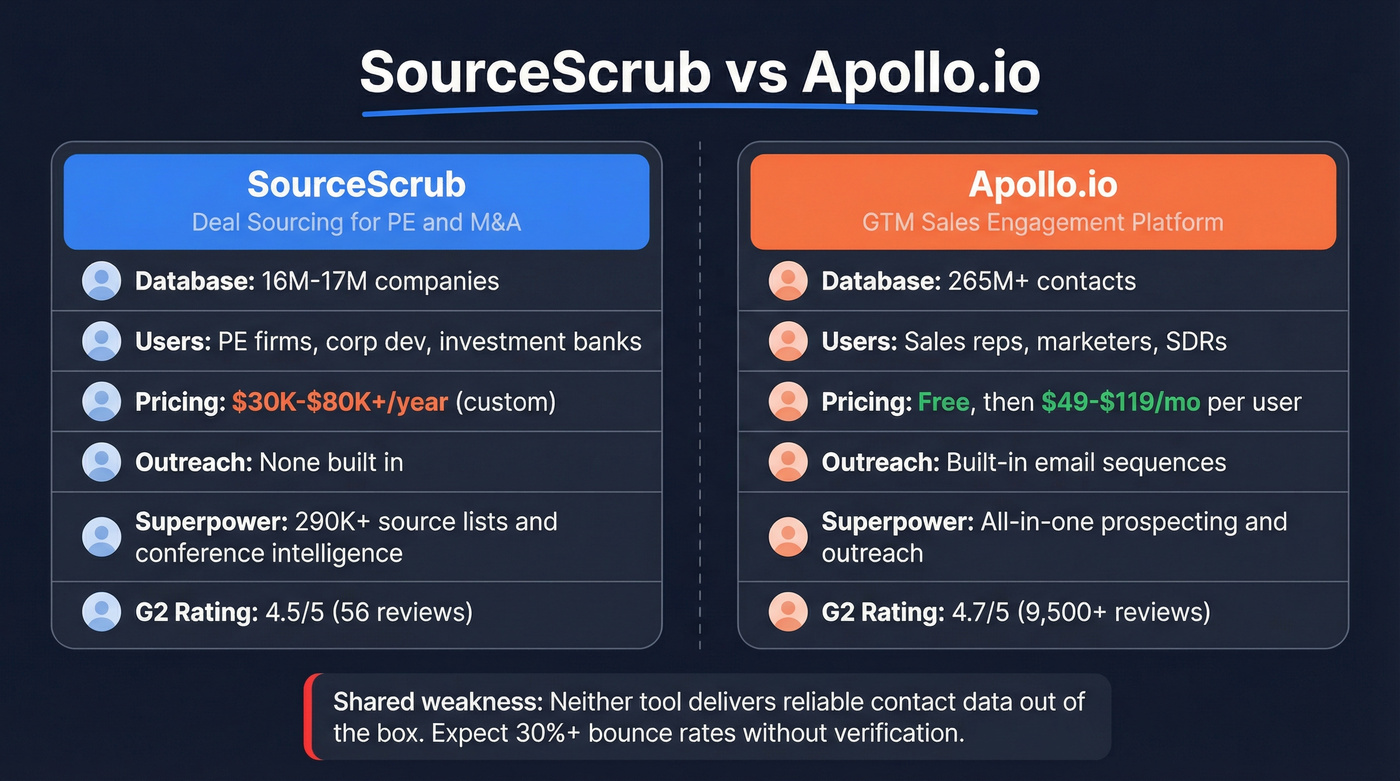
| SourceScrub | Apollo.io | |
|---|---|---|
| Category | Deal sourcing (PE/M&A) | GTM / sales engagement |
| Primary user | Investors, corp dev | Sales reps, marketers |
| Database | 16M-17M companies | 265M+ contacts |
| Contact data accuracy | User-reported issues, esp. owner-operated | User-reported 32-38% bounce rates on raw exports |
| CRM integrations | Salesforce, HubSpot | Salesforce, HubSpot |
| Pricing model | Custom / annual | Per-user/mo + credits |
| Starting price | ~$30K-$80K+/yr | Free / $49/mo |
| G2 rating | 4.5/5 (56 reviews) | 4.7/5 (9,512 reviews) |
| Built-in outreach | No | Yes |
| AI features | SourcingGPT | AI-assisted outreach |
What Is SourceScrub?
The downsides first, because they matter. On G2, data inaccuracy is the most-mentioned con. A search fund operator on Reddit put it bluntly: "a lot of the emails are wrong," particularly for owner-operated businesses that aren't active on professional networks. The UI has a steep learning curve too.

So why do PE teams still pay $30K-$80K+ a year for it?
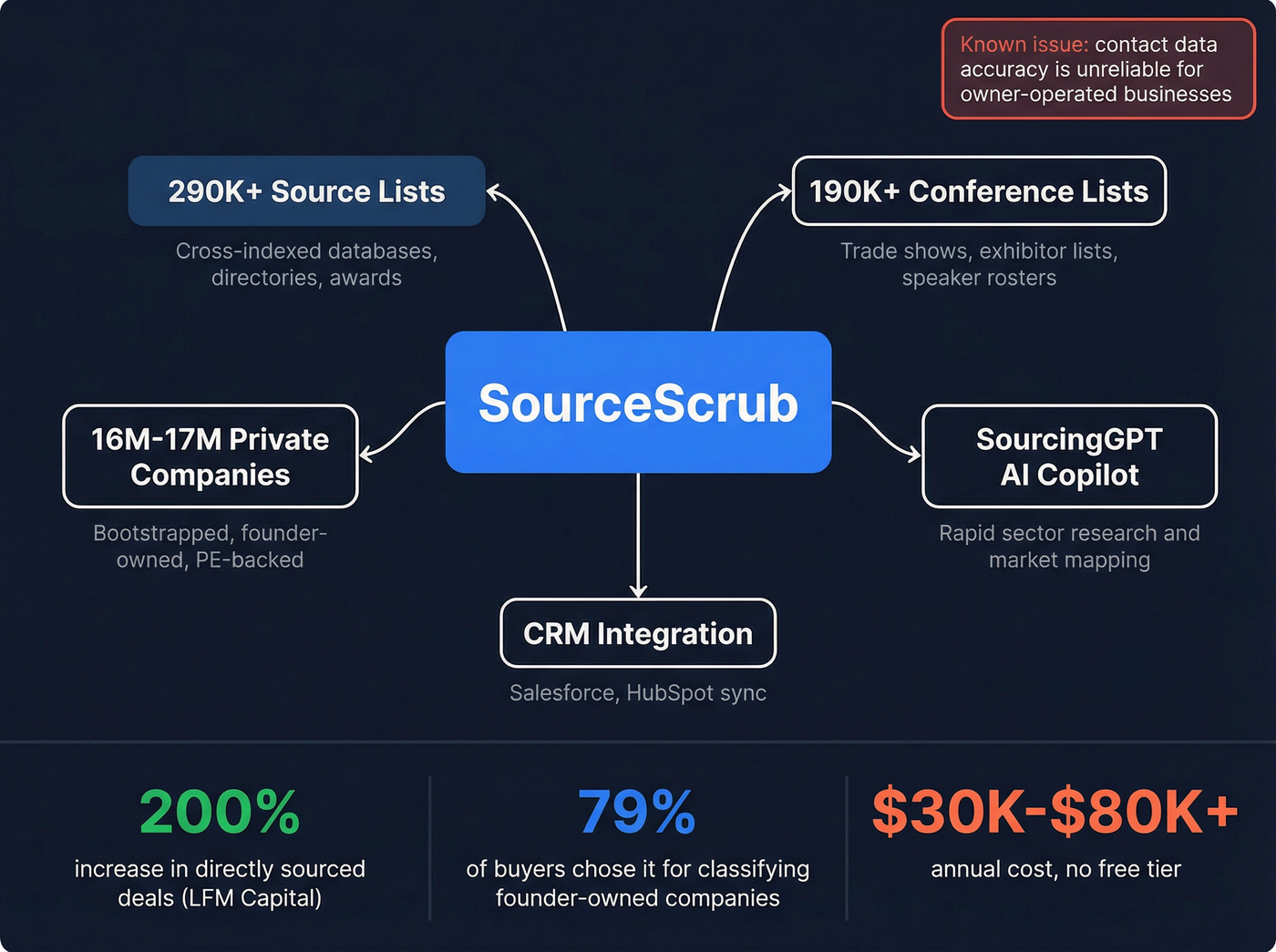
Because nothing else does what SourceScrub does. It connects 16M-17M companies across 290,000+ cross-indexed sources and lists, including 190,000+ conference and trade show lists, and ties them together so you can map markets by where companies actually show up. SourcingGPT, their AI copilot, helps investors get smart on a sector fast. In a survey of 121 buyers, 79% chose SourceScrub specifically for its ability to classify bootstrapped and founder-owned companies. LFM Capital reported that directly sourced opportunities increased by 200% after adopting the platform.
It ranks #3 in deal sourcing with 5% overall adoption and 8% mid-market adoption according to Ramp's vendor data. Three pricing tiers exist - Discovery Essentials, Sourcing Plus, and Winning - but all require a demo.
One thing to watch: SourceScrub and Grata are joining forces, combining SourceScrub's source-list intelligence with Grata's AI-powered company search. For current users, this likely means a broader dataset and richer filters. For prospective buyers, it means the product you demo today will look different by late 2026.
Pros:
- Unmatched conference and source-list intelligence for private company discovery
- Classifies bootstrapped, founder-owned, and PE-backed companies
- SourcingGPT accelerates sector research
Cons:
- Contact data accuracy is unreliable, especially for small, owner-operated targets
- Steep learning curve
- No published pricing; $30K+ minimum locks out smaller funds

SourceScrub finds the targets. Apollo builds the lists. But neither verifies the data well enough to protect your domain. Prospeo's 5-step email verification catches spam traps, honeypots, and catch-all domains - dropping bounce rates from 30%+ to under 4%. At $0.01 per email, it costs less than a single bounced send costs your sender reputation.
Stop gambling your domain on unverified exports. Verify before you send.
What Is Apollo.io?
Apollo is the Swiss Army knife of sales prospecting: 265M+ contacts, email sequencing, and basic sales workflows in a single platform. For sales teams that want to find leads and email them without stitching together five tools, it's the obvious starting point.
Pricing is transparent: Free, Basic ($49/mo), Professional ($79/mo), and Organization ($119/mo, minimum 3 seats). But the credit mechanics add hidden complexity. Each email reveal costs 1 credit, phone numbers cost 5, and enriched records burn up to 6. Credits don't roll over. Annual contact volume caps matter too - Free tops out around 1,200 contacts/year, Basic around 60K, Professional around 120K, and Organization around 180K. Legacy accounts sometimes operate under different limits, a recurring source of confusion in community threads on r/salestools.
Apollo holds a 4.7/5 across 9,500+ reviews, with users praising its filters and ease of use. One G2 reviewer summed it up: "Great for building lists fast, but I always verify emails before sending." That's the right instinct. Practitioners on r/coldemail have reported bounce rates of 32-38% on raw exports, and accuracy varies significantly by region and ICP. Apollo's deliverability shield pauses sends to likely-to-bounce addresses, but that's a band-aid, not a fix.
Pros:
- Transparent, self-serve pricing with a generous free tier
- All-in-one: contact search, sequencing, and outreach in one tool
- Massive 265M+ contact database with strong filtering
Cons:
- 30%+ bounce rates on unverified exports
- Credit system creates hidden costs at scale
- Data accuracy drops outside core North American B2B segments
The Real Problem: Contact Data
Here's the thing both tools share: contact data you can't trust out of the box. SourceScrub users report wrong emails for the exact targets PE teams care about most. Apollo users see 30%+ bounce rates on unverified exports. We've tested exports from both platforms, and neither tool's raw contact data is reliable enough to use for outreach without a verification step.

This is where a dedicated verification layer changes the equation. When Snyk's 50-person AE team ran their exports through Prospeo's verification, bounce rates dropped from 35-40% to under 5% and AE-sourced pipeline climbed 180%. That's not a marginal improvement - it's the difference between a campaign that tanks your domain reputation and one that actually books meetings.
If you're trying to reduce bounces systematically, start with the fundamentals of email deliverability and track your email bounce rate by campaign and source.
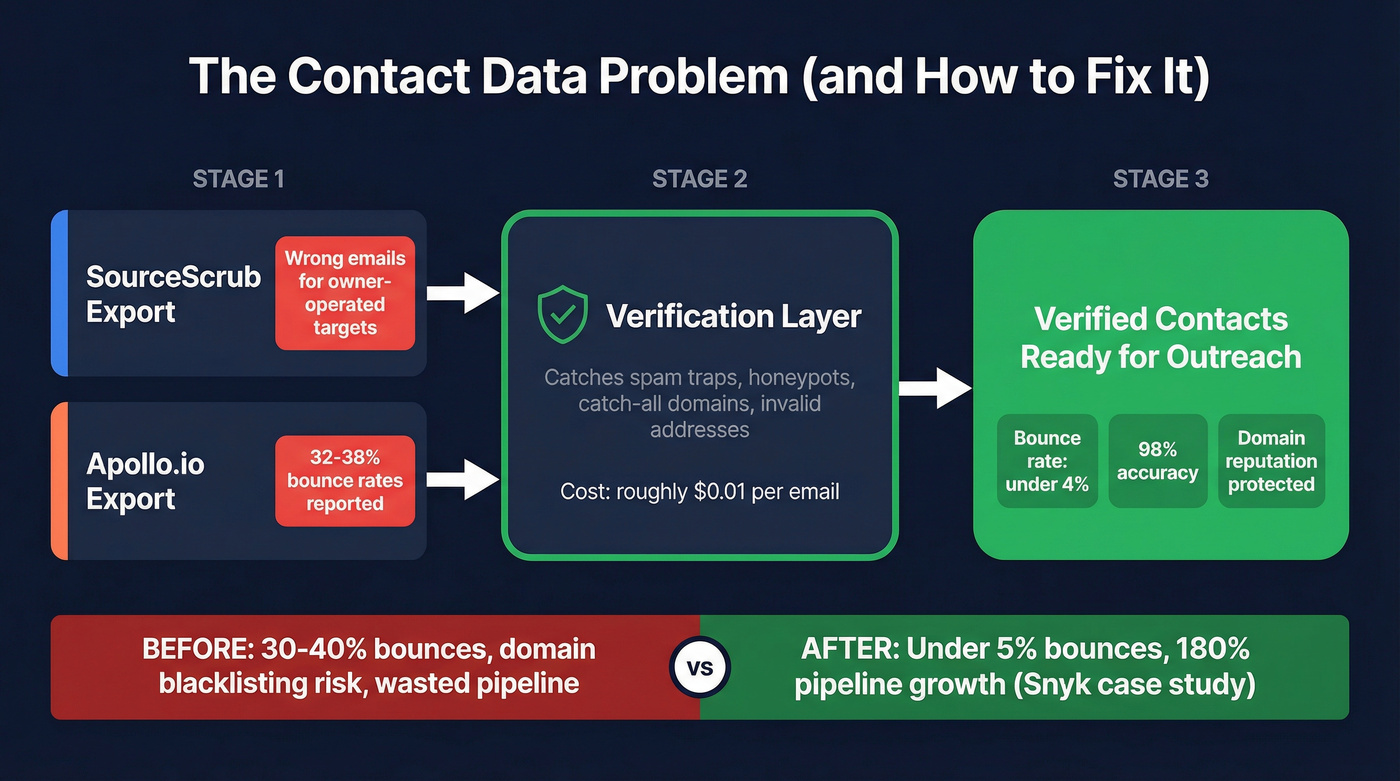
PE teams using SourceScrub and sales teams on Apollo hit the same wall: bad contact data for the people who matter most. Prospeo's 300M+ profiles refresh every 7 days - not every 6 weeks - so you reach decision-makers with 98% accurate emails and 125M+ verified mobile numbers. Snyk's 50 AEs cut bounce rates from 35% to under 5% and grew pipeline 180%.
Layer Prospeo on any deal-sourcing or sales tool and actually connect.
Which Tool Should You Pick?
Choose SourceScrub if you're in PE, IB, or corp dev. You need private company discovery, conference intelligence, and source-list mapping. No sales tool replicates this.
If you're building a repeatable outbound motion on top of that, it helps to standardize your ideal customer profile and use consistent firmographic filters so your lists don't drift.
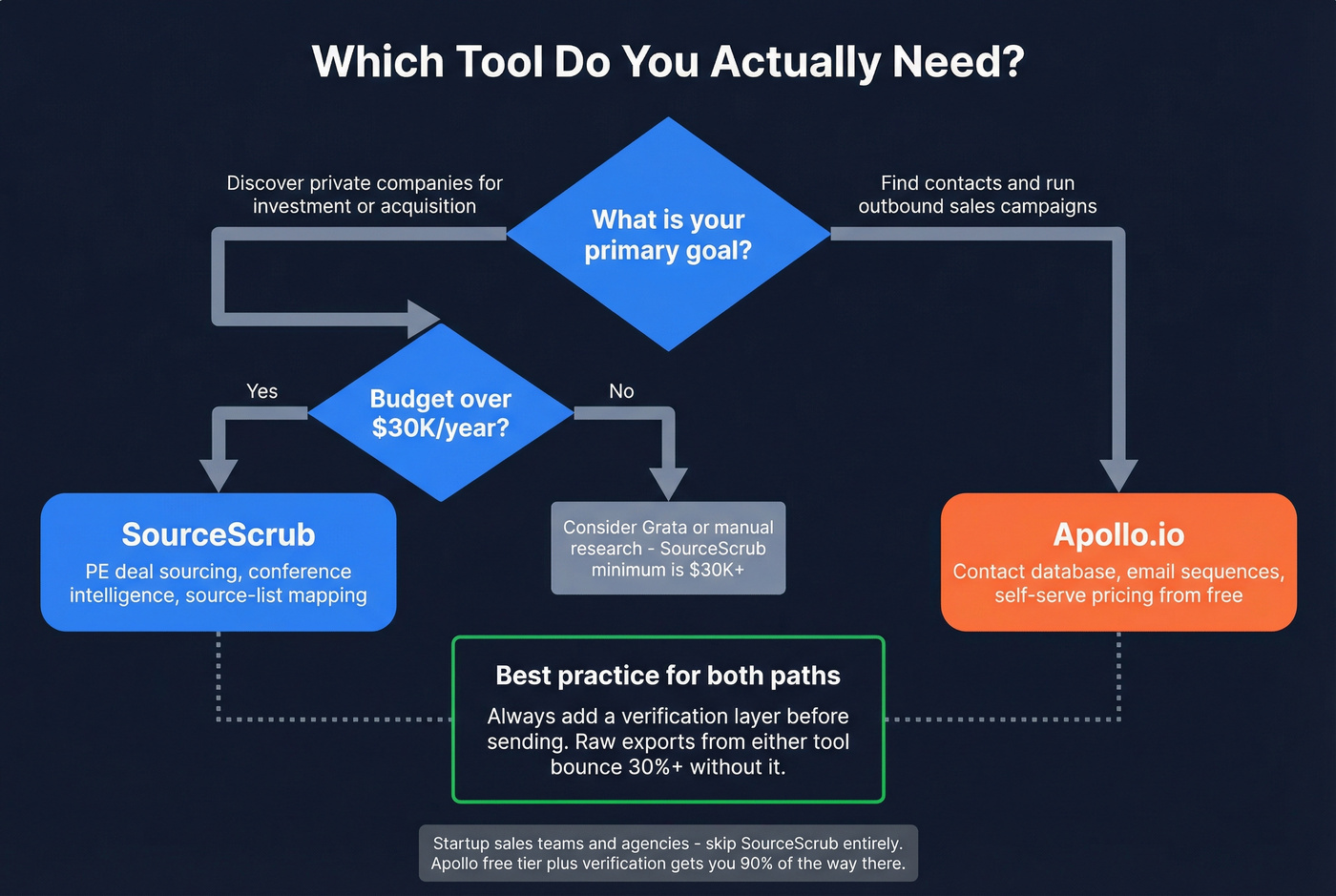
Choose Apollo if you're running outbound sales or marketing. You want contact data plus sequencing in one platform with transparent, self-serve pricing.
For teams that source targets in SourceScrub and need verified contacts to reach decision-makers, the best setup we've seen is a three-layer stack: SourceScrub finds companies, a verification tool like Prospeo finds and verifies contacts, and your outreach tool engages. That eliminates the bounce-rate problem that every SourceScrub vs Apollo.io debate circles back to.
If you're evaluating the broader category, compare options in our guide to sales prospecting databases and consider whether you also need data enrichment services to keep records fresh after import.
Skip SourceScrub entirely if you're a startup sales team or agency. The $30K+ annual minimum doesn't make sense unless you're running proprietary deal flow. And skip Apollo's built-in email data if your domain reputation matters to you - verify first, send second.
FAQ
Does SourceScrub publish pricing?
No. Three tiers exist (Discovery Essentials, Sourcing Plus, Winning) but all require a demo. Expect $30K-$80K+/year depending on team size and data volume. There's no free tier or monthly option.
Can Apollo replace SourceScrub for deal sourcing?
Not even close. Apollo doesn't index private companies by source, track conference exhibitor lists, or classify bootstrapped businesses - the core capabilities PE and M&A teams rely on for proprietary deal flow.
What's the best way to verify contacts exported from either platform?
Run exports through a dedicated verification tool before launching outreach. Prospeo's Email Finder processes CSV uploads and returns verified results in minutes - 98% accuracy, free tier included. Teams typically cut bounce rates from 30%+ to under 5%.
Is the SourceScrub-Grata merger complete?
As of mid-2026, the two platforms are actively combining. Expect SourceScrub's source-list intelligence merged with Grata's AI-powered company search. If you're evaluating either tool, request a demo of the combined product to see the latest capabilities.