

Sparkle vs Apollo.io: Deliverability Stack or Prospecting Database?
Your bounce rate just crossed 3-5% and you can't tell if the problem is Apollo's data or your sending setup. Maybe both. Direct Sparkle vs Apollo.io comparisons barely exist online - and half the "Sparkle" results point to a macOS framework or an IPTV app. You're not choosing from a list of 19 tools here. You're choosing where truth lives in your stack: the database, the sending platform, or verification.
30-Second Verdict
Pick Sparkle if your bottleneck is deliverability - warmup, inbox rotation, monitoring, and CRM visibility in one platform.
Pick Apollo if you need a massive prospecting database with 210M+ contacts and your team can handle list cleaning and credit management.
Skip both if your real problem is stale contacts. Prospeo's 98% email accuracy and 7-day refresh cycle fix the root cause - bad data - regardless of which outreach platform you run.
Feature Comparison at a Glance
| Dimension | Sparkle.io | Apollo.io | Edge |
|---|---|---|---|
| Primary strength | Deliverability stack | Prospecting database | Depends on need |
| Database size | Not published | 210M+ contacts | Apollo |
| Warmup | Built-in, full suite | Included, but less deliverability-focused | Sparkle |
| Verification | Built-in | "Verified" label (see caveats below) | Sparkle |
| CRM | Built-in with custom pipelines | Basic CRM | Sparkle |
| Deliverability tools | Full monitoring + 99% deliverability claim | Limited vs. deliverability-first platforms | Sparkle |
| Best for | Execution-first teams | Database-first teams | - |
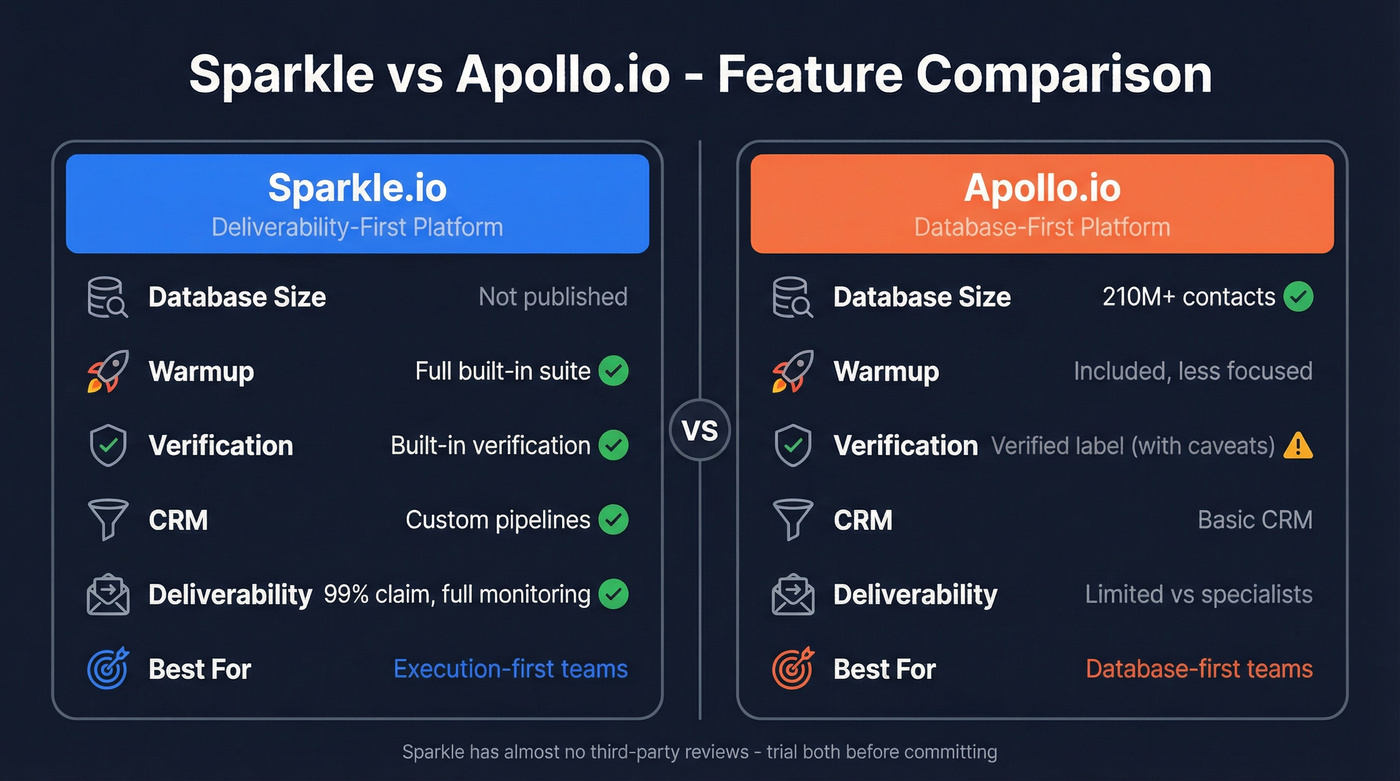
One thing worth flagging: Sparkle.io has almost no third-party review footprint compared to Apollo's large presence across G2, Capterra, and Reddit. That makes trials your best evaluation tool.
Pricing and True Cost
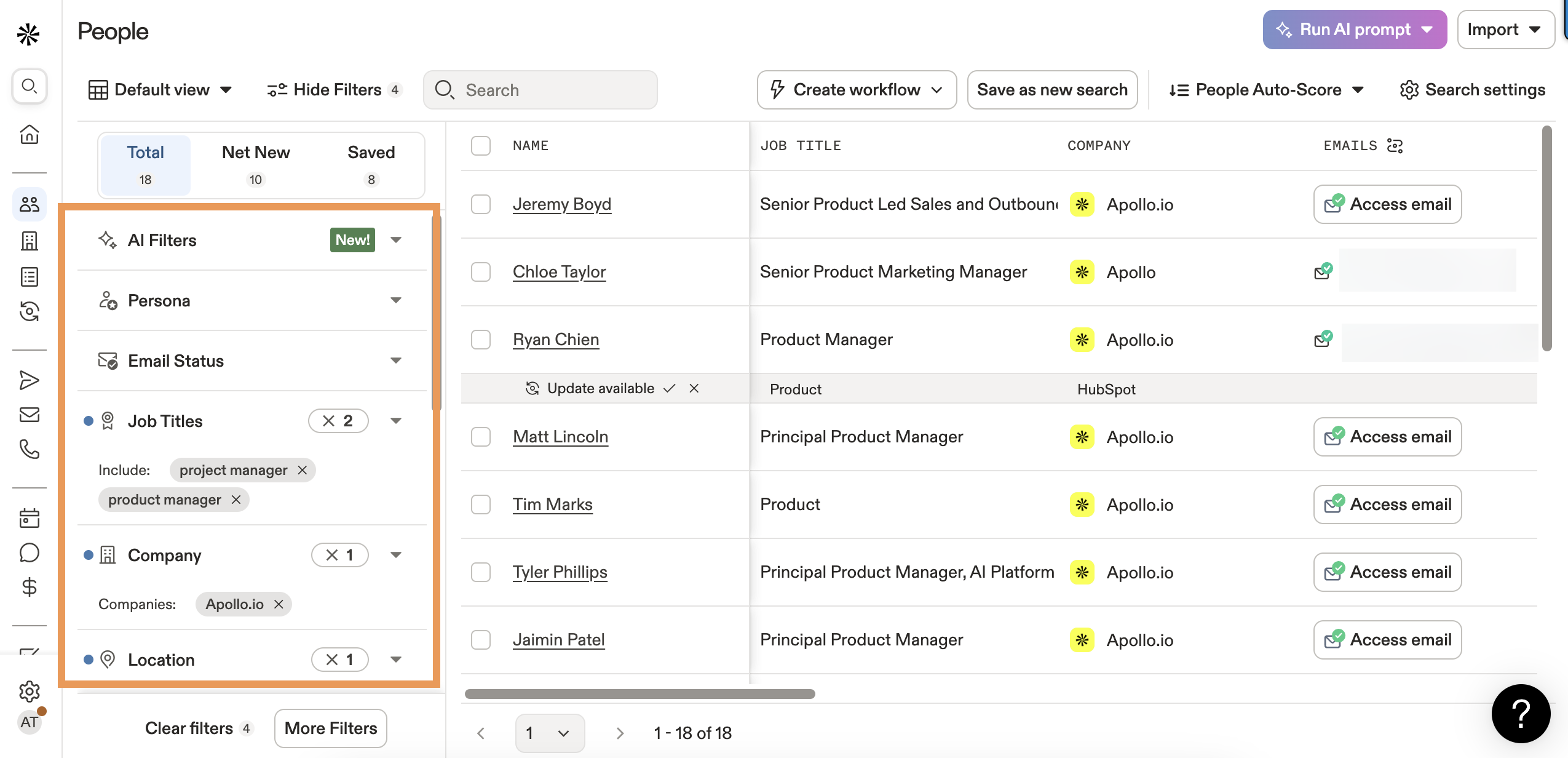
Apollo's sticker prices look reasonable: Basic at $49/user/month, Pro at $79, Organization at $119, all on annual billing. Monthly billing bumps those to $59, $99, and $149 respectively. The real cost hides in credit mechanics - mobile credits cost 8x email credits, credits expire each billing cycle, and overages run $0.20/credit with a 250-credit minimum. For teams doing heavy outbound and cold calling, the actual operating range lands at $150-$400/user/month once add-ons and overages stack up. Scale from 1 sender to 10 inboxes and that "$49/mo" pitch evaporates fast. "Credits expiring unexpectedly" is a recurring complaint in user forums.
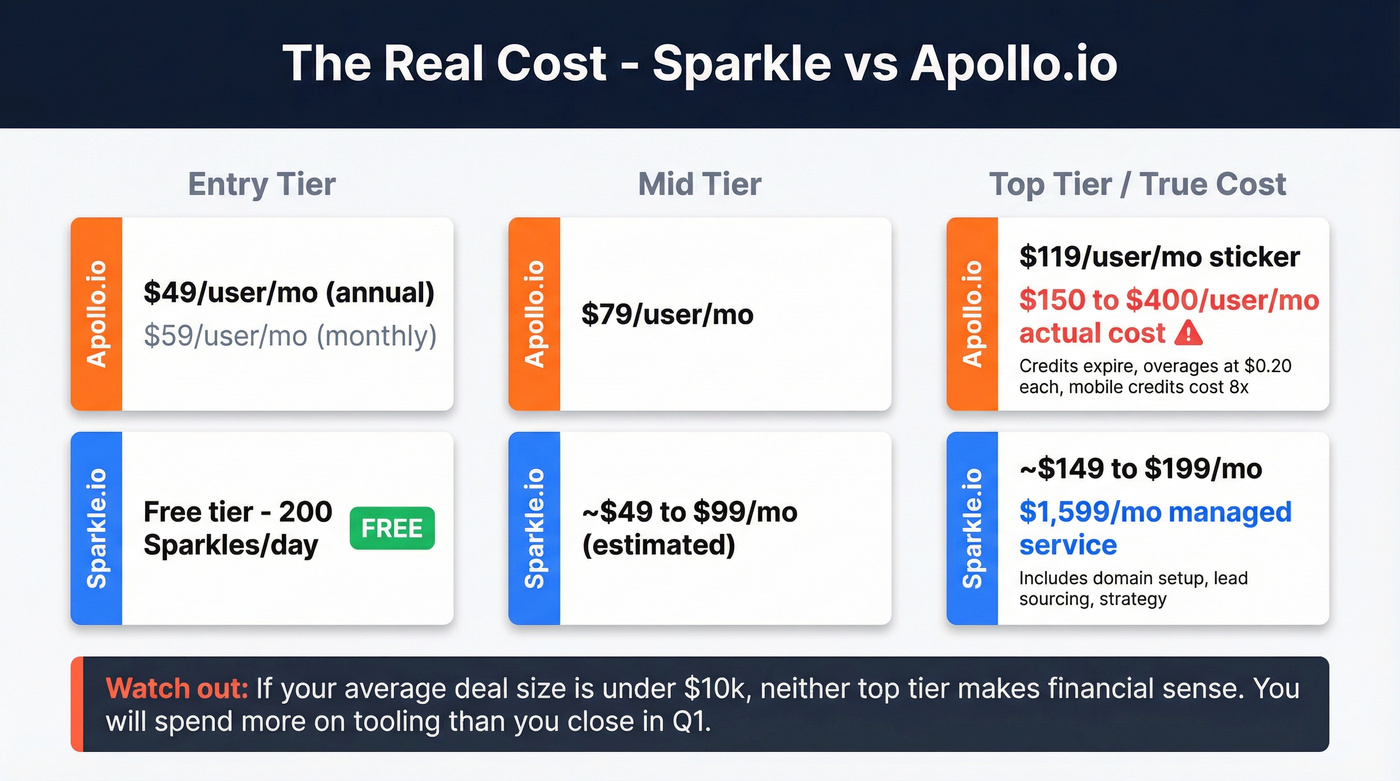
Sparkle uses a "Sparkles" credit system. The Free tier gives 200 Sparkles/day. Starter runs 15,000 Sparkles/month, Business jumps to 150,000/month, and a Managed Service tier costs $1,599/month for 3,000 contacts/month - that includes domain and mailbox setup, CRM integration, lead sourcing, performance reports, and strategy support. Sparkle publishes Sparkles quantities and add-on pack pricing, but doesn't present simple "$X/month" sticker pricing for mid-tiers the way Apollo does. Expect roughly $49-$199/month depending on volume.
| Apollo (annual) | Sparkle | |
|---|---|---|
| Entry paid tier | $49/user/mo | Free (200/day) |
| Mid tier | $79/user/mo | ~$49-$99/mo (est.) |
| Top tier | $119/user/mo | ~$149-$199/mo (est.) |
| Managed / true cost | $150-$400/user/mo | $1,599/mo (full service) |
Here's the thing: if your average deal size sits below $10k, neither platform's top tier makes financial sense. You'll spend more on tooling than you'll close in the first quarter.

Apollo's "verified" label still lets 11% of contacts bounce. Sparkle monitors deliverability but can't fix stale data upstream. Prospeo's 5-step verification and 7-day refresh cycle deliver 98% email accuracy at $0.01/email - then push clean lists to Instantly, Smartlead, or Lemlist.
Stop debating outreach tools. Fix the data that feeds them.
Data Quality and What "Verified" Actually Means
Apollo's "verified" label doesn't mean what most people think. One Reddit user exported 787 records using 787 credits and found 11%+ were invalid - despite every one carrying the "verified" tag. That's not a rounding error. That's a sender reputation risk. An AeroLeads test of 1,000 Apollo contacts came in better at 93.2% valid, but that still means roughly 1 in 25 emails bounces before you write a single subject line.
If you're trying to get bounces under control, start with email bounce rate benchmarks and then add a dedicated email deliverability guide to your stack review.
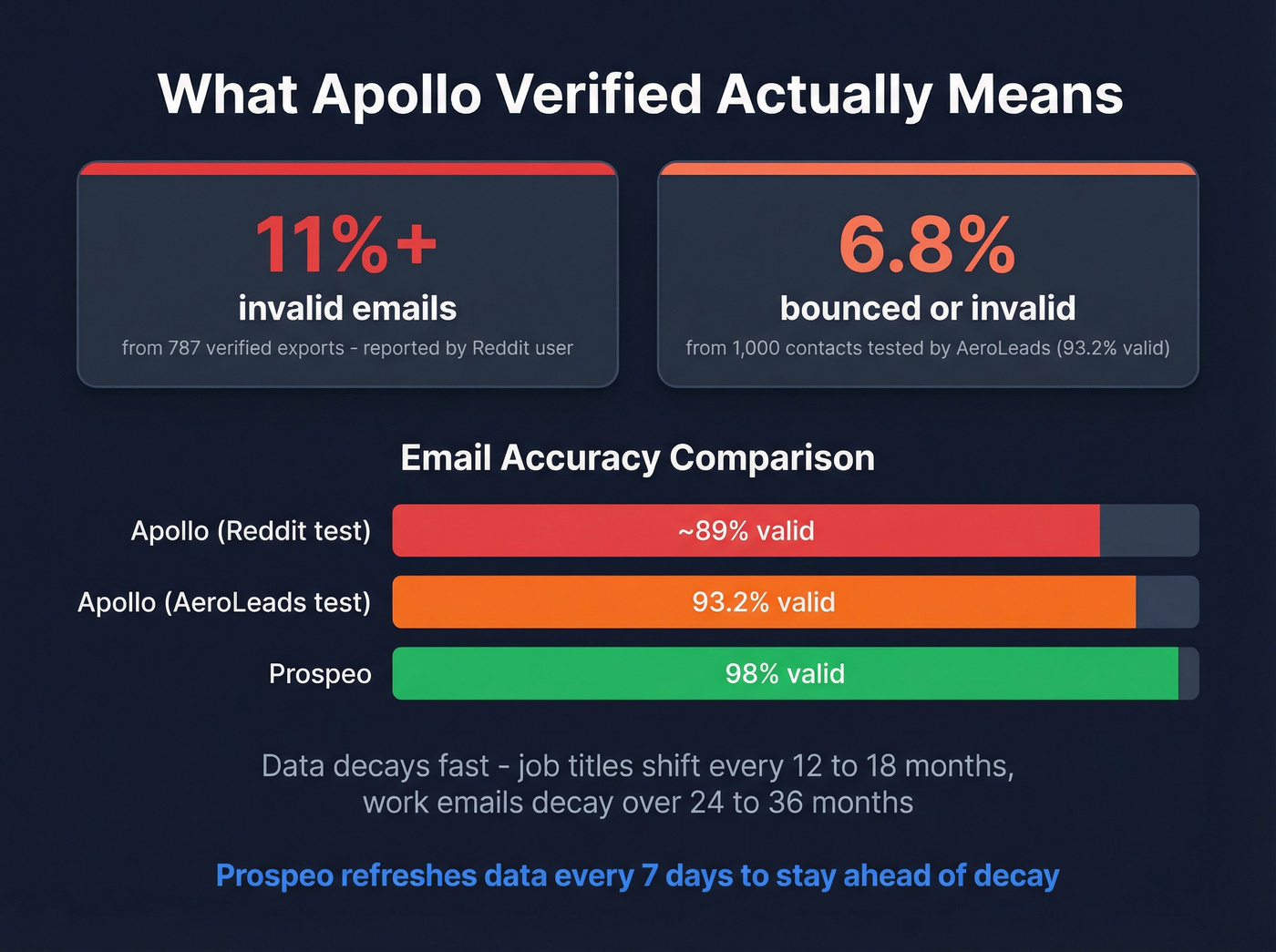
The deeper issue is freshness. Reddit threads consistently flag Apollo showing people at companies they left months ago, outdated titles, and emails bouncing post-verification. Work emails decay over 24-36 months, but job titles shift every 12-18 months, and Apollo's refresh cycle can't always keep pace. We've talked to teams who spend more time cleaning Apollo lists than actually running outreach. That's backwards.
If you're building lists at scale, a data enrichment services layer can reduce manual cleanup.
Deliverability and Warmup
Sparkle's core advantage is its deliverability infrastructure. Their 81,966-email benchmark study produced concrete thresholds: keep hard bounces under 1%, soft bounces under 2%, start at 10-20 emails per inbox per day, and ramp gradually. The platform bundles warmup, inbox rotation, blacklist monitoring, SPF/DKIM/DMARC checks, and inbox placement testing into a single dashboard. Think of it as monitoring and diagnostics - visibility into what's happening after launch, not just preventive setup.
If you're troubleshooting setup issues, it helps to understand DMARC alignment and how to improve sender reputation.
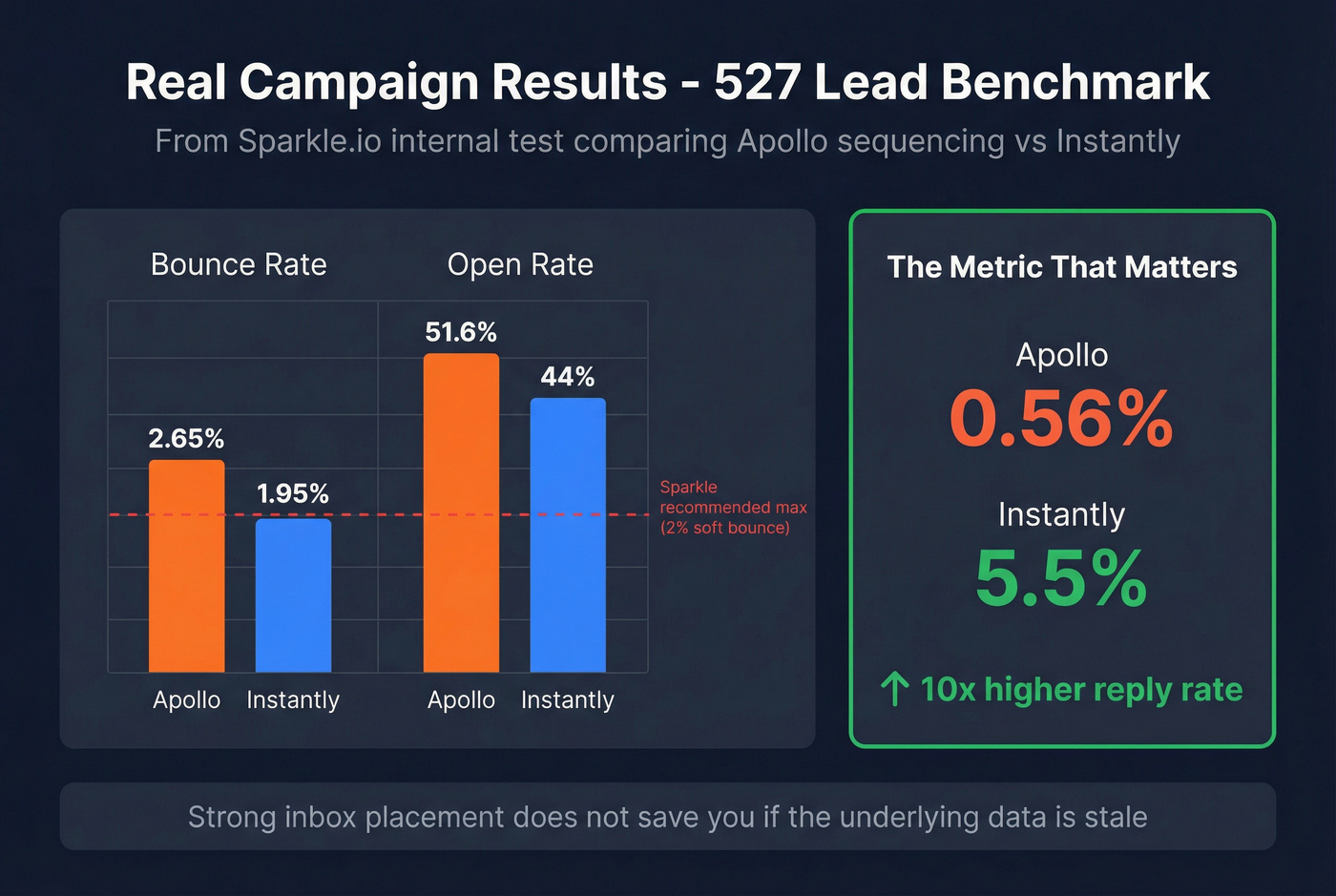
Apollo's sequencing is functional but less focused than specialist tools. Sparkle's own 527-lead test tells the story: Apollo bounced at 2.65% with a 0.56% reply rate, while Instantly hit 1.95% bounce and 5.5% reply. Apollo won on open rate (51.6% vs 44%), but reply rate - the metric that actually matters - wasn't close.
We've seen this pattern across dozens of campaigns: strong inbox placement doesn't save you if the underlying data is stale. If you need a broader stack view, compare your options across SDR tools and sales prospecting techniques.

Reviews and Brand Confusion
Let's be honest about a frustrating research problem. If you Google "Sparkle G2 reviews," you'll find a listing rated 4.8/5 from 20 reviews. That's a UGC/social walls product - not Sparkle.io. The actual Sparkle.io listing sits under Email Verification Software with exactly 1 review (5.0). On Reddit, "Sparkle" returns the Swift macOS update framework and an IPTV app. The brand collision makes independent research genuinely difficult, and we haven't found a workaround beyond trialing the product directly.
Apollo has a large review footprint across G2 and Capterra, plus extensive Reddit discussion. That volume doesn't make Apollo better, but it does make it far easier to evaluate with confidence before committing budget.
When Neither Tool Solves the Problem
If your decision between these two platforms is really about bounces and stale contacts, the fix isn't switching outreach tools - it's adding a verification layer before data hits your sequences. If you're evaluating providers, start with a shortlist of sales prospecting databases.
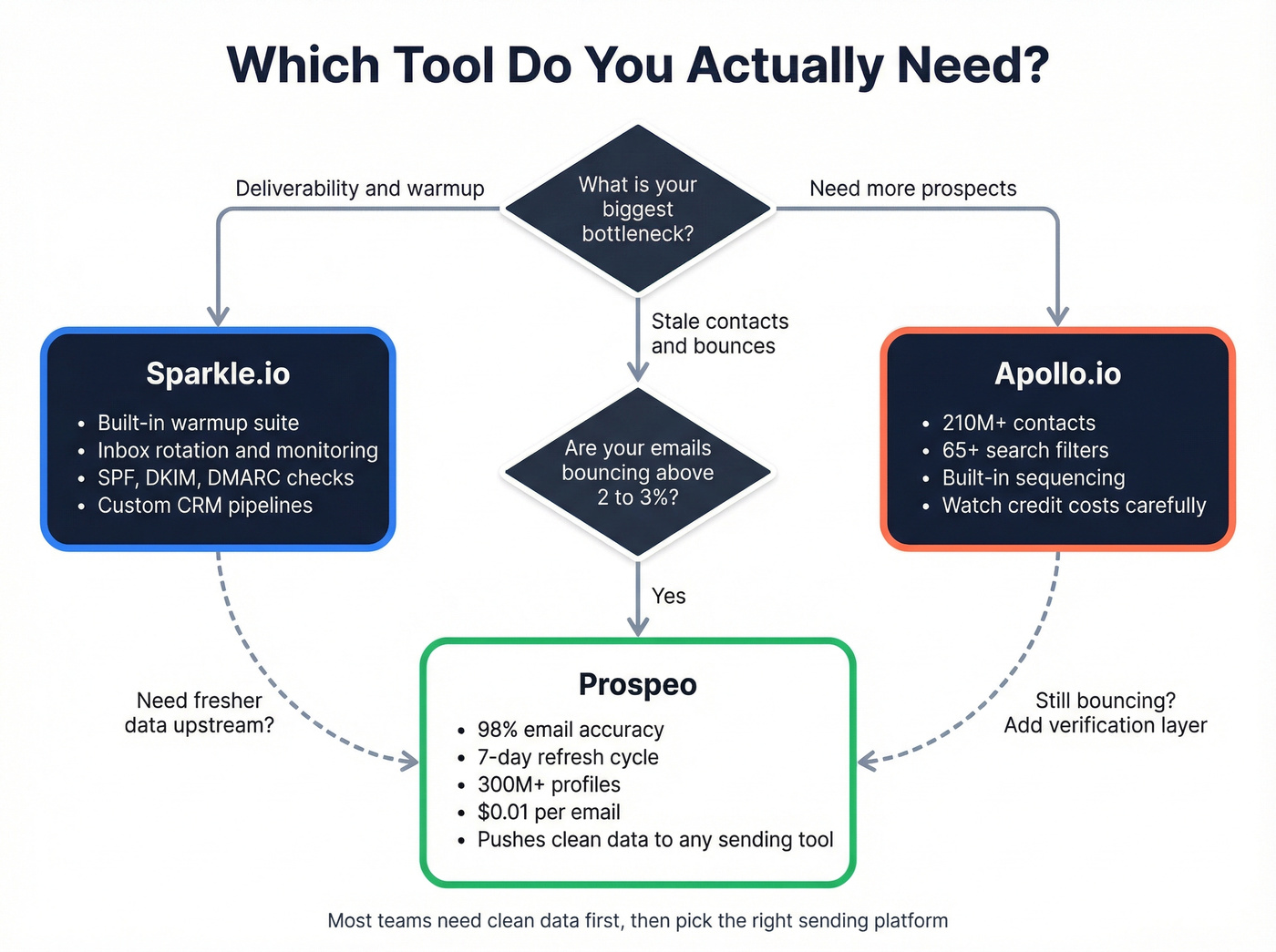
Prospeo covers 300M+ professional profiles with 143M+ verified emails and 125M+ verified mobile numbers, with 98% email accuracy on a 7-day refresh cycle. The workflow is straightforward: search by 30+ filters including buyer intent and technographics, export verified contacts, and push them to Smartlead, Instantly, Lemlist, HubSpot, or Salesforce through native integrations. At roughly $0.01 per email with a free tier of 75 emails/month, there's no contract and no sales call required. Teams running Prospeo data through their outreach stack book 35% more meetings compared to Apollo-sourced lists - pair it with whichever sending platform fits your workflow.
Teams using Prospeo-sourced data book 35% more meetings than Apollo lists - not because of better sequences, but because 98% of those emails actually land. 300M+ profiles, 30+ filters, native CRM integrations, and no contracts.
Your sending platform is only as good as the contacts you load into it.
FAQ
Is Sparkle.io the same as "Sparkle" on G2?
No. The G2 listing rated 4.8/5 with 20 reviews is a UGC and social walls product. Sparkle.io's actual listing shows 1 review under Email Verification Software. Always confirm you're looking at the correct product before comparing ratings.
Why do Apollo "verified" emails still bounce?
Apollo's "verified" label doesn't guarantee deliverability. One user reported 11%+ invalid emails from 787 "verified" exports. Data decays fast - job titles shift every 12-18 months - and Apollo's refresh cycle can't keep pace with real-world changes.
What's the main difference between Sparkle and Apollo?
Sparkle is a deliverability-first platform: warmup, inbox rotation, monitoring, and a built-in CRM. Apollo is a database-first platform: 210M+ contacts, sequencing, and prospecting filters. Most teams need both capabilities, which is why a dedicated data layer often fills the gap between them.
Which tool is better for a small team under 5 reps?
Go with Sparkle if deliverability is your bottleneck - warmup, monitoring, and CRM come built in. Go with Apollo if you need a large prospecting database and can manage credit costs carefully. For either path, starting with verified data eliminates the biggest source of wasted effort. Prospeo's free tier gives you 75 emails/month to test that theory without spending a dime.