

Speed to Lead Statistics That Actually Cite Their Sources
You've seen the "respond in 5 minutes or lose the deal" stat in a dozen slide decks. Not one of them links to the original study. Most speed to lead statistics floating around are just copies of copies - articles citing articles that cite other articles, with nobody reading the actual research.
Here are the real numbers, with sources you can verify. Plus the one variable that makes speed irrelevant if you get it wrong.
The Numbers Worth Screenshotting
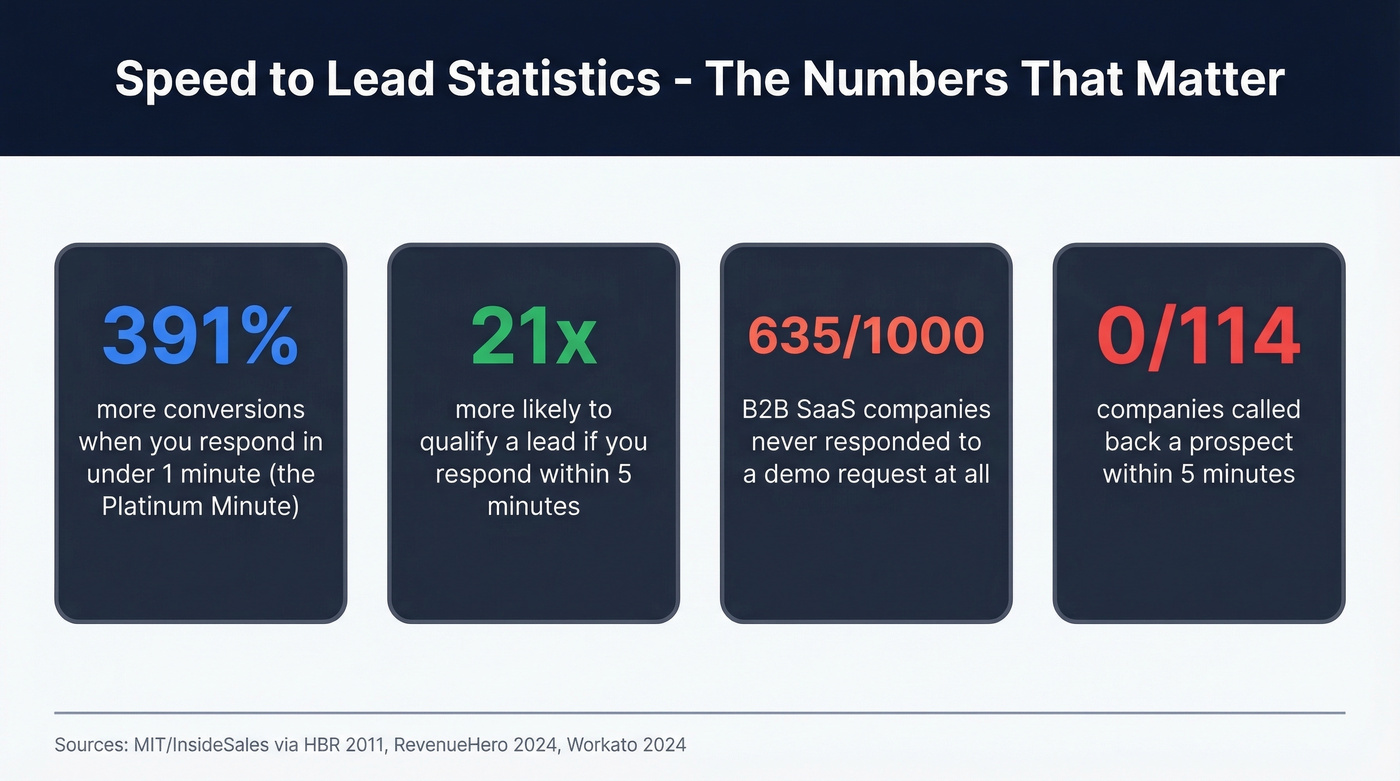
- 1-minute response = 391% more conversions (the "Platinum Minute")
- 635 out of 1,000 B2B SaaS companies never responded at all
- 0 out of 114 companies called back within 5 minutes
- Speed is useless if a third of your contact data bounces
What Is Speed to Lead?
Speed to lead is the elapsed time between a prospect's inquiry - form fill, demo request, chat message - and your first sales contact. The formula is simple: timestamp of first outbound touch minus timestamp of inbound signal. Response time is measured in minutes, not hours, and every additional minute of delay erodes your odds of qualifying that prospect.
Core Response Time Data
Conversion Decay by Lead Response Time
The foundational lead response time study comes from James B. Oldroyd, Kristina McElheran, and David Elkington, published in Harvard Business Review in March 2011. The underlying MIT/InsideSales research analyzed roughly 15,000 leads and around 100,000 call attempts.
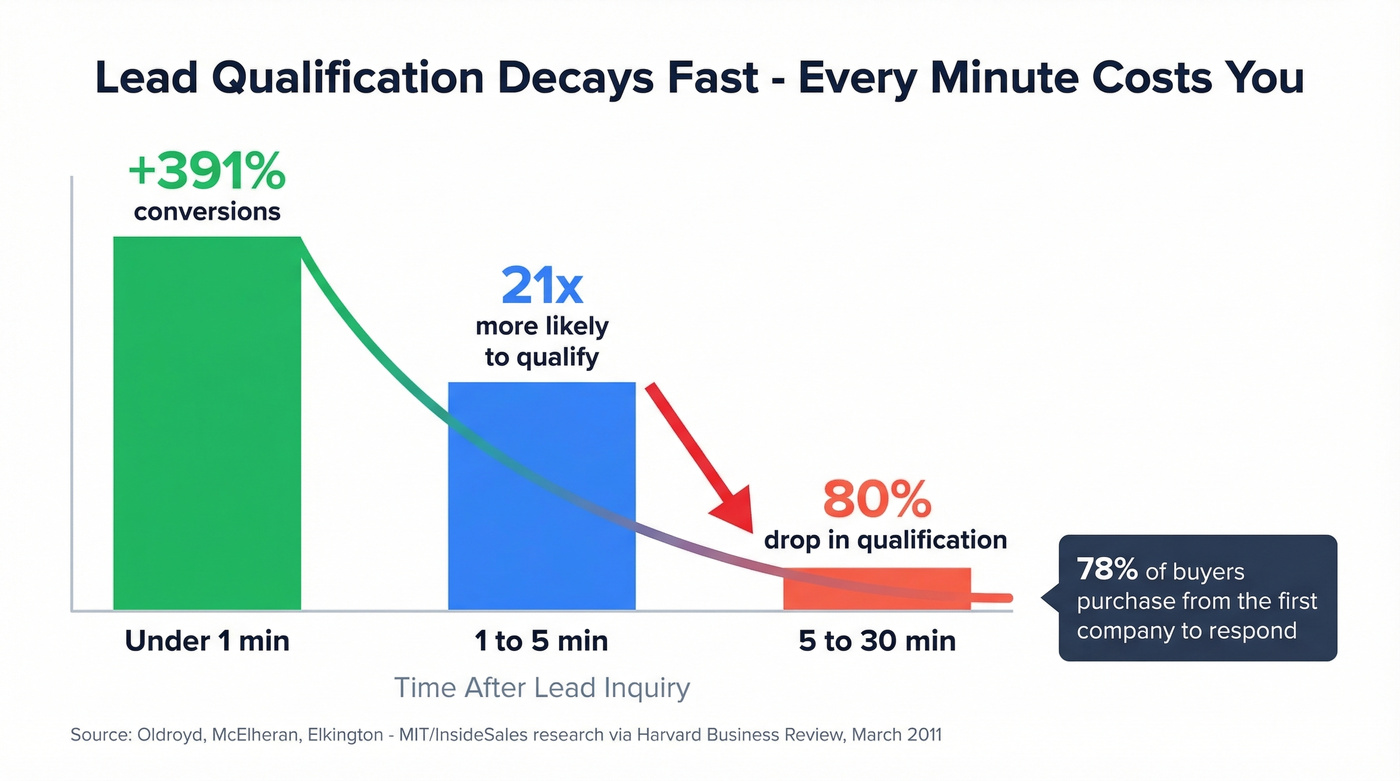
| Response Time | Conversion Effect |
|---|---|
| Under 1 min | +391% conversions ("Platinum Minute") |
| Under 5 min | 21x more likely to qualify |
| 5 min to 30 min | 80% drop in qualification |
You'll also see this one everywhere: 78% of buyers purchase from the first responder. That number gets repeated without attribution so often it's practically folklore, but first-mover advantage in lead response is real and significant.
Every hour of delay is marketing spend evaporating. You paid to generate that lead, and your team is letting it rot in a queue.
The Research Everyone Misquotes
Here's the thing: the "MIT study" and the "HBR study" that every speed-to-lead article cites? Same research. It's one study from 2011, later popularized through the Harvard Business Review write-up. In a 2026 context, that's about 15 years old. The directional findings still hold - responding faster converts better, full stop - but the exact multipliers come from a pre-Slack, pre-Zoom, pre-PLG era. Treat them as strong signals, not gospel.

The data shows 80% of qualification odds vanish after 30 minutes. But responding fast to a bounced email is just burning budget. Prospeo's 98% email accuracy and 7-day refresh cycle mean your routing automation reaches real inboxes - not dead addresses.
Stop turbocharging outreach on flat tires. Verify your data first.
2026 Benchmarks: What Companies Actually Do
RevenueHero submitted demo requests to 1,000 B2B SaaS companies and tracked what happened. The results are damning.
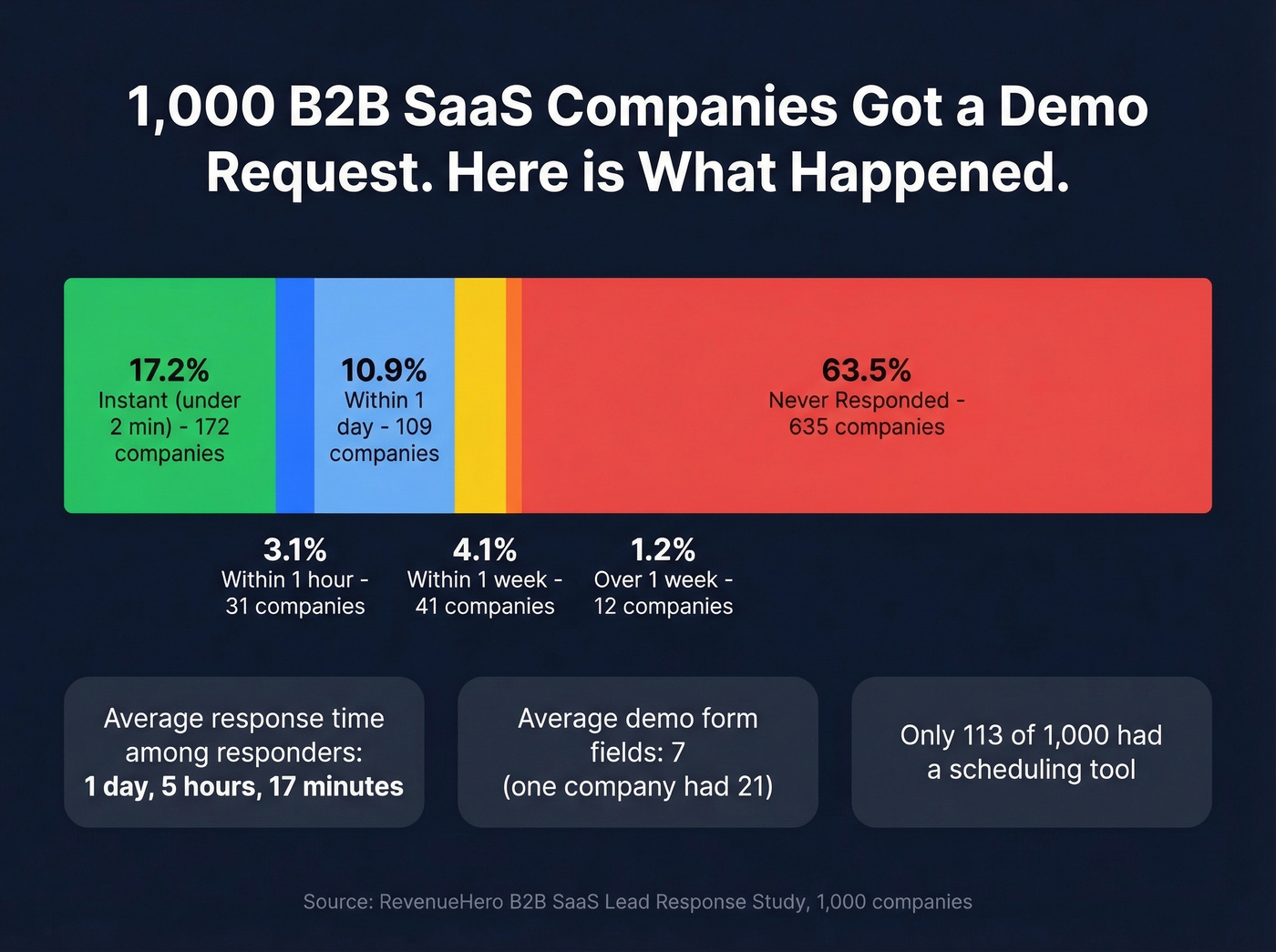
Only 365 companies responded at all:
| Response Bucket | Companies | Avg Response Time |
|---|---|---|
| Instant (under 2 min) | 172 | 2 minutes |
| Within an hour | 31 | 25 minutes |
| Within a day | 109 | 10h 32m |
| Within a week | 41 | 3d 9h 31m |
| Over a week | 12 | 27d 14h 33m |
| Never responded | 635 | - |
Average response time among those who did respond: 1 day, 5 hours, 17 minutes. The form friction was just as bad - the average demo form had 7 fields. One company had 21. Only 113 out of 1,000 websites had any scheduling tool installed.
Drift ran a similar survey seven years earlier with 433 B2B SaaS companies. Only 7% responded within 5 minutes, and 55% didn't respond within five business days. All 10 of the fastest responders used live chat, but only 14% of companies had it.
The takeaway across both studies is consistent: response times are slow, and non-response is shockingly common. Industry averages vary wildly beyond SaaS too - insurance leads wait roughly 28 hours, and manufacturing leads wait 3+ days.
Speed to Lead by Channel
Workato's 114-company study breaks response time down by channel:
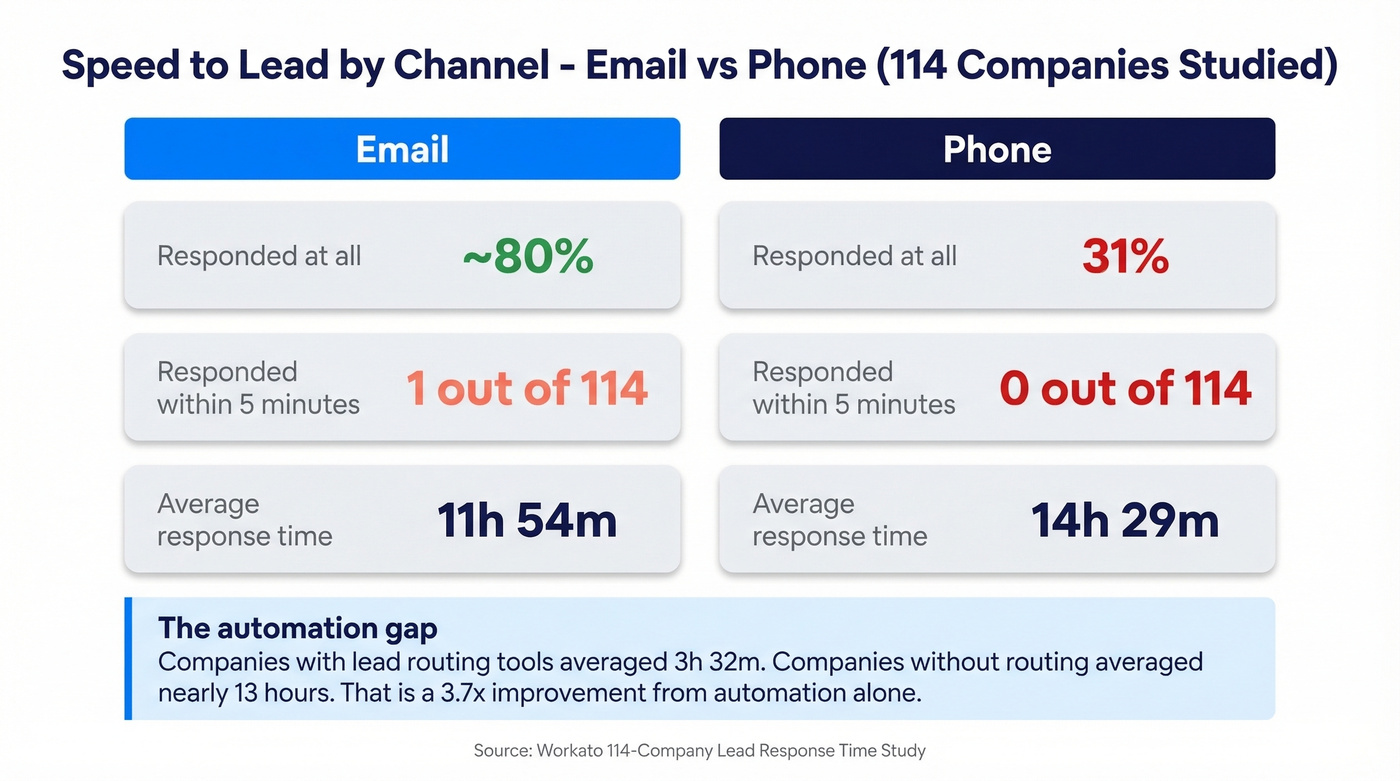
| Metric | Phone | |
|---|---|---|
| Responded at all | ~80% | 31% |
| Within 5 minutes | 1 of 114 | 0 of 114 |
| Average response | 11h 54m | 14h 29m |
Zero out of 114 companies called within 5 minutes. Not one.
Companies using lead routing tools averaged 3 hours 32 minutes to respond. Companies without routing? Nearly 13 hours. That's a 3.7x improvement from automation alone. Small teams often push back that instant response is unrealistic without headcount, but the Workato data shows routing tools close most of the gap without adding a single rep.
Why Speed Alone Isn't Enough
Your SDR team responds in 3 minutes - but half the emails bounce and the phone numbers go to voicemail. You solved the speed problem. You haven't solved the data problem.
Speed-to-lead automation on bad data is a turbocharger on a car with flat tires. We've seen this pattern repeatedly: teams invest in routing tools, scheduling widgets, and instant-response workflows, then wonder why conversion rates don't move. The answer is usually sitting in their bounce reports. One team we tracked - Meritt - dropped their bounce rate from 35% to under 4% after switching to verified data, and their connect rate tripled to 20-25%.
In our experience, teams that fix data quality before optimizing speed see 2-3x the conversion lift compared to teams that do it the other way around. The r/sales consensus backs this up too - threads about "speed to lead" tools almost always devolve into complaints about bad phone numbers and bounced emails.

How to Improve Your Lead Response Time
Five changes, ranked by impact:
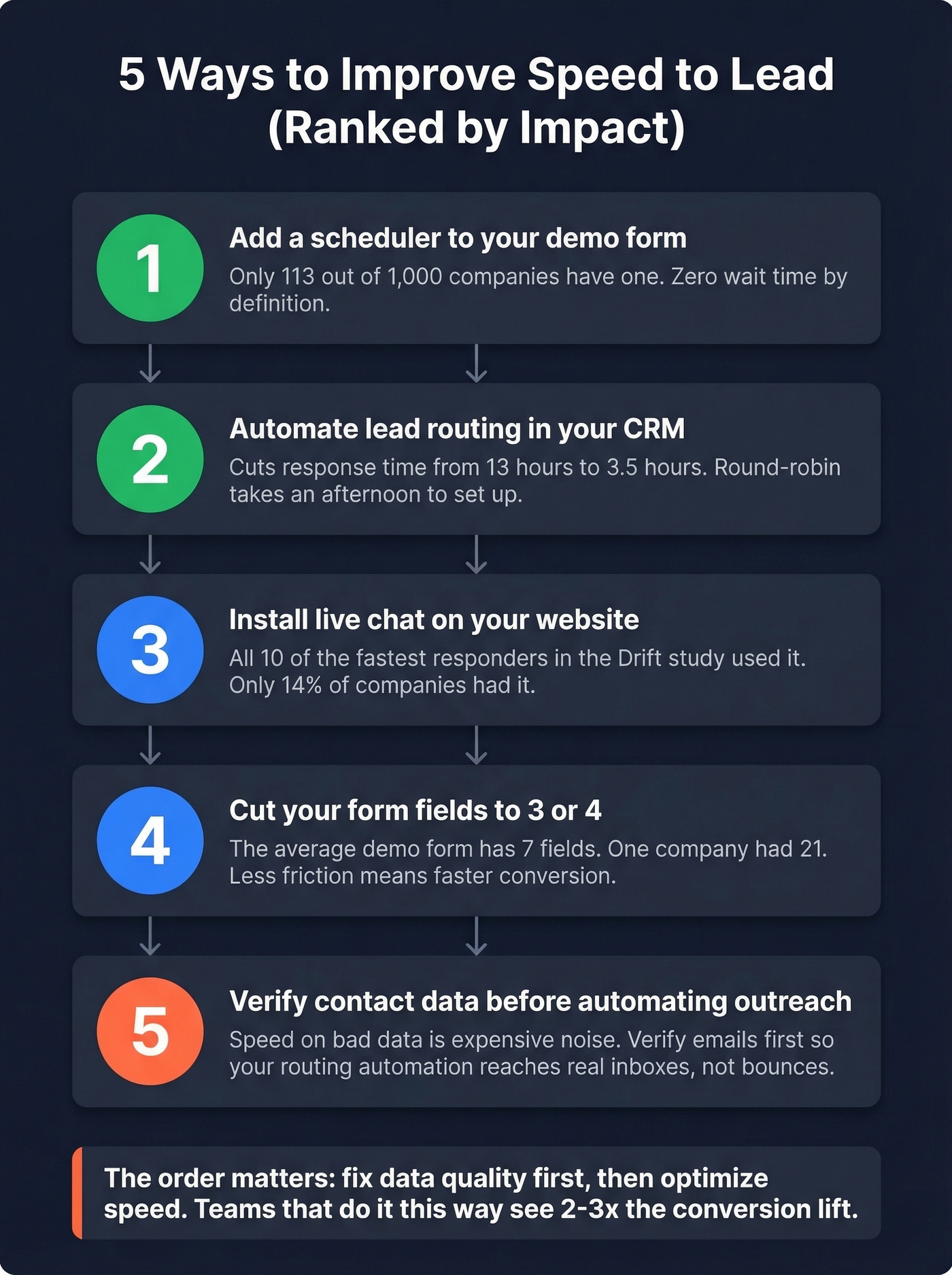
1. Add a scheduler to your demo form. Only 113 out of 1,000 companies have one. Tools like Chili Piper or RevenueHero let prospects book instantly - zero wait time by definition.
2. Automate lead routing in your CRM. Routing tools cut response time from ~13 hours to 3.5 hours. Round-robin assignment in HubSpot or Salesforce takes an afternoon to configure.
3. Install live chat. Every one of the 10 fastest responders in Drift's study used it. Only 14% of companies had it. The correlation is hard to ignore.
4. Cut your form fields. Seven is the average. Aim for 3-4. Not all leads need the same SLA either - a demo request warrants sub-5-minute response, but a whitepaper download can wait an hour.
5. Verify contact data before automating outreach. This is the step most teams skip. Prospeo checks emails in real time with 98% accuracy on a 7-day refresh cycle, so when your routing automation fires, it reaches a verified inbox - not a bounce. (If you're seeing issues, start with email bounce rate benchmarks and fixes.)
Let's be honest: most teams obsess over shaving seconds off response time when their real problem is that 30% of their contact records are dead on arrival. Fix the data layer first. Speed optimization on clean data is a force multiplier; speed optimization on dirty data is expensive noise.
Skip the speed optimization entirely if you haven't audited your bounce rate in the last 90 days. You're optimizing the wrong thing.
635 out of 1,000 companies never responded. The ones that did averaged a 29-hour delay. Prospeo's CRM enrichment returns 50+ verified data points per contact at 92% match rate - so when your lead routing fires, every email and phone number actually connects.
Respond in minutes with data that doesn't bounce - starting at $0.01 per email.
FAQ
What's a good speed to lead time?
Under 5 minutes is the research-backed standard - you're 21x more likely to qualify a lead at that threshold. Under 1 minute delivers 391% more conversions. Most B2B companies average over 24 hours, so hitting sub-5-minute response puts you ahead of roughly 95% of competitors.
What do lead follow-up statistics tell us about sales performance?
Lead follow-up statistics consistently show persistence matters almost as much as speed. The majority of reps give up after one or two attempts, yet it often takes five or more touches to connect. Pair fast initial response with a structured multi-touch cadence for the best results.
Why do most companies respond so slowly?
Manual lead routing, bloated forms, no scheduling tools, and zero after-hours coverage. 635 out of 1,000 companies never responded at all - only 11% had a scheduler installed. Automation closes most of the gap without adding headcount.
Does fast response matter if your contact data is bad?
No. If emails bounce or phone numbers are invalid, sub-minute follow-up reaches nobody. Verify data first, then optimize speed. That order matters more than most teams realize.