

SPIN Problem Questions: Examples, Mistakes, and How to Craft Your Own
You're five minutes into a discovery call. You've burned through your Situation questions - company size, current tools, reporting structure. The prospect is polite but checked out. You can feel the energy draining.
The gap isn't your product knowledge. It's that you never asked a question that made them think. You need better problem questions, and more importantly, you need to know how to build your own from scratch.
What Are SPIN Problem Questions?
Neil Rackham's SPIN framework is built on a landmark sales research study - 35,000+ sales calls across 23 countries over 12 years. The four question types map to the "investigating" phase of a sales call:
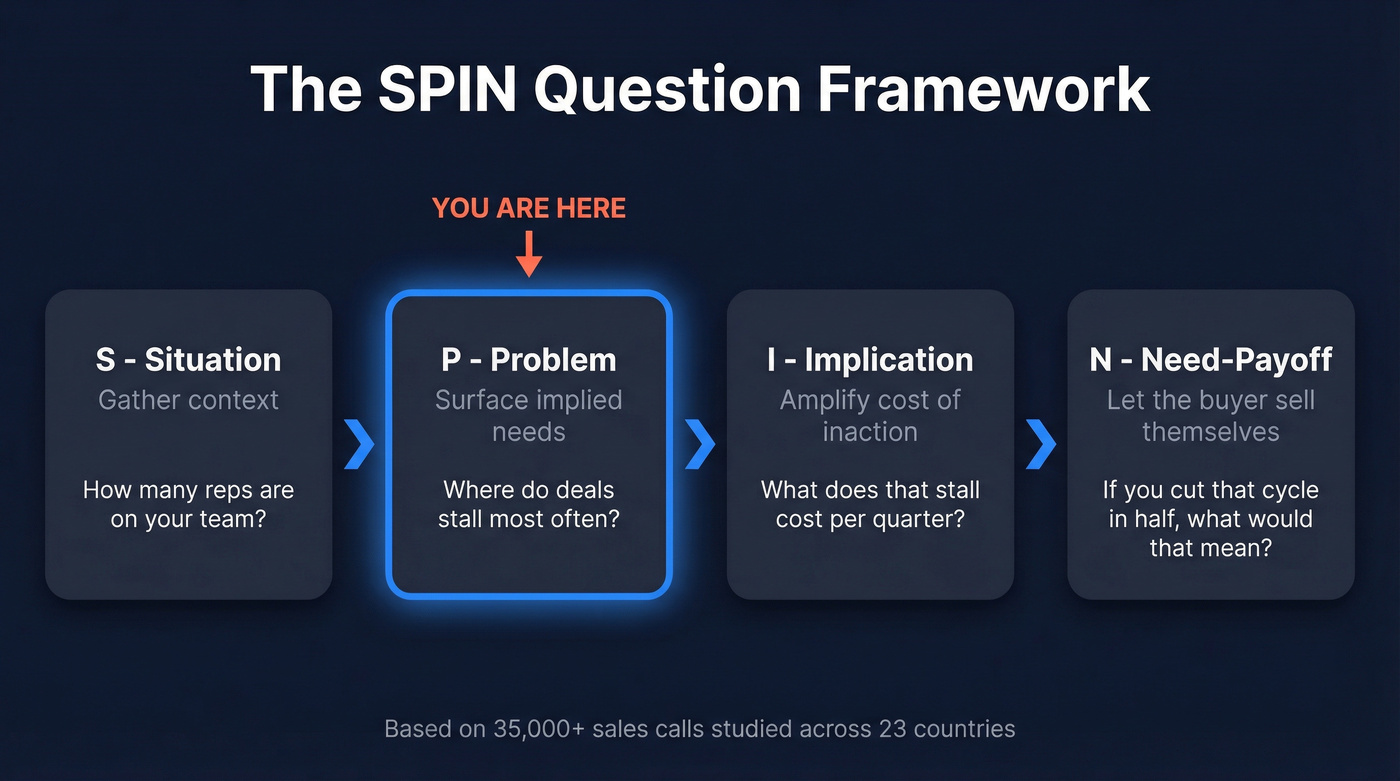
| Stage | Purpose | Example |
|---|---|---|
| Situation | Gather context | "How many reps are on your team?" |
| Problem | Surface implied needs | "Where do deals stall most often?" |
| Implication | Amplify the cost of inaction | "What does that stall cost per quarter?" |
| Need-Payoff | Let the buyer sell themselves | "If you cut that cycle in half, what would that mean?" |
Problem questions pull dissatisfaction into the open so you can develop it into an explicit need - the kind that actually drives buying decisions.
Why Problem Questions Matter
69% of buyers prefer reps who clearly understand their business problems. That's not a soft preference. It's the difference between getting a second meeting and getting ghosted.
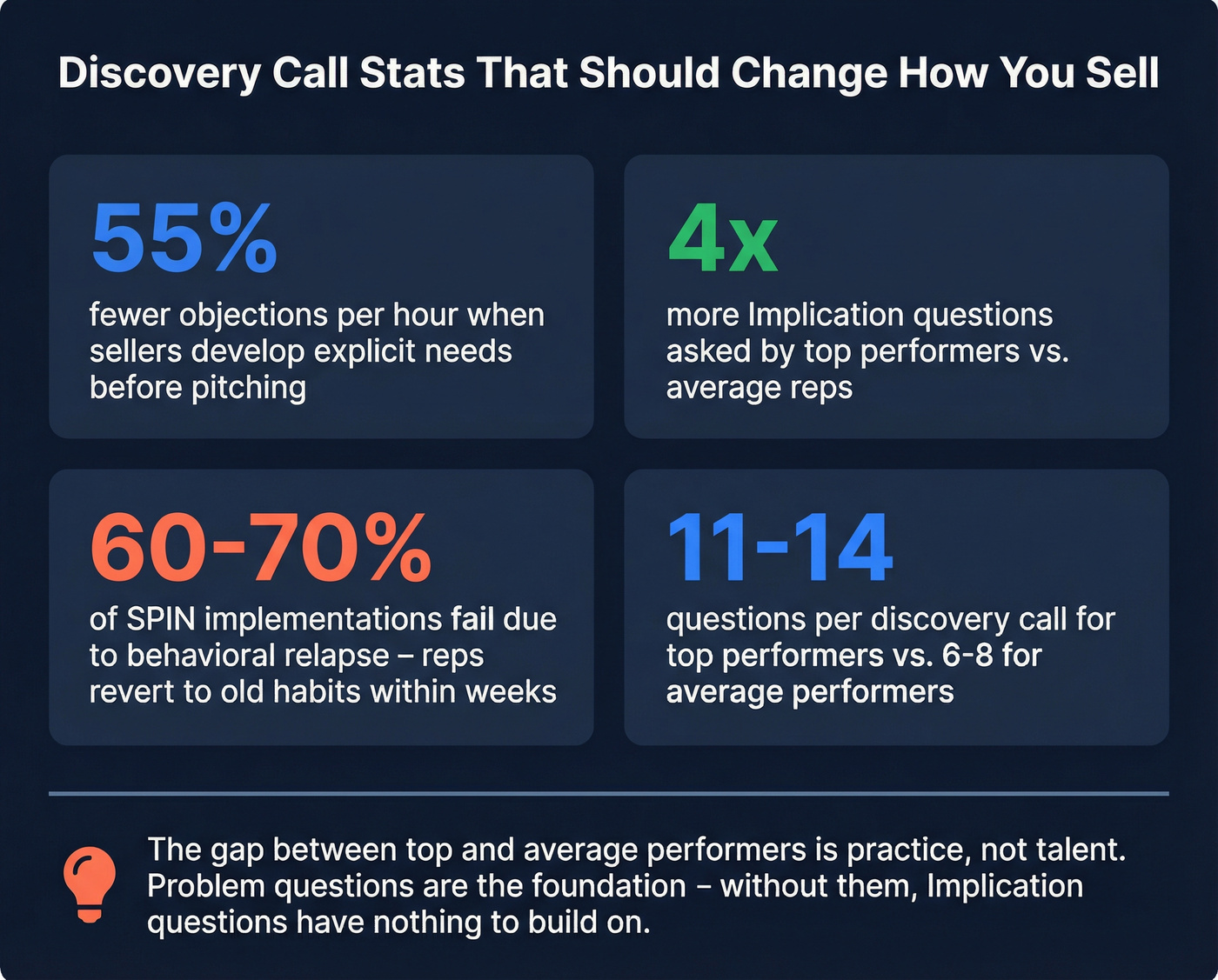
When sellers develop explicit needs before offering solutions, objections per selling hour drop by 55%. Top salespeople ask four times more Implication questions than average performers - but Implication questions only work if Problem questions have already surfaced real pain. You can't amplify a problem the prospect hasn't acknowledged. And in larger deals with 6-10 decision-makers, your Problem questions need to address organizational pain, not just individual frustration.
20+ Problem Question Examples by Industry
Use these as starting points, then customize for each prospect using the framework below.
SaaS / Technology
- "Which part of your onboarding process creates the most support tickets?"
- "How confident are you that you're picking up all the opportunities your team should be working?"
- "What happens when your current tool goes down - do you have a workaround, or does the team just stop?"
- "Where in your pipeline do deals stall most often, and do you know why?"
- "What holds your team back from hitting full adoption on your current platform?"
That "unknown unknowns" question - how confident are you that you're picking up all opportunities - comes from a real SaaS seller scenario on r/sales. It works because it doesn't accuse. It invites doubt.
Manufacturing
Manufacturing Problem questions hit hardest when they target the gap between what leadership thinks is happening on the floor and what actually happens day-to-day. Questions about downtime, scrap, and rework can uncover expensive operational bottlenecks fast.
- "How often does unplanned downtime disrupt your production schedule?"
- "What's your scrap rate look like compared to where you'd want it?"
- "Are you running into supply chain delays that affect delivery commitments?"
- "Which quality control step creates the most rework?"
Professional Services
- "How much time does your team spend on manual reporting that could be automated?"
- "What's the biggest bottleneck when onboarding a new client?"
- "Are you losing billable hours to internal admin work?"
- "What happens to your margins when scope creep goes unaddressed for a full quarter?"
Healthcare / Compliance
In compliance-heavy industries, frame questions around systems, not people. "Is patient data spread across systems that don't talk to each other?" feels safer than "Is your team making compliance mistakes?"
- "How do you track regulatory changes, and does anything fall through the cracks?"
- "Is patient data spread across systems that don't talk to each other?"
- "What happens when an audit reveals a documentation gap?"
Financial Services
- "How are you managing risk exposure across your portfolio right now?"
- "Is your current reporting fast enough for real-time decision-making?"
- "Where does your client onboarding process create the most friction for compliance?"

Your Problem questions are only as sharp as your pre-call research. Prospeo surfaces 50+ data points per contact - firmographics, technographics, funding, headcount growth - so you walk into every discovery call with specific, informed questions that make prospects think.
Stop guessing on calls. Start prospecting with 300M+ verified profiles.
Good vs. Bad: Side-by-Side
"What challenges do you face?" isn't a Problem question - it's a conversation filler. The difference between good and bad is specificity.
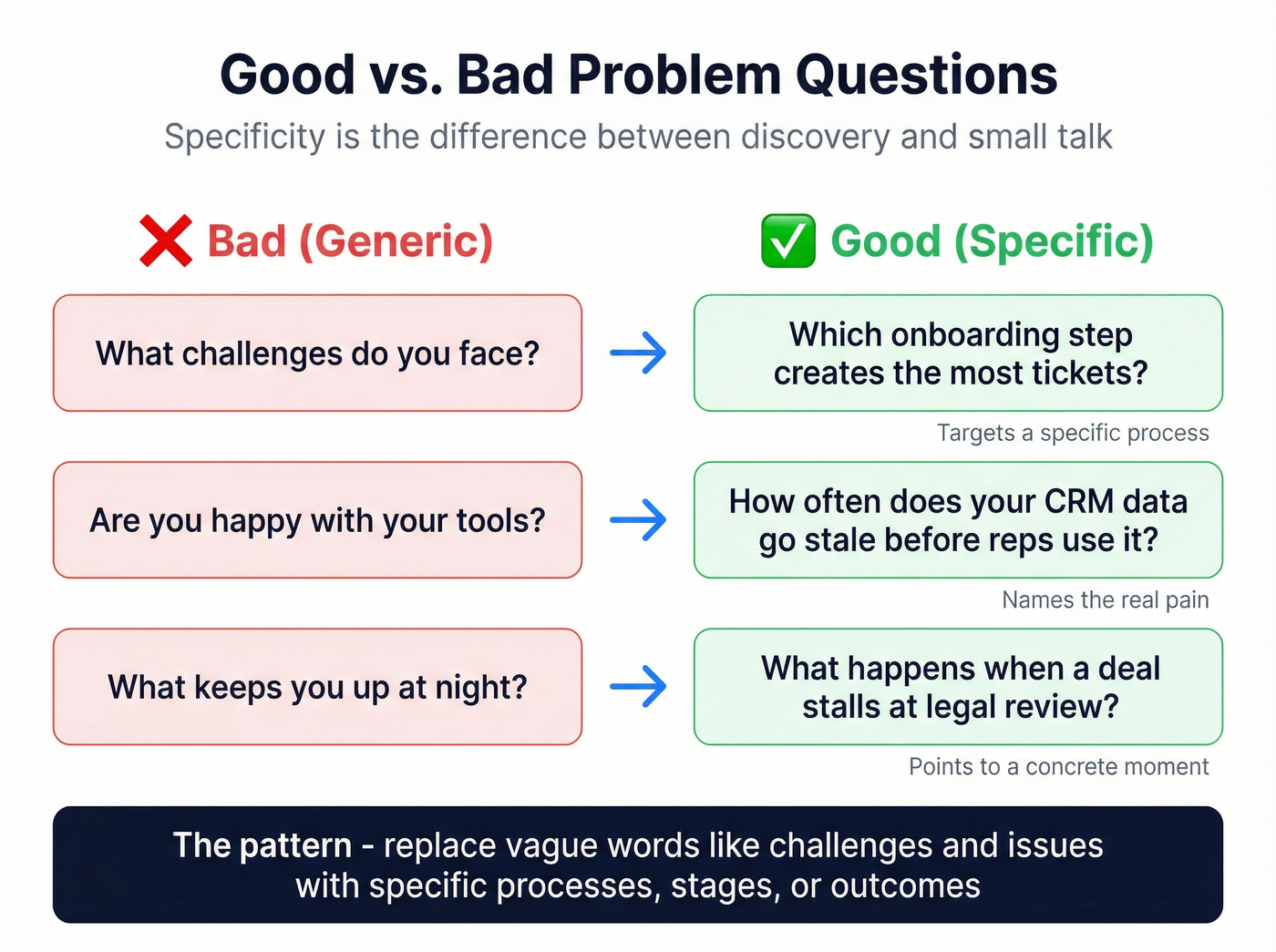
| ❌ Bad (Generic) | ✅ Good (Specific) | Why It's Better |
|---|---|---|
| "What challenges do you face?" | "Which onboarding step creates the most tickets?" | Targets a specific process |
| "Are you happy with your tools?" | "How often does your CRM data go stale before reps use it?" | Names the real pain |
| "What keeps you up at night?" | "What happens when a deal stalls at legal review?" | Points to a concrete moment |
The pattern: replace vague words like "challenges," "issues," and "concerns" with specific processes, stages, or outcomes the prospect actually manages.
Problem Questions in Action
Here's a manufacturing scenario adapted from a real r/techsales thread.
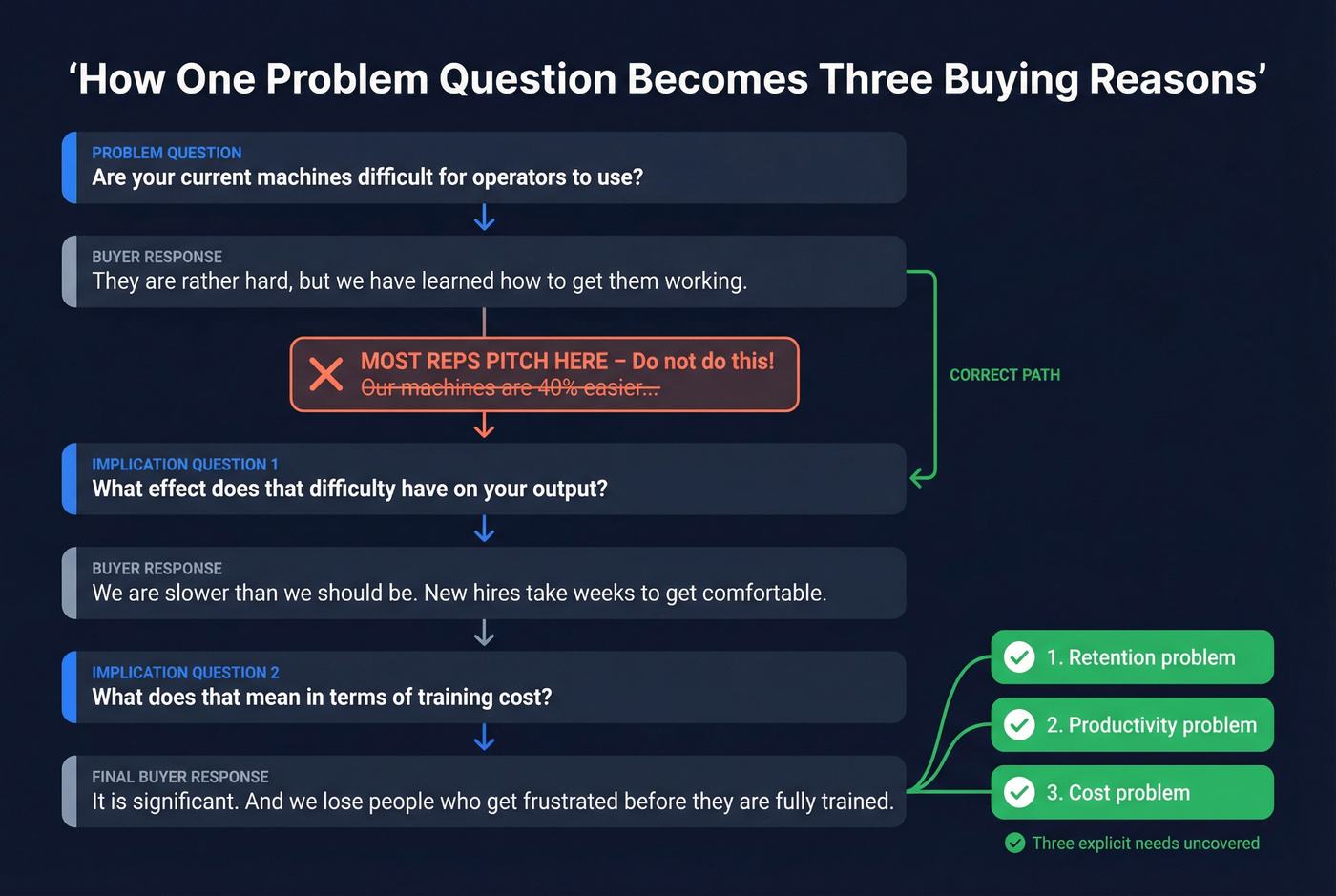
Seller: "Are your current machines difficult for your operators to use?"
Prospect: "They're rather hard, but we've learned how to get them working."
This is where most reps blow it. The prospect acknowledged a problem, and the instinct is to pitch. "Well, our machines are 40% easier to operate..." Don't.
Rackham's guidance is explicit: build the seriousness of the problem before offering a solution.
Seller: "What effect does that difficulty have on your output?"
Prospect: "We're slower than we should be. New hires take weeks to get comfortable."
Seller: "What does that mean in terms of training cost?"
Prospect: "Honestly, it's significant. And we lose people who get frustrated before they're fully trained."
Now the prospect isn't describing a minor inconvenience. They're describing a retention problem, a productivity problem, and a cost problem - all from one Problem question followed by two Implication questions. That's the sequence working as designed.
How to Craft Your Own Problem Questions
Stop memorizing SPIN question lists. Memorized questions sound memorized. Here's the three-step pre-call workflow we use:
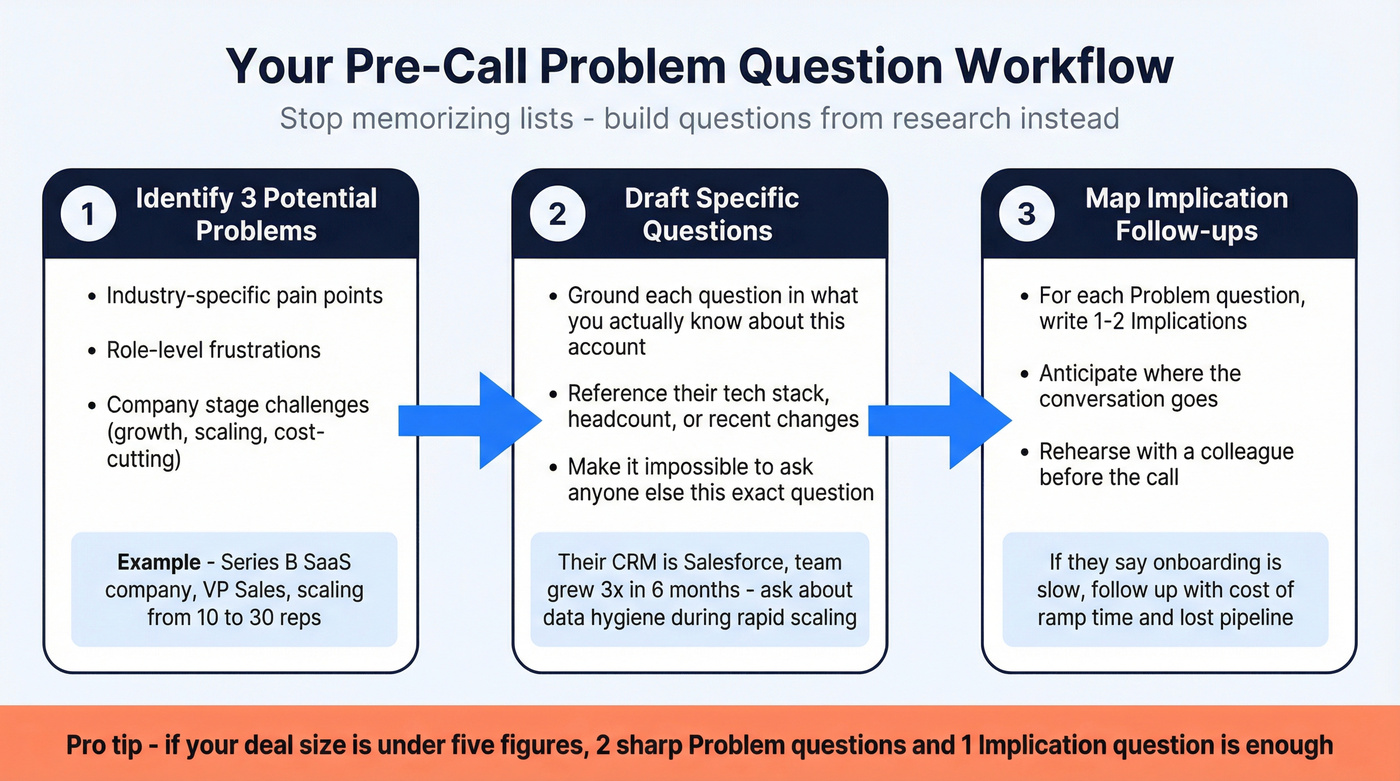
- Write down three potential problems based on the prospect's industry, role, and company stage.
- Draft a specific Problem question for each. Not a template you'd ask anyone - something grounded in what you actually know about this account.
- Anticipate where each leads and write Implication follow-ups.
Run through these three problems with a colleague before the call. Rehearsed questions sound natural; memorized ones don't. Buyers complete 70-80% of their purchase journey before talking to sales, so your Problem questions need to reflect research, not cold guessing.
Tools like Prospeo surface 50+ data points during enrichment - firmographics, technographics, headcount growth, recent funding - so you can skip generic Situation questions and jump straight to targeted Problem questions grounded in real context.
Here's the thing: if your average deal size is under five figures, you probably don't need a 14-question discovery framework. Two sharp Problem questions and one Implication question will do more than a rigid SPIN checklist. The framework is a thinking tool, not a script.
Mistakes That Kill Discovery
60-70% of SPIN implementations fail due to behavioral relapse - reps learn the framework in a workshop and revert to old habits within weeks. Top performers ask 11-14 questions per discovery call vs. 6-8 for average performers. That gap is practice, not talent.
The most common execution failures we've seen across our own team and the teams we talk to:
Pitching after the first problem surfaces. One acknowledged problem isn't enough to build urgency. Develop it with Implication questions first. This is the single biggest mistake, and it happens constantly.
Staying surface-level. "What keeps you up at night?" gets a cliche answer. Get specific or don't bother asking.
Skipping to Implication without enough Problem depth. If you haven't uncovered two or three distinct problems, your Implications feel like leading questions - and prospects notice.
Machine-gunning questions without listening. Firing five Problem questions without pausing for answers is just as damaging as asking none. Let's be honest: if you're reading from a list during the call, you've already lost.
If you want a tighter structure for qualification, many teams pair SPIN with MEDDIC discovery questions to keep pain, metrics, and process aligned.
FAQ
How many Problem questions should I ask per call?
Aim for 2-4 strong Problem questions before transitioning to Implication questions. Top performers average 11-14 total discovery questions per call, so budget roughly a third for surfacing pain and let the conversation guide you.
What's the difference between Problem and Implication questions?
Problem questions uncover what's broken. Implication questions make the prospect feel the cost. Problem: "Is onboarding slow?" Implication: "What does that cost in lost revenue per quarter?" You need both, but Problem comes first.
Do SPIN Problem questions work on cold calls?
Yes, but only with pre-call research. A cold Problem question lands when it's specific to the prospect's industry and role. Pull verified contact data and company context before dialing so you're asking informed questions, not guessing.
Can I combine SPIN with other sales frameworks?
Absolutely. Many teams layer SPIN's discovery questions into MEDDIC or Challenger Sale workflows. The Problem-to-Implication sequence is framework-agnostic - it works anywhere you need to surface and develop buyer pain before proposing a solution.
Master the Problem question, and the rest of SPIN falls into place.
If you're building a full outbound motion around this, it helps to standardize your sales prospecting techniques and track pipeline health so discovery insights actually translate into revenue.
The best SPIN sellers don't wing it - they research. With 30+ search filters including buyer intent, job changes, and tech stack data, Prospeo gives you the context to craft Problem questions that hit real pain points, not generic conversation fillers.
Turn pre-call research from 15 hours into 2 - starting at $0.01 per lead.