

SPIN Selling Examples That Actually Sound Like Real Conversations
Most spin selling examples read like textbook excerpts - the same four question types, the same generic scenarios, zero sense of what an actual conversation sounds like. You've read the book. You know what S, P, I, and N stand for. What you need are dialogues where you can hear the rhythm of a real discovery call and steal the structure for your own.
One seller on r/sales described it perfectly: after applying SPIN to workers' comp renewal calls, they saw a 100% increase in applications - "more apps by lunch time than I would after an entire day." Their calls stopped feeling like a grind. That's what good SPIN execution does. It turns interrogation into conversation.
What You Need (Quick Version)
Three things separate reps who've read SPIN Selling from reps who use it:
Build question chains, not question lists. A Situation question should set up a Problem question, which triggers an Implication chain, which lands on a Need-Payoff. They're connected, not random. Jump to full dialogues →
Master the Implication Chain Math. Quantify pain in dollars. "Reporting takes 10 hours a week" becomes "$26,000 in lost productivity per year." That's the moment a prospect's eyes widen. Jump to the math template →
Replace Situation questions with pre-call research. Don't minimize them - eliminate them. Every Situation question you ask is one the prospect wishes you already knew. Jump to modern SPIN →
What Is SPIN Selling?
SPIN Selling comes from Neil Rackham's research with Huthwaite International - 35,000+ sales calls studied over 12 years across 13 countries, originally funded by Xerox. The question that launched the whole project: why do the top 10% of salespeople outsell the bottom 10% by 3:1?
The answer wasn't charisma, closing techniques, or objection handling. It was questions. Specifically, the type of questions. Rackham found that top performers followed the same pattern regardless of geography - whether they were selling in Scandinavia or Southern Europe. He mapped these four question types to four selling stages/05%3A_The_Sales_Presentation/5.04%3A_Using_the_SPIN_Method) (Opening, Investigating, Demonstrating Capability, and Obtaining Commitment), but the question types are what matter in practice. Early trainees saw a 17% improvement in sales results.
SPIN is an acronym for four question types that build on each other:
- Situation - gather facts about the prospect's current state
- Problem - surface pain points and challenges
- Implication - expand the consequences of those problems
- Need-Payoff - get the prospect to articulate the value of solving
The framework isn't a script. It's a conversational architecture. Let's break down each type with a working example for every stage, then watch them work together in full dialogues.
The Four SPIN Question Types (With Examples)
Situation Questions
Situation questions gather facts: company size, current tools, team structure, processes. They're necessary - but Rackham's data shows the more Situation questions in a call, the less likely that call was to succeed. Senior buyers especially hate them because they feel like you didn't do your homework.
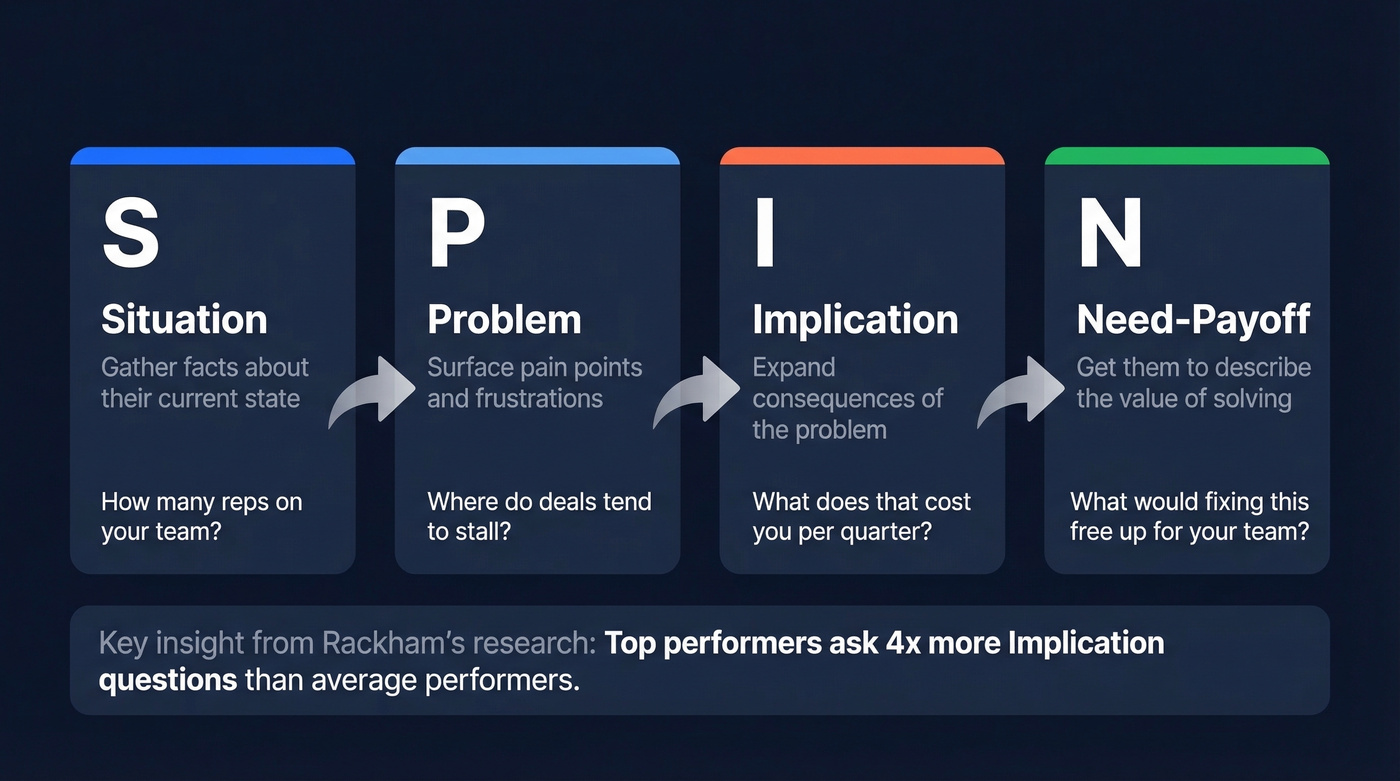
Limit yourself to one or two, max. Better yet, do your research beforehand and skip them entirely.
Examples:
- "How many reps are on your outbound team right now?"
- "What CRM are you running?"
- "Walk me through how a new lead gets routed today."
- "Who's involved in evaluating new vendors?"
- "What does your current tech stack look like for prospecting?"
Mini-dialogue:
Rep: "I saw you're running Salesforce with about 40 reps across two regions - is that still accurate?" Prospect: "Close. We're at 45 now, added a LATAM team last quarter." Rep: "Got it. How's ramping that new team going?"
One Situation question. Confirmed with research. Pivoted immediately to a Problem question. That's the goal.
Problem Questions
Problem questions surface implied needs - the frustrations, inefficiencies, and gaps the prospect lives with daily. These are where the conversation starts getting interesting, because you're asking the prospect to name their own pain.
Skip this section if you're still fishing for basic facts about the account. That means you need more research, not more Problem questions.
Examples:
- "What's the biggest bottleneck when onboarding new reps?"
- "Where do deals tend to stall in your pipeline?"
- "How often do integration issues slow down your team?"
- "What's frustrating about your current reporting workflow?"
- "Where are you seeing the most churn in your pipeline right now?"
- "What breaks first when your team tries to scale outbound?"
Mini-dialogue:
Rep: "How's ramping that new team going?" Prospect: "Honestly, it's been rough. Our playbooks are built for North America, and the LATAM reps are struggling with localization." Rep: "What does that look like day-to-day?" Prospect: "Reps are improvising. Messaging is inconsistent. We're seeing lower connect rates across the board."
The prospect just handed you the thread. Now you pull it.
Implication Questions
This is where deals are won or lost. Rackham's research found that top performers ask four times more Implication questions than average performers. Most reps ask two or three and then jump to their pitch. That's leaving money on the table.
Implication questions expand a problem into its full consequences. A useful framework for generating them: think people, process, and price. For every problem the prospect names, ask yourself - who else does this affect? What processes break downstream? What does it cost?
Here's the thing most training programs won't tell you: the best implication questions often double as qualification questions. "What happens if you don't solve this by end of quarter?" isn't just expanding consequences - it's testing whether the prospect has real urgency or is just browsing. If they shrug, you're probably talking to the wrong person.
Examples:
- "When reps improvise messaging, how does that affect your win rates?"
- "If connect rates stay low in LATAM, what happens to your Q3 targets?"
- "How much time is your sales manager spending fixing inconsistent outreach instead of coaching?"
- "What's the downstream impact on customer experience when onboarding takes twice as long?"
- "If this doesn't get fixed this quarter, what does that mean for your hiring plan?"
- "How does that inconsistency affect your ability to forecast accurately?"
Mini-dialogue:
Rep: "When messaging is inconsistent across regions, how does that show up in your pipeline?" Prospect: "Conversion from first call to demo is about half what it is in North America." Rep: "So if your LATAM team is running 200 calls a month but converting at half the rate, that's roughly 100 missed demos per month. What does a demo-to-close rate look like for you?" Prospect: "About 25%." Rep: "So that's 25 deals a month you're not closing. At your average deal size, what does that represent?" Prospect: "...that's a lot of revenue."
That's an implication chain. You didn't tell the prospect the problem was big. They calculated it themselves.
Need-Payoff Questions
Need-Payoff questions flip the lens from present-negative to future-positive. Where Implication questions build urgency by expanding consequences, Need-Payoff questions build vision by getting the prospect to describe what solving the problem would mean.
Why they matter: The prospect sells themselves on the solution. You create explicit needs (stated desires) from implied needs (vague frustrations). Your pitch feels like a natural answer, not a hard sell.
What happens if you skip them: You've built urgency but no vision - the prospect feels pain without hope. You end up pitching features instead of letting the prospect describe their ideal outcome.
Examples:
- "If your LATAM reps had localized playbooks on day one, how would that change ramp time?"
- "What would it mean for your Q3 number if LATAM conversion matched North America?"
- "If you could cut onboarding from 8 weeks to 4, what would your managers do with that time?"
- "How would it change your forecasting if every rep followed the same playbook?"
- "What would it free up for your team if reporting happened automatically?"
Mini-dialogue:
Rep: "If you could get LATAM reps to North American conversion rates within their first quarter, what would that do for your annual target?" Prospect: "We'd probably hit plan for the first time in three quarters. And honestly, it would take a ton of pressure off our VP." Rep: "And if the playbooks were already localized before reps started - so they weren't improvising from day one?" Prospect: "That would change everything. We'd actually be able to scale the team instead of constantly firefighting."
The prospect just described your solution without you pitching it. That's the power of Need-Payoff done right.
Full SPIN Conversation Examples
SaaS Discovery Call
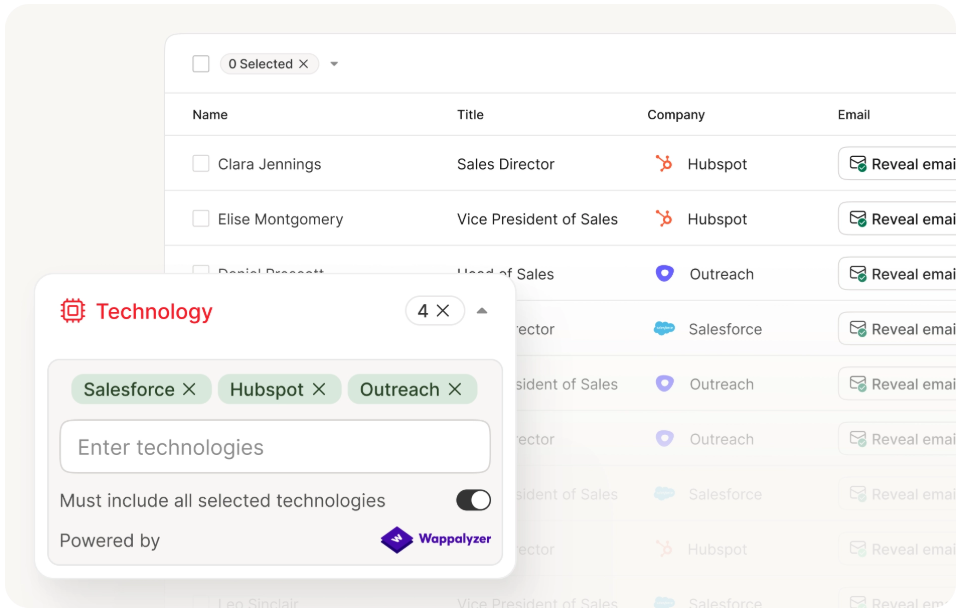
Context: A rep selling a sales enablement platform is calling a VP of Sales at a 200-person SaaS company. Before the call, the rep pulled the prospect's technographics, recent headcount growth (12 new sales hires in 90 days), and department structure - so they're skipping Situation questions entirely.
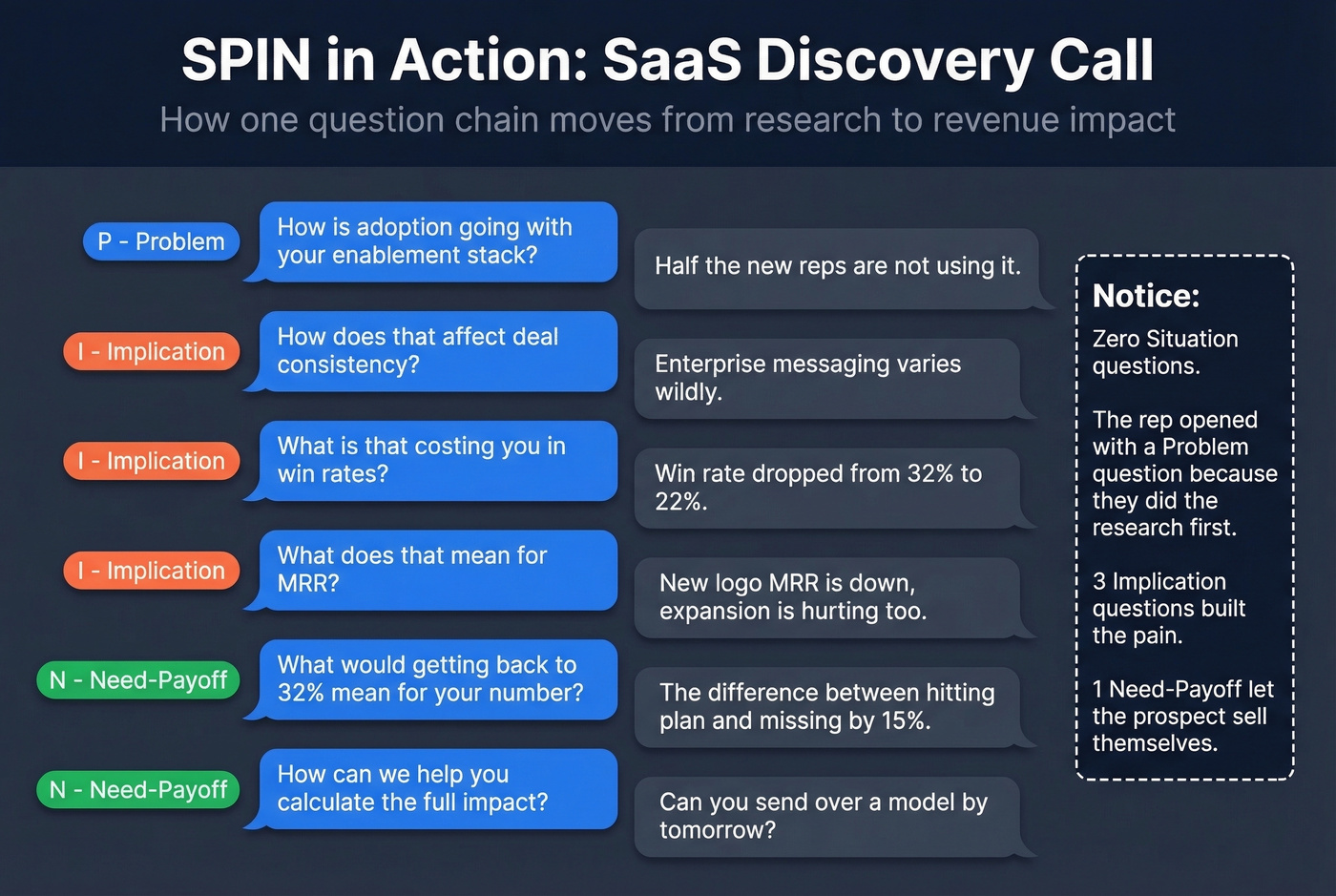
Rep: "I noticed you've added about a dozen reps in the last quarter. How's adoption going with your current enablement stack?"
Prospect: "It's been a challenge. We're on [Tool X], but honestly, half the new reps aren't using it. They're building their own decks."
Rep: "When reps build their own materials, how does that affect deal consistency?"
Prospect: "It's all over the place. Our enterprise deals especially - messaging varies wildly depending on who's running the call."
Rep: "What does that inconsistency cost you on enterprise deals? Are you seeing it in win rates?"
Prospect: "Our enterprise win rate dropped from 32% to about 22% since we scaled the team. That's millions in pipeline we're not converting."
Rep: "A 10-point drop on enterprise - what does that mean for your MRR? Are you seeing it in expansion revenue too, or just new logos?"
Prospect: "Both. New logo MRR is down, and the inconsistent onboarding experience is hurting expansion. Customers who had a rough sales process don't expand."
Rep: "If every rep - new or tenured - had the same battle-tested messaging for enterprise calls from their first week, what would getting back to 32% mean for your number?"
Prospect: "That's the difference between hitting plan and missing by 15%. It's a board-level conversation at this point."
Zero Situation questions. The rep opened with a Problem question because they'd already done the research. The MRR question is what makes this a SaaS discovery call instead of a generic one - it connects the operational problem to the metric the CFO cares about.
Medical Device Sales
Context: A medical device rep is meeting with a physician about a diagnostic workflow. The rep confirmed panel volume beforehand but opens with it to establish credibility - one of the rare cases where a single Situation question builds rapport rather than wasting time.
Rep: "Dr. Patel, I know your clinic runs about 40 diagnostic panels a week. How's the turnaround time on results?"
Prospect: "It's slow. We're sending everything to an outside lab, so we're looking at 48 to 72 hours."
Rep: "When results take three days, what happens to the patient's treatment timeline?"
Prospect: "They wait. Sometimes they don't come back for the follow-up. We lose them."
Rep: "How many patients would you estimate you lose to follow-up drop-off in a given month?"
Prospect: "Probably eight to ten. And those are patients who need treatment - it's not elective."
Rep: "What's the downstream impact when those patients delay treatment by weeks or months?"
Prospect: "Conditions worsen. They end up in the ER. It's worse outcomes for them and higher costs for the system."
Rep: "If you could get results same-day - right in the clinic - how would that change your follow-through rate?"
Prospect: "Dramatically. If I can show them results while they're sitting in front of me, we start treatment that day. No drop-off."
The doctor did most of the talking. That's the sign of a well-run medical sales call.
Manufacturing Sales
Context: A rep selling industrial equipment maintenance software is talking to an operations director at a mid-size manufacturer.
Rep: "I understand you're running about 15 CNC machines across two shifts. When one goes down, what's your current process for getting it back online?"
Prospect: "We call our maintenance guy, he diagnoses it, then we order parts. If it's an older machine, finding parts can take a week."
Rep: "A week of downtime on a CNC machine - what does that do to your production schedule?"
Prospect: "It cascades. We miss delivery dates. Last month we had to call a client and push a $180,000 order back two weeks. Embarrassing."
Rep: "When you push a delivery like that, what's the impact on the client relationship?"
Prospect: "They start looking at other shops. We've lost two accounts this year that I can directly trace to late deliveries."
Rep: "If you could predict which machines were likely to fail before they went down - and have parts staged in advance - what would that mean for your delivery commitments?"
Prospect: "We'd stop losing clients to something that's completely preventable. That's probably $400K in revenue we left on the table this year."
The implication chain here went from "parts are hard to find" to "$400K in lost revenue." That's the math that closes deals.

The article says it clearly: every Situation question you ask is one the prospect wishes you already knew. Prospeo gives you 50+ data points per contact - company size, tech stack, funding, headcount growth - so you walk into discovery calls armed with context, not fishing for basics.
Replace Situation questions with pre-call intel at $0.01 per lead.
The Implication Chain Math
This is the single highest-ROI SPIN technique, and most reps never use it.
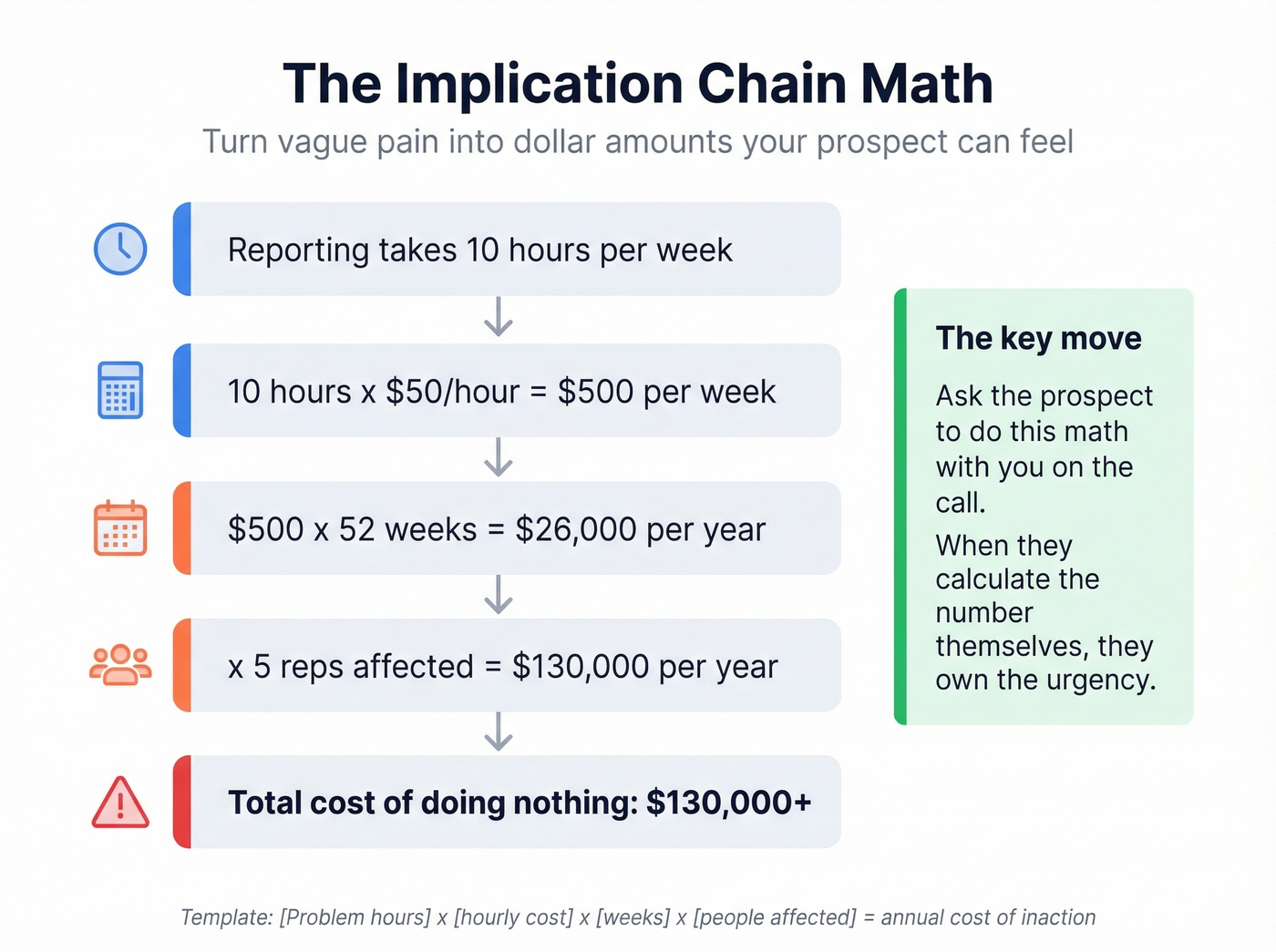
Worked example:
- Prospect says: "Our reporting process takes forever."
- Quantify: "How many hours per week does your team spend on reporting?" - 10 hours/week
- Annualize: 10 hrs x 52 weeks = 520 hours/year
- Dollarize: 520 hrs x $50/hr (loaded cost) = $26,000/year in lost productivity
- Flip to Need-Payoff: "What could your team do with 520 extra hours a year?"
Blank template - copy this into your CRM notes before every discovery call:
- Problem: _______________
- Weekly time/cost impact: ___ x 52 = ___ annual hours
- Dollar cost: ___ hours x $___ loaded rate = $___ /year
- Need-Payoff question: "What would your team do with ___ extra hours?"
The numbers don't have to be precise. They have to be real enough that the prospect starts doing their own math. Once they're calculating, they're selling themselves.
Common SPIN Mistakes
Five mistakes we see repeatedly - and in our experience, fixing even one of these transforms a rep's discovery calls overnight.
Too many Situation questions. Move them off the call entirely. If you're asking "How big is your team?" you didn't prepare.
Weak Implication questions. Use the people/process/price lens. For every problem, ask who else it affects, what processes break, and what it costs.
Treating SPIN as a rigid S-P-I-N script. It's a framework, not a sequence. Real conversations loop back. You'll hit a new Problem question after an Implication chain. That's fine - it means the prospect is opening up.
Answering your own Need-Payoff questions. Ask the question and shut up. "What would it mean if you could cut onboarding time in half?" Then wait. The prospect's answer is worth more than your pitch. We've watched reps on recorded calls ask a perfect Need-Payoff question, wait two seconds, panic at the silence, and start listing features. Don't be that rep.
Skipping from Problem straight to pitch. You haven't built urgency yet. Without Implication questions, the prospect thinks their problem is manageable. Implication is what makes it urgent.
How to Use SPIN Selling in 2026
Here's the hot take: if your average deal size is under five figures, you don't need three sales methodologies. You need one you actually practice. Stop memorizing questions. Start building chains.
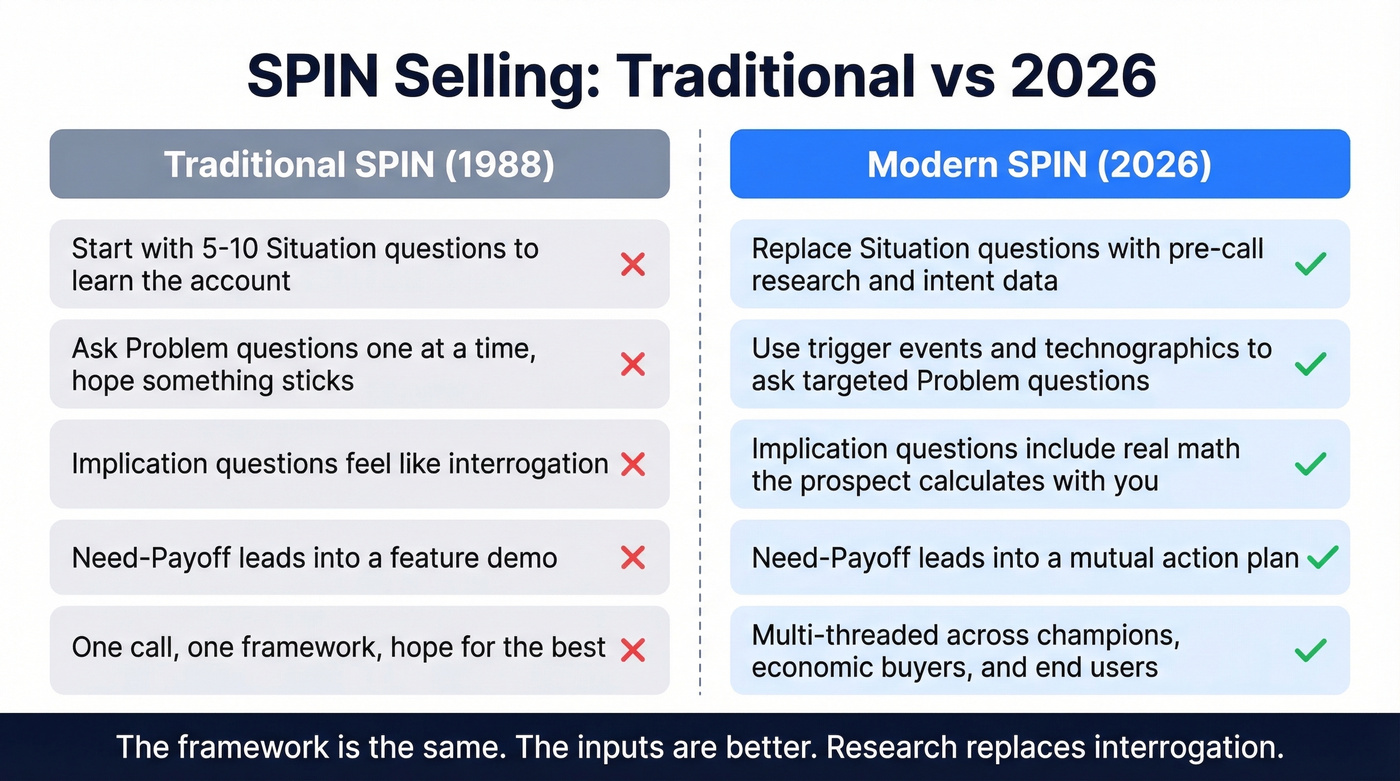
Modern B2B buyers complete 70-80% of their purchase journey before talking to sales. By the time they're on a call with you, they don't want to answer "Tell me about your company." They want you to already know. The consensus on r/sales is that SPIN remains relevant because it's fundamentally about connection - guiding a prospect through an emotional and logical journey. But the execution has to evolve.
The biggest evolution is treating Situation questions as a research task, not a call task. Tools like Prospeo give you 50+ data points per contact before you ever pick up the phone - technographics, funding, revenue, headcount growth, department headcount, and job changes. With data refreshed every 7 days instead of the industry average of 6 weeks, you're walking into every call with context that used to take three Situation questions to gather. Your first question becomes a Problem question, not "So what does your company do?"
If you want a deeper library of talk tracks beyond SPIN, start with discovery questions and then build your own chains from there.
Research from discovery call analytics shows top performers ask 11-14 questions per discovery call versus 6-8 for average performers. But quality matters more than count. Every question should be Problem, Implication, or Need-Payoff. If you're burning three of your 12 questions on Situation, you're wasting 25% of your discovery on information you could've found in two minutes of research.
SPIN vs Challenger vs MEDDIC
| Methodology | Core Mechanism | Best For | Key Limitation |
|---|---|---|---|
| SPIN | Discovery questioning | Complex sales | No qualification rigor |
| Challenger | Insight-led reframing | Commoditized markets | Needs deep industry expertise |
| MEDDIC | Qualification discipline | Enterprise pipeline | Heavy process overhead |
For complex enterprise deals, layer all three: SPIN for discovery, Challenger for the insight that reframes the problem, MEDDIC for qualifying whether the deal is real. Gap selling borrows heavily from SPIN's implication stage - if you've mastered implication chains, you already understand the core of gap selling.
For SMB and mid-market? SPIN alone gets you 80% of the way. It's the foundation everything else builds on.
Most reps don't need three methodologies. They need one they actually practice. If you're going to pick one, SPIN's question framework has the most research behind it and the lowest implementation barrier. These spin selling examples give you the starting structure - but the highest-converting questions will always be the ones you tailor to your prospect's world.
If you want a ready-to-run talk track, use a SPIN Selling script and customize the prompts to your ICP.
Great Implication questions require reaching the right decision-maker in the first place. Prospeo delivers 98% verified emails and 125M+ direct dials with a 30% pickup rate - so your SPIN conversations happen with buyers who actually have the authority and urgency to act.
Stop perfecting questions for prospects who never pick up the phone.
FAQ
Is SPIN selling still effective in 2026?
Yes. Rackham's core insight - that questions beat pitches and implication questions beat feature dumps - is backed by 35,000+ call studies and hasn't been disproven. What's changed is execution: move Situation questions off the call through pre-call research, and quantify every implication in dollars. The framework is as sound as ever; delivery needs to match modern buyer expectations.
How many questions should I ask on a discovery call?
Top performers ask 11-14 questions per discovery call, but every question should be Problem, Implication, or Need-Payoff. If you're asking six questions and four are Situation, you're running a worse call than someone who asks twelve and skips Situation entirely.
What's the difference between Implication and Need-Payoff questions?
Implication questions are present-negative - they expand the consequences of inaction ("What does that cost you per quarter?"). Need-Payoff questions are future-positive - they get the prospect to describe the value of solving ("What would fixing that free up?"). You need both: urgency without vision creates anxiety, not action.
What's the hardest part of SPIN selling?
Implication questions, by a wide margin. Most reps generate two or three and stall. The fix: for every problem the prospect names, run it through the people/process/price framework - who else does this affect, what processes break, what does it cost in dollars? Then use the implication chain math to quantify. Practice generating ten Implication questions per Problem until the pattern becomes instinct.
Can I use SPIN for cold outreach?
SPIN is a discovery framework, not a cold-call script, but the pre-call research mindset absolutely applies. Gather technographics, headcount changes, and funding data before any outreach so your first touchpoint references a specific problem rather than "I'd love to learn about your challenges." Cold emails built on real prospect context consistently outperform generic templates.