

How to Manage Your Sales Pipeline (Without Drowning in Zombie Deals)
Your pipeline says 4.2x coverage. Your forecast says you'll hit quota. But a third of those deals haven't had a meaningful buyer interaction in six weeks - they're ghosts wearing opportunity labels. 63% of sales managers admit their org does a poor job managing the sales pipeline, and with sales cycles running 21% longer than they were in 2020, the cost of a bloated pipe has never been higher. Average quota attainment sits at just 43%. Companies that optimize pipeline management grow revenue 28% faster.
Something's broken - and it's probably not your reps.
Here's the short version of what works:
- Pipeline coverage should be 3-5x quota, calculated as 1 / win rate. Below 2x = danger. Above 5x = graveyard.
- Hold 1:1 pipeline reviews weekly, 30 minutes, focused on 5-8 deals. Cancel the team-wide status meeting.
- Fix your data before your process - if more than 5% of prospecting emails bounce, no framework saves you.
What Is Sales Pipeline Management?
Sales pipeline management is the discipline of tracking, advancing, and pruning active deals through defined stages - from first contact to closed revenue. It's how reps and managers keep deals moving and forecasts honest.
People confuse pipeline with funnel constantly. Pipeline = deals. Funnel = rates. Your pipeline is the set of active deals and their current stages, what reps manage daily. Your funnel is the conversion math across the buyer journey, what leadership analyzes for marketing-to-sales handoff health.
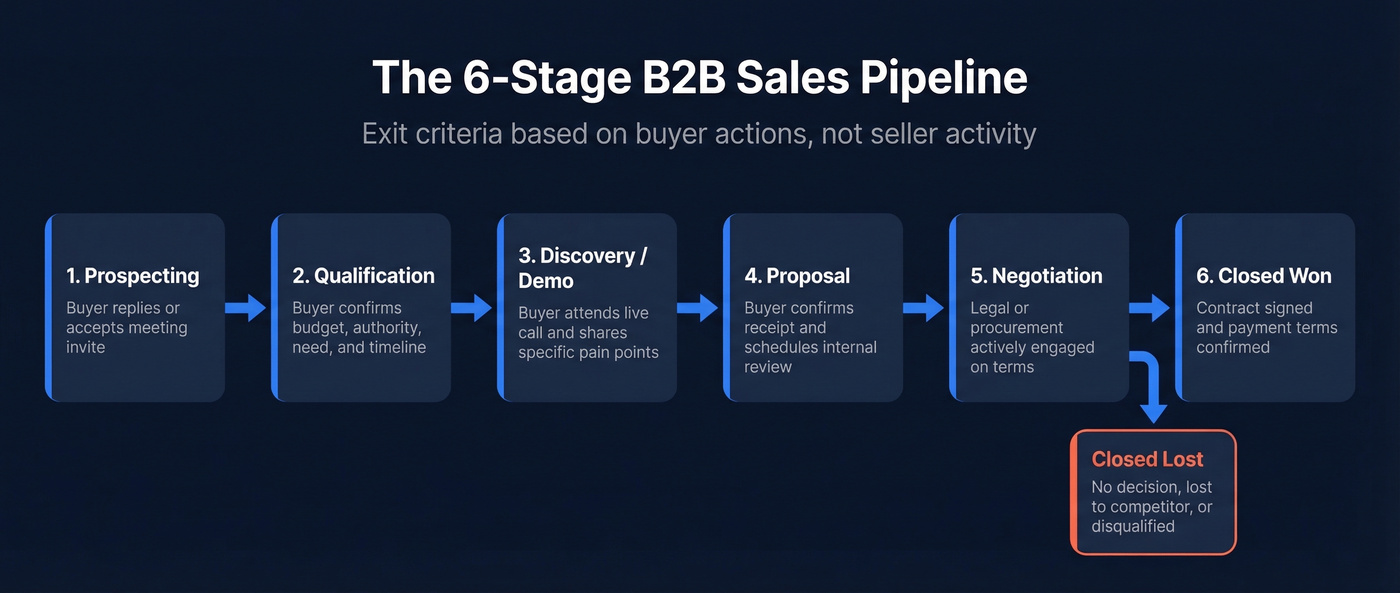
A typical B2B pipeline runs around 6-7 stages. The exact labels vary, but the structure doesn't:
- Prospecting: Identified a potential buyer, initiated outreach.
- Qualification: Confirm budget, authority, need, and timeline (BANT).
- Discovery/Demo: Buyer attends a live conversation and shares pain points.
- Proposal: Pricing and scope delivered; buyer circulates internally.
- Negotiation: Terms discussed, legal/procurement engaged.
- Closed Won / Closed Lost: Deal resolves.
Here's the concept most teams miss: exit criteria should be based on customer actions, not seller activity. "Rep sent proposal" isn't an exit criterion. "Buyer confirmed receipt and scheduled internal review" is. That distinction separates functional pipelines from fiction.
Why Most Teams Struggle With Pipeline Health
Pipeline management sounds simple. Track deals, move them forward, close them. Three failure modes make it anything but.
Pipeline Inflation Under Pressure
Leadership wants 3x coverage. Reps know this. So they keep deals alive that should've been disqualified weeks ago - because removing a $50K opportunity from the pipe means explaining the gap.
One r/sales thread captures this perfectly: a rep described labeling tasks "Final Decision" for weak deals and "Close" for real ones, so both look similar in the CRM but the rep can actually prioritize. If your team needs workarounds like that, your process is broken. You're incentivizing fiction.
Cognitive Overload at Scale
An enterprise AE managing ~40 active deals isn't managing anything - they're reacting. Another Reddit post from an AE using HubSpot and Gong described feeling "reactive rather than proactive," overwhelmed by follow-ups and momentum management across dozens of accounts. Most reps spend only 28-30% of their time actually selling. High-performing teams hit 60-70%. The gap isn't talent. It's process and data quality.
Bad Data at the Top of Funnel
Here's the thing nobody writes about in pipeline guides: garbage in, garbage out. If 20-35% of your prospecting emails bounce and half your phone numbers are dead, your pipeline starves before process even matters. You can have perfect stage definitions and weekly reviews, but if reps can't reach the people they're supposed to be selling to, none of it works. We'll come back to this one.
Pipeline Metrics That Matter
Teams tracking 5-7 KPIs achieve 91% average quota attainment versus 73% for teams tracking 0-3. But more isn't better - 30-metric dashboards create noise, not clarity. Start with these five and resist the urge to add more until you've mastered them.
Pipeline Velocity
This is the single most useful metric. It tells you how much revenue your pipeline generates per day:
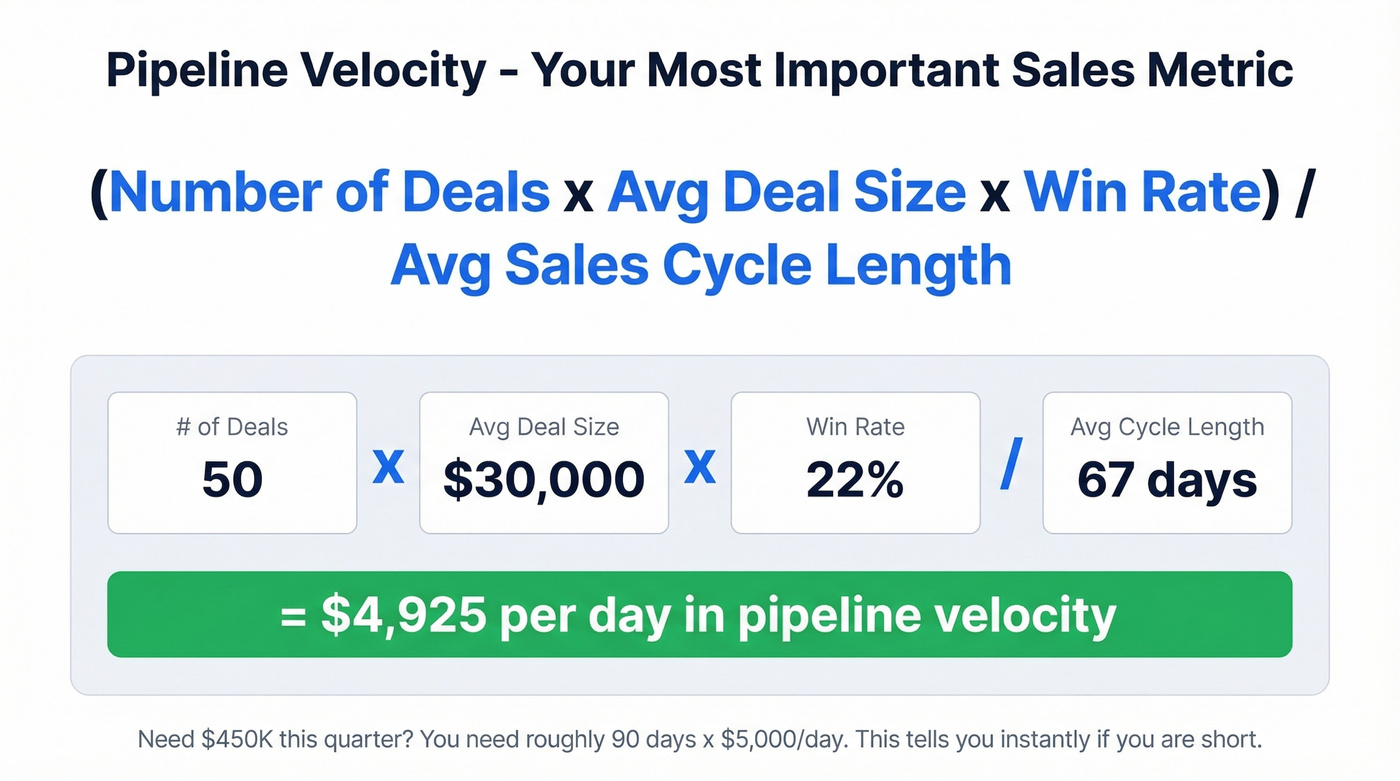
Pipeline Velocity = (# of Deals x Avg Deal Size x Win Rate) / Avg Sales Cycle Length
Worked example: 50 deals x $30,000 x 22% / 67 days = $4,925/day. If you need $450K this quarter, you need roughly 90 days x $5,000/day in velocity - and you can see immediately whether you're short.
Coverage Ratio by Segment
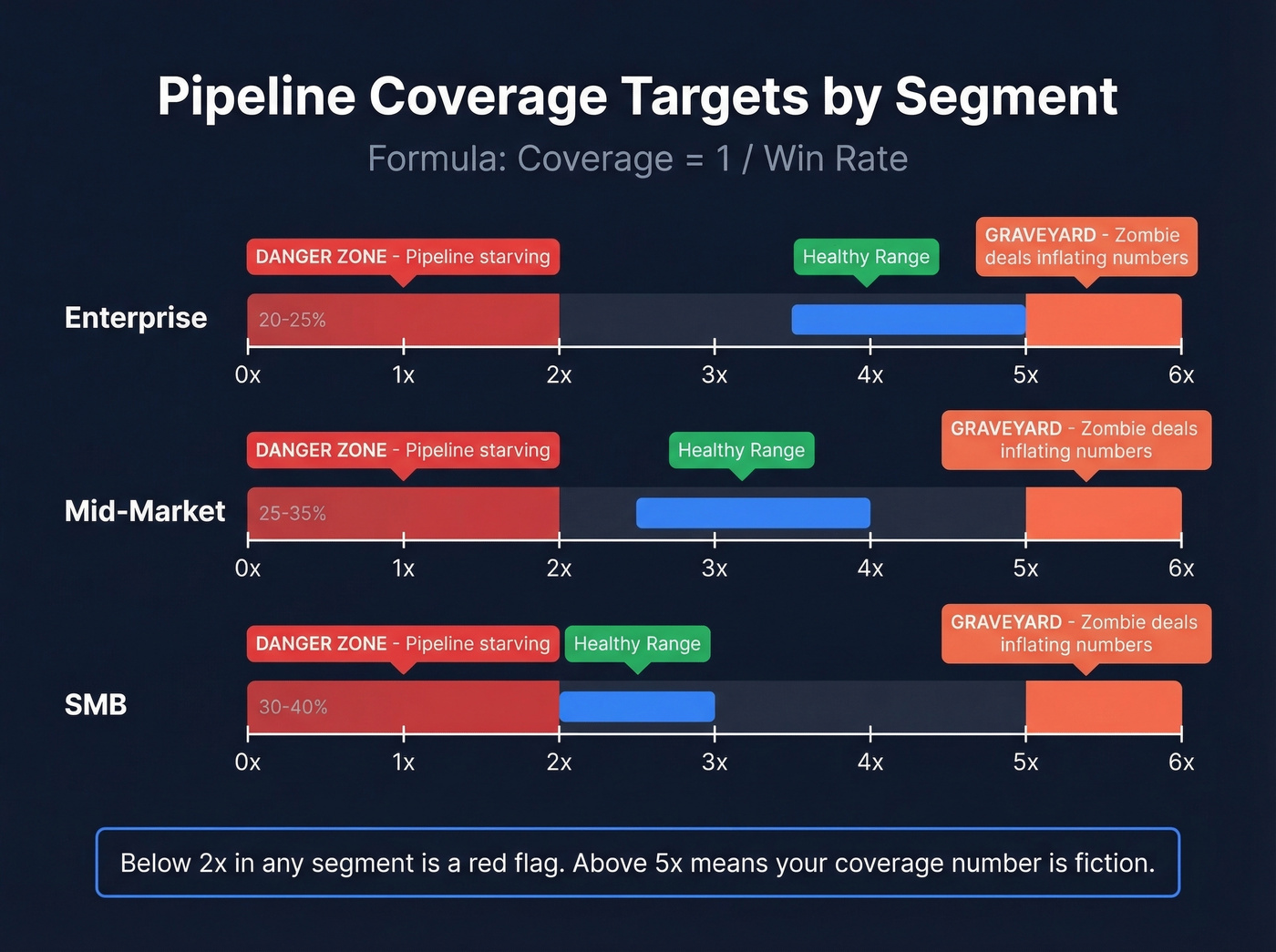
The "3-5x coverage" rule is too blunt. Coverage needs vary by win rate, and win rates vary by segment:
| Segment | Typical Win Rate | Target Coverage | Formula |
|---|---|---|---|
| Enterprise | 20-25% | 3-5x | 1 / 0.20 = 5x |
| Mid-Market | 25-35% | 2.5-4x | 1 / 0.30 = 3.3x |
| SMB | 30-40% | 2-3x | 1 / 0.35 = 2.9x |
Below 2x in any segment is a red flag. Above 5x usually means zombie deals are inflating the number.
Win Rate and Cycle Length
These benchmarks are hard to find in one place. Here's what the 2026 data shows:
| Vertical | Win Rate | Avg Cycle |
|---|---|---|
| Professional Services | 28% | 51 days |
| Healthcare & MedTech | 25% | 72 days |
| Marketing & Advertising | 24% | 58 days |
| SaaS & Technology | 22% | 67 days |
| Manufacturing | 19% | 124 days |
| Financial Services | 18% | 89 days |
| Real Estate & Construction | 16% | 147 days |
If you're selling SaaS and your average cycle is 120 days, something's stalling. These numbers give you a baseline to diagnose against.
Stage Conversion Benchmarks
Rough B2B conversion rates by funnel stage:
- Awareness to Lead: 1-3%
- Lead to Qualified Opportunity: 10-15%
- Qualified Opportunity to Closed Won: 20-30%
When your lead-to-opportunity rate drops below 10%, your qualification criteria are probably too loose - or bad data is letting unqualified contacts flood the top of funnel. If opportunity-to-close is below 20%, look at your discovery and proposal stages for leaks.

You just read it: bad data at the top of funnel kills pipeline before process even matters. Prospeo's 98% email accuracy and 7-day data refresh cycle mean your reps actually reach buyers - not dead inboxes. Teams using Prospeo cut bounce rates from 35%+ to under 4% and tripled pipeline output.
Stop managing zombie deals. Start filling your pipeline with contacts that connect.
10 Best Practices for Pipeline Execution
1. Standardize Stages With Customer-Action Exit Criteria
Every stage needs a gate, and that gate should be something the buyer did - not something the rep did. Exit criteria based on customer actions are what separate accurate pipelines from wishful thinking. "Rep sent proposal" isn't a stage change. "Buyer confirmed receipt and scheduled internal review by [date]" is. Write one customer-action exit criterion per stage and enforce it in your CRM.
2. Set Coverage Targets by Segment
Don't apply a blanket 3x rule across your entire pipeline. Use the formula: coverage equals 1 divided by win rate. A team selling enterprise deals at a 20% win rate needs 5x coverage. An SMB team closing at 35% needs under 3x. Reference the segment table above and set targets per team or territory.
Above 5x? You don't have a pipeline. You have a graveyard.
3. Kill Zombie Deals
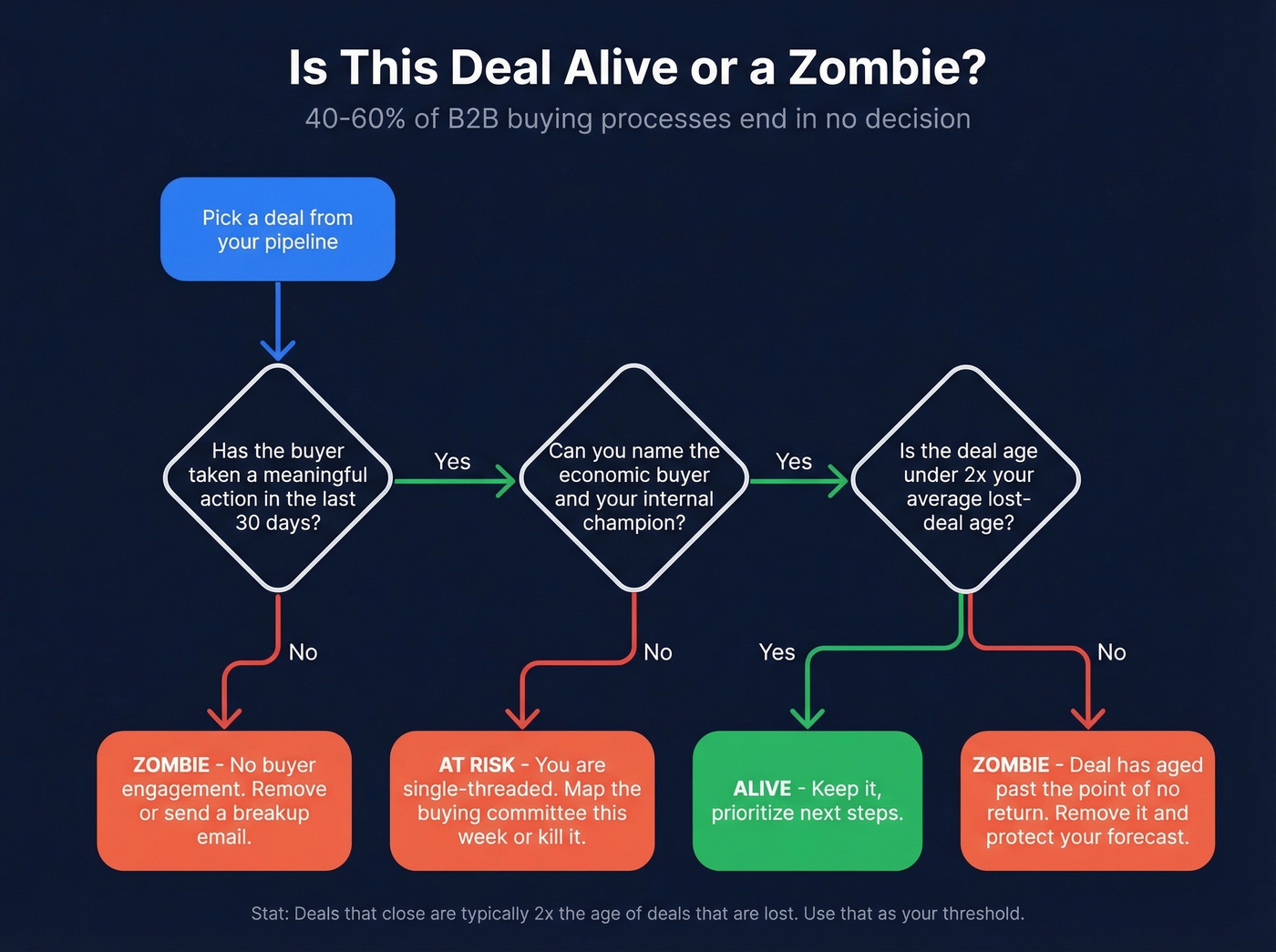
40-60% of B2B buying processes end in no decision. Not "lost to competitor" - just... nothing. And roughly 60% of those no-decisions come from buyer indecision, not seller failure. The diagnostic is simple: deals that close are typically ~2x the age of deals that are lost. If a deal has aged past that threshold with no meaningful buyer action in 30+ days, it's a zombie. Remove it. Your coverage number will drop. Your forecast accuracy will improve. That's the trade-off every healthy pipeline makes.
4. Build a Follow-Up Cadence
It takes 8+ touches to close a deal, yet 44% of salespeople give up after one. Prescribe a minimum cadence: Day 1 (email), Day 3 (call), Day 5 (email + value add), Day 8 (call), Day 14 (breakup email). A cadence nobody follows is worse than no cadence at all - it creates false confidence that outreach is happening.
5. Run 1:1 Pipeline Reviews Weekly
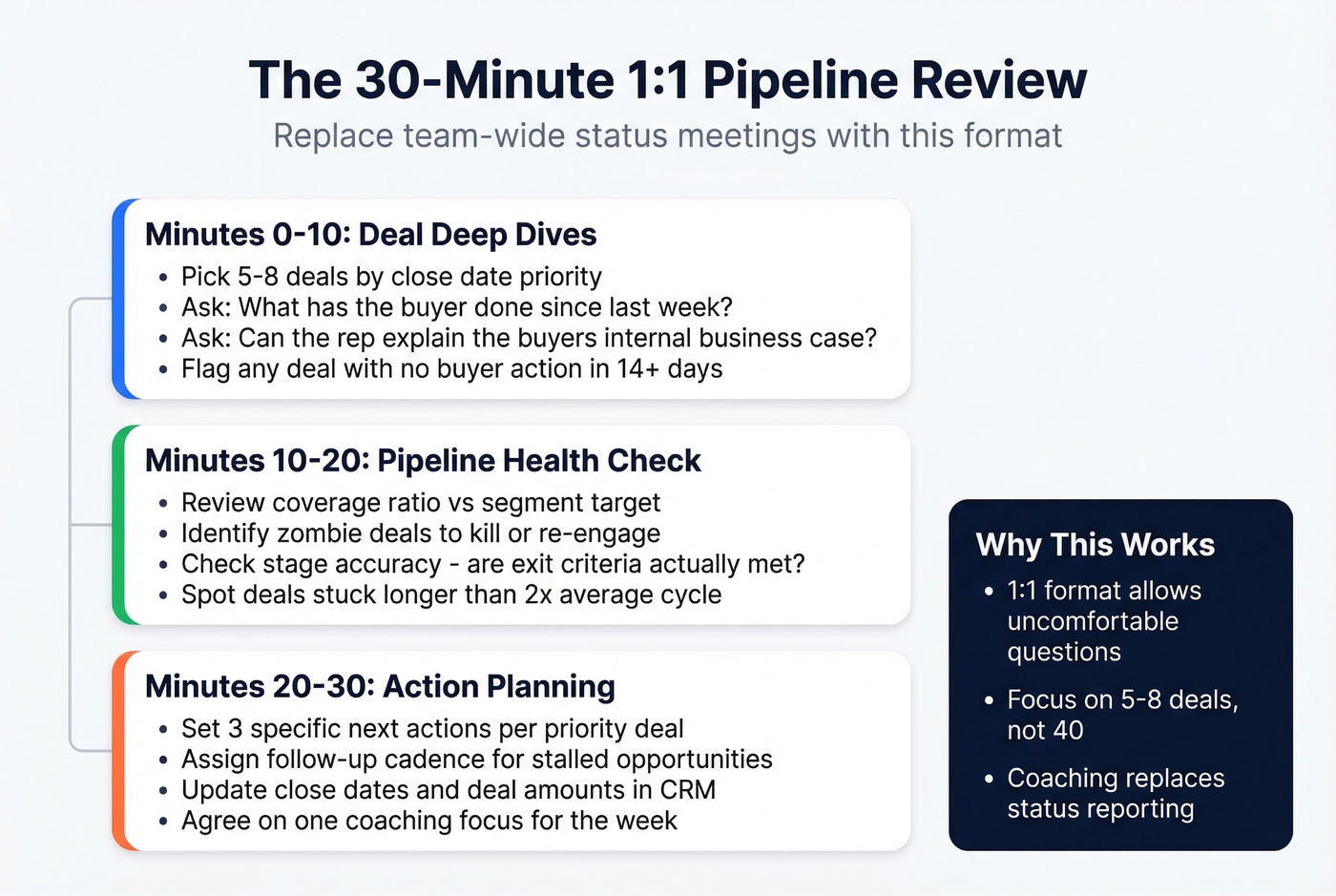
Cancel the team-wide pipeline review. Weekly 1:1 reviews between rep and manager, timeboxed to 30 minutes, are the format that actually works. Team-wide reviews are status meetings where 8 reps sit silently while 2 present. The 1:1 format lets you dig into 5-8 specific deals, ask uncomfortable questions, and coach. Full template is in the next section.
6. Qualify Ruthlessly
MEDDPICC exists for a reason. If your reps can't articulate the buyer's business case - not the product pitch, but the internal justification the champion will use - the deal isn't qualified. Ask the rep to explain why the buyer would change from the status quo. If the answer is vague, the deal stays in early stage regardless of what the CRM says.
7. Track Relationship Depth
Pipeline stages tell you where a deal is. Relationship maps tell you whether it'll actually close. Enterprise buying committees average 7.2 stakeholders - if you're only talking to one, you're exposed. Track the seniority of meetings, not just "had a call." Have you met the economic buyer? Do you have a champion who's actively selling internally? If your only contact is a mid-level evaluator, you don't have a deal. You have a research project.
8. Automate CRM Hygiene
Manual CRM updates are where pipeline accuracy goes to die. Auto-log calls, emails, and meeting notes - Salesforce, HubSpot, and most modern CRMs support this natively. Set stale-deal alerts: if a deal hasn't had activity in 14 days, flag it automatically. Run a weekly cleanup routine, 15 minutes every Friday, to remove or re-engage stale deals, update close dates, and add notes. AI-powered deal scoring is making it easier to monitor pipeline health at scale, but the discipline still starts with clean data.
9. Fix Data Quality at the Source
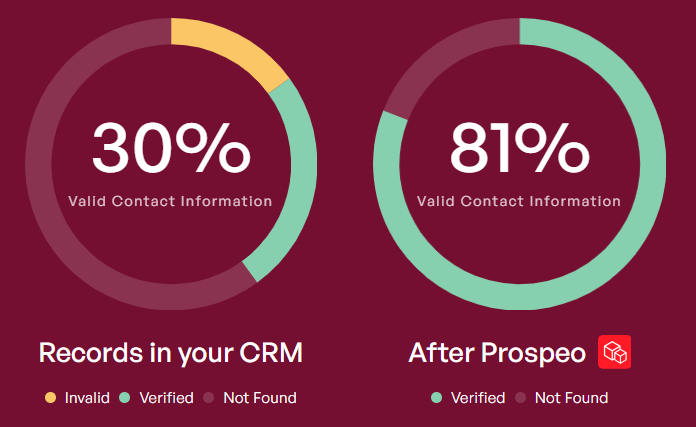
Bad emails and dead phone numbers are a silent pipeline killer. If your prospecting list bounces at 20-35%, reps waste hours chasing ghosts instead of selling. We've seen this pattern repeatedly - teams optimize their stages, review cadences, and qualification frameworks, then wonder why the top of funnel is still anemic.
Prospeo fixes this at the source. 98% email accuracy on a 7-day refresh cycle means contacts don't decay between the time you find them and the time you reach out. CRM enrichment returns 50+ data points per contact at a 92% API match rate, so reps get complete profiles - not just a name and a maybe-valid email. Snyk's results tell the story: their bounce rate dropped from 35-40% to under 5%, and AE-sourced pipeline jumped 180%, generating 200+ new opportunities per month. That's what happens when you fix the data layer before optimizing the process.
10. Use Intent Data to Prioritize
Not all pipeline deals deserve equal attention. Layer intent data - tracking 15,000 topics via Bombora - to identify which accounts are actively researching solutions like yours. Prioritize deals where buyer intent signals are spiking. Deprioritize the rest. This is the difference between working your pipeline and letting your pipeline work you.
The 30-Minute Pipeline Review Template
This is the agenda we recommend stealing. It merges the 5-pillar framework with relationship-focused review questions into a single 1:1 format. Manager and rep, weekly, no exceptions.
Minutes 0-5: Pipeline Health Check
Open the dashboard together. Review total coverage ratio against target. Flag any segment below 2x. Check net new opportunities added since last week - this is your leading indicator for whether the pipe is growing or shrinking.
Minutes 5-15: Deal Deep-Dives (3-4 Deals)
Select deals from three buckets: late-stage (closing this month), stalled (no buyer action in 14+ days), and newly added. For each deal, ask:
- What's the next buyer action, and when is it scheduled?
- Who do you have relationships with? Where are the gaps?
- Have you met the economic buyer?
- Can you articulate the buyer's business case - not our pitch, their internal justification?
If the rep can't answer these, the deal stage is probably wrong.
Minutes 15-25: Risks and Next Actions
Identify the top 2-3 deals most likely to slip. Stress-test close dates - if a deal has slipped twice, it's not closing this quarter. Assign specific next actions with dates. "Follow up" isn't an action. "Send revised proposal by Thursday and confirm review meeting for Monday" is.
Minutes 25-30: Pipeline Generation Check
Are enough new opportunities entering the pipe to sustain next month's target? If not, what's the plan? This is where prospecting activity, outbound cadence health, and data quality get a quick check. If bounce rates are climbing or connect rates are dropping, surface it here - don't wait for the end-of-quarter post-mortem.
Best Pipeline Management Tools
Look, most teams don't need a better CRM. They need better data feeding the CRM they already have. I've watched companies spend six figures migrating from HubSpot to Salesforce when the real problem was that 30% of their contacts had dead emails. Fix the inputs before you upgrade the container.
| Tool | Category | Starting Price | Best For |
|---|---|---|---|
| Prospeo | Data Quality | Free / ~$0.01/lead | Email accuracy + CRM enrichment |
| Pipedrive | CRM | $14/user/mo | Visual pipeline, <20 reps |
| HubSpot Sales Hub | CRM | Free / $90/user/mo Pro | Marketing-aligned teams |
| Salesforce Sales Cloud | CRM | $25/user/mo (Starter) | Enterprise orgs |
| Zoho CRM | CRM | $14/user/mo | Budget pick (PCMag 4.5/5) |
| monday CRM | CRM | $12/seat/mo | Project-oriented teams |
| Close | CRM | $29/user/mo | Inside sales / SMB |
| Apollo.io | Data / Prospecting | Free / $49/user/mo | All-in-one prospecting |
| Gong | Revenue Intel | ~$100-150/user/mo (est.) | Conversation intelligence |

Starting from scratch with under 20 reps? Pipedrive. The visual pipeline is intuitive and reps actually use it. Watch the add-on costs though - LeadBooster and Prospector can push your per-user cost to $80-160/month.
Need marketing integration? HubSpot Sales Hub. The free CRM is genuinely useful for small teams, and the Pro tier at $90/user/month gives you sequences, automation, and tight marketing alignment. The downside is complexity creep as you scale.
Enterprise? Salesforce. But budget for the real total cost of ownership. A $25/user/month sticker price is misleading - once you add admin, implementation, and integrations, mid-market deployments run $50K-$150K/year.
Apollo.io is worth a look for teams that want prospecting and sequencing in one platform. The free tier is generous and paid plans start at $49/user/month. It's less accurate on email verification than dedicated tools, but the all-in-one workflow appeals to teams that don't want to manage multiple vendors.
Skip Gong if you're running a short, transactional sales cycle - the ROI doesn't justify $100-150/user/month unless you're doing complex, multi-stakeholder deals where conversation analytics actually change outcomes. For those longer cycles, though, it's genuinely useful. Pair it with your CRM; don't replace your CRM with it.

If you’re rebuilding your outbound motion, start with sales prospecting techniques and a clean list.
If bounce rates are hurting deliverability, use these email bounce rate benchmarks to diagnose the root cause.
For tighter outreach, keep a set of sales follow-up templates your team actually uses.
If you want a broader view of what “good” looks like, compare against sales pipeline benchmarks.
And if you’re trying to fix the system (not just the symptoms), align your stages with sales process optimization.
Pipeline velocity depends on four levers - and data quality quietly wrecks all of them. When 30% of outreach never lands, your deal count drops, cycles stretch, and win rates crater. Prospeo gives you 300M+ verified profiles, 125M+ direct dials with 30% pickup rates, and 30+ filters to target in-market buyers.
Increase your pipeline velocity by reaching real decision-makers on day one.
FAQ
What's the difference between a sales pipeline and a sales funnel?
A pipeline is the set of active deals and their current stages - what reps work daily. A funnel is the conversion-rate math across the buyer journey, showing what percentage of leads become opportunities and close. Pipeline tracks deals. Funnel tracks rates. Both matter, but reps live in the pipeline.
How often should you review your pipeline?
Weekly, 1:1 between rep and manager, 30 minutes max. Cancel team-wide pipeline reviews - they're status meetings that waste everyone's time. Focus each session on 5-8 deals across three buckets: late-stage, stalled, and newly added.
What's a good pipeline coverage ratio?
3-5x your quota target, calculated as 1 / win rate. A 25% win rate needs 4x coverage. Below 2x signals a pipeline generation problem. Above 5x usually means zombie deals are inflating the number - clean them out before trusting your forecast.
How do you spot zombie deals?
Compare deal age to your average win timeline - closed-won deals are typically ~2x the age of closed-lost deals. Any opportunity past that threshold with no meaningful buyer action in 30+ days is a zombie. Remove it. Coverage drops, but forecast accuracy and rep focus improve immediately.