

How to Build a Strategic Account Plan That Doesn't Just Sit There
Your VP just asked for account plans by Friday. You know exactly what happens next: you'll spend 12 hours building a deck, present it once, and never open it again. 83% of organizations complete less than 25% of their strategic projects. The strategic account plan isn't exempt from that failure rate - it's a poster child for it.
The problem isn't that teams don't plan. It's that they build the wrong artifact.
The Short Version
- Keep your plan under 40 elements. Plans with fewer than 20 elements succeed 68% of the time. Plans with 60+ succeed 8%. Complexity kills execution.
- Use a 5-tab living document, not a 40-page deck. Google Sheet or Notion page - something you'll actually open on a Tuesday.
- Tier your accounts. Only 5-10 get full strategic plans. The rest get abbreviated plans or signal monitoring.
- Verify your stakeholder data before you plan around ghosts. CRM data decays around 30% annually, which means if 3 of your 11 stakeholders have changed roles since your last import, your plan targets people who aren't there anymore.
What a Strategic Account Plan Actually Is
A strategic account plan isn't a sales forecast, a QBR deck, or a CRM record with extra fields filled in. It's a living document that maps how you'll grow and defend a specific high-value account over the next 12-18 months.
Why this matters more than it did five years ago: B2B deals now involve an average of 11 stakeholders. You're not selling to a person. You're navigating a political system, and your plan is the map of that system, your playbook for influencing it, and your early-warning radar for when it shifts.
Why Most Account Plans Fail
We've watched dozens of teams build plans that go nowhere. The failure modes are remarkably consistent.
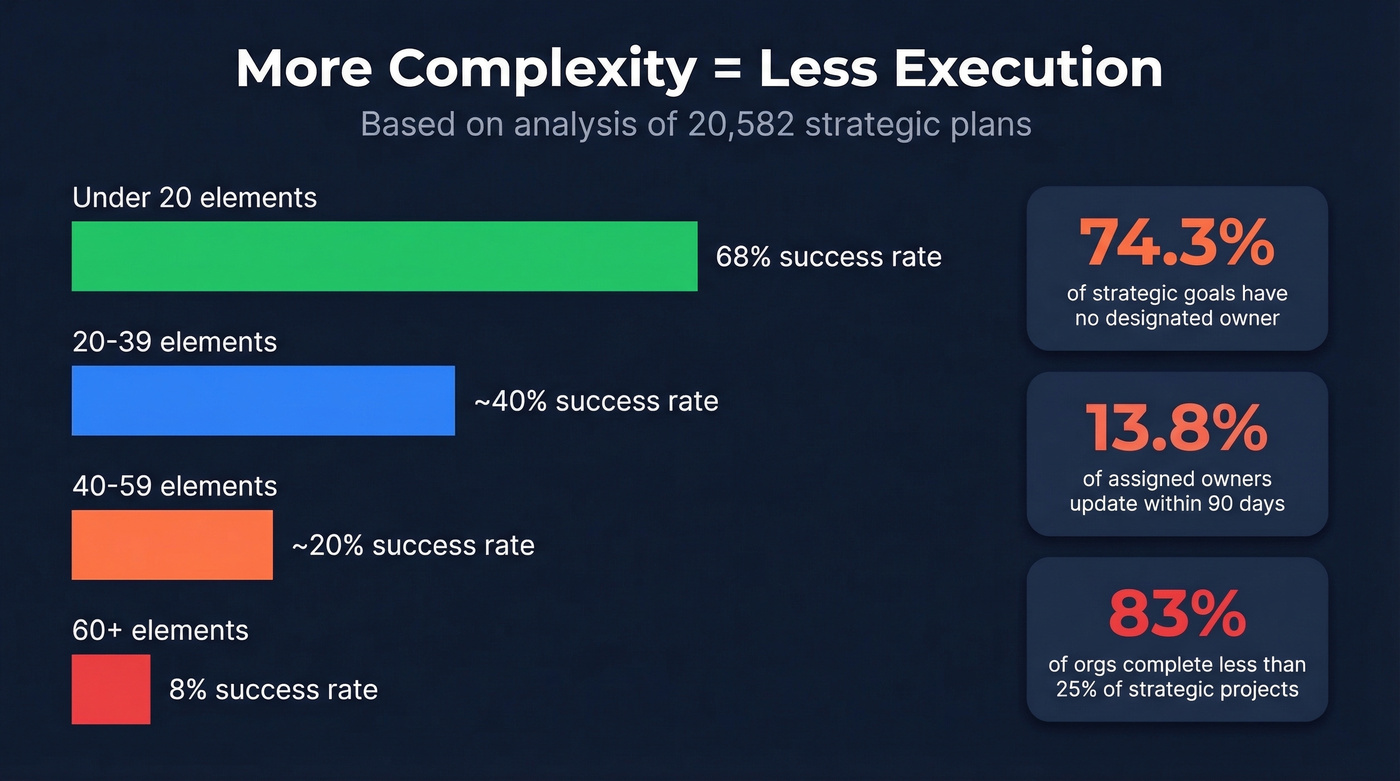
They're too complex. ClearPoint Strategy analyzed 20,582 strategic plans and found a brutal complexity curve: plans with fewer than 20 elements succeed 68% of the time. Plans with 60+ elements? Eight percent. Most account plan templates push teams well past 40 elements before anyone's even started filling them in.
Nobody owns anything. 74.3% of strategic goals have no designated owner. Only 13.8% of assigned owners update their work within 90 days. Your beautifully crafted plan is orphaned the moment the meeting ends.
They're built on stale data. You're mapping an org chart with contacts imported 18 months ago. Three of your 11 stakeholders have changed roles. You're planning around ghosts.
Too many tactics, not enough strategy. Teams fill forms instead of thinking. The plan becomes a CRM scavenger hunt - what one CS leader on r/CustomerSuccess called "a scavenger hunt for minute details that could be found in our CRM" rather than actual strategic thinking.
They're created and abandoned. The consensus on r/sales is blunt: plans get built early in the year and then just sit there. Leadership is vague on what outputs they actually want, so the plan becomes a compliance exercise rather than a working tool.
Signal-Led Account Planning
Static plans die because the world moves and the plan doesn't. The modern approach flips the model: instead of building a massive document once per year, you build a lightweight living plan that updates based on real signals.
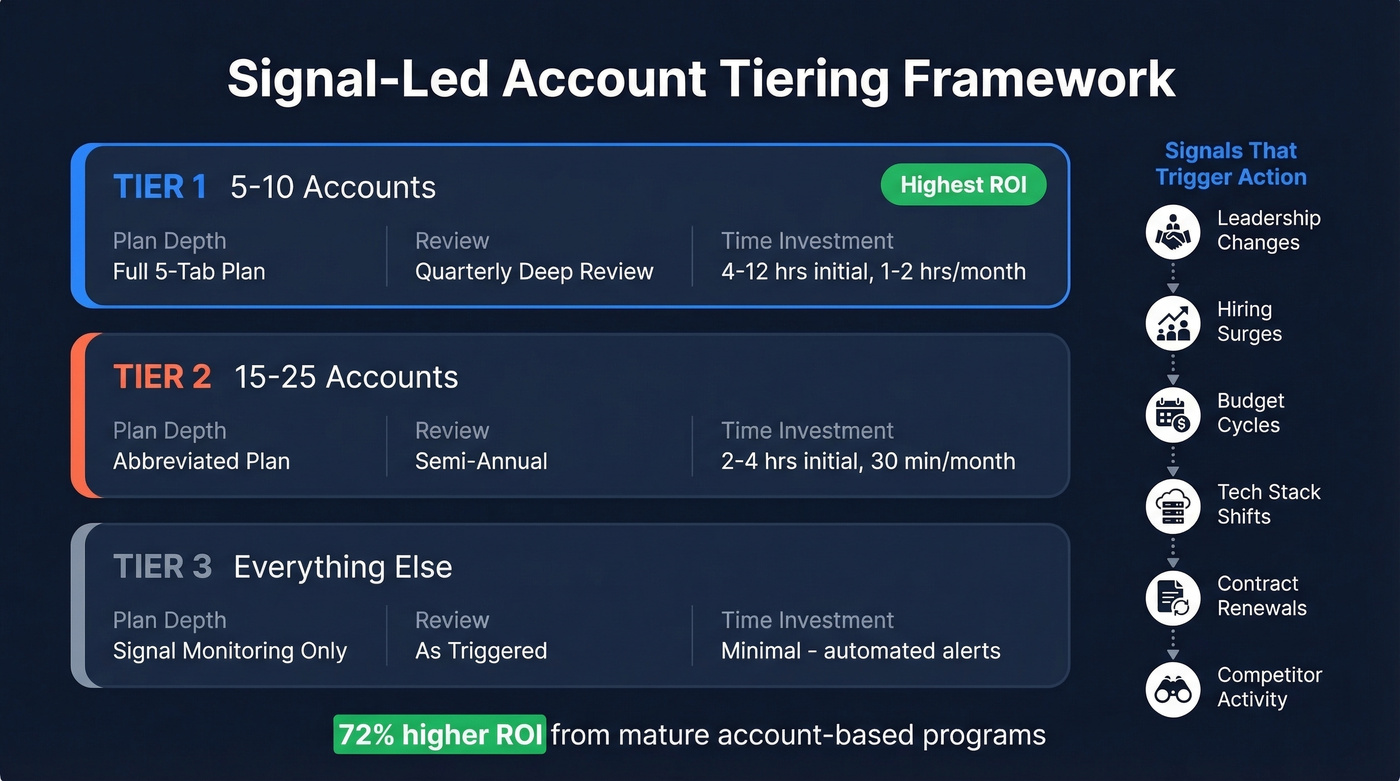
Only 5% of B2B accounts are actively looking to buy at any given time. That means 95% of your planning energy should go toward detecting when an account shifts from passive to active - and being positioned when it does.
The signals that matter: leadership changes, hiring patterns, budget cycle timing, tech stack shifts, vendor dissatisfaction, and contract renewal windows. When you see a VP of Engineering leave your champion account, that's not a CRM note - that's a plan-level event that changes your strategy.
Start with aggressive tiering:
| Tier | Accounts | Plan Depth | Review Cadence |
|---|---|---|---|
| Tier 1 | 5-10 | Full 5-tab plan | Quarterly deep review |
| Tier 2 | 15-25 | Abbreviated plan | Semi-annual |
| Tier 3 | Everything else | Signal monitoring only | As triggered |
The ROI of getting this right is staggering. Mature account-based programs report 72% higher ROI than other marketing investments, with organizations seeing 36% higher retention and 38% higher win rates. Teams with structured plans close deals 28% faster.
Here's the thing: most teams don't need better planning software. They need fewer plans, better data, and the discipline to review what they've built. A five-tab Google Sheet updated monthly will outperform a $30K platform that nobody opens.

CRM data decays ~30% per year. If your shadow org chart targets stakeholders who've already changed roles, your entire account plan is built on ghosts. Prospeo refreshes data every 7 days and returns 50+ data points per contact - current titles, verified emails, and direct dials - so your strategic account plan maps real people, not outdated CRM records.
Stop planning around ghosts. Enrich your accounts before you strategize.
The 5-Tab Framework
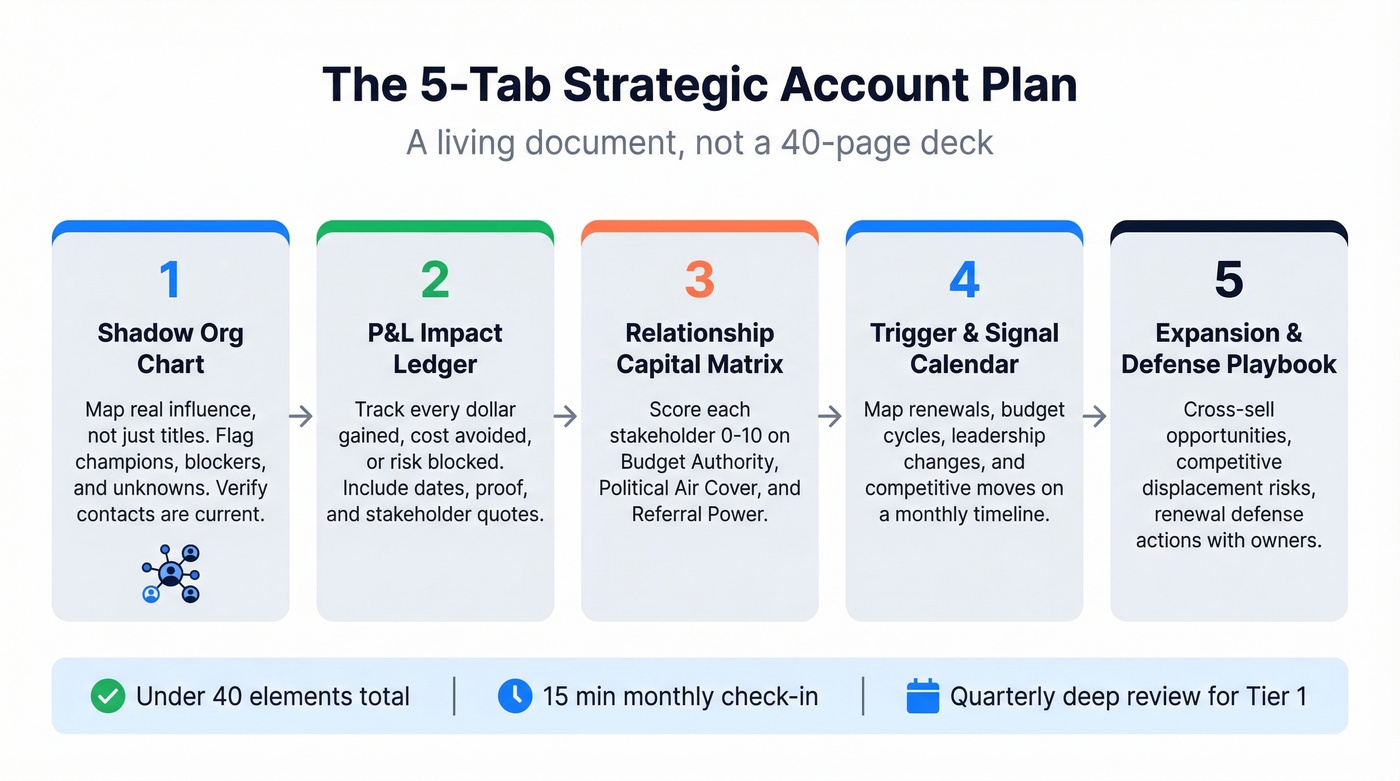
Forget the 40-page PDF. Your plan lives in a single shared document - Google Sheet, Notion page, whatever your team will actually open - with five tabs. Each tab serves a specific function. Together, they give you a complete picture without the bloat that kills execution.
Tab 1: Shadow Org Chart
This isn't the formal reporting structure from the company's website. It's the real influence map: who actually makes decisions, who blocks them, and who has the political capital to push things through. In our experience, this tab is where 80% of the strategic value lives.
For each stakeholder, capture their formal title, actual influence level, career incentives, and personal KPIs. Flag every contact as champion, neutral, blocker, or unknown. The "unknown" category is critical - if you can't classify someone, you haven't done enough discovery. Before you build this tab, export your CRM contacts for the account and run an enrichment pass to confirm current titles and direct contact info, not whatever was imported a year and a half ago.
Tab 2: P&L Impact Ledger
Track every dollar of revenue gained, cost avoided, or risk blocked that your solution has delivered. Include dates, proof like screenshots and reports, and stakeholder quotes.
This isn't a feel-good exercise - it's your ammunition for renewal conversations and executive sponsorship requests. When a champion needs to justify your contract internally, this tab is what they'll pull from.
Tab 3: Relationship Capital Matrix
Score each stakeholder on three dimensions, 0-10:
| Stakeholder | Budget Authority | Political Air Cover | Referral Power | Total |
|---|---|---|---|---|
| VP Eng | 8 | 9 | 7 | 24 |
| Dir. Ops | 6 | 4 | 5 | 15 |
| Procurement | 9 | 3 | 2 | 14 |
Anyone scoring less than 6 on political air cover is a landmine. They might love your product, but they can't protect the deal when budget cuts come. Invest in building air cover before you need it.
Tab 4: Trigger & Signal Calendar
Map the account's key dates and signals on a monthly timeline: contract renewals, budget cycle deadlines, fiscal year boundaries, leadership changes, hiring surges, and tech stack evaluations. Layer in external signals like funding rounds, earnings calls, and competitive moves.
Review this tab monthly - 15 minutes, no more. The goal is to spot windows of opportunity before they close and threats before they materialize.
Tab 5: Expansion & Defense Playbook
Map cross-sell and upsell opportunities to specific stakeholder pain points. Identify competitive displacement risks - who's trying to take your seat, and which stakeholders are they talking to? Define renewal defense actions with owners and deadlines.
Every entry should have an owner and a next action. If it doesn't, it's a wish, not a plan.
Building Your Plan Step by Step
The initial build for a Tier 1 account takes 4-12 hours depending on account complexity and how much discovery you've already done. After that, expect 1-2 hours per month to maintain it. Here's the sequence.
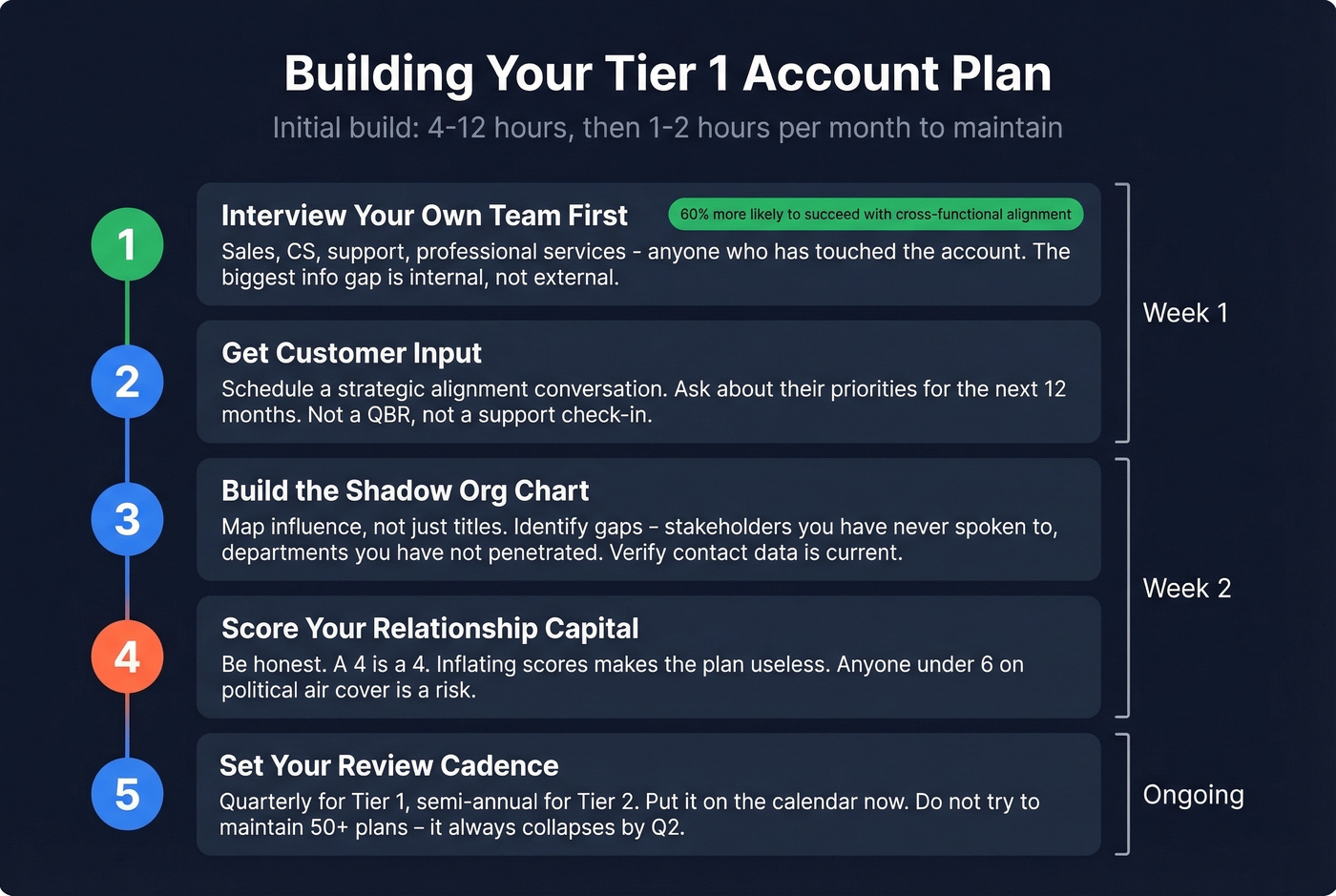
Interview your own team first. Sales, CS, support, professional services - anyone who's touched the account. The biggest information gap isn't external; it's that other teams talk to customers and don't share notes. This is exactly why sales communication breaks down in most orgs, and why high-growth organizations are 60% more likely to have a central planning process with cross-functional alignment.
Get customer input. This is where most plans go wrong - you're building a plan about the customer without the customer. Schedule a strategic alignment conversation, not a QBR, not a support check-in. Use a tight set of discovery questions to surface priorities, constraints, and internal politics. Ask about their priorities for the next 12 months.
Build the shadow org chart. Map influence, not just titles. Identify gaps: stakeholders you've never spoken to, departments you haven't penetrated.
Score your relationship capital. Be honest. A 4 is a 4. Inflating scores makes the plan useless.
Set your review cadence and stick to it. Quarterly for Tier 1, semi-annual for Tier 2. Put it on the calendar now. We've seen teams try to maintain 50+ plans - it always collapses by Q2.
Keeping Your Plan Alive
Set a 15-minute monthly check-in for each Tier 1 account. Open the trigger calendar, scan for signal changes, update one or two fields. Quarterly, do a deeper review - rescore relationship capital, refresh the org chart, update the expansion playbook. For Tier 2, semi-annual is enough.
Don't try to maintain full plans for 80 accounts. One CSM on Reddit described managing a $10M book across 120 accounts and being pushed to keep plans updated for the 80 largest. That's organizational malpractice. Be brutal about tiering: 5-10 full plans, 15-25 abbreviated, everything else gets signal monitoring and nothing more.
And don't wait for the quarterly review to act on new information. If a signal fires - a leadership change, a competitor showing up in the account, a budget freeze - update the plan that day. The review cadence is a floor, not a ceiling. If you need a system for this, borrow from how to track sales triggers and keep it lightweight.
Account Planning Tools Worth Evaluating
Purpose-built account planning platforms exist, and they're worth evaluating if you're running a formal KAM program across 50+ reps. But most teams don't need a $30K platform - they need a clean template and accurate data.
| Tool | Best For | Approx. Pricing |
|---|---|---|
| DemandFarm | Enterprise KAM programs | ~$15K-40K/yr |
| ARPEDIO | Salesforce-native teams | ~$10K-30K/yr |
| Kapta | Mid-market key account mgmt | ~$1K-3K/mo |
| SalesHood | Enablement + AI coaching | ~$30-50/user/mo |
| Mural | Visual org chart mapping | Free; paid from $12/user/mo |
Skip the enterprise platforms if you're a team of five reps managing 30 accounts. You'll spend more time configuring the tool than using it. Start with the 5-tab template, get your data right, and upgrade when the process outgrows the spreadsheet - not before.
If you're spending $30K on planning software but your reps still can't reach the right stakeholders because their contact data is 18 months old, you've got the priorities backwards. At minimum, use data enrichment services or a dedicated lead enrichment workflow to keep titles and contact channels current.
FAQ
How often should you update a strategic account plan?
Tier 1 accounts need a quarterly deep review plus a monthly 15-minute signal check. Tier 2 accounts need semi-annual reviews. If your plan hasn't been touched in 90 days, the org chart has already shifted and your competitive position has changed.
How many accounts deserve full strategic plans?
Five to ten, maximum. Plans with fewer than 20 elements succeed at 68% - 8x the rate of bloated ones with 60+ elements. Trying to maintain full plans for 80 accounts guarantees none get the attention they need.
What's the difference between an account plan and a key account plan?
Functionally, nothing. "Key account plan" implies the account has been formally designated as strategic based on revenue potential or relationship depth. The planning framework, tabs, and review cadence are identical regardless of what you call it.
What's the best free tool for keeping account plan data accurate?
Prospeo's free tier gives you 75 verified emails per month - enough to audit one Tier 1 account's org chart. For teams needing broader enrichment, paid plans run about $0.01 per email with 98% accuracy and a 7-day data refresh cycle, compared to the 6-week industry average.
Your 5-tab framework is only as strong as Tab 1. With 300M+ profiles, 98% email accuracy, and job change tracking, Prospeo lets you build a shadow org chart that reflects reality - not last quarter's import. Detect leadership changes the moment they happen so your plan stays live.
Verify every stakeholder in your top accounts for $0.01 per email.