

SuperSend vs Apollo.io: Different Tools for Different Problems
If you're weighing SuperSend vs Apollo.io, the first thing to understand is they don't actually compete. Apollo.io is a database with a sequencer bolted on. SuperSend is sending infrastructure with a sequencer built in. Pick the wrong one and you'll waste months trying to force a tool into a job it wasn't designed for.
30-Second Verdict
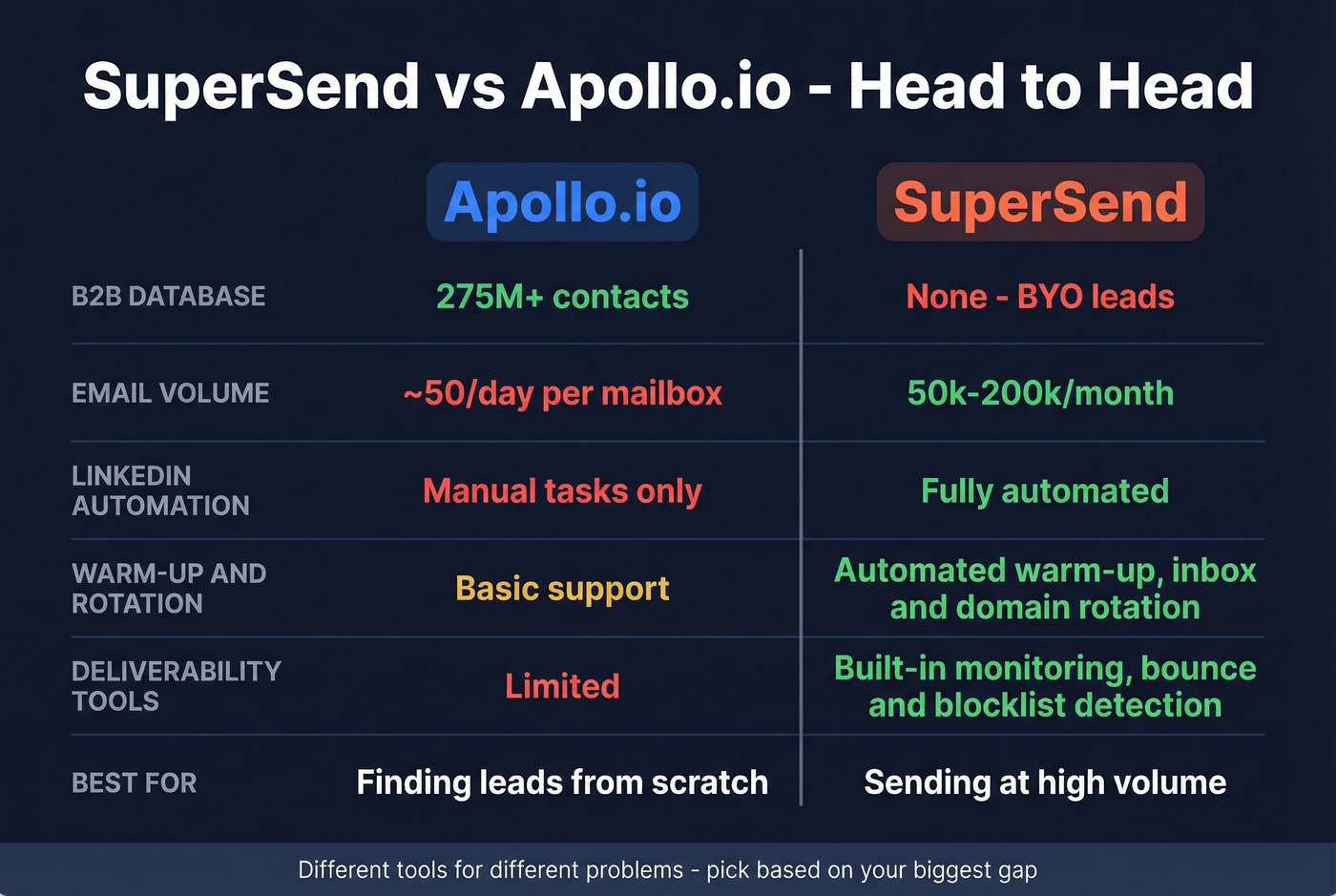
Apollo.io - pick it if you need to find leads. 275M+ contacts, 73M+ companies, and intent signals. The sequencer works for low-volume outreach, but don't expect to scale past a few hundred emails a day without pain.
SuperSend - pick it if you already have leads and need to send at scale. Growth includes 50,000 emails per month, Scale includes 200,000, plus automated warm-up, domain/inbox rotation, and multichannel automation across email, LinkedIn, and Twitter/X.
Skip both if your real problem is data accuracy. Apollo's database has user-reported bounce rates of 32-38%. SuperSend has no database at all. You need a dedicated verification layer regardless.
Side-by-Side Comparison
| Feature | Apollo.io | SuperSend | Winner |
|---|---|---|---|
| B2B Database | 275M+ contacts | None - BYO leads | Apollo |
| Email Sending | ~50/day per mailbox (recommended) | 50k-200k/month | SuperSend |
| LinkedIn Automation | Manual tasks only | Automated | SuperSend |
| Twitter/X Outreach | No | Yes | SuperSend |
| Warm-up | Supported | Automated warm-up + deliverability tooling | SuperSend |
| Domain/Inbox Rotation | Not a core feature | Yes | SuperSend |
| Deliverability Monitoring | Limited | Built-in | SuperSend |
| G2 Rating | 4.7/5 (9,514 reviews) | 4.6/5 (18 reviews) | Apollo (review volume) |
| Best For | Finding leads | Sending at scale | Depends on your gap |
Where Apollo Wins
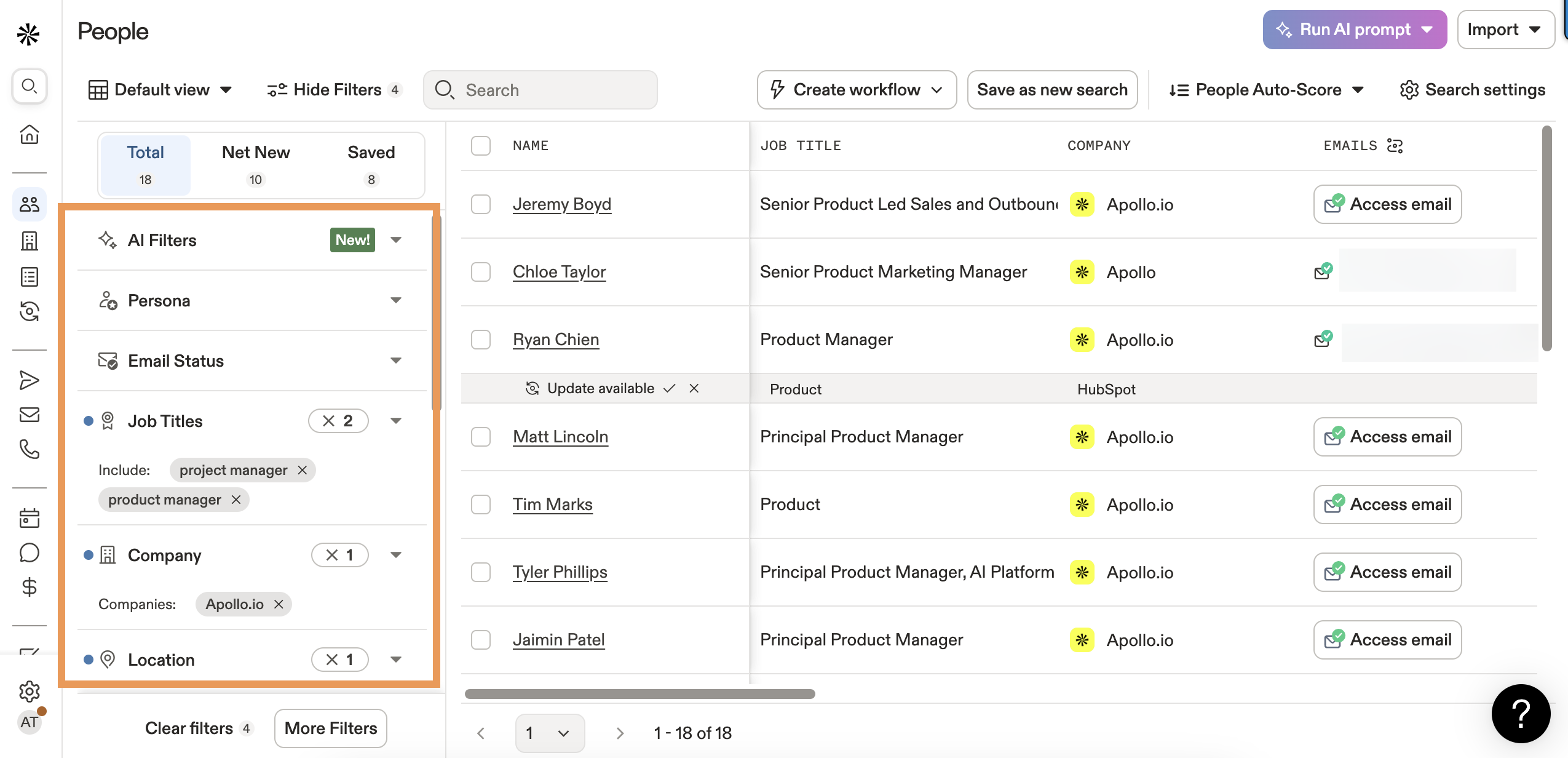
Use Apollo if you're starting from zero - no leads, no lists, no idea who to target. The search UX is genuinely strong: 275M+ contacts, 73M+ companies, granular filters, and intent signals that help you build a list fast. The free tier gives you 10,000 email credits per month, which is generous enough to validate whether the data works for your ICP.
In one practitioner-run 6-week benchmark, Apollo came in around ~65% accuracy, and building plus verifying a 500-account list took about 6 hours in Apollo versus ~2.5 hours with a waterfall enrichment setup after initial configuration. The database is big. It's not always clean.
Skip Apollo if you're planning to send more than a few hundred emails per day. Apollo's own documentation recommends 50 emails/day per mailbox with 6 emails per hour and 600-second delays. Users on Reddit report 2-3 hour gaps where nothing goes out. For teams running serious volume, that's a dealbreaker.

Apollo gives you leads with 32-38% bounce rates. SuperSend gives you sending power but no leads at all. Prospeo fills the gap both miss - 300M+ profiles, 98% email accuracy, 7-day refresh, at $0.01/lead. Pipe verified contacts straight into your sending tool.
Stop debating tools when bad data is the real bottleneck.
Where SuperSend Wins
SuperSend is a different animal entirely. Instead of comparing features line by line, think of it this way: if Apollo is where you find people, SuperSend is how you reach them at scale. We've run campaigns through both, and the infrastructure gap becomes obvious once you push past 500 sends a day (see email velocity limits).
The numbers tell the story. Growth includes 50,000 emails per month and Scale includes 200,000 on self-serve plans. For enterprise teams, SuperSend Relay handles 300k+ emails per month, including 1M+ tiers. You also get automated warm-up, inbox/domain rotation, deliverability monitoring with bounce and blocklist detection, and placement testing.
GrowthList calls SuperSend their "de facto cold outreach tool," and the multichannel piece is real - automated LinkedIn and Twitter/X sequencing, not manual tasks your reps click through one by one. That distinction matters more than it sounds. Manual LinkedIn steps in Apollo sequences mean reps still spend 20-30 minutes a day clicking "send" on connection requests. SuperSend handles that automatically.

Skip SuperSend if you don't have leads yet. There's no native database, so you're bringing your own contacts. That means you need a separate sourcing and verification tool upstream (more on sales prospecting techniques).
Pricing Breakdown
| Apollo.io | SuperSend | |
|---|---|---|
| Entry | Free ($0) - 250 emails/day | Growth ($99/mo) - 50k emails |
| Mid-Low | Basic ($49/user/mo annual) | - |
| Mid | Professional ($79/user/mo annual) | Scale ($319/mo) - 200k emails |
| Top | Organization ($119/user/mo annual, 3-seat min) | Relay (custom) - 300k+/mo |
| Model | Per-user + credits | Flat-rate + volume add-ons |
| 5 reps (seat cost) | ~$395/mo (Professional, annual) + credit overages | $99/mo (Growth) |
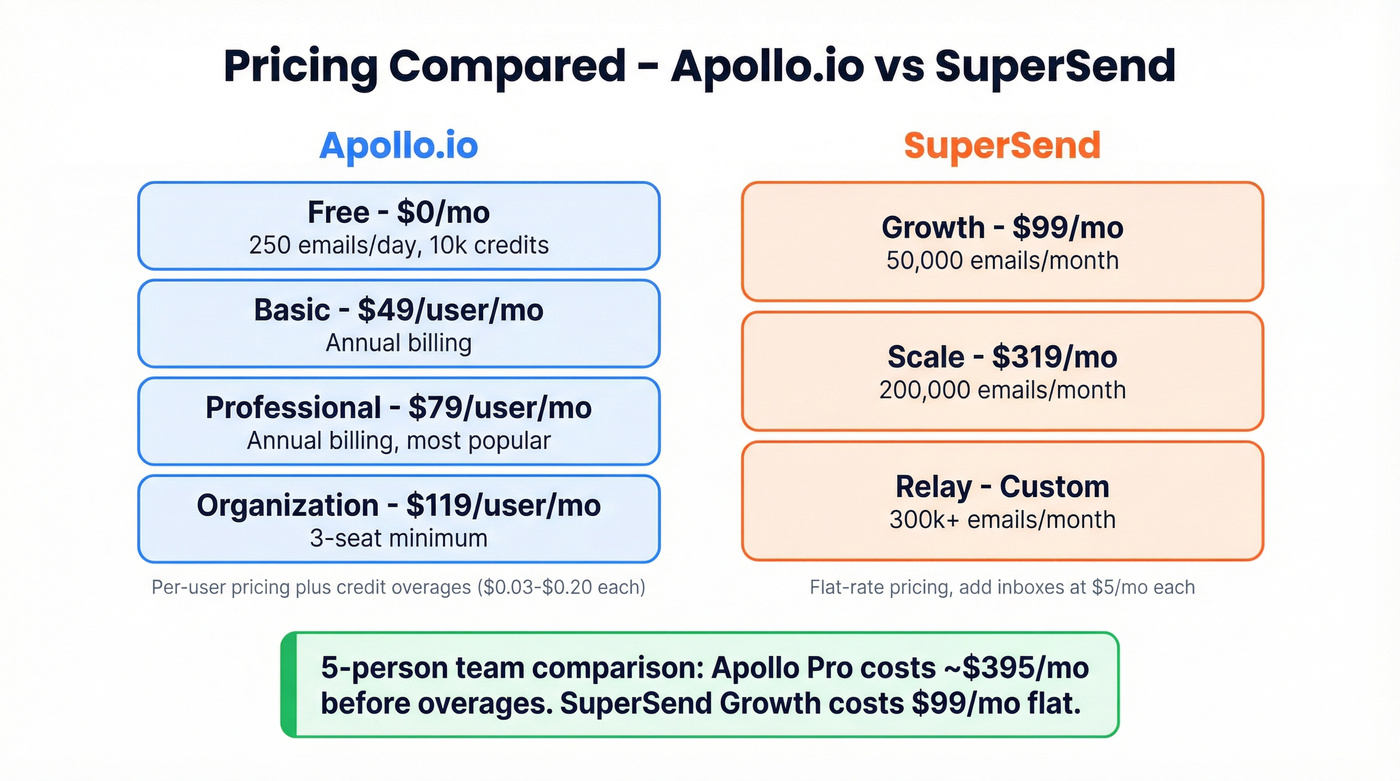
That last row matters most. A five-person team on Apollo Professional pays ~$395/month before credit overages, which typically run ~$0.03-$0.20 per credit depending on type and volume.
SuperSend's Growth plan covers 50,000 emails for a flat $99/month, with add-ons like extra inboxes at $5/month each and domains at $13/year. If sending volume is your primary concern, SuperSend is dramatically cheaper.
The Data Problem Neither Solves
Here's the thing. Neither tool handles data quality well, and that's the problem most teams actually have. Apollo's database is massive but noisy - practitioners on r/coldemail consistently report bounce rates in the 32-38% range on raw exports. SuperSend doesn't even pretend to solve this.
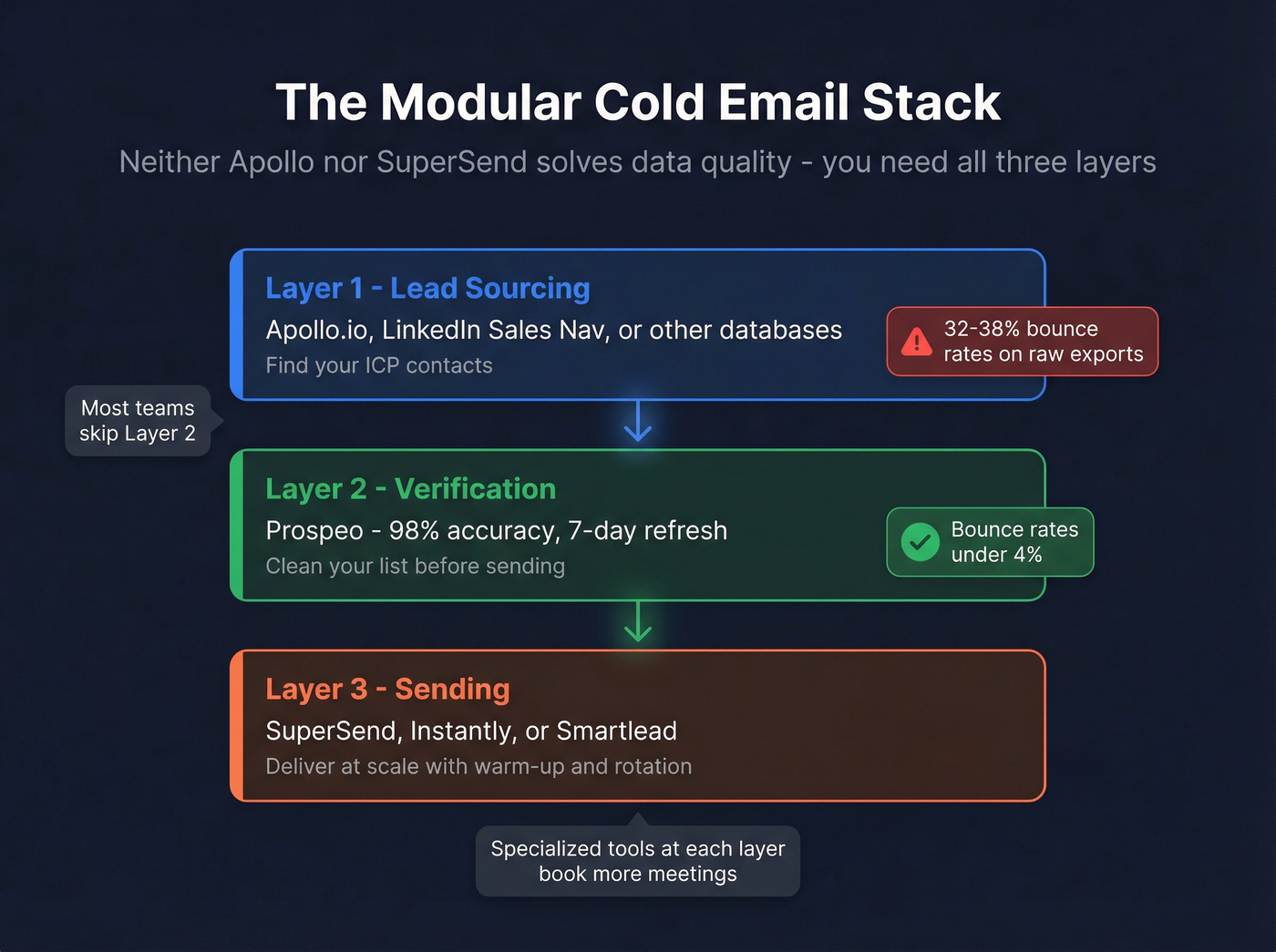
Most teams agonize over which outreach tool to pick when the real bottleneck is data quality. The best cold email stacks are modular. Prospeo fills the gap both tools leave open - 300M+ professional profiles, 98% email accuracy, and a 7-day refresh cycle at roughly $0.01 per lead. It integrates natively with both Instantly and Smartlead, so you can pipe verified contacts straight into your sending platform (and keep an eye on email bounce rate benchmarks).

Running SuperSend at 200K emails/month on unverified lists is lighting money on fire. Prospeo's 5-step verification and catch-all handling keep bounce rates under 4% - exactly what high-volume senders need to protect domain reputation.
Verify your entire list before a single email leaves the inbox.
Which Tool Should You Pick?
Three clear paths:
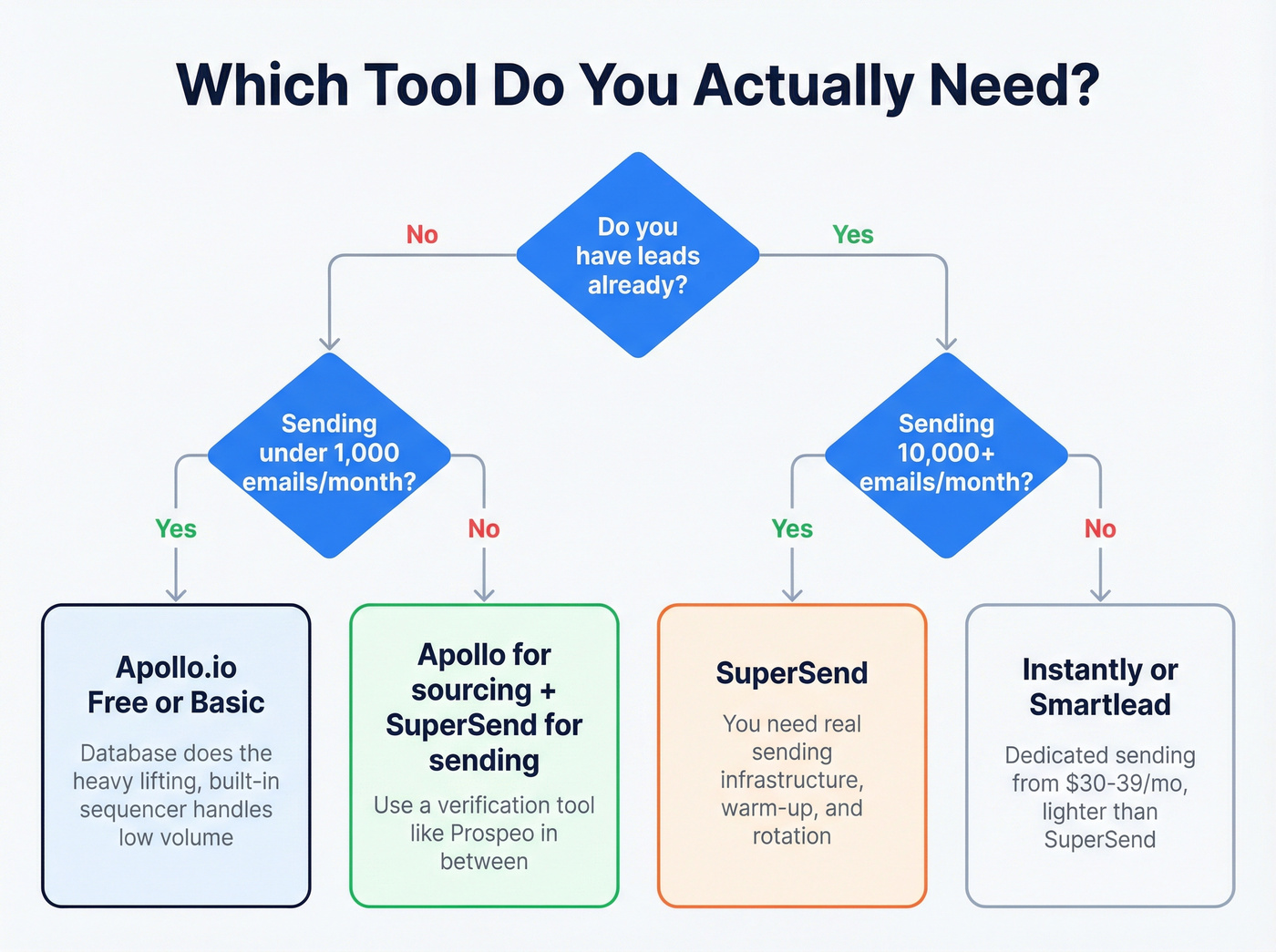
- Need leads, sending under 1,000 emails/month - Apollo Free or Basic. The database does the heavy lifting, and the built-in sequencer handles low volume fine.
- Have leads, sending 10,000+ emails/month - SuperSend. You need real sending infrastructure, not a database tool's sequencer.
- Want the best of both - Use a dedicated data provider for sourcing and verification, then pipe clean lists into SuperSend for delivery.
For teams that want a middle ground between Apollo's sequencer and SuperSend's full infrastructure, look at Instantly (plans from ~$30/month for warm-up and sending) or Smartlead (starting around ~$39/month with auto-rotation). Both are dedicated sending platforms that sit between Apollo's basic sequencer and SuperSend's high-volume engine (more options in our guide to AI bulk email senders).
Let's be honest: stop looking for one tool that does everything. The teams we've seen book the most meetings run specialized tools at each layer - sourcing, verification, sending - rather than forcing a database platform to double as their outbound engine (use a solid B2B cold email sequence either way).
FAQ
Can I use SuperSend and Apollo together?
Yes, and many teams do. Use Apollo for list-building, then export to SuperSend for high-volume sending. Verify the exported data first - Apollo lists often bounce at 30%+, which will torch your domain reputation fast.
Does Apollo automate LinkedIn outreach?
Not meaningfully. Apollo sequences include LinkedIn steps, but they're manual tasks reps complete individually. Users on r/GrowthHacking report the automated connection feature stopped working. SuperSend offers actual LinkedIn automation built into sequences.
Is SuperSend good for small teams?
Under 500 emails per day, Apollo's built-in sequencer is simpler and cheaper - the free tier is genuinely useful. SuperSend shines past 10,000 emails per month when you need warm-up, rotation, and deliverability monitoring. For teams under that threshold, the $99/month minimum may not justify the infrastructure.
What's the cheapest way to get accurate B2B data for SuperSend?
Prospeo's free tier gives you 75 verified emails per month at 98% accuracy. Paid plans run about $0.01 per lead, which is significantly cheaper and more reliable than Apollo's credit-based model for pure data extraction. The 7-day refresh cycle means you're not emailing stale contacts.