


Talisma Pricing, Reviews, Pros & Cons (2026)
You've been trying to find a straight answer on Talisma's pricing, reviews, and real-world pros and cons. Every vendor page says "contact sales," every directory shows a different rating, and the most recent review you can find is from someone managing 30,000 contacts who says the thing is slow. Let's cut through it.
30-Second Verdict
Talisma is a niche CXM platform built for education institutions and specific enterprise verticals like banking and hospitality. For most B2B teams, the opaque pricing, a 2.7/5 ease-of-use score, and persistent performance complaints make it hard to recommend over HubSpot or Zoho.
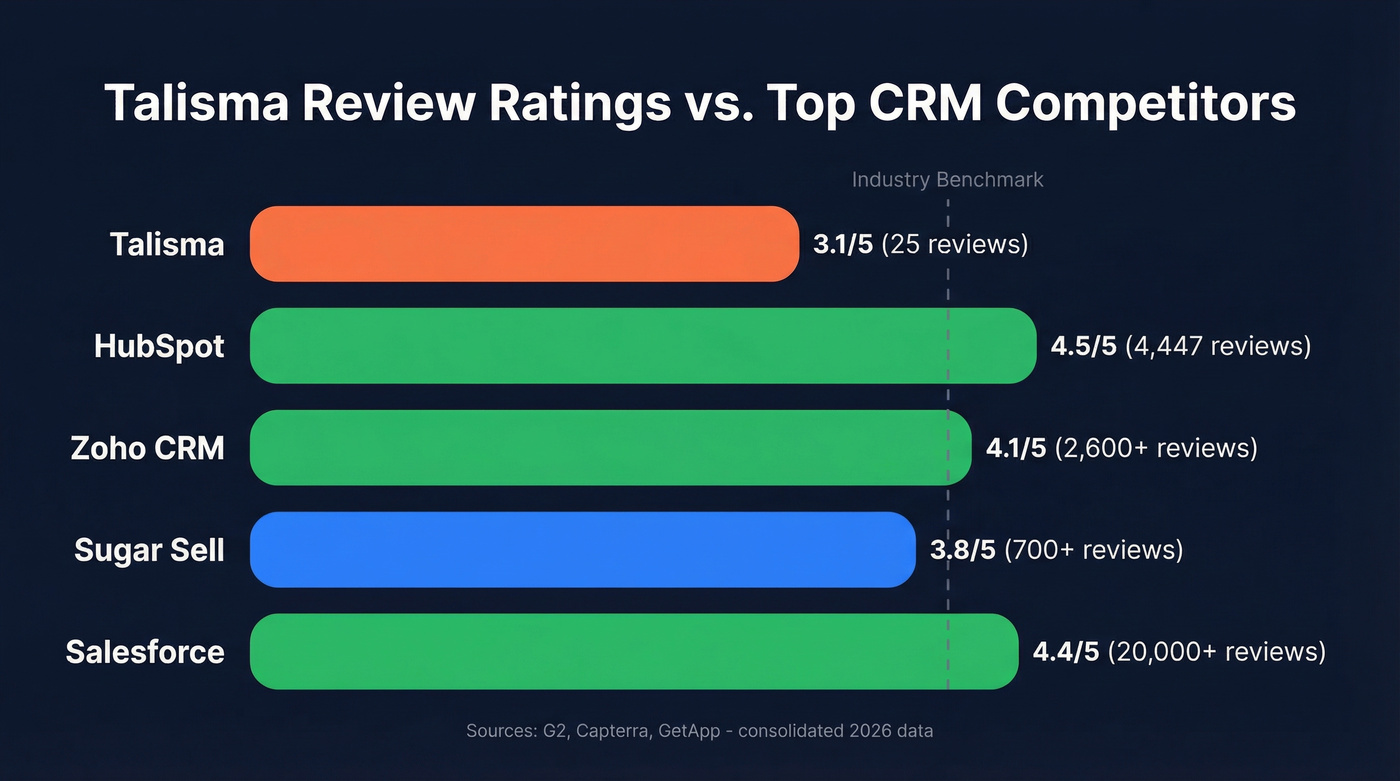
Across major review directories, Talisma lands at 3.1/5 on G2 and 3.7/5 on Capterra and GetApp - not competitive with mainstream CRMs sitting around 4.5/5 with thousands of reviews. If you're already in the Talisma ecosystem, the CXM.AI launch shows the product line is evolving. If you're not, keep reading.
What Is Talisma?
Talisma has been in the CXM space for over 25 years, headquartered in India with a presence in 30+ countries. The company's bread and butter is education - student lifecycle management, admissions workflows, and academic counseling - plus enterprise CXM/CRM use cases in verticals like banking and hospitality.
In early 2025, Talisma launched CXM.AI, an AI-powered hyper-personalization platform that supports cloud, on-premise, and hybrid deployments.
What Does Talisma Cost?
SelectHub lists Talisma's starting price at $99/month with a free trial available. There's no free tier, and most enterprise buyers should still expect a "contact vendor" sales process.
If you're comparing options, it helps to sanity-check against other examples of a CRM with published tiers.
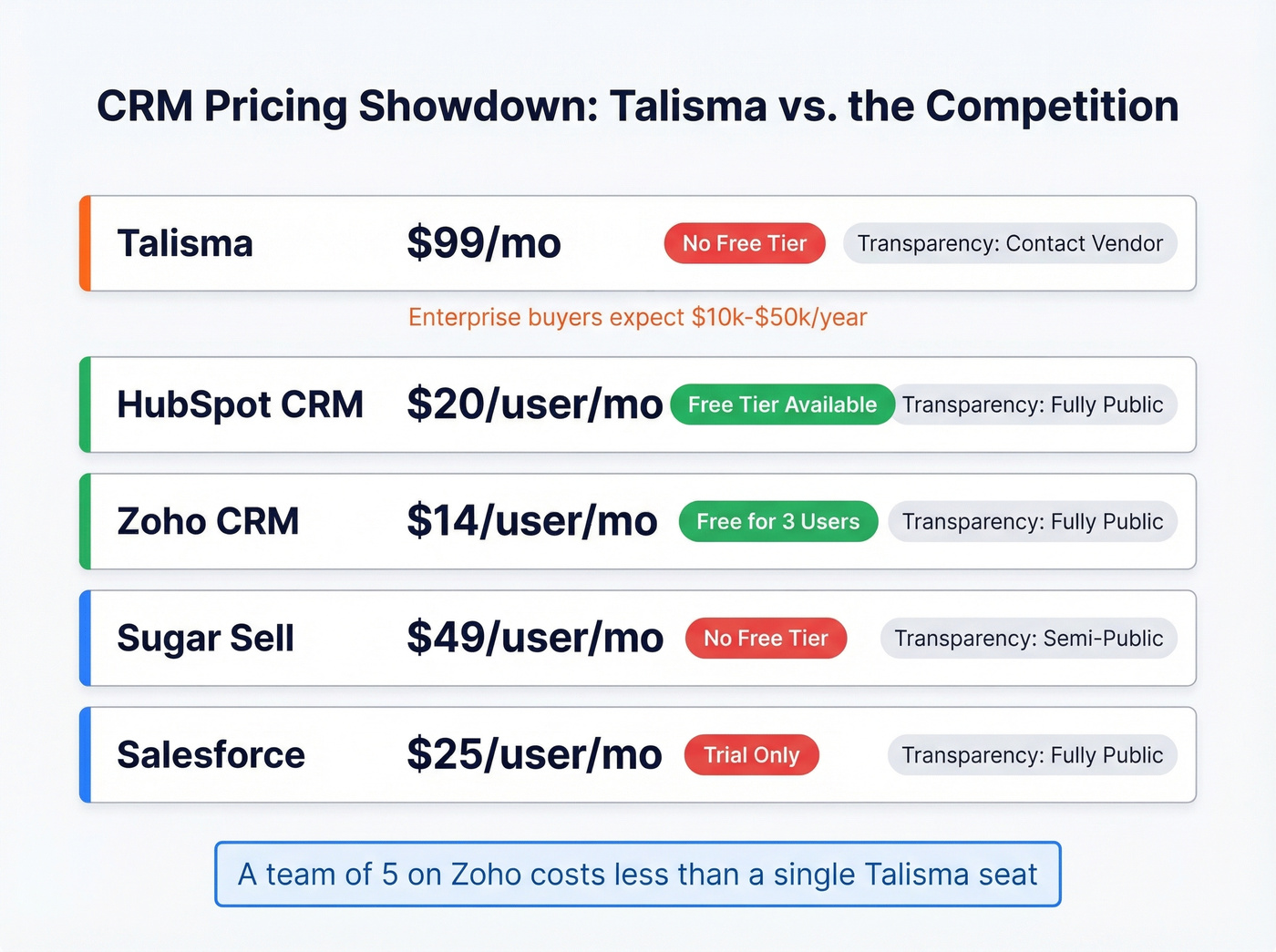
Based on typical enterprise CXM licensing, expect $10k-$50k/year depending on seats, integrations, and implementation scope. That's a wide range, but Talisma doesn't publish tiers publicly, so you won't know your number until you talk to their team.
| Tool | Starting Price | Free Tier | Pricing Transparency |
|---|---|---|---|
| Talisma | $99/mo | No (trial only) | Contact vendor |
| HubSpot CRM | $20/user/mo | Yes | Public |
| Zoho CRM | $14/user/mo | Yes (3 users) | Public |
| Sugar Sell | ~$49/user/mo | No | Semi-public |
| Salesforce | $25/user/mo | No (trial only) | Public |
You can get a team of five onto Zoho for less than a single Talisma seat. HubSpot is in the same general ballpark for five seats, but it's far more self-serve and transparent.
Ratings Across Review Platforms
We consolidated ratings from four platforms to get the full picture:
| Platform | Rating | Reviews |
|---|---|---|
| G2 | 3.1/5 | 25 |
| Capterra | 3.7/5 | 15 |
| GetApp | 3.7/5 | 15 |
| SelectHub | 69% satisfaction | 47 |
For context, HubSpot sits at 4.5/5 with 4,447 reviews. Talisma's 25 G2 reviews aren't just lower-rated - they signal a tiny user community. 52% of those reviewers gave 4 stars, so most users are lukewarm rather than hostile, but the sample is too small to draw confidence from.
We also did a pass through Reddit and higher-ed forums. There's almost no Talisma-specific discussion, which tells its own story about community size.
If you're evaluating tools with limited review volume, it helps to pressure-test your sales prospecting techniques and data quality assumptions before you commit.

Talisma's tiny review pool and 2.7/5 usability score signal risk. But whichever CRM you pick - HubSpot, Zoho, or Salesforce - bad contact data will tank your outreach. Prospeo verifies 143M+ emails at 98% accuracy on a 7-day refresh cycle, so your CRM stays clean from day one.
Stop importing stale data into your shiny new CRM.
Pros and Cons
What works:
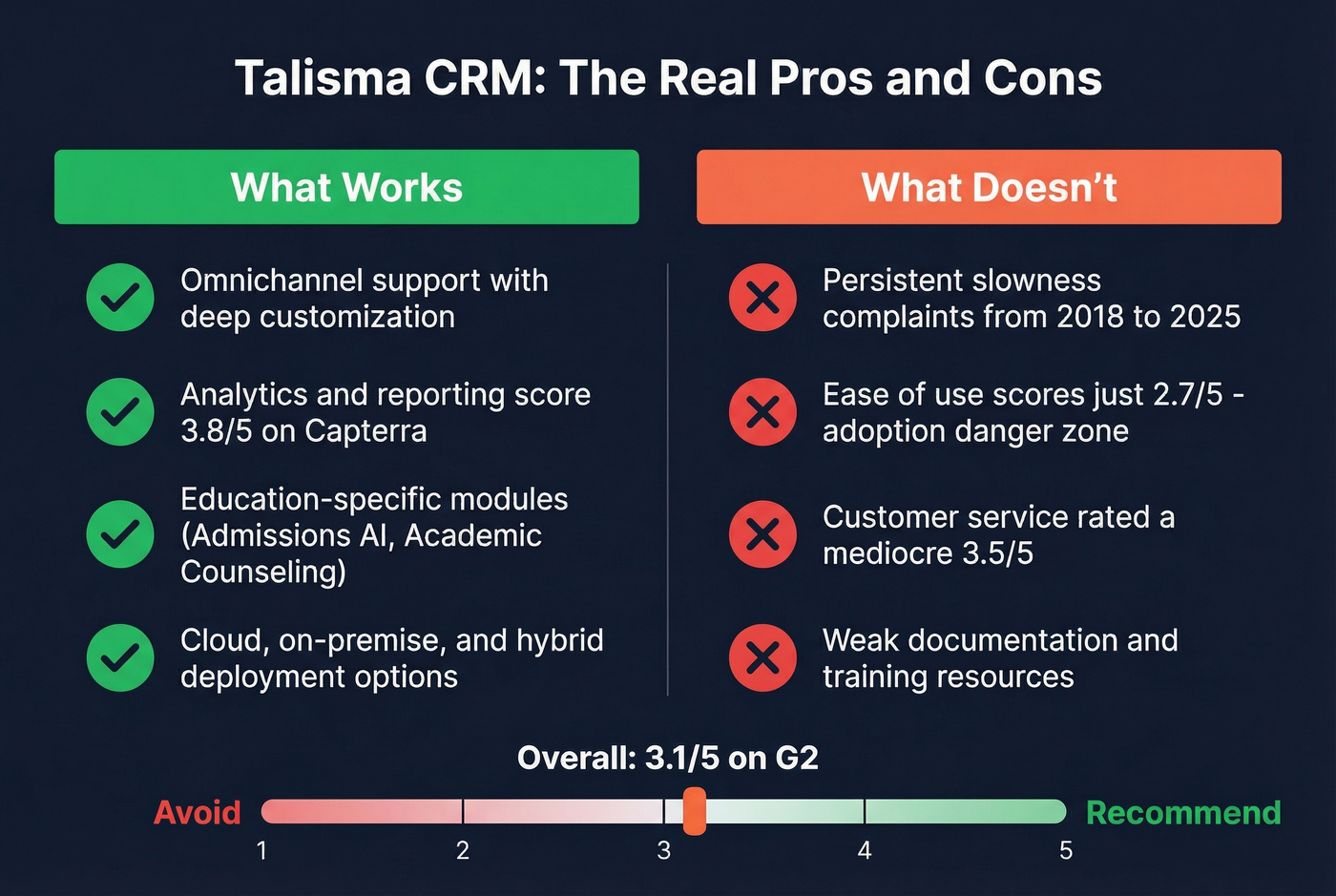
Omnichannel support and deep customization give enterprises real flexibility. Analytics and reporting are consistently praised - features score a respectable 3.8 on Capterra, Talisma's strongest subscore. The education-specific modules (Admissions AI, AI Academic Pathway, Academic Counseling) are genuinely differentiated. No mainstream CRM offers this out of the box.
What doesn't:
Slowness. It shows up repeatedly across reviews spanning 2018 to 2025.
A 2025 reviewer wrote: "it can be really slow to respond to commands." A 2021 reviewer asked: "I don't understand why this software is slow?" And a 2018 reviewer noted it was "fairly fast... as long as the server links were maintained."
Here's the thing: in our experience, CRMs scoring below 3.0 on ease-of-use create adoption nightmares. Talisma's 2.7 is firmly in that danger zone. Customer service scores a mediocre 3.5, and documentation and training resources are a recurring weak spot in reviews.
If you're trying to prevent adoption issues post-rollout, treat it like sales process optimization: remove friction, standardize workflows, and measure usage.
Who Should Use Talisma?
This makes sense if you're an education institution managing the student lifecycle, you're already deep in the ecosystem and migration costs outweigh the pain, or you need on-premise deployment for compliance reasons. The fact that pricing is still "contact vendor" in 2026 tells you who the buyer is - large institutions with procurement teams, not self-serve B2B shops.
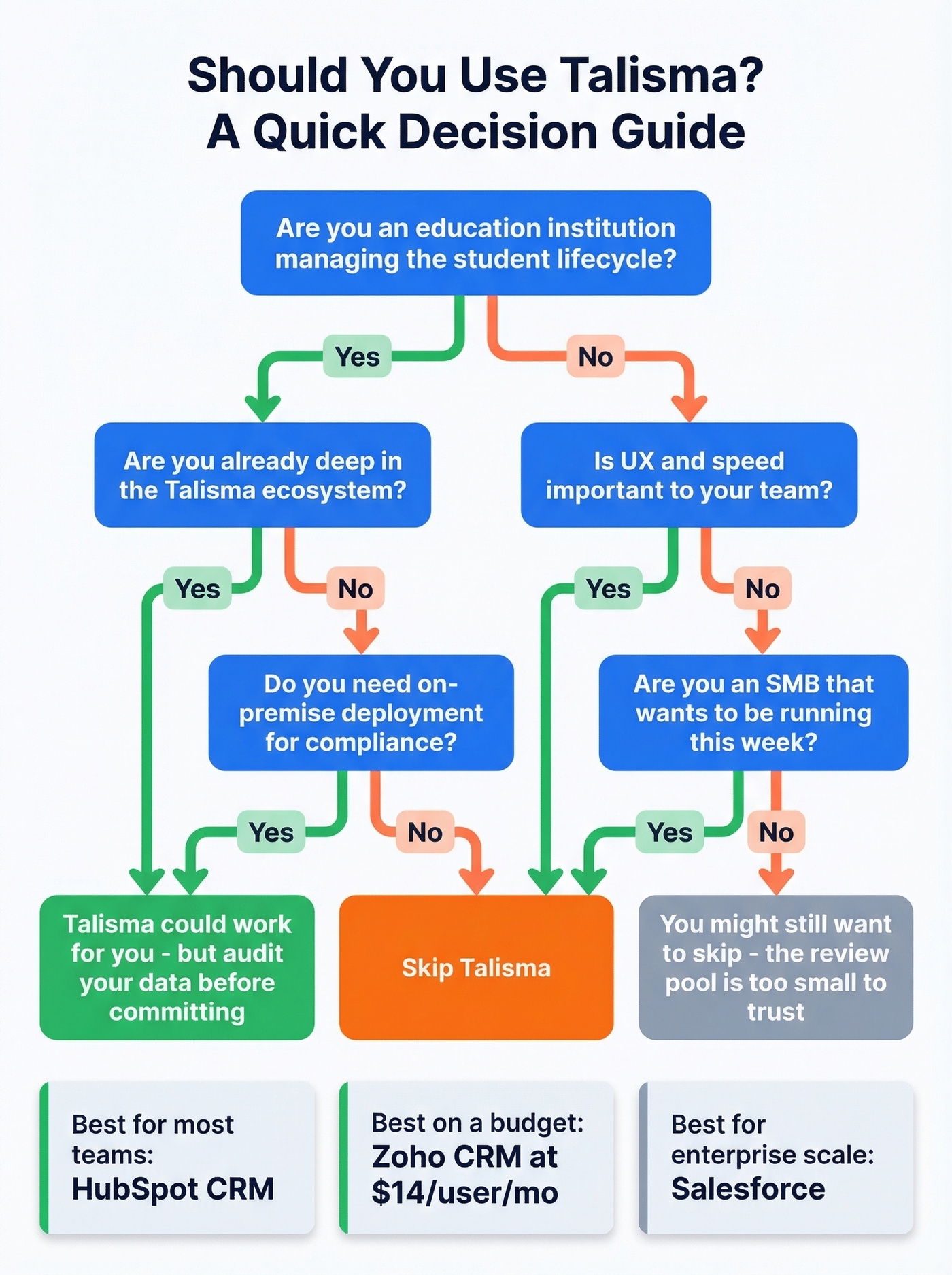
Skip this if UX and speed matter to your team (they should), you're an SMB that wants to be running this week, or you want a CRM with a thriving integration ecosystem and active community.
If you're an SMB and the goal is simply to organize leads and conversations, start with contact management software before you overbuy an enterprise platform.
Best Alternatives to Talisma
HubSpot CRM is the default for teams under 50 people. Free tier, starting around $20/user/month when you upgrade, and an ecosystem so deep you'll rarely hit a wall before you can afford Salesforce. For most teams reading this, HubSpot is the answer - and it isn't close.
When budget is the constraint, Zoho CRM at $14/user/month with 2,000+ integrations punches way above its price. We'd pick Zoho over Talisma ten times out of ten for any team that isn't in higher education.
For mid-market sales teams needing pipeline depth, G2 names Sugar Sell as the best overall Talisma alternative at roughly $49/user/month. And if you're leaving Talisma because you outgrew it, Salesforce at $25/user/month is the obvious landing spot.
If you're building a modern outbound stack alongside your CRM, compare SDR tools and make sure your workflows connect cleanly.
One thing worth flagging before you migrate anywhere: audit your data first. A CRM with 30,000 contacts is useless if 20% bounce on your first outreach. Prospeo verifies emails at 98% accuracy on a 7-day refresh cycle, keeping your database clean regardless of which CRM you pick. There's a free tier with no contract, so you can test before committing.
If you need to go deeper on list hygiene, start with email bounce rate benchmarks and remediation.

The Bottom Line
Talisma is defensible for education institutions and enterprises already embedded in the ecosystem. For everyone else - and that's most B2B teams reading this - pick HubSpot or Zoho, pair it with verified contact data, and you'll outperform Talisma on cost, usability, and speed from day one. When you weigh the full picture of pricing, reviews, and real-world pros and cons, the math just doesn't favor Talisma for general B2B use.
If you're planning the switch, use a simple lead generation workflow to keep handoffs clean during migration.
Migrating 30,000 contacts to a new CRM? Audit before you import. Prospeo enriches and verifies at 92% match rate, returning 50+ data points per contact - at roughly $0.01 per email. No contracts, no sales calls.
Audit your database before your next CRM migration.
FAQ
Does Talisma offer a free plan?
No. Talisma has no free tier - only a free trial, with starting pricing commonly listed at $99/month. Both HubSpot and Zoho offer permanent free CRM tiers that support small teams without a credit card.
Is Talisma good for small businesses?
No. The opaque pricing, 2.7/5 ease-of-use score on Capterra, and enterprise-gated sales process make it a poor fit for SMBs. HubSpot's free tier and Zoho at $14/user/month are better self-serve options you can set up in a day.
What is CXM.AI by Talisma?
CXM.AI is Talisma's AI-powered hyper-personalization platform, launched in early 2025. It layers onto existing systems using customer history and interaction data, supporting cloud, on-premise, and hybrid deployments. It's still early - expect limited third-party reviews until late 2026.
How do I keep contact data clean after switching CRMs?
Run your database through a verification tool before and after migration. Prospeo's enrichment returns 50+ data points per contact at a 92% match rate, with records refreshed every 7 days. The free tier gives you 75 emails per month to test without commitment.