

Talk to Listen Ratio: 2026 Benchmarks & Tips
You spent 30 minutes perfecting your discovery questions, then dialed 40 numbers and reached 6 people. Three were wrong contacts. Your talk to listen ratio on those calls was great. Your pipeline impact was zero.
The famous 43:57 ratio is oversimplified, and most teams misapply it. Gong's analysis of 326K calls shows the real average is 60/40, with the gap between won and lost deals sitting at just 5 percentage points. The ratio matters - but it matters less than you think, and it shifts by call stage and buyer persona. Let's get into the full picture.
What Is Talk to Listen Ratio?
Talk to listen ratio measures how much of a sales call the rep spends talking versus listening. The formula is straightforward: agent talk time divided by total talk time equals your ratio. Most tools compute this on talk segments only, stripping out silence and hold music, so total talk time = agent talk + customer talk. A 60/40 ratio means the rep talked 60% and the prospect talked 40%.
Most conversation intelligence platforms track this automatically when speaker detection is enabled. It's the most-cited metric in sales coaching - and the most misunderstood, because a single number can't capture what actually happens across different call stages and buyer types.
Here's the short version: the 43:57 "golden ratio" is a starting point, not gospel. Gong's 326K-call dataset puts the won-deal average at 57% talk / 43% listen. The bigger lever is interactivity - how often the conversation bounces back and forth - not raw talk time. ExecVision's analysis of 2,000+ Conversation Style Matrices found zero examples of the 80/20 "listen rule" in real calls. And none of it matters if you're dialing wrong numbers. Fix connect rate first, then interactivity, then ratio.
Benchmarks From 326K Sales Calls
The internet's favorite ratio - 43:57 - comes from Gong research originally authored in 2016. It was a useful finding at the time, and it's been copy-pasted into every sales blog since. The problem? Gong's own updated data tells a different story.
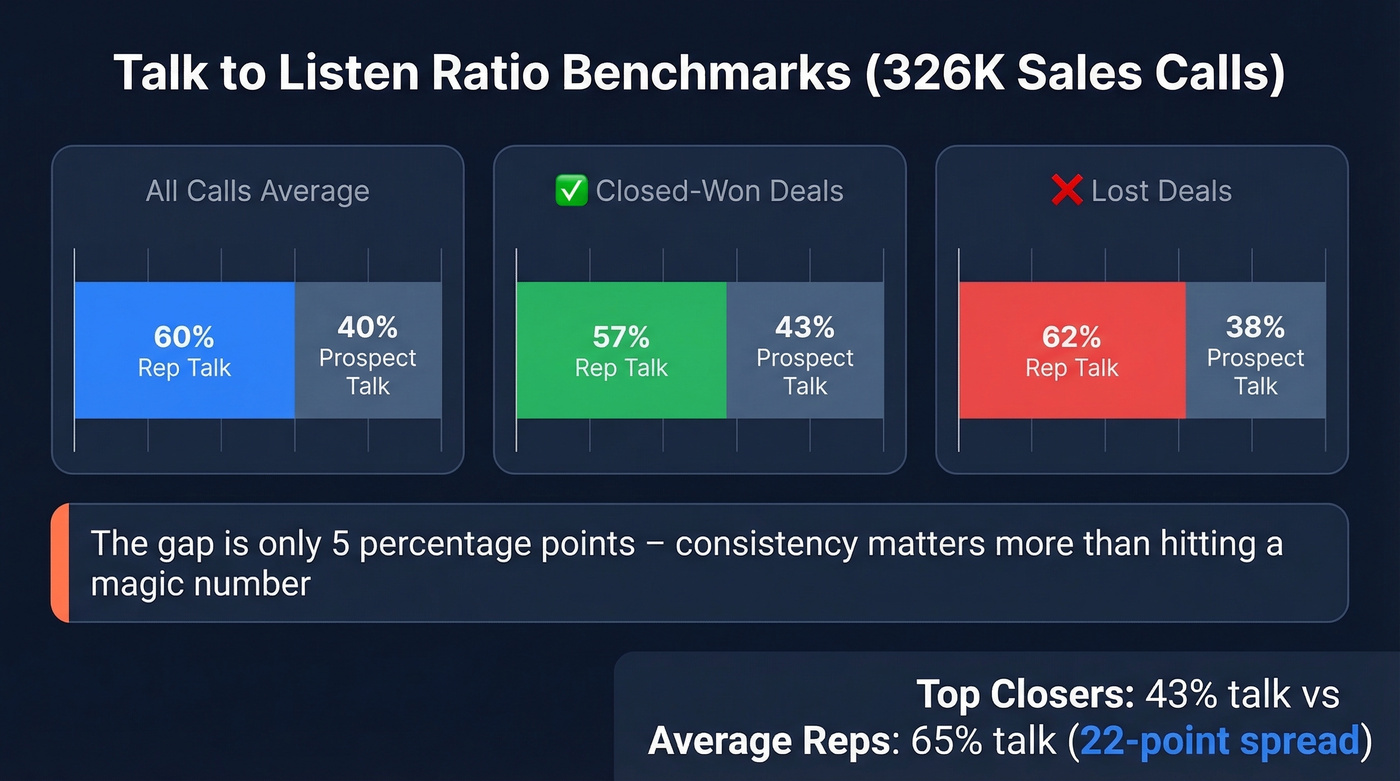
In their refreshed analysis of 326K sales calls - minimum 10 minutes each - the average ratio across all calls was 60% talk / 40% listen. Closed-won deals averaged 57% rep talk time. Lost deals averaged 62%. That's a 5-point gap. Meaningful, but not the chasm most articles imply.
The real separator is consistency. Low performers swing roughly 10 points between outcomes - something like 54% talk time in won deals versus 64% in lost ones. High performers stay steady regardless of outcome. They've internalized the right cadence and don't panic-monologue when a deal goes sideways. In our audits of sales calls, this consistency pattern shows up over and over: the best reps sound the same whether they win or lose.
A widely-cited summary puts top closers at 43% talk versus 65% for average reps. That's a 22-point spread. So the ratio does separate great from mediocre - it just doesn't separate won from lost as dramatically as the old 43:57 framing suggests.
Here's what surprised us in the data: won deals averaged 15-16 questions per call. Lost deals averaged around 20. More questions didn't help. They hurt. Quality of conversation beats quantity of interrogation every time.
Ratio by Call Stage
One universal ratio is meaningless because it should shift throughout a single call. Mindful Communication's stage breakdown makes this concrete:
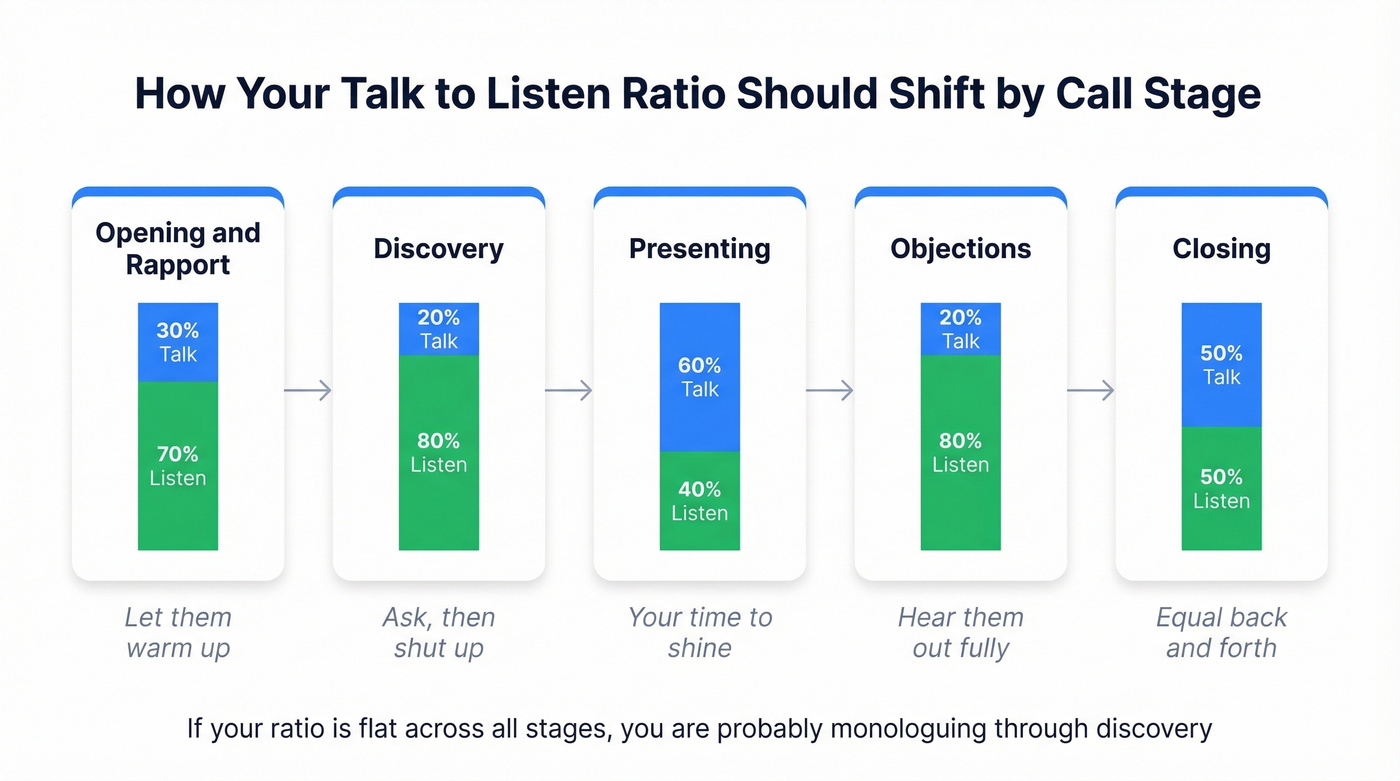
| Call Stage | Rep Talk | Rep Listen |
|---|---|---|
| Opening/Rapport | 30% | 70% |
| Discovery | 20% | 80% |
| Presenting | 60% | 40% |
| Objections | 20% | 80% |
| Closing | 50% | 50% |
The pattern is clear: listen heavily early, talk more when presenting your solution, then pull back again for objections. If your ratio is flat across all stages, you're probably monologuing through discovery or staying silent when you should be closing.

You read it above: three of six connects were wrong contacts. Your talk to listen ratio is irrelevant if you're reaching the wrong people. Prospeo's 300M+ profiles with 98% email accuracy and 125M+ verified mobiles (30% pickup rate) mean every call counts.
Stop perfecting your ratio on prospects who were never real buyers.
Ratio by Buyer Persona
ExecVision analyzed 2,000+ conversation style matrices and found that persona type changes the target ratio dramatically. A C-level exec expects you to lead the conversation. An end user expects you to ask and listen.
If you're mapping this to your ideal customer profile, the takeaway is simple: persona dictates cadence, not just content.
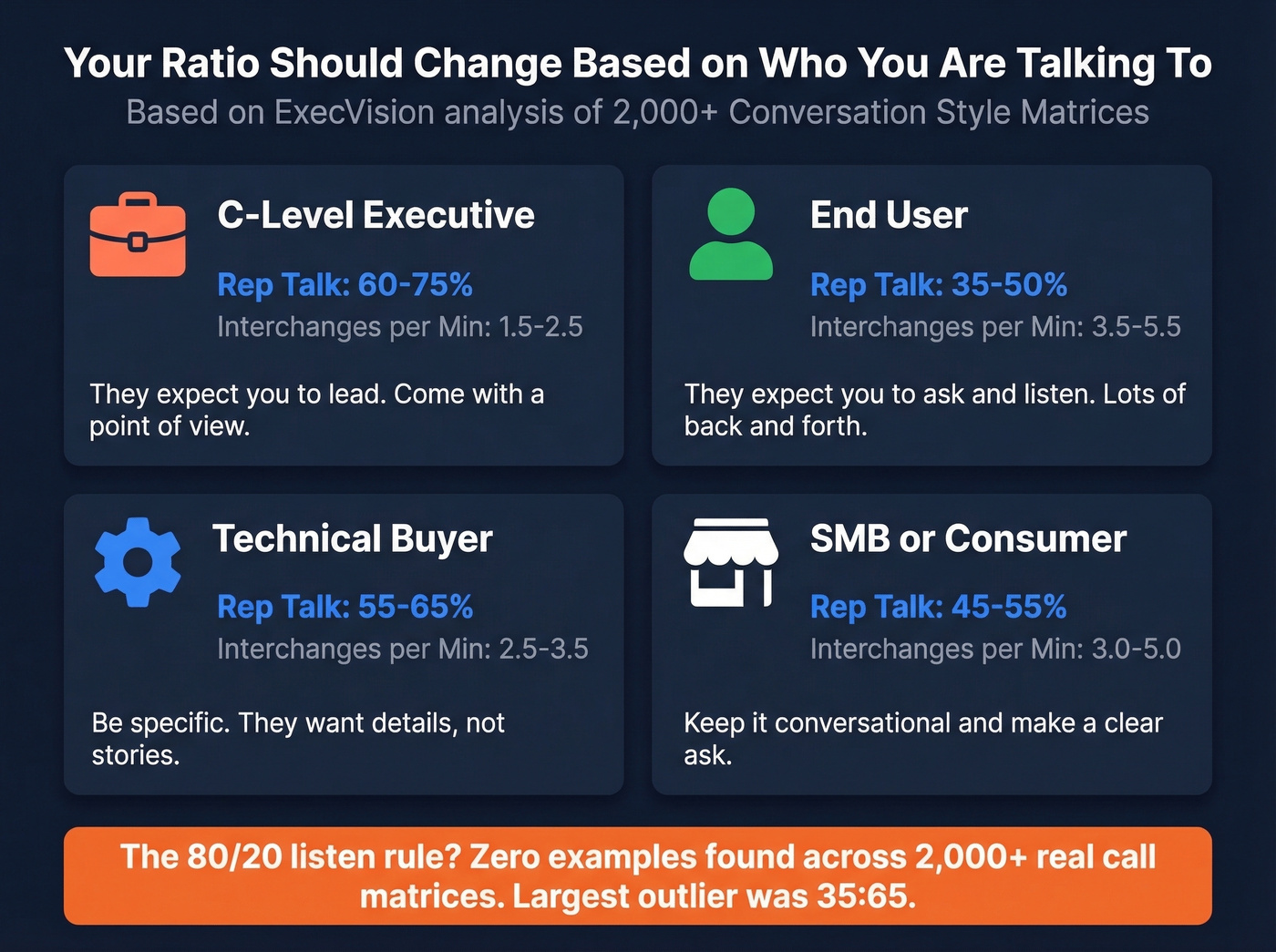
Interchanges per minute measures how many back-and-forth turns happen per minute - think of it as conversational ping-pong speed.
| Persona | Rep Talk | Interchanges/Min |
|---|---|---|
| C-Level | 60-75% | 1.5-2.5 |
| End User | 35-50% | 3.5-5.5 |
| Technical Buyer | 55-65% | 2.5-3.5 |
| SMB/Consumer | 45-55% | 3.0-5.0 |
One thing ExecVision's data killed definitively: the 80/20 "listen rule." Across 2,000+ matrices, they found zero examples that extreme. The largest outlier was 35:65 over a full month of calls. The 80/20 rule is motivational poster advice, not real-world data.
Look, if your average deal size is under $15k and you're selling to SMBs, obsessing over this metric is a distraction. Your problem isn't that reps talk too much - it's that they're reaching the wrong people or failing to make a clear ask. Fix those first.
The Metric That Matters More
If you're only tracking talk-to-listen ratio, you're watching the wrong scoreboard. ExecVision's framework makes this obvious: conversation style is talk:listen ratio plus interchanges per minute. Their ranges of 1.5-5.5 depending on persona give you a second axis that ratio alone misses entirely.
Gong's data reinforces this: the longest rep monologue correlates with lost deals. It's not about total talk time - it's about whether the conversation flows or stalls. A rep who talks 55% of the time in short, interactive exchanges will outperform one who talks 45% but delivers two 4-minute monologues. Coach the longest monologue per call - keep it under roughly 60-90 seconds - before obsessing over the overall ratio.
And here's a stat that should bother every sales leader: 35% of businesses never ask the prospect to buy or book an appointment, per Invoca's analysis of 60M+ calls. The ratio is irrelevant if you never make the ask.
We've seen teams improve talk ratios fastest by coaching monologues and interchanges - not by telling reps to "listen more." That advice is too vague to act on. "Your longest monologue was 3 minutes and 42 seconds - here's where you lost them" is coaching. "Listen more" is a bumper sticker.
If you want a broader view of what to track beyond talk time, align this with your pipeline health metrics so coaching ties to revenue outcomes.
How to Measure It
The formula: agent talk time divided by the sum of agent talk time and customer talk time. Most CI tools handle speaker segmentation automatically - Gong, Aircall, CloudTalk, and Chorus all track it natively.
Four pitfalls to avoid:
- Counting silence as listening. Dead air isn't engagement. Good tools strip it out before calculating.
- Chasing team averages. A team average of 55% hides the rep at 40% and the one at 70%. Coach individuals.
- Ignoring call type. A demo should run 60/40. A discovery-heavy call should run 20/80. Blending them into one metric is useless.
- Bad speaker detection. If your tool can't reliably distinguish rep from prospect, the ratio is garbage. Test diarization accuracy before trusting the numbers.
Skip the CI investment entirely if your team runs fewer than 50 calls a week. Record your calls with consent, manually time a sample of 5-10 per rep each month, and you'll spot the patterns without a five-figure software contract.
If you're building a repeatable outbound motion, this fits best inside a documented cold calling system so measurement and coaching are consistent.
How to Improve Your Ratio
Most articles about this topic miss the point. The ratio is a symptom, not a cause. Here's the hierarchy that actually moves pipeline:
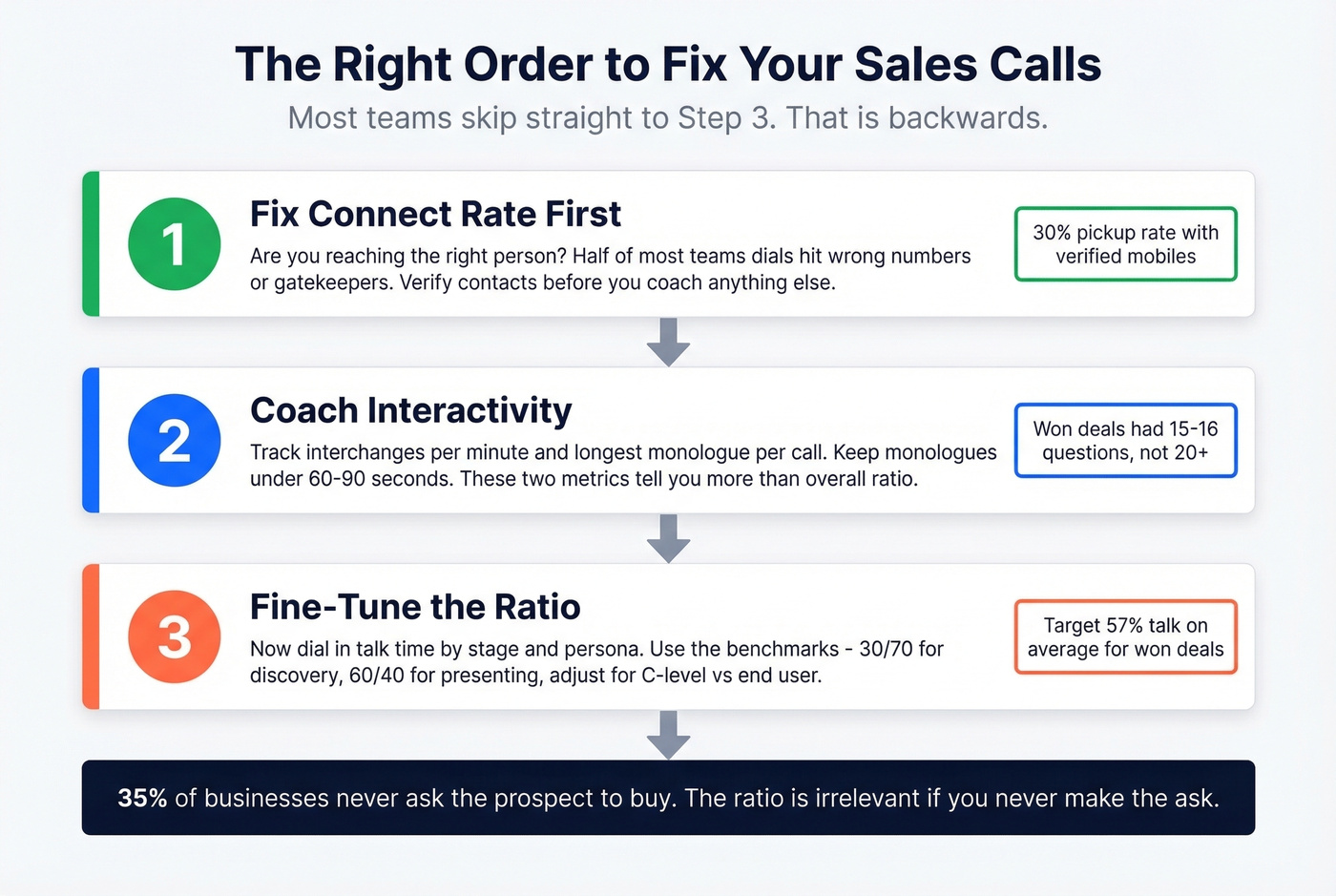
Step 1 - Connect rate. Before you optimize talk time, make sure you're reaching the right person. We've watched teams pour hours into call coaching only to realize half their dials were hitting wrong numbers or gatekeepers. Prospeo's mobile finder verifies numbers before you dial - 125M+ verified mobiles with a 30% pickup rate, refreshed on a 7-day cycle - so your ratio coaching happens on real buyer conversations, not dead ends.
Step 2 - Interactivity. Track interchanges per minute and longest monologue per call. These two metrics tell you more about call quality than the overall ratio ever will.
If your reps struggle to keep discovery interactive, tighten the structure with a discovery questions framework (and coach for fewer, better questions).
Step 3 - Ratio fine-tuning. Once you're reaching the right people and having real conversations, dial in the ratio by stage and persona using the benchmarks above.
For the actual on-call techniques: pause after asking a question. Silence is uncomfortable, but it's where prospects fill the gap with real information. Paraphrase what you heard before responding. And ask better questions, not more of them - Gong's data is unambiguous that more questions correlate with losses. One sharp, well-timed question beats a rapid-fire interrogation.
Pre-call prep is step zero. Research the account, know the persona, have a hypothesis about their problem. Reps who prep talk less because they don't need to fish. They already know where to cast. The consensus on r/sales threads about talk-to-listen ratio echoes this: prep and genuine curiosity beat any scripted question framework.
To make the "ask" easier (and more consistent), keep a set of talk tracks and a clear steps to close a sale checklist for each call type.
The bottom line: connect rate, then interactivity, then ratio. Get the order right, and every coaching conversation becomes more productive.
35% of businesses never ask the prospect to buy - partly because reps waste calls on bad data. Prospeo refreshes every 7 days (not 6 weeks) so your team spends talk time on live decision-makers, not dead leads. At $0.01 per email, fixing connect rate costs less than one lost deal.
Dial real buyers. Coach the ratio after.
FAQ
What's a good talk to listen ratio for cold calls?
Aim for 45-55% rep talk time on cold calls. You're establishing context and relevance before the prospect has any reason to engage, so you'll naturally talk more than on a warm call. Keep your opening under 30 seconds, then shift to questions. ExecVision's cold-call data targets the same 45-55% range with roughly 3-5 interchanges per minute.
Does this ratio matter for customer success calls?
Support and CS calls should skew heavily toward listening - aim for 30% talk / 70% listen or lower. The goal is understanding the customer's situation, not pitching. Aircall tracks this metric for both sales and support teams, making it easy to benchmark across functions.
How do I track it without conversation intelligence software?
Record your calls with consent, then manually time your speaking versus the prospect's. It's tedious but free. For a scalable approach, Aircall or CloudTalk calculate it automatically with plans starting around $25-30/user/mo. Before investing in CI tooling, make sure you're reaching verified contacts - Prospeo's free tier includes 75 email credits so you aren't wasting recordings on wrong numbers.