

Territory Planning Best Practices: The Math, the Template, and the Conversations Nobody Talks About
Your VP wants territories rebalanced by Monday. You open the spreadsheet. It has 47 tabs, 12 color codes, and a formula referencing a sheet someone deleted in Q2. On r/SalesOperations, teams describe territory design as "a massive Excel sheet" combining zip codes, account lists, and tribal knowledge - and balancing on anything beyond geography as "a nightmare."
Here's the revenue paradox that makes this urgent: 73% of field sales orgs grew revenue last year, but only about 35% have 70%+ of reps consistently hitting quota. Reps spend just 35-39% of their time actually selling. The rest disappears into admin, travel, and chasing dead contacts. Growth is masking a distribution problem, and this guide gives you the math, the template, and the uncomfortable conversations that fix it.
Why Territory Planning Drives Revenue
HBR research ties territory realignment to a 2-7% revenue lift without adding headcount or changing strategy. Xactly's benchmarks go further: 15% higher revenue, 20% productivity increase, and up to 30% higher quota attainment for teams that get territory design right.
The case studies back it up. Samsung cut costs by $8.8M (25%) and increased customer visits by 50% through territory optimization alone. Lobel Financial scaled from a regional lender to a national operation, quadrupling sales volume in eight months across 50+ field reps - largely by redesigning territories around opportunity density instead of state lines. If you're still carving by zip code, you're leaving 2-7% revenue on the table before your reps make a single call.
Calculate Sales Capacity First
Before you carve a single territory, you need to know how many productive reps you actually have. Every competitor guide skips this step. Don't.
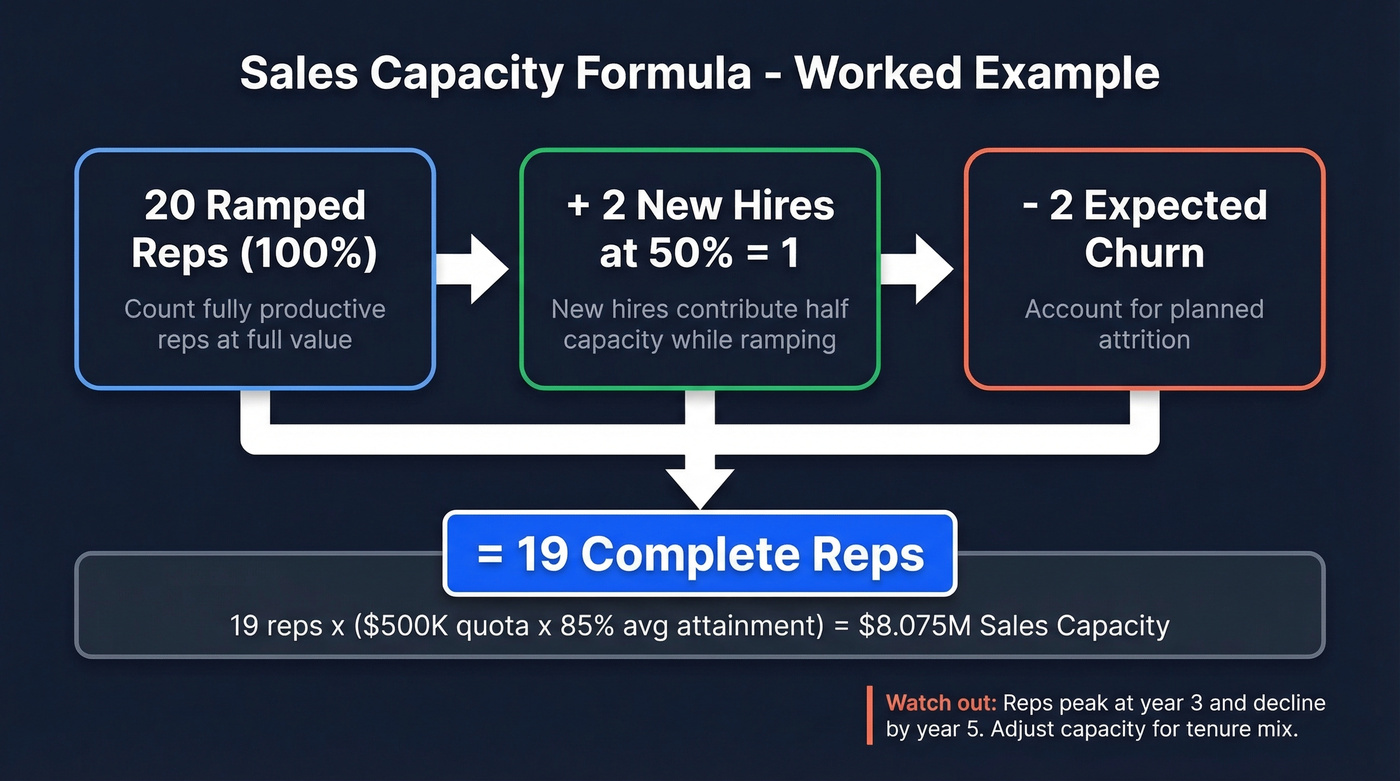
Salesforce's capacity formula is straightforward:
(# of reps) x (individual quota x avg quota attainment) = sales capacity
But raw headcount lies. Count 100% of fully ramped reps and 50% of new hires. Worked example: 20 ramped reps + 50% of 2 new hires - 2 expected churn = 19 "complete reps" as your capacity baseline.
One nuance most teams miss: Xactly's aggregated performance data shows reps peak at year three and begin declining by year five. If half your team has five-plus years of tenure, your capacity model needs to reflect that reality, not the quota you wish they'd hit.
Territory Planning Best Practices: The 7 That Matter
Start With Market, Not Maps
TAM and SAM by segment should drive your first cut, not zip codes. Map total addressable revenue by industry vertical, company size, and buying propensity. Then run a white space analysis - identify accounts and segments where you have zero coverage but clear ICP fit.
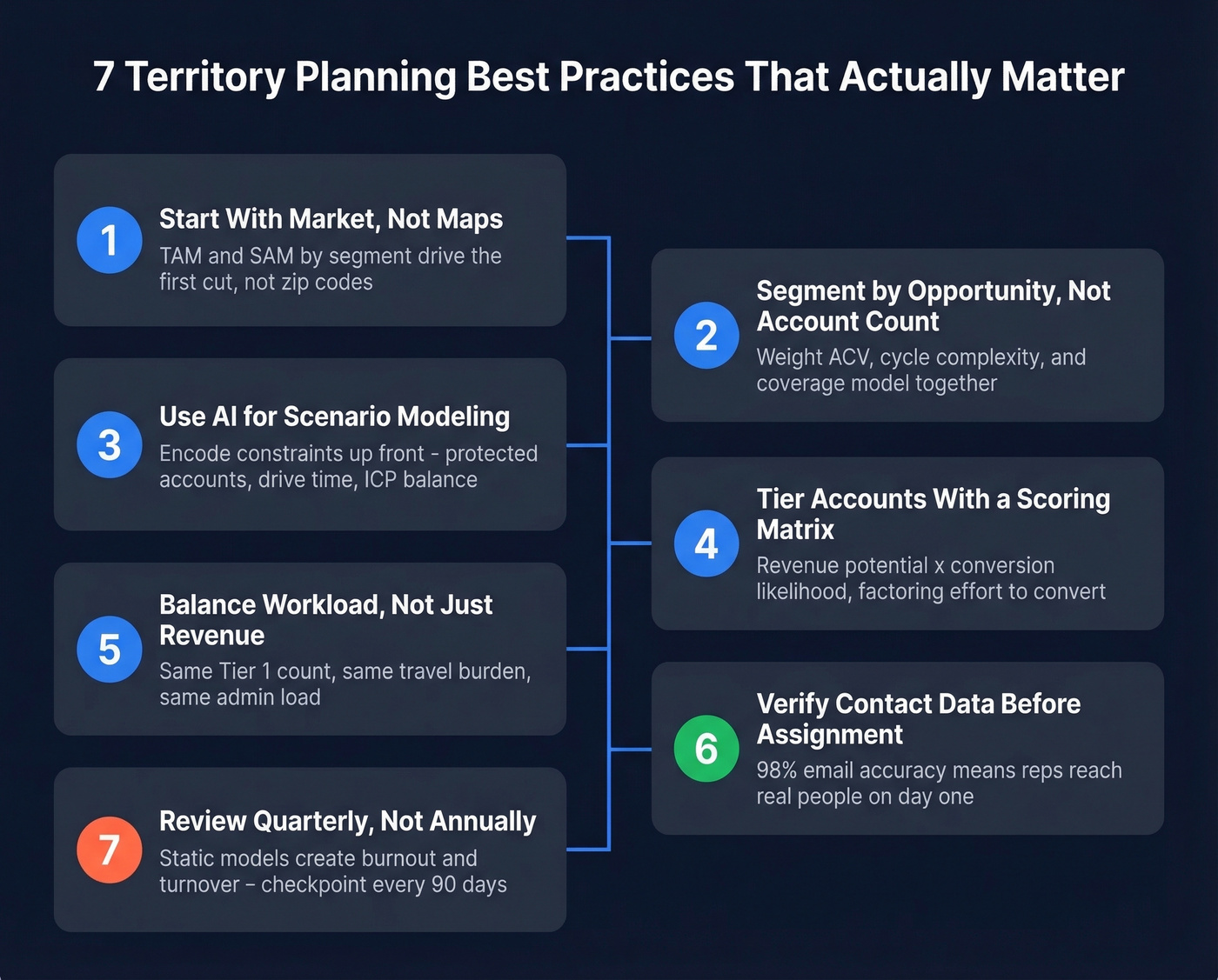
The Reddit frustration is real: teams that start with geography end up "eyeballing it" and fielding endless rep complaints about thin vs. swamped patches. Start with where the money is, then overlay geography as a constraint like travel time, time zones, language, and on-site requirements.
Segment by Opportunity, Not Account Count
Fifty enterprise accounts aren't the same workload as 200 SMB accounts. Gartner's territory design guidance recommends selecting an anchor role, building a territory profile, and prioritizing balance across all territories. Equal account counts create unequal outcomes.
Segment by opportunity value (expected ACV or LTV), sales cycle complexity (stakeholders, security review, procurement), and coverage model (AE-only vs. AE+SDR vs. pods). We've found that weighting these three dimensions together gives you a much more honest picture than any single metric.
Use AI for Scenario Modeling
Territory redesigns used to take 90 days and tank team morale. AI compresses that cycle. One practitioner on Reddit described rebalancing five territories down to three in 72 hours by encoding constraints like protected accounts, drive time, and ICP balance.
You don't need a custom model. Even feeding your account data and constraints into a general-purpose AI tool can generate defensible scenarios faster than any spreadsheet ever will. The key is defining constraints up front - protected accounts, max drive time, minimum Tier 1 coverage, vertical specialization - so the output is something you can actually defend in front of your CRO.
Tier Accounts With a Scoring Matrix
This is where most plans fall apart. Use a scoring model similar to a BCG Matrix approach: revenue potential x conversion likelihood, factoring effort-to-convert. Rate each dimension on a 1-5 scale.
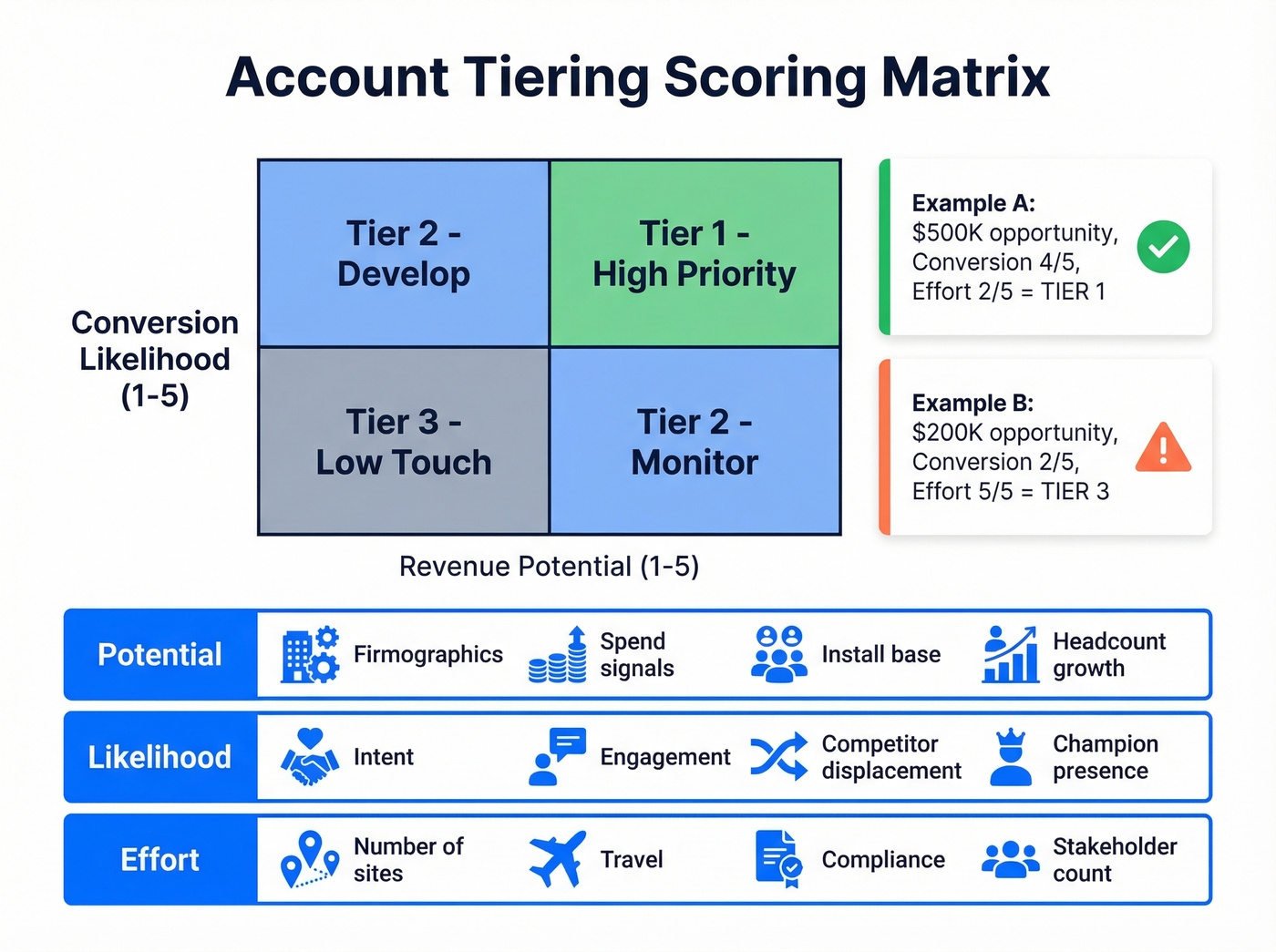
A $500K opportunity with a 4/5 conversion score and 2/5 effort score is Tier 1. A $200K opportunity with a 2/5 conversion score and 5/5 effort score? Tier 3 at best.
If you want this to survive contact with reality, define the scoring inputs in plain language so reps don't call it "RevOps astrology":
- Potential: firmographics + spend signals + install base + headcount growth
- Likelihood: intent, past engagement, competitor displacement, champion presence
- Effort: number of sites, travel, compliance/security, stakeholder count
Balance Workload, Not Just Revenue
Equal revenue across territories doesn't mean equal effort. Factor deal complexity, travel time, account count, and physical viability. SPOTIO flags "phantom territories" where gated communities or secured office parks make accounts look workable on paper but impossible to reach in practice.
We've seen teams assign 80 accounts to a rep only to discover 30 of them sit behind security desks that won't let a salesperson past the lobby. Seller-perceived fairness matters as much as mathematical balance - a territory that looks unfair to the rep will produce like an unfair territory, regardless of what your model says.
A practical "fairness check" that works: same Tier 1 count (plus or minus 2 accounts), same travel burden measured in drive-time bands rather than raw miles, and same admin load across renewals, expansions, and channel management.
Verify Contact Data Before Assignment
A perfectly balanced territory is fiction if the contact data is stale. We use Prospeo for this - 98% email accuracy on a 7-day refresh cycle - so when a rep opens their new patch, the emails actually land and the phones actually ring.
This matters especially when your territory logic depends on reaching a specific persona, not just "owning" an account. The free tier covers 75 emails per month plus 100 Chrome extension credits, which is enough to audit one territory's contactability before rollout. Skip this step and you're handing reps a list of ghosts.
If you're building this into your workflow, treat it like data enrichment: verify, append, and standardize before you assign.
Review Quarterly, Not Annually
Markets shift. Reps leave. Accounts churn. Static territory models are one of Xactly's top pitfalls - they create burnout, frustration, and turnover.
You don't need a full redesign every quarter, but you do need a checkpoint. Are territories still balanced on workload? Has churn shifted the book of business? Are any reps consistently over or under quota by 30%+? Did a vertical heat up or cool off enough to justify specialization? If you can't answer these questions quickly, your territory plan is already decaying.
If you want a tighter operating rhythm, run the checkpoint like a lightweight QBR with the same inputs every time.

You just built a scoring matrix and balanced workload across territories. Now make sure reps can actually reach the accounts you assigned. Prospeo's 98% email accuracy and 7-day refresh cycle means every Tier 1 account comes with verified contact data - not a bounced email and a disconnected number.
A balanced territory with stale data is just a prettier spreadsheet.
What a Territory Plan Actually Looks Like
Every guide says "use data." None of them show you the finished plan. Here's ours.
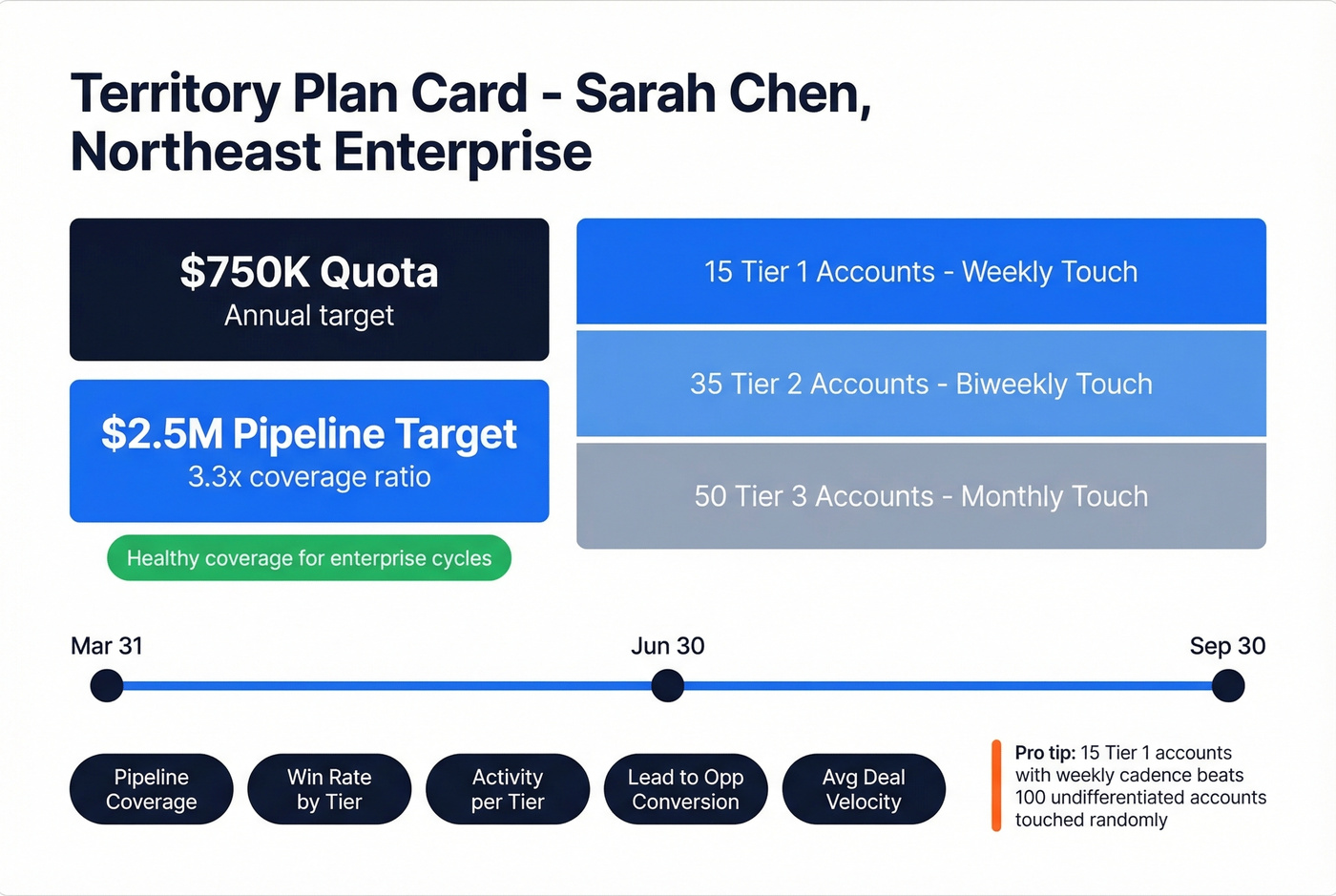
| Element | Detail |
|---|---|
| Rep | Sarah Chen |
| Territory | Northeast Enterprise |
| Quota | $750,000 |
| Pipeline Target | $2,500,000 (3.3x) |
| Tier 1 Accounts | 15 (weekly touch) |
| Tier 2 Accounts | 35 (biweekly touch) |
| Tier 3 Accounts | 50 (monthly touch) |
| Review Dates | Mar 31, Jun 30, Sep 30 |
| Territory KPIs | Pipeline coverage ratio, win rate by tier, activity per tier, lead-to-opportunity conversion, avg deal velocity |
Pipeline coverage guidance: target 3x-5x quota. Sarah's 3.3x is healthy for enterprise cycles. For SMB with higher velocity, push closer to 5x. The tiering logic matters more than the total account count - 15 Tier 1 accounts with weekly cadence will generate more pipeline than 100 undifferentiated accounts touched randomly.
If you need a sanity check on the numbers, align the plan to your sales pipeline benchmarks and pipeline health metrics.
Tools for Sales Territory Mapping
| Tool | Starting Price | Best For |
|---|---|---|
| Prospeo | Free; paid is credit-based | Verifying territory contact data + enrichment |
| MapBusinessOnline | $29/mo | Budget-friendly entry |
| SPOTIO | $39/user/mo | Field-heavy teams |
| Badger Maps | $49/user/mo | Route optimization |
| Mapline | $99/mo | Data visualization |
| Maptitude | $695 one-time | Desktop power users |
| eSpatial | $1,295/user/year | Mid-market mapping |
| Salesforce Maps | ~$75/user/mo | Salesforce-native orgs |
| Anaplan / Fullcast | ~$50K+/yr | Enterprise RevOps |
Here's how to cut through the sprawl. Under 20 reps, start with MapBusinessOnline or Badger Maps. Field-heavy org? SPOTIO. Enterprise RevOps with complex overlays and role hierarchies? Evaluate Anaplan or Fullcast. For smaller teams that aren't already running Salesforce, Salesforce Maps is usually hard to justify - the value is in the native CRM integration, and without that, you're overpaying for a map.
Let's be honest: you don't need a $50K platform. You need the capacity formula, a scoring model, and clean contact data. The tool is the last 10% of the problem. Most teams that buy enterprise territory software are compensating for a process they never built.
If you're still deciding what to buy, start with a quick scan of sales mapping software options before you commit.
Communicating Changes Without Losing Reps
The hardest part of territory planning isn't the data - it's the conversation with the rep whose territory just got split in half. Two-thirds of organizations report losing more than 30% of their sales force annually, and botched territory changes accelerate that churn.
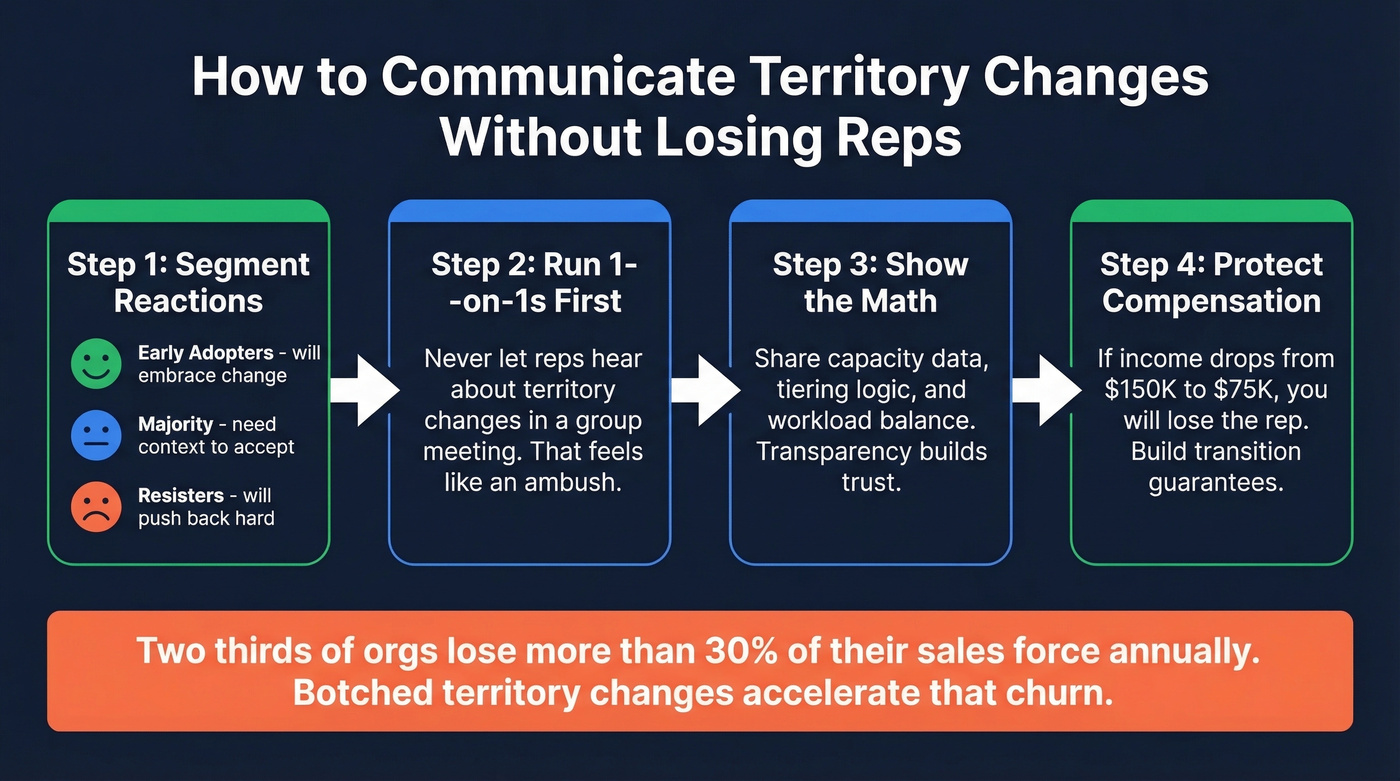
Segment your team's likely reactions: early adopters who'll embrace the change, the majority who'll accept it with context, and a minority who'll resist hard. Run 1:1 conversations before the all-hands announcement. Reps who hear about territory changes in a group meeting feel ambushed. That's how you lose your best people.
The compensation cliff is the real danger. If a rep's income drops from $150K to $75K because you carved their best accounts into a new territory, no framing saves that. Model the comp impact before you announce. Position splits around benefits like reduced travel, better focus, and manageable workload. But if the math doesn't work for the rep, fix the math first or expect to backfill the seat within 90 days.
Done right, territory planning best practices aren't just "cleaner maps." They're capacity-based coverage, tiered execution, and a rollout that doesn't trigger attrition.
If you need a repeatable rollout, borrow from sales communication frameworks and bake it into enablement.
Territory redesigns fail when reps open their new patch and find dead emails and wrong numbers. Prospeo gives you 300M+ verified profiles with 30+ filters - including headcount growth, intent data, and technographics - so your territory tiers match real, reachable buyers. At $0.01 per email, validating every account in every territory costs less than one lost deal.
Stop assigning accounts your reps can't actually contact.
FAQ
How often should you redesign sales territories?
Quarterly reviews are the minimum. Do a full redesign yearly or anytime headcount shifts by 20%+, you enter a new region, or quota attainment gaps stay above 30% across multiple territories. Treat reviews like a forecast cadence: light, consistent, and tied to real performance signals.
What's the biggest territory planning mistake?
Balancing on geography alone is the fastest way to create "fair-looking" territories that perform wildly differently. Use a 1-5 scoring matrix for revenue potential and conversion likelihood, then balance workload - Tier 1 count, travel burden, and admin load - not just projected dollars.
How does contact data quality affect territory planning?
Bad contact data turns a "perfect" territory into dead pipeline because reps can't reach decision-makers. Audit each territory before rollout by verifying a sample of 50-100 contacts. Prospeo's 98% email accuracy and weekly refresh makes that check fast, and the free tier covers 75 emails/month for a quick health test.