

Territory Strategy: How to Build One That Actually Works
Reps on r/sales talk about quarterly territory plans like they're something you build for your boss, not for you. They're right. 58% of B2B companies rate their own territory design as ineffective. The reason is simple - most territory plans are static documents that never touch the CRM.
A territory strategy isn't a document. It's a system. If it doesn't change how your CRM routes leads tomorrow morning, it's busywork.
The Framework in Four Bullets
- Choose a model - geographic, vertical, or hybrid - based on your sales motion, not tradition.
- Score accounts by potential, not historical revenue. Balance territories on growth opportunity.
- Push rules into your CRM - routing, ownership, alerts. If it isn't automated, it won't stick.
- Review monthly, not quarterly. Markets move faster than your planning cycle.
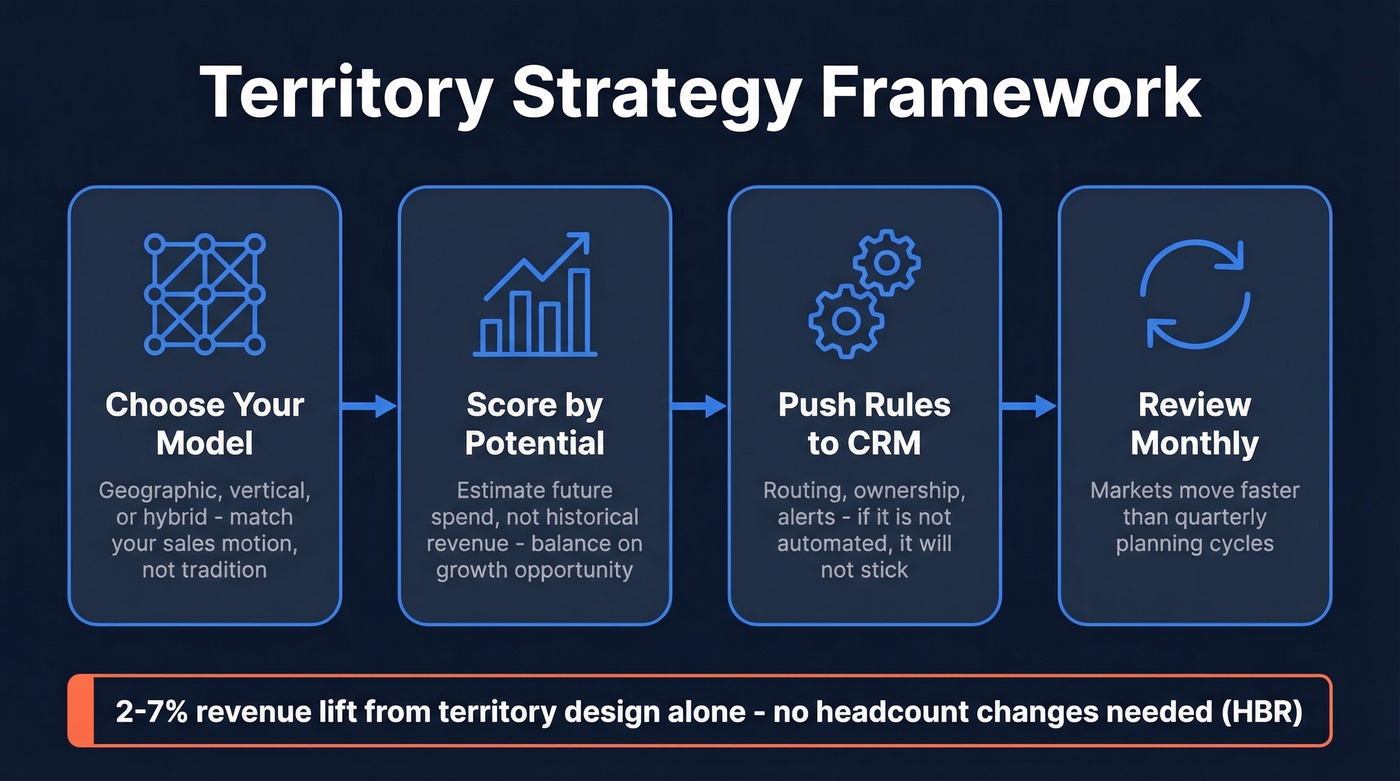
Why bother? HBR research shows territory design alone lifts revenue 2-7% without changing headcount or resources. That's free money sitting in your territory map.
Pick Your Sales Territory Structure
| Model | Best For | Strengths | Watch Out For |
|---|---|---|---|
| Geographic | SMB, field sales | Simple ownership, less overlap | Ignores industry nuance |
| Vertical | Enterprise, complex sales | Deep specialization | Longer onboarding |
| Hybrid | Scaling orgs | Balances breadth + depth | Harder to manage |
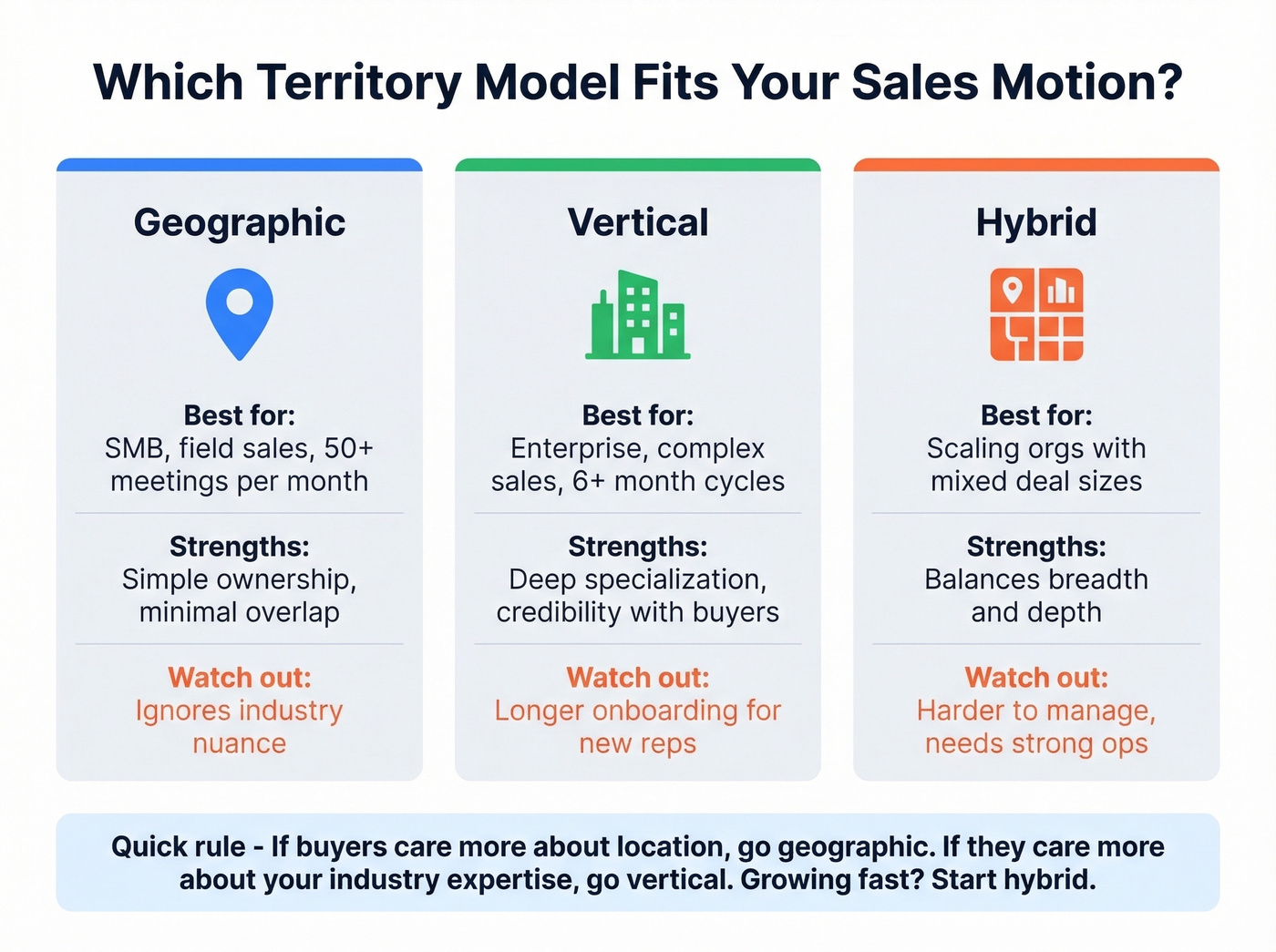
If your reps run 50+ meetings a month with smaller accounts, go geographic. If they're navigating six-month enterprise cycles with eight-person buying committees, go vertical. A common scaling approach is a hybrid - geo for SMB, vertical for enterprise - and that's the right call if you can manage the complexity.
The structure you choose should reflect how your buyers actually buy, not how your org chart happens to look.

Territory scoring only works when your contact data connects. Prospeo's B2B database covers 300M+ profiles with 98% email accuracy and 125M+ verified mobiles - refreshed every 7 days, not every 6 weeks. Layer 30+ filters like buyer intent, headcount growth, and technographics to fill territory whitespace with accounts that actually pick up.
Stop building territory plans on top of stale data.
Five-Step Territory Planning Framework
1. Analyze Your Market
Map your total addressable market, narrow to serviceable, and identify whitespace - accounts or segments nobody's covering. Field reps spend just 35-39% of their time actually selling and you can benchmark that against your own sales activities. A clear market and coverage view helps you cut time lost to low-fit accounts, routing confusion, and overlap.
2. Score and Segment Accounts
This is where most teams go wrong - and in our experience, it's where teams spend the least time yet get the most lift. They assign territories by revenue history, which rewards incumbency and ignores growth. Instead, run a potentialization exercise: estimate each account's ultimate potential spend, not just what they've bought. Build a territory index score to quantify balance, and align it to your ideal customer profile so scoring doesn’t drift.
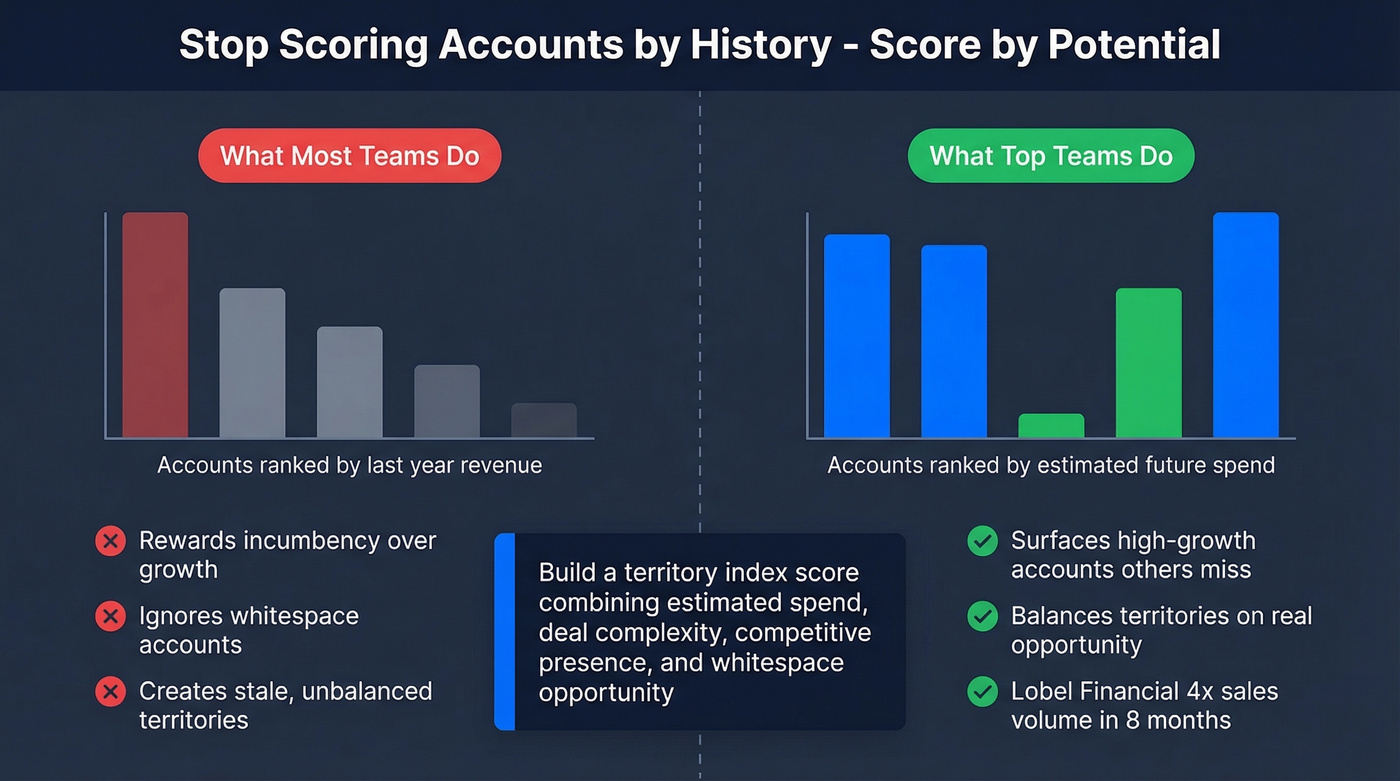
When Lobel Financial redesigned territories using analytics, they quadrupled sales volume in eight months. That kind of result doesn't come from reshuffling a spreadsheet - it comes from rethinking what "value" means at the account level and rebuilding assignments around it.
3. Assign Reps to Territories
Match rep strengths to territory demands. Reps hit peak performance around year three and often decline by year five, per Xactly's aggregated data. That tenure curve matters when deciding who gets the high-growth territory versus the mature one.
Balance workload, not just account count. Samsung cut operational costs by $8.8M - a 25% reduction - and increased customer visits by 50% by optimizing around workload, not headcount.
4. Set Territory-Level Metrics
Track territory-level KPIs, not just rep-level ones:
- Pipeline coverage ratio by territory (tie this back to pipeline health)
- Conversion rates by segment (compare against your baseline sales conversion rate)
- Average deal velocity per region
If Territory A has 3x pipeline coverage but Territory B has 1.2x, you don't have a rep problem. You have a territory problem. Strong territory management surfaces these imbalances before they cost you a quarter.
5. Operationalize and Review
Here's where territory plans die. Push rules into your CRM: lead routing, account ownership, automated alerts. Set a monthly review cadence (and if you run QBRs, keep your territory review separate from the QBR meaning meeting).
But CRM rules only work if the underlying data is clean. We've tested this firsthand - when contact records are stale, even the best routing logic sends reps chasing dead ends. Prospeo's B2B database refreshes every seven days with 98% email accuracy and 125M+ verified mobiles, so the contacts in your territory plan actually connect.
Mistakes That Kill Quota
Static territory models. Markets shift, competitors enter, customers churn. If you built territories in January and haven't touched them, you're leaving the 2-7% revenue lift on the table.
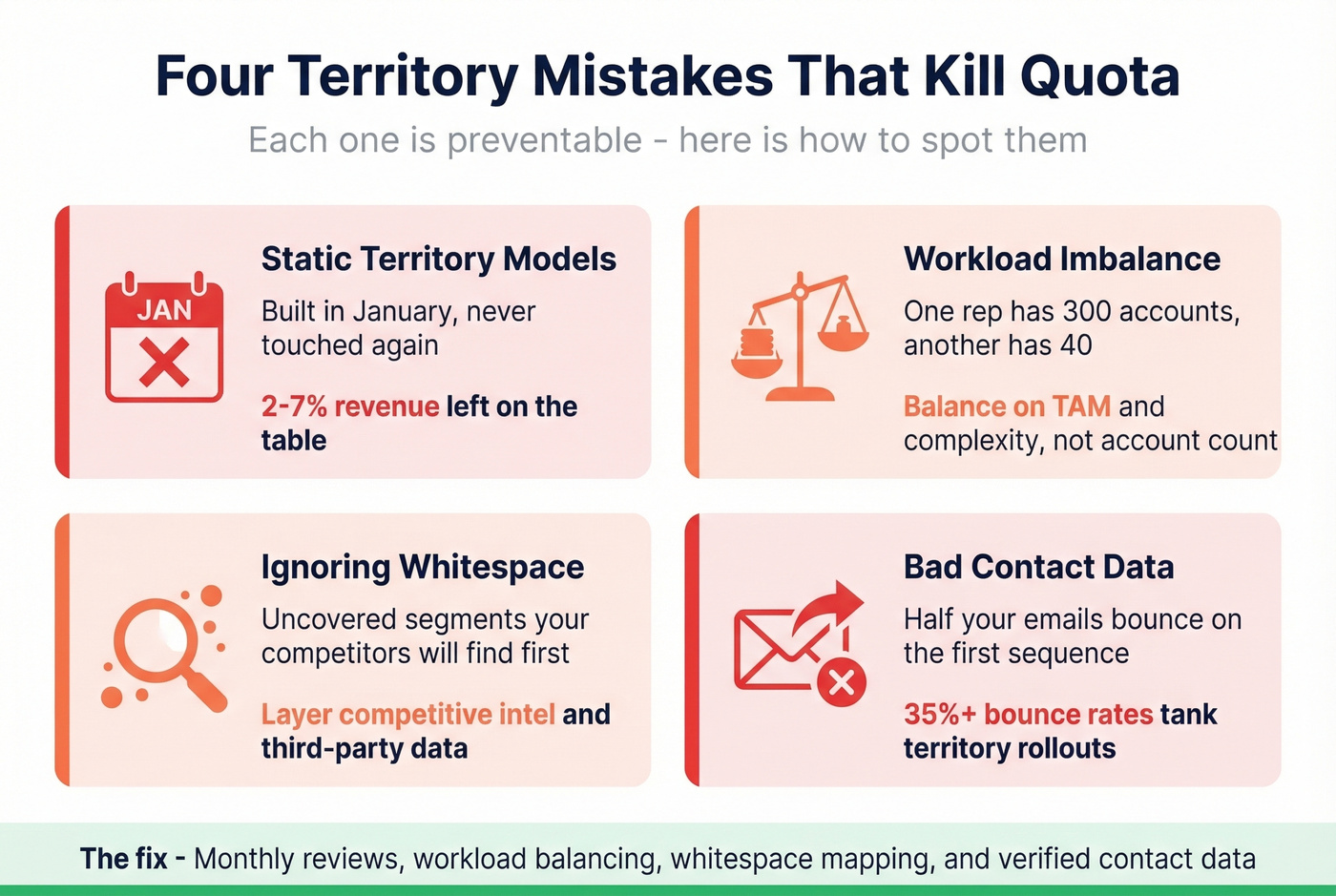
Workload imbalance. One rep has 300 accounts and no time to breathe; another has 40 and hits quota by March. Balance on TAM and deal complexity, not raw account count.
Ignoring whitespace. Layer in competitive intelligence and third-party data to spot uncovered segments before a competitor does (a lightweight competitive intelligence strategy helps here).
Bad contact data. Look, we've seen territory plans that looked perfect on paper fall apart because half the email addresses bounced on the first sequence. Stale emails and dead phone numbers are one of the most common execution failures in territory rollouts - and the most preventable (start with email bounce rate benchmarks and fixes).
Tools Worth Knowing
Here's my hot take: if your average deal size is under $15k, you don't need a $50K territory platform. You need a spreadsheet, clean data, and 90 minutes.
| Tool | What It Does | Starting Price |
|---|---|---|
| SPOTIO | Field sales mapping + tracking | ~$39/user/mo |
| Badger Maps | Route optimization + territory viz | ~$49/user/mo |
| MapBusinessOnline | GIS-based territory design | ~$29/mo |
Territory mapping tools show you where to sell. Prospeo tells you who to reach - it's the data quality layer underneath any mapping tool you choose. Skip the mapping tools entirely if your team is inside sales only; for field teams covering physical ground, SPOTIO or Badger Maps earn their price fast (and if you want a broader shortlist, see sales mapping software).
Bad contact data is the #1 execution killer for territory rollouts. Teams using Prospeo cut bounce rates from 35%+ to under 4% and book 26% more meetings than ZoomInfo users. At $0.01 per email with no contracts, clean territory data costs less than one dead-end sequence.
75 free verified emails - enough to validate your top territory accounts today.
FAQ
What's the difference between a territory strategy and a 30/60/90 plan?
A territory strategy defines which accounts a rep owns and how they're prioritized across a region or vertical. A 30/60/90 plan is the execution timeline for ramping into a role. The strategy outlasts any single ramp cycle and should be revisited independently on a monthly cadence.
How often should you review territory assignments?
Monthly. Quarterly reviews are too slow - by the time you spot an imbalance, a rep has burned three months in a broken territory. Monthly check-ins on pipeline coverage and conversion rates let you course-correct before quota is at risk.