

Time Management for Sales Managers in 2026: Build an Operating System, Not a To-Do List
It's Tuesday at 2pm. You've answered fourteen Slack messages, jumped on two "quick" calls that weren't quick, rebuilt a forecast your VP asked for at 11am, and you haven't talked to a single rep about an actual deal.
The problem isn't discipline - it's that you don't have a system. Time management for sales managers isn't about willpower or a better app. It's about building an operating rhythm that handles chaos before it reaches you.
You're Managing Chaos, Not Time
The numbers confirm what you already feel. Sales reps spend 60% of their time on non-selling tasks. Managers have it worse - you carry the same admin burden plus coaching, forecasting, hiring, and the endless "hey, got a sec?" interruptions.
A Sales Management Association survey found that 20% of a typical sales manager's time goes to solo administrative work for the company or department. That's a full day every week spent on stuff that doesn't move a single deal forward.
And if you've done this job for more than a week, you already know what kills your calendar: meetings that should've been messages and messages that should've been meetings. That's not a productivity problem. That's an operating system problem.
Three Jobs That Actually Move Revenue
Strip away the noise and your week boils down to three tasks. Everything else is delegatable:
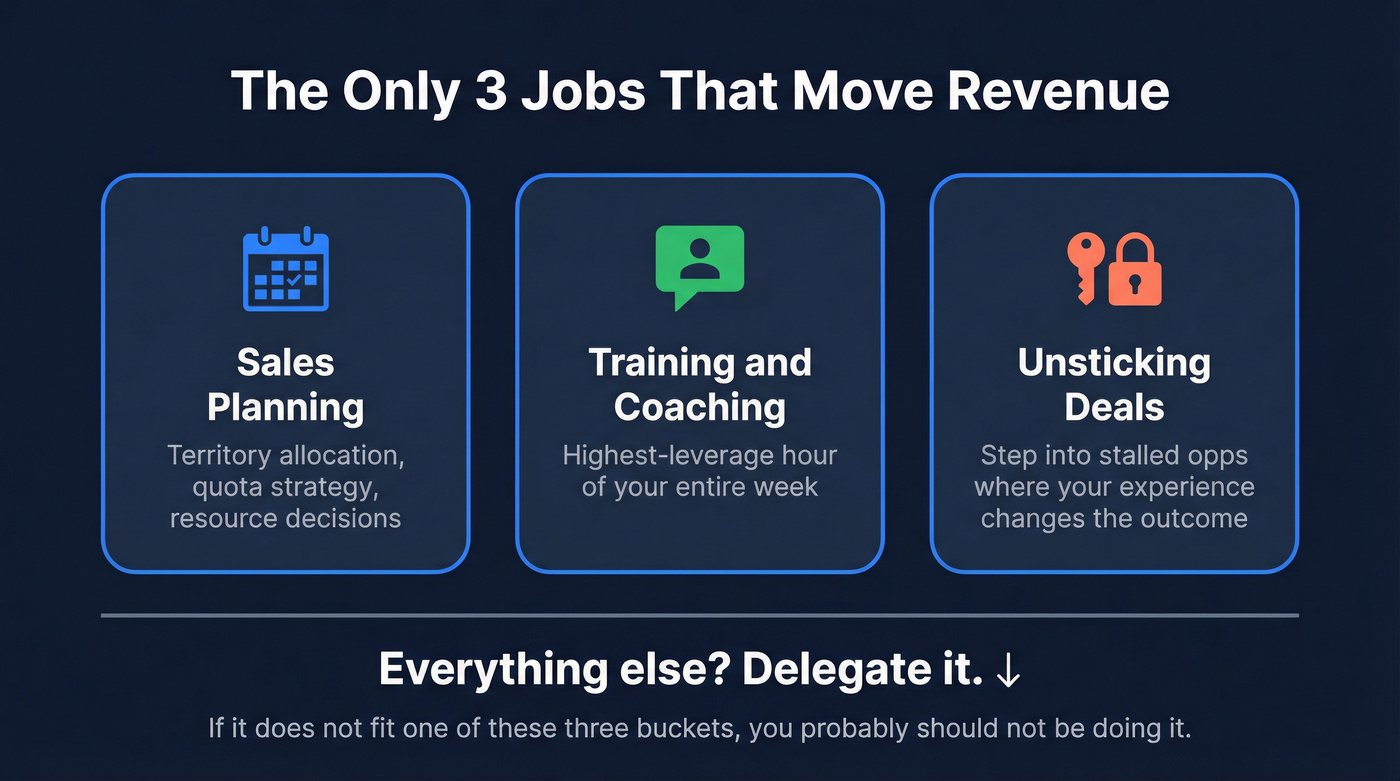
- Sales planning - territory allocation, quota strategy, resource decisions
- Training and coaching - the highest-leverage hour you'll spend all week (and the foundation of consistent sales training)
- Unsticking deals - stepping into stalled opportunities where your experience changes the outcome
If an activity doesn't fall into one of these buckets, you probably shouldn't be doing it. We've watched managers reclaim entire afternoons just by running every calendar invite through this filter before accepting.
Build Your Weekly Operating Rhythm
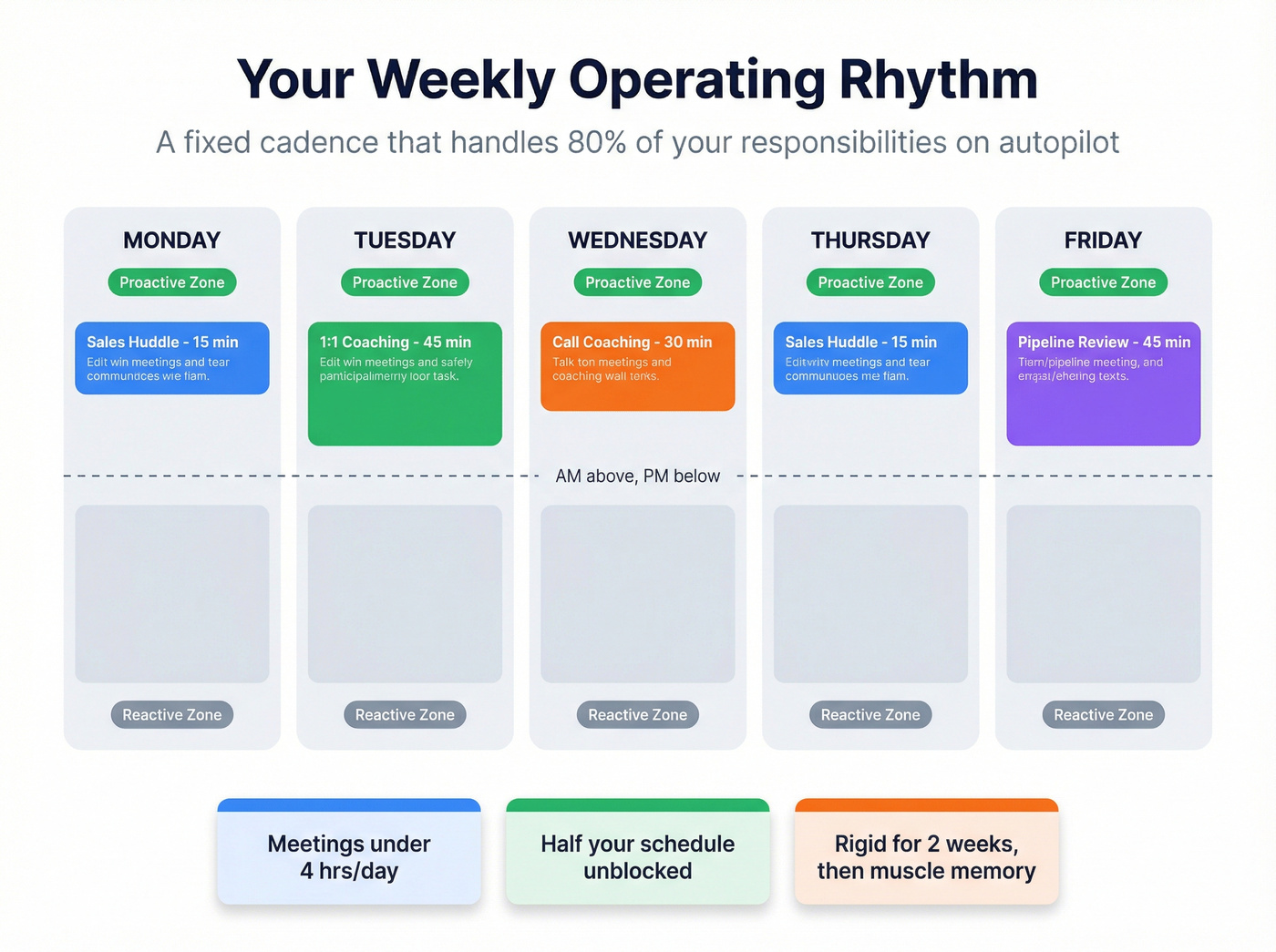
The best managers we've worked with don't run on to-do lists. They run on a cadence - a fixed weekly rhythm that handles 80% of responsibilities on autopilot, freeing judgment for the 20% that actually requires it.
The Cadence Template
Adapted from Factor8's manager cadence framework and the Brevet Group's operator checklist:
| Meeting | Frequency | Duration | Purpose |
|---|---|---|---|
| Sales huddles | 2x/week | 15 min | Wins, blockers, energy |
| Pipeline reviews | 2x/month | 45 min | Deal health, forecast accuracy |
| 1:1 coaching | Monthly | 45 min | Performance and development |
| Call coaching | 2x/month | 30 min | Small groups, three reps max |
| Team meeting | 1x/month | 60 min | Culture, recognition, updates |
| Career reviews | 1x/quarter | 60 min | Long-term growth plans |
Run pipeline reviews as group sessions - it saves hours versus doing them 1:1, and reps learn from each other's deals. Standardize templates so reps come prepared (a lightweight sales process optimization move that pays back fast). The first two weeks feel rigid. By week three, it's muscle memory.
The Half-Day Rule
Protect your mornings for proactive work: coaching prep, planning, deal strategy. Leave afternoons open for reactive stuff. Factor8 recommends keeping meetings under four hours per day and leaving half your schedule unblocked.
Those drive-by interruptions from reps don't stop. Instead of fighting them, channel them. When a rep pops in with a question, redirect: "Bring that to our huddle tomorrow" or "Let's cover it in our 1:1." You're not ignoring them - you're routing chaos into your cadence.

You just blocked coaching time and built a weekly cadence. Now make sure your reps aren't burning those reclaimed hours on bounced emails and dead contacts. Prospeo's 98% email accuracy and 7-day data refresh mean your pipeline reflects reality - not last quarter's org chart.
Stop managing a pipeline full of ghosts. Start with verified data.
Coaching Is Your Highest-ROI Hour
Here's the thing: most sales managers know coaching matters and still don't do it. The data from Objective Management Group - 11,078 salespeople and their managers - makes the cost of that gap painfully clear.
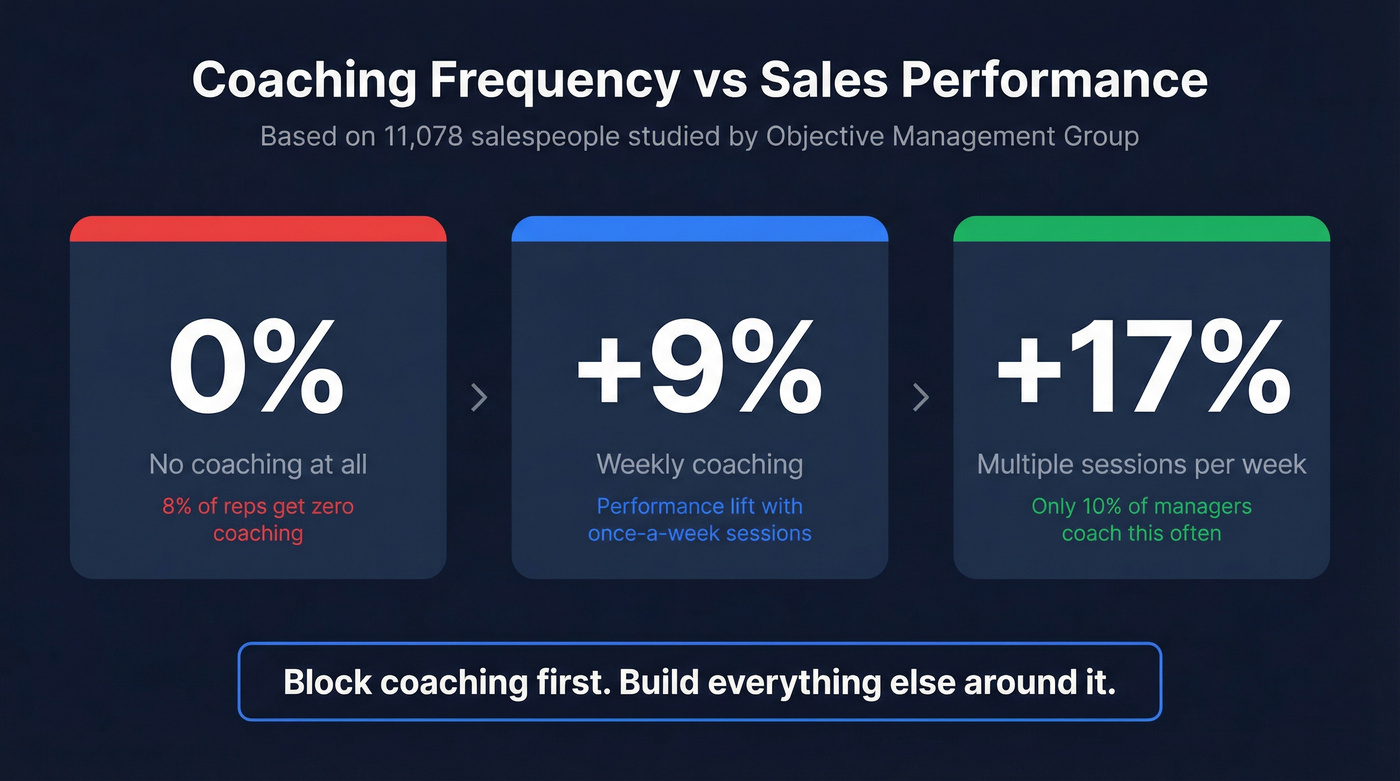
Weekly coaching lifts sales performance by 9%. Several sessions per week jumps to +17%. Only 10% of managers coach that frequently, and 8% of reps report receiving zero coaching. Zero.
Block coaching time on your calendar like you'd block a meeting with your VP. In our experience, the managers who schedule coaching first and build everything else around it consistently outperform those who treat it as "when I have time." The difference isn't subtle - it shows up in quota attainment within a single quarter (and it compounds when you pair coaching with better sales performance management).
Delegate or Drown
Effective delegation lifts productivity by 33%. The key is knowing what to keep.
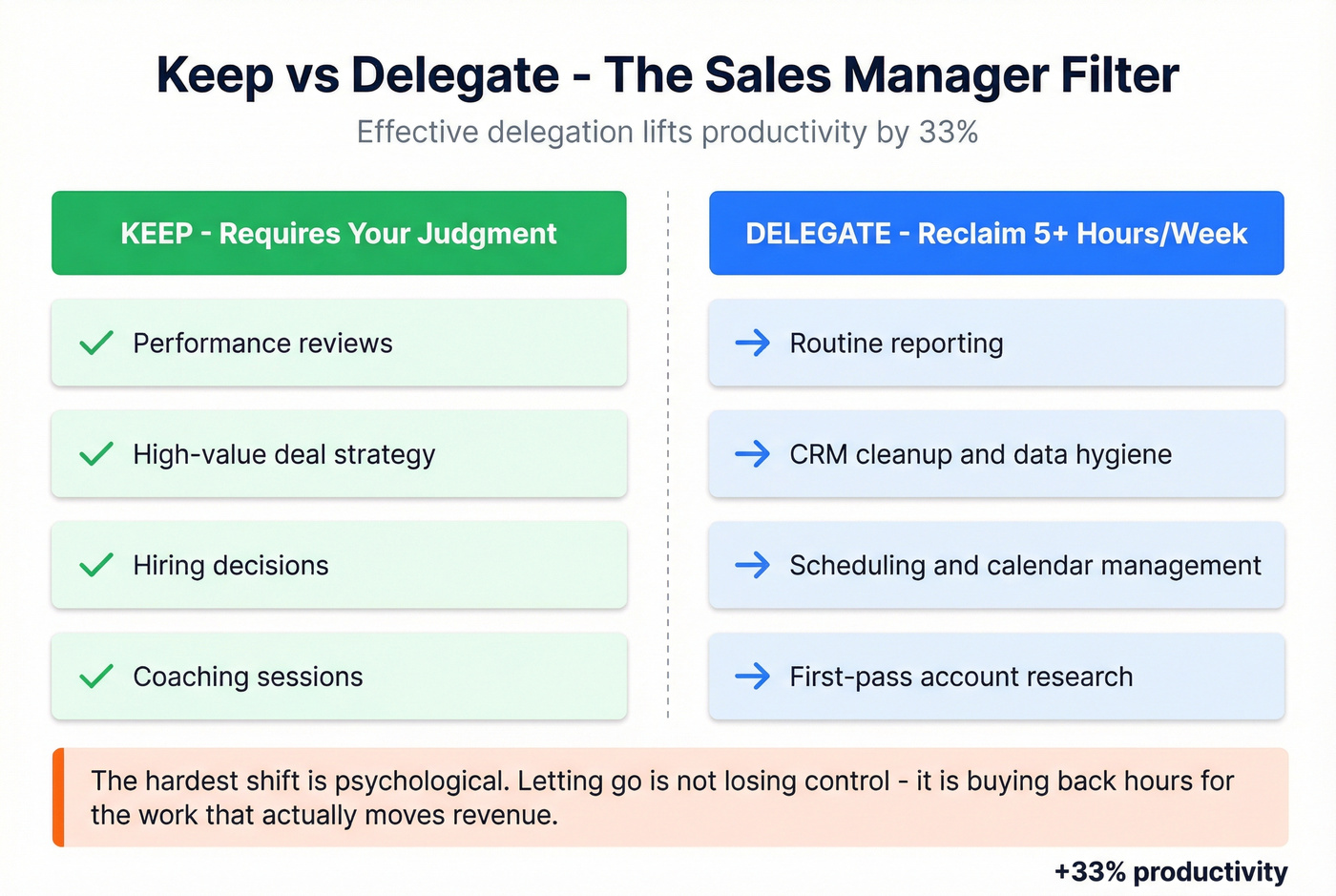
Keep: Performance reviews, high-value deal strategy, hiring decisions.
Delegate ruthlessly: Routine reporting, CRM cleanup, scheduling, first-pass account research. I've seen managers reclaim 5+ hours a week just by handing off data hygiene tasks to ops or automating them entirely (especially when you standardize lead status and ownership rules).
The hardest shift is psychological. Most managers got promoted because they were great individual contributors, and letting go feels like losing control. It's not. It's buying back hours for the three jobs that actually move revenue.
Tools That Buy Back Hours
A system needs infrastructure. Here's what's worth paying for:
| Tool | Category | Starting Price | Best For |
|---|---|---|---|
| Calendly | Scheduling | Free tier; $10/user/mo paid | Eliminating booking back-and-forth |
| Motion | AI scheduling | $29-$69/user/mo | Enforcing focus blocks automatically |
| tl;dv | Meeting intelligence | Free plan; ~$20/seat/mo paid | Async call review for coaching |
| Gong | Conversation intelligence | ~$1,200-$1,600/user/year | Enterprise teams with 50+ reps |
| Prospeo | Data quality | Free tier; ~$0.01/email | Eliminating bounced emails and dead leads |
For teams under 50 reps, tl;dv covers the core "record, summarize, share, and coach" workflow at a fraction of enterprise conversation intelligence pricing. Skip Gong until your team size justifies the spend.
Let's be honest about a hidden time tax most managers overlook: bad contact data. When 30-40% of outbound emails bounce, reps waste 4-6 hours per week chasing ghosts, and you waste hours reviewing pipelines full of dead leads. Snyk's team of 50 AEs dealt with exactly this problem - after cleaning up their data layer, bounce rates dropped under 5%, each AE reclaimed those lost hours, and AE-sourced pipeline jumped 180%. A 7-day data refresh cycle means your pipeline reflects reality instead of last month's org chart (and it’s much easier to maintain pipeline health when the inputs are clean).

Snyk's 50 AEs were losing hours to 35-40% bounce rates. After switching to verified contact data, bounces dropped under 5%, reps reclaimed prospecting time, and AE-sourced pipeline jumped 180%. Your operating rhythm only works when your data does.
Clean data is the time management hack nobody talks about.
Build the System, Protect the Hours
Better time management for sales managers comes down to three moves: lock in a weekly cadence, protect coaching hours like they're revenue-generating (because they are), and delegate everything that doesn't require your judgment. Layer in the right tools - scheduling automation, async call review, clean data - and you stop managing chaos and start running an operating system (the same systems-first mindset behind modern sales leadership).
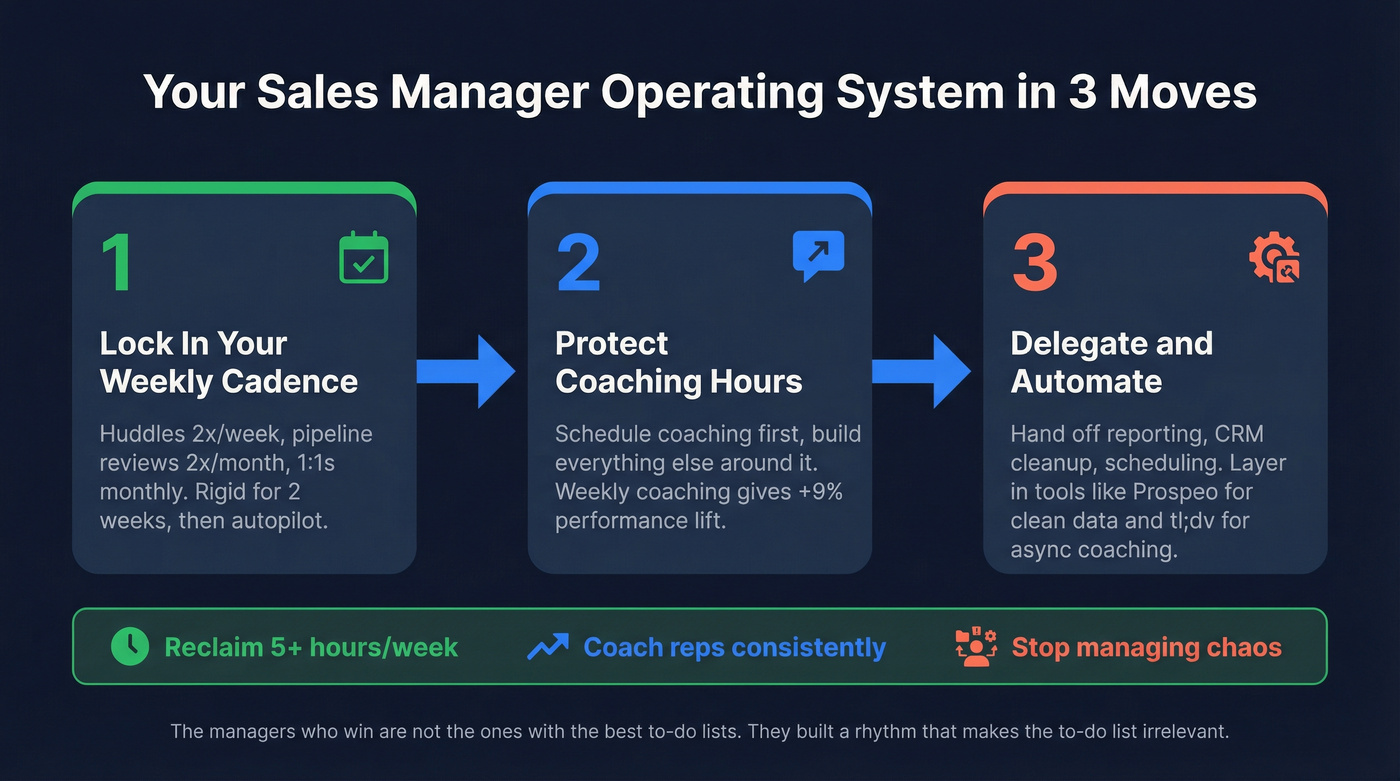
The managers who win aren't the ones with the best to-do lists. They're the ones who built a rhythm that makes the to-do list irrelevant.
FAQ
How many hours per week should a sales manager spend coaching?
At minimum, one hour per rep per week. OMG's research across 11,078 salespeople shows weekly coaching lifts performance 9%, and several sessions per week yields +17%. Block it on your calendar first - everything else fits around it.
What's the biggest time waster for sales managers?
Unstructured reactive work - Slack pings, ad-hoc forecast requests, and "quick questions" that eat twenty minutes each. A fixed weekly cadence with huddles and 1:1s redirects 80% of these into scheduled touchpoints.
How does bad data waste a sales manager's time?
When 30%+ of outbound emails bounce, reps waste hours on dead leads and managers review inflated pipelines. Cleaning up data accuracy and enforcing a regular refresh cycle eliminates that noise - Snyk's 50-AE team reclaimed 4-6 hours per rep per week after fixing this.
What's the best daily schedule structure?
Reserve mornings for proactive, high-leverage work - coaching prep, deal strategy, planning. Leave afternoons open for reactive tasks and interruptions. Factor8 recommends capping meetings at four hours daily and keeping half your schedule unblocked.