

TOFU, MOFU, BOFU: The Implementation Guide Most Articles Won't Give You
Your CMO just asked for a "full-funnel content strategy" by Friday. You know what TOFU, MOFU, and BOFU stand for - everyone does. But knowing the acronyms and actually building a content engine that moves people from awareness to closed-won are completely different problems. As many as 50% of leads aren't ready to buy when they first show up, and it takes roughly 10 ad exposures just to build brand recall. The definitions aren't the hard part. Execution is.
Quick Version
If you already understand the three stages, here's what this guide delivers that most don't: conversion benchmarks by stage, a step-by-step content planning workflow that starts at BOFU and works backwards, a lead scoring model with actual point values, and an honest take on whether the funnel framework still matters in 2026. Skip to whatever section you need.
What Are the Three Funnel Stages?
The framework traces back to 1898, when Elias St. Elmo Lewis introduced the AIDA model) - Attention, Interest, Desire, Action. TOFU, MOFU, and BOFU are the modern shorthand marketers use to map content against the buyer's journey: awareness, consideration, and decision. In plain terms, they represent the top of funnel, middle of funnel, and bottom of funnel - three distinct stages where prospects need different content, different messaging, and different success metrics.
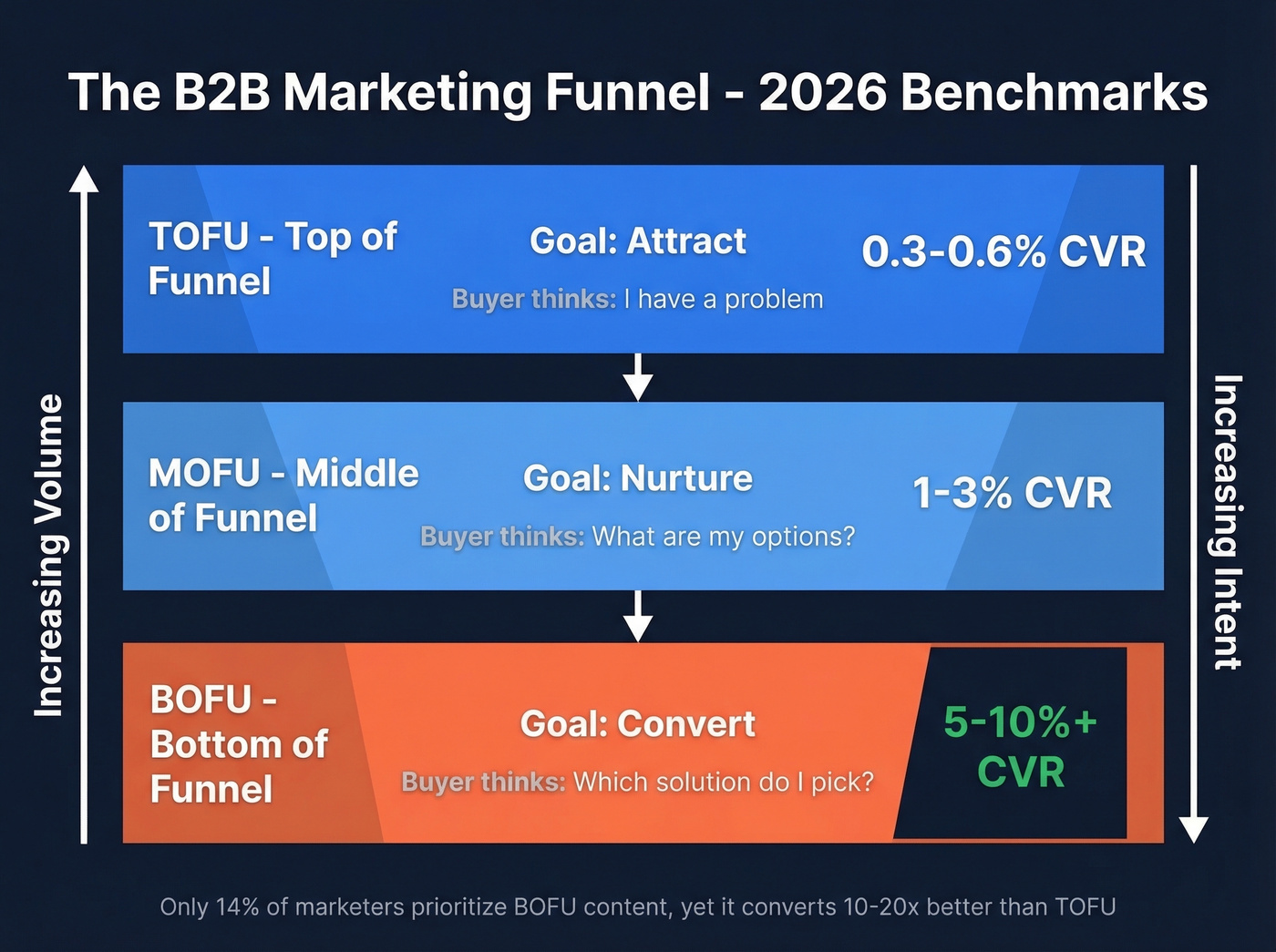
The beauty of the model is its simplicity. Every piece of content you create should serve one of these three stages, and the metrics you use to judge success should change accordingly.
| Stage | Goal | Buyer Mindset | Example Content | Benchmark CVR |
|---|---|---|---|---|
| TOFU | Attract | "I have a problem" | Blog posts, videos, infographics | 0.3-0.6% |
| MOFU | Nurture | "What are my options?" | Webinars, case studies, comparisons | 1-3% |
| BOFU | Convert | "Which solution do I pick?" | Demos, pricing pages, free trials | 5-10%+ |
The gap between TOFU's 0.3-0.6% and BOFU's 5-10%+ is the entire reason you need to think about content differently at each stage. A blog post and a competitor comparison page aren't doing the same job, and they shouldn't be measured the same way.
TOFU - Top of Funnel
TOFU content exists to make people aware you exist and that their problem has a name. That's it. You're not selling here. You're earning the right to show up in someone's consideration set six months from now.
Here's the reality that should reshape your top-of-funnel thinking: nearly 60% of Google searches end without a click. Your TOFU strategy can't rely purely on driving traffic to your site. Brand impressions - showing up in search results, social feeds, podcast apps - matter even when nobody clicks. The 95:5 rule reinforces this: only about 5% of your ICP is actively in-market at any given time. TOFU targets the other 95%, building mental availability for the day they do start looking.
Content types that perform best at this stage:
- Blog posts answering "what is" and "how to" questions
- Infographics and data visualizations
- Educational videos, both short and long form
- Organic and paid social content
- Podcasts and guest appearances
- Original research and industry benchmarks
- Frameworks, templates, and interactive assessments
A healthy TOFU capture rate is around 2% of page visitors giving you their contact info. If you're well below that, your CTAs are either invisible or irrelevant to the content around them.
KPIs to track: traffic, impressions, bounce rate, and time on page. Don't obsess over conversion at this stage - you're measuring reach and engagement, not revenue.
MOFU - Middle of Funnel
Content That Moves Leads Forward
MOFU is where most teams drop the ball. They create great awareness content, then jump straight to "book a demo." The middle of the funnel is the nurture layer - it's where you help prospects evaluate their options and build enough trust to consider you seriously.
Companies that excel at lead nurturing generate 50% more sales-ready leads at 33% lower cost. That stat alone justifies investing in MOFU content. The formats that work here are more specific and more gated than TOFU:
- Webinars with tactical depth
- Case studies with real numbers
- Comparison guides covering your category, not just your product
- Whitepapers and research reports
- ROI calculators
- Methodology guides that show how you think
- Email nurture sequences - plan for at least 5-7 touches
The key metric at this stage is your MQL-to-SQL conversion rate: (SQLs / MQLs) x 100. If that number is low, your middle-of-funnel content isn't qualifying effectively - you're passing unready leads to sales. Teams with aligned sales and marketing functions see 67% higher conversion rates and 208% more revenue from marketing efforts. Without that alignment, marketing passes leads that sales ignores.
A Lead Scoring Model You Can Use Monday
Most articles mention lead scoring without giving you actual numbers. We've built and iterated on scoring models across dozens of campaigns, and here's a starting framework that works:
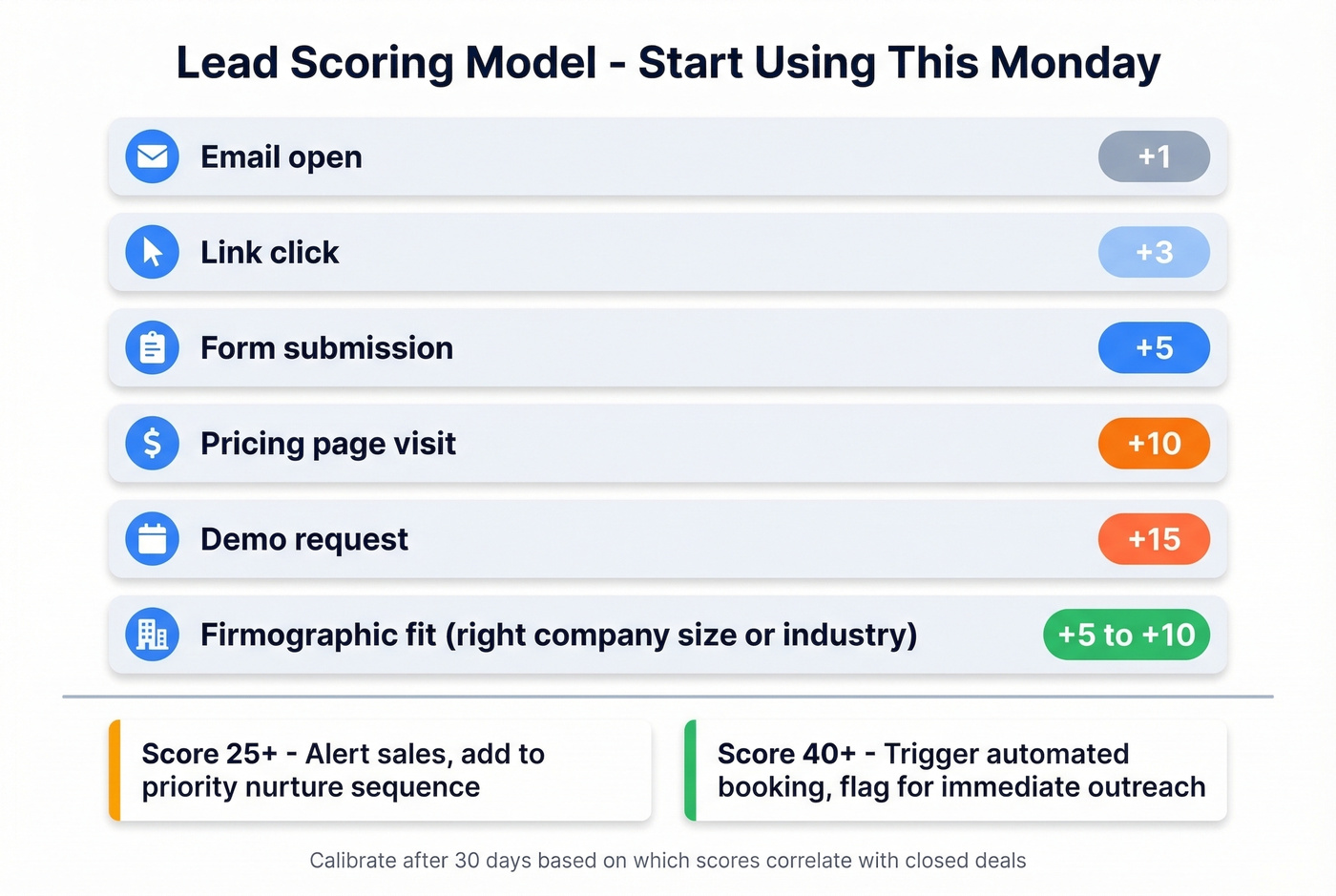
| Action | Points | Rationale |
|---|---|---|
| Email open | +1 | Low intent signal |
| Link click | +3 | Active engagement |
| Form submission | +5 | Willingness to exchange info |
| Pricing page visit | +10 | High commercial intent |
| Demo request | +15 | Direct buying signal |
| Firmographic fit | +5 to +10 | Right company size/industry |
Threshold actions:
- Score 25+ - Alert sales, add to priority nurture sequence
- Score 40+ - Trigger automated booking sequence, flag for immediate outreach
These triggers map directly to what platforms like HubSpot and HighLevel let you automate. The point values are starting points - calibrate them after 30 days based on which scores actually correlate with closed deals in your pipeline.
BOFU - Bottom of Funnel
Why Decision-Stage Content Has the Highest ROI
The average B2B SaaS deal now requires 266 distinct touchpoints to close, a 20% year-over-year increase. For enterprise deals above $100K ACV, that number balloons to roughly 5,500 impressions and 400+ touchpoints. By the time someone reaches BOFU, they've invested serious time evaluating you. Your job is to remove the last barriers.
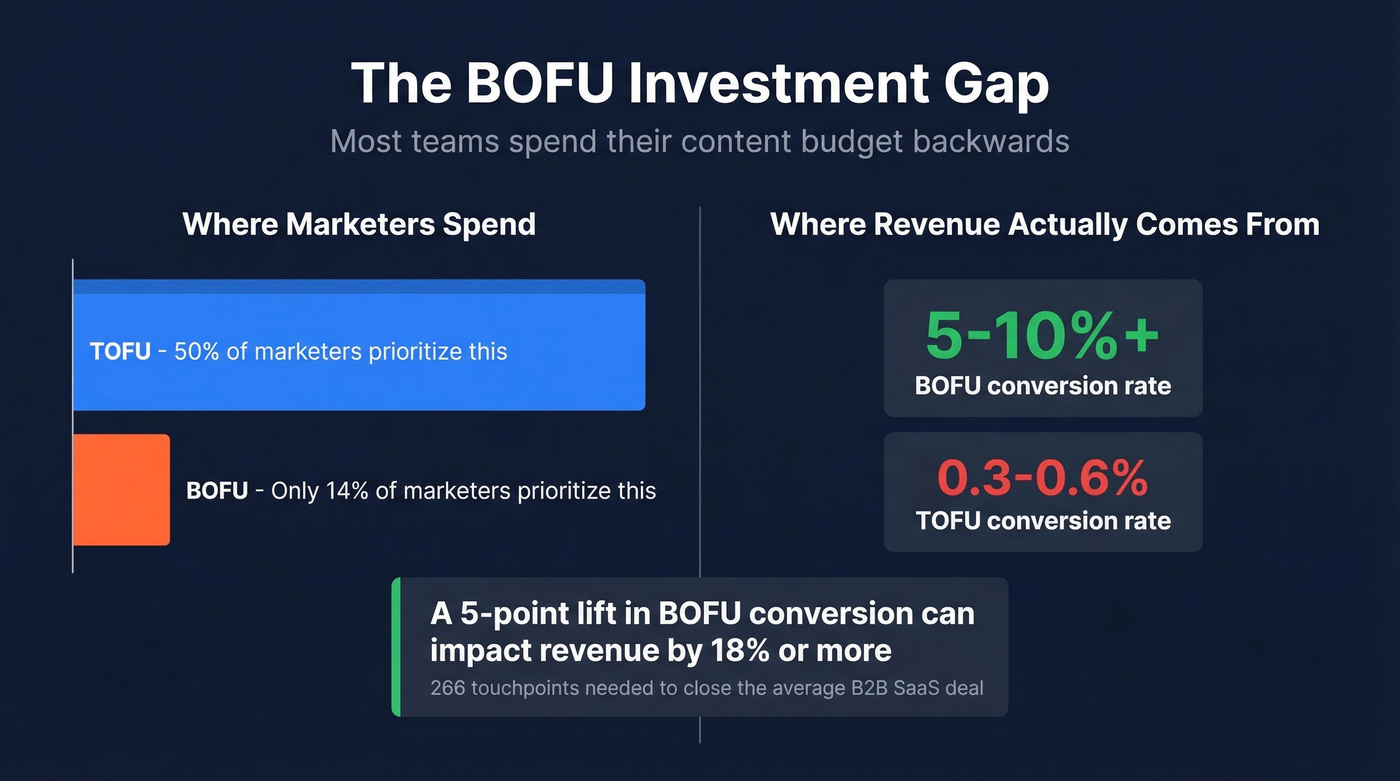
Bottom-of-funnel content converts at 5-10%+ compared to TOFU's 0.3-0.6%. A 5-point lift in BOFU conversion can impact revenue by upwards of 18%. Yet only about 14% of marketers prioritize BOFU content, while 50% focus on TOFU.
The ratio is backwards.
If your average deal size exceeds $5K and you're spending more than 60% of your content budget on awareness, you're leaving money on the table. Flip the ratio. BOFU content generates revenue now; TOFU content generates brand equity over months. Both matter, but most teams are dangerously overweight on awareness.
Content types that close deals:
- Competitor comparison pages - strategic, not generic
- Pricing transparency pages
- Implementation guides and timelines
- Live demos and recorded walkthroughs
- Free trials with guided onboarding
- Personalized outreach with verified contact data
Plan for refresh cycles: competitor comparison pages typically need updating every 12-18 months, while technical use cases hold up for 18-24 months. Build that cadence into your content calendar from day one.
That last bullet - personalized outreach - is where most funnels quietly break. You've built the content. The prospect is ready. And then your outreach bounces because the email address is stale or the phone number is wrong. Bad data is the unsexy reason BOFU fails. Tools like Prospeo, with 98% email accuracy and a 7-day data refresh cycle versus the six-week industry average, exist specifically to close this gap. When you've invested hundreds of touchpoints getting someone to BOFU, a bounced email shouldn't be what kills the deal.
Four BOFU Mistakes That Kill Conversions
Shipping generic comparisons instead of strategic ones. A feature checklist isn't a comparison page. Map your competitor's weaknesses to your prospect's specific pain points. Interview your sales team about the top 3 objections they hear and build the page around those.
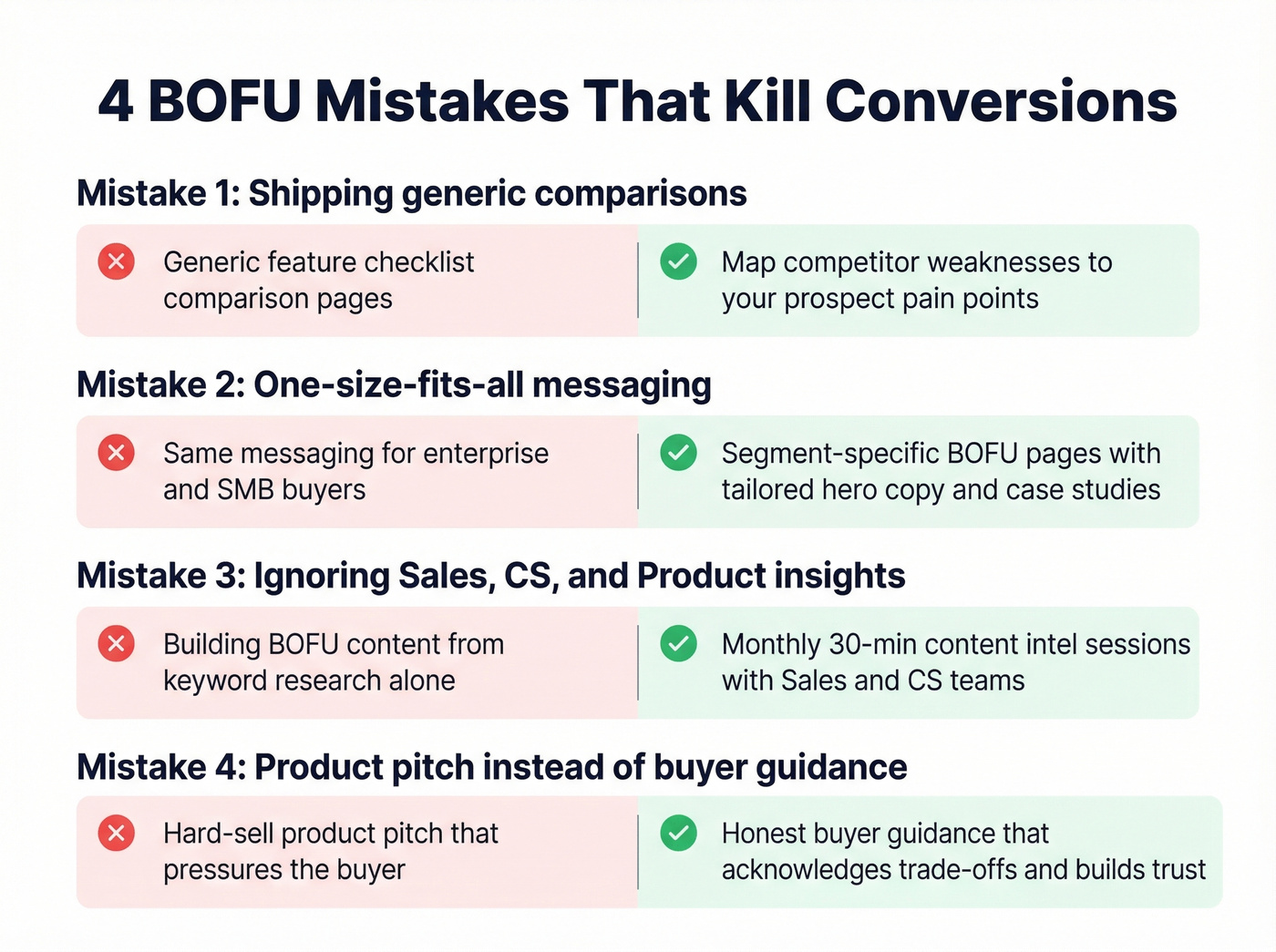
One-size-fits-all messaging across segments. An enterprise buyer and an SMB founder have different decision criteria. Create segment-specific BOFU pages, even if it's just different hero copy and case studies.
Ignoring Sales, CS, and Product insights. Your customer-facing teams hear the real objections every day. Run a monthly 30-minute "content intel" session with sales and CS. Record it. Mine it for BOFU angles. We've found these sessions produce more usable content ideas in 30 minutes than a week of keyword research.
Treating BOFU like a product pitch instead of buyer guidance. BOFU content should help the buyer make a confident decision, not pressure them into yours. Acknowledge trade-offs honestly. Counterintuitively, this builds more trust than a hard sell.

Your lead scoring model is only as good as the contact data behind it. Prospeo gives you 98% verified emails, 125M+ direct dials, and intent data across 15,000 topics - so when a lead hits your BOFU threshold, you actually reach a real person.
Stop nurturing leads you can't contact. Fix the data first.
Beyond BOFU - Retention and Advocacy
The funnel doesn't end at the sale. Post-purchase content - onboarding sequences, customer communities, referral programs, upsell campaigns - is where customer lifetime value gets built. Some practitioners call this "ROFU" (retention-of-funnel), a concept that maps to the "Act" and "Engage" stages in Dave Chaffey's RACE framework, though the term itself hasn't fully caught on.
This is where the flywheel model picks up where the funnel leaves off. The funnel treats the customer as an endpoint. The flywheel treats them as the center, generating referrals and expansion revenue that feed back into the top. CLV becomes your north star metric, not just conversion rate.
Let's be honest: we've seen teams obsess over acquisition funnels while ignoring the fact that a 5% improvement in retention often outperforms a 20% improvement in TOFU traffic. Don't make that mistake.
How to Build Your Funnel Content Plan
The Keyword Expansion Pyramid
A practical workflow shared by a practitioner on r/seogrowth who reported 200-300% organic traffic growth in six months:
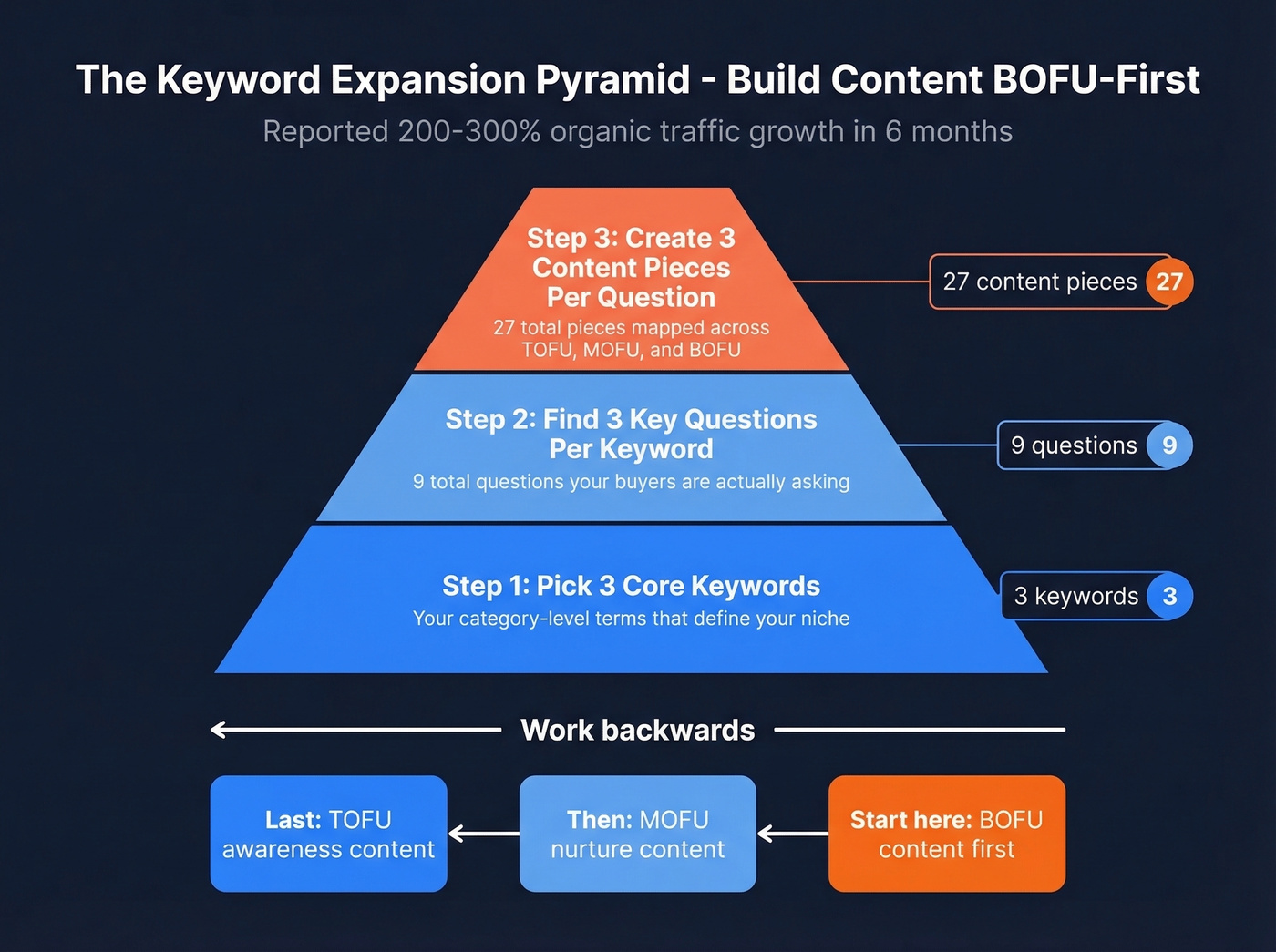
- Pick 3 core keywords for your niche. These are your category-level terms.
- Find 3 key questions per keyword using a question-mining tool like AnswerSocrates, AlsoAsked, or Google's "People Also Ask." Write in-depth TOFU posts answering each.
- Extract concepts from your TOFU posts - terms and ideas you mentioned but didn't fully explain. These become your MOFU keywords.
- From MOFU posts, identify BOFU keywords - product-specific, comparison, and decision-stage terms. Write BOFU content targeting those.
Internal Linking Rules
Link sideways or downward, not upward. MOFU pages should link to other MOFU pages and down to BOFU pages. Avoid linking from BOFU back up to MOFU within the same topic cluster - it dilutes the commercial intent signal. The exception: cross-topic links can go upward, like a BOFU pricing page linking to a TOFU post in a different product category.
Start at BOFU, Work Backwards
Most teams build content top-down. They start with blog posts, generate some traffic, and wonder why nothing converts.
Flip it. Build your BOFU content first - competitor comparisons, pricing pages, implementation guides. These convert at 10-20x the rate of awareness content and generate revenue immediately. Once your bottom of funnel is solid, build MOFU content that feeds into it. Then create TOFU content that feeds into MOFU. Every piece of content should have a clear "next step" pointing further down the funnel.
When you're building out that MOFU-to-BOFU handoff, make sure your CRM records are enriched before routing to sales. Reps waste enormous time on incomplete profiles - a problem that tools returning 50+ data points per contact at a 92% API match rate solve almost instantly.
Applying the Framework in B2B
B2B funnels differ from B2C in one critical way: buying committees. A full-funnel B2B strategy needs to account for the fact that six to ten stakeholders touch the decision, each entering the funnel at different stages and with different concerns. Your champion might be at BOFU while their CFO is still at TOFU, wondering whether the problem is worth solving at all.
This means your content library needs depth at every stage, not just volume at the top. Create role-specific assets - a technical deep-dive for the engineering lead at MOFU, an ROI summary for the finance stakeholder at BOFU - so your champion can distribute the right content to the right person at the right time. Skip this step if you're selling to single decision-makers with deal sizes under $2K; the overhead isn't worth it.
What to Measure at Each Stage
| Stage | Primary KPIs | Formula / Definition | Benchmark |
|---|---|---|---|
| TOFU | Traffic, impressions, bounce rate | Unique visitors, SERP impressions | 2% capture rate |
| MOFU | MQL-to-SQL rate, email engagement | (SQLs / MQLs) x 100 | 1-3% CVR |
| BOFU | Conversion rate, CAC, deal velocity | Closed-won / BOFU visitors | 5-10%+ CVR |
| Post-purchase | Retention rate, CLV | Revenue per customer over lifetime | 90%+ annual retention for SaaS |
For landing pages specifically, the average conversion rate is 2.35%, with top performers hitting 5.31%+. If your BOFU landing pages are below 2.35%, you've got a messaging or UX problem worth diagnosing before you create more content.
Is the Funnel Framework Still Relevant?
The AIDA model is from 1898. Modern B2B buying is non-linear - prospects bounce between stages, loop back, involve six to ten stakeholders, and consume content in unpredictable order. Forbes argued the marketing funnel is dead, making the case for superfan marketing: instead of treating every prospect equally, concentrate resources on your highest-value advocates who drive outsized referral and expansion revenue. The r/DigitalMarketing community still asks basic implementation questions, suggesting the framework is simultaneously everywhere and poorly understood.
Here's my take: the funnel isn't dead. It's the best shorthand we have for mapping content to buyer intent. But treating it as a literal description of how people buy is a mistake.
The more useful adaptation is the out-market vs. in-market framework. Out-market campaigns target the 95% of your ICP that isn't buying right now - optimize for reach, frequency, and brand recall. In-market campaigns target the 5% showing intent signals - optimize for conversion and deal velocity.
| Dimension | Funnel | Flywheel |
|---|---|---|
| Structure | Linear | Circular |
| Customer role | Endpoint | Center |
| Core metric | Conversion rate | CLV |
Use the funnel for content planning. Use the flywheel for business strategy. They're complementary, not competing. The teams that win in 2026 aren't debating which model is "right" - they're using both.
If you want a deeper breakdown of stage-by-stage mechanics, start with the AIDA model and then map it to your B2B sales funnel template.
266 touchpoints to close a B2B deal - and bad data wastes half of them. Prospeo's 7-day refresh cycle and 92% enrichment match rate mean every MOFU nurture email and BOFU demo invite lands in a real inbox, not a dead end.
Make every funnel touchpoint count with data that's never stale.
FAQ
What does TOFU MOFU BOFU stand for?
Top of Funnel, Middle of Funnel, and Bottom of Funnel - mapping to awareness, consideration, and decision in the buyer's journey. The framework helps marketers create stage-appropriate content and measure each stage with distinct KPIs rather than a single conversion metric.
What's a good conversion rate for each funnel stage?
TOFU typically converts at 0.3-0.6%, MOFU at 1-3%, and BOFU at 5-10%+. Top-performing landing pages hit 5.31%+, while the average sits at 2.35%. These ranges vary by industry but are reliable B2B benchmarks.
Should I create TOFU or BOFU content first?
Start with BOFU. It converts at 10-20x the rate of awareness content and generates revenue faster. Build competitor comparisons, pricing pages, and implementation guides first, then work backwards through MOFU and TOFU to feed qualified traffic downward.
Is the marketing funnel still relevant in 2026?
Yes, as a content planning framework. Modern B2B buying is non-linear, so pair the funnel with the flywheel model for retention and the 95:5 rule for campaign targeting. The funnel organizes your content; the flywheel organizes your growth engine.
How do I prevent bounced emails from killing BOFU conversions?
Use a real-time verification tool with high accuracy and frequent data refreshes. Stale contact data is the most common silent failure at the bottom of the funnel. Prospeo's free tier gives you 75 verified emails per month to test before committing.