

Trigger-Based Selling: The Implementation Guide Most Teams Are Missing
Trigger-based selling is how you consistently reach the small slice of your market that's already in motion - before your competitors do. 84% of reps missed quota in 2024. Not because they couldn't sell, but because they were selling to people who weren't ready. Chet Holmes's framework still holds: only 3% of any market is actively buying, 7% is open to it, and the rest doesn't care.
This guide covers the five triggers worth tracking, the system to act on them within hours, and the tools that make it work.
Why Timing Beats Volume
More emails, more calls, more sequences - diminishing returns on all of it. The teams that outperform aren't sending more; they're sending at the right moment.
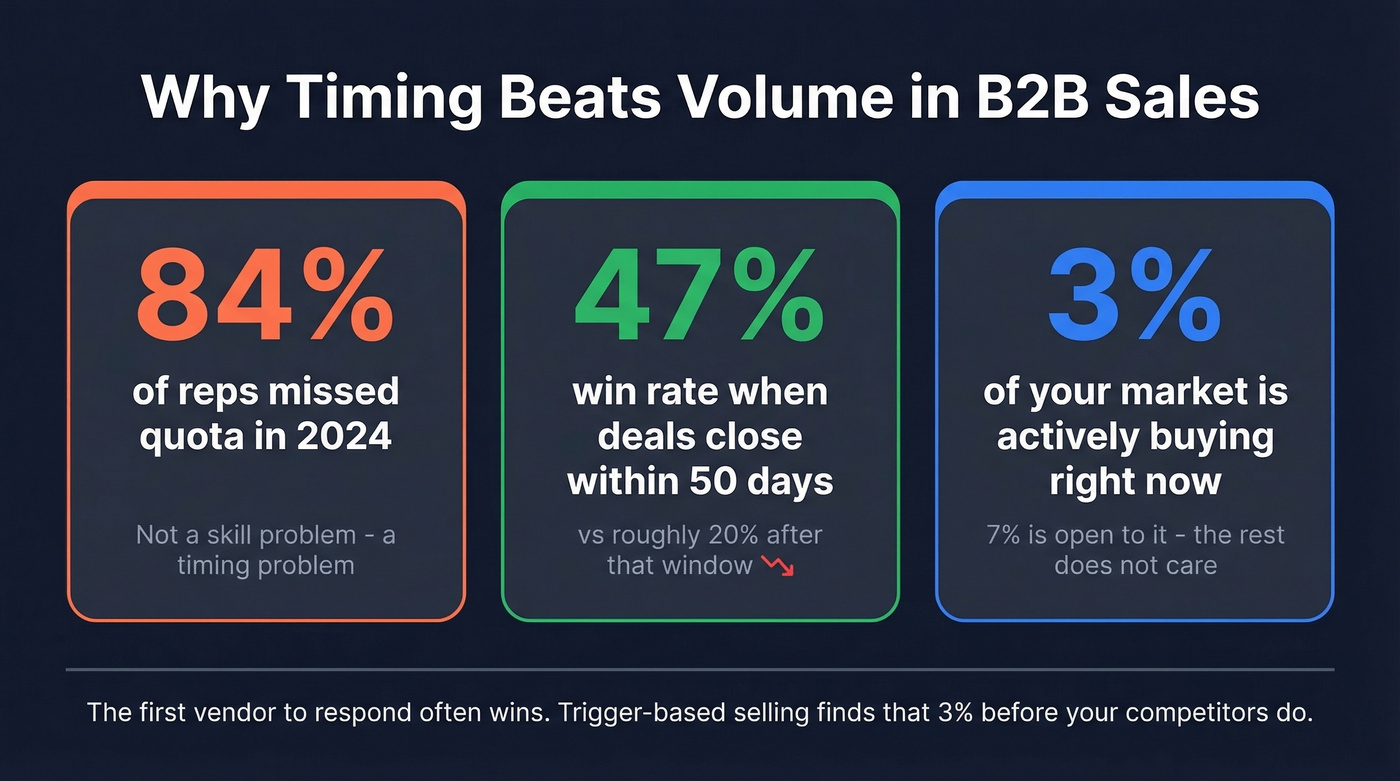
Outreach's data backs this up: deals closed within 50 days show a 47% win rate, while deals past that threshold drop to roughly 20%. The first vendor to respond often wins. Timing isn't a nice-to-have - it's the variable that separates quota-crushers from the 84%.
What Is Trigger-Based Selling?
It's an operational system. You identify real-world events that correlate with buying intent, detect them as they happen, and route outreach to the right rep before the window closes. Some teams call this trigger event selling. The label varies, but the mechanics are the same.
Instead of blasting 5,000 contacts and hoping 50 reply, you're reaching 200 contacts at the exact moment something changed in their world. The conversion math is completely different. But it only works if the plumbing - detection, routing, scoring, data quality - actually functions.
Intent Data vs. Triggers vs. Signals
These terms get used interchangeably, which causes real confusion when teams try to buy tooling.
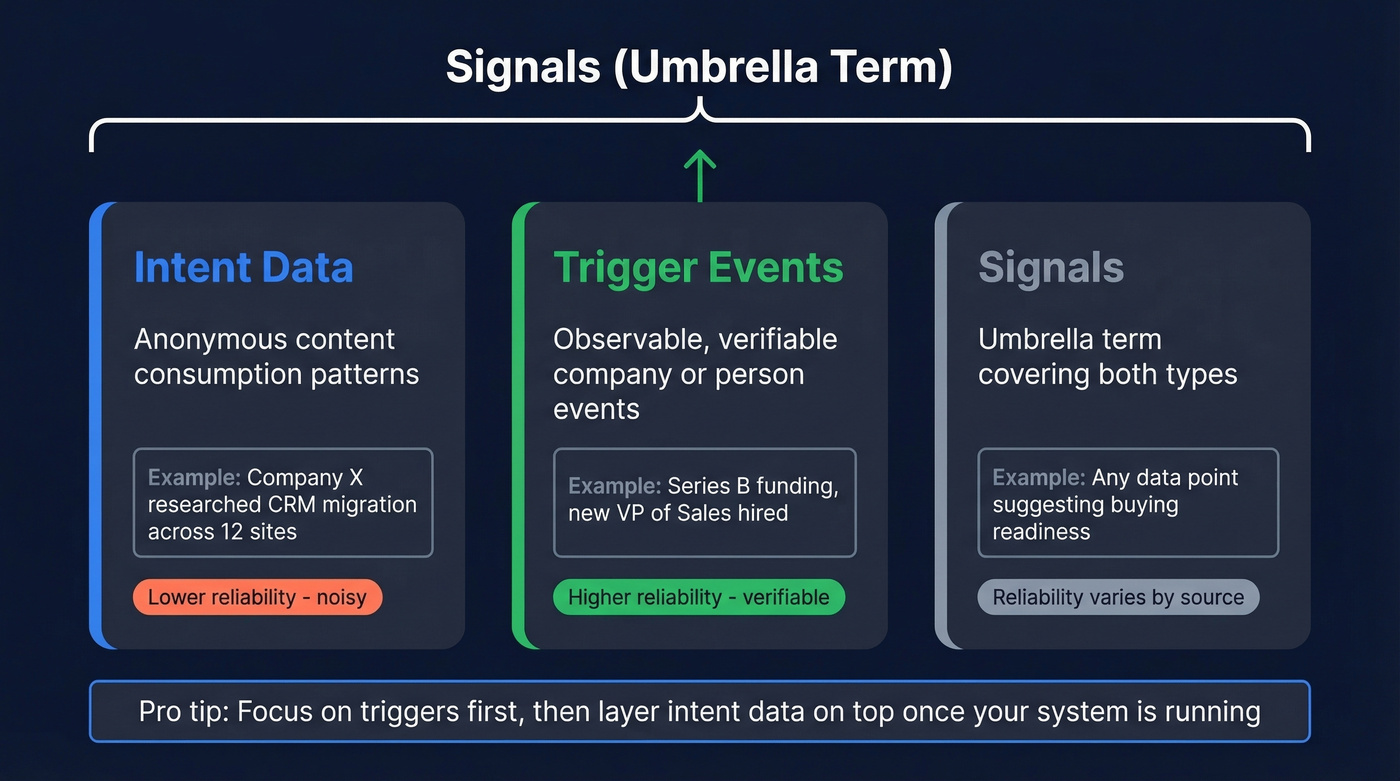
| Term | Definition | Example | Reliability |
|---|---|---|---|
| Intent data | Anonymous content consumption patterns | Company X researched "CRM migration" across 12 sites | Lower - noisy |
| Trigger events | Observable events tied to a company or person | Series B funding, new VP of Sales hired | Higher - verifiable |
| Signals | Umbrella term covering both | Any data point suggesting buying readiness | Varies by source |
Here's the thing: intent data is noisier than most vendors admit. A "research spike" could be an intern writing a report. A trigger event - like a funding round - is concrete and verifiable. We've seen teams get much better results focusing on triggers first, then layering intent data on top once the system is running.

Stale contact data is the silent killer of trigger programs. Prospeo refreshes every record on a 7-day cycle - not the 6-week industry average - so the email you send after a funding round or leadership change actually lands. 98% email accuracy, 125M+ verified mobiles, and 30+ filters including buyer intent and job changes.
Your triggers are only as good as the data behind them.
Why Most Trigger Programs Fail
Most teams don't fail at detection. They fail at everything after it.
Too many false positives. A practitioner on r/sales flagged this: generic triggers like "new to role" or "new funding" don't reliably indicate buying intent on their own. Reps end up parsing what's legit versus what's noise, and the advantage over traditional prospecting evaporates.
Alert fatigue. UserGems lists 23 trigger types. If you track all of them, your reps drown. We've watched teams generate 200 alerts a week and book three meetings from them. That's not a system - that's a distraction engine.
Stale contact data. You detected the trigger, found the decision-maker, wrote a sharp email - and it bounced. This last-mile problem kills trigger programs silently. A trigger is worthless if your outreach never lands.
How to Build a Trigger Selling System
Pick 5 Triggers, Not 25
Audit your last 20 closed-won deals. What happened at those accounts in the 90 days before they entered your pipeline? Those patterns are your trigger list.
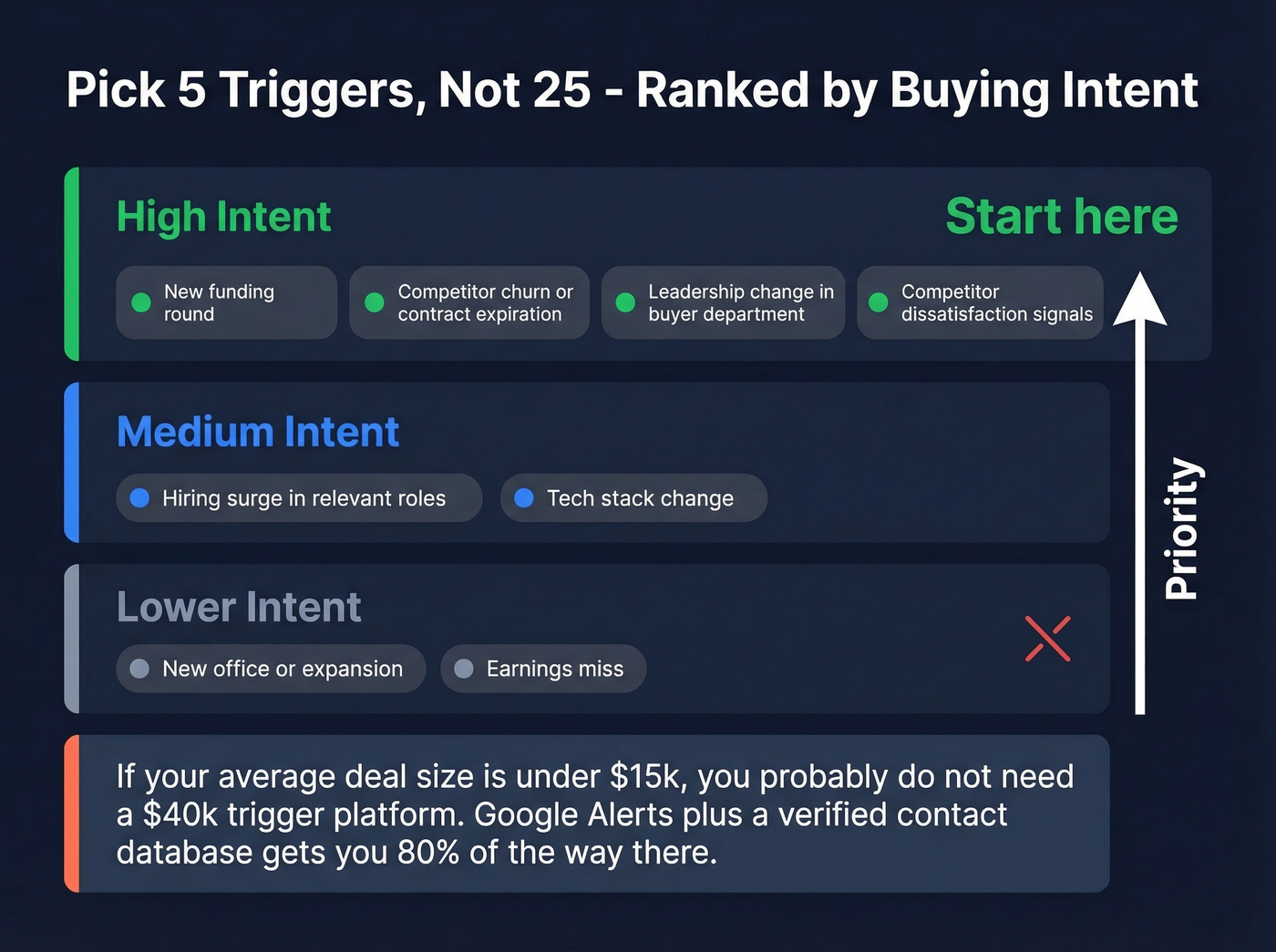
High intent: New funding round, competitor churn or contract expiration, leadership change in your buyer's department, competitor dissatisfaction signals like negative reviews, support forum complaints, or public churn announcements.
Medium intent: Hiring surge in relevant roles, tech stack change.
Lower intent: New office or expansion, earnings miss.
Start with three to five from the high and medium tiers. Expand only after you've built reliable workflows around those first.
If your average deal size is under $15k, you probably don't need a $40k trigger platform. Google Alerts plus a verified contact database will get you 80% of the way there.
Set Response SLAs by Trigger Type
Not all sales trigger events demand the same speed. A pricing page visit decays in hours. A funding round gives you days.
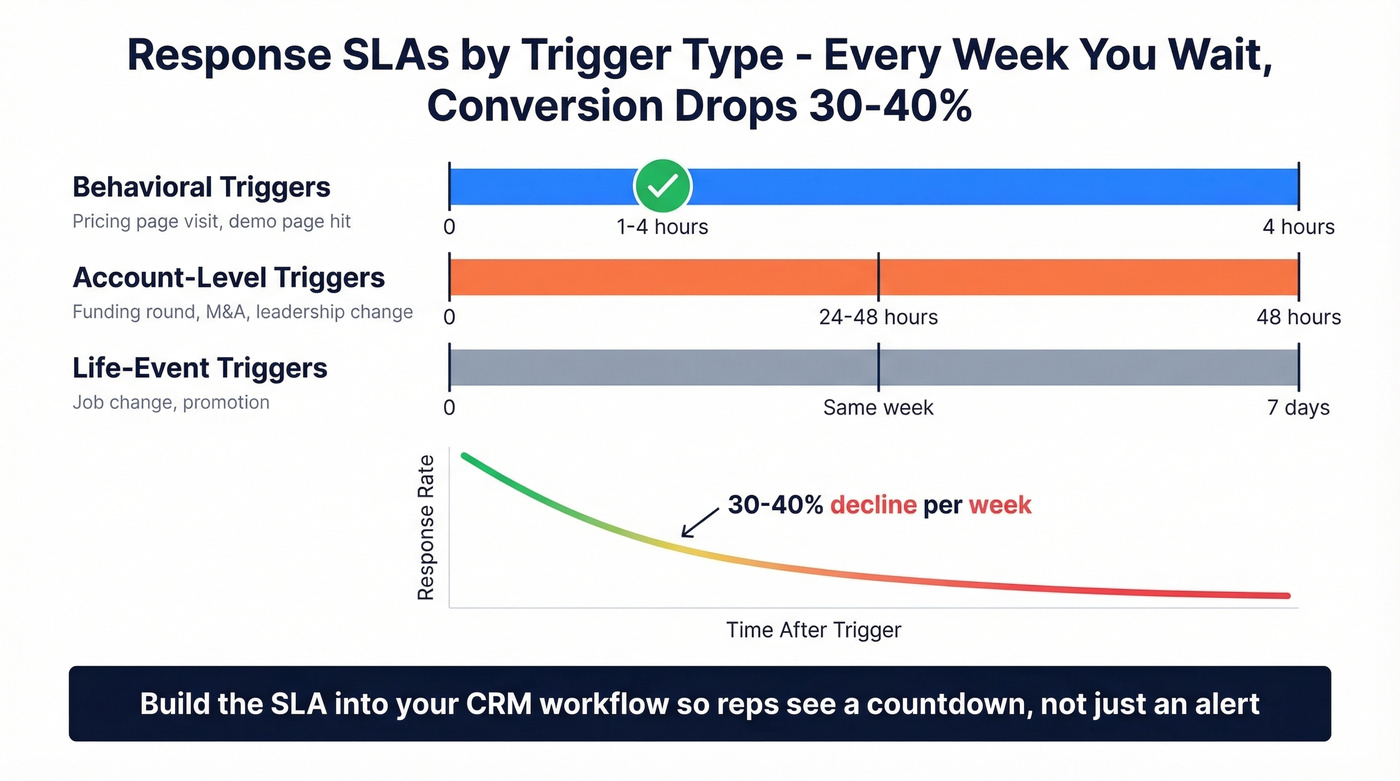
| Trigger type | Example | Response SLA |
|---|---|---|
| Behavioral | Pricing page visit, demo page hit | 1-4 hours |
| Account-level | Funding, M&A, leadership change | 24-48 hours |
| Life-event | Job change, promotion | Same week |
Response rates decline 30-40% per week after a trigger fires. Build the SLA into your CRM workflow so reps see a countdown, not just an alert. A funding-round email might open with: "Congrats on the Series B - teams at your stage typically face [problem you solve]."
Route, Score, and Right-Size
Add four fields to every triggered account in your CRM: trigger type, trigger date, trigger source, and SLA deadline. Build scoring logic with decay - a funding round detected yesterday outranks one from three weeks ago.
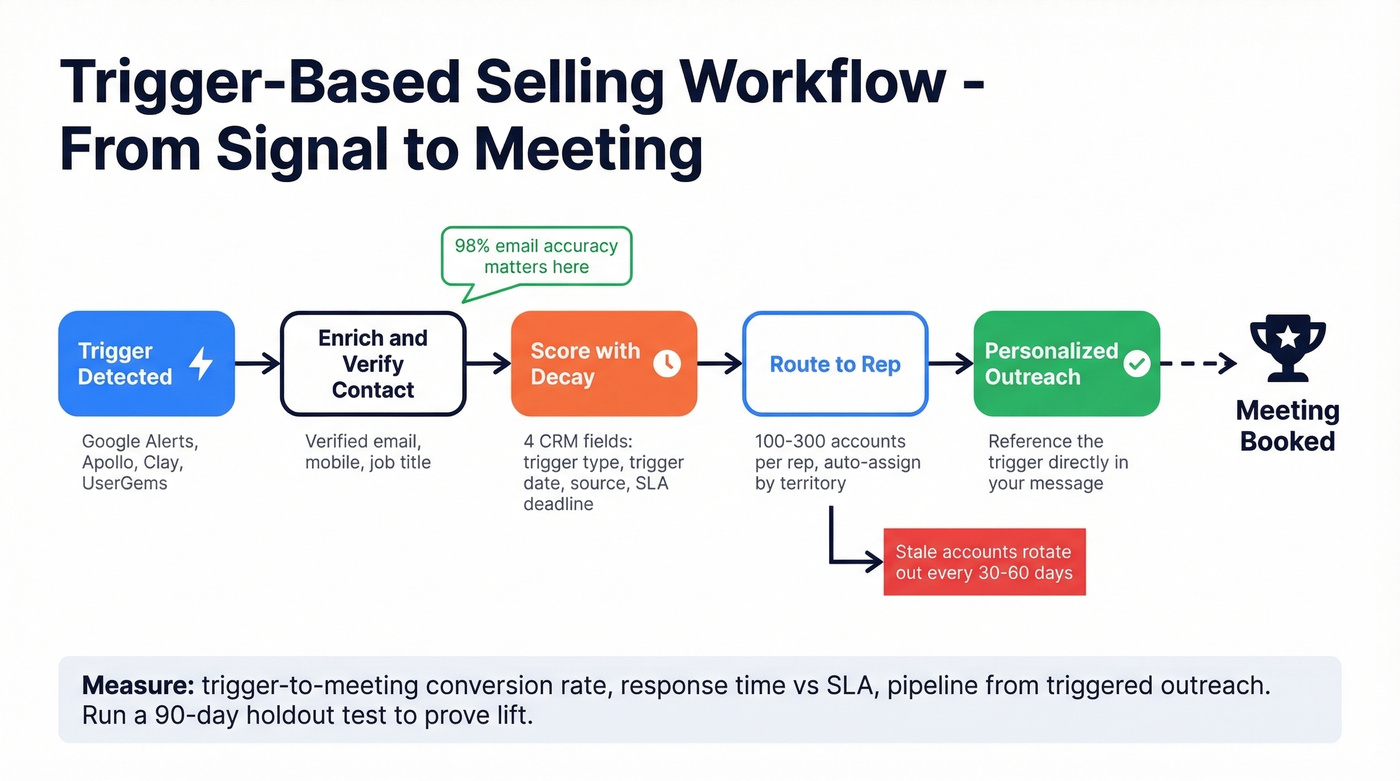
Spreadsheets die within two weeks. Automate this in HubSpot or Salesforce with workflow rules that assign, score, and escalate.
Triggers also don't help if reps are buried under 2,000 accounts. Box reduced rep books to 200-250 high-potential accounts and saw pipeline correlation improve immediately. The sweet spot is 100-300 active accounts per rep, refreshed every 30-60 days, with triggers dynamically pushing accounts in and rotating stale ones out. (If you need a repeatable way to operationalize this, start with an Ideal Customer Profile and a simple lead scoring model.)
Measure What Matters
Three KPIs tell you if the system works: trigger-to-meeting conversion rate, response time versus SLA, and pipeline sourced from triggered outreach.
Let's be honest - run a holdout test. Keep a control group on traditional outbound. Compare conversion rates over 90 days. That's the only way to prove lift and justify the tooling investment to your CFO. If triggered outreach isn't converting at least 2x your baseline, something in the plumbing is broken. (To benchmark what “good” looks like, compare against your sales conversion rate and overall funnel metrics.)
Tools for Detection and Outreach
Free tier (20-30 accounts): Google Alerts, SEC/EDGAR filings, industry newsletters. Manual, but it forces you to build the muscle before you automate.
Mid-market: Apollo (from $49/user/mo) covers job changes and funding. Clay ($149/mo, credit-based) chains triggers from multiple sources into enrichment sequences. UserGems (~$1,000+/mo, enterprise) specializes in job-change tracking. Trigify ($450+/mo) monitors company-level events.
Skip the enterprise trigger platforms if you're running fewer than 500 target accounts. I've seen too many teams sign $30k annual contracts for tools they use at 10% capacity. Start scrappy, prove the model, then scale the tooling. For more options, see our breakdown of SDR tools and outbound lead generation tools.
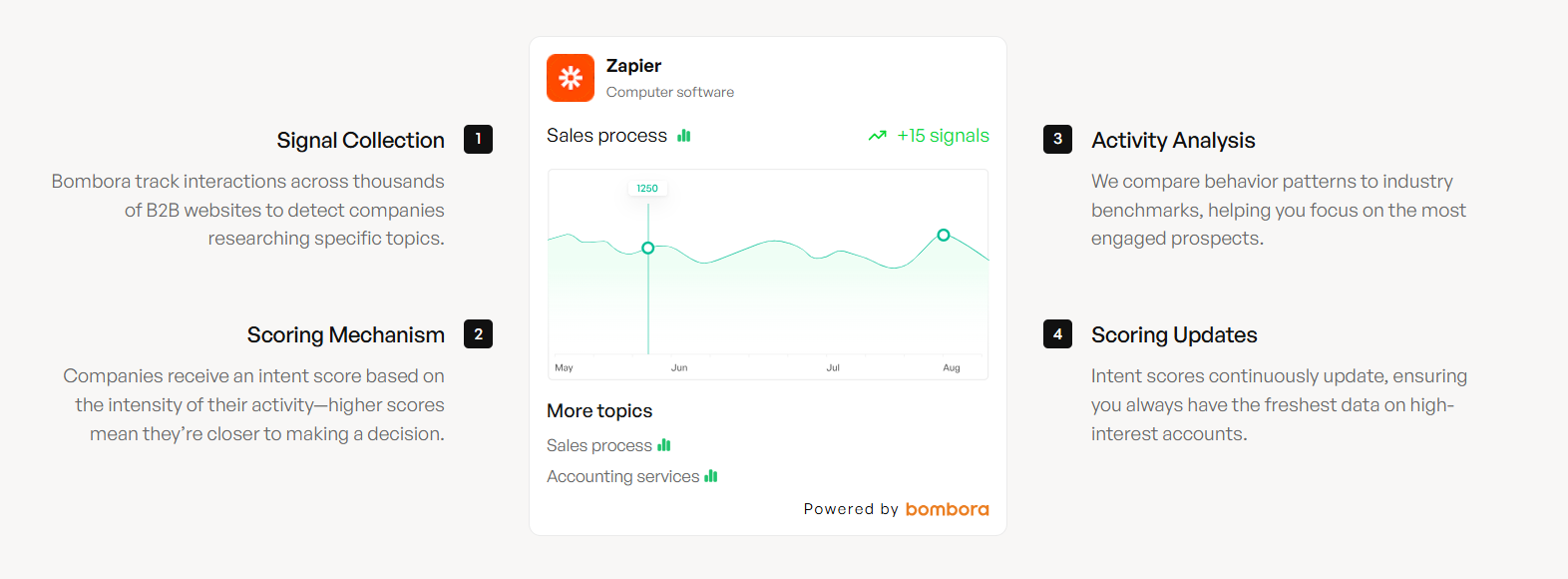
You don't need a $40K platform to run trigger-based selling. Prospeo gives you intent data across 15,000 Bombora topics, job change tracking, funding signals, and headcount growth filters - all at roughly $0.01 per email. No contracts. No sales calls. Just the signals and verified contacts to act on them.
Stop paying enterprise prices for trigger data that bounces.
FAQ
What's the difference between trigger-based and intent-based selling?
Trigger-based selling acts on observable events like funding rounds or executive hires. Intent-based selling acts on anonymous behavioral signals like content consumption patterns. Triggers are more specific and verifiable; intent data covers a wider funnel but carries more noise. Most high-performing teams layer intent on top of triggers, not the other way around.
How many trigger events should a team track?
Start with five that correlate with your closed-won deals. More than that creates alert fatigue and dilutes rep focus. Expand only after you've built reliable detection, routing, and measurement workflows around those first five.
What tools do you need for trigger-based prospecting?
Three layers: a trigger detection source (Google Alerts for free, Apollo or Clay for scale), a CRM with automation like HubSpot or Salesforce, and a verified contact data provider. Prospeo covers that third layer with 98% email accuracy, 125M+ verified mobiles, and a 7-day refresh cycle - critical when you're acting on time-sensitive buying signals.