


TrulyInbox Review 2026: Pricing, Pros, Cons, and What Users Actually Think
You're scaling from 3 inboxes to 15, and suddenly your per-inbox warm-up tool costs $375/mo. That math breaks fast. TrulyInbox built its entire pitch around fixing that problem - flat-rate pricing, unlimited accounts. But here's what most reviews won't tell you: nearly every one online is published by a competing warm-up tool. We don't sell warm-up, so let's give this an honest look.
30-Second Verdict
TrulyInbox is the best-value warm-up tool if you're managing 5+ inboxes. The unlimited-accounts model crushes per-inbox competitors at scale. Solo senders with 1-2 accounts should skip it - Lemwarm or Warmbox are simpler at that level. Customer support is a known weak spot. And the biggest gap in every warm-up strategy isn't the tool itself - it's the data feeding your outreach. Pair TrulyInbox with email verification from Prospeo so your warm-up isn't fighting bad data from day one.
What Is TrulyInbox?
TrulyInbox is a dedicated email warm-up platform running 500K+ warmup emails daily across 40K+ real accounts. The network skews Google-heavy at 21K+ accounts, with Microsoft at 9K+ and 10K+ across other providers. Setup takes about two minutes via OAuth for Google/Microsoft or SMTP for 18+ other providers, and the platform generates AI-powered warmup content in 12 languages.

You get three warmup strategies - progressive, random, and flat - plus Bounce Shield Protection that maintains a pool bounce rate under 0.004%. Hard bounces get removed instantly, accounts are pulled after three soft bounces, and MX records are verified daily.
TrulyInbox Pricing Breakdown
Half the review sites get these numbers wrong. Here's what's actually on TrulyInbox's pricing page right now:
| Plan | Annual | Monthly | Emails/Day | Accounts |
|---|---|---|---|---|
| Free | $0 | $0 | 10 | 1 |
| Starter | $22/mo | $29/mo | 200 | Unlimited |
| Growth | $59/mo | $79/mo | 1,000 | Unlimited |
| Scale | $142/mo | $189/mo | 3,000 | Unlimited |
| Business | Custom | Custom | 6,000 | Unlimited |
Every paid plan includes all three warmup strategies, AI-powered content, deliverability scoring, and account health monitoring. Reply rates scale with plan tier - 25% on Starter up to 65% on Business. There's a 7-day free trial on paid plans, no credit card required, plus a 14-day money-back guarantee.
The Growth plan at $59/mo annual is the sweet spot for most teams. You get 1,000 warmup emails/day, custom reply rates up to 45%, ESP-level analytics, and custom sending schedules - enough to warm 50 accounts simultaneously.
How TrulyInbox Compares on Price
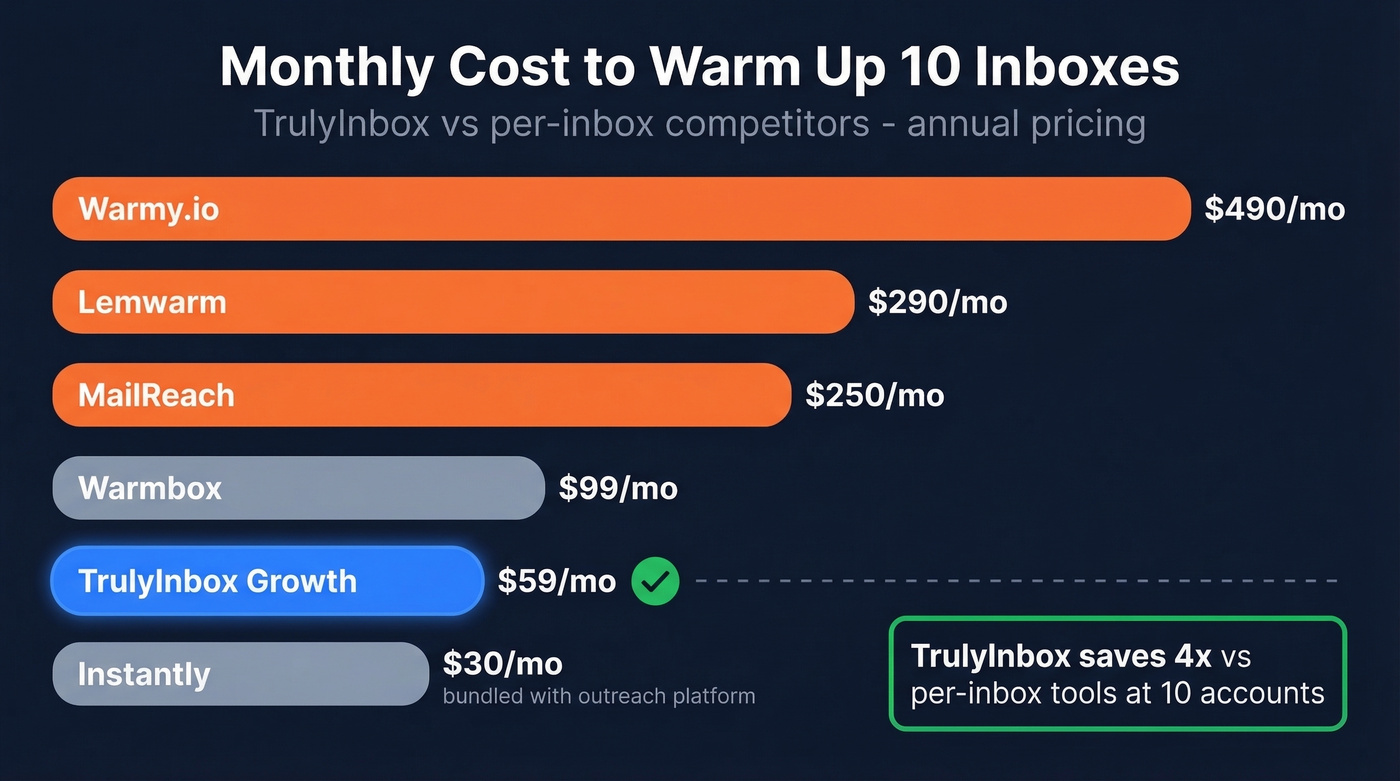
Let's do the math for 10 inboxes:
| Tool | 10-Inbox Cost | Model |
|---|---|---|
| TrulyInbox Growth | $59/mo | Flat rate |
| MailReach | ~$250/mo | $25/inbox |
| Lemwarm | ~$290/mo | $29/inbox |
| Warmy.io | ~$490/mo | $49/inbox |
| Warmbox | ~$99/mo | Up to 25 inboxes |
| Instantly | ~$30/mo+ | Bundled w/ outreach |
TrulyInbox at $59/mo vs $250+ for per-inbox tools - that's a 4x difference. The cost advantage is real once you're past 3-4 accounts. Instantly deserves an asterisk: warmup comes bundled with their outreach platform, so if you're already on Instantly for sending, you don't need a separate warm-up tool.

TrulyInbox saves you money on warm-up. But warm-up can't fix bounces from bad data. Prospeo's 5-step email verification catches spam traps, honeypots, and invalid addresses at 98% accuracy - refreshed every 7 days, not 6 weeks. At $0.01/email, verifying your entire list costs less than one month of warm-up.
Stop warming up inboxes just to bounce off bad emails.
Pros and Cons
Pros:
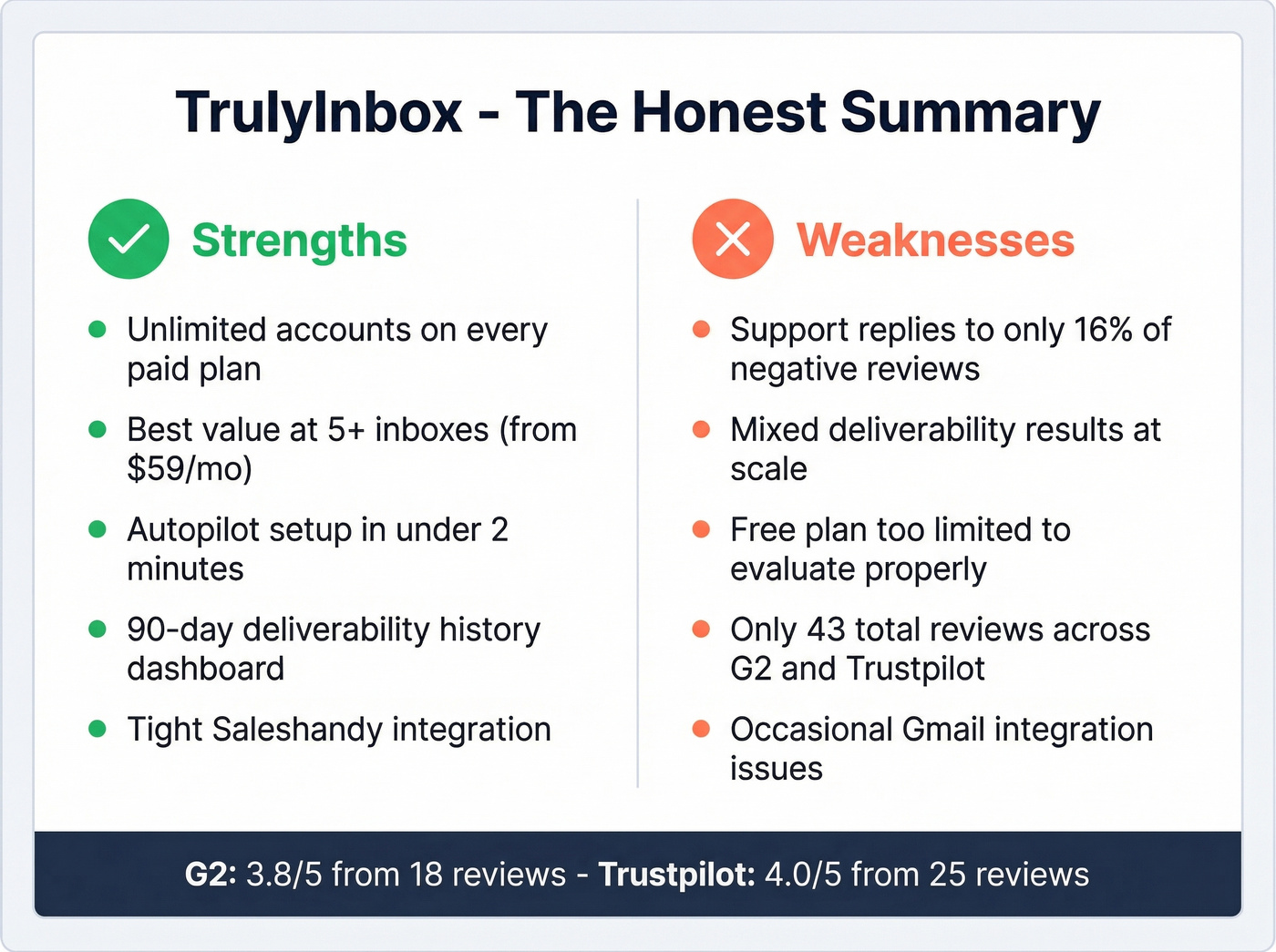
- Unlimited accounts on every paid plan - the core value proposition
- Aggressively competitive pricing at scale, especially 5+ inboxes
- Easy setup with autopilot operation - minimal ongoing management
- Clear dashboard with 90-day deliverability history and ESP-level breakdowns
- Direct Saleshandy integration that works well if you're in that ecosystem
Cons:
- Customer support is slow - TrulyInbox replies to only 16% of negative Trustpilot reviews
- Mixed deliverability results at scale (more on this below)
- Free plan is nearly useless for evaluation: 10 emails/day on 1 account
- Small review footprint - just 43 total reviews across G2 and Trustpilot
- Occasional Gmail integration issues reported on Reddit and G2
What Users Actually Say
G2 Reviews
TrulyInbox holds a 3.8/5 on G2 from 18 reviews. The distribution is bimodal: 55% five-star, 27% four-star, 16% one-star - not much middle ground. People either love it or have a bad experience.
One reviewer praised the free tier as "genuinely useful," noting they connected and warmed five email accounts without paying (the current free plan limits to 1 account, so this likely reflects an earlier version or a trial). Another reported deliverability jumping from 40% to 91% in a single week - an outlier we'd take with a grain of salt, frankly. A practical complaint that came up multiple times: users want warmup emails categorized into a separate folder to avoid cluttering their inbox. The recurring pattern across reviews is consistent - ease of use gets praised, customer support gets flagged.
Trustpilot Reviews
Trustpilot paints a similar picture at 4.0/5 from 25 reviews. Positive themes cluster around the clear dashboard, strong value, and Saleshandy integration.
The most concerning review describes a deliverability score dropping from ~75% to 45% over two weeks with no active campaigns running. TrulyInbox responded, attributing it to a temporary issue and offering to help recover the account. That's a reasonable response, but the fact that it happened at all matters. The consensus on r/coldemail echoes the support concerns - users mention flexible warmup settings as a strength but flag customer support and Gmail integration as risks.
The Deliverability Reality Check
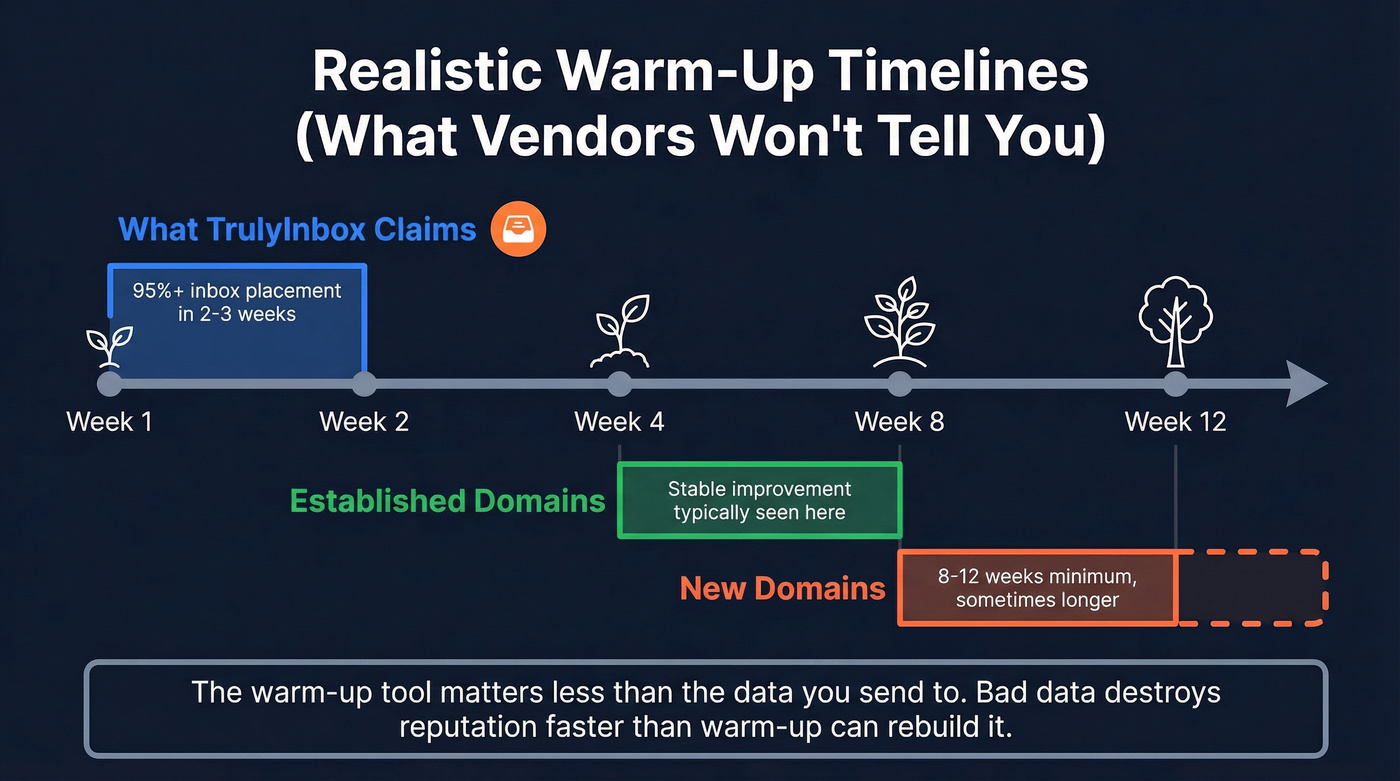
TrulyInbox markets 95%+ inbox placement for most users within 2-3 weeks. Let's put that in context. According to EmailTooltester's deliverability benchmarks, average deliverability across 15 ESPs is just 83.1%. Anything above 89% is "good," and above 95% is "excellent." Google delivers 89.8% to inbox; Microsoft only manages 77.4%.
If TrulyInbox's 95% number holds, that's genuinely top-tier. But it's a marketing figure, not independently verified - and marketing figures deserve skepticism.
Here's the thing: realistic warm-up timelines are much longer than any vendor will tell you. Established domains typically need 4-8 weeks to see stable improvement. New domains? Budget 8-12 weeks minimum, sometimes longer. Anyone claiming meaningful results in "one week" either got lucky or is measuring wrong.
The warm-up tool matters far less than people think. What matters is the data you're sending to.
Bad data destroys sender reputation faster than any warm-up tool can rebuild it - bouncing off invalid addresses, hitting spam traps, sending to catch-all domains that silently flag you. Warm-up can't fix any of that. Before you warm up a single inbox, verify your list. Prospeo's 5-step verification catches bounces, spam traps, and honeypots at 98% accuracy on a 7-day data refresh cycle, and the free tier gives you 75 verifications per month to test the impact on your bounce rates before committing. If you want the deeper mechanics behind this, start with an email deliverability guide and then benchmark your email bounce rate before scaling volume.

Is TrulyInbox Worth It?
For teams warming 5+ inboxes who want flat-rate pricing, TrulyInbox is the obvious choice. The math simply works in your favor. If you're on Saleshandy, it's a no-brainer - the integration is tight and well-reviewed.
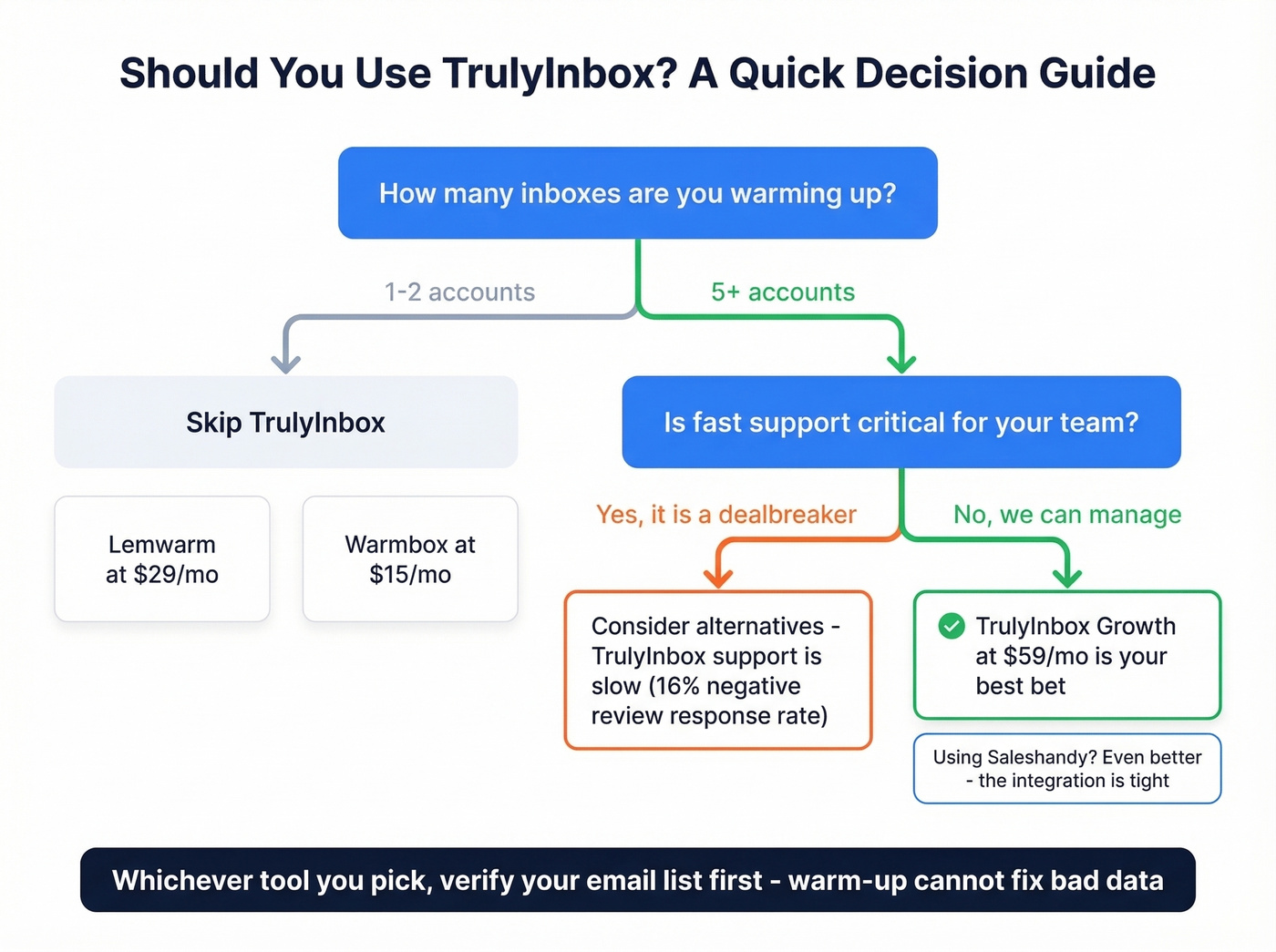
Solo users with 1-2 accounts should look at Lemwarm (~$29/mo) or Warmbox ($15/mo) instead. Skip TrulyInbox entirely if fast, responsive support is a dealbreaker for your team - we've seen teams get stuck waiting days for responses during critical deliverability issues, and that's a real operational risk when your domain reputation is on the line.
Regardless of which warm-up tool you pick, the reputation you're building is only as strong as the data you're sending to. If you're building lists from scratch, use a data enrichment workflow and validate addresses with an AI email checker before you ever hit “send.” Then keep your outreach safe by monitoring email velocity and tightening your cold email marketing process.
You're optimizing warm-up strategy, reply rates, and sending schedules - but none of that matters if 15% of your list is invalid. Teams using Prospeo-verified data see bounce rates under 4%. Stack Optimize built a $1M agency on it with 94%+ deliverability across every client.
Fix your data before you fix your deliverability.
FAQ
Is TrulyInbox's free plan worth using?
Barely. Ten warmup emails per day on one account gives almost no meaningful signal. Use it to test the dashboard UI, but you'll need at least the Starter plan ($22/mo annual) for real evaluation. The 7-day free trial on paid plans is a better path.
How long does TrulyInbox take to improve deliverability?
Expect 4-8 weeks for established domains and 8-12 weeks for new ones, despite TrulyInbox's 2-3 week claim. Some G2 reviewers report faster results, but at least one Trustpilot user saw scores drop during the same period. Domain age, sending volume, and contact data quality all play a role.
Do I need email verification alongside a warm-up tool?
Yes. Warm-up builds sender reputation through engagement signals, but it can't undo damage from bouncing off invalid addresses or hitting spam traps. Verification is the foundation; warm-up is the insulation.