

Types of Intent Data (and Which Ones Actually Drive Pipeline)
A RevOps lead we know spent $36,000 last year on an intent data platform. She got a weekly spreadsheet of "surging accounts" - company names, topic scores, and zero contact information. Her SDRs still had to manually hunt for the right person to email. That's the dirty secret of the different types of intent data: most tell you where to look but not who to talk to.
We've seen this pattern across dozens of RevOps teams. An analysis of ~1,100 practitioner posts across Reddit and other communities surfaced the same complaints - signals too generic, timing off, teams stitching together three or four tools just to act on a single buying signal. Only 24% of teams report exceptional ROI from intent data. The category has a signal saturation problem, and it starts with understanding what you're actually buying.
The Quick Version
Intent data breaks into two taxonomies: by source (first-party, second-party, third-party, co-op, bidstream) and by signal (search, engagement, firmographic, technographic, hiring, community). You don't need all of them. Most teams get the best results from two or three combinations, scored by fit + intent + recency, and acted on fast.
Here's the thing: if your average deal size is under $15K, you probably don't need a $40K intent platform. You need verified contacts at companies showing basic buying signals - and you can get that for a fraction of the cost.
Intent Data Sources: Owned to Purchased
Think of intent data sources on a spectrum from owned to purchased. Each step outward trades signal quality for scale.
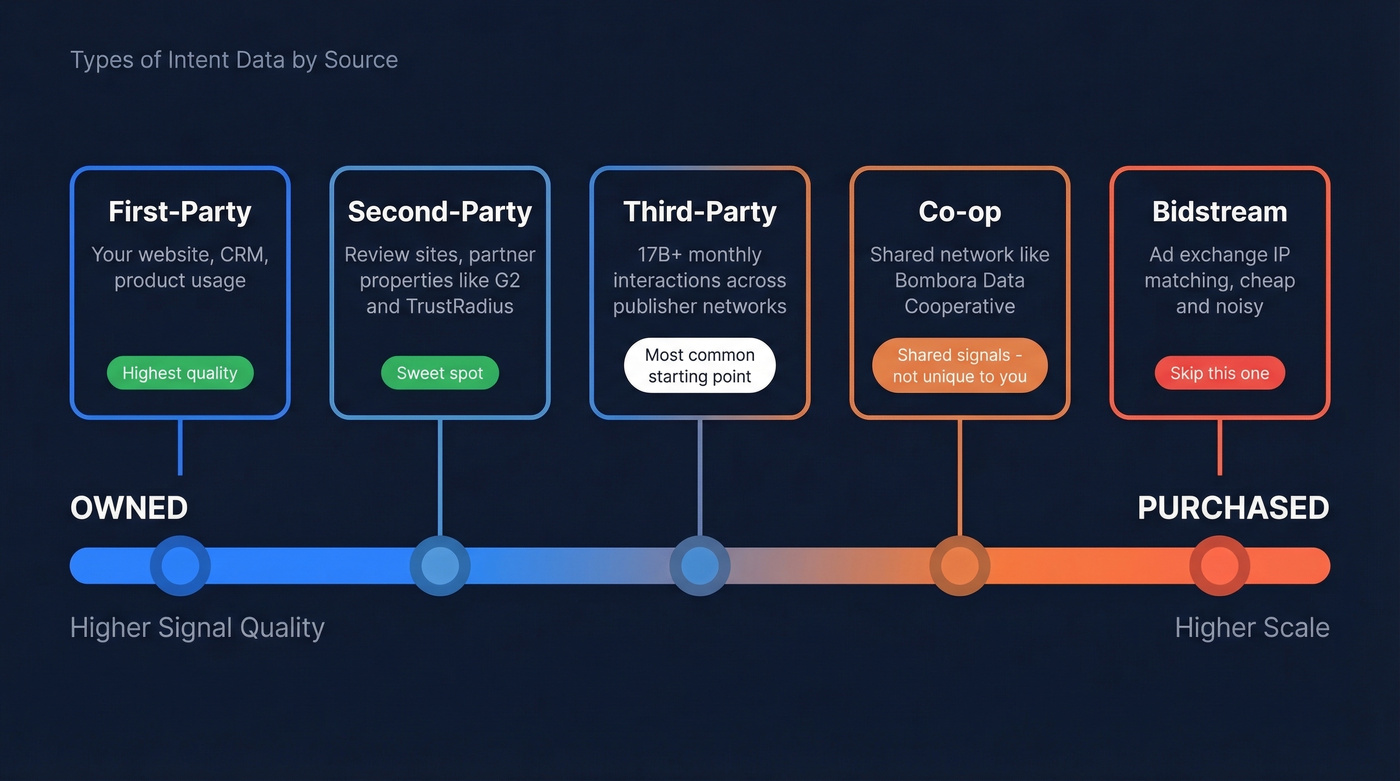
First-Party Intent Data
These are signals from your own properties - website visits, content downloads, product usage, CRM activity. Highest quality, lowest scale. If someone hits your pricing page three times in a week, that's gold.
The limitation is obvious: you only see people who already found you. That's why most teams pair first-party signals with broader sources to fill the top of the funnel.
Some organizations go a step further and collect zero-party intent data - information prospects voluntarily share through survey responses, preference center selections, or quiz answers. Zero-party signals are the highest-fidelity you can get because the buyer is explicitly telling you what they need, but you need enough inbound traffic to generate meaningful volume.
Second-Party Intent Data
This is data from partner properties like review sites and marketplaces - G2, TrustRadius, Capterra - shared through a formal agreement. When a prospect reads reviews comparing your category, that's second-party intent in action. It sits in a sweet spot between first-party precision and third-party scale.
You'll also hear the term "downstream intent." TrustRadius uses it to describe signals captured after a buyer leaves a vendor's website, like comparison shopping and review reading.
HG Insights acquired TrustRadius in mid-2025, bringing review-site intent closer to technographic data in the same ecosystem. In practice, that pushes the market toward more bundled "intent + fit" packages - one of the clearest trends carrying into 2026.
Third-Party Intent Data
Publisher networks and data aggregators tracking content consumption across thousands of sites. Bombora tracks 17 billion interactions monthly across 5,000+ sites. Third-party buyer intent is where most teams start because the scale is massive - you can spot accounts researching your category long before they visit your site.
One wrinkle worth knowing: Google's third-party cookie deprecation has shifted toward privacy controls rather than full removal. Chrome still holds ~65% global browser share, so third-party collection still works. But it's getting noisier every quarter.
Co-op Intent
A subset of third-party where multiple organizations contribute aggregated research and behavior signals into a shared network. Bombora's Data Cooperative is the best-known example.
The tradeoff: because the network is shared, many customers end up seeing similar "surging" accounts and topics. You're not the only one getting that alert.
Bidstream Intent (Skip This One)
Bidstream data comes from programmatic ad exchanges - IP addresses matched to companies based on ad bid requests. It's cheap, widely available, and everyone has it. That's the problem. You're inferring intent from ad impressions, not actual content consumption. If a vendor won't tell you whether their data is bidstream or publisher-sourced, assume the worst.
Intent Signals: What Each Type Captures
The source taxonomy tells you where data comes from. The signal taxonomy tells you what it captures. Gartner identifies four core types but two additional categories matter for technical-buyer ICPs.
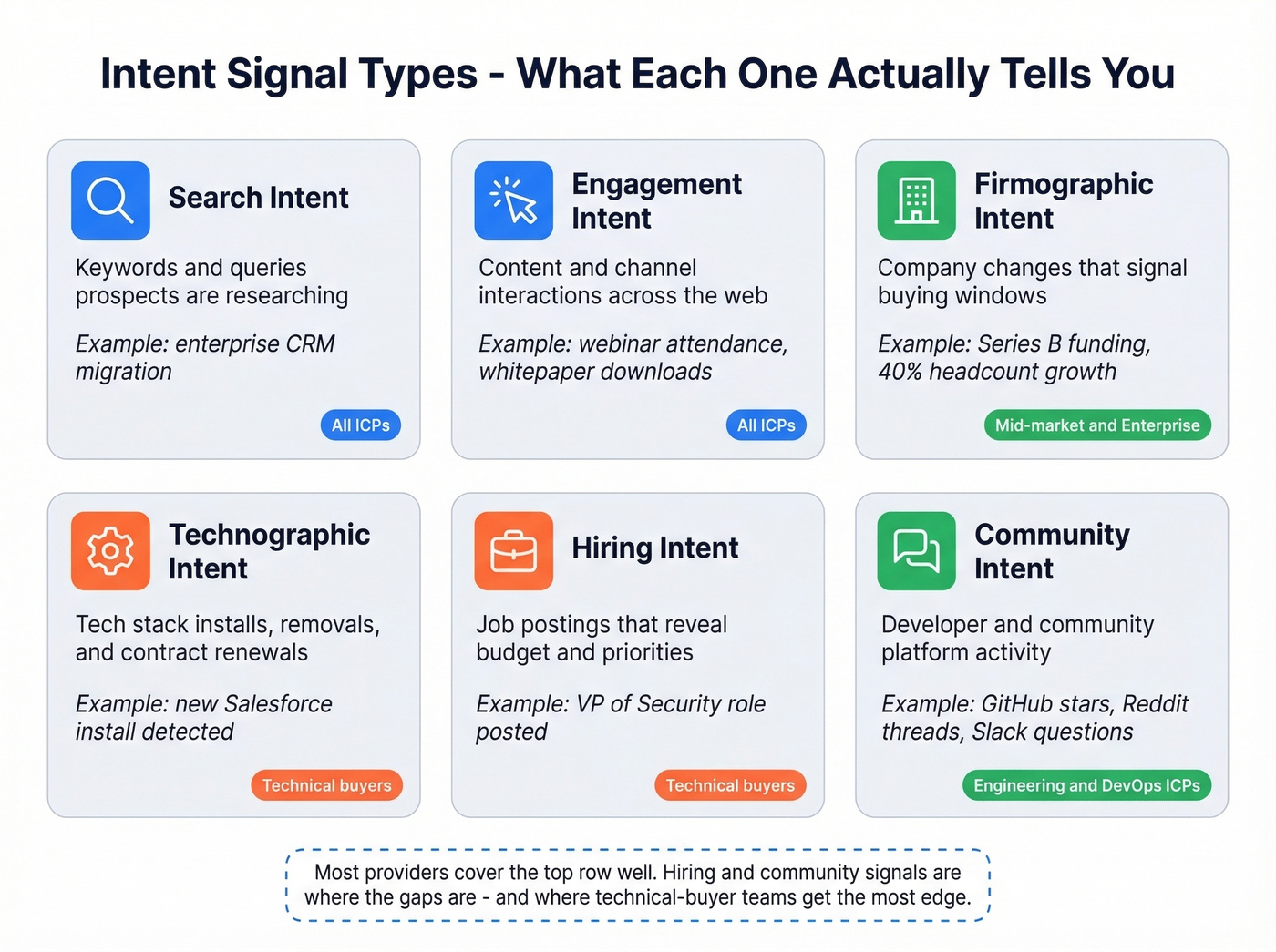
| Signal Type | What It Captures | Example |
|---|---|---|
| Search | Keywords and queries | "enterprise CRM migration" |
| Engagement | Content and channel interaction | Webinar attendance, email clicks, whitepaper downloads |
| Firmographic | Company attributes and changes | Funding rounds, headcount growth |
| Technographic | Tech stack signals | New Salesforce install |
| Hiring | Role-based signals | VP of Security posting |
| Community | Developer/community activity | GitHub stars, forum threads |
Hiring and community intent are where most providers fall short. For technical-buyer ICPs, signals from GitHub, Reddit, Stack Overflow, and niche Slack communities are often the missing layer in a traditional publisher-network stack. We've found that teams selling to engineering or security buyers get far more value from community signals than from generic topic surges.
How Intent Data Is Collected
Understanding collection methods helps you evaluate what you're actually buying. First-party signals come from your own tracking - website analytics, marketing automation platforms, and product telemetry. Second-party data is gathered by a partner like a review site through their own tracking pixels and user interactions, then shared under a data agreement. Third-party relies on publisher cooperatives, reverse-IP lookup, cookie-based tracking, and content syndication networks to map topic consumption across the open web. Bidstream data is scraped passively from ad exchange bid requests - the lowest-effort, lowest-quality collection method.
The collection method directly determines signal quality. A content download captured by a publisher cooperative is far more meaningful than an IP address that appeared in an ad bid request.

Most intent platforms give you company names. Prospeo gives you the verified contacts at those companies - 300M+ profiles with 98% email accuracy, layered with Bombora intent data tracking 15,000 topics. No more $36K spreadsheets of account names your SDRs can't act on.
Turn surging accounts into booked meetings for $0.01 per email.
The Account-to-Contact Problem
Here's the scenario that kills intent data ROI: you get a list of 200 surging accounts. Now what?
64% of teams collect intent data but struggle to use it effectively. The consensus on r/sales echoes this frustration constantly - teams paying for account lists they can't act on. The core issue is detection-to-action lag: intent fires in one tool, you hunt for contacts in another, and by the time you send an email the buying window has moved.
If you're building a workflow around this, treat it like lead scoring plus fast routing: fit + intent + recency, then immediate enrichment.
Signal Decay Timelines
Intent signals aren't permanent. Ignoring data decay is one of the biggest mistakes Forrester flags - without a decay model, everyone looks "in intent" and the data becomes useless.
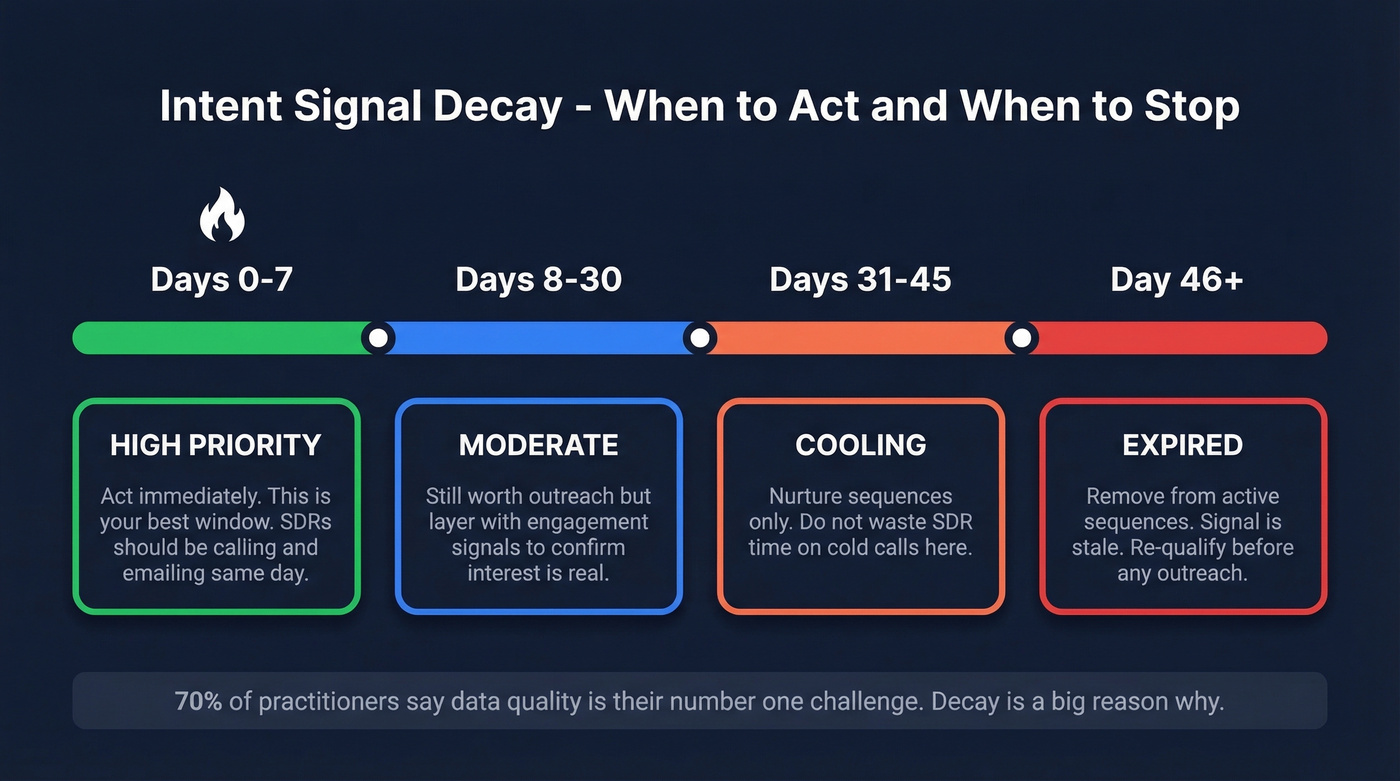
- Days 0-7: High priority. Act immediately - this is your best window.
- Days 8-30: Moderate. Still worth outreach, but layer with engagement signals.
- Days 31-45: Cooling. Nurture only. Don't waste SDR time on cold calls here.
- Day 46+: Expired. Remove from active sequences.
70% of practitioners say data quality is their #1 challenge. Decay is a big reason why. Even the best intent signal is worthless if the contact data underneath it is stale by the time you act.
Evaluating Intent Data Providers
Before you sign a contract, ask three questions. In our experience, the third one separates serious providers from resellers.
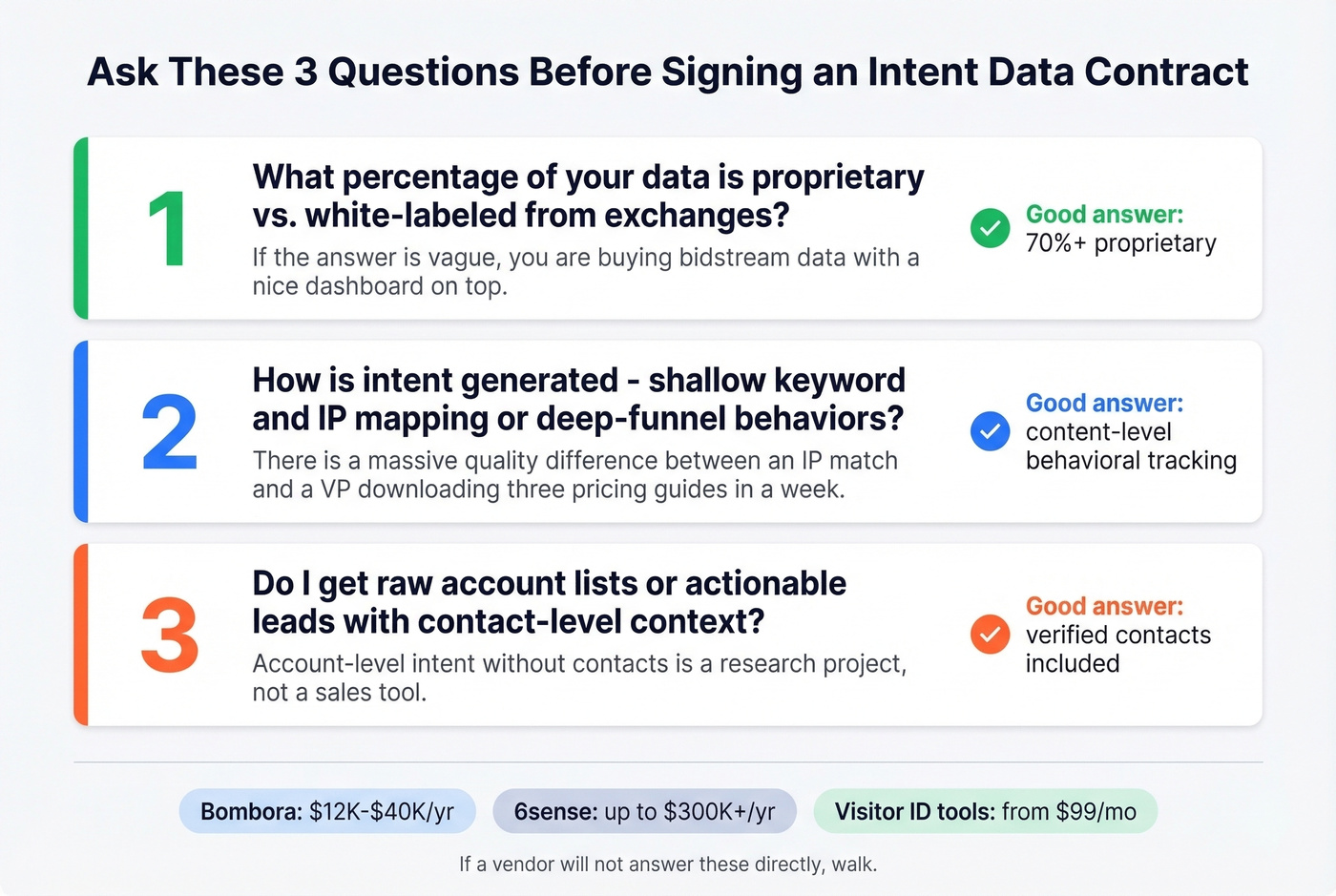
What percentage of your data is proprietary vs. white-labeled from exchanges? If the answer is vague, you're buying bidstream data with a nice dashboard on top.
How is intent generated - shallow keyword/IP mapping or deep-funnel behaviors? There's a massive quality difference between "someone at this IP searched a keyword" and "a VP at this company downloaded three pricing comparison guides in a week."
Do I get raw account lists or actionable leads with contact-level context? Account-level intent without contacts is a research project, not a sales tool.
Look - if a vendor won't answer these three questions directly, walk.
Pricing ranges to calibrate expectations: Bombora runs $12K-$40K/year, 6sense can hit $300K+/year for enterprise, and visitor identification tools start around $99/month. If you're comparing stacks, it helps to benchmark against best sales prospecting databases and B2B company data providers too.
Compliance in 2026
Privacy compliance got harder. As of early 2026, 20 US states have comprehensive privacy laws in effect or enacted - eight new state privacy laws took effect in 2025 alone, including Iowa, Delaware, Nebraska, New Hampshire, New Jersey, Tennessee, Minnesota, and Maryland. Iowa penalties reach $7,500 per violation.
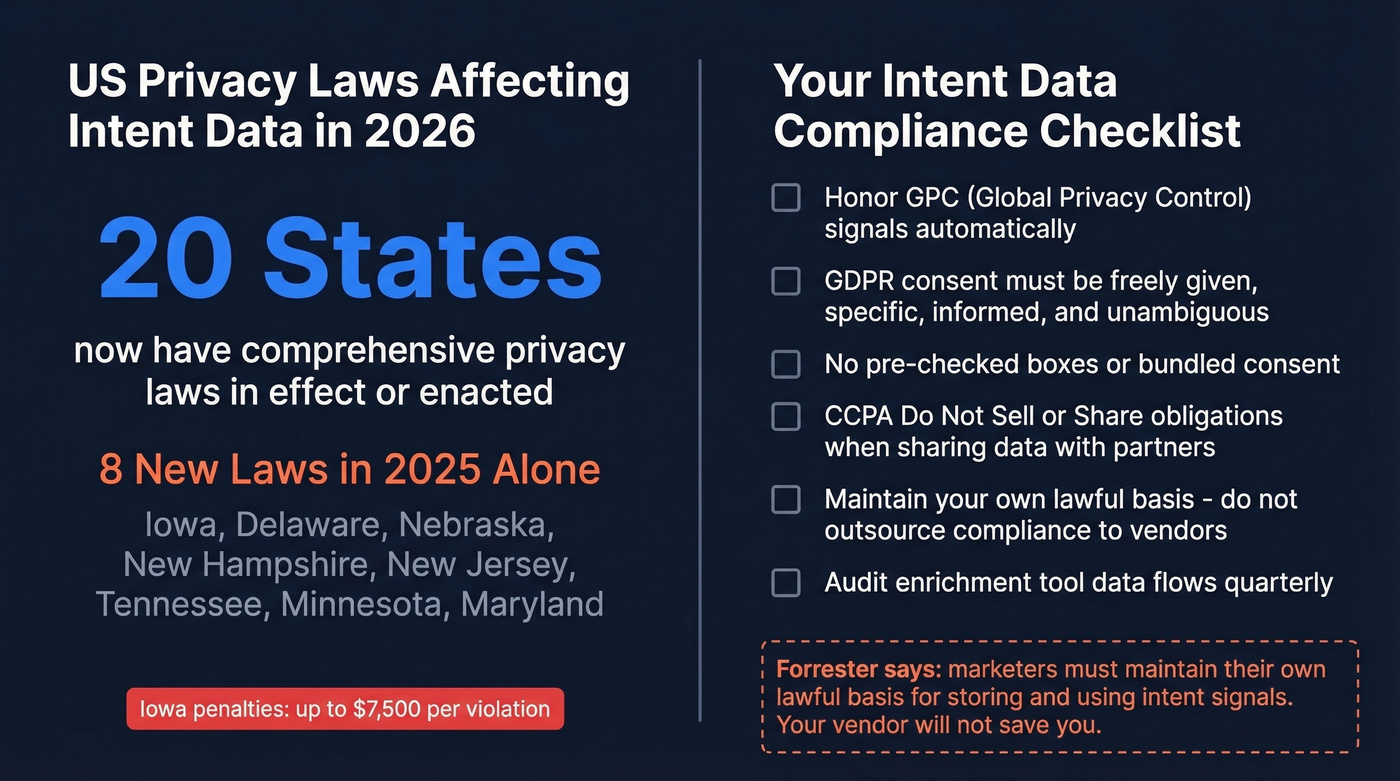
GPC (Global Privacy Control) signal requirements are expanding across states, and your tools need to honor them automatically. GDPR consent must be freely given, specific, informed, and unambiguous - pre-checked boxes and bundled consent violate the regulation. CCPA's "Do Not Sell or Share" obligations apply when you're sharing intent data with partners or enrichment tools.
Don't outsource compliance to your vendor. Forrester's guidance is clear: marketers must maintain their own lawful basis for storing and using intent signals.
If you're operationalizing this, document it like a lead generation workflow: collection method, lawful basis, retention window, and suppression rules.
The account-to-contact gap is where intent data ROI dies. Prospeo closes it - layer buyer intent across 15,000 topics with 30+ filters like job change, headcount growth, and technographics, then export verified emails and direct dials in one workflow. No stitching tools together.
Stop paying for signals you can't act on. Start reaching the actual buyers.
FAQ
What's the difference between first-party and third-party intent data?
First-party intent data comes from your own properties - website visits, product usage, CRM activity. Third-party comes from external publisher networks and data co-ops tracking content consumption across thousands of sites. First-party is higher quality but limited to people who already found you. Most teams need both working together to cover the full buyer journey.
How do I combine intent data with outreach?
Layer intent signals with verified contact data so you can act immediately. Filter a B2B leads database by intent topics, job title, and company size, then push results directly to Salesforce, HubSpot, or your sequencer. The goal is zero lag between signal detection and first touch.
Is intent data GDPR compliant?
It depends on the provider and collection methodology. Under GDPR, you need a lawful basis - typically legitimate interest or consent - to process intent signals tied to individuals. Verify your provider's data sourcing, maintain your own consent records, and honor opt-out requests promptly. Responsibility sits with you, not your vendor.
What is second-party intent data and when should I use it?
Second-party intent data is collected by a partner organization - typically a review site like G2 or TrustRadius - and shared through a formal agreement. It's especially valuable for mid-funnel signals because it captures buyers actively comparing solutions in your category. For sales cycles that involve heavy evaluation and comparison shopping, second-party sources surface accounts that neither first-party nor third-party signals would catch alone.
What's the most cost-effective way to act on intent signals?
Combining intent detection with contact-level data in a single tool eliminates the need to stitch together separate platforms. For teams with deal sizes under $20K, that bundled approach - intent topics plus verified emails at roughly $0.01 per lead - beats paying $12K-$40K/year for standalone intent platforms that deliver account lists without contacts.