

Unsolicited Sales Proposals: When They Work and How to Write One
You've received them. Three paragraphs of company history, a generic value prop, and a pricing table for a problem you don't have. That's the unsolicited sales proposal most people picture - and they're right to delete it.
But there's another version: a sharp, well-timed proposal that lands on a decision-maker's desk right before their contract renewal, solves a problem they've been quietly wrestling with, and closes without a formal RFP. That version works. The difference between the two isn't luck - it's research, timing, and knowing when a proposal is the right move versus when it's just expensive spam.
Here's the thesis upfront: unsolicited proposals work for existing accounts and warm relationships. For cold prospects, they almost never do. And a bad one doesn't just get ignored - it damages your reputation with that buyer permanently.
What Is an Unsolicited Proposal?
An unsolicited sales proposal is a formal offer you send without being asked. No RFP, no RFQ, no procurement process inviting submissions. You identify a problem, build a case, and pitch a solution on your own initiative.
That's the opposite of a solicited proposal, where the buyer defines the scope and invites vendors to respond. If you're in government contracting, unsolicited proposals have their own regulatory framework (FAR 15.6 covers the federal process). This article isn't about that. We're talking about commercial B2B sales - the kind where you're trying to win a deal nobody posted.
Do They Actually Convert?
Let's be honest about the numbers. In grant and NGO contexts, unsolicited applications see success rates below 1%. Commercial B2B is better, but cold proposals still convert in the low single digits for most teams. You're asking someone who didn't ask for help to read a multi-page document from a stranger. That's a big ask.
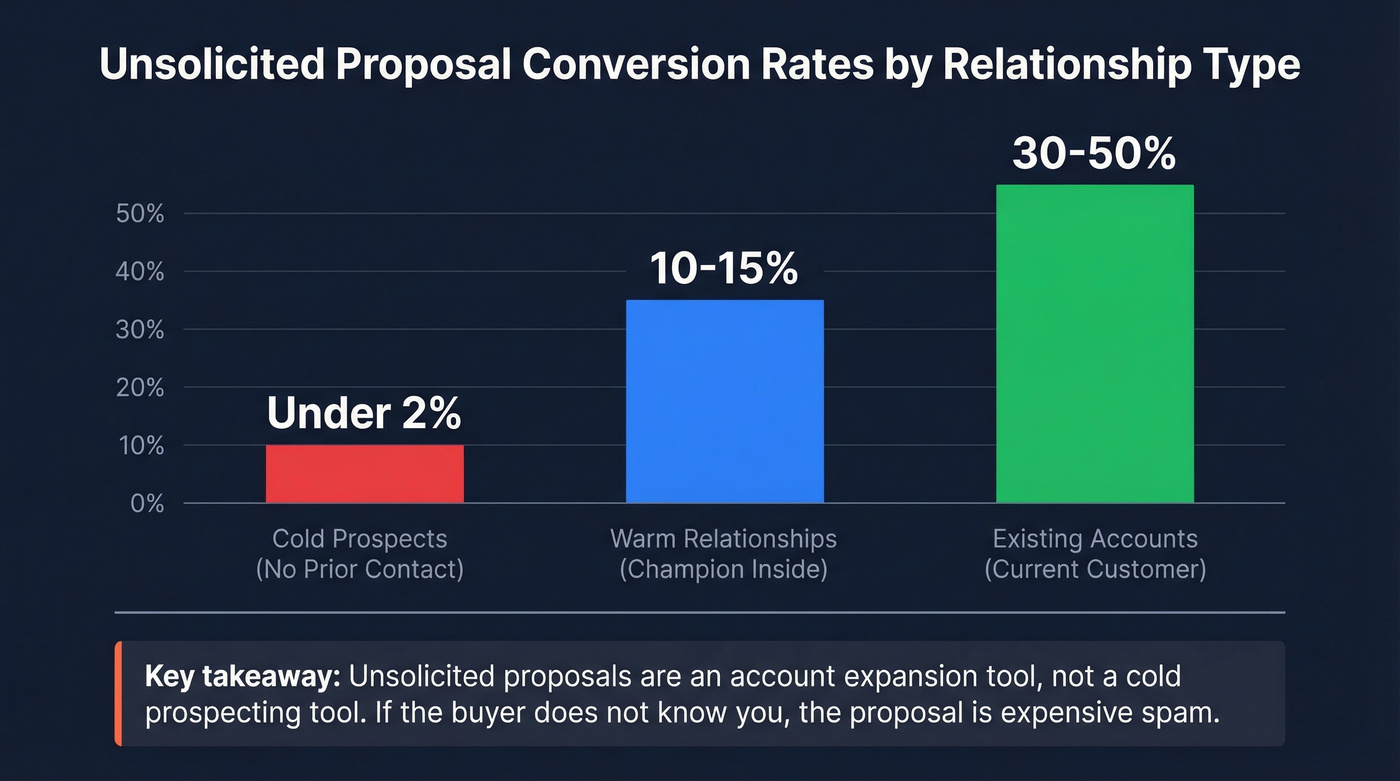
The picture changes dramatically for existing accounts. Proposals sent to current customers or truly warm relationships win at materially higher rates because the buyer already trusts you, knows your work, and wants to avoid rebids and the transition pain that comes with switching vendors. In our experience, the proposals that actually close are the ones sent to accounts where you already have a relationship - this is an account expansion tool, not a cold prospecting tool.
If your average contract value is under $15k, skip the formal proposal entirely and just book a meeting. The ROI on crafting a multi-page document for a small deal doesn't pencil out.
When to Send One (and When to Skip It)
Send one when:
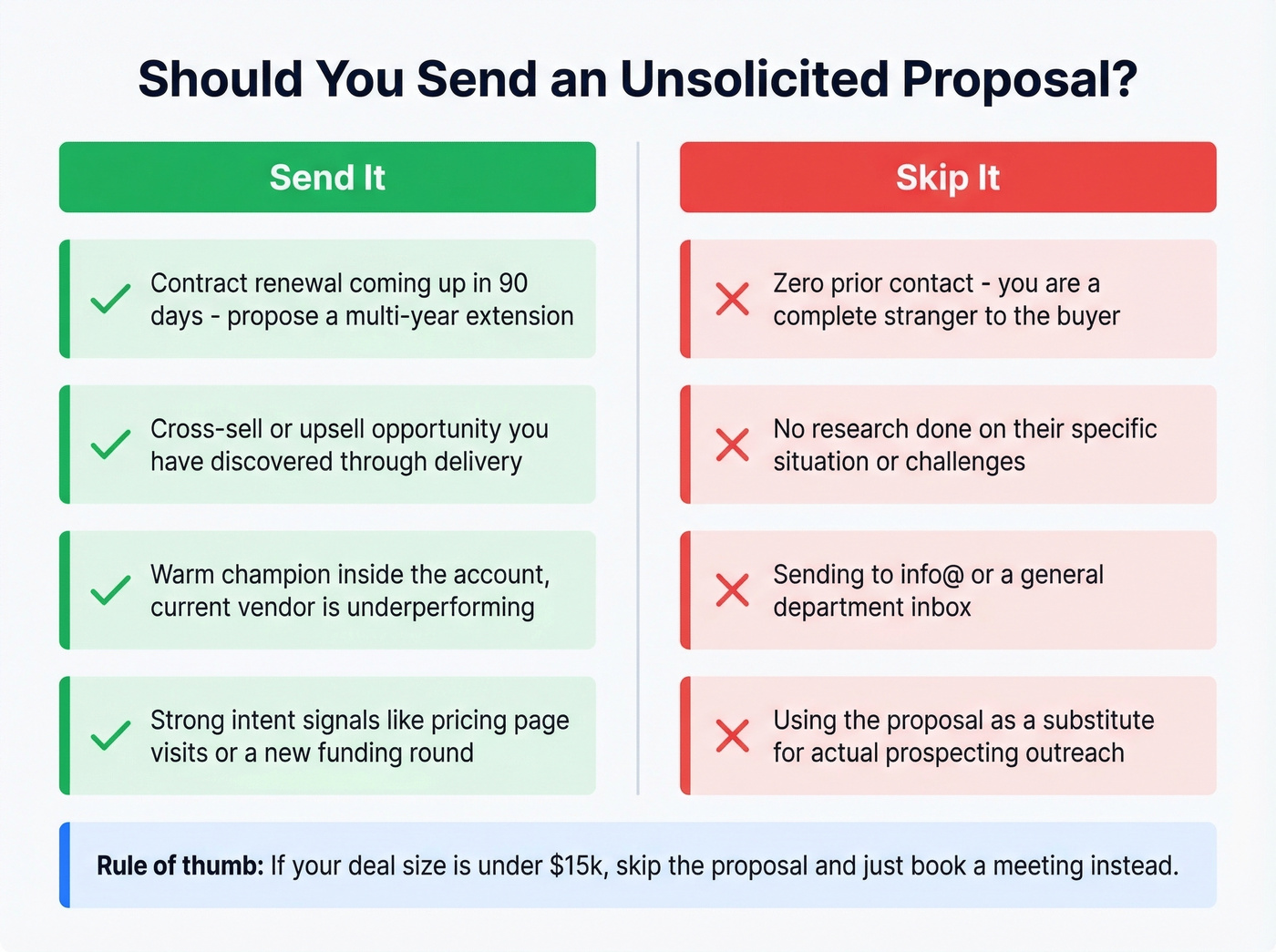
- You're preempting a contract renewal. Your customer's agreement expires in 90 days. Propose a multi-year extension with re-scoped terms that save them money - and give their champion internal ammunition to justify skipping the rebid.
- You see a cross-sell or upsell opportunity. You're delivering one service and notice the client needs another. Do the discovery, build the case, propose it proactively. (If you need the distinction, see cross-sell or upsell.)
- You're displacing a competitor. You have a warm relationship with a champion inside the account, and their current vendor is underperforming. A well-researched proposal gives your champion the ammo to make the switch.
- A cold prospect is showing strong intent signals. They've visited your pricing page three times or their company just raised a round. Even then, a meeting request usually works better than a full document.
Skip it when:
- You have zero prior contact. A proposal to a stranger is just expensive spam.
- You haven't researched their specific situation. Generic proposals get deleted.
- You're sending to info@ or a general inbox. No decision-maker, no deal.
- You're using it as a substitute for prospecting. A proposal isn't a first touch - it's a closing document.

Sending an unsolicited proposal to the wrong person is worse than not sending one at all. Prospeo's 30+ search filters - including buyer intent, job changes, and department headcount - help you identify the exact decision-maker whose contract is up for renewal. 98% email accuracy means your proposal actually lands.
Stop sending proposals into the void. Find the right buyer first.
How to Structure It
Keep it under 5 pages. If you can't make the case in 3-5, you don't understand the prospect's problem well enough.
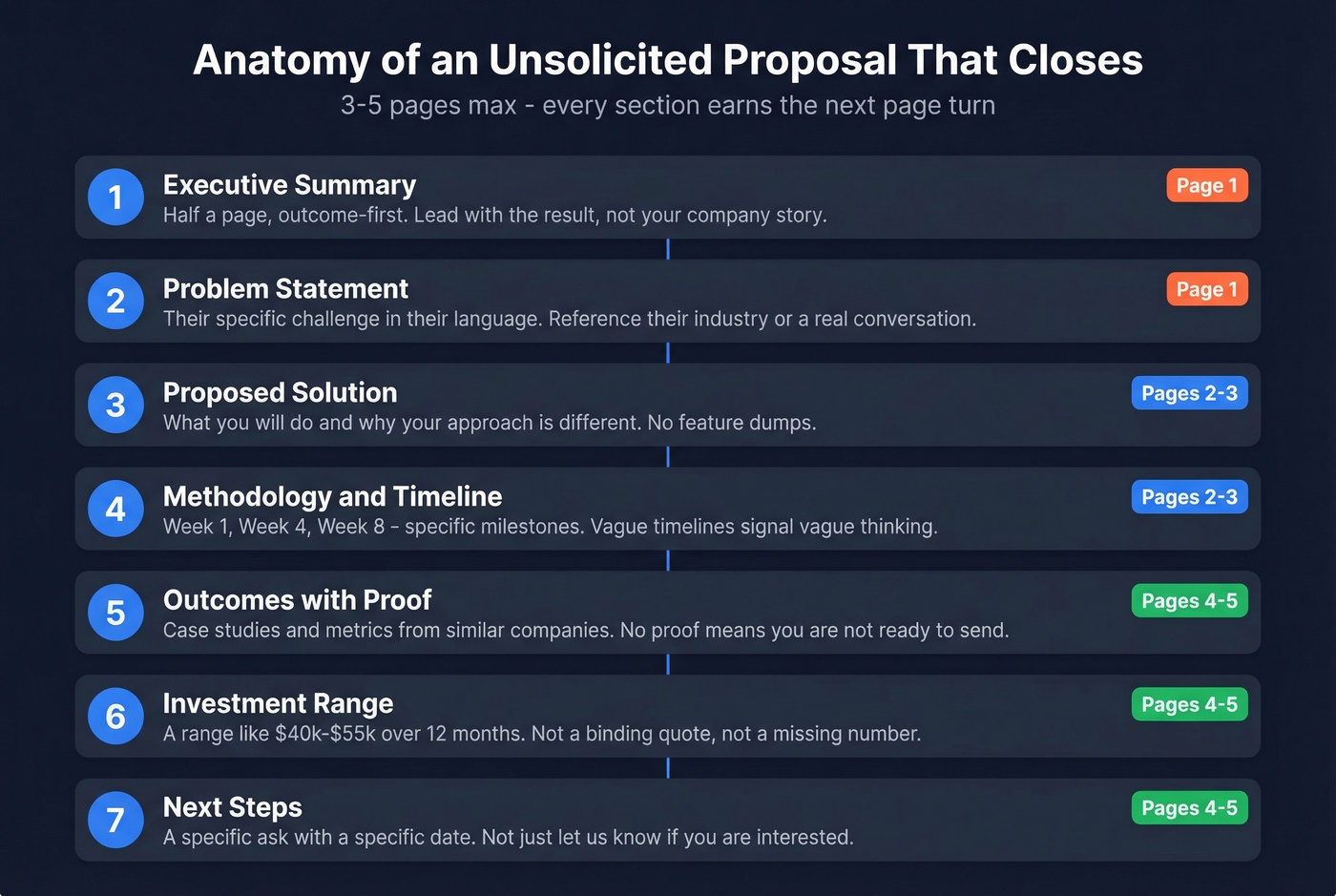
1. Executive summary - half a page, outcome-first. Example: "If [Company] extends the current engagement through Q4 2026, we project a 22% reduction in onboarding costs based on the workflow changes we implemented in Phase 1."
2. Problem statement. Describe their specific challenge in their language. Reference their industry, their competitors, or a conversation you've had. This is where research separates a real proposal from a template.
3. Proposed solution. What you'll do, how it maps to their problem, and why your approach is different. Skip the feature dump.
4. Methodology and timeline. Week 1, Week 4, Week 8 - whatever's realistic. Vague timelines signal vague thinking.
5. Outcomes with proof. Case studies, metrics, references. "We helped [similar company] reduce X by 30% in 90 days" is worth more than any capability slide. If you don't have proof, you're not ready to send the proposal.
6. Investment range. Not a binding quote - frame it as a range like "$40k-$55k over 12 months." Omitting pricing makes the proposal feel incomplete. Overly detailed pricing feels presumptuous without discovery.
7. Next steps. A specific ask. "I'd like 20 minutes on Thursday to walk through the outcomes section and confirm alignment with your Q3 priorities." That beats "Let us know if you're interested" every time.
Mistakes That Kill Proposals
The fastest way to get deleted is leading with your company history. We've seen proposals die within seconds because the first page was all about the vendor, not the buyer.
The second-fastest killer is zero personalization. If you could swap the company name and send the same document to 50 other prospects, it's a brochure, not a proposal. Jargon-heavy language signals you're more interested in sounding smart than solving problems - write at the level your buyer thinks, not your engineers. And vague outcomes like "we'll improve your operations" mean nothing; "we'll reduce onboarding time from 6 weeks to 2 weeks" means everything.
Here's the thing that frustrates us most: 48% of reps never follow up a second time. Sending a proposal and waiting is the most common failure mode in the entire sales cadence. You did the hard work of writing the thing. Don't let it die in someone's inbox.
The Follow-Up Cadence
Only 2% of sales close at the first point of contact, while 75% of online buyers expect 2-4 follow-ups before making a decision. When more than one stakeholder views your proposal, the close rate doubles. Your follow-up strategy isn't just about persistence - it's about getting the document in front of more people inside the account.
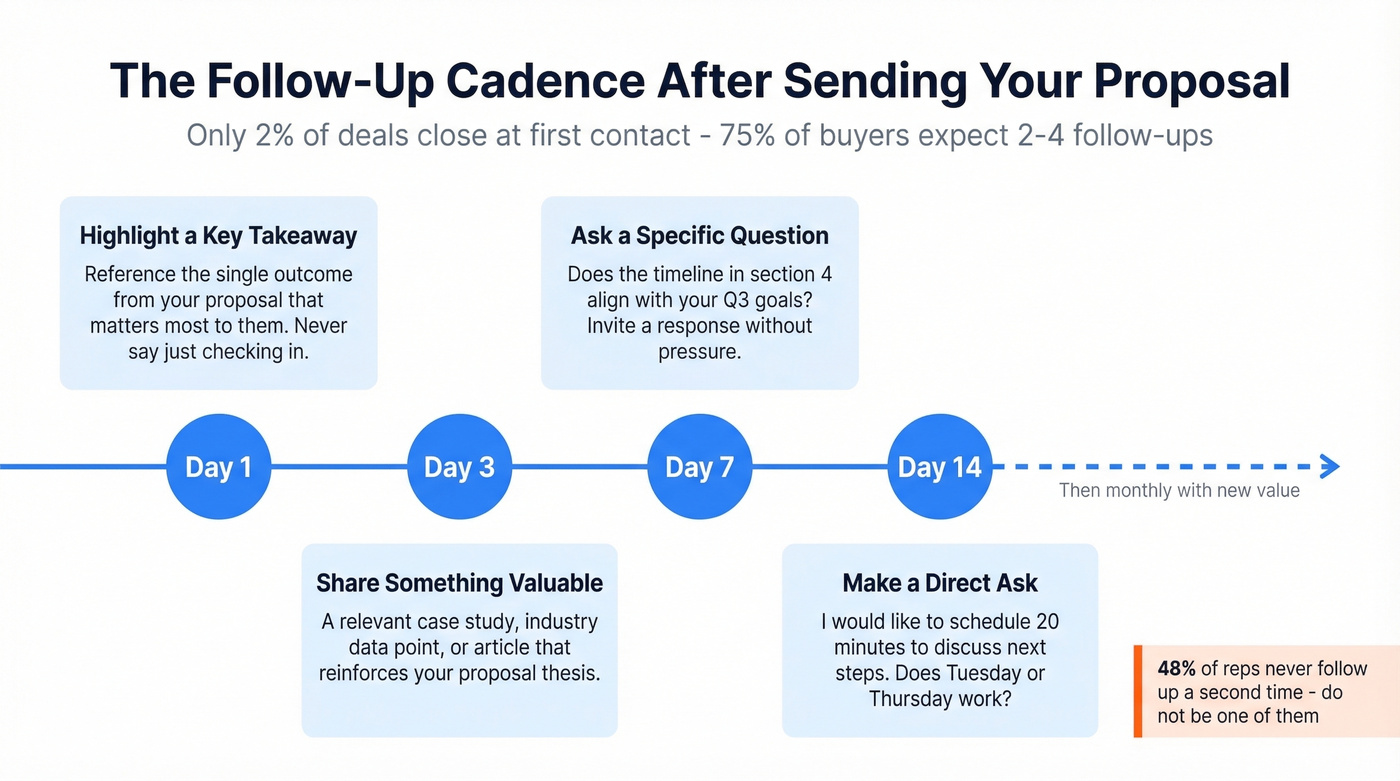
- Day 1: Reference one key takeaway from the proposal. Not "just checking in" - highlight the outcome that matters most to them.
- Day 3: Share something valuable: a relevant case study, an industry data point, or an article that reinforces your proposal's thesis.
- Day 7: Ask a question. "Does the timeline in section 4 align with your Q3 goals?" This invites a response without pressure.
- Day 14: Direct ask. "I'd like to schedule 20 minutes to discuss next steps. Does Tuesday or Thursday work?"
After Day 14, shift to monthly. Always lead with new value - a fresh insight, a relevant win, an industry shift. The Day 1 / 3 / 7 / 14 approach is simple for a reason: every follow-up needs a reason beyond your own pipeline anxiety.
If you want plug-and-play language for those touches, use sales follow-up templates and adapt them to the outcomes in your proposal.
Verify Your Contact Before Sending
None of this matters if your proposal lands in the wrong inbox. A perfectly timed unsolicited sales proposal sent to a dead email address or a generic department alias is just a PDF nobody reads.
If you're prospecting into a new account, tighten your targeting first with an Ideal Customer Profile and a clear view of buying signals.
You read that 48% of reps never follow up a second time. The ones who do need verified direct dials to break through. Prospeo delivers 125M+ verified mobile numbers with a 30% pickup rate - so your Day 3 and Day 7 follow-ups reach a real person, not a voicemail tree.
Your follow-up cadence needs direct dials that actually connect.
FAQ
What's the difference between a solicited and unsolicited proposal?
A solicited proposal responds to a formal buyer request like an RFP or tender, while an unsolicited proposal is one you initiate based on your own research into the prospect's needs. Solicited proposals compete against a defined vendor shortlist; unsolicited ones must create urgency from scratch.
How long should an unsolicited proposal be?
Three to five pages maximum. Every page beyond five reduces the chance someone reads to the end. Focus on outcomes and proof, not company background - most buyers decide within the first two pages whether to keep reading.
Should I include pricing in an unsolicited proposal?
Yes - frame it as an investment range rather than a binding quote. Omitting pricing forces unnecessary back-and-forth and signals you're hiding the number. A range sets expectations without overcommitting before discovery.
How do I find the right person to send it to?
Target the budget holder or project sponsor, not a generic inbox. Use an email finder tool to locate and verify their direct email before sending - reaching the wrong person is the fastest way to waste a good proposal.