

Upselling and Cross-Selling Techniques: Benchmarks, Templates, and the Psychology That Moves the Needle
Most guides on upselling and cross-selling techniques hand you a list of platitudes - "know your customer," "add value," "don't be pushy" - and zero benchmarks. You finish reading and still don't know what a good acceptance rate looks like, what to write in the email, or how to tell whether any of it's working.
This guide is different. Every technique here comes with a number, a template, or both.
The Short Version
You don't need 15 techniques. You need three that match your business model, benchmarks to measure them, and templates to deploy this week.
- Post-purchase one-click offers have the highest acceptance rate of any touchpoint: 3-8%. If you're not running these, start here.
- Automated recommendations outperform manual picks by 2.4x (3.8% vs. 1.56% acceptance). If you're still hand-curating "you might also like" sections, you're leaving money on the table.
- The 10-25% price rule: upsells priced within 10-25% of the original order convert best. Go above 25% and acceptance drops sharply.
- Combined upsell and cross-sell motions increase total revenue by 10-30%.
- The probability of selling to an existing customer is 60-70%, versus 5-20% for a new prospect.
Everything below gives you the playbook to execute - for eCommerce and B2B SaaS.
Upselling vs. Cross-Selling
Upselling encourages a customer to buy a higher-tier version of what they're already purchasing. Cross-selling suggests complementary products alongside the original purchase. One raises the ticket on a single item; the other adds items to the cart.
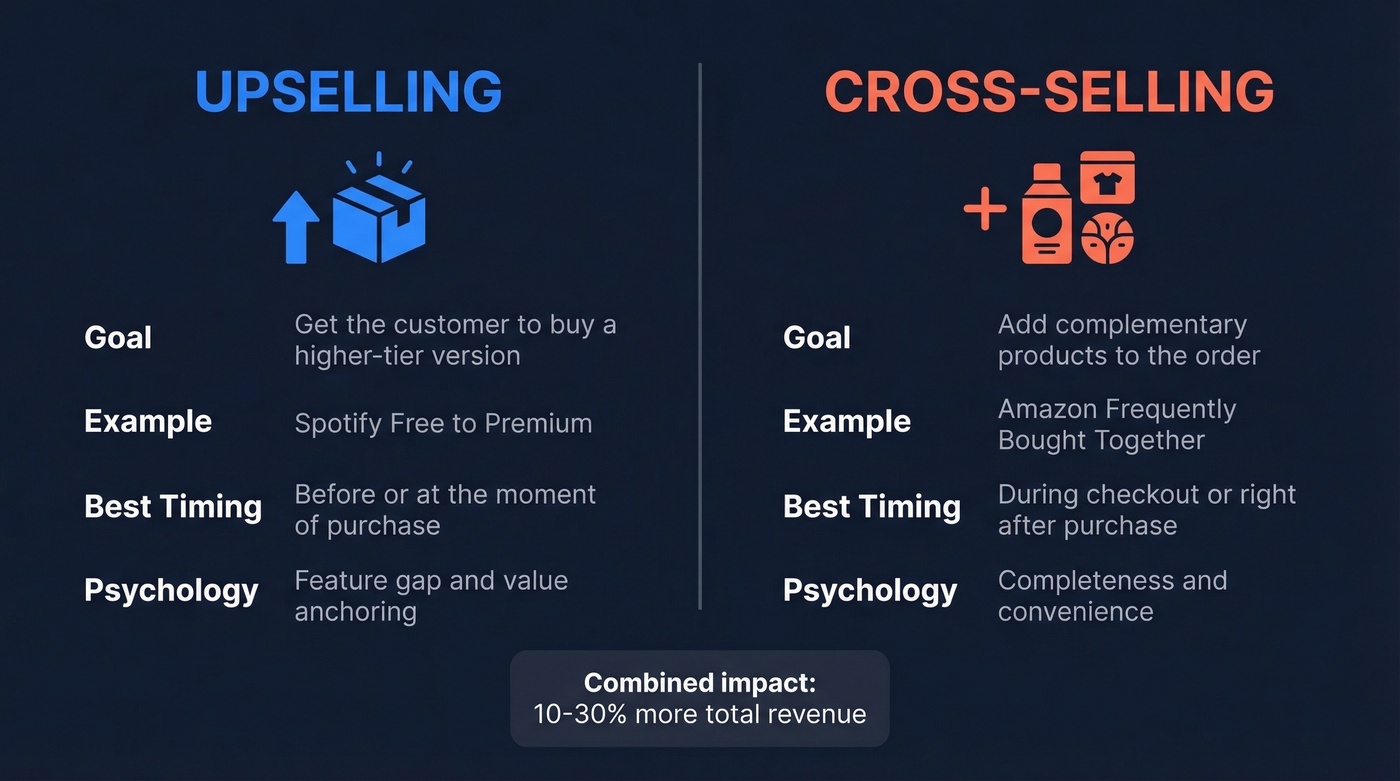
The classic cross-sell is Amazon's "Frequently Bought Together" - you're buying a camera, and they suggest a memory card and a case. The classic upsell is Spotify nudging free users toward Premium with features they can't access. Both increase order value, but they pull different psychological levers, and the distinction matters because the techniques, timing, and copy framing differ for each.
| Upselling | Cross-Selling | |
|---|---|---|
| Goal | Higher-tier purchase | Complementary add-ons |
| Example | Spotify Free to Premium | Amazon "Bought Together" |
| Timing | Before or at purchase | During or after purchase |
| Key lever | Feature/value gap | Completeness/convenience |
Conflating them leads to sloppy execution.
Why Revenue Expansion Matters
Selling to existing customers isn't just easier - it's dramatically more profitable. That 60-70% close rate on existing customers versus 5-20% for new prospects should reshape how you allocate sales resources.
Product recommendations already drive up to 35% of revenue at Amazon, and AI-driven versions can lift AOV by 15-22%. Across industries, the combined effect of upsell and cross-sell motions adds 10-30% to total revenue.
Let's make it concrete. Say you run 1,000 orders per month and implement a post-purchase upsell with a 5% acceptance rate and an $18 average upsell value. That's 50 additional upsells x $18 = $900/month, or $10,800/year in incremental revenue. Most Shopify upsell apps cost $5-$100/month, so the ROI math is almost embarrassingly favorable.
For B2B SaaS, the numbers look different but the principle holds. One documented example showed that implementing usage-based triggers, CSM-led QBRs, and in-app prompts increased NRR to 112% within six months.
12 Techniques That Actually Work
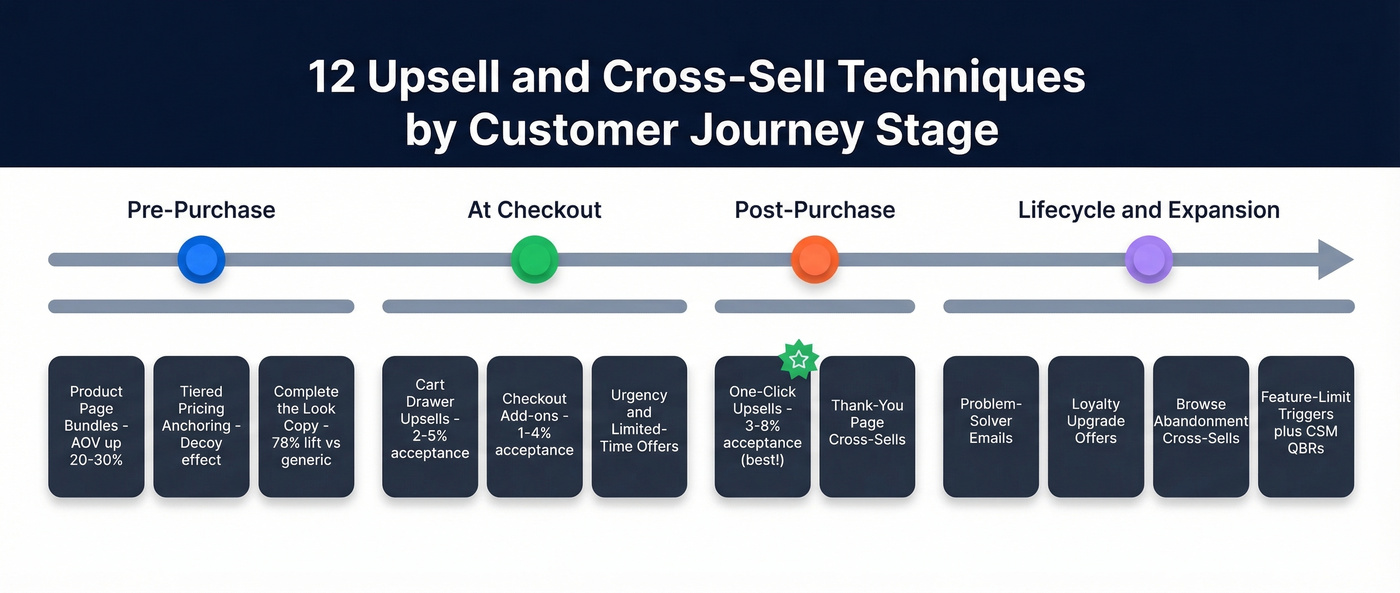
These are organized by when they fire in the customer journey. Pick the ones that match your model - you don't need all twelve.
Pre-Purchase
1. Product page bundles. Bundles can lift AOV by 20-30%. The key is making the bundle feel like a deal, not a trick. Show the individual prices, then the bundle price, and let the math do the selling. "Save 15% when you buy all three" works because the customer can verify the savings instantly.
2. Tiered pricing anchoring. Show three pricing tiers and make the middle one the obvious choice. The expensive tier exists to make the mid-tier feel reasonable - that's the decoy effect in action. SaaS companies like Slack and HubSpot have turned this into an art form. The top tier anchors perceived value; the middle tier captures the majority of conversions.
3. "Complete the look" copy framing. This outperforms generic "You may also like" language because it triggers loss aversion - the customer feels like their purchase is incomplete without the add-on. We've seen A/B tests where "Complete the look" converted at 3.2% versus 1.8% for the generic variant. That's a 78% lift from changing five words.
At Checkout
4. Cart drawer upsells. These convert at 2-5%, with anything above 3% considered strong. The trick is relevance - a phone case when someone's buying a phone, not a random accessory. Keep the upsell under 25% of the cart total and make it one click to add.
5. Checkout add-ons. Slightly lower acceptance at 1-4%, but these catch high-intent buyers at the moment of maximum commitment. Extended warranties, gift wrapping, expedited shipping - all work here. Keep options to two or three. More than that and decision fatigue kills conversion.
6. Urgency and limited-time offers. "Add this in the next 10 minutes and save 20%" works because scarcity is one of the most reliable psychological triggers in commerce. But use it honestly. Fake countdown timers erode trust fast, and savvy customers notice when the "limited time" resets every visit.
Post-Purchase
7. One-click post-purchase upsells. This is the highest-converting touchpoint in the entire journey: 3-8% acceptance, with above 5% considered strong. The optimal window is roughly 30 seconds after checkout, when buying momentum peaks - the credit card is entered, the dopamine is flowing, and a single relevant offer with one-click acceptance capitalizes on that momentum beautifully.
App store ratings reflect how widely adopted this approach has become. Tools like Selleasy (4.9/5 from 2,230+ reviews) and ReConvert (4.8/5 from ~3,000 reviews) dominate the category.
8. Thank-you page cross-sells. Lower pressure than the one-click upsell but still effective. Use this space for complementary products, subscription offers, or referral incentives. It's real estate most stores waste on a generic "your order is confirmed" message.
Email and Lifecycle
9. Proactive problem-solver emails. Instead of "buy more stuff," frame the cross-sell around a problem the customer likely has. "You bought running shoes - here's how to prevent blisters" with a link to moisture-wicking socks. The sell is embedded in genuine helpfulness, and that's what makes it convert.
10. Loyalty-based upgrade offers. Reward your best customers with exclusive upgrade pricing. "You've been with us for 6 months - here's 30% off our premium plan" works because it combines reciprocity with exclusivity in the same breath.
11. Browse-abandonment cross-sells. Someone looked at a product but didn't buy. Instead of the standard abandonment email, suggest a complementary product at a lower price point. It re-engages the customer without the pressure of "you forgot something in your cart."
B2B SaaS Expansion
12. Feature-limit triggers + CSM-led QBR upsells. When a customer hits 80% of their plan limit - API calls, seats, storage - trigger an automated upgrade prompt paired with CSM outreach. Brands like Canva, Buffer, and Instapage use feature-limit triggers combined with loss aversion messaging ("You're about to lose access to...") to drive upgrades.
New feature announcements work similarly. Don't just announce the feature - show the customer how it solves a problem they're already experiencing, based on their usage data. CSM-led QBRs are the human layer on top: a quarterly review where the CSM identifies expansion opportunities based on actual product usage, not guesswork.
To run expansion campaigns at scale, you need verified contact data for the right stakeholders - not just your day-to-day user, but the budget holder and the executive sponsor. Tools like Prospeo can return verified emails with 98% accuracy across 143M+ contacts, so your upsell outreach actually reaches decision-makers instead of bouncing.
If you’re building a repeatable motion, align this with account-based selling so expansion targets the right accounts first.
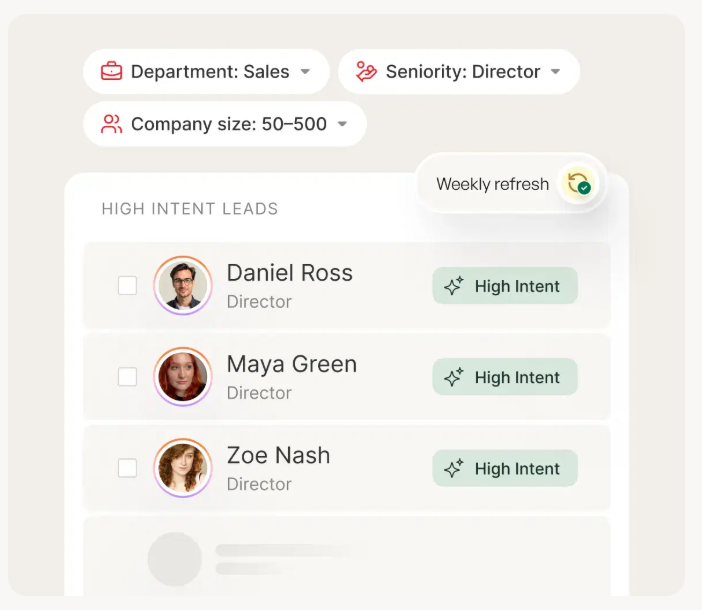

Selling to existing customers converts at 60-70%. But expansion revenue starts with reaching decision-makers at accounts that are ready to buy more. Prospeo tracks 15,000 intent topics so you can spot upsell-ready accounts before your competitors do - then gives you 98% accurate emails and verified direct dials to reach them.
Stop guessing which accounts are ready to expand. Start seeing the signals.
The Psychology Behind It All
Understanding why these techniques work makes you better at deploying them. Five principles drive most upsell and cross-sell conversions.
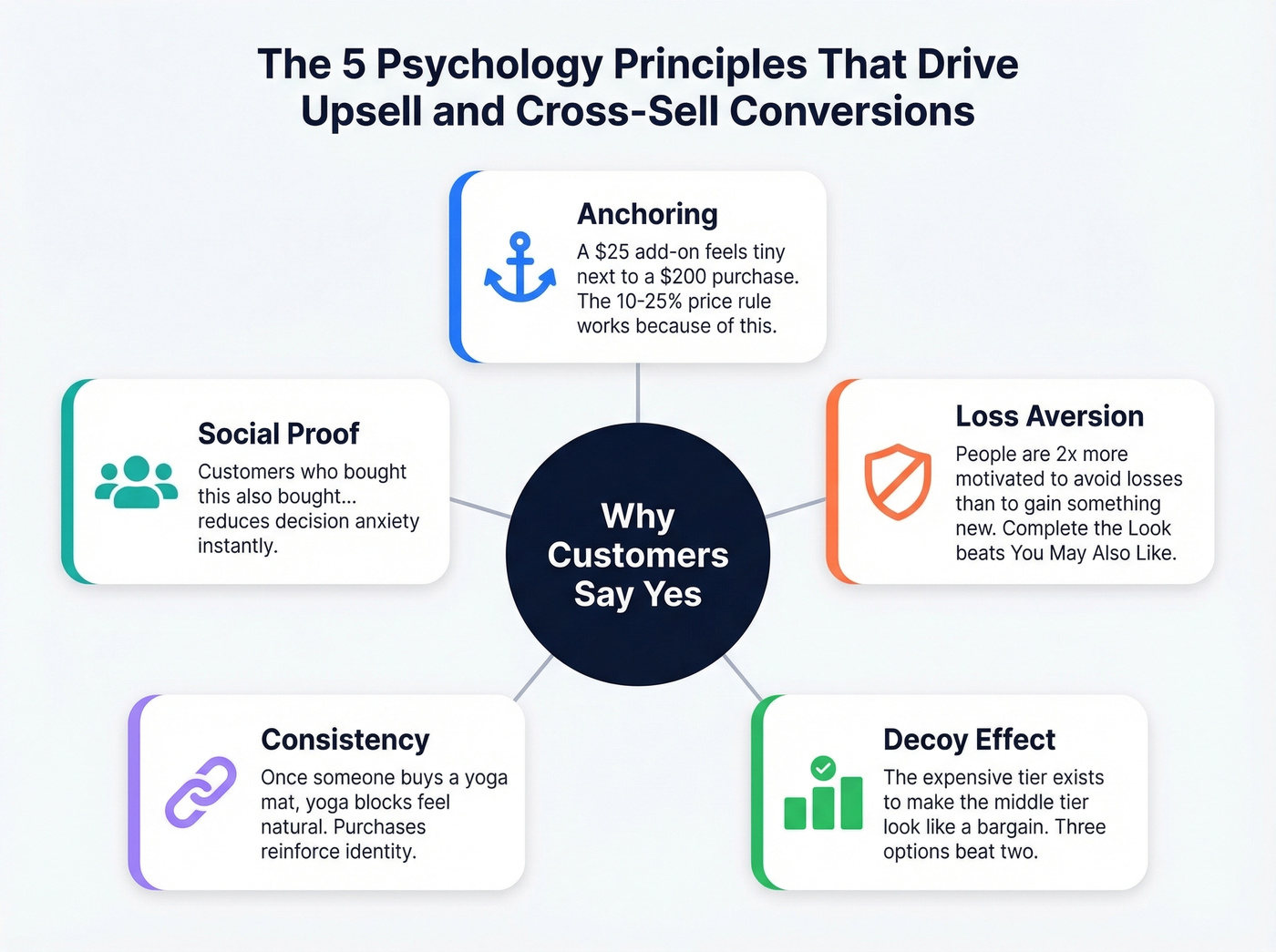
Anchoring is the most powerful. When a customer has a $200 item in their cart, a $25 add-on feels trivial - just 12.5% of what they're already spending. That same $25 product on its own page might feel like a considered purchase. Context changes perception entirely, and this is why the 10-25% price sweet spot exists: upsells in that range feel like rounding errors relative to the main purchase.
Loss aversion explains why "Complete the look" outperforms "You may also like." The first framing implies something is missing; the second is a neutral suggestion. Humans are roughly twice as motivated to avoid losses as they are to acquire gains, and the best copy leans into that gap.
The decoy effect is why three-tier pricing works. The expensive option isn't there to sell - it's there to make the middle option look like a bargain. When Starbucks offers Tall, Grande, and Venti, the Venti makes Grande feel reasonable. Without the Venti, Grande feels expensive.
Consistency principle means that once someone has made a purchase, they're psychologically primed to make related purchases that align with their initial decision. A customer who just bought a yoga mat is more likely to buy yoga blocks - not because they need them right now, but because the purchase is consistent with the identity they've just expressed.
Social proof closes the loop. "Customers who bought this also bought..." reduces decision anxiety. Someone else already validated this combination.
Here's the thing: you don't need to deploy all five principles in every offer. Pick one or two that fit the touchpoint and nail the execution. A post-purchase one-click offer with strong anchoring and loss aversion copy will outperform almost anything. A product page that tries to cram in scarcity, social proof, and a decoy simultaneously just confuses the buyer.
Acceptance Rates - What Good Looks Like
Benchmarks tell you whether your implementation is working or broken.
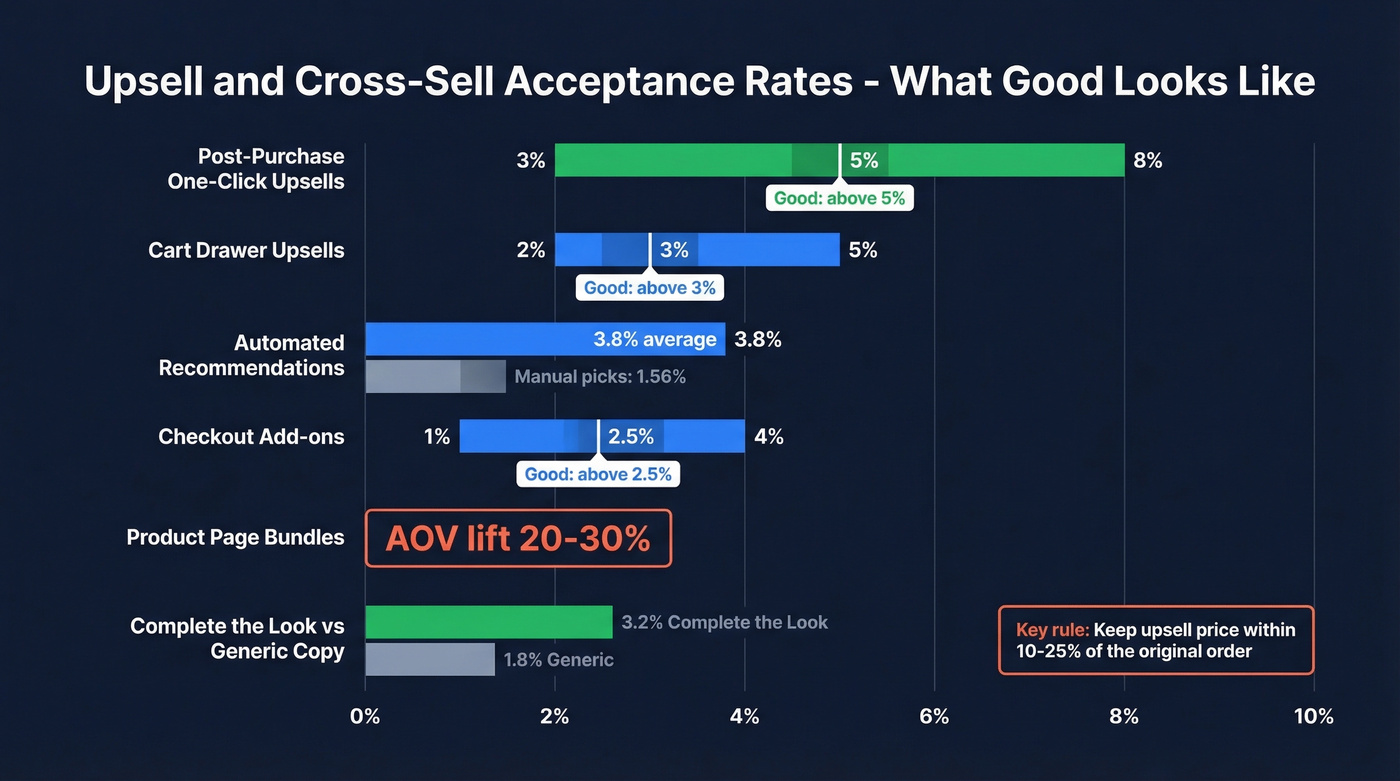
| Touchpoint | Acceptance Range | "Good" Threshold | Notes |
|---|---|---|---|
| Post-purchase one-click | 3-8% | Above 5% | Highest-converting |
| Cart drawer | 2-5% | Above 3% | Relevance is critical |
| Checkout add-ons | 1-4% | Above 2% | Keep options to 2-3 |
| Product page (FBT) | 1-3% | Above 1.5% | Bundles lift this |
The most important benchmark in this table isn't any single touchpoint - it's the gap between automated and manual recommendations. Automated recommendations convert at 3.8% versus 1.56% for manual, a 2.4x difference. If you're still having a merchandiser hand-pick "related products" every week, you're operating at less than half the conversion rate you'd get from even basic algorithmic recommendations.
In our experience, switching from manual to automated recommendations has been the single highest-ROI change a store made all quarter. Not a redesign, not a new ad channel - just letting the algorithm pick the cross-sells.
For B2B SaaS, the benchmarks look different. SaaS upsell conversion rates average around 27.6%, which makes sense given the longer sales cycle and higher deal values involved. If you want a deeper breakdown, compare this to broader sales conversion rate benchmarks.
Upsell and Cross-Sell Email Templates
Templates save time, but only if the email actually lands. Four proven formats below, then a note on deliverability.
Template 1: Proactive Problem-Solver
Subject: Quick tip - conquer [challenge] with your [product name]
Body: "Hey [Name], most customers who buy [product] run into [specific problem] within the first month. Here's a quick fix: [complementary product] solves it in [timeframe]. [Link to product]." Best timing: 7-14 days after purchase, when the customer has had time to encounter the problem.
Template 2: Exclusive Insider Offer
Subject: Just for you - a special offer on [product] add-ons
Body: "You've been a customer for [X months], and we wanted to say thanks. Here's 20% off [upgrade/add-on] - available for the next 48 hours. [Link]." Best timing: Loyalty milestones (3 months, 6 months, 1 year) or after positive support interactions.
Template 3: Post-Purchase Cross-Sell
Subject: Customers who bought [item] also grabbed this
Body: "Your [product] is on its way. While you wait, here's what other [product] buyers paired it with - and why. [2-3 complementary products with one-line descriptions]. [Link]." Best timing: Immediately after purchase confirmation, within the first hour.
Template 4: SaaS Feature-Limit Upgrade
Subject: You've used 85% of your [feature] limit
Body: "Hey [Name], your team has used [X] of [Y] available [seats/API calls/storage]. At this pace, you'll hit the cap by [date]. Upgrading to [plan name] gives you [specific benefit] - and it takes about 30 seconds. [Upgrade link]." Best timing: Customer crosses 75-85% of any plan limit.
These templates only work if the email lands in the inbox. If your bounce rate hits 20%+, it doesn't just waste your campaign - it damages your sender reputation for every future send. Verify your list before launching any upsell sequence. Prospeo's real-time verification catches bad addresses before they tank your deliverability, which matters especially for expansion campaigns where you're reaching new stakeholders at existing accounts. If you need a tighter process, start with an email deliverability guide and track your email bounce rate by campaign.
7 Mistakes That Kill Conversions
1. Breaking the 25% rule. Upsells priced above 25% of the original order feel like a separate purchase decision, not an impulse add. The anchoring effect breaks down and acceptance rates drop sharply.
2. Offering too many options. Cap upsell choices at two or three. Teams think more options means more revenue, but the data consistently shows the opposite - decision fatigue wins.
3. Wrong timing. A premium upgrade offer on the first visit, before the customer has experienced any value, feels tone-deaf. Match the offer to the customer's stage. Post-purchase and post-value-realization are the sweet spots.
4. No A/B testing. If you're not testing offer copy, placement, and pricing, you're guessing. Even small changes - "Complete the look" vs. "You may also like" - can swing acceptance rates by double digits. Run the test.
5. Selling features instead of benefits. "This plan includes 10GB more storage" is a feature. "Never worry about running out of space during a client presentation" is a benefit. Customers buy outcomes, not specifications.
6. Ignoring the data. If you can't measure cross-sell revenue separately from new sales, you can't optimize it. Tag upsell and cross-sell revenue in your CRM from day one. We've seen teams run expansion motions for six months without any way to attribute the revenue. That's flying blind. (If you’re formalizing this, a simple churn analysis model plus expansion tracking usually reveals the real story fast.)
7. Being too aggressive. Three upsell popups before checkout is a great way to lose the entire sale. The customer came to buy one thing. Respect that intent. One well-timed, relevant offer beats three desperate ones every time.
Skip the aggressive multi-popup approach entirely if your average order value is under $30 - the friction cost outweighs the potential upsell revenue at that price point.
How to Measure Success
Most teams measure expansion revenue poorly - or not at all. Here's a framework organized by what you're actually trying to learn.
| Category | KPIs | What It Tells You |
|---|---|---|
| Revenue | Cross-sell revenue, ARPA, CLV | Is this making money? |
| Sales Performance | Conversion rate, opp size | Is the team executing? |
| Customer Success | CSAT, NPS, churn rate | Are customers happy? |
| Operational | Qualified opps, product mix | Is the pipeline healthy? |
For eCommerce, the core metrics are straightforward: AOV lift, upsell acceptance rate by touchpoint, and incremental revenue attributed to recommendations. Most Shopify analytics dashboards surface these natively.
For B2B SaaS, Net Revenue Retention (NRR) is the north star - it captures expansion, contraction, and churn in a single number. The 112% NRR example mentioned earlier is a realistic target for mid-market SaaS with a deliberate expansion motion. Expansion MRR isolates the recurring revenue from upgrades and add-ons, separate from new customer acquisition. Track this monthly and compare it to your churn MRR - if expansion exceeds churn, your existing customer base is growing even without new logos.
The biggest measurement mistake isn't picking the wrong KPIs. It's failing to tag upsell and cross-sell revenue separately in your CRM. Without that tagging, every metric above is impossible to calculate. Set up the attribution before you launch the campaign.
If you’re operationalizing this across teams, it helps to standardize sales operations metrics so expansion reporting doesn’t get messy.
Your cross-sell and upsell campaigns are only as good as the contact data behind them. One bad email tanks your domain reputation and kills the entire motion. Prospeo's 5-step verification and 7-day data refresh keep bounce rates under 4% - so every expansion email actually lands.
Protect your sender reputation while scaling revenue expansion campaigns.
FAQ
What's the difference between upselling and cross-selling?
Upselling encourages a higher-tier version of what the customer is already buying - like upgrading from a basic to a premium plan. Cross-selling suggests complementary products alongside the original purchase, like a phone case with a new phone. Both increase order value through different mechanisms.
What's a good upsell acceptance rate?
Post-purchase one-click offers convert at 3-8%, with above 5% considered strong. Cart drawer offers hit 2-5%, and checkout add-ons land at 1-4%. If you're consistently above the midpoint of each range, your offer-market fit is working.
How much should an upsell cost relative to the original purchase?
Keep upsells within 10-25% of the original order value. Anchoring makes the add-on feel trivial at this range - a $20 accessory on a $150 purchase barely registers. Go above 25% and you trigger a separate buying decision, which tanks acceptance rates.
Do automated recommendations outperform manual ones?
Automated recommendations convert at 3.8% versus 1.56% for manual selections - a 2.4x difference. AI-driven engines also lift AOV by 15-22%. The algorithm sees patterns across thousands of transactions that no merchandiser can replicate manually.
How do you find the right stakeholders for B2B upsell campaigns?
You need a verified data platform to identify budget holders and executive sponsors at existing accounts - not just your day-to-day user. Prospeo's 98% email accuracy across 143M+ verified contacts ensures expansion outreach reaches decision-makers instead of bouncing. Tools like Clearbit and ZoomInfo also offer enrichment, though accuracy and pricing vary.