

Upselling Tactics: Benchmarks, Templates, and a Plan That Works
You added an upsell popup to your checkout flow and revenue didn't move - but support tickets went up. Sound familiar? Most advice on upselling tactics gives you a numbered list with zero data on what actually converts, so we built this around benchmarks, templates, and a plan you can run this quarter.
The Short Version
- Add an order bump at checkout. They convert at 37.8% - higher than any other mechanism.
- Structure pricing as good-better-best with a decoy. The decoy effect shifts buyers toward your target tier without a hard sell.
- Send a post-purchase upsell email 1-7 days after the initial buy. Post-purchase upsells average 14.6%, and email sequence upsells average 11.3% - lower than checkout mechanisms, but nearly free to run.
Here's the thing: fewer, better-targeted offers beat a wall of options every time. Most teams would double their upsell revenue by cutting half their offers and nailing the timing on the rest.
Upsell Benchmarks - What Good Looks Like
A 2026 Focus Digital study analyzing 1,847 digital businesses in North America gives us the clearest benchmark set available right now.
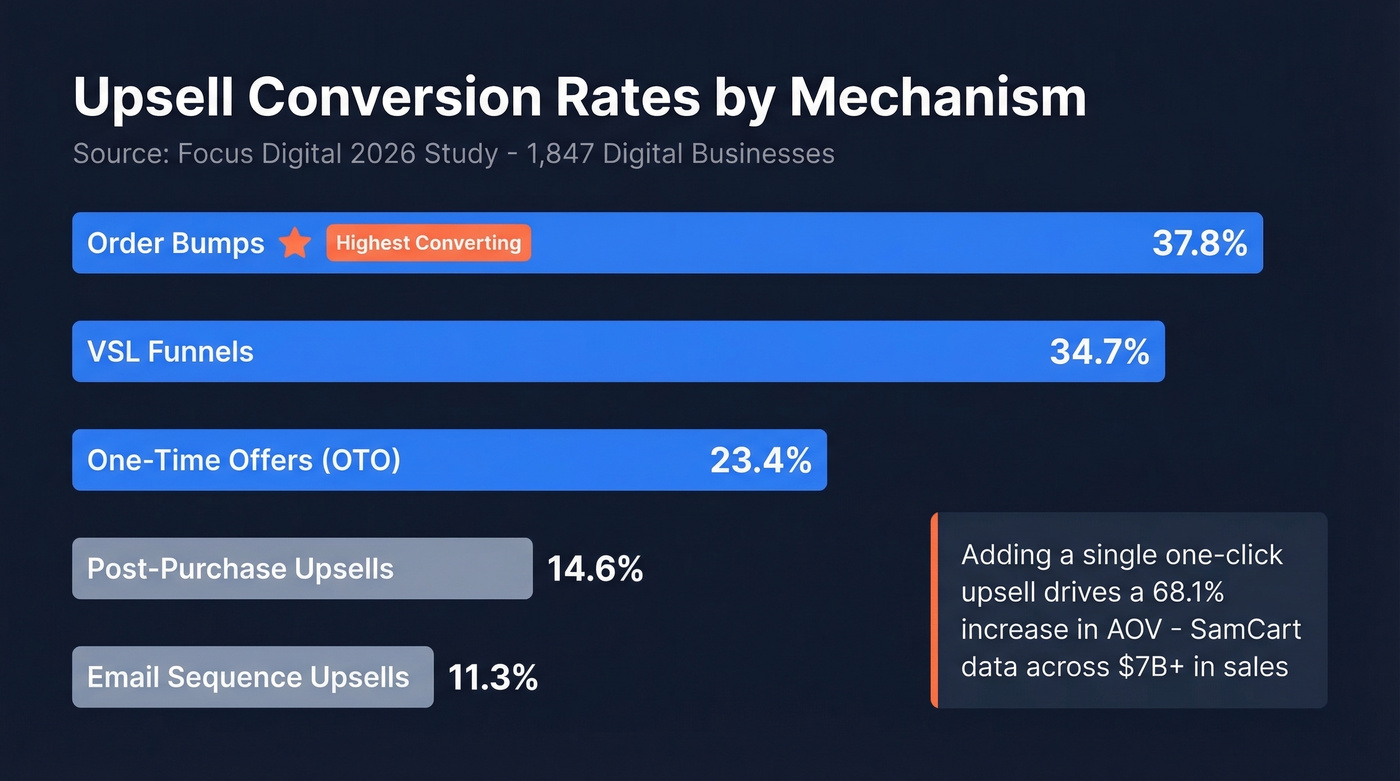
By industry (average / top quartile):
| Industry | Avg Rate | Top Quartile |
|---|---|---|
| SaaS & Software | 27.6% | 42.3% |
| E-commerce (physical) | 18.7% | 29.4% |
| Info products | 31.2% | 47.8% |
By mechanism:
| Mechanism | Conversion Rate |
|---|---|
| Order bumps | 37.8% |
| VSL funnels | 34.7% |
| One-time offers (OTO) | 23.4% |
| Post-purchase upsells | 14.6% |
| Email sequence upsells | 11.3% |
Desktop converts at 28.9% versus mobile web at 18.7% - a gap that should alarm anyone with a mobile-heavy audience. Mobile apps hit 31.4%, beating both, which tells you the problem isn't the screen size but the browser checkout experience. The pricing sweet spot sits at $51-$100, where upsells pull a 16.2% conversion rate and a 31.4% revenue lift.
SamCart reports that adding a single one-click upsell drives a 68.1% increase in AOV across $7B+ in processed sales. For scale context, one financial services company generated $50M in annual revenue from cross-sell and upsell initiatives paired with call analytics and agent scorecards. These aren't marginal improvements - they're different business models.
Strategies Grouped by Moment
Before Checkout: Pricing and Tiering
Use this if you sell tiered products or subscriptions. Skip this if you only have a single SKU with no logical upgrade path.
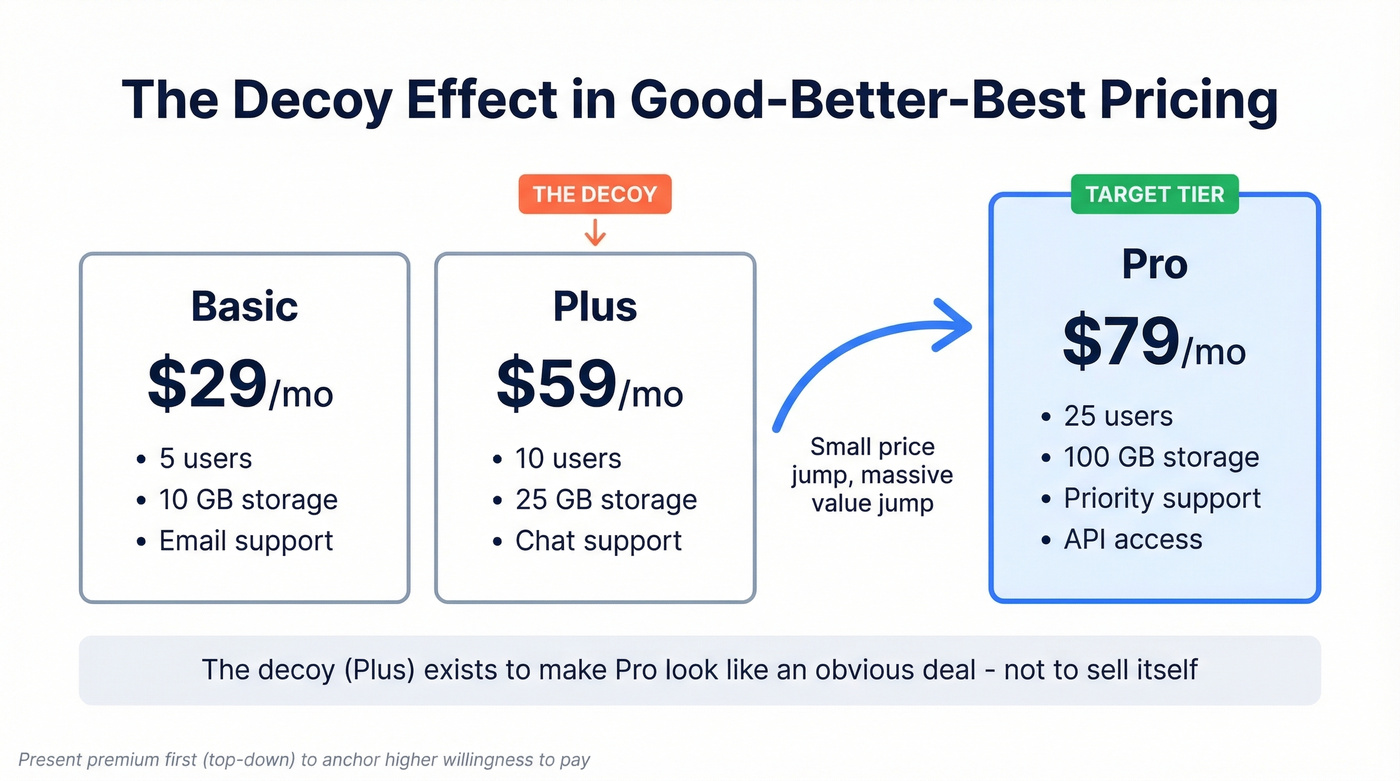
Good-better-best pricing works because of the decoy effect. Adding a strategically inferior option pushes buyers toward the tier you actually want them on. The classic popcorn pricing example still applies: a "bad value" medium makes the large look like a steal. Anchoring matters too - presenting your premium tier first, before the buyer sees cheaper options, increases willingness to pay. Structure your pricing page top-down, not bottom-up.
At Checkout: Highest Leverage
Use this if you have a digital checkout flow you control. Skip this if you sell through marketplaces where you can't modify the purchase experience.
Order bumps are the single highest-converting upsell mechanism at 37.8%. They work because the buyer has already committed - you're adding a checkbox, not asking for a new decision. One-click post-purchase offers are a major AOV driver: SamCart's data shows 58% of all revenue on their platform comes from upsell transactions, which is a staggering number when you think about what that means for unit economics.
Cap options at 2-3. When you force focus, the best offer gets more attention and conversion usually climbs. Keep the upsell price within roughly 25% of the original order - a $12 add-on on a $50 purchase feels obvious, a $200 add-on feels aggressive.
After Purchase: Email and Lifecycle
Use this if you have an email list and any repeat purchase potential.
Post-purchase emails sent 1-7 days after the initial buy are the standard window. For B2B contracts, start the renewal conversation weeks earlier, not days. One timing trigger that's underused: send an upsell offer 24-48 hours after resolving a support ticket. Research shows 56% of buyers say successful customer service influences loyalty more than any other factor - so the trust window right after a support interaction is one of your best email moments.
If you're building lifecycle sequences, it helps to treat them like a customer nurturing system, not a one-off campaign.
SaaS Expansion Upsells
Healthy SaaS businesses target 110-130% net revenue retention, and expansion revenue is how they get there. Build upsell ladders - a clear path from free to starter to pro to enterprise - and trigger in-app modals when users hit capacity limits. Frame every expansion offer as a helpful next step, not a pushy pitch.
Expansion offers fail when your targeting data is stale. If you're emailing a champion who left the company three months ago, you've wasted the touchpoint and possibly annoyed someone who can't help you. Tools like Prospeo, which refresh contact records every 7 days, keep B2B expansion segments clean so upgrade offers reach the right decision-maker at the right account.
This is also where intent data can outperform generic “time since purchase” triggers.

Expansion upsells fail when your champion left the company months ago. Prospeo refreshes 300M+ contact records every 7 days - so your upgrade offers reach the actual decision-maker, not a dead inbox. 98% email accuracy means your upsell sequences land.
Stop wasting your best upsell offers on stale contacts.
Mistakes That Kill Conversion
The consensus across r/sales and r/ecommerce threads is remarkably consistent - teams keep making the same errors:
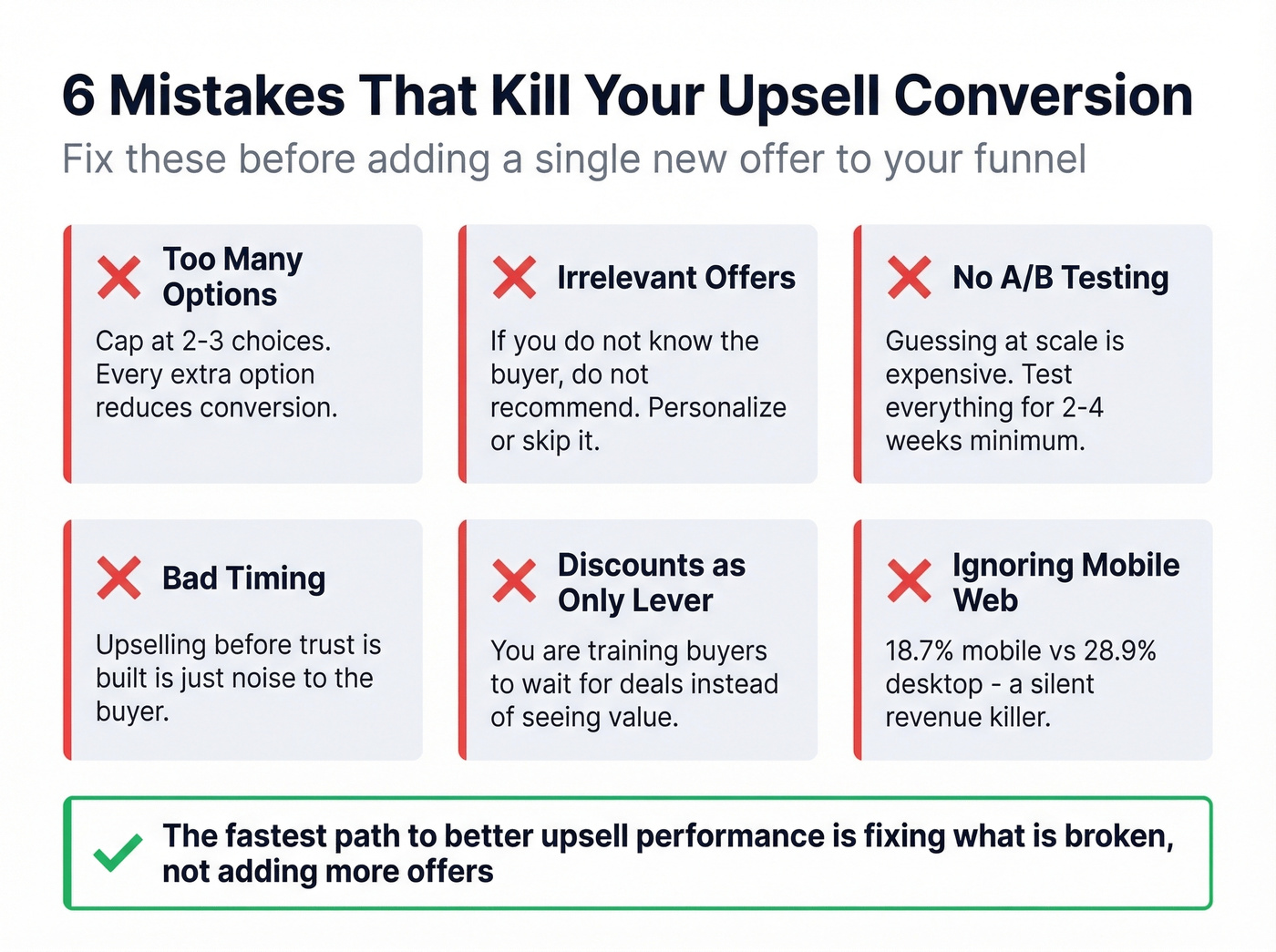
- Too many options. Cap at 2-3. Every additional choice reduces conversion.
- Irrelevant offers. Recommending a product the buyer has no use for signals you don't know them. Personalize or don't bother.
- No A/B testing. If you're not testing, you're guessing - and guessing at scale is expensive. (If you want a broader diagnostic, start with common sales process mistakes.)
- Bad timing. An upsell before the buyer trusts you is just noise.
- Discounts as your only lever. Discounting trains buyers to wait for deals instead of seeing value. It's the fastest way to erode your pricing power.
- Ignoring mobile web. That 18.7% vs 28.9% desktop gap is a silent killer. If your checkout is clunky on mobile, no upselling tactic will save it.
Fixing these six issues is the fastest way to improve performance without adding a single new offer to your funnel.
How to Measure Upsell Performance
Establish your baseline AOV before you add a single offer. You can't measure lift if you don't know where you started.
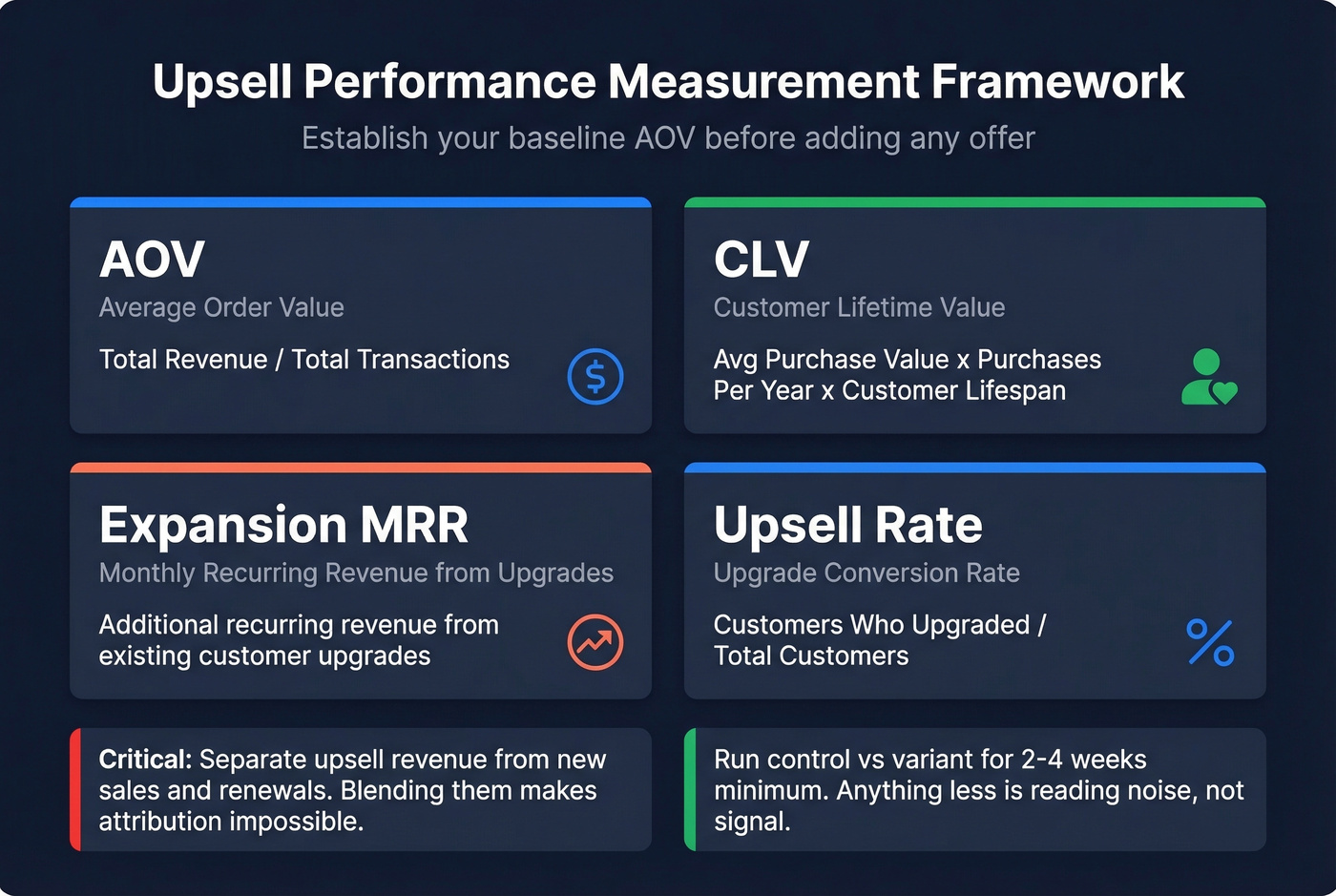
Track these KPIs: AOV (total revenue / transactions), CLV (average purchase value x purchases per year x customer lifespan), Expansion MRR (additional recurring revenue from upgrades), and upsell rate (customers who upgraded / total customers). Separate upsell revenue from new sales and renewals - blending them makes attribution impossible.
If you need a tighter definition of what counts as a KPI, see what does KPI stand for.
Run control vs. variant for 2-4 weeks minimum. We've seen teams celebrate a "winning" upsell after three days of data, only to watch it regress to the mean by week two. If you don't run a holdout group, you're reading noise, not signal.
Email Templates for Upselling
Post-Purchase (send 1-3 days after buy)
Subject: Unlock the full [Product] experience
Hi [First Name], most customers at your stage get more value from [Premium Feature]. One-click upgrade: [Link].
Renewal Window (send 7-14 days before renewal)
Subject: Your [Product] renewal is coming up
Hi [First Name], before your renewal on [Date], check out [Higher Tier] - it includes [Key Benefit]. Upgrade here: [Link].
Feature Launch (send day of launch)
Subject: New: [Feature Name]
Hi [First Name], we just shipped [Feature Name]. It does [One-Sentence Benefit]. Available on [Tier] plans - upgrade to try it: [Link].
Keep subject lines under 50 characters. Keep bodies under 100 words. Let's be honest - nobody reads a 400-word upsell email. Get in, make the case, get out.
If you want more variations beyond upsells, pull from these sales follow-up templates and adapt the CTA.
That 110-130% net revenue retention target depends on reaching the right buyer at the right time. Prospeo's intent data tracks 15,000 topics so you can trigger upsell campaigns when accounts are actively researching upgrades - not when your calendar says it's time.
Send upsell offers when buyers are ready, not when you're guessing.
FAQ
What's a good upsell conversion rate?
SaaS averages 27.6%, e-commerce 18.7%, and info products 31.2%. Top-quartile performers hit 42-48%. If you're below your industry average, start with order bumps - they convert at 37.8% with minimal setup.
Which upsell mechanism converts best?
Order bumps at 37.8% are the highest-converting mechanism overall. For pure AOV lift, one-click post-purchase offers win - SamCart data shows a 68.1% AOV increase from a single offer added to checkout.
How do I personalize B2B upsells at scale?
Segment by product usage, current tier, and lifecycle stage, then keep contact data current. Stale data is the number one reason expansion emails bounce or land with the wrong person. A weekly data refresh cycle and enrichment that returns 50+ data points per contact will keep your segments sharp enough that upgrade offers actually reach the right stakeholder.