

Customer Nurturing: Frameworks, Sequences, and Benchmarks for 2026
Most nurture programs are where leads go to die. That's not our phrasing - it's how practitioners on r/marketing describe their own workflows: a "graveyard" of generic sequences that never convert.
The bigger mistake is what happens after the deal closes. Most teams just stop. Customer nurturing is where retention, expansion, and referrals compound, yet the majority of brands still don't do it. They spend months warming up a prospect, close the deal, then hand the customer a drip sequence written in 2019 and wonder why churn is climbing.
The Short Version
- Post-sale isn't lead nurturing. After the signature is where revenue compounds: retention, upsells, advocacy.
- Segment contacts into Cold / Warm / Hot and map content to each stage. One sequence for everyone is why your program fails.
- Follow the 3:1 give-to-get ratio. Three value touches for every ask. No exceptions.
- Verify your contact data before launching any sequence. B2B contact data decays about 30% annually. Bad data kills deliverability before your copy ever gets a chance.
- Measure CTR, not just open rates. Well-executed post-sale nurturing hits 25-35% CTR. If you're sitting at 2-5%, you're running a lead nurture program and calling it something else.
Customer Nurturing vs. Lead Nurturing
These terms get used interchangeably, and that's a mistake. Forrester defines customer relationship nurturing as post-sale communications that start after the deal closes and continue for the life of the account - including win-back after churn. Lead nurturing is everything before the signature: turning MQLs into SQLs and moving prospects toward a buying decision.
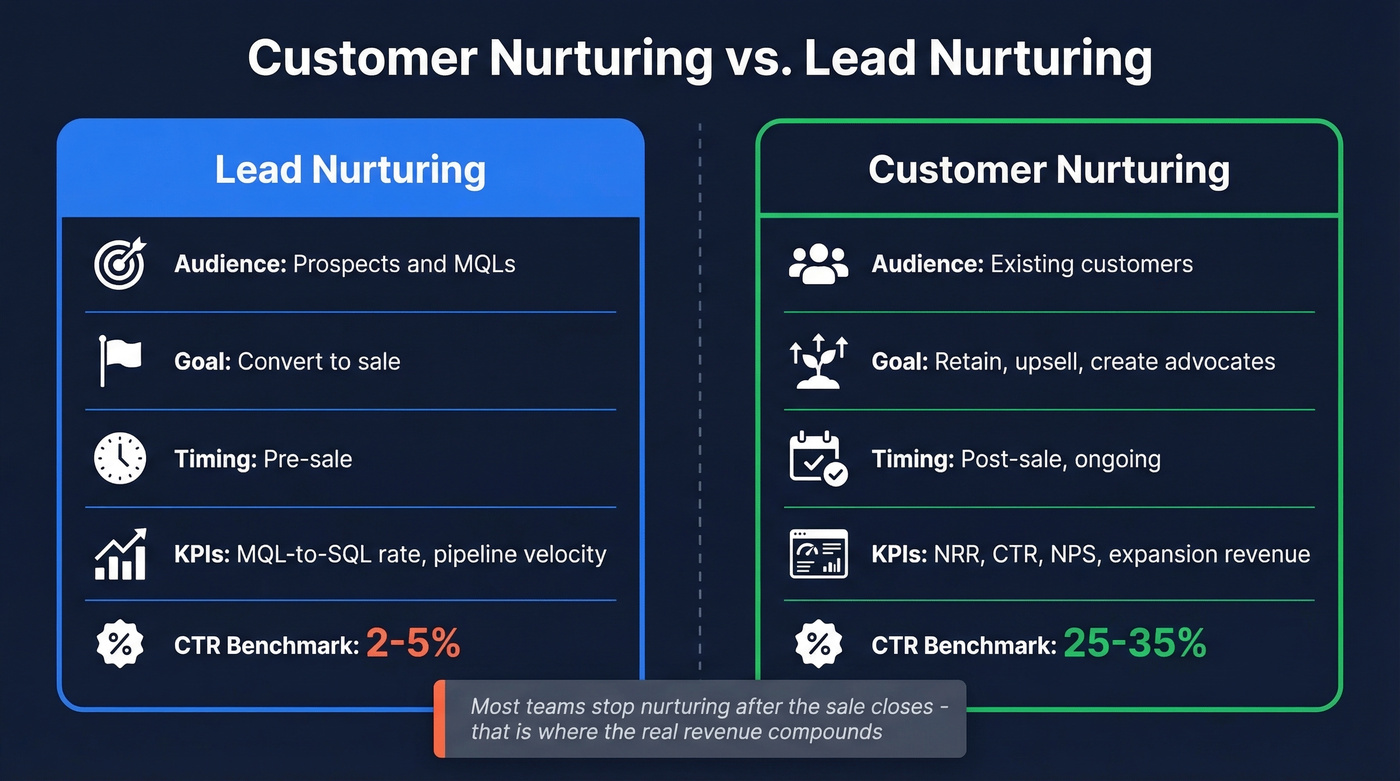
The goals are different. Lead nurturing optimizes for conversion. A post-sale nurture strategy optimizes for lifetime value: retention, expansion revenue, and turning customers into referral engines.
| Lead Nurturing | Customer Nurturing | |
|---|---|---|
| Audience | Prospects, MQLs | Existing customers |
| Goal | Convert to sale | Retain, upsell, advocate |
| Timing | Pre-sale | Post-sale |
| KPIs | MQL-to-SQL rate, pipeline | NRR, CTR, NPS, expansion |
| CTR benchmark | 2-5% | 25-35% (Forrester) |
Most "nurture programs" still feel like a one-and-done onboarding drip instead of an actual growth engine.
Why It Matters - The Economics
CAC has increased 60% over five years, and bottom-quartile SaaS companies now spend $2.82 to acquire $1 of new ARR. Retention is cheaper, faster, and more predictable than constantly refilling the top of the funnel. (If you want to pressure-test your acquisition math, start with CAC.)
Nurturing existing accounts also changes deal economics, not just churn. Nurtured leads' purchases are 47% larger on average. That's the compounding effect you're trying to build.
The latest retention benchmarks from Focus Digital's analysis (Oct 2024 through Dec 2025) look like this:
| Segment | Avg. Retention | Median Lifetime |
|---|---|---|
| B2B SaaS (subscription) | 90% | 5.2 years |
| IT & Software (sector avg.) | 77% | - |
| Contractual services | 86% | 4.1 years |
| B2C subscription | 72% | 2.8 years |
| Retail (sector avg.) | 63% | - |
| E-commerce (transactional) | 38% | 18 months |
Subscription-model benchmarks reflect business model performance; sector averages like IT & Software and Retail include mixed models, so they aren't meant to line up neatly with the subscription rows.
Retention + CAC by Company Size
This is where the story gets practical. Company size changes both the cost to acquire and the likelihood they stick around:
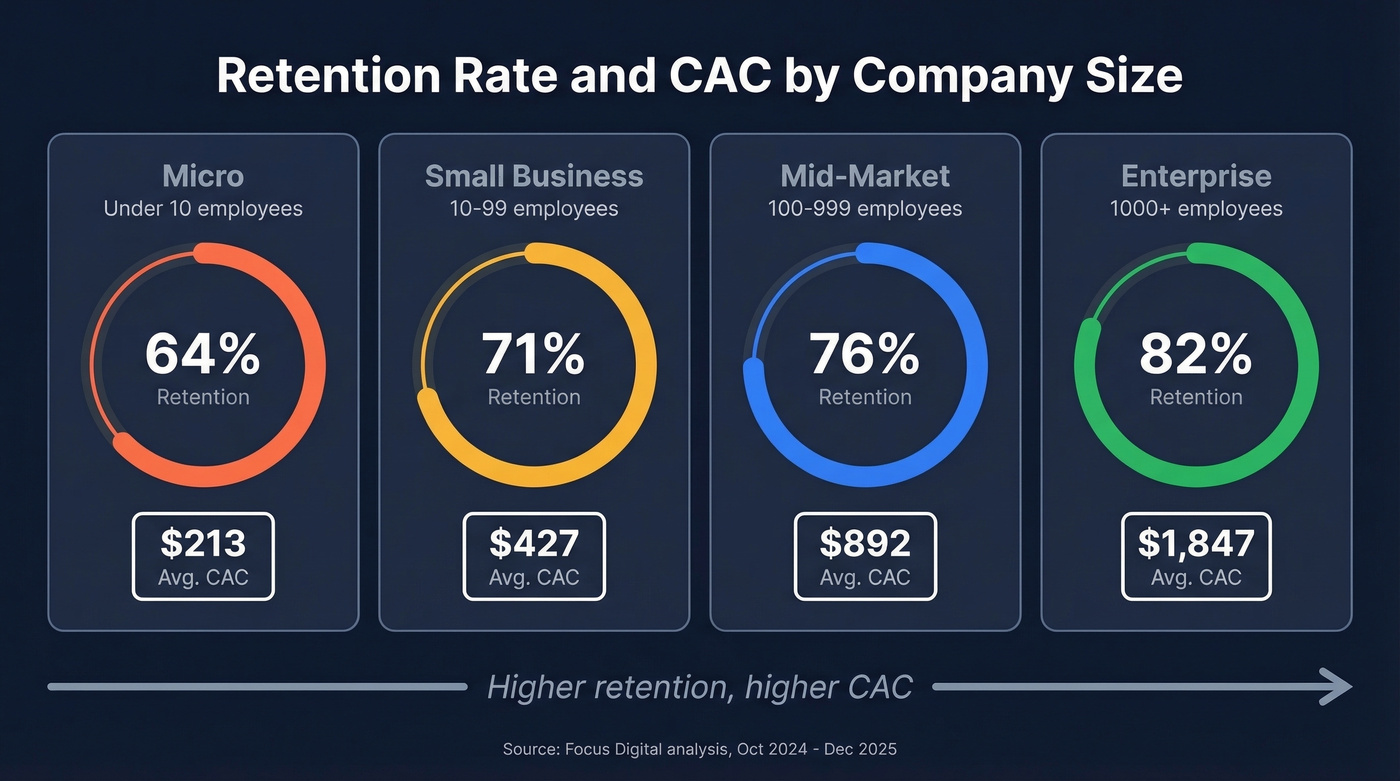
| Company size | Avg. retention | Avg. CAC |
|---|---|---|
| Micro (<10 employees) | 64% | $213 |
| Small business (10-99) | 71% | $427 |
| Mid-market (100-999) | 76% | $892 |
| Enterprise (1000+) | 82% | $1,847 |
If you sell to micro and small business, you don't win by "more pipeline." You win by shortening time-to-value and running tight, role-based client nurturing that keeps accounts active. For enterprise, the play is preventing silent churn and making expansion the default path.
Here's the thing: if your average deal size is under $10k, you probably don't need a "customer marketing platform." You need two things done ruthlessly well - onboarding that drives adoption, and a simple expansion motion triggered by usage. (If you're building the expansion motion, it helps to align on upsell vs cross-sell first.)
How to Build a Customer Nurturing System
Segment Your Contacts
Not every customer needs the same thing. The simplest model that works is still Cold / Warm / Hot, but you have to define it with behavior, not vibes. And personalization isn't optional: 71% of customers expect personalized experiences, and they punish generic messaging with silence. (If you want a practical framework for this, use intent based segmentation.)
Cold - no recent engagement, lapsed usage, hasn't opened in 60+ days. Send re-engagement value: trend notes, short educational clips, "here's what changed" updates. The goal is to stay on their radar without being annoying.
Warm - active or semi-active, stable usage, no expansion signals. Send education that broadens use cases: playbooks, role-based templates, customer stories. This is where most of your base lives, and it's the segment teams neglect most because there's no urgency attached to it.
Hot - clear buying signals: hitting limits, adding seats, asking about features they don't have. Send upgrade paths: ROI calculators, plan comparisons, "here's the next step" offers. (If you need a tighter definition of signals, see identifying buying signals.)
Skip this if you have fewer than 50 customers. At that scale, you'll get a higher ROI by talking to people directly and logging patterns you can automate later.
Map Post-Sale Campaign Types
Most teams run onboarding and call it a day. A real post-sale nurture system has multiple campaign types that fire at different moments:
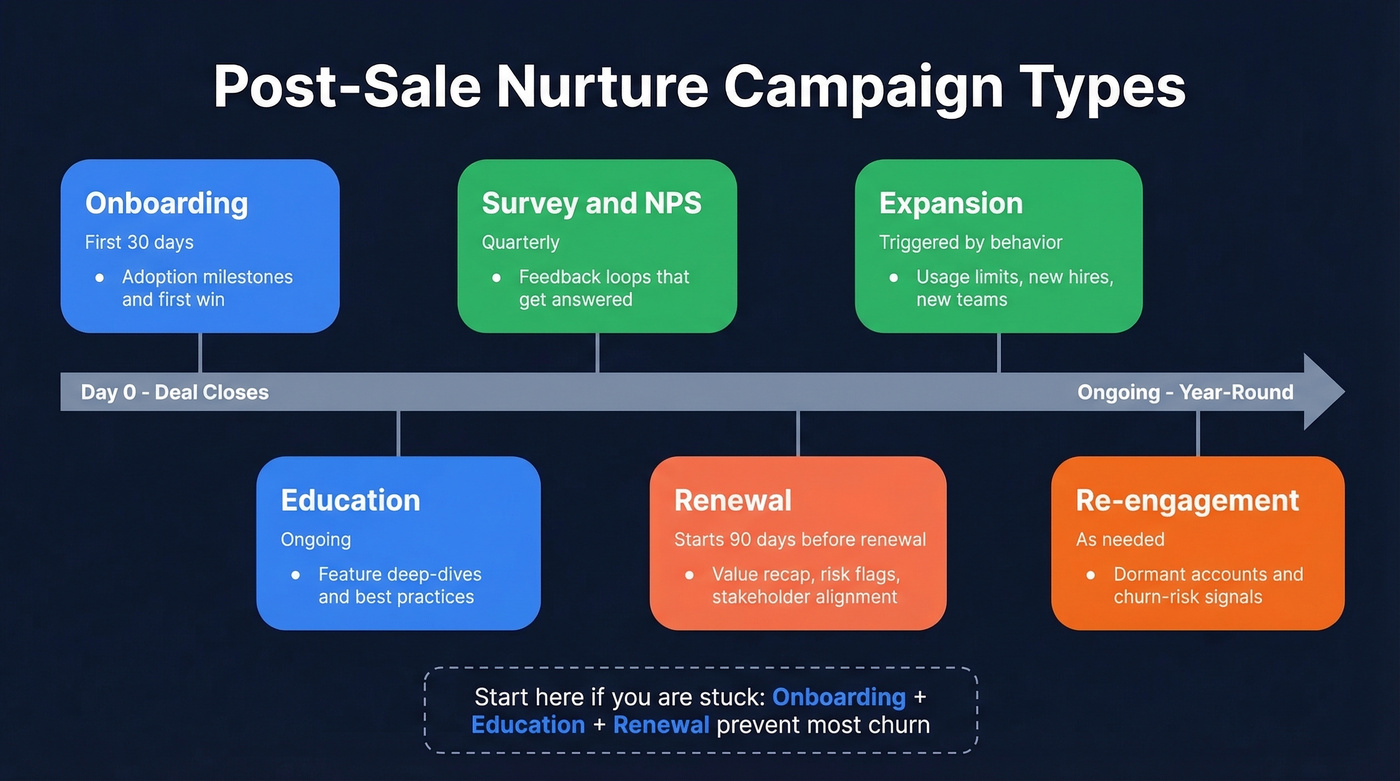
- Onboarding (first 30 days): adoption milestones and "first win"
- Education (ongoing): feature deep-dives and best practices
- Renewal (starts ~90 days out): value recap, risk flags, stakeholder alignment
- Expansion (triggered): usage limits, new hires, new teams, new needs
- Survey/NPS (quarterly): feedback loops that actually get answered
- Re-engagement (as needed): dormant accounts and churn-risk signals
If you're stuck, start with onboarding + education + renewal. Those three alone prevent most churn. (To quantify what “prevent churn” means in your model, start with churn analysis.)
Go Multichannel Without Overcomplicating It
Only 6% of marketers still rely on one or two channels. Everyone else diversified because inbox-only nurturing is fragile - a single deliverability dip can tank your entire program overnight. A well-designed client nurturing campaign uses multiple touchpoints so no single channel failure breaks the relationship.
A simple, high-leverage mix:
- Email for structured education and product updates
- In-app messages for "do this now" prompts
- Retargeting for light reinforcement
- A human touch from CS or sales when engagement spikes or usage drops
Video is the cheat code here. A 30-60 second clip inside a nurture flow routinely outperforms a 600-word "newsletter" because it feels like help, not marketing. (If you want a proven format, borrow from Loom video cold email and adapt it post-sale.)
Fix Your Data First
None of this matters if your emails don't land. B2B contact data decays about 30% annually as people change roles, companies rebrand, and domains shift. A bounce-heavy send damages your domain reputation and drags down deliverability for everyone, including your best customers. We've seen teams with great copy and smart segmentation still fail because 20% of their list was dead addresses. (If you’re troubleshooting, start with email bounce rate and then work backward.)
Prospeo verifies emails in real time at 98% accuracy and refreshes records every 7 days - the industry average is about 6 weeks. You can audit a segment quickly, enrich missing fields, and launch sequences knowing you're sending to deliverable inboxes.


You just read that B2B contact data decays 30% annually. That means a third of your customer nurture emails are hitting dead inboxes right now - tanking deliverability for every sequence you run. Prospeo's 7-day data refresh cycle and 98% email accuracy keep your post-sale nurture lists clean so your onboarding, education, and renewal campaigns actually land.
Stop nurturing ghosts. Verify your customer data before your next send.
Sequences You Can Steal
SaaS Post-Sale Onboarding (8 Emails, 30 Days)
Welcome emails generate 4x more opens and 5x more clicks than promotional emails. This is your highest-attention window - treat it like it. (If you need more options, pull from these email subject line examples.)
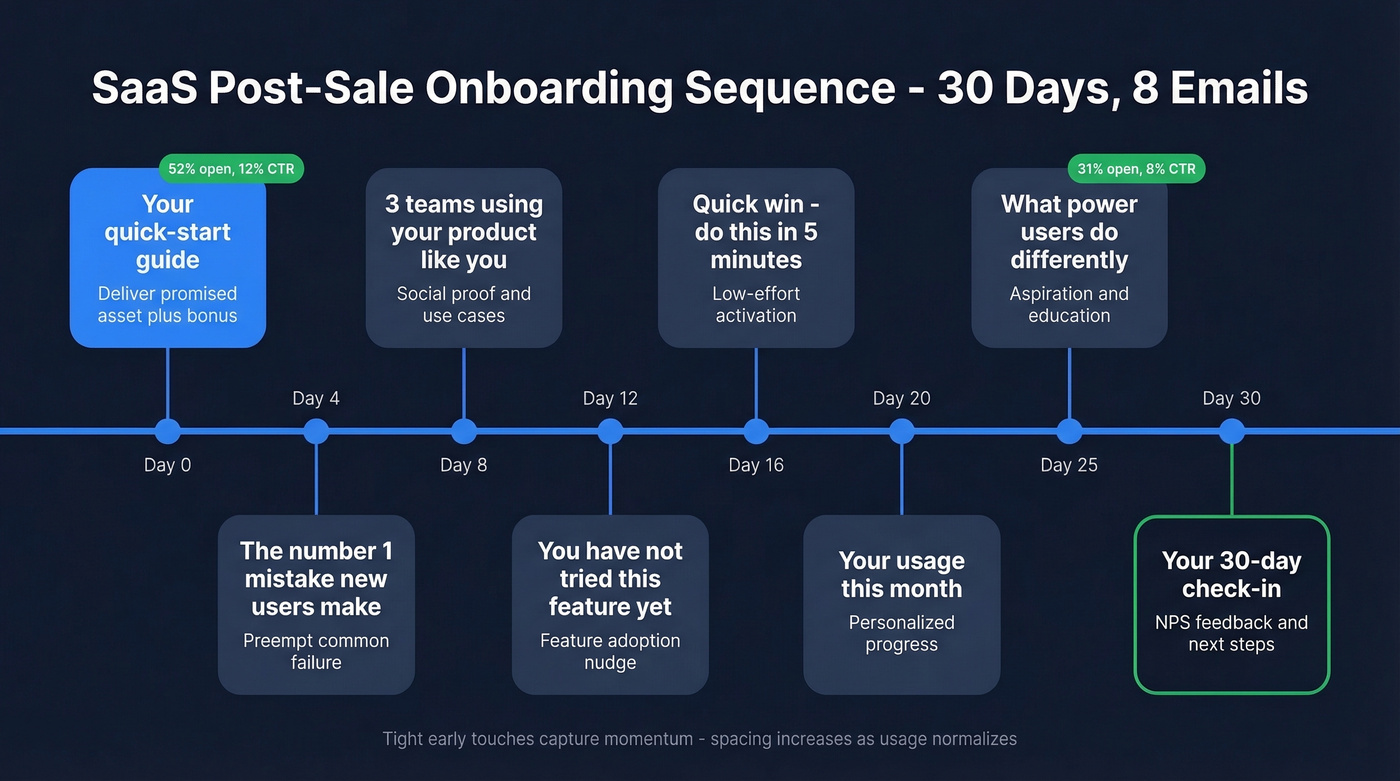
| Day | Subject Line | Purpose | Benchmark |
|---|---|---|---|
| 0 | "Your quick-start guide" | Deliver promised asset + bonus | 52% open, 12% CTR |
| 4 | "The #1 mistake new users make" | Preempt common failure | - |
| 8 | "3 teams using [product] like you" | Social proof + use cases | - |
| 12 | "You haven't tried [feature] yet" | Feature adoption nudge | - |
| 16 | "Quick win: do this in 5 minutes" | Low-effort activation | - |
| 20 | "[Name], your usage this month" | Personalized progress | - |
| 25 | "What power users do differently" | Aspiration + education | 31% open, 8% CTR |
| 30 | "Your 30-day check-in" | NPS/feedback + next steps | - |
Cadence is part of the strategy. Tight early touches (days 0-12) capture momentum; later touches space out as usage normalizes.
B2B Re-Engagement (5 Emails, 21 Days)
On r/SaaSSales, people are blunt about "just checking in" emails: they're lazy and they get ignored. Use a context switch instead - acknowledge the gap, bring something new, and keep the CTA tiny. (If you want better language for this, see how to say just checking in professionally.)
| Day | Subject Line | Structure |
|---|---|---|
| 1 | "Something changed since we last talked" | Context switch + new value |
| 5 | "[Case study]: how [similar company] solved X" | Social proof |
| 9 | "Quick framework for [their problem]" | Pure value, no ask |
| 15 | "The feature you asked about is live" | Product update, soft CTA |
| 21 | "Last one from me (for now)" | Breakup email + opt-out |
Keep it to five emails. More than that turns "re-engagement" into "spam with persistence."
Five Mistakes That Kill Nurture Programs
1. Turning every touch into a pitch. Customers learn fast: if every email asks for something, they stop opening. Fix it with a strict 3:1 give-to-get ratio.
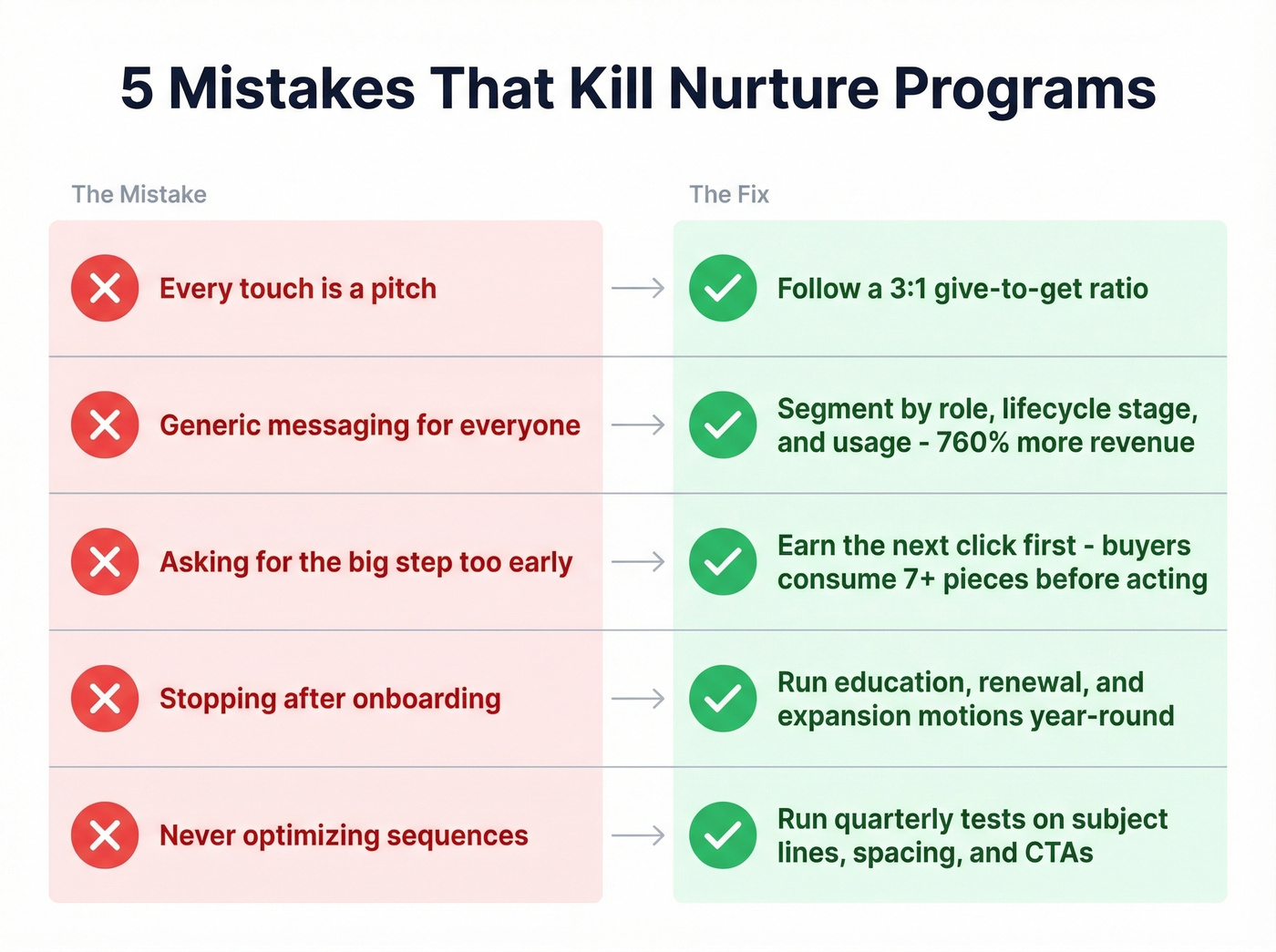
2. Generic messaging. One sequence for everyone is how nurture becomes a graveyard. Segmented campaigns can drive up to 760% more revenue than non-segmented ones because relevance wins. Segment by role, lifecycle stage, and usage.
3. Asking for the big step too early. B2B buyers consume content before they act - 45.8% consume more than 7 pieces during a purchase process. Earn the next click first, then the meeting.
4. Stopping after onboarding. Onboarding isn't customer nurturing; it's table stakes. Run education + renewal + expansion motions year-round, not just in month one.
5. Never optimizing. Sequences decay. Run quarterly tests on subject lines, spacing, and CTAs. A small CTR lift compounds across every send, and what worked six months ago probably doesn't work now. (If you want to standardize measurement, use a consistent click rate formula.)
Does It Actually Work?
When teams commit to nurturing, the outcomes are dramatic. Here are real numbers:
- Airstream: 78% more leads and 52% lower cost per lead after automated nurture sequences
- Centrics IT: 59% increase in lead generation and $1.5M in revenue tied to marketing automation in year one
- Skype: 650% increase in qualified leads and 400% more programs managed without adding headcount
- SmartBear: 200% increase in lead generation; 85% of revenue came from trial leads nurtured through automation
- BOLT ON Technology: 272% increase in inbound demos booked and 411% ROI on marketing-impacted revenue
Let's be honest - these are best-case results from companies that went all-in. But even a modest implementation that nails onboarding + education + renewal will move your retention numbers meaningfully. We've watched teams cut churn by double digits just by adding a renewal sequence 90 days before contract end. (If you’re setting targets, start with a clean renewal rate definition.)
AI and the Future of Nurturing
Sellers spend only 28% of their time actually selling. AI wins when it gives that time back - by triggering the right message at the right moment and keeping follow-up consistent.
The AI pieces worth paying for in 2026 are practical: behavioral triggers for usage drops and pricing-page visits, dynamic next-email logic based on clicks, and predictive scoring that updates continuously. One proof point: Omniplex Learning hit forecast accuracy within 5% after consolidating AI-driven workflows.
None of it works without clean data. Automation amplifies whatever you feed it - especially bad contact records. (If you’re building scoring, start with lead scoring and adapt it for customers.)
Tools for Customer Nurturing
You don't need a perfect stack. You need one platform to run journeys and one way to keep contact data deliverable.
| Tool | Starting Price | Best For |
|---|---|---|
| Prospeo | Free / paid from ~$39/mo | Verified data + enrichment |
| HubSpot | Free CRM / paid from ~$20+/mo | CRM-first nurturing |
| ActiveCampaign | ~$145/mo | SMB automation |
| Customer.io | ~$100/mo | Event-based, product-led |
| Brevo | Free / ~$9+/mo | Budget starter |
| Ortto | ~$169/mo | Journey orchestration |
The consensus in RevOps communities is consistent: "Our automation is fine - our data is the mess." That's the problem worth solving first. (If you’re evaluating vendors, compare data enrichment services side-by-side.)
Expansion revenue depends on reaching the right stakeholders - new hires, new teams, new decision-makers inside existing accounts. Prospeo enriches your CRM with 50+ data points per contact at a 92% match rate, so your Hot-segment expansion campaigns hit real buyers, not outdated records from the original deal.
Enrich your customer accounts and turn usage signals into upsell pipeline.
FAQ
What's the difference between customer nurturing and lead nurturing?
Lead nurturing is pre-sale and drives conversion; customer nurturing is post-sale and drives retention, expansion, and advocacy. Expect much higher engagement post-sale: 25-35% CTR versus ~2-5% for typical B2B lead nurture sequences.
How many emails should a nurture sequence have?
Aim for 5-9 emails over 2-4 weeks. Front-load value early, then space messages out. Fewer than five lacks momentum; more than nine usually creates fatigue and unsubscribes.
What's a good CTR for post-sale nurture emails?
Strong programs hit 25-35% CTR per Forrester's benchmarks. If you're under 10%, your segmentation is too broad or your content is too salesy. CTR beats opens as a KPI because open tracking is unreliable.
How do I keep contact data clean for nurture campaigns?
Verify emails before every major send and enrich records quarterly. A 7-day refresh cycle - compared to the 6-week industry average - keeps your sequences reaching real inboxes instead of bouncing and damaging domain reputation.
How do I re-engage dormant customers?
Use a context switch: acknowledge the gap, share something genuinely new like a feature update or case study, then use a low-friction CTA like "worth a peek?" A five-email sequence over 21 days works best - anything longer turns re-engagement into spam.