

Verified Mobile Numbers: What They Actually Mean and How to Get Ones That Work
You dial 200 numbers. Twelve people pick up. Half the rest are disconnected, recycled, or ring through to someone who left the company two years ago. Your "verified" list just cost you an afternoon and a pile of wasted rep hours.
The gap between what data providers call verified mobile numbers and what actually connects when you dial is the single biggest hidden cost in outbound sales. A $50,000 independent accuracy test that called and validated 10,000 contacts found 38-52% actual phone accuracy across major platforms - a far cry from the 81-95% claimed rates highlighted in the same comparison. That means roughly half the phone numbers you're paying for will never reach a human. For SDR teams dialing hundreds of cell numbers each day, the wasted time and crushed morale compound fast. And the worst part? Most teams never measure it. They blame the reps, blame the script, blame the market - when the real problem is the data sitting in their dialer.
Let's break down what "verified" should actually mean, why the accuracy gaps exist, and how to build a mobile list that connects.
What You Need (Quick Version)
Most providers' "verified" labels don't hold up. Three picks depending on your situation:
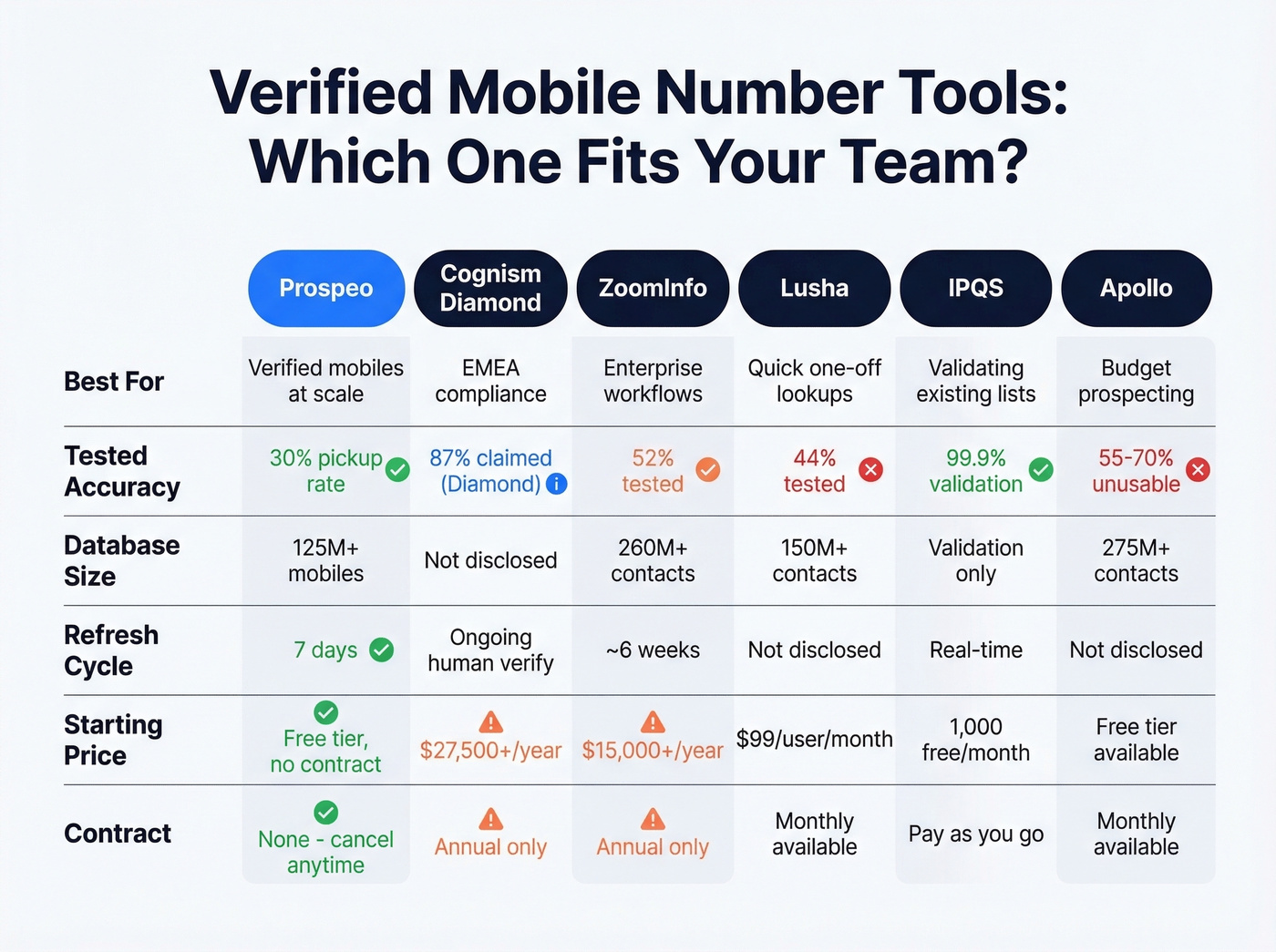
- Prospeo - 125M+ verified mobiles, 98% email accuracy, 30% pickup rate, 7-day refresh cycle. Free tier to test. Best accuracy-to-price ratio on the market.
- Cognism Diamond - Human-verified mobile numbers with DNC scrubbing. Strong EMEA coverage. Enterprise pricing ($27,500+/year minimum).
- IPQS - Best standalone validation API if you already have numbers and need to clean them. 99.9% accuracy. 1,000 free lookups/month.
What "Verified" Actually Means
The word "verified" gets thrown around loosely in B2B data. A provider might call a number "verified" because it has the right number of digits and a valid country code. That's format validation - it catches typos, and nothing else.
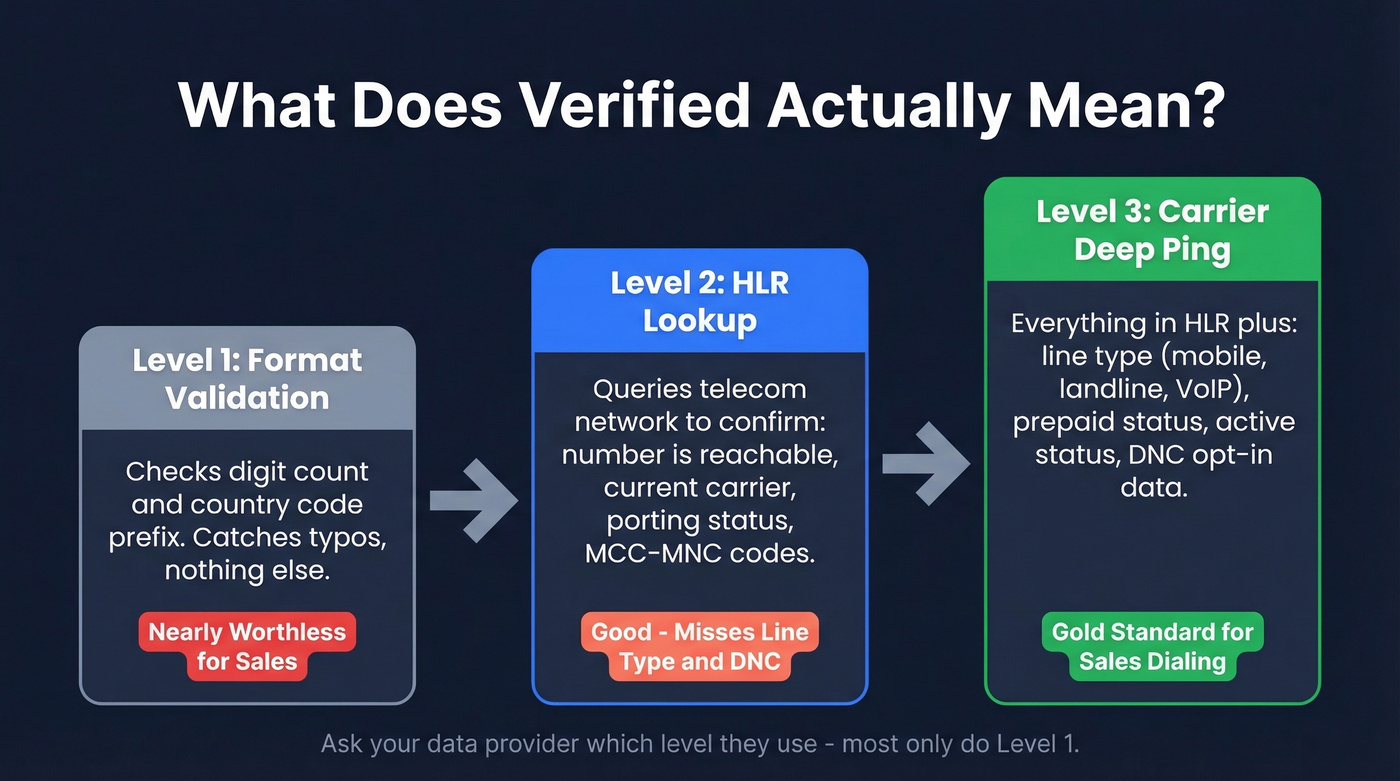
Real verification queries telecom infrastructure. An HLR (Home Location Register) lookup sends a signaling request through the telecom network to confirm whether a number is reachable, which carrier currently serves it, and whether it's been ported to a different network. That last part matters more than most people realize: with mobile number portability, the prefix of a phone number no longer reliably tells you the carrier. A number that looks like it belongs to Verizon might have been ported to T-Mobile three years ago. These lookups also return MCC-MNC codes - unique identifiers for the mobile country and network - which confirm the exact operator handling the number right now.
The deepest level is a carrier deep ping - a direct check with the carrier that returns line type (mobile, landline, VoIP), prepaid status, active status, and sometimes DNC opt-in data. IPQS uses this approach across 75+ countries. Numbers that pass this level of scrutiny are the gold standard. They confirm not just that a number exists, but that it's active and reachable on a mobile network.
| Method | What It Checks | What It Misses |
|---|---|---|
| Format validation | Length, country code, prefix | Dead lines, ported numbers, VoIP |
| HLR lookup | Live status, current carrier, porting | Fraud signals, line type, DNC |
| Carrier deep ping | All above + line type + active status | DNC compliance (separate step) |
Experian's phone verification service processes 61.8M+ validation requests annually across ~1,500 telecom providers and returns granular statuses including Verified, Invalid, Unknown, Unavailable, Teleservice not provisioned, Call barred, Absent, No coverage, and Dead. When a provider tells you a number is "verified," ask which of these levels they're actually running. Format validation alone is nearly worthless for sales dialing.
Why Verified Mobiles Matter for B2B Sales
The math is brutal. A study of 55,000+ cold calls found a 16.6% connect rate - roughly one in six dials reaches a live person. It takes an average of 8 attempts to reach a prospect. That's already a grind.
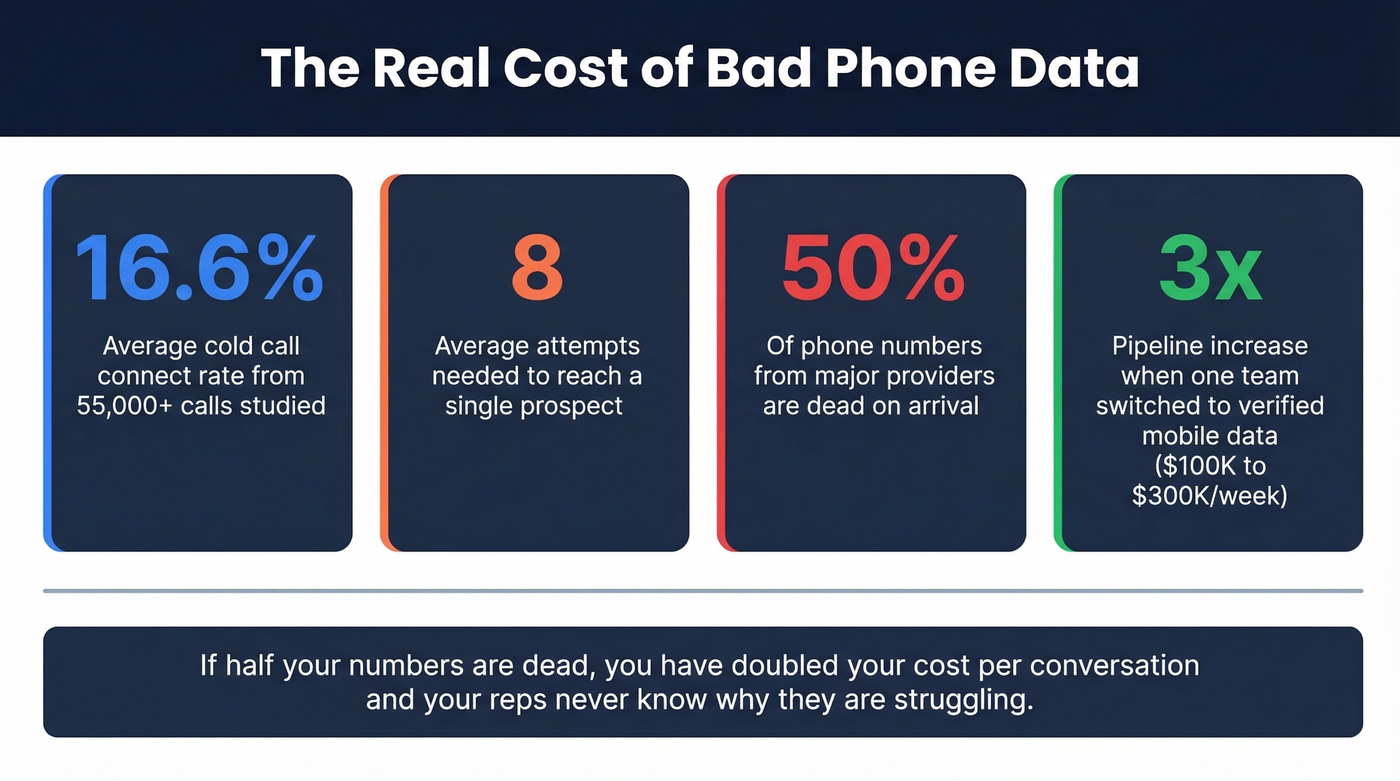
Now imagine half your numbers are dead. You've just doubled your cost per conversation. Your reps burn through dials that were never going to connect, and the psychological toll is real - nothing kills calling energy faster than a string of disconnected tones.
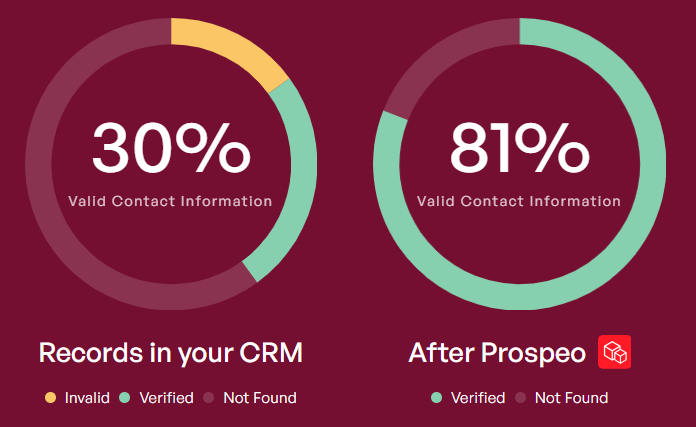
We've seen this play out firsthand. One team we worked with, Meritt, was running outbound with a data provider that looked fine on paper. After switching to verified mobile data, their pipeline tripled from $100K to $300K per week, and their connect rate jumped 3x to 20-25%. That's not a marginal improvement - it's a completely different business.
The economics work in reverse too. If you're paying $0.10-$1.00 per phone number from a data provider, and half those numbers are dead, your effective cost per valid contact just doubled. Add in the SDR time wasted on dead dials at $25-40/hour fully loaded, and bad phone data becomes one of the most expensive line items in your outbound stack that nobody tracks. For distributed teams relying on mobile contacts in remote work setups, the problem compounds - reps working from home have fewer coaching touchpoints, so bad data goes undetected longer.
Here's the thing: if your deal sizes sit below $10K, you probably don't need ZoomInfo-level data. A lighter tool with genuinely verified mobiles will outperform a bloated platform where half the numbers are dead - and cost a fraction of the price.

Half the mobile numbers from major providers are dead on arrival. Prospeo's 125M+ verified mobiles deliver a 30% pickup rate - backed by a 7-day refresh cycle that catches disconnects, port-outs, and job changes before your reps dial.
Stop paying for numbers that never connect. Test it free.
The Accuracy Gap in B2B Phone Data
Every provider says their data is accurate. The numbers tell a different story.
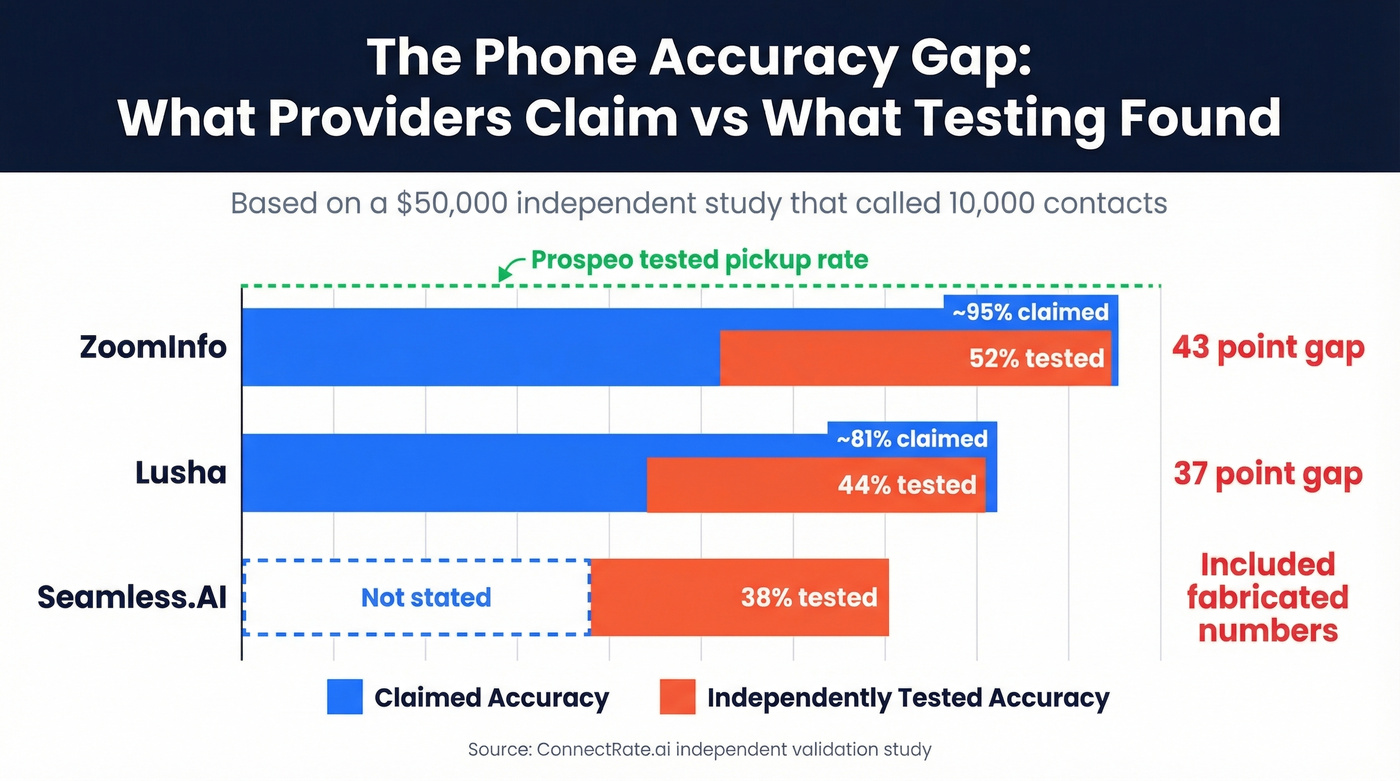
That independent study spent $50,000 testing 10,000 contacts across three major providers, actually calling the numbers to validate them:
| Provider | Claimed Accuracy | Tested Accuracy | Gap |
|---|---|---|---|
| ZoomInfo | ~95% | 52% | 43 points |
| Lusha | ~81% | 44% | 37 points |
| Seamless.AI | Not stated | 38% | - |
ZoomInfo's tested accuracy was barely half its claimed rate. Seamless.AI's failure patterns included what the study described as "fabricated numbers" - entries that had never been valid.
Reddit sentiment tracks with this. One post on r/coldemail broke down an Apollo export labeled "95% accuracy" and found 55-70% of leads were unusable - between hard bounces, people who'd left the company, and disconnected numbers. Threads on r/b2bmarketing echo the frustration, with teams consistently emphasizing that quality-to-price ratio matters more than raw database size, especially for EMEA coverage.
Why does this happen? Data decay. People change jobs, switch carriers, disconnect lines. A number that was valid three months ago is dead today. The industry average refresh cycle is about 6 weeks, which means by the time you export a list, a meaningful chunk is already stale.
Best Tools for Finding Verified Mobile Numbers
Not every tool approaches mobile verification the same way. Some source and verify. Some only validate numbers you already have. We've tested most of these, and the differences are stark.
Prospeo
Use this if: You need verified direct dials at scale without enterprise pricing or annual contracts.
Skip this if: You need a built-in power dialer - pair with Orum or Nooks for that.
Prospeo's mobile finder covers 125M+ verified numbers with a 30% pickup rate across all regions. The database refreshes every 7 days, which is why the accuracy holds up in practice rather than just on a spec sheet. You get 30+ search filters - buyer intent across 15,000 Bombora topics, technographics, job changes, headcount growth, funding - so you're pulling mobile numbers matched to the right people, not just any people.
Pricing is credit-based and transparent: roughly $0.01 per email, 10 credits per mobile number. The free tier gives you 75 emails and 100 Chrome extension credits per month to test before spending anything. No contracts, no sales calls required, cancel anytime. In our experience, the 7-day refresh is the real differentiator - it's the reason connect rates hold steady over time instead of degrading week after week.
If you're comparing list-building workflows end-to-end, it also helps to map this into a broader lead generation workflow and decide where you want to add lead enrichment vs. verification.
Cognism Diamond
Cognism's Diamond tier is the premium play for phone-verified mobile numbers in EMEA and APAC. They employ humans to phone-verify numbers, check against global DNC registries, and promote an 87% connect rate on Diamond data along with 3x higher connect rates than non-verified alternatives. This is where Cognism genuinely beats ZoomInfo for teams that need work mobiles with compliance built in.
The tradeoffs are real, though. Pricing starts at $25,000/year platform fee plus $2,500/user/year, with setup fees of $3,000-$8,000. Annual contracts only. User reviews consistently flag weaker US coverage and a G2 accuracy score of 7.9/10 - solid but not exceptional. If your team sells primarily into Europe, Cognism Diamond is worth the premium. US-focused teams should look elsewhere.
ZoomInfo
Still the enterprise benchmark for workflow integrations and database breadth. But for teams where connect rate is the priority metric, 52% tested accuracy on a $15,000-$40,000+/year contract is a hard pill to swallow. You're paying premium prices for a coin flip on every dial. ZoomInfo makes sense if you're already embedded in the ecosystem and use it for more than just phone data. For phone-first outbound, the numbers don't justify the spend.
If you're building a phone-first motion, it’s worth pairing your data choice with a repeatable cold calling system so you can measure connect rate and conversion cleanly.
Lusha
Quick one-off lookups are Lusha's sweet spot - but the credit math gets ugly at scale. At 10 credits per phone number and a free plan of just 70 credits/month, you get exactly 7 free phone numbers. Paid plans run $99-$199/user/month. Combined with 44% tested accuracy, the cost per valid number climbs fast. Fine for grabbing a prospect's direct dial before a meeting. Not a list-building tool.
IPQS
The best standalone validation API available. IPQS runs carrier deep pings in 75+ countries, returns line type, carrier, active status, and DNC opt-in data, and verifies phone numbers with 99.9% accuracy. You get 1,000 free lookups/month. Use this if you already have numbers and need to clean them before loading into a dialer. IPQS doesn't build prospect lists - it validates the ones you already have.
If you’re cleaning lists before outreach, you’ll usually want to align phone checks with your data enrichment services and your email hygiene process too.
Apollo
Apollo's the budget entry point at ~$49/mo with a large database. But for phone-first workflows, the accuracy complaints are well-documented - the "95% accuracy" label on exports doesn't survive contact with reality. Best for email-first outbound where phone is a secondary channel.
If you’re running email-first, you’ll get more leverage from a strong B2B cold email sequence and tighter sales prospecting techniques than from chasing marginal phone accuracy.
Seamless.AI
At $147-$297/user/month, 38% tested phone accuracy - the lowest in the independent study - makes Seamless.AI hard to recommend for mobile-focused outreach.
Numverify
A developer-friendly validation API with transparent pricing: free tier (100 requests), paid from $14.99/mo to $129.99/mo (250K requests). Good for programmatic bulk validation if you're building your own tooling.
Tool Comparison
| Tool | Verified Mobiles | Pricing | Best For |
|---|---|---|---|
| Prospeo | 125M+ | Free tier; ~$0.01/email | Accuracy-first teams, any size |
| Cognism Diamond | Included (Diamond) | $27,500+/yr min | Enterprise EMEA |
| ZoomInfo | Included | $15K-$40K+/yr | Large enterprise, US |
| Lusha | Credit-gated | $99-$199/user/mo | Quick one-off lookups |
| IPQS | Validates only | 1K free/mo | Cleaning existing lists |
| Apollo | Included | From ~$49/mo | Budget email-first |
| Seamless.AI | Included | $147-$297/user/mo | Real-time search |
| Numverify | Validates only | Free-$129.99/mo | Developer bulk validation |
Verified Doesn't Mean Legal to Call
Having a verified, active mobile number doesn't give you permission to call it. This is where teams get into expensive trouble.
The TCPA opt-out rule, effective since April 2025, requires businesses to honor revocation requests made in "any reasonable manner" - not just the word "STOP" via text. You have 10 days to process an opt-out. Statutory damages run $500-$1,500 per violation, and TCPA class action filings surged 95% year-over-year, with verdicts exceeding $925M. Federal DNC violation fines reached $53,088 per violation. Calling hours are restricted to 8 AM-9 PM in the recipient's local time zone, and the FCC's Reassigned Numbers Database offers a safe harbor - query it before dialing to confirm numbers haven't been reassigned.
Compliance isn't optional, and "we didn't know" isn't a defense. Build DNC scrubbing into your workflow before you load a single number into your dialer.
How to Build a Verified Mobile List
Five steps, in order:
Define your ICP with precision. Role, industry, company headcount, funding stage, intent signals. The tighter your filters, the fewer wasted dials. Vague targeting is the #1 reason teams burn through phone data. (If you need a scoring rubric, use an ideal customer profile template.)
Source numbers from a verified database. Use filters to pull mobile numbers that match your exact ICP - intent data, technographics, job changes, and headcount growth narrow the list to prospects worth calling.
Validate with HLR or carrier lookup. If you're sourcing from multiple providers or working with older lists, run numbers through a validation API like IPQS or Numverify before dialing. This catches numbers that have gone stale since export.
Scrub against DNC registries. Check the federal Do Not Call list, state-level registries, and your own internal suppression list. Some tools build this into the workflow. If yours doesn't, add it as a manual step.
Load into your dialer and track connect rates. Your connect rate is the ground truth. If it drops below 15%, your data quality has degraded and it's time to re-source or re-validate.
Meritt tripled their pipeline to $300K/week and hit a 20-25% connect rate after switching to Prospeo's verified mobile data. At $0.01/email and 10 credits per mobile, you get enterprise-grade phone accuracy without the $27K+ enterprise contract.
Build a call list that actually picks up - starting at zero dollars.
FAQ
What's the difference between phone validation and verification?
Validation checks formatting - correct length, country code, valid prefix. Verification queries telecom infrastructure to confirm the number is reachable and identifies the current carrier. Validation catches typos; verification catches dead lines. For sales dialing, you need verification.
How often should I re-verify my mobile list?
Re-verify at minimum every 30 days. Phone data decays fast - people change jobs, switch carriers, and disconnect lines constantly. If your provider doesn't refresh weekly, build a monthly validation step into your workflow.
What's a good connect rate for verified mobile numbers?
The industry benchmark is 16.6% across all dials. With genuinely verified mobiles, teams report 20-30% connect rates. Consistently below 10%? Your data quality is the bottleneck, not your reps.
Can I verify mobile numbers in bulk?
Yes. Validation APIs like IPQS support CSV upload and batch API calls. Numverify handles batch requests too. Some B2B data platforms pre-verify before delivery, so bulk exports come already validated - no extra step needed.
Is it legal to cold call verified mobile numbers?
A verified number isn't automatically legal to call. Scrub against DNC registries, honor opt-outs within 10 days under the TCPA rule, and call only during 8 AM-9 PM local time. Violations carry fines up to $1,500 per call.