


Versium REACH Review: Pricing, Pros, Cons & Honest Verdict (2026)
B2B contact data decays at roughly 2.1% per month. That means a quarter of your database goes stale every year. If you're looking into Versium REACH, you're probably trying to solve that problem without signing a $30K ZoomInfo contract. The good news is that Versium's pricing is actually public, and we've broken down every tier below.
30-Second Verdict
What Is Versium REACH?
Versium REACH is a data-as-a-service platform built around a proprietary B2B2C identity graph containing over 2 billion contact points. The core value proposition is identity resolution - crosswalking business identities with consumer identities so you can match a professional email to a personal phone number, a mailing address, or demographic attributes.
Think of it as a data enrichment engine, not a prospecting database. You upload a list of contacts with whatever identifiers you have - email, phone, address - and Versium fills in the gaps. It's particularly strong for improving ad platform match rates, where raw B2B lists typically perform poorly against consumer-oriented targeting systems like Facebook and YouTube.
Versium REACH Pricing Breakdown
Here's the thing most review articles get wrong about Versium: the pricing is actually transparent. Most vendor pricing pages just say "contact sales." We've got every tier laid out.
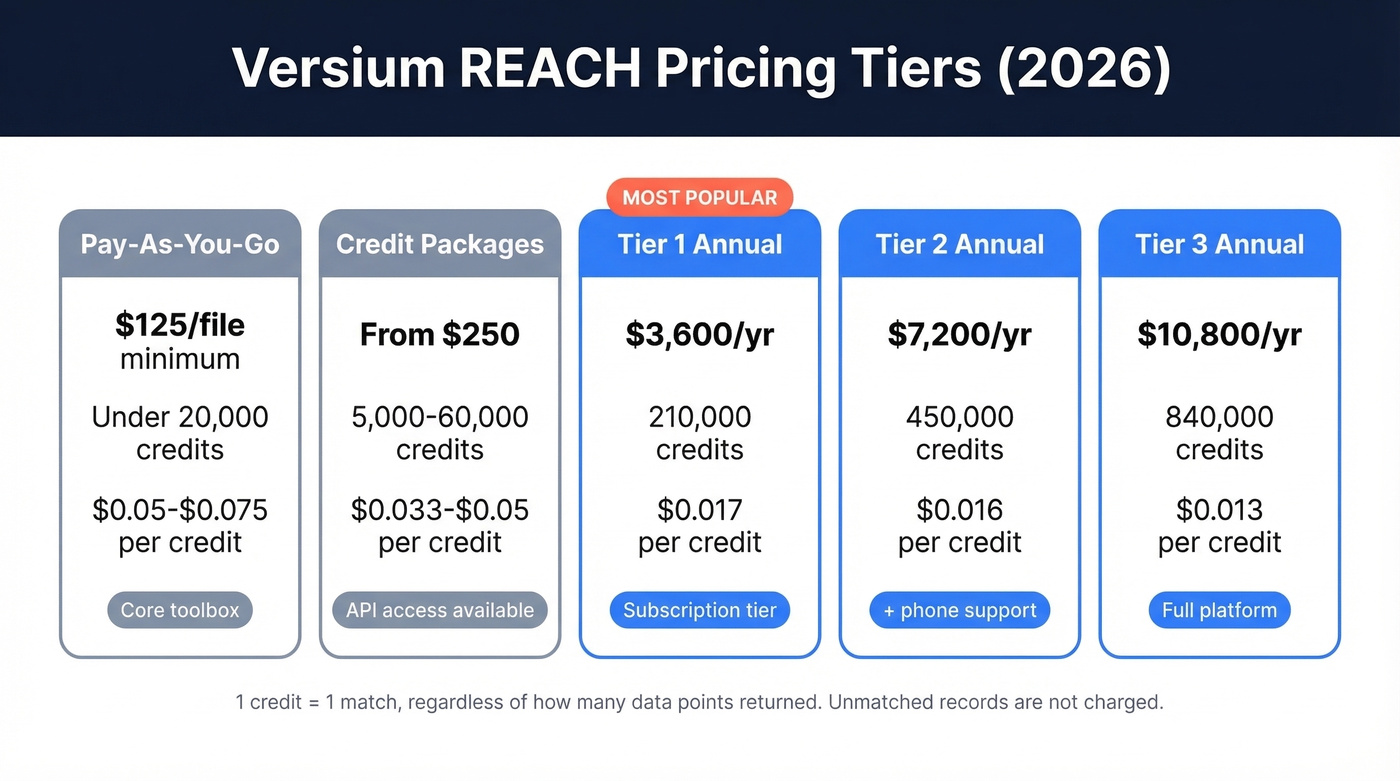
| Plan | Cost | Credits/Yr | Per Credit | Includes |
|---|---|---|---|---|
| Pay-As-You-Go | $125/file min | <20,000 | $0.05-$0.075 | Core toolbox |
| Credit Packages | From $250 | 5,000-60,000 | $0.033-$0.05 | API access available |
| Tier 1 (Annual) | $3,600/yr | 210,000 | $0.017 | Subscription tier |
| Tier 2 (Annual) | $7,200/yr | 450,000 | $0.016 | + phone support |
| Tier 3 (Annual) | $10,800/yr | 840,000 | $0.013 | Full platform |
| Custom/Reseller | Contact sales | - | - | Volume discounts |
Each successful match consumes one credit regardless of how many data points come back - so pulling multiple phone numbers for a single record costs one credit. Versium also offers 5 free data downloads so you can test before committing. No credit card required for those initial test files.
For context, a 10-seat ZoomInfo contract runs $15K-$40K+/year. Apollo.io charges $59-$149/user/month. Versium's Tier 1 at $3,600/yr is genuinely cheap by comparison, but you're buying enrichment, not a full sales intelligence suite (more like a sales prospecting database alternative for specific use cases).
Pros - What Users Like
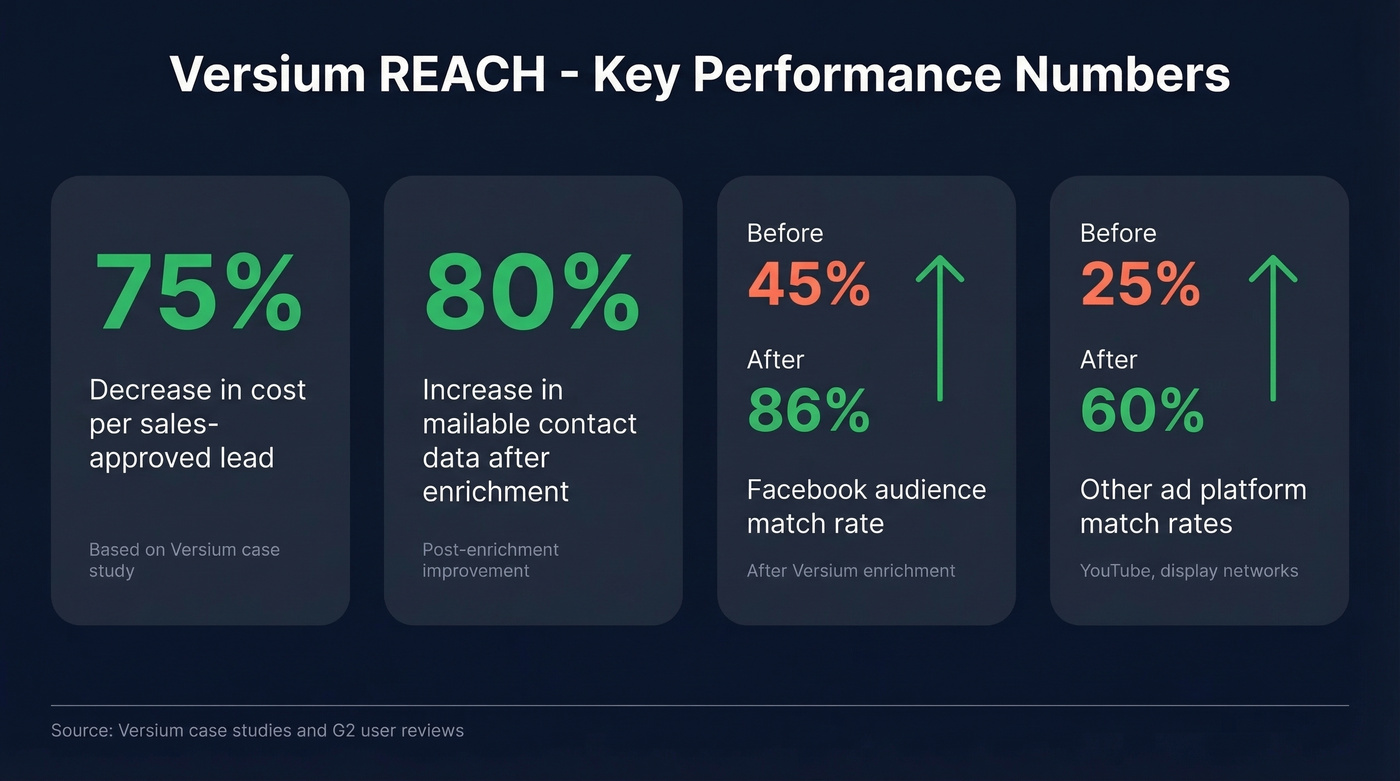
A Versium case study puts the headline numbers front and center: a 75% decrease in cost per sales-approved lead and an 80% increase in mailable contact data after enrichment. Those are the kinds of results that justify the platform for the right team. In our testing, the auto field mapping worked as advertised - upload a messy CSV and Versium figures out what's what without manual column assignments.
Use Versium REACH if:
- You care about match rates. One G2 reviewer described match rates as "like 99%." A case study backs this up: Facebook match rates jumped from 45% to 86%, and on other platforms went from 25% to 60% after enrichment.
- You hate re-buying data. Versium's suppression lists mean you don't repurchase records you've already bought. Most enrichment vendors make you dedupe manually or just charge you again.
- You need fuzzy matching. The algorithm finds the right people even when source file names are misspelled - a small feature that saves real headaches with messy CRM exports.
- You want small batch flexibility. Pre-buy credits and the ability to run small batch appends make it workable for teams that don't need 200K+ matches per year.
- You're optimizing ad spend. If you're running B2B audiences through Facebook or YouTube, Versium's identity resolution is one of the fastest ways to improve match rates without switching ad platforms. (If you're building lists for outbound too, see our sales prospecting techniques.)

Versium's strength is identity resolution - bridging B2B and consumer data for ad targeting. But if your team needs verified emails and direct dials for outbound, that's a different problem. Prospeo delivers 98% email accuracy on 300M+ profiles with a 7-day data refresh, at roughly $0.01 per email. No $3,600/yr minimum. No annual contract.
Skip the identity graph. Get emails that actually land.
Cons - The Real Downsides
Let's be honest about where Versium falls short.
Skip Versium REACH if:
- You're on the East Coast and need support. Versium's team operates on PST. One G2 reviewer on EST called it "more challenging to reach someone" during their working hours. For a platform where you might need help mapping complex files, that's a real friction point.
- You need speed. G2's review summary flags that some users find the platform slow at times. Not a dealbreaker for batch processing, but annoying if you're running time-sensitive campaigns.
- You want a proven review track record. Versium has 35 reviews on G2 and essentially zero on Capterra. The 94% five-star rating looks great, but many reviews are seller-invited, which skews positivity. Public discussion on Reddit and other communities is virtually nonexistent - another signal that the independent user base is still small.
- You need global data. Versium's identity graph is US-centric. Selling into EMEA or APAC? This isn't your tool.
- You need a sales engagement suite. Versium enriches data. It doesn't sequence emails, track opens, or manage cadences. It's a data layer, not a GTM platform. (If you need that layer, start with our guide to implementing a sales engagement platform.)
Who Should (and Shouldn't) Use It
Best for:
- Marketing teams enriching B2B lists for ad platform targeting on Facebook, YouTube, and similar audience networks
- Real estate investors running skip tracing at ~1.7 cents/lead at scale - cutting out the middleman from reseller skip trace services
- Data teams needing B2B2C identity resolution to bridge professional and consumer identifiers
Not for:
- SDR teams who just need verified emails and phone numbers for sequencers (see our list of SDR tools)
- Teams selling outside the US who need international coverage
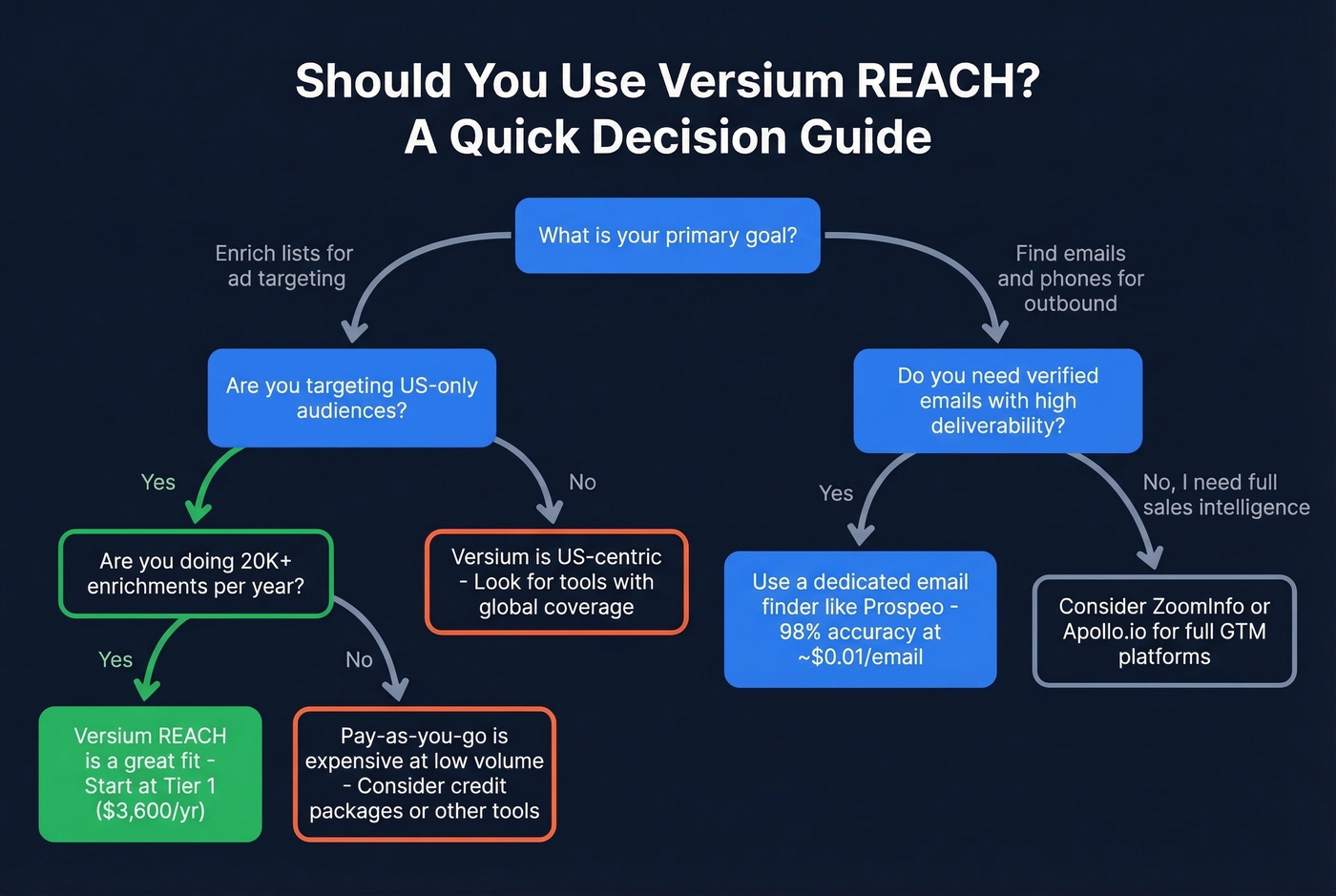
- Small teams running fewer than 20K enrichments per year, where the per-credit cost at low volume isn't competitive
Here's our hot take: if your deal sizes sit below five figures and your primary motion is outbound email, you probably don't need identity resolution at all. You need accurate emails and direct dials. We've watched teams spend months trying to force an enrichment tool into an outbound workflow, and it never ends well. Versium solves a real problem - it's just not the problem most outbound teams actually have. (If you're fixing list quality, start with lead enrichment.)
How Versium REACH Compares
| Tool | Starting Price | Best For | Key Strength |
|---|---|---|---|
| Versium REACH | $3,600/yr | Audience enrichment, skip tracing | B2B2C identity resolution |
| Prospeo | Free tier; ~$0.01/email | Verified emails + direct dials | 98% email accuracy, 7-day refresh |
| ZoomInfo | $15K-$40K+/yr | Enterprise sales intel | Largest B2B database |
| Apollo.io | $59-$149/user/mo | Sales engagement + data | All-in-one prospecting |
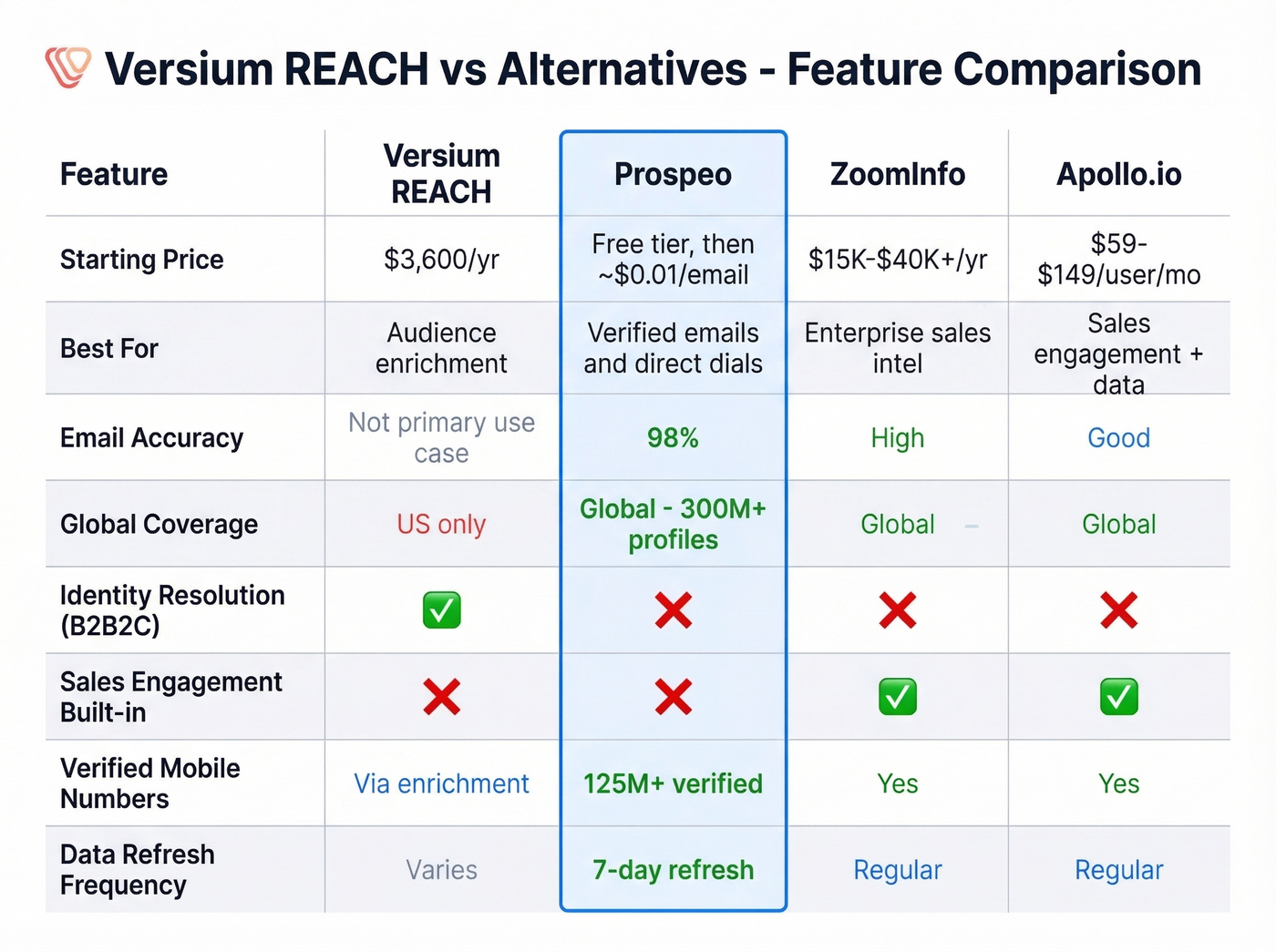
ZoomInfo is the obvious comparison, but it's solving a different problem at 4-10x the price. You're paying for intent data, workflow automation, and a massive B2B database - not identity resolution. Apollo.io is closer to a sales engagement platform with a built-in database; it's what SDR teams actually use day-to-day. Clearbit (now Breeze) has been absorbed into HubSpot's ecosystem and is typically bundled as an add-on - expect mid-to-high hundreds per month for smaller packages, scaling with volume. (If you're evaluating vendors broadly, see our roundup of data enrichment services.)
The Verdict
Versium REACH is genuinely good at what it does. For B2B2C identity resolution, ad platform match rate optimization, and skip tracing at scale, the pricing is fair and the match rates are strong. At $3,600/yr for Tier 1, it's one of the more accessible enrichment platforms on the market.
The thin review base is a concern. With 35 reviews on G2 and near-zero community discussion elsewhere, we'd like to see more independent validation before calling it a category leader. And it's not a ZoomInfo replacement - don't buy it expecting one. We'd recommend Versium REACH for marketing teams running audience enrichment at scale, but if you need a full sales intelligence stack or verified emails for outbound, look elsewhere. (If outbound is the goal, start with free lead generation tools and then tighten deliverability with an email deliverability guide.)
At Versium's lowest tier, you're paying $0.017/credit for enrichment data that's US-only. Prospeo covers global contacts across 300M+ profiles, returns 50+ data points per enrichment at a 92% match rate, and refreshes every 7 days - not whenever Versium's identity graph catches up. Plus, you get 125M+ verified mobile numbers with a 30% pickup rate.
Get global coverage, verified mobiles, and 98% accurate emails - from $0.01/lead.
FAQ
Does Versium REACH offer a free trial?
Yes - Versium provides 5 free data downloads so you can test match rates and data quality before committing to any paid plan. No credit card required for the initial test files.
How do match credits work?
Each successful match consumes one credit regardless of how many data points are returned. Pulling multiple phone numbers, demographic attributes, or mailing addresses for a single record still costs just one credit. Unmatched records aren't charged.
What's a better option for outbound email prospecting?
Versium is built for audience enrichment, not cold outbound. For verified B2B emails and direct dials, a dedicated tool like Prospeo - with 98% email accuracy, 125M+ verified mobiles, and a free tier - is purpose-built for that workflow at roughly $0.01 per lead.
Is Versium REACH worth it for small teams?
For teams running fewer than 20,000 enrichments per year, the per-credit cost on pay-as-you-go ($0.05-$0.075) isn't competitive. The annual tiers only make sense at 200K+ matches. Small teams get better value from credit-based tools with lower minimums.