

Webinar Lead Generation: Stop Optimizing Slides, Start Optimizing Your Invite List
300 registrants. 120 show up. Sales works the list for two weeks and closes four deals. The CMO asks whether webinars are worth the investment. The answer is yes - but only if you stop treating every registrant like a qualified lead and start controlling who gets invited in the first place. Webinar lead generation works when you fix the inputs, not just the presentation.
What You Need (Quick Version)
- Build a targeted invite list first. A bad list means low-intent attendees, which means "garbage leads" feedback from sales every single time.
- Start promoting 4 weeks out, but know that 59% of registrations come in the final week. Your last email matters most.
- Follow up within 24 hours - 58% open rate on webinar follow-ups - and score leads by engagement, not just attendance.
Here's the full playbook, with 2026 benchmarks and a scoring model you can steal.
The Uncomfortable Truth About Webinar Leads
In B2B marketing communities, the same question comes up constantly: "Are lead generation webinars still relevant?" 89% of marketers say webinars outperform other channels for creating qualified leads. And yet, Cognism's own marketing team found that their webinars produced high volume but low intent - lots of names in the CRM, very few turning into pipeline.
The disconnect isn't the format. It's the assumption that attending a 45-minute session means someone's ready to buy. We've seen this pattern across dozens of campaigns: teams run webinars, dump every registrant into a sales sequence, and then wonder why conversion rates are terrible. The fix isn't better slides or a flashier platform. It's better targeting on the front end and smarter scoring on the back end.
2026 Benchmarks Worth Knowing
Before you plan anything, here's where the bar sits. These come from ON24's benchmark report, the most recent data available.
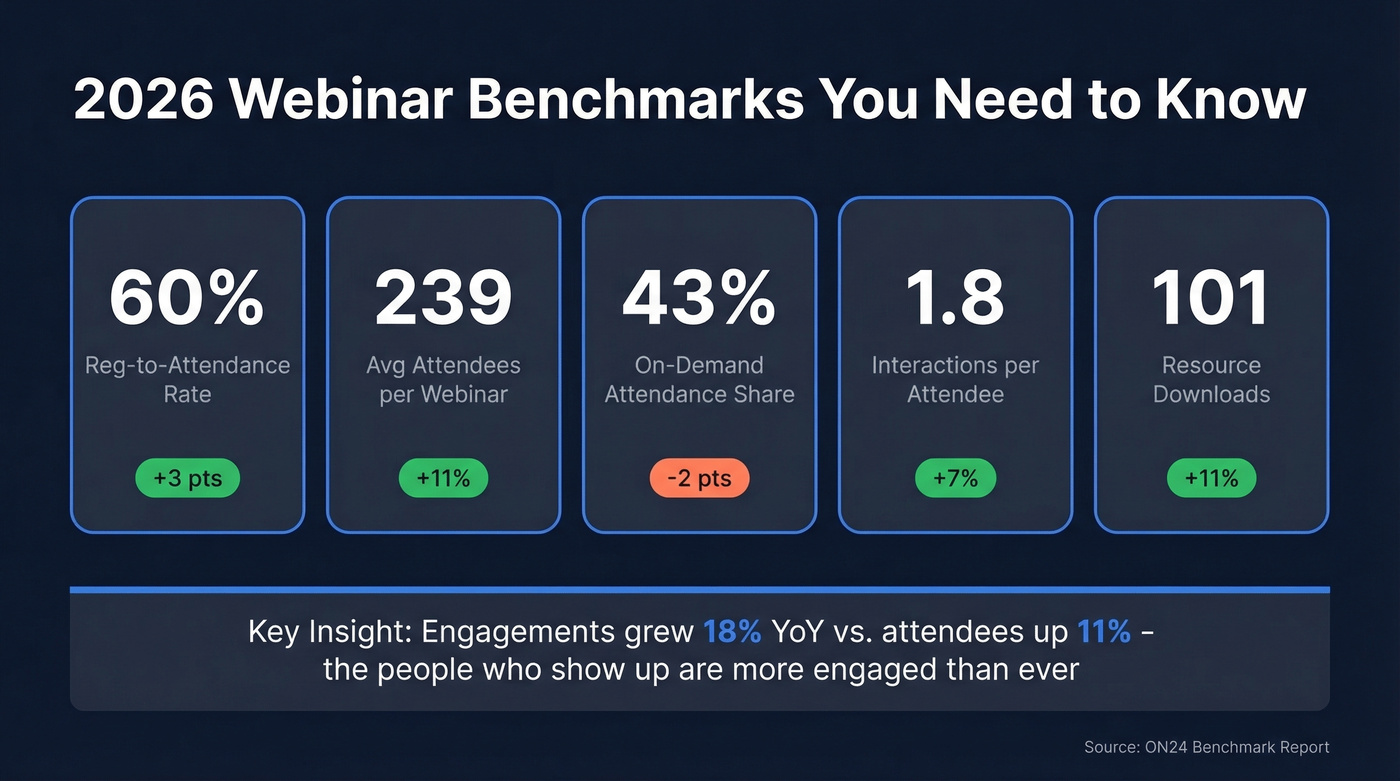
| Metric | Benchmark | YoY Change |
|---|---|---|
| Reg-to-Attendance | 60% | +3 pts |
| Avg Attendees | 239 | +11% |
| On-demand attendance share | 43% | -2 pts |
| Interactions/Attendee | 1.8 | +7% |
| Resource Downloads | 101 | +11% |
Total engagements rose faster than attendance - engagements up 18% YoY vs. attendees up 11% - which tells you something important: the people who do show up are more active than ever. The webinar market itself is projected to hit $134.2B by 2032 at a 13.9% CAGR. The channel isn't going anywhere. The question is whether your execution keeps pace.

59% of webinar registrations happen in the final week - which means every invite email has to land. Prospeo's 98% email accuracy and 7-day data refresh ensure your promotion cadence hits real inboxes, not dead addresses that inflate your bounce rate.
Stop promoting webinars to stale lists. Start with verified contacts.
How to Generate Leads From Webinars
Three phases. Get all three right and webinars become your highest-ROI demand gen channel. Get one wrong and you're just collecting email addresses that go nowhere.
Build the List and Promote
Promoting at least 4 weeks before your event yields 12% more registrations on average. Here's the cadence that works:
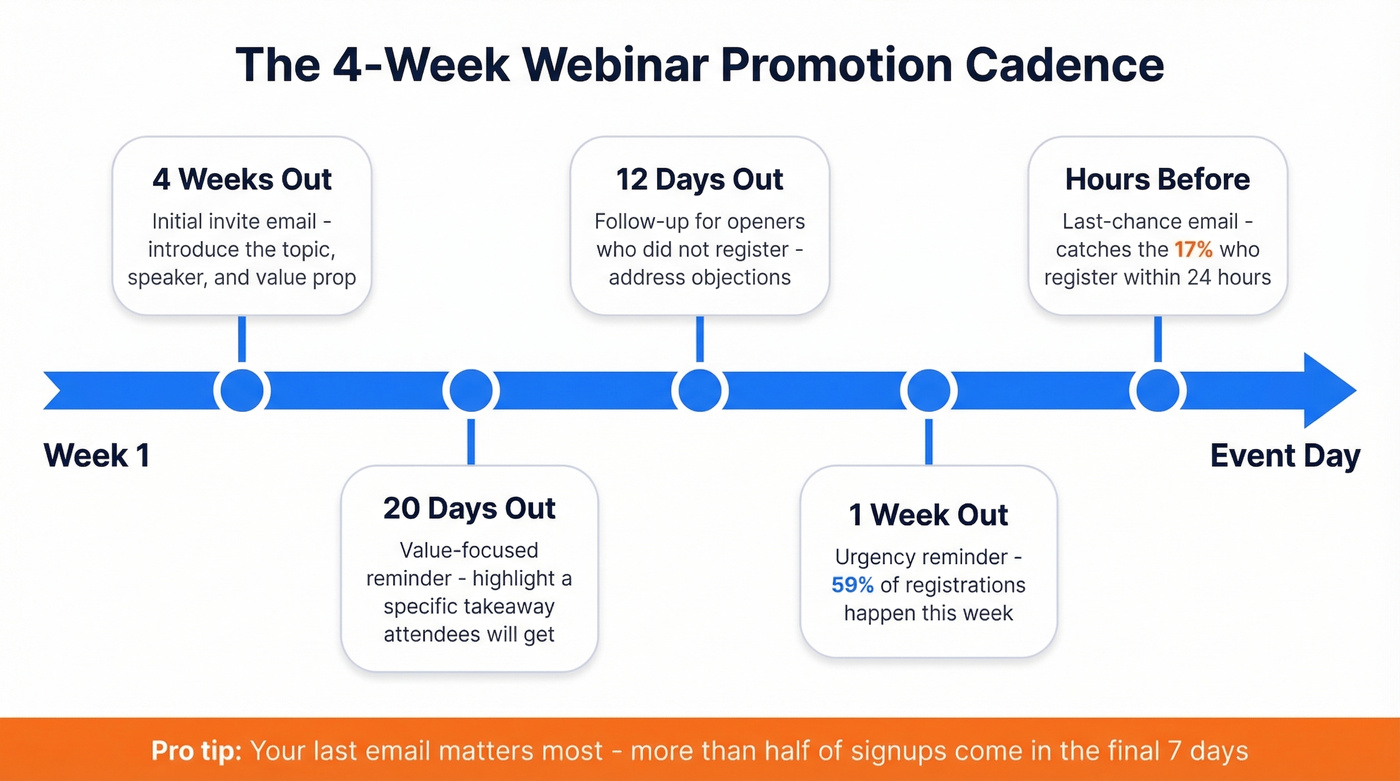
- 4 weeks out - initial invite
- 20 days out - value-focused reminder
- 12 days out - follow-up for openers who didn't register
- 1 week out - urgency reminder
- Hours before - last-chance email, catching the 17% who register within 24 hours of the event
Here's the thing every webinar guide glosses over: "promote via email" assumes you already have verified emails of the right people. Most teams don't. They blast their existing newsletter list and wonder why attendees don't match their ICP.
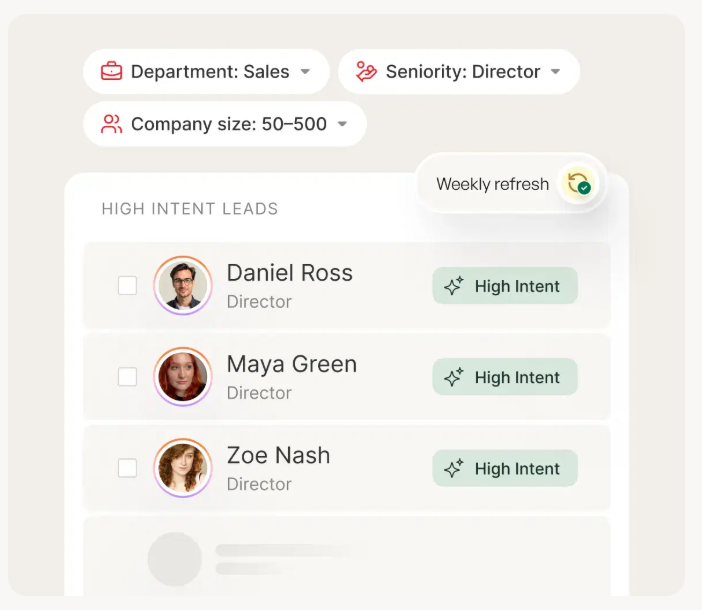
Before you send that first invite, build a targeted list of people who actually have the problem your webinar solves. Prospeo's 30+ search filters - including buyer intent powered by Bombora across 15,000 topics, plus job title, industry, and company size - let you assemble an invite list of in-market prospects instead of random contacts. With 98% email accuracy, your invites actually land instead of bouncing off stale addresses (and your email bounce rate stays under control).
Create Content That Holds Attention
Most webinar advice focuses on platform features. That's backwards. I've watched webinars with $50K production budgets lose half their audience by minute 12 because the content was a thinly veiled sales pitch. The bar is simpler than people think.
Structure it tight. Two-minute open, 20-30 minutes of content, 10-15 minutes of Q&A. Don't spend the first 5-7 minutes on company intros nobody asked for.
Slides should be readable. Font size 20-24, one key point per slide. If your audience is squinting, you've lost them.
Test audio before you go live. Poor audio kills webinars faster than bad content. This sounds obvious, but we've seen it tank otherwise excellent sessions more times than we can count.
Use polls. They break up the monologue and give you engagement data for lead scoring later.
Don't bait-and-switch. If you promised education and deliver a product demo, attendees check out - and they won't come back for the next one.
Follow Up Fast, Score Smart
Webinar follow-up emails hit a 58% open rate - but only if you send them fast.
When response time slips from 5 minutes to 30 minutes, the odds of qualifying a lead drop 21x. That stat alone should change how you operationalize post-webinar workflows. Speed isn't a nice-to-have here. It's the whole game.
Send different messages to attendees and no-shows. Attendees get a thank-you with the recording plus a relevant next step. No-shows get the recording with a "sorry we missed you" angle - no guilt, just value.
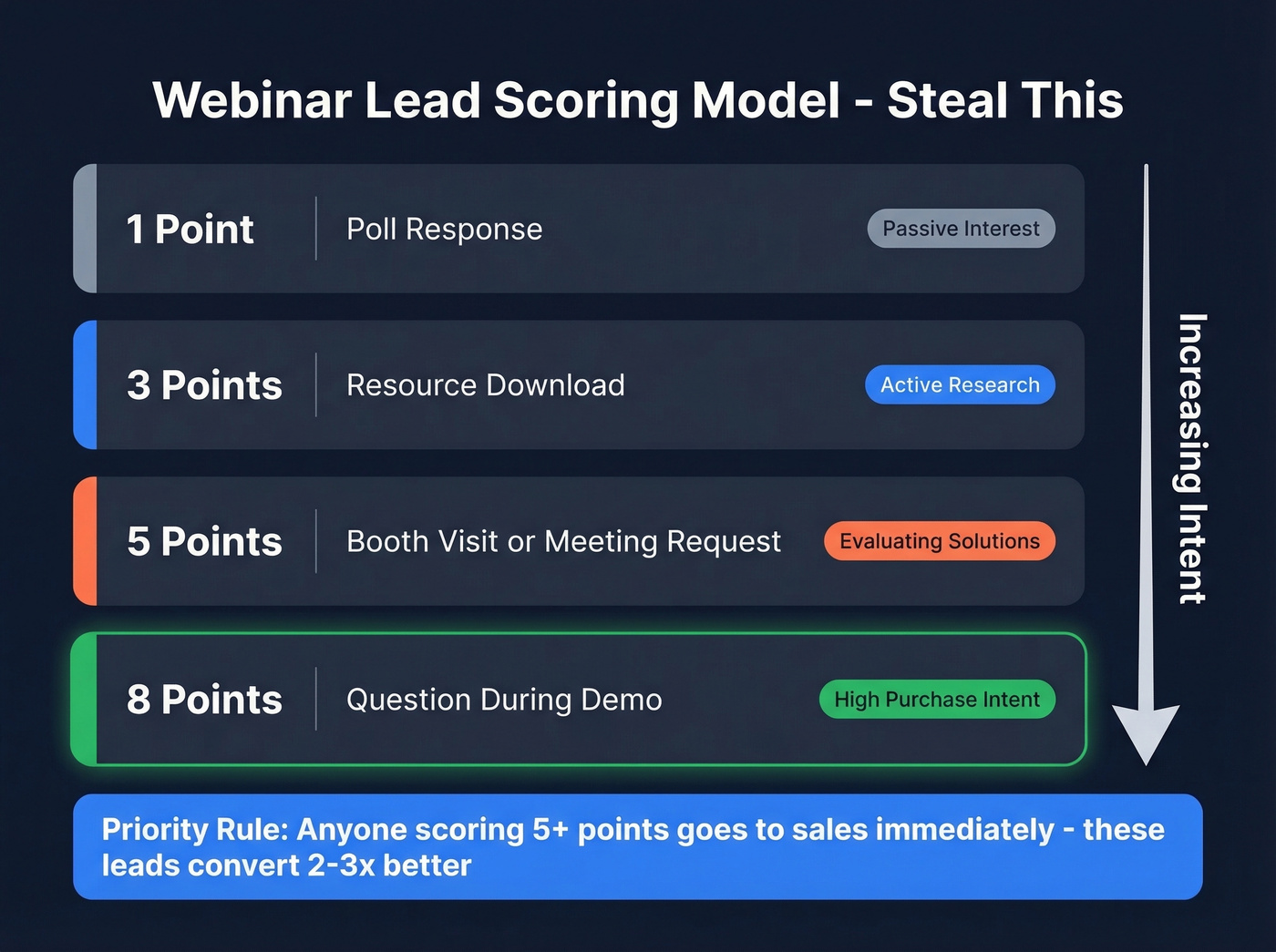
Then score by engagement, not just attendance:
| Webinar Action | Points | Signal |
|---|---|---|
| Poll response | 1 | Passive interest |
| Resource download | 3 | Active research |
| Booth visit / meeting request | 5 | Evaluating solutions |
| Question during demo | 8 | High purchase intent |
Your cadence after the event: first touch within 0-24 hours, then 2-4 additional touches over 5-7 days. In our experience, teams that score by engagement rather than attendance see 2-3x better sales acceptance rates. Reps should prioritize anyone scoring 5+ points - those are the people who leaned in during the session, not the ones who opened a tab and walked away. If you need copy you can deploy immediately, keep a set of sales follow-up templates ready before the event ends.
Scoring webinar leads by engagement only works when the right people registered in the first place. Prospeo's intent data tracks 15,000 topics via Bombora - so you can invite prospects actively researching your category, not just anyone with a pulse and a job title.
Fill your webinar with in-market buyers for $0.01 per email.
Webinar ROI vs. Other Channels
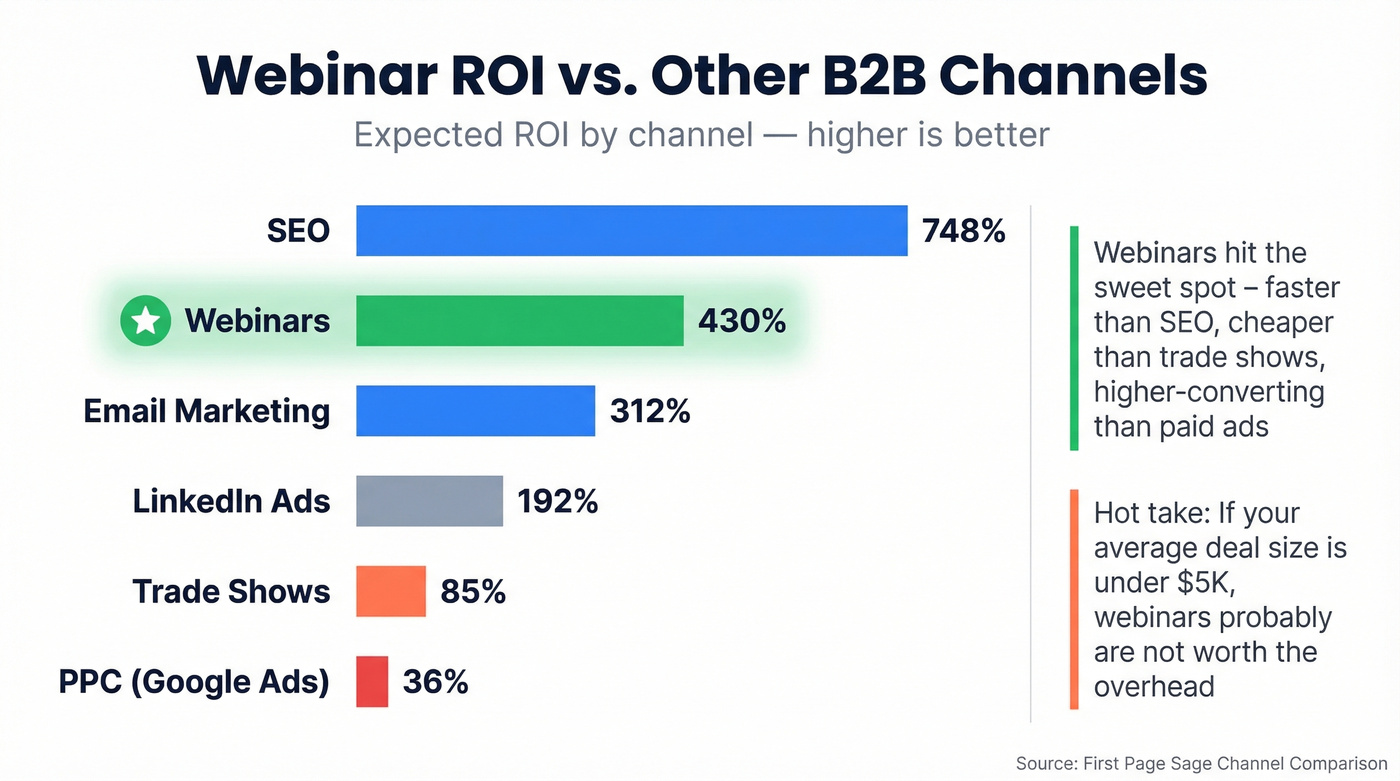
We've tested webinars against paid channels head-to-head, and the cost-per-qualified-lead difference is stark. This data from First Page Sage's channel comparison mirrors what we've seen:
| Channel | Typical Cost | Expected ROI | Time to Results |
|---|---|---|---|
| Webinars | $15K-$35K | 430% | 2-4 months |
| SEO | $10K-$20K/mo | 748% | 6-12 months |
| Email Marketing | $5K-$15K | 312% | 1-3 months |
| LinkedIn Ads | $15K-$30K | 192% | 3-6 months |
| Trade Shows | $30K-$100K | 85% | 3-6 months |
| PPC (Google Ads) | $10K-$30K | 36% | Immediate |
That $15K-$35K webinar cost includes platform fees (many common plans start around $49-$79/month for 250-500 attendees), promotion spend, and production time. Webinars sit in the sweet spot - faster than SEO, cheaper than trade shows, higher-converting than paid ads. SEO has better long-term ROI but takes 6-12 months to compound. If you need pipeline next quarter, webinars win.
Hot take: If your average deal size is under $5K, you probably don't need webinars at all. The production overhead only pays off when each converted lead is worth enough to justify the investment. For high-ACV B2B? Nothing else comes close on a cost-per-qualified-lead basis.
Tips That Actually Move the Needle
Most tip lists rehash the same generic advice. These are the ones that separate teams who consistently convert webinar attendees from those who don't.
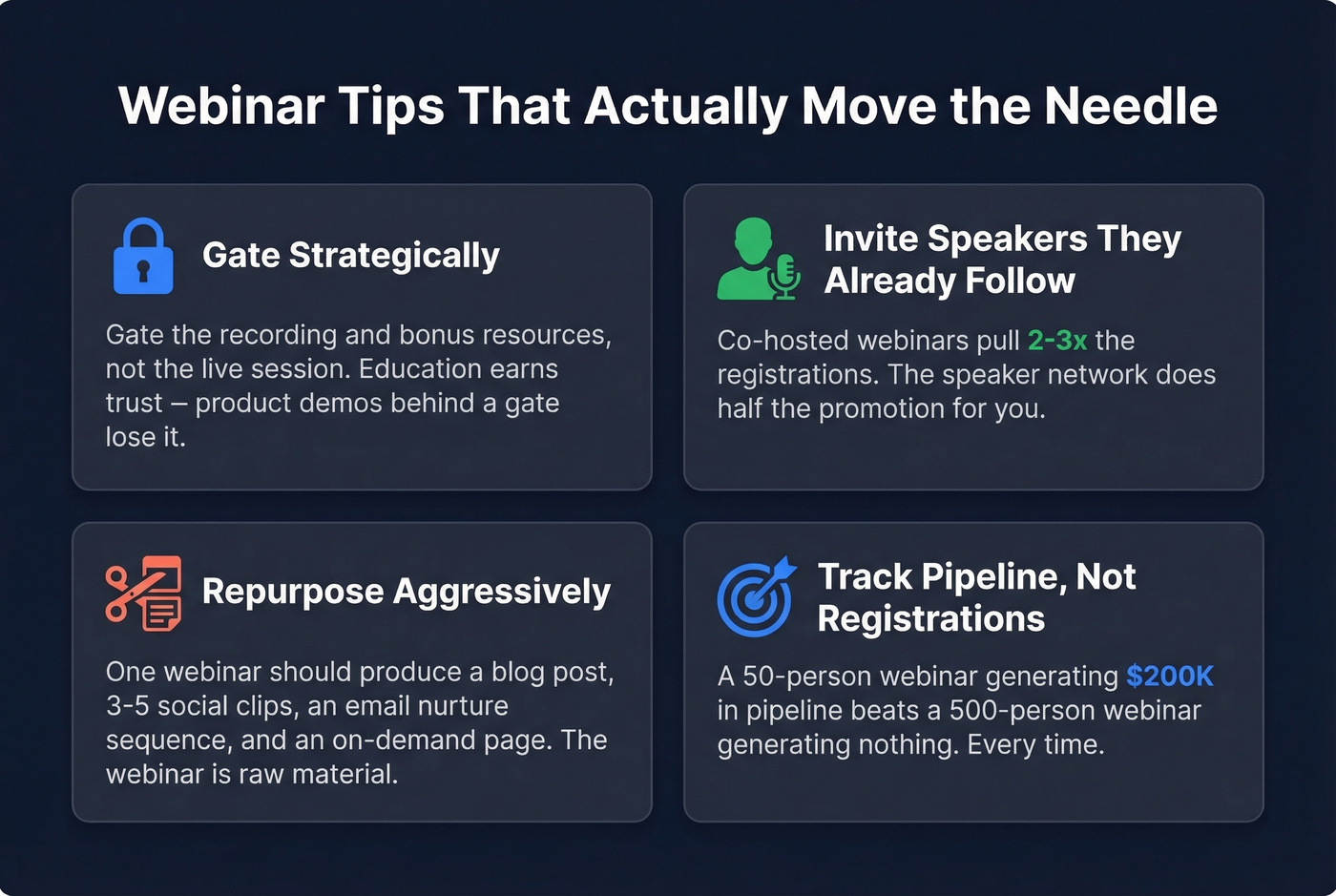
Gate strategically. Gated webinars work best when the content delivers genuine expertise - not a product walkthrough disguised as education. If your topic is broad awareness, consider ungating the live session and gating the recording plus bonus resources instead.
Invite speakers your audience already follows. Co-hosted webinars with industry practitioners pull 2-3x the registrations of solo brand webinars because the speaker's network does half the promotion for you. Let's be honest - nobody's excited about a webinar hosted by "Senior Director of Product Marketing at [Your Company]." They're excited about hearing from someone they already trust.
Repurpose aggressively. One webinar should produce a blog post, 3-5 social clips, an email nurture sequence, and an on-demand landing page. The webinar itself is the raw material, not the final product. If you want a system for turning one asset into many, this is basically B2B content marketing done right.
Track the right metric. Pipeline influenced, not registrations. A 50-person webinar that generates $200K in pipeline beats a 500-person webinar that generates nothing. Every time. Skip vanity metrics entirely - if your reporting dashboard leads with "total registrations," rebuild it (start with the funnel metrics that actually predict revenue).
FAQ
What's a good registration-to-attendance rate?
60% is the current ON24 benchmark. Anything above 50% is solid. Below 40% usually means your invite list is reaching the wrong audience - tighten targeting by ICP filters before you change the topic.
How do you generate leads from a webinar?
Target the right audience before the event, deliver genuinely useful content during it, and follow up within 24 hours using engagement-based scoring. Most teams fail because they treat every registrant equally instead of prioritizing attendees who asked questions, clicked polls, or downloaded resources.
How do I get people to register for my webinar?
Start promoting 4 weeks out via email, event pages, and social. The biggest lever is list quality - build a verified invite list filtered by job title, industry, and buyer intent so you're reaching people who actually care about your topic.
Should I gate the webinar recording?
Gate it lightly - name and email only. 43% of attendees watch on-demand, and a 10-field form will lose them. Capture the email, deliver the recording, and let your follow-up sequence do the qualifying.