

What Are Bookings in Sales - And Why Does Everyone Define Them Differently?
The CEO asks for the bookings number. Sales says $2.4M. Finance says $1.8M. Both are technically right - they're just using different definitions. If you've ever walked away from that conversation more confused than when you started, you're in good company.
Quick version:
- Bookings = total value of signed contracts in a period. It's a commitment, not cash or revenue.
- Revenue ≠ bookings - revenue gets recognized as you deliver; bookings happen at signing.
- No universal definition exists - your company needs a written bookings policy.
- The full sequence: bookings → billings → revenue → cash → MRR/ARR.
What Bookings Mean in Sales
Bookings represent the total dollar value of customer commitments in a given period. When a customer signs a contract - or starts a month-to-month subscription - that's a booking. The commitment is what counts, not the formality of the signature.
Think of bookings as a leading indicator. They tell you what's coming down the pipe before a single dollar is recognized as revenue or collected as cash. VCs and PE firms treat bookings as a primary demand signal during due diligence, and it's one of the first numbers they'll challenge. That makes bookings the single most important forward-looking metric for any sales org - and, frustratingly, the metric most likely to be defined differently by every team in the building.
Bookings vs Revenue vs Billings
This is the section that matters most.
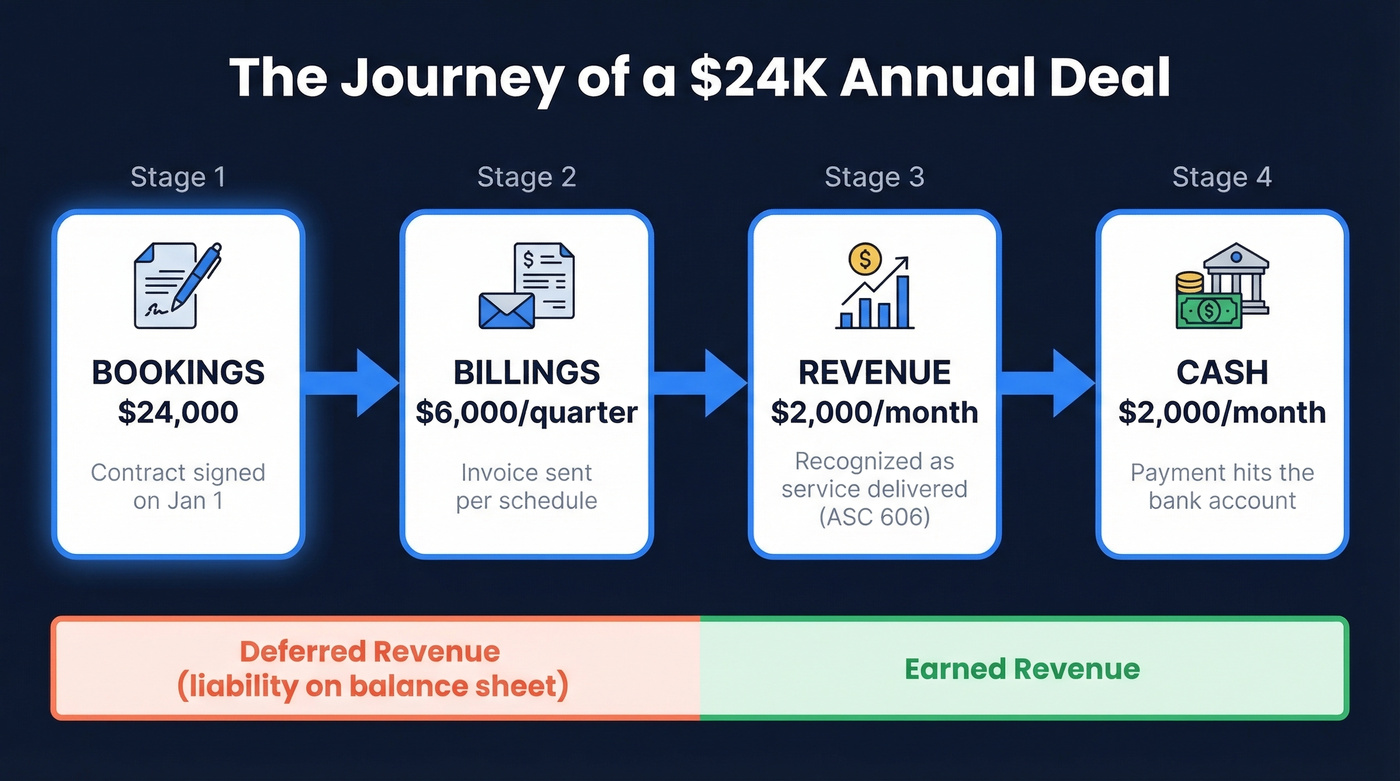
| Bookings | Billings | Revenue | |
|---|---|---|---|
| When recorded | Contract signed | Invoice sent | Service delivered |
| What it represents | Commitment | Amount owed | Earned income |
| GAAP-compliant? | No | No | Yes (ASC 606) |
| $24K annual deal | $24,000 at signing | Per invoice schedule | $2,000/month recognized |
The gap between bookings and recognized revenue sits on the balance sheet as [deferred revenue - a liability](https://viewpoint.pwc.com/dt/us/en/pwc/accounting_guides/financial_statement_/financial_statement___18_US/Chapter-33 - Revenue-and-contract-costs/33-3-Presenting-contract-related-assets-and-liabilities-ASC-606.html) until you deliver. Understanding what it means to generate revenue - actually earning income by delivering on obligations - is key to grasping why bookings and revenue diverge so sharply.
Revenue recognition follows ASC 606's five-step model: identify the contract, identify obligations, determine price, allocate, and recognize as obligations are satisfied. Per FERF's 2023 survey, 67% of companies reported that implementing ASC 606 required significant process changes.
Here's where the numbers diverge in practice. Take a $360K, 3-year contract with a first-year discount and implementation fees. The CRM records $360K in bookings. Billing sends invoices on a different schedule. Rev-rec software recognizes revenue ratably - but if the billing data has the wrong start date or discount structure, finance finds an $18,000 annual variance during close. That's not a rounding error. That's a board-level problem.
Types of Sales Bookings
Most companies track four categories.
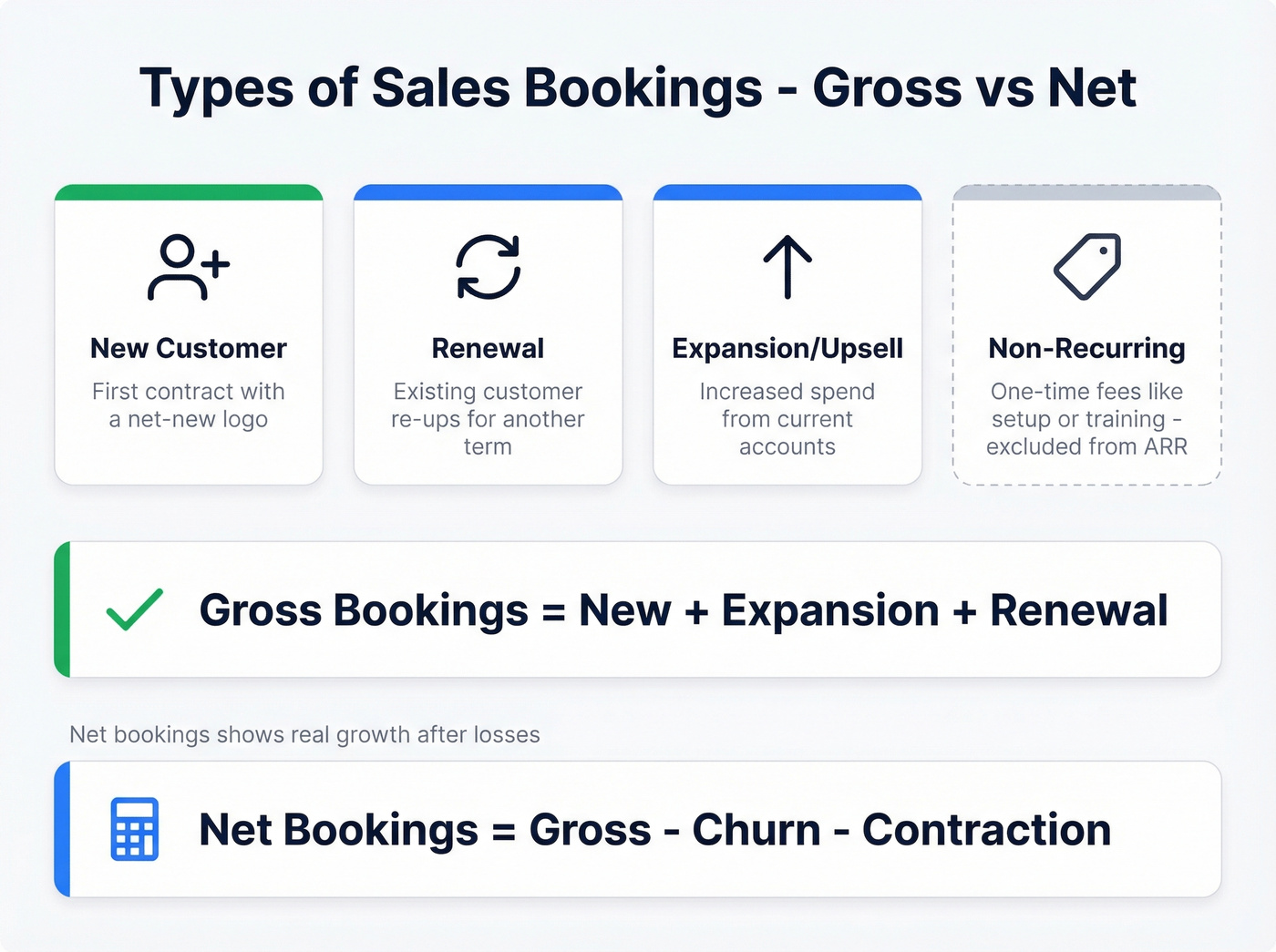
New customer bookings are first contracts with net-new logos. Renewal bookings cover existing customers re-upping for another term. Expansion/upsell bookings capture increased spend from current accounts. And non-recurring bookings - one-time fees like implementation or training - are typically tracked separately and excluded from recurring metrics like ARR.
The formulas that matter:
- Gross bookings = new + expansion + renewal
- Net bookings = gross − churn − contraction
When you isolate new customer bookings and expansion from existing accounts, you arrive at what's called net new revenue - the incremental dollars your business added that weren't simply renewals. David Skok's decomposition framework makes the case that raw bookings are nearly useless if you're mixing durations and types. Break them apart, or you're flying blind.
This isn't just a SaaS concept, either. Services firms track bookings as signed SOW value. Agencies count retainer commitments. Hardware companies use purchase order value and backlog. The contract structure differs, but the principle stays the same: committed dollars, not yet earned.

Bookings growth starts upstream - with pipeline quality. If 15-25% of your outbound emails bounce, those are conversations that never happen and contracts that never get signed. Prospeo delivers 98% email accuracy across 300M+ profiles, so your reps spend time closing, not chasing dead contacts.
More valid contacts. More conversations. More bookings. It's that simple.
ACV vs TCV Bookings
Two formulas you'll use constantly:
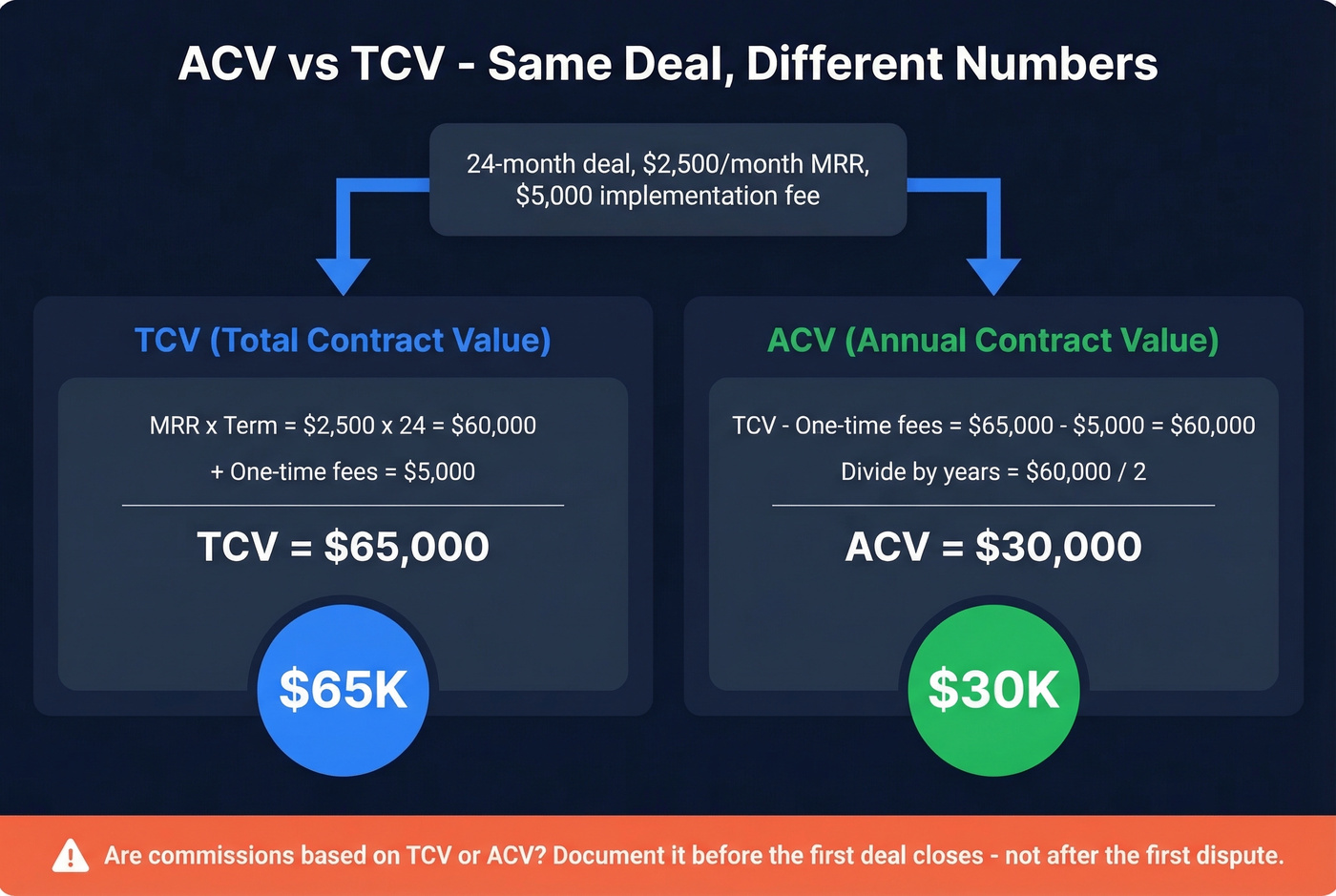
TCV = MRR × term (months) + one-time fees. ACV = (TCV − one-time fees) ÷ years.
Worked example: a 24-month deal at $2,500/month MRR plus a $5,000 implementation fee. TCV = ($2,500 × 24) + $5,000 = $65,000. ACV = ($65,000 − $5,000) ÷ 2 = $30,000.
That 3-year deal worth $360K? Your CRM shows $360K. Finance shows $120K ACV. Your commission is based on... which one?
We've seen comp disputes drag on for months because nobody documented whether commissions were on TCV or ACV. The distinction determines how reps get paid and how the board evaluates growth. Most sales orgs credit reps at booking with clawback provisions if the deal cancels within a defined window - and for good reason. Crediting at revenue recognition kills pipeline visibility and frustrates sellers. Track both metrics, but let sales forecast and earn on bookings.
Why Bookings Definitions Drift
Bookings isn't a GAAP metric. There's no authoritative standard that says "this is how you count it." That's the root cause of every bookings argument you've ever witnessed.
Sales tracks bookings in the CRM. Finance tracks them in accounting software. Different fields, different timestamps, different logic. In r/Netsuite, operators regularly complain they can't reconcile the built-in "Bookings" report to operational dates. In r/SalesOperations, teams that forecast on accrual timing instead of bookings describe pipeline visibility as "messy and hard to forecast." And per a recent Conga survey, 95% of SaaS finance leaders say technology gaps block order-to-cash effectiveness - 54% call those gaps severe.
Let's be honest: the companies that get bookings right aren't the ones with the fanciest formula. They're the ones where Sales and Finance agreed on a written policy before the first deal closed.
How to Diagnose a Decrease in Bookings
Understanding bookings is step one. Growing them is the actual job - but before you can grow, you need to know what's dragging numbers down.
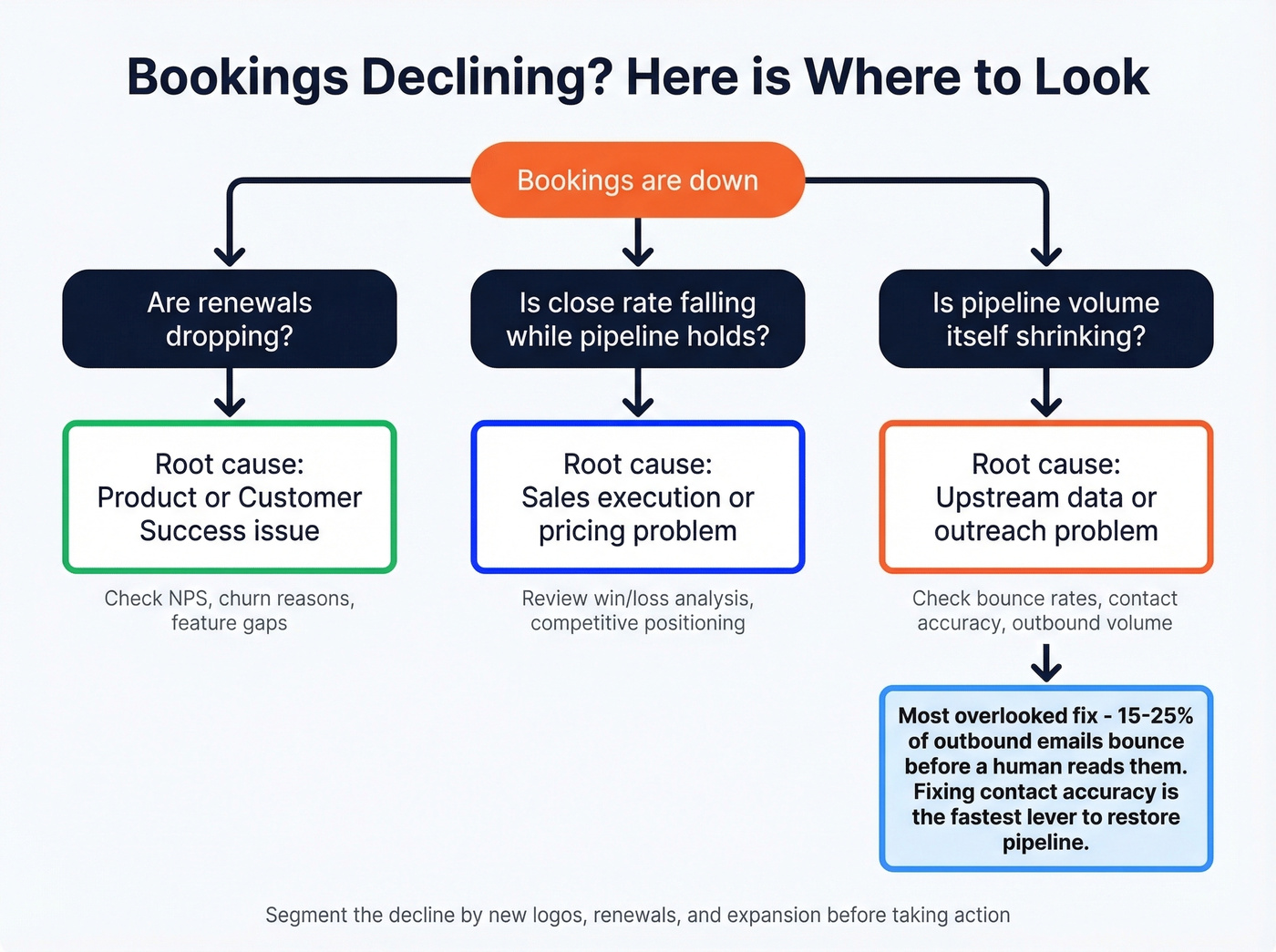
A sustained decrease in bookings is rarely caused by a single factor. It's usually a combination of pipeline quality issues, market shifts, and operational friction between teams that compounds over two or three quarters before anyone sounds the alarm.
Start by segmenting the decline: is it concentrated in new logos, renewals, or expansion? If renewals are dropping, that's a product or CS problem. If new bookings are falling while pipeline volume holds steady, your close rate is the bottleneck. If pipeline itself is shrinking, the issue is upstream - and that's where most teams should look first.
Here's the thing most teams get wrong: they over-invest in closing tactics and under-invest in contact accuracy. We've seen teams obsess over close rates while 15-25% of their outbound emails bounce before a human ever reads them. More valid contacts means more conversations, and more conversations convert to signed contracts. That's the bookings math that actually matters. Tools like Prospeo - with 98% email accuracy and a 7-day data refresh cycle across 300M+ professional profiles - exist specifically to fix that upstream problem before it starves your pipeline.
If you want to go deeper on the upstream mechanics, start with sales prospecting techniques and then tighten your list quality with data enrichment services and email deliverability.
Diagnosing a bookings decline? Before you overhaul your close process, check your contact data. Teams using Prospeo cut bounce rates below 4% and tripled pipeline - because every rep reaches real buyers at verified emails and direct dials, not dead inboxes.
Stop losing bookings to bad data - start with 75 free verified emails.
FAQ
Are bookings the same as sales?
Not exactly. Bookings specifically means committed contract value at signing - before revenue is recognized or cash collected. "Sales" is colloquial and vague; in finance conversations the two terms aren't interchangeable, and conflating them causes reporting errors.
Do bookings include upsells and renewals?
Yes, if your bookings policy counts them. Most companies track new, expansion, and renewal bookings separately, then sum them into gross bookings. Net bookings subtracts churn and contraction, giving a clearer picture of real growth.
When should reps get credit - at booking or revenue recognition?
At booking, with clawback provisions if the deal cancels within 60-90 days. Crediting at rev-rec kills pipeline visibility and delays comp payouts. Track both metrics, but let sellers forecast and earn on bookings.
How can better data help increase bookings?
Inaccurate contact data inflates bounce rates and shrinks the pipeline that feeds bookings. Cutting bounce rates below 4% means more live conversations and more signed contracts per quarter - and that's the most direct lever most teams aren't pulling.