

What Is a Lead in Marketing - And What Do You Actually Do With One?
Your marketing team just hit their MQL target for the quarter, but sales says 80% of the leads are garbage. Sound familiar? The word "lead" is doing too much work - a PDF download isn't a demo request, and a webinar registrant isn't a hand-raiser. If you've ever asked what a lead in marketing actually is and gotten a different answer from every department, you're not alone. Let's fix the definition, then build a system that turns marketing leads into revenue.
What Is a Lead in Marketing?
A lead is a person who's given you their contact information and shown some signal of interest in what you sell. That's it. Not a name scraped from a directory. Not a random business card from a conference. A lead has done something - downloaded a guide, filled out a form, started a free trial, asked a question in live chat - that tells you they could eventually buy.
The confusion starts because "lead" gets used to describe three different things: a person, a data record in your CRM, and a conversion event on your website. Marketing teams count form fills. Sales teams count conversations. Finance counts pipeline dollars. When those three groups use the same word to mean different things, you get the quarterly argument about lead quality that every B2B company knows too well.
85% of marketers say lead generation is their top performance measure. If you're measuring the wrong thing - or measuring the right thing with the wrong definition - every downstream decision is built on sand.
Quick Version
If you're short on time:
- Align your definition first. Marketing and sales must agree - in writing - on what counts as a lead before you spend a dollar on generation. This is the single highest-leverage thing you can do.
- The average visitor-to-lead conversion rate is 2.9%. If you're in that range, you're normal. Below 1%? You've got a targeting or offer problem.
- Lead scoring becomes essential once you're generating 50+ leads per month. Without it, you're handing sales a pile of names instead of a prioritized pipeline.
- A lead with a bounced email is worthless. Tools like Prospeo keep bounce rates under 4% with 98% email accuracy - that's the difference between a contact list and a pipeline you can actually work.
Why Leads Matter More Than You Think
Most "what is a lead" explainers treat leads like a vocabulary word. They're the most important unit of measurement in your go-to-market engine.
The B2B buying process is long and front-loaded. According to 6sense research, the average B2B buying cycle runs 10.1 months, and first contact with a vendor doesn't happen until 61% of the journey is already complete. By the time someone fills out your demo form, they've been researching for months.
Forrester data shows 92% of buyers start with at least one vendor already in mind, and 41% already have a preferred vendor before formal evaluation even begins. The winning vendor is on the Day One shortlist 95% of the time, and the pre-contact favorite wins roughly 80% of deals. That means the lead you capture today started thinking about their problem back in the spring.
Here's the thing: if you're not generating leads early - through content, brand awareness, and educational touchpoints - you're not even in the consideration set when the budget gets approved. Lead generation isn't about volume. It's about being present before the buyer knows they're buying.
Types of Leads - The Full Taxonomy
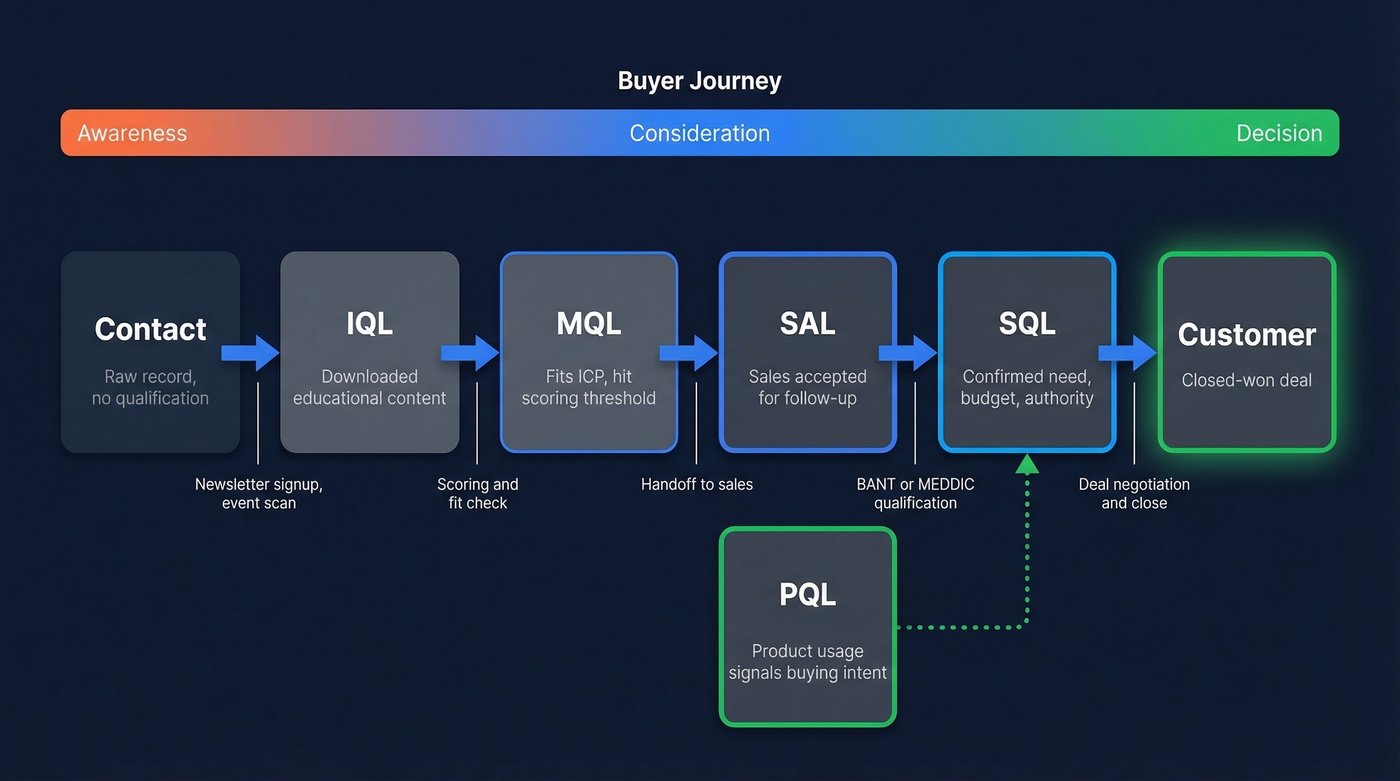
The journey from "anonymous visitor" to "closed customer" has more stages than most teams track. Here's the full lifecycle, with the conversion math at each step.
IQL, MQL, and SAL
The journey starts with a Contact - a raw record in your system with no qualification applied. They subscribed to a newsletter or got added from an event scan. They exist in your database, but you know almost nothing about their intent.
An Information Qualified Lead (IQL) is someone who's exchanged contact info for educational content - a whitepaper download, a webinar registration. They're learning, not buying. Most companies don't formally track IQLs, but they should, because this is where your nurture engine starts.
A Marketing Qualified Lead (MQL) has been vetted by marketing as ready for sales outreach based on fit and engagement criteria. They match your ICP, they've hit a scoring threshold, and they've done something beyond passive consumption - visited the pricing page, attended a live demo, or engaged with multiple pieces of content. In account-based marketing, teams also track MQAs (Marketing Qualified Accounts), where the qualification unit is the company rather than the individual contact.
A Sales Accepted Lead (SAL) is the handoff moment. Sales has reviewed the MQL and formally accepted it for follow-up within a defined timeframe. This stage matters because it creates accountability - without it, leads disappear into a black hole between marketing's "we sent it over" and sales' "we never got anything good."
SQL and PQL
A Sales Qualified Lead (SQL) has been confirmed by sales as a legitimate opportunity with need, budget, authority, and intent. Think demo requests, quote inquiries, or direct outreach responses where the prospect engages substantively. Sales teams typically qualify SQLs using frameworks like BANT, CHAMP, or MEDDIC.
A Product Qualified Lead (PQL) is unique to product-led growth companies. This is someone who's used your free tier or trial and hit a usage threshold that signals buying intent - they've invited teammates, hit a feature wall, or used the product consistently for weeks. PQLs tend to convert better than MQLs because they've already experienced the value firsthand.
Further down the funnel, Service Qualified Leads are existing customers signaling expansion or upsell intent through support interactions, and Opportunities are SQLs with a defined deal value and timeline in the CRM.
Stage-to-Stage Conversion Benchmarks
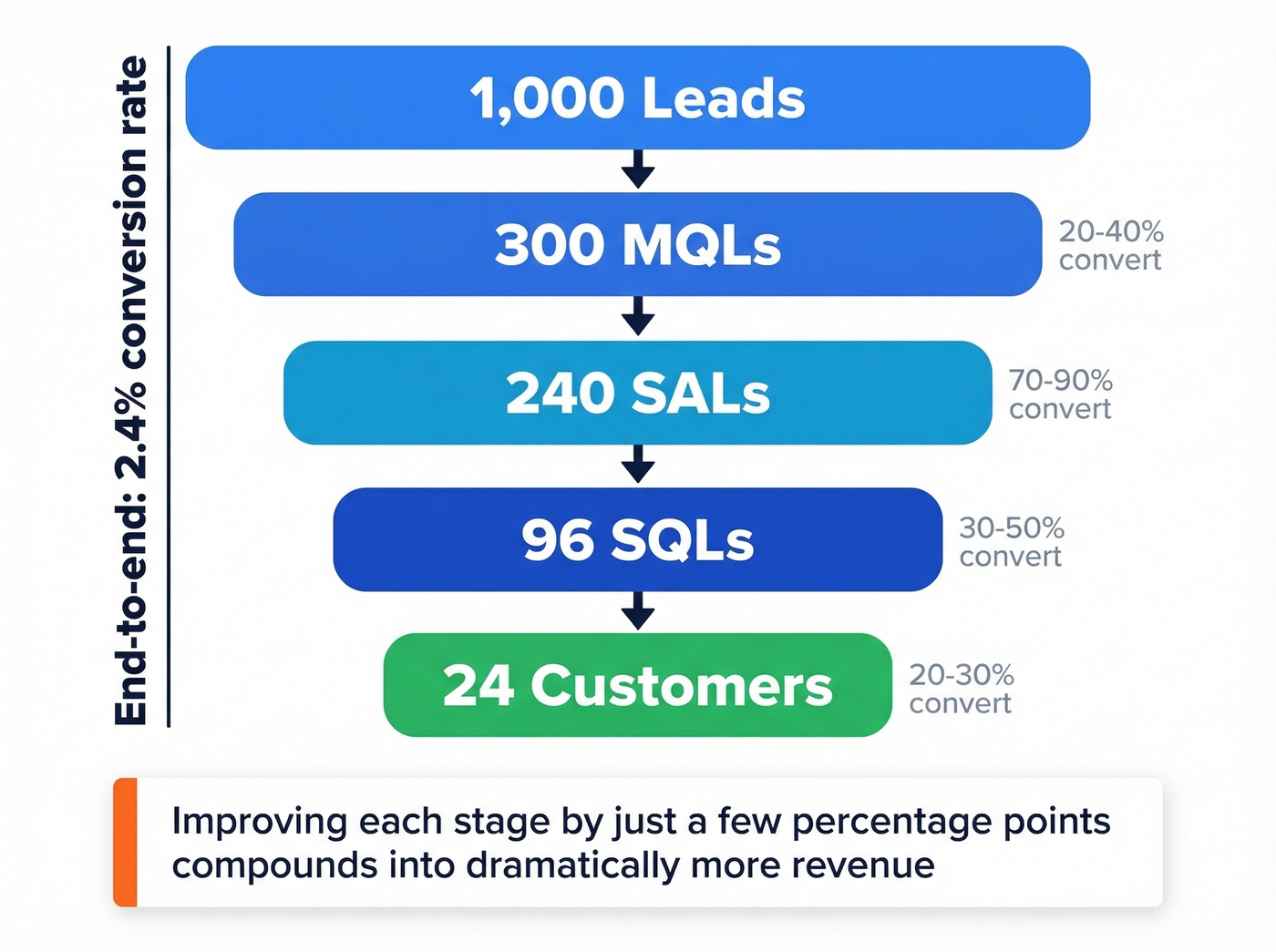
Here's where most leads actually go:
| Stage Transition | Conversion Rate |
|---|---|
| Lead → MQL | 20-40% |
| MQL → SAL | 70-90% |
| SAL → SQL | 30-50% |
| SQL → Customer | 20-30% |
The math is sobering. Start with 1,000 leads and you get roughly 300 MQLs, 240 SALs, 96 SQLs, and 24 customers. That's a 2.4% end-to-end conversion rate - and that's normal. The teams that win aren't generating more leads at the top. They're improving conversion rates at each stage by even a few percentage points.

You just saw the math: 1,000 leads become 24 customers - and that's only if the data is clean. A bounced email kills the funnel before scoring even starts. Prospeo delivers 98% email accuracy with a 7-day refresh cycle, so every MQL you hand to sales has a verified, deliverable contact behind it. Teams using Prospeo cut bounce rates from 35%+ to under 4%.
Fix your lead quality problem at the source - the data.
B2B vs B2C Leads
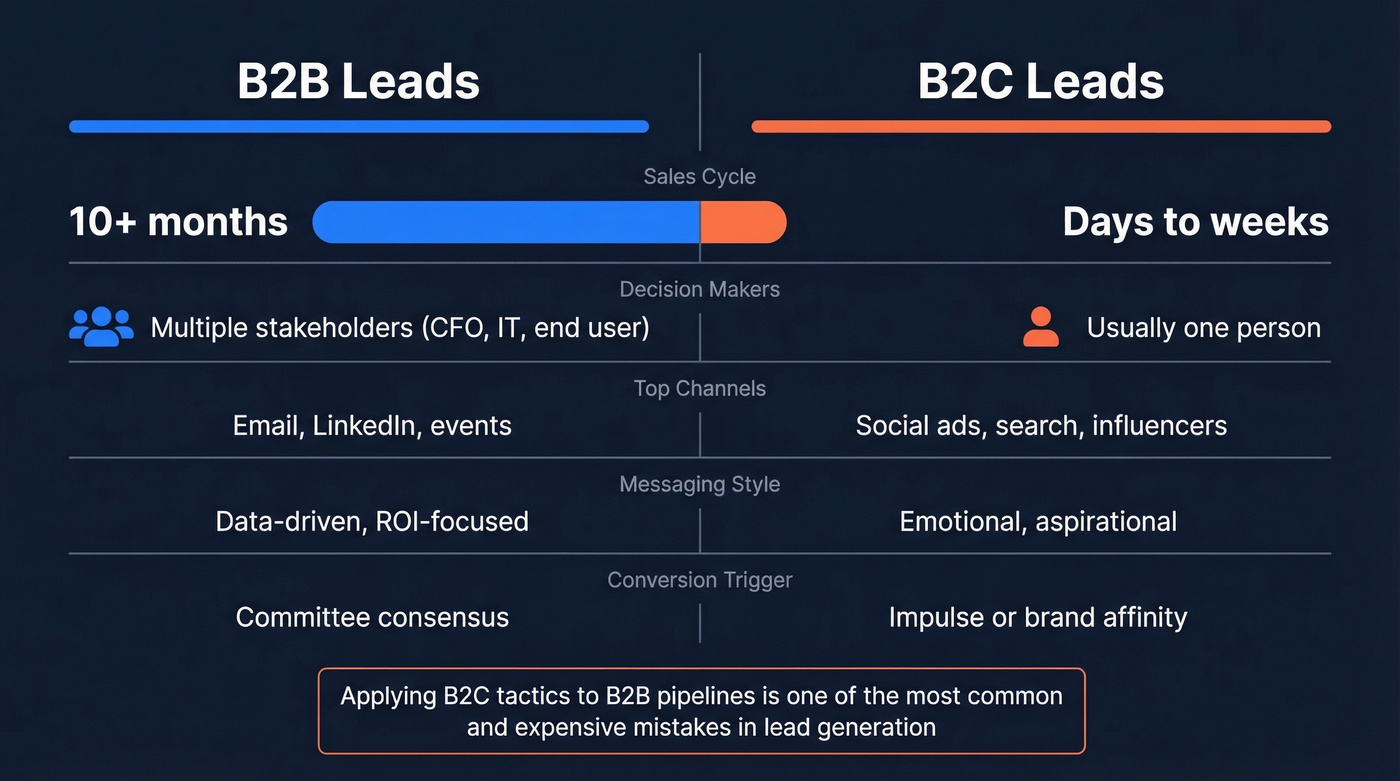
The word "lead" means something fundamentally different in B2B and B2C contexts. Treating them the same is a common mistake.
| Dimension | B2B | B2C |
|---|---|---|
| Sales cycle | ~10 months on average | Days to weeks |
| Decision-makers | Multiple stakeholders | Usually one person |
| Channels | Email, professional networks, events | Social, search ads, influencers |
| Messaging style | Data-driven, ROI-focused | Emotional, aspirational |
| Conversion trigger | Committee consensus | Impulse or brand affinity |
B2B leads require relationship-building across multiple stakeholders who each evaluate your product through a different lens - the CFO cares about ROI, the end user cares about ease of use, and the IT team cares about security. Your lead nurture has to speak to all of them, which is why B2B cycles stretch past 10 months on average.
B2C leads convert on emotion and convenience. A well-timed social ad with a discount code can close a sale in minutes. In many B2C funnels, the "lead" stage is compressed or skipped entirely - the visitor goes straight to buyer.
We've watched teams try to apply B2C lead gen tactics - high-volume, low-touch, discount-driven - to B2B pipelines. It doesn't work. You end up with thousands of contacts that'll never translate into $50k enterprise contracts.
What's a Good Lead Conversion Rate?
Lower than you think. A Ruler Analytics study across 100M+ data points and 14 industries found the average visitor-to-qualified-lead conversion rate is 2.9%. The average form conversion rate is 1.7%, and the average phone call rate is 1.2%.
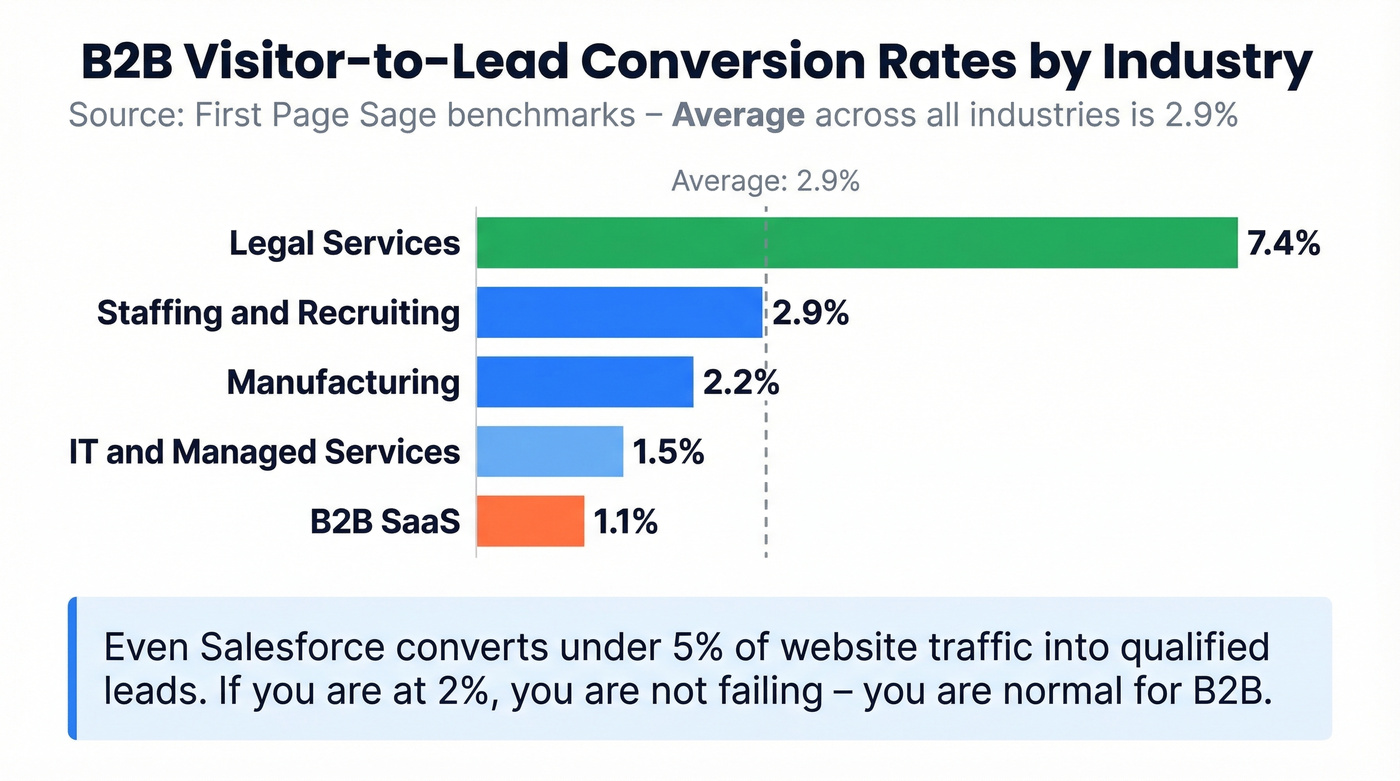
Here's how specific B2B industries stack up, per First Page Sage benchmarks:
| Industry | Conversion Rate |
|---|---|
| B2B SaaS | 1.1% |
| IT & Managed Services | 1.5% |
| Manufacturing | 2.2% |
| Staffing & Recruiting | 2.9% |
| Legal Services | 7.4% |
First Page Sage notes Salesforce converts under 5% of its website traffic into qualified leads. If you're sitting at 2%, you're not failing - you're operating within normal range for most B2B categories.
The takeaway isn't to accept low conversion rates. It's to stop panicking about them and start optimizing methodically. A 0.5% improvement from 2% to 2.5% on 100,000 monthly visitors means 500 more leads per month. That's meaningful pipeline.
How to Score Marketing Leads
Lead scoring separates the "downloaded a PDF once" contacts from the "visited pricing three times this week" prospects. Without it, sales wastes time on leads that'll never buy, and hot prospects go cold while they wait.
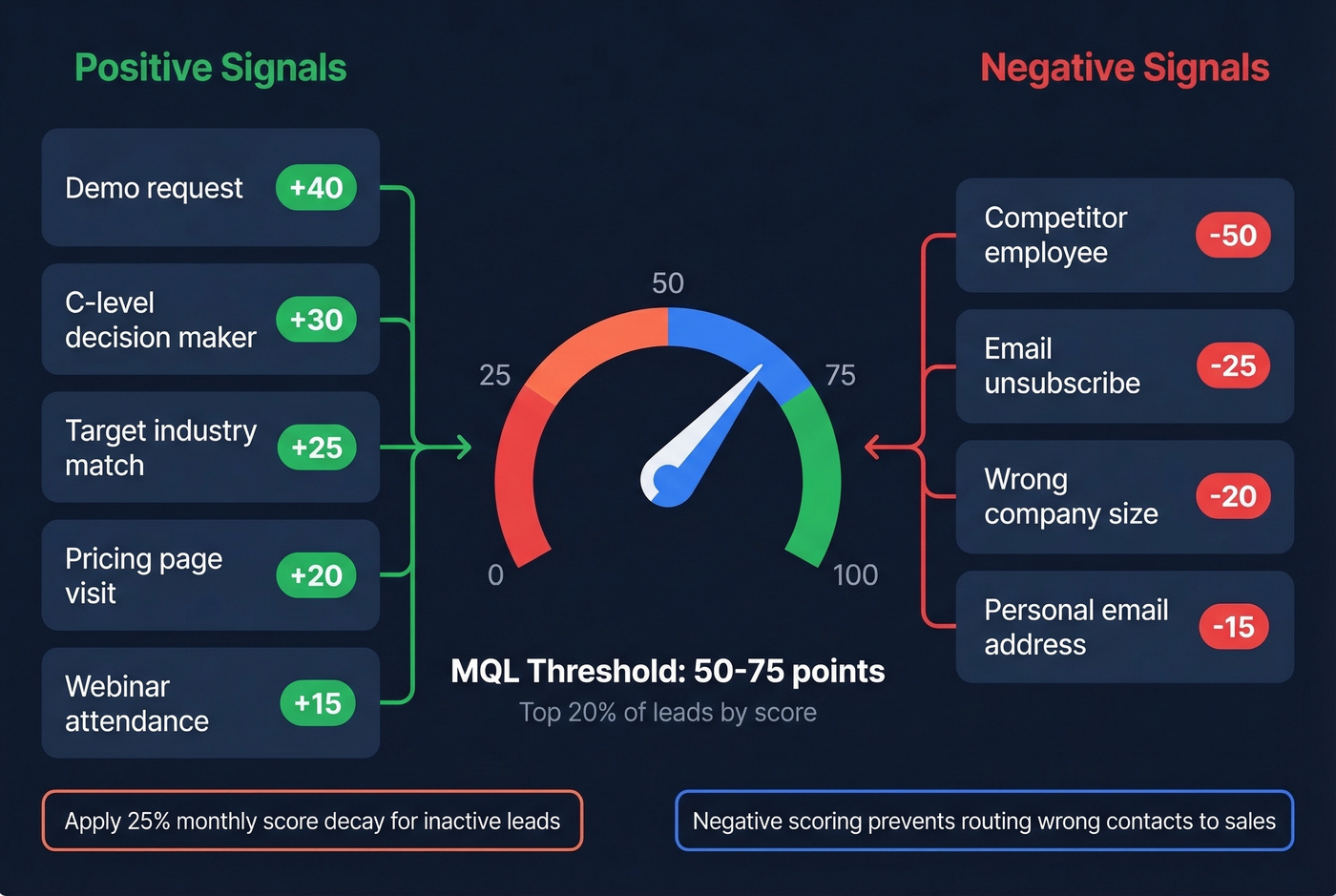
Start with 5-7 core criteria that predict most of your conversions. Combine explicit signals - who they are - with implicit signals - what they've done.
Positive signals:
| Signal | Points |
|---|---|
| C-level decision-maker | +30 |
| Target industry match | +25 |
| Pricing page visit | +20 |
| Demo request | +40 |
| Webinar attendance | +15 |
Negative signals:
| Signal | Points |
|---|---|
| Personal email (B2B context) | -15 |
| Competitor employee | -50 |
| Email unsubscribe | -25 |
| Wrong company size | -20 |
A VP of Marketing at a target-industry company who visited your pricing page and attended a webinar scores 90 points - well above the MQL threshold. Set that threshold to capture the top ~20% of leads by score, typically 50-75 points on a 100-point scale.
Two things most teams skip that matter enormously. First, time-based score decay: reduce scores by 25% monthly without new activity. A lead who was hot in January and silent through March isn't hot anymore. Second, negative scoring: skip it and you end up routing the wrong people to sales. That -50 for competitor employees saves your team hours of wasted outreach every week.
Generating Quality Leads
The channels are well-established: content and SEO for inbound, paid search and social for acceleration, email for outreach, webinars for mid-funnel engagement, and referrals for the highest-converting leads you'll ever get.
But most teams optimize for lead volume at the top of the funnel and ignore what happens downstream. An eBook converting 10% of visitors into leads sounds great - until you realize only 0.1% of those leads become customers. A demo page converting just 0.5% of visitors produces a 20% lead-to-customer rate. Fewer leads, dramatically more revenue.
For teams with average deal sizes under $15k, you probably don't need 10,000 leads per month. You need 200 good ones. Most teams are over-indexed on top-of-funnel volume because it's the easiest metric to inflate.
Buying lists is lighting money on fire. Purchased contacts haven't shown any interest in your business. When you email them, you get bounces, spam complaints, and domain reputation damage that tanks deliverability for every email you send. Cold email reply rates hover around 2%, which means the quality of who you're emailing matters more than how many you email. If your bounce rate is above 5%, you've got a data problem, not a volume problem.
This is where data quality becomes the foundation everything else sits on. Once you've built your ICP and scoring model, you need verified contact data to actually reach those leads. Prospeo covers 300M+ professional profiles with 98% email accuracy and refreshes data every 7 days - the industry average is 6 weeks. One customer, Meritt, dropped their bounce rate from 35% to under 4% and tripled pipeline from $100K to $300K per week.
What Happens After Capture
Generating a lead is the beginning, not the finish line. 80% of new leads never convert into sales - not because they're bad leads, but because nobody followed up properly.
Lead nurturing campaigns generate 50% more sales-ready leads at 33% lower cost than non-nurtured approaches. Nurtured leads make 47% larger purchases. The ROI on email marketing runs about $36 for every $1 invested, which is why email remains the backbone of most nurture sequences.
Nurture email open rates run 36-42% with click-through rates around 8%, compared to roughly 3% CTR for standard marketing emails. High-performing sequences push past 55% open rates and 10-12% CTR.
Speed matters as much as sequence. Leads contacted within 5 minutes are 21x more likely to qualify than those contacted after 30 minutes. We've tested speed-to-lead across dozens of campaigns - the 5-minute window is real. Every minute of delay costs you conversion probability. If your lead routing takes hours, or worse, days, you're losing deals before sales ever picks up the phone.
If you want to tighten this up fast, start with your sales follow-up and your lead generation workflow.
Defining lead stages is step one. Actually reaching those leads is step two. Prospeo gives you 300M+ verified profiles with 30+ filters - buyer intent, technographics, job changes, funding - so you're not just generating leads, you're generating the right ones. At $0.01 per email, enterprise-grade lead data no longer requires an enterprise budget.
Turn your lead taxonomy into a working pipeline for a penny per contact.
FAQ
What's the difference between a lead and a prospect?
A lead has given you contact information and shown initial interest - a form fill, a download, a signup. A prospect is a lead that's been qualified as fitting your ideal customer profile with genuine buying potential. Every prospect was once a lead, but most leads never become prospects. Sales should spend time on prospects, not unqualified leads.
How many leads do I need to hit my revenue target?
Work backward. If you need 20 new customers per quarter and your SQL-to-customer rate is 25%, you need 80 SQLs. If your lead-to-SQL rate is roughly 10%, that's 800 leads. Adjust based on your actual stage-to-stage conversion rates - the benchmarks above give you a starting framework.
What's a good cost per lead in B2B?
B2B SaaS companies typically see $50-200 per MQL through content marketing and $100-400+ through paid channels. Legal and financial services run higher. The more important metric is cost per qualified lead - a $500 lead that converts is cheaper than a $50 lead that doesn't.
How do I keep lead contact data accurate?
Verify before you send. Bad emails destroy domain reputation and waste every dollar you spent generating the lead. Run contacts through a verification tool before any outreach - you need 98%+ accuracy and catch-all domain handling at minimum. Prospeo's free tier gives you 75 verified emails per month to test the difference clean data makes before committing to a paid plan.
Do I need a CRM to manage leads?
Once you're past 20-30 leads per month, yes. HubSpot's free CRM handles basic lead tracking, scoring, and pipeline management for small teams. Salesforce is the enterprise standard. The tool matters less than the discipline - if leads aren't tracked, scored, and routed systematically, they die in someone's inbox. Skip the CRM if you're a solo founder with 10 leads a month; don't skip it once you've got a team.