

What Is a SaaS Company? Definition & Guide (2026)
You know what SaaS stands for. Software as a Service. That part's easy. What's harder is understanding why 90% of SaaS startups fail, which metrics separate a healthy company from one that's quietly bleeding out, and why AI is putting real pressure on the entire model right now.
Quick definition: A SaaS company delivers software over the internet on a subscription basis. The vendor hosts the application centrally, and customers access it through a browser without installing anything. A practical rule some market lists use: if more than 65% of a company's revenue comes from recurring payments for cloud-based software, it qualifies as SaaS.
How the SaaS Model Works
Instead of buying software, installing it on your servers, and managing updates yourself, you rent access to an application someone else runs. The vendor handles everything behind the curtain - servers, security patches, uptime, backups. You open a browser and use it.
Most SaaS products run on multi-tenant architecture. One codebase serves thousands of customers simultaneously, with each customer's data isolated but the infrastructure shared. This is what makes SaaS economics work: the marginal cost of adding one more customer is low.
The practical differences from on-premise software:
- Updates happen automatically. No IT team scheduling weekend maintenance windows.
- Access is browser-based. Any device, any location.
- Scaling is the vendor's problem. Need to handle 10x traffic? That's on them.
- You don't own the software. Stop paying, lose access. That's the tradeoff.
For the customer, it's convenience and lower upfront cost. For the vendor, it's predictable recurring revenue and a direct relationship with every user.
SaaS companies increasingly fall into two camps. Horizontal SaaS serves broad functions across industries - think Salesforce for CRM or Slack for messaging. Vertical SaaS goes deep into a single industry: Veeva for life sciences, Procore for construction, Toast for restaurants. Then there's Micro-SaaS, tiny, often bootstrapped products solving one narrow problem for a niche audience, which has become a popular path for solo founders because the surface area is small enough to ship fast and stay focused.
SaaS vs PaaS vs IaaS
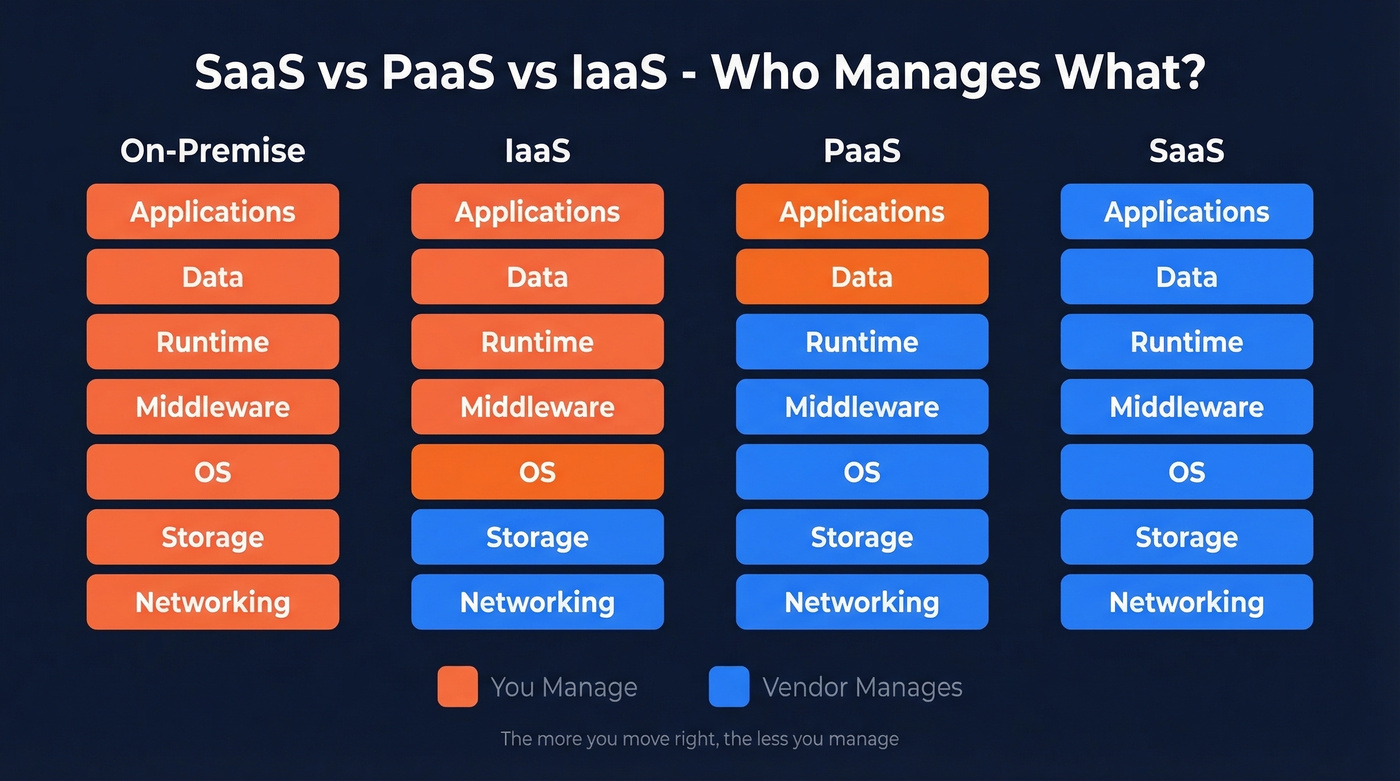
These three models sit on a spectrum of how much the vendor manages for you. Red Hat's responsibility framework breaks it down cleanly.
| Layer | On-Premise | IaaS | PaaS | SaaS |
|---|---|---|---|---|
| Applications | You | You | You | Vendor |
| Data | You | You | You | Vendor |
| Runtime | You | You | Vendor | Vendor |
| Middleware | You | You | Vendor | Vendor |
| OS | You | You | Vendor | Vendor |
| Networking | You | Vendor | Vendor | Vendor |
| Storage | You | Vendor | Vendor | Vendor |
IaaS (Infrastructure as a Service) gives you raw computing resources - servers, storage, networking. AWS, Microsoft Azure, and Google Cloud are the big three. You still manage the OS, middleware, and applications yourself.
PaaS (Platform as a Service) adds a development environment on top. Think Heroku or Google App Engine. You write code; the platform handles deployment and scaling.
SaaS is the full stack. The vendor manages everything. You just use the product.
A newer category worth knowing: MaaS (Model as a Service) delivers pre-trained AI models on demand - OpenAI's API, Google's Vertex AI. It's blurring the line between PaaS and SaaS as more companies consume AI capabilities without building models themselves.
How SaaS Companies Make Money
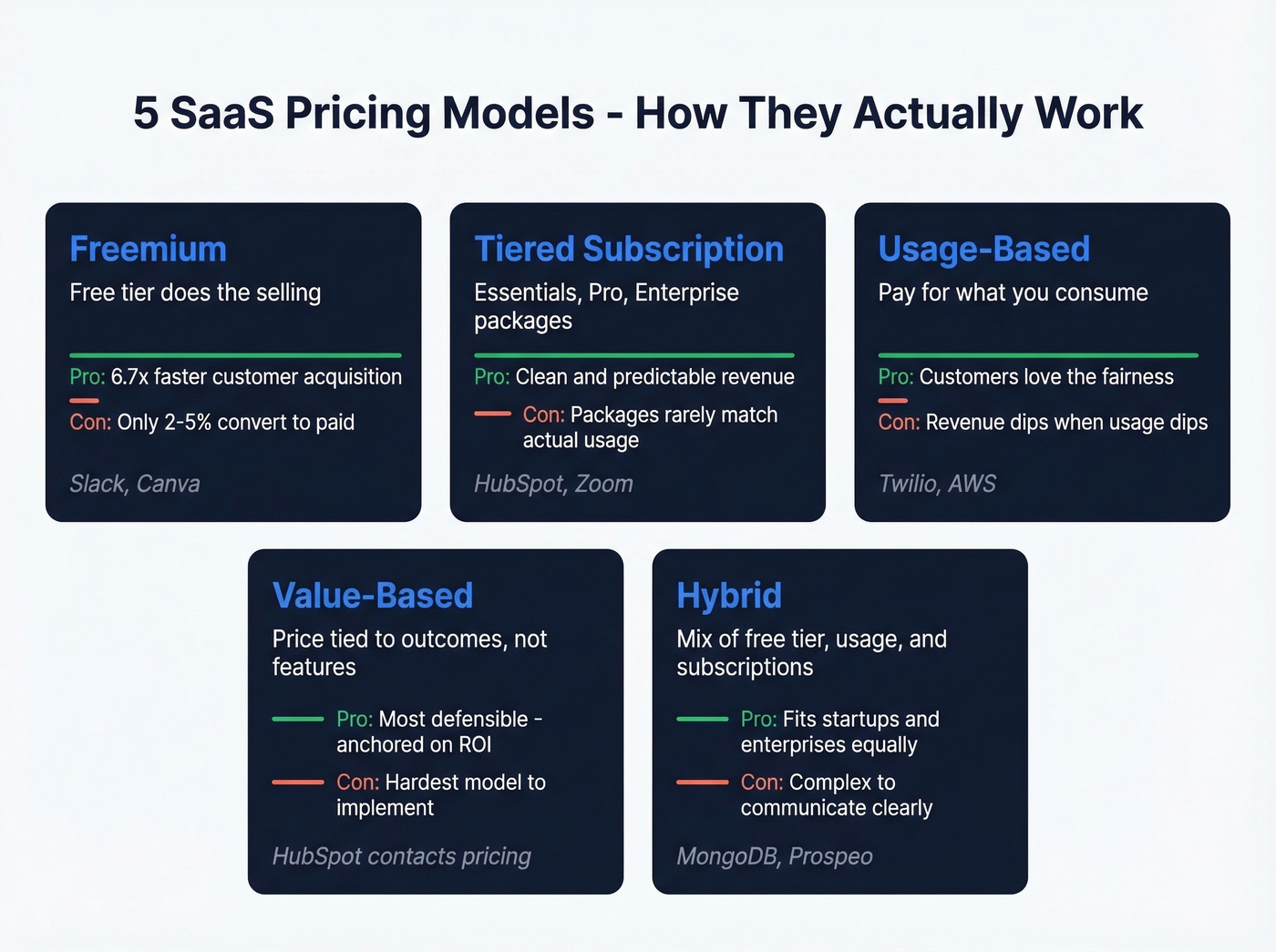
Not every SaaS company charges the same way. The pricing model tells you a lot about strategy.
Freemium
Only 2-5% of free users convert to paid. That sounds terrible until you learn freemium companies acquire customers 6.7x faster than non-freemium ones. Slack built a $27.7B acquisition with a product-led motion that made the free tier do the selling. The tradeoff is margin for velocity - acquisition costs are near zero for free users, and the product sells itself.
Tiered Subscription
The most common model: Essentials, Professional, Enterprise, Unlimited - each tier unlocks more features at a higher price. It's clean and predictable, but it forces customers into packages that don't always match their actual usage. A lot of mid-market SaaS still defaults here.
Usage-Based Pricing
Usage-based pricing grew from 23% adoption in 2020 to 45% in 2023, and AI compute costs are accelerating the shift. Twilio charges per message. AWS charges per compute hour. Customers love the fairness; CFOs love the alignment between cost and value. The downside is revenue unpredictability - usage dips in a recession, and your ARR dips with it.
Value-Based
Price tied to the outcome, not the feature set. HubSpot charges based on the number of marketing contacts - the more contacts you manage, the more you pay. About 39% of SaaS companies use some form of value-based pricing. It's the hardest model to implement but the most defensible, because customers anchor on ROI rather than line items.
Hybrid Is Where Things Are Heading
One model rarely fits a startup and an enterprise equally. MongoDB combines a free tier, usage-based cloud pricing, and enterprise subscriptions. Prospeo runs a credit-based model with a free tier and paid plans starting around $0.01 per email - fully self-serve, no annual contracts, no "talk to sales" gate.
That last point matters more than you'd think. 55% of SaaS companies don't publish pricing at all. They gate it behind a sales call, which tells you the price is high enough that they'd rather negotiate than lose prospects to sticker shock. Here's the thing: if a SaaS company hides its pricing in 2026, it's not protecting margins. It's signaling that the product can't sell itself.
SaaS Market in 2026
The SaaS market isn't slowing down, even with AI disruption looming.
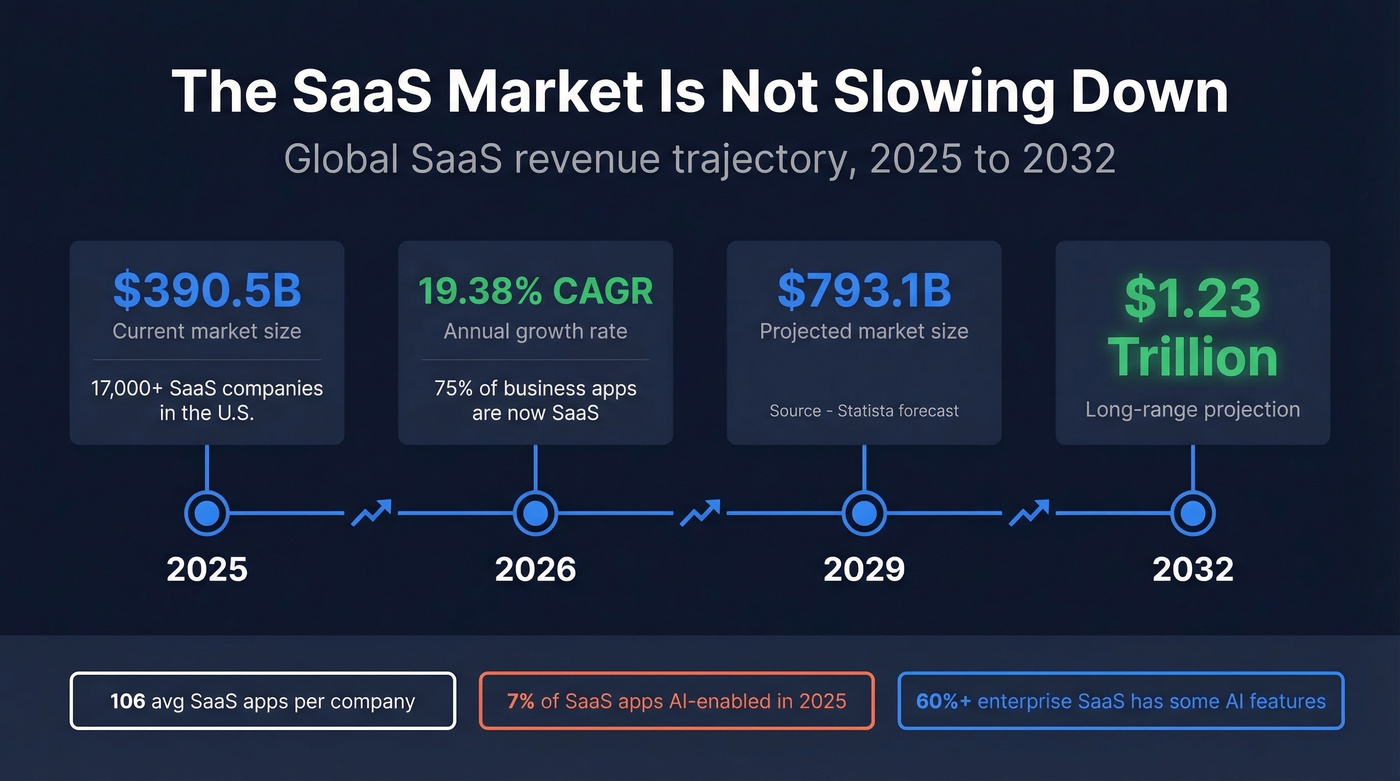
Global SaaS revenue hit $390.5B in 2025. One widely cited Statista forecast pegs growth at 19.38% per year from 2025-2029, reaching $793.1B by 2029. Longer-range projections put the market at $1.23 trillion by 2032. The U.S. alone has over 17,000 SaaS companies.
The average company's software stack sits at 106 SaaS apps, down slightly from 112 in 2023 as consolidation picks up. Roughly 75% of all business applications are now SaaS - the on-premise era is effectively over for most categories.
The AI layer is growing fast but still early. In 2025, 7% of SaaS apps were AI-enabled, and 60%+ of enterprise SaaS products had embedded AI features in some form. The gap between "has AI" and "AI is core to the product" remains enormous.

You just read how SaaS pricing models work. Prospeo is a real example: credit-based, self-serve, no contracts. 300M+ profiles, 98% email accuracy, starting at $0.01 per email. The kind of transparent SaaS pricing this article says every company should adopt.
See what a SaaS product looks like when it doesn't hide behind a sales call.
SaaS Company Examples
SaaS spans every business category. Here's a cross-section organized by function:
| Company | Category | Revenue / Scale | Year |
|---|---|---|---|
| Salesforce | CRM | $34.8B | 2023 |
| HubSpot | Marketing / CRM | - | - |
| Prospeo | Sales Intelligence | 15,000+ companies | - |
| Zoom | Video Communications | - | - |
| Slack | Team Messaging | Acquired for $27.7B | 2021 |
| Twilio | Communications API | - | - |
| DocuSign | E-Signatures | $2.6B | 2024 |
| Canva | Design | $2B | 2023 |
| Dropbox | Cloud Storage | $2.5B | 2023 |
| monday.com | Project Management | $729.7M | 2023 |
| Asana | Work Management | $652.5M | 2023 |

A common question: is Netflix SaaS? Short answer is no - see the FAQ below.
Key SaaS Metrics
Whether you're evaluating, building, or investing in a SaaS company, these are the numbers that matter.
Revenue Metrics
MRR/ARR (Monthly/Annual Recurring Revenue) is the foundation. Everything else builds on this.
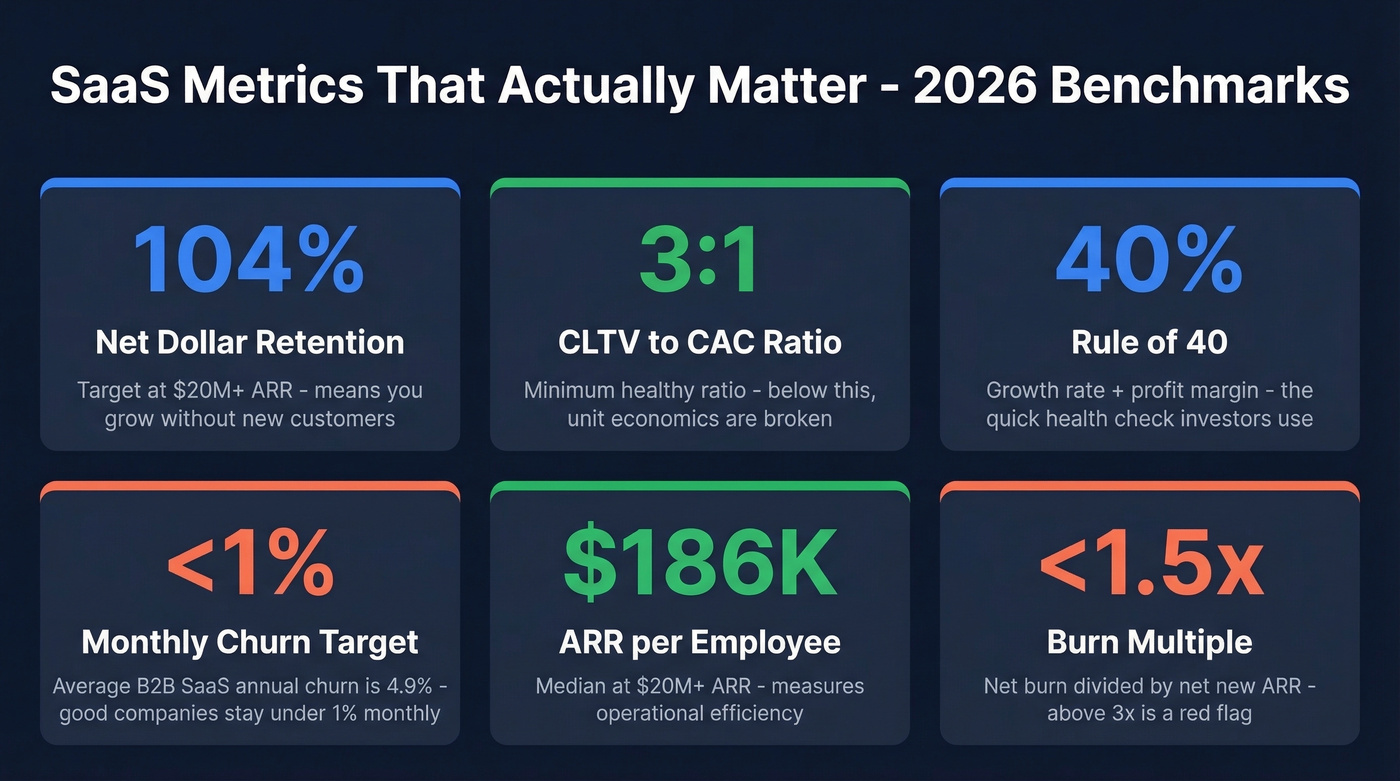
Net Dollar Retention (NDR) tells you whether existing customers are spending more or less over time. The formula: (Starting ARR + expansion - contraction - churn) / Starting ARR. NDR above 100% means you're growing revenue from your existing base without acquiring a single new customer. Benchmarks: 100% at under $1M ARR, 104% at over $20M ARR.
ARR per employee measures operational efficiency. The median for private SaaS is $125,000. Companies above $20M ARR average $186,661 per employee.
Churn
Customer churn formula: (Customers Lost / Customers at Start) x 100.
Revenue churn matters more when customer sizes vary - losing one enterprise account hurts differently than losing ten SMB accounts. Negative net revenue churn, where expansions exceed losses, is the gold standard.
Benchmarks: average annual SaaS churn runs ~3.8% overall, ~4.9% for B2B SaaS. "Good" is under 1% per month.
For a deeper breakdown of churn math and benchmarks, see churn.
Efficiency
Rule of 40: Revenue growth rate + profit margin >= 40%. This is the quick-and-dirty health check investors use. A company growing 60% with -15% margins passes (45%). A company growing 15% with 20% margins doesn't pass (35%). Neither number alone tells the story.
CLTV:CAC ratio measures how much a customer is worth relative to what it cost to acquire them. 3:1 or higher is the target. If you want to go deeper on CAC, start with cost to acquire.
CAC payback period varies by segment - roughly 5-7 months for SMB, 12-18 months for enterprise. If it takes longer than 18 months to recoup acquisition costs, the unit economics are strained.
Burn multiple: Net Burn / Net New ARR. Lower is better. Under 1.5x is efficient; above 3x is a red flag.
Why Most SaaS Startups Fail
About 90% of SaaS startups fail. The single biggest reason, at 42%, is building something nobody needs. Not bad code, not poor marketing - just no market need.
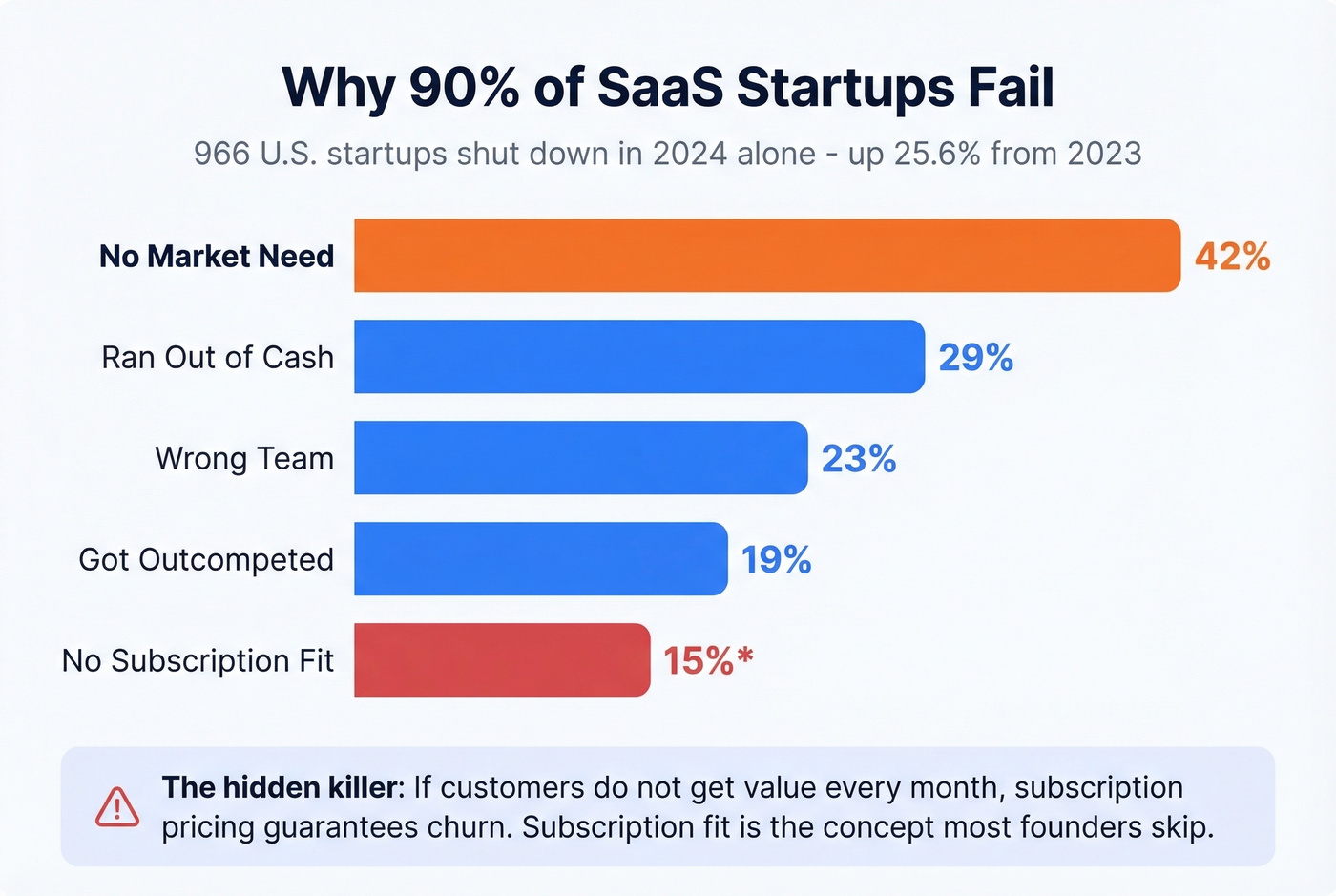
The numbers got worse recently. In 2024, 966 U.S. startups shut down - a 25.6% increase over 2023. That's an estimated $6-8B in venture capital evaporated.
Let's be honest about something most founders miss: SaaS only works when the value is continuous and recurring. A Reddit thread on r/Entrepreneur nailed this with a cautionary tale about an electricity-switching service. Customers switch providers once or twice a year. Charging monthly for something people use annually felt like "paying for nothing" - and churn was brutal. The founder eventually realized a one-time fee or revenue-share model would've been a better fit.
We've seen this pattern repeatedly. If your customers don't get value every month, subscription pricing guarantees churn. "Subscription fit" is the concept most SaaS founders skip in their business plan, and it kills more companies than bad engineering ever will.
If you're building a SaaS and need to validate demand, start with a clear ideal customer profile and a measurable addressable market.
AI and the Future of SaaS
The software-as-a-service model is under more pressure in 2026 than at any point since its inception.
AI isn't just an add-on feature anymore - it's becoming the core capability. Early adopters report tangible gains: one learning platform saw 60% higher engagement from AI personalization, while another cut support ticket backlog by 40% in a month. This is pushing pricing models toward usage-based and hybrid structures, because AI compute costs scale with consumption in ways that flat subscriptions can't absorb.
But the bigger threat is build-vs-buy. A Forbes report on a Retool survey found that 35% of companies have already replaced at least one SaaS tool with something built in-house, and 78% plan to replace more in 2026. What are they building? Workflow automation tools, BI dashboards, CRM systems, project management apps - the exact categories where SaaS has dominated.
The tools enabling this shift are accessible. Among companies building internally, 70% use ChatGPT, 56% use Gemini, and 53% use Claude. "Vibe coding" - using AI to generate functional software without deep engineering expertise - is real and accelerating.
That said, 49% of companies that tried haven't built workable software yet. 22% ran into hallucinations and incorrect data structures. Six in ten built tools outside IT oversight, which creates its own security and compliance problems. By 2027, Gartner expects 75% of employees to acquire or modify tech without IT involvement.
The SaaS companies that survive will be the ones where the product is genuinely better than what a team could build in a weekend with Claude. Commodity features are vulnerable. Deep domain expertise, proprietary data, and network effects are not. Skip the SaaS tools that do one simple thing you could automate yourself - invest in the ones sitting on data or workflows you can't replicate.
If you're on the go-to-market side of this shift, it helps to understand modern SaaS sales and the lead generation trends reshaping budgets.
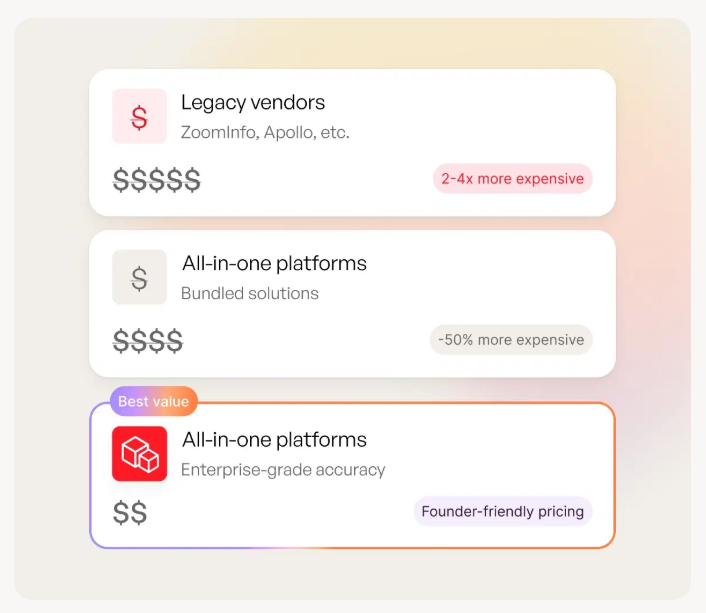
Every SaaS company in that table above needs one thing: a way to reach buyers. Prospeo delivers 143M+ verified emails and 125M+ mobile numbers on a 7-day refresh cycle - 90% cheaper than legacy sales intelligence platforms like ZoomInfo.
Build your pipeline the way modern SaaS companies actually grow.
FAQ
What does SaaS stand for?
Software as a Service - applications hosted in the cloud and accessed via browser on a subscription basis. The vendor manages infrastructure, updates, and security. You pay monthly or annually instead of buying a perpetual license.
Is Netflix a SaaS company?
No. Netflix delivers streaming media content, not software tools. The subscription billing model alone doesn't make something SaaS - the product itself has to be software that helps users accomplish a task or workflow.
How do SaaS companies measure success?
Net Dollar Retention above 100% is healthy. Monthly churn under 1% is good. The Rule of 40 - revenue growth % + profit margin % >= 40% - is the quick investor health check. A CLTV:CAC ratio of 3:1 or higher confirms sustainable unit economics.
What's the difference between SaaS and cloud computing?
Cloud computing is the broader infrastructure layer encompassing IaaS, PaaS, and SaaS. SaaS is specifically the application layer that end users interact with directly. All SaaS runs on cloud computing, but cloud computing also includes raw infrastructure and developer platforms.